
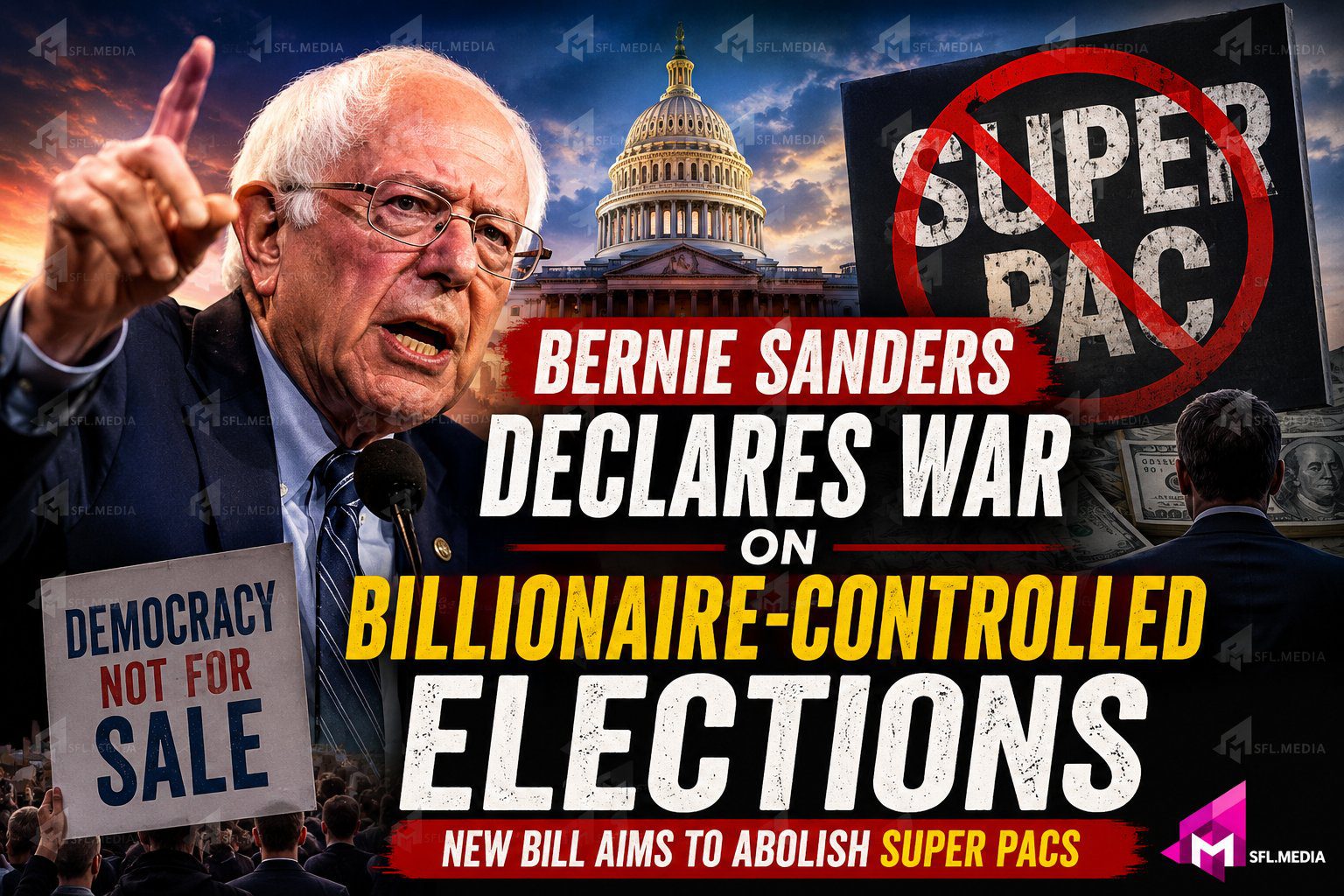
Bernie Sanders and Summer Lee Introduce Bill to Abolish Super PACs as Billionaire Election Spending Explodes
A new bill introduced by Bernie Sanders and Summer Lee is reigniting one of the most explosive debates in American politics: whether billionaires and corporate funded political committees have effectively purchased control over U.S. elections.
On May 20, Sanders and Lee formally unveiled the “Abolish Super PACs Act,” legislation designed to dismantle the financial structure that has allowed wealthy donors and special interest groups to pour virtually unlimited money into American campaigns since the Supreme Court’s landmark 2010 Citizens United decision.
The proposal arrives at a moment when campaign spending has reached historic levels, fueled increasingly by crypto billionaires, AI industry money, and powerful lobbying organizations capable of flooding elections with massive independent advertising campaigns.
For Sanders, the bill represents a direct challenge to what he has repeatedly described as “oligarchic control” of the American political system.
“A handful of billionaires should not be able to buy elections,” Sanders said during a Capitol Hill press conference announcing the legislation.
The Core Goal: Cripple the Super PAC System
The bill takes a targeted approach rather than attempting the politically impossible task of immediately overturning Citizens United through a constitutional amendment. Instead, Sanders and Lee propose something simpler and potentially more disruptive: placing a hard legal cap on donations to super PACs.
Under the legislation, individuals would be limited to giving no more than $5,000 annually to independent expenditure-only political committees, better known as super PACs. That number matters because it effectively destroys the central business model that made super PACs so powerful in the first place.
Currently, wealthy donors can pour millions, and sometimes tens of millions, into outside political groups operating parallel to campaigns. While these organizations technically cannot coordinate directly with candidates, they often function as shadow campaign machines capable of dominating television, digital advertising, and voter outreach.
By limiting donations to $5,000, Sanders and Lee aim to sever the pipeline that allows a tiny group of ultra wealthy individuals to dominate election financing.
The Billionaire Spending Boom
The legislation did not emerge in a vacuum. Campaign finance reform advocates have watched political spending skyrocket across recent election cycles, particularly after the 2024 presidential race and the opening months of the 2026 primary season. According to Sanders, the 100 wealthiest billionaire families spent a combined $2.6 billion during the 2024 election cycle alone. The 2026 primaries have only intensified those concerns.
The senators specifically pointed to massive independent spending operations tied to:
- cryptocurrency interests,
- artificial intelligence investors,
- and powerful pro-Israel lobbying groups including AIPAC.
Collectively, those organizations have already spent more than half a billion dollars influencing congressional primaries and key races during the current cycle, according to the bill’s sponsors. Critics argue the system has evolved into an arms race where policy influence increasingly correlates with donor wealth rather than voter support. Supporters of the current system counter that independent political spending constitutes protected political speech under the First Amendment. That constitutional conflict sits at the center of the fight.
Citizens United Still Shapes American Politics
The modern super PAC era began in 2010 when the Supreme Court issued its controversial ruling in Citizens United v. FEC. The Court ruled that corporations, unions, and outside organizations possess broad First Amendment protections allowing them to spend unlimited amounts independently in support of political candidates.
A subsequent federal court ruling, SpeechNow.org v. FEC, further cemented the legal foundation for modern super PACs by allowing unlimited contributions to groups making independent expenditures.
Together, those rulings transformed campaign finance in America. Supporters argued the decisions protected political free speech from government restriction. Critics argued they opened the door for billionaire domination of democratic institutions. More than fifteen years later, the results remain deeply polarizing. Outside spending has exploded across both parties, with Democrats and Republicans alike increasingly dependent on wealthy donor networks and aligned independent expenditure groups to remain competitive nationally.
Progressive Democrats Are Escalating the Fight
The House version of the bill already carries support from several high profile progressive lawmakers, including:
- Ro Khanna
- Pramila Jayapal
- Rashida Tlaib
- Greg Casar
Outside advocacy organizations have also lined up behind the legislation, including campaign finance reform groups like:
- End Citizens United
- Free Speech For People
- Move to Amend
For progressives, the issue extends beyond elections themselves. Many argue the rise of super PACs has fundamentally distorted policy making by making politicians increasingly dependent on wealthy donors tied to industries such as defense contracting, pharmaceuticals, fossil fuels, crypto, and finance. The result, critics say, is a political system structurally incapable of responding to ordinary voters.
The Bill Faces Enormous Legal Obstacles
Even supporters openly acknowledge the legislation faces steep odds. If passed, the law would almost certainly trigger an immediate constitutional challenge that could quickly reach the Supreme Court. Opponents would argue the $5,000 cap violates the First Amendment protections established under Citizens United and later federal rulings protecting independent political expenditures. In practical terms, many legal analysts believe the current Supreme Court would likely strike the law down unless the Court itself dramatically reinterprets campaign finance precedent.
But supporters of the legislation argue that may not be the point. For Sanders and Lee, the bill appears designed as much to reshape public pressure and political momentum as it is to immediately survive judicial review. That strategy reflects a growing frustration inside parts of the Democratic Party that traditional campaign finance reform efforts have failed while billionaire political influence continues expanding at unprecedented speed.
A Broader Crisis of Trust
The fight over super PACs is ultimately about more than campaign donations. It is about whether Americans still believe their political system belongs to voters, or to whoever can spend the most money. Public trust in Congress, the courts, and major institutions remains near historic lows. Meanwhile, campaign costs continue climbing into the billions while outside political groups increasingly dominate elections through digital advertising, media saturation, and targeted influence campaigns.
Critics warn the United States is drifting toward a system where elections remain technically democratic while becoming financially controlled by a narrow class of ultra wealthy donors and special interests. Supporters of unrestricted spending argue limiting political expenditures risks empowering government censorship over political speech. The collision between those two visions may define the future of American democracy itself.











































Want to join the conversation?
Create an account or sign in to share your thoughts, vote,
and reply to other readers.
Showing 0 of 0 comments
Don't have an account?
Already have an account?