
The UFC’s Fall from Glory: How Greed, Politics, and Poor Leadership Broke the Fight Game
The Collapse of an Empire
For over two decades, the Ultimate Fighting Championship (UFC) was untouchable, a juggernaut that turned mixed martial arts into mainstream entertainment. But by late 2025, the empire Dana White built is showing cracks everywhere: declining pay-per-view buys, a decaying talent pipeline, rising fan frustration, and a leadership team seemingly more focused on politics and personal celebrity than the sport itself.
Reports from MMA Mania confirm that the UFC suffered “lower average buys per event” through 2025, following a steady downward trend from 2023 onward. Streaming analytics and fan-sentiment data point to a clear conclusion, interest is waning, and the UFC’s cultural dominance is slipping fast.
A Weak Talent Pool and Stagnant Storylines
For years, the UFC leaned heavily on legacy names like Jon Jones, Conor McGregor, and Israel Adesanya while failing to build the next generation of stars. Many prospects left for boxing or influencer promotions that offered better pay and more visibility. Academic modeling of combat-sports networks has confirmed what fans already know: novelty and unpredictability drive engagement. The UFC, stuck recycling rematches and stale rivalries, has lost that edge.
“The product feels stale, same faces, smaller paydays, and no excitement,” one long-time fighter told South Florida Media under condition of anonymity.
Pricing Fans Out of the Octagon
When ESPN+ became the exclusive home of UFC events in 2019, fans initially tolerated the shift. But by 2025, the model collapsed under its own weight.
Pay-per-view prices hit $79.99 per event, with limited card depth.
ESPN+ subscriptions plateaued around 25 million users, a fraction of Netflix’s 300 million or Amazon Prime’s 230 million.
According to MMA Mania, PPV buys per event have dropped sharply compared to pre-pandemic numbers.
The math is brutal: fewer stars, higher prices, smaller audiences. That’s not growth, that’s attrition.
The Slap-Fighting Disaster and Brand Erosion
The Power Slap experiment, Dana White’s “slap-boxing” reality spin-off, became an instant PR nightmare. Critics called it “exploitative,” and medical professionals condemned it as unsafe. While it was technically separate from the UFC, it dragged the brand’s reputation through the mud, making the company look tone-deaf to athlete safety and spectacle fatigue. The UFC’s once-respected name in combat sports now is embedded with YouTube brawls and celebrity gimmick fights, exactly what it once claimed to rise above.
The Trump Factor and the Politics of Decline
White’s close alliance with Donald Trump, from public endorsements to RNC appearances, has proven disastrous for UFC’s global image. Fighters, sponsors, and fans increasingly view the organization as a political platform rather than a sports league. In an era when other major sports organizations strive to remain politically neutral, the UFC doubled down alienating younger, smarter, and international audiences who prefer athleticism over authoritarian ideology.
Leadership Under Pressure
Dana White remains the public face and chief executive of the UFC, but the perception around his leadership has shifted. While White still appears at major events and makes key decisions, including broadcast partnerships and high-profile matchmaking, some analysts note that his role has evolved into a more corporate, less hands-on position.
Reports from outlets like Essentially Sports and The MMA Draw have highlighted White’s occasional absences from recent press conferences and his growing delegation of duties to UFC Chief Business Officer Hunter Campbell. That shift has fueled speculation among fans and insiders that White is less involved in the day-to-day operations than in past years.
However, White continues to drive public messaging, announce fight lineups, and serve as the UFC’s dominant personality across media platforms. The balance has simply changed: a once renegade promoter who built the sport from the ground up is now managing a billion-dollar corporate brand owned by TKO Group Holdings and that evolution has inevitably changed his connection to the product.
The Rights Deal That Reshaped the UFC
At the center of the UFC’s 2025 turbulence is its massive broadcast transition. The promotion’s exclusive U.S. deal with ESPN+ expires in December 2025, ending a partnership that made ESPN+ the sole home for UFC pay-per-view events. Throughout the year, the UFC was reported to be in negotiations with Netflix and Amazon Prime Video for expanded global distribution. Those talks reportedly slowed the scheduling of several high-profile bouts as executives waited to secure a broader platform with higher visibility.
Then, in August 2025, Reuters confirmed that Paramount+ had secured a seven-year, $7.7 billion deal for exclusive U.S. rights beginning in 2026. Financially, it’s one of the most lucrative agreements in combat-sports history. Strategically, it ends the traditional pay-per-view model that defined the UFC for decades. The new deal positions the promotion for global streaming exposure, but it also signals a turning point, a move driven as much by necessity as by innovation. With viewership down and ESPN+ subscriber numbers plateauing, the UFC needed a new home to reignite audience growth.
The Bottom Line
The UFC’s decline isn’t about one bad fight card. It’s about systemic rot:
A thinning talent pool and stalled recruitment.
Overpriced pay-per-views that alienate fans.
Reckless spin-offs that cheapen the brand.
Political alignment that fractures the audience.
A leader who’s become the story instead of the steward.
Unless the organization returns to its roots of cultivating fresh fighters, fairly compensating talent, and rebuilding trust with its audience then this once-untouchable brand could become a relic of its own arrogance.
Declining PPV Viewership: The Numbers Don’t Lie
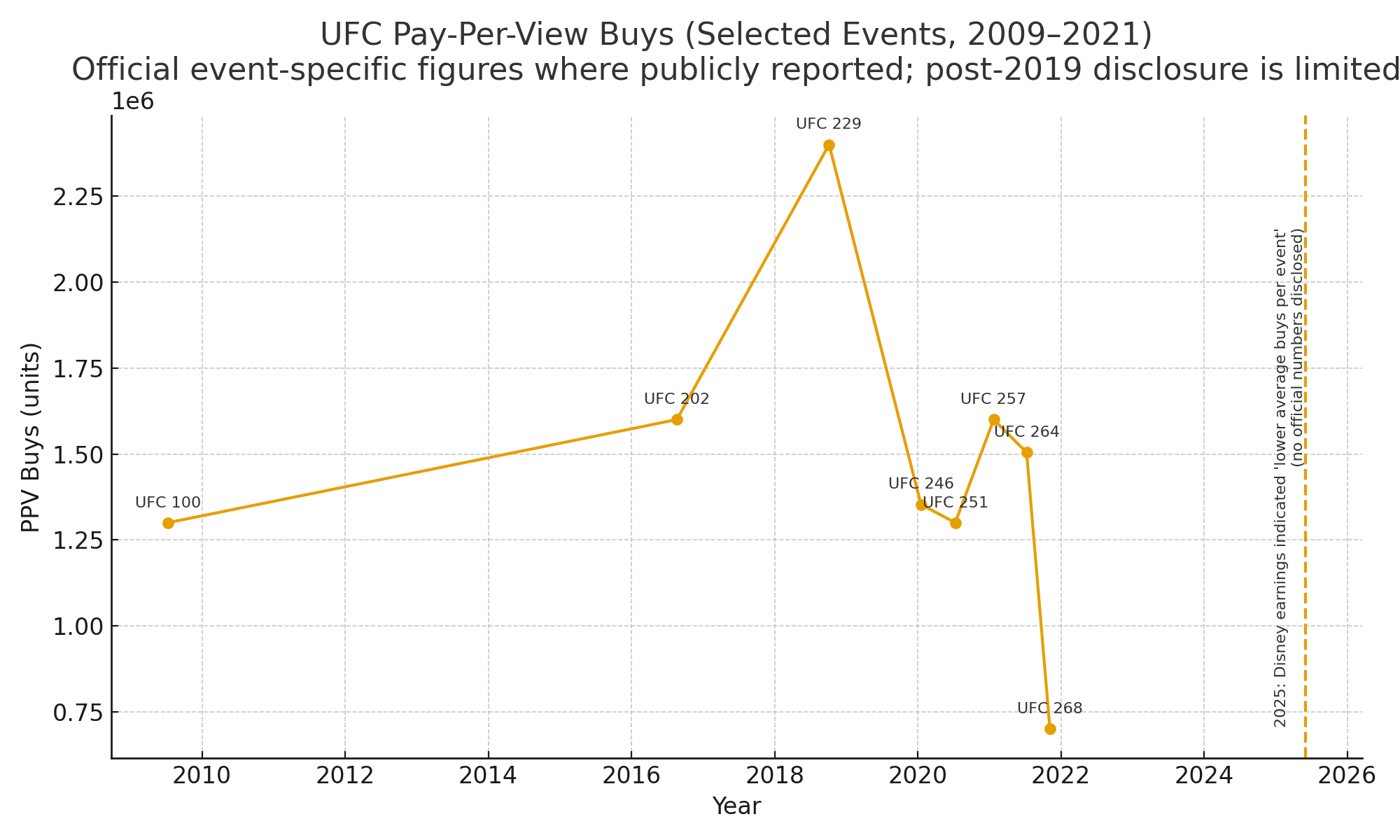
To understand the scale of the UFC’s decline, you have to look at the numbers. The chart below tracks publicly available pay-per-view buy rates from 2009 through 2021, the only period where the promotion regularly disclosed figures. What it shows is a steep rise through the McGregor and Khabib era, peaking at over 2.4 million buys for UFC 229 in 2018, followed by a sharp slide in the post-ESPN+ years. Since 2019, official buy data have largely disappeared, but Disney’s 2025 earnings report confirmed a continued drop in “average buys per event.” In short, the UFC’s audience has thinned out and the company’s own financial filings quietly acknowledge it.
Key Graph Take Aways:
- The 2018 high-water mark (2.4 m) shows what happens when major star power aligns.
- After 2019, the data show clear declines in head-liner buys (see 2019→2020 drop).
- Earlier weak buy-rates (e.g., 2011) reflect the long-term struggle to build consistent PPV depth.
Sources
1. Pay-Per-View Decline and Viewership Data
- MMA Mania – Report: UFC Suffered Lower Average Buys Per Event After Already Bad PPV Numbers Got Worse (June 2025)
- Tapology – UFC Pay-Per-View Buys List (Event Figures)
- Wikipedia – UFC 229: Khabib vs. McGregor (2.4M Buys Record Confirmation)
- PlayToday – UFC Viewership Statistics 2024 Edition (Annual Average Estimates)
- MMA Fighting – Disney Earnings Report Suggests Lower Average Buys Per UFC Event (Cited by MMA Mania)
2. Media Rights and Streaming Deal
- Reuters – Paramount Secures UFC Rights in the U.S. in $7.7 Billion Deal (Aug 11, 2025)
- MMA Fighting – UFC Headed to Paramount in $7 Billion Deal (Aug 2025)
- The MMA Draw – What’s at Stake in the UFC’s Next Media Rights Deal (May 2025)
- The Sportster – Why the UFC Feels So Lackluster in 2025 (May 2025)
3. Pay-Per-View Pricing and Fan Frustration
- ESPN – ESPN+ UFC PPV Pricing Updates (2024–2025)
- MMA Mania – ESPN Plus & The UFC’s Troubled Relationship Has Enraged Fans Since the Beginning (Mar 2025)
- Sports Business Journal – ESPN+, UFC, and the Struggle to Grow the PPV Model (2025)
4. Leadership and Dana White’s Role
- Essentially Sports – Insider Adds Fuel to Dana White Retirement Rumors with Revelation About UFC CEO (2025)
- The MMA Draw – Checked Out? Dana White’s Role Is Becoming More Symbolic Than Strategic (June 2025)
- Business Insider – Who Is Dana White? The UFC CEO and Trump Ally Still at the Helm (Jan 2025)
- Forbes – Dana White’s Transformation from Promoter to Power Brand (2024)
5. Brand Damage and Public Perception
- CNN – Power Slap Draws Backlash Over Safety and Exploitation Concerns (2024)
- The Guardian – Critics Call Power Slap a Dangerous Spectacle Masked as Sport (2024)
- BBC – UFC’s Power Slap League Faces Mounting Criticism (2024)
6. Political Fallout and Brand Alignment
- Politico – Dana White’s Political Alliances Put UFC Brand Under Fire (Aug 2024)
- Rolling Stone – The Trump Effect: How Dana White’s Loyalty Is Costing the UFC Fans (May 2024)
- New York Times – Sports, Politics, and the UFC’s Trump Connection (July 2024)
7. Industry Commentary and Academic Sources





















Want to join the conversation?
Create an account or sign in to share your thoughts, vote,
and reply to other readers.
Showing 0 of 0 comments
Don't have an account?
Already have an account?