
The FCC Decided “No More” Robots… We’re Talking to You, China
For years, Americans have welcomed robots into their homes without giving them much thought. Robot vacuums map our living rooms, robot lawnmowers learn the layout of our yards, and humanoid robots are becoming increasingly common in research labs, warehouses, and even retail stores. Now, however, the U.S. government has drawn a line in the sand. In one of the most sweeping technology restrictions in recent memory, the Federal Communications Commission (FCC) has moved to block the import and approval of many new foreign-made “advanced robotic devices,” citing national security and cybersecurity concerns.
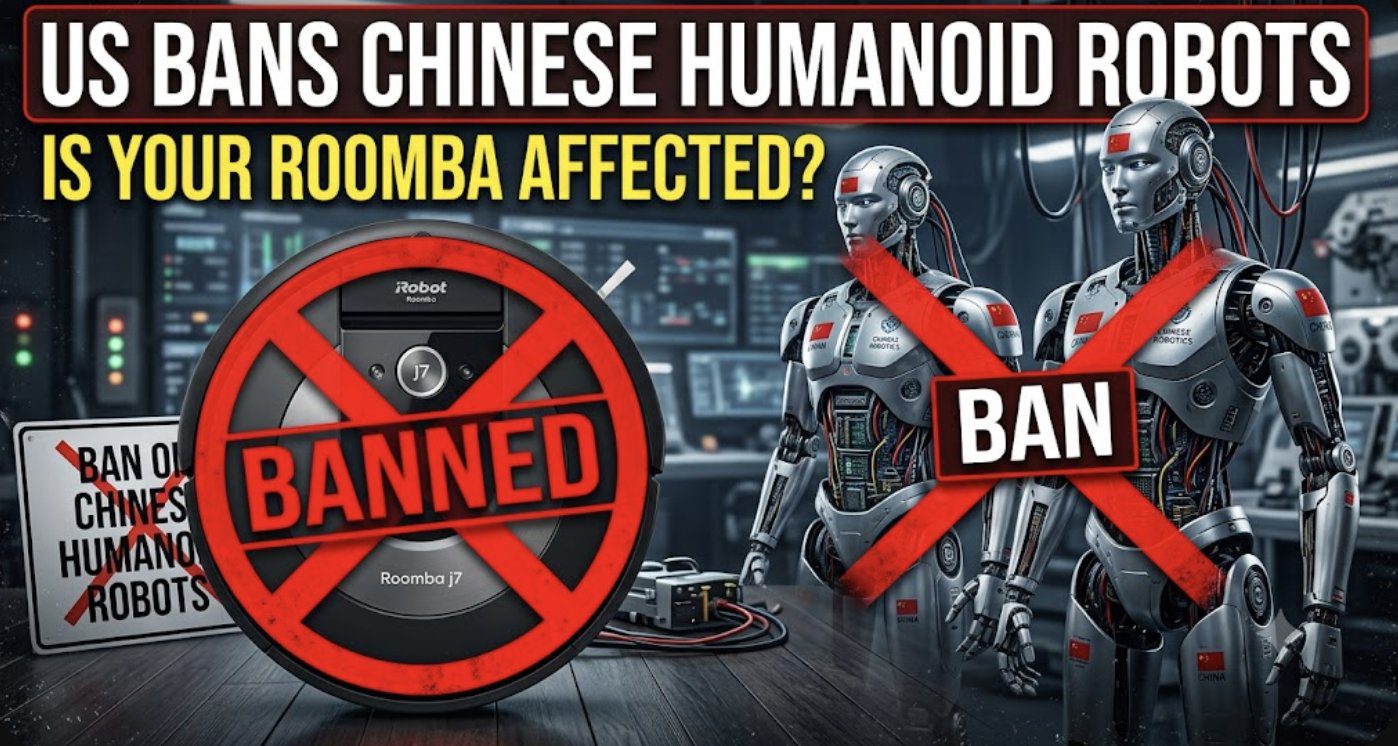
The new rules don’t just target futuristic humanoid robots from China. They also cover products that millions of Americans already use every day, including robotic vacuum cleaners, autonomous lawnmowers, warehouse robots, delivery robots, and other mobile machines equipped with cameras, sensors, artificial intelligence, and wireless internet connectivity. In other words, if the robot can move around on its own, collect data about its environment, and communicate over Wi-Fi or Bluetooth, it may now fall under the government’s definition of an “advanced robotic device.”
Even Roombas Are Getting Swept Up in the Ban
One of the biggest surprises is that Roomba-style robot vacuums are included in the crackdown. At first glance, it may seem ridiculous that a vacuum cleaner could be viewed as a national security threat. After all, its biggest crime is usually getting stuck under the couch. But modern robotic vacuums are far more sophisticated than many people realize. They use cameras, laser scanners, infrared sensors, microphones, artificial intelligence, and detailed mapping software to build highly accurate floor plans of your home.
They know where your bedrooms are, where your valuables may be located, and in some cases can even recognize furniture and obstacles. That information is transmitted and stored through cloud-connected systems to improve navigation and software updates. Government officials argue that in the wrong hands, this type of data could be exploited for surveillance or cyberattacks.
The FCC says the concern isn’t simply theoretical. Recent cybersecurity vulnerabilities involving connected robotic devices have demonstrated that hackers can potentially gain access to live camera feeds, microphone audio, and detailed maps generated inside homes and businesses. Officials worry that foreign governments could compel manufacturers headquartered overseas to provide access to data or exploit software vulnerabilities for intelligence gathering. That concern mirrors previous U.S. actions against certain telecommunications equipment, surveillance cameras, Wi-Fi networking equipment, and Chinese-made drones.
Here is How the Ban is Going to Work
Many consumers immediately assumed this meant they would have to throw away the Roomba sitting in their living room. Fortunately, that isn’t the case. The ban does not affect robots that have already been approved, imported, or purchased. If you already own a robot vacuum, it will continue to function normally. Retailers can also continue selling inventory that has already received FCC authorization. The restrictions primarily affect future models manufactured overseas that have not yet been approved for sale in the United States.
Ironically, Roomba itself has a fascinating history that makes this story even more complicated. The Roomba was originally developed by iRobot, an American robotics company founded in 1990 by engineers from the Massachusetts Institute of Technology (MIT). The company initially built military robots for bomb disposal and defense applications before revolutionizing the consumer robotics market with the first Roomba vacuum in 2002.
Over time, however, the company struggled financially. Amazon’s planned acquisition collapsed under antitrust scrutiny, and after filing for bankruptcy in late 2025, iRobot was ultimately acquired by Shenzhen-based Picea Robotics, making one of America’s most recognizable robot brands foreign-owned.
China Will Certainly Feel the Crunch
The policy is expected to hit Chinese manufacturers especially hard. Companies like Roborock, Ecovacs, Dreame, Narwal, and other brands dominate the global robot vacuum market, while China also leads the world in affordable humanoid robots and robotic dogs. Supporters of the restrictions argue that America made a similar mistake by allowing China to dominate drone manufacturing through companies like DJI. They believe robotics represents the next major technological frontier and that the United States cannot afford to become dependent on foreign-made intelligent machines operating inside homes, businesses, factories, and critical infrastructure.
Critics, however, warn that the restrictions could reduce consumer choice, increase prices, and slow innovation. Many American robotics startups rely on lower-cost foreign hardware for research and development. Some industry experts argue that cybersecurity standards, source-code audits, and stricter software requirements would be more effective than broad manufacturing bans based primarily on where a robot is built. Others fear the rules could spark a technological arms race as countries increasingly separate their AI and robotics industries along geopolitical lines.
Whether you agree with the government’s decision or not, one thing is becoming increasingly clear: robots are no longer viewed as simple household gadgets. As artificial intelligence continues advancing, Washington is beginning to treat connected robots much like smartphones, telecommunications equipment, and drones, recognizing that any machine capable of seeing, hearing, mapping, and communicating can also become a valuable source of intelligence. The humble robot vacuum may still be cleaning crumbs off your kitchen floor, but in the eyes of federal regulators, it’s now part of a much larger battle over cybersecurity, artificial intelligence, and the technological rivalry between the United States and China.

















































Want to join the conversation?
Create an account or sign in to share your thoughts, vote,
and reply to other readers.
Showing 0 of 0 comments
Don't have an account?
Already have an account?