
Tucker Carlson Releases Video of Palestinian American Brutally Beaten in West Bank, Accuses U.S. Ambassador Mike Huckabee of Abandoning Him
Disturbing footage of an alleged Israeli settler attack on an American citizen ignites a confrontation between Tucker Carlson and Ambassador Mike Huckabee as United Nations reports document escalating violence across the occupied West Bank.
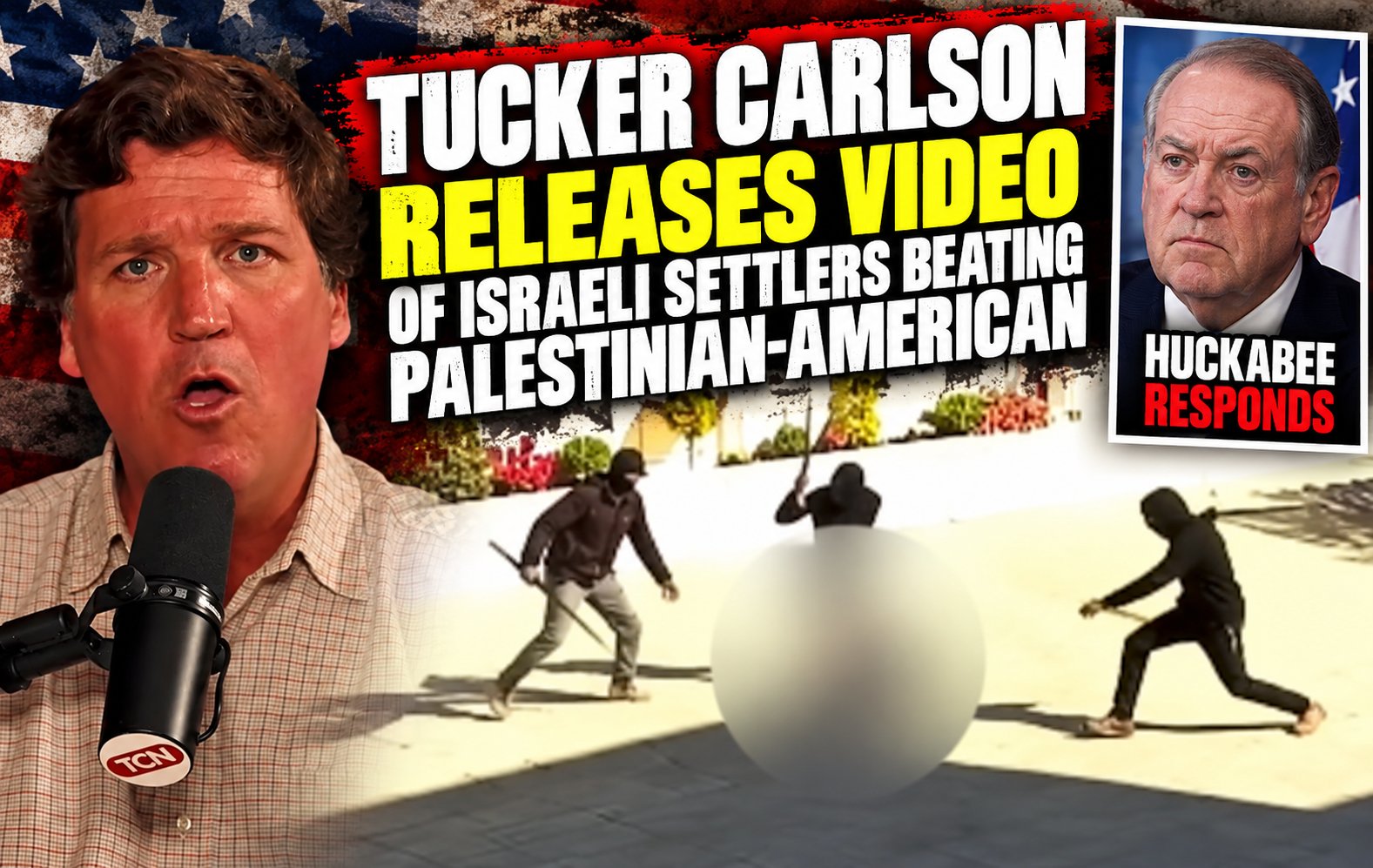
Conservative commentator Tucker Carlson has released disturbing security camera footage that he says shows a Palestinian-American citizen being brutally beaten by Israeli settlers in the occupied West Bank, triggering a public confrontation with U.S. Ambassador to Israel Mike Huckabee over the American government’s response to the attack. Carlson published the video on October 29 and accused Huckabee of failing to assist the injured American despite being aware of his situation. The accusation prompted an angry response from the ambassador, who denied ignoring the victim and released a detailed account of the U.S. Embassy’s efforts to communicate with the man’s family.
The confrontation has drawn national attention not only because it involves two influential conservative figures with sharply different views on Israel, but because it raises a fundamental question about American foreign policy: What responsibility does the United States have to protect its citizens when they are attacked in territory controlled by one of Washington’s closest allies?
The controversy comes amid a documented escalation in Israeli settler violence across the West Bank, where Palestinian communities, agricultural workers, journalists, and international volunteers have reported assaults, intimidation, and destruction of property. United Nations figures show that violence surrounding the 2026 olive harvest has already exceeded the totals recorded during the entire harvest seasons of the previous two years.
Carlson Publishes Disturbing Footage of Alleged Settler Assault
The video shared by Carlson appears to show several men dressed in dark clothing attacking an individual whose identity has been obscured. Published descriptions of the footage indicate that some of the men are carrying sticks and that additional individuals enter the scene during the confrontation. The recording also appears to show a vehicle being set on fire. Carlson identified the injured man as an American citizen and attributed the attack to Israeli settlers. The incident reportedly occurred in Turmus Ayya, a Palestinian town northeast of Ramallah that is home to numerous Palestinian families with American citizenship or relatives living in the United States.
The footage is deeply disturbing, although the recording alone does not establish the identities of the attackers, the full sequence of events, or the extent of the victim’s injuries. Carlson characterized the assault as nearly fatal, but that specific medical assessment has not been independently verified through publicly released hospital records.
According to Huckabee’s subsequent account, the injured man was hospitalized at Istishari Hospital in Ramallah and underwent surgery. Those details are consistent with a serious assault, although the ambassador’s description remains an account of information provided to embassy officials rather than an independently released medical report.
Carlson also stated that a relative of the victim withdrew from a planned interview because of concerns about the safety of family members remaining in the West Bank. That claim has not been independently corroborated, but it reflects the broader climate of insecurity reported by Palestinian residents and human rights organizations documenting attacks in the territory.
Tucker Carlson Directly Challenges Ambassador Mike Huckabee
Carlson accompanied the footage with an unusually direct public accusation against Huckabee, tagging the ambassador, Secretary of State Marco Rubio, and the White House in a post on X. Carlson alleged that the ambassador knew the injured man’s identity because the victim had sought assistance, yet had failed to provide meaningful help. He described Huckabee’s alleged response as disgraceful and demanded that the ambassador fulfill his responsibilities.
The accusation struck at the heart of the ambassador’s diplomatic role. American embassies are responsible for providing consular services to U.S. nationals abroad, including assistance when citizens are injured, hospitalized, detained, or victimized by crime. Although American diplomats cannot directly control foreign criminal investigations, they can communicate with families, seek information from local authorities, and advocate for the safety and fair treatment of U.S. citizens.
Carlson’s criticism therefore extended beyond a personal disagreement with Huckabee. It suggested that American diplomatic officials were failing to respond adequately to violence against a citizen whose Palestinian identity placed him in a politically sensitive situation. The public confrontation also underscored a growing division within American conservative politics. Huckabee has long been an outspoken supporter of Israel, while Carlson has increasingly questioned the extent of American diplomatic and military support for Israeli government policies.
Huckabee Fires Back, Calling Carlson’s Accusations Unfounded
Huckabee responded forcefully, rejecting Carlson’s account and accusing the commentator of making allegations without first seeking information directly from the embassy. In his public response, the ambassador called Carlson “deranged” and argued that the available facts contradicted the claim that officials had ignored the injured American. Rather than offering only a general denial, Huckabee published a chronological account of the embassy’s reported communications with the victim’s family. According to that timeline, the U.S. Embassy in Jerusalem first learned about the assault on October 19, when the injured man’s son contacted American Citizen Services from Chicago.
The son reportedly informed embassy personnel that his father had been attacked at his home in Turmus Ayya and was receiving treatment at Istishari Hospital in Ramallah. Huckabee said embassy staff contacted the son that same day and requested information that would allow them to communicate directly with the injured man. According to the ambassador, the son declined to provide his father’s contact information and requested that embassy officials communicate through him instead. Embassy personnel subsequently sent follow up emails, attempted additional telephone calls, and tried unsuccessfully to reach the hospital.
Huckabee’s account states that the son informed officials on October 21 that his father was undergoing surgery. The son also reportedly raised concerns about whether family members traveling from the United States would be permitted to enter the West Bank. The ambassador said embassy staff continued communicating with the family over the following days and received medical documentation and photographs concerning the injuries. However, officials were unable to establish direct contact with the victim, according to Huckabee.
The timeline, which Huckabee made public, provides a substantially different account from Carlson’s accusation that the embassy simply dismissed the case. It does not independently establish that every action taken by embassy personnel was sufficient, nor does it resolve what assistance the family ultimately received. The underlying communications have not been independently authenticated in full.
The Real Question Is Whether the Attackers Will Face Justice
The disagreement between Carlson and Huckabee has focused heavily on embassy communications, but the most consequential issue remains the violent assault itself and whether the individuals responsible will face criminal accountability.
As of the reporting reviewed for this article, there has been no independently confirmed public announcement identifying the attackers shown in Carlson’s footage or establishing that arrests have been made in connection with this specific incident. The available information also does not establish whether Israeli prosecutors have filed charges or whether investigators have completed an examination of the recording. Those unanswered questions are particularly significant in the occupied West Bank, where Israeli settlers and Palestinian residents live under different legal and administrative arrangements. Israeli authorities retain substantial security responsibilities throughout the territory, while the Palestinian Authority exercises limited powers in designated areas.
International human rights organizations have repeatedly raised concerns about the investigation and prosecution of violence committed by Israeli settlers against Palestinians. Israeli officials have condemned some attacks, announced investigations, and arrested suspects in certain cases, but the continuing frequency of incidents has intensified scrutiny of whether enforcement is effective. Huckabee has previously condemned violent settlers, describing perpetrators of attacks as terrorists while emphasizing that they do not represent the broader Israeli settler population. His position reflects a distinction between condemning individual acts of violence and criticizing the wider settlement movement.
For Palestinian American families affected by attacks, however, the central concern is whether diplomatic condemnation translates into protection, investigation, and accountability.
United Nations Reports 2,159 Settler Attacks Across the West Bank in 2026
The assault highlighted by Carlson comes amid a broader escalation in settler violence documented by the United Nations Office for the Coordination of Humanitarian Affairs. In its humanitarian situation report published October 26, OCHA documented 2,159 Israeli settler attacks resulting in Palestinian casualties, property damage, or both across more than 300 West Bank communities since the beginning of 2026. That represents an average of approximately 7.4 attacks per day, compared with an average of five per day during 2025.
During the single reporting period of October 13 through October 19, the agency documented 83 settler attacks affecting 48 Palestinian communities. Those incidents caused injuries or damage to homes, agricultural property, religious buildings, and other civilian assets. The UN also reported that 148 Palestinians were injured by Israeli forces or settlers during that seven-day period, including 74 injured in the context of settler attacks. Of those 74, 69 were injured during incidents connected to the olive harvest.
These figures describe documented incidents and their reported consequences, rather than criminal convictions or findings of individual legal responsibility. Nevertheless, the scale of the incidents demonstrates that the violence surrounding the case raised by Carlson is part of a much larger security and humanitarian problem.
Palestinian Olive Harvest Becomes a Flashpoint for Violence
The annual olive harvest is one of the most important economic and cultural events for Palestinian communities in the West Bank. Olive cultivation supports rural livelihoods, family owned agricultural businesses, and the production of olive oil, while many groves have been maintained by successive generations.
In 2026, the harvest has been accompanied by widespread reports of assaults, intimidation, theft, and destruction of agricultural property. According to OCHA, 272 olive harvest related settler attacks were documented between September 1 and October 19, resulting in one Palestinian fatality, injuries to 200 Palestinians, and damage to more than 3,200 olive trees and saplings.
The number of documented attacks during that period had already exceeded the totals recorded during the entire 2024 and 2025 harvest seasons, when the UN counted 224 and 185 incidents respectively. More than 60 percent of the attacks occurred in Ramallah governorate, the same broader region in which Turmus Ayya is located. Other heavily affected areas included communities around Nablus, where residents reported attacks on farmers and interference with access to agricultural land.
The UN also documented incidents in which Israeli forces were reportedly present during settler attacks or where Palestinians faced restrictions preventing them from reaching their farmland. Israeli authorities have stated that they act to facilitate the harvest and have arrested suspects following some incidents.
On October 16, a group of masked settlers attacked Palestinian olive harvesters, journalists, and volunteers near Khirbet Abu Falah. Reuters reported that American photojournalist Heidi Levine, working for The Washington Post, was among those injured. Levine suffered injuries that reportedly included a broken rib and a hand injury requiring surgery, prompting demands for an investigation and condemnation from American officials. The repeated attacks have raised concerns that violence and restricted access to farmland are undermining Palestinian livelihoods and contributing to the displacement of vulnerable rural communities.
Violence Against American Citizens Raises Diplomatic Concerns
The case publicized by Carlson is especially sensitive because the victim is reportedly an American citizen. U.S. nationality ordinarily provides access to consular assistance, regardless of an individual’s ethnic background or political identity.
However, consular assistance is not equivalent to a guarantee of physical protection. American diplomats cannot arrest suspects in a foreign jurisdiction or compel another government to prosecute a case. Their influence depends on diplomatic engagement, communication with local authorities, and the willingness of the host government to cooperate. That distinction is central to the controversy surrounding Huckabee. The ambassador’s account indicates that embassy personnel attempted to communicate with the victim’s family, but it does not fully explain what representations were made to Israeli authorities concerning the attack or what investigative steps followed.
The incident also comes amid wider concern about violence affecting Americans in the West Bank. In October, reports emerged of a separate confrontation in the South Hebron Hills in which American activist and journalist Jasper Nathaniel and Israeli activist Andrey Kharzhanovsky were reportedly assaulted during an encounter with settlers. Israeli police subsequently detained the activists, while police described the incident differently and said an investigation had been opened.
That separate confrontation illustrates the contested circumstances surrounding some incidents in the territory and the importance of independently establishing facts before assigning legal responsibility.
For American citizens with Palestinian family connections, these incidents have intensified concerns about whether their government can secure meaningful protection when they are threatened or attacked.
Carlson and Huckabee Represent Competing Visions of U.S. Policy Toward Israel
The public dispute is also politically significant because it exposes competing priorities within the American conservative movement.
Huckabee has spent decades advocating strong support for Israel and has defended Israeli territorial claims in the West Bank. His appointment as ambassador placed one of Israel’s most prominent American political supporters in a senior diplomatic position.
Carlson, by contrast, has become increasingly skeptical of American involvement in Middle Eastern conflicts and has questioned whether U.S. policy consistently places American citizens and national interests first. His criticism of Huckabee frames the assault as a test of whether American officials are willing to confront an allied government when its citizens are accused of attacking an American.
The disagreement is not simply about whether Israel should receive American support. It concerns the obligations that accompany a close diplomatic relationship, particularly when allegations of violence involve civilians and American nationals. Supporters of Huckabee argue that Carlson’s accusation was premature because the embassy had already been communicating with the family. Critics of the administration counter that the existence of consular correspondence does not settle the broader question of whether Washington is doing enough to deter settler violence or demand accountability. Both arguments can be evaluated separately from the unresolved facts of the assault itself.
What Remains Unanswered About the Palestinian American Victim
Despite the attention generated by the footage and the diplomatic confrontation, important questions remain unanswered. The victim’s identity has not been established through the sources reviewed for this article, and his current medical condition has not been independently confirmed. It also remains unclear whether the men shown in the recording have been identified by Israeli authorities, whether arrests have been made, or whether criminal charges are being considered. The publicly available reporting does not establish the full circumstances preceding the assault or the complete sequence of events captured by the security cameras.
Huckabee’s account offers specific details about embassy communications, but additional documentation would be needed to independently assess the quality and effectiveness of the assistance provided. Carlson’s accusation that the ambassador abandoned the victim remains disputed rather than established fact. These distinctions matter because the case involves serious allegations of violence, the conduct of American diplomatic officials, and the potential criminal responsibility of individuals who have not been publicly identified.
A Test of America’s Commitment to Protecting Its Citizens
The confrontation between Tucker Carlson and Mike Huckabee has brought a disturbing alleged settler assault into the national spotlight, but the political dispute should not overshadow the central issue: an American citizen reportedly suffered serious injuries in an attack in the occupied West Bank, and questions remain about accountability. Huckabee has presented a detailed account challenging Carlson’s claim that the U.S. Embassy ignored the victim. Carlson’s criticism, meanwhile, has placed renewed pressure on American officials to explain what concrete steps are being taken to protect citizens affected by settler violence.
The broader humanitarian picture is equally troubling. United Nations documentation shows thousands of settler attacks across the West Bank in 2026, with violence during the olive harvest reaching levels higher than those recorded during the previous two harvest seasons. For the injured Palestinian-American and his family, the immediate priorities are recovery, safety, and a credible investigation. For the United States, the case raises a larger question that extends beyond partisan politics: whether the protection of American citizens overseas is pursued with equal determination when the alleged perpetrators come from a country that Washington considers a close ally.
Sources & Further Reading

The Carlson / Huckabee Confrontation
- The Times of Israel — Huckabee Denies Tucker Carlson’s Claim That Embassy Failed to Assist Palestinian-American
- The National News Desk — Mike Huckabee and Tucker Carlson Feud Over Video of American Man Being Beaten
- The Daily Caller — Huckabee Accused of Ignoring American Beaten by Israeli Settlers
- VINnews — Huckabee and Carlson Clash Over U.S. Citizen Allegedly Beaten by Israeli Settlers
United Nations and International Reporting
- United Nations OCHA — Humanitarian Situation Report, October 22, 2026 (Published October 26)
- United Nations in Palestine — Ominous Start to West Bank Olive Harvest Amid Settler Attacks
- Reuters — Israeli Settlers Burn Olive Trees, Injure Journalist in West Bank Attack
- The Times of Israel — Activists Arrested After Footage Shows Settlers Beating Them in West Bank
Related SFL Media Coverage





































Want to join the conversation?
Create an account or sign in to share your thoughts, vote,
and reply to other readers.
Showing 0 of 0 comments
Don't have an account?
Already have an account?