
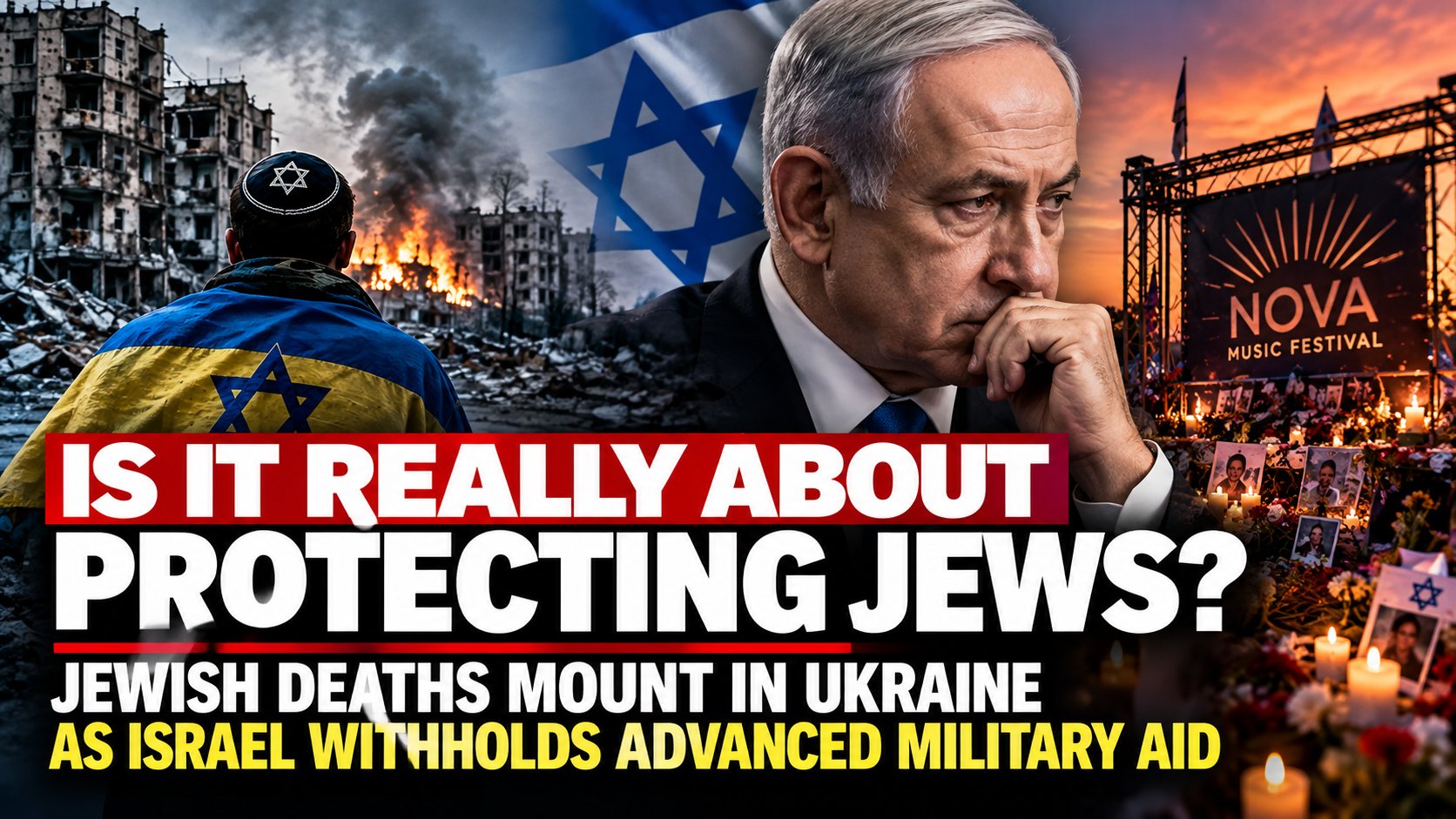
Israel Claims a Mission to Protect Jews Worldwide. Why Has It Refused to Arm Ukraine Against Russia?
Israel has spent decades presenting itself as a refuge for Jewish people facing persecution and violence. Yet as Russian missiles and Iranian designed drones devastate Ukrainian cities, including historic Jewish communities, the Israeli government has largely withheld the advanced military defenses Kyiv has repeatedly requested. The contradiction raises difficult questions about Israel’s priorities, its relationship with Vladimir Putin and whether the protection of Jewish lives abroad takes a back seat to regional military strategy.
Israel’s historic identity as a national homeland and refuge for Jewish people has come into conflict with the realities of modern geopolitics, as its government continues to resist providing advanced military weapons to Ukraine despite years of Russian attacks that have killed civilians, displaced Jewish communities and devastated cities with centuries of Jewish history. Ukraine is led by President Volodymyr Zelenskyy, who is Jewish, and has long been home to one of Europe’s most culturally and historically significant Jewish populations. Since Russia launched its full scale invasion in February 2022, Jewish Ukrainians have fought in the country’s armed forces, endured Russian bombardments and joined millions of fellow citizens forced from their homes.
Yet Israel, a country that has developed some of the world’s most sophisticated missile defense technology, has largely declined Ukraine’s requests for advanced air defense systems, including Iron Dome. Israeli leaders have cited national security concerns, particularly Russia’s military influence in Syria, the possibility of Israeli technology reaching Iran and the need to preserve defensive capabilities for Israel’s own population. Those concerns are substantial, but they raise an uncomfortable question about the relationship between Israel’s national interests and its stated responsibility toward Jewish communities around the world: When the security of Jews living outside Israel conflicts with the Israeli government’s military and diplomatic priorities, which obligation prevails?
The answer emerging from Israel’s Ukraine policy is that immediate national security interests have generally taken precedence over broader diaspora solidarity. Israel has provided meaningful humanitarian assistance, welcomed refugees and supported civilian warning capabilities, but it has stopped short of the military cooperation Ukrainian leaders have sought to defend their cities against Russian missiles and drones. That distinction has fueled criticism from Zelenskyy, Ukrainian Jewish community members and international observers who question whether offering refuge and medical treatment is an adequate response when additional defensive weapons might help prevent civilian casualties in the first place.
Ukraine’s Jewish Communities Are Once Again Living Through a Devastating European War
Jewish history in Ukraine stretches back centuries, encompassing major centers of religious scholarship, literature, commerce and political life. Kyiv, Odesa, Dnipro, Kharkiv and other Ukrainian cities have played significant roles in the development of European Jewish culture, while the country is also associated with some of the Holocaust’s most horrific atrocities. In September 1941, Nazi forces and their collaborators murdered tens of thousands of Jews at Babyn Yar in Kyiv, a site that remains one of the defining memorials of the Holocaust and a symbol of the mass killings that devastated Jewish communities across Eastern Europe during World War II.
Before Russia’s full scale invasion, estimates of Ukraine’s core Jewish population generally numbered in the tens of thousands, while broader estimates that included people with Jewish ancestry or eligibility for immigration under Israel’s Law of Return were substantially higher. These figures vary because religious identity, family ancestry and legal eligibility for Israeli citizenship are not interchangeable demographic categories. Russia’s invasion disrupted Jewish life alongside the lives of millions of other Ukrainians, forcing synagogues and community institutions to interrupt operations, leaving elderly residents struggling through power outages and driving families across international borders. Jewish Ukrainians also joined the military effort to defend their country, demonstrating that their relationship to Ukraine is one of citizenship, community and national identity rather than simply religious heritage.
One of the war’s most haunting casualties was Boris Romanchenko, a 96 year old survivor of Nazi concentration camps who was killed during Russian shelling of Kharkiv in March 2022. Having survived persecution under Nazi Germany, Romanchenko died decades later during another war that brought widespread destruction to his homeland. His death illustrated the historical tragedy facing Ukraine’s Jewish population, but it also demonstrated why the conflict cannot be reduced to a dispute involving one religious community. Russian attacks have harmed Ukrainians of many ethnicities and faiths, and Jewish soldiers defending Ukraine are fighting for their country alongside their fellow citizens.
The United Nations has documented extensive civilian suffering, displacement and destruction since February 2022, including deaths, injuries, destroyed housing, disrupted medical services and widespread damage to electrical and heating infrastructure. Many victims remain unidentified in public reporting by religious affiliation, making precise Jewish-specific casualty totals difficult to establish. Nevertheless, the historical significance of Ukraine’s Jewish communities and the experience of Holocaust survivors confronting another European war have given the conflict particular resonance among Jewish organizations and families worldwide.
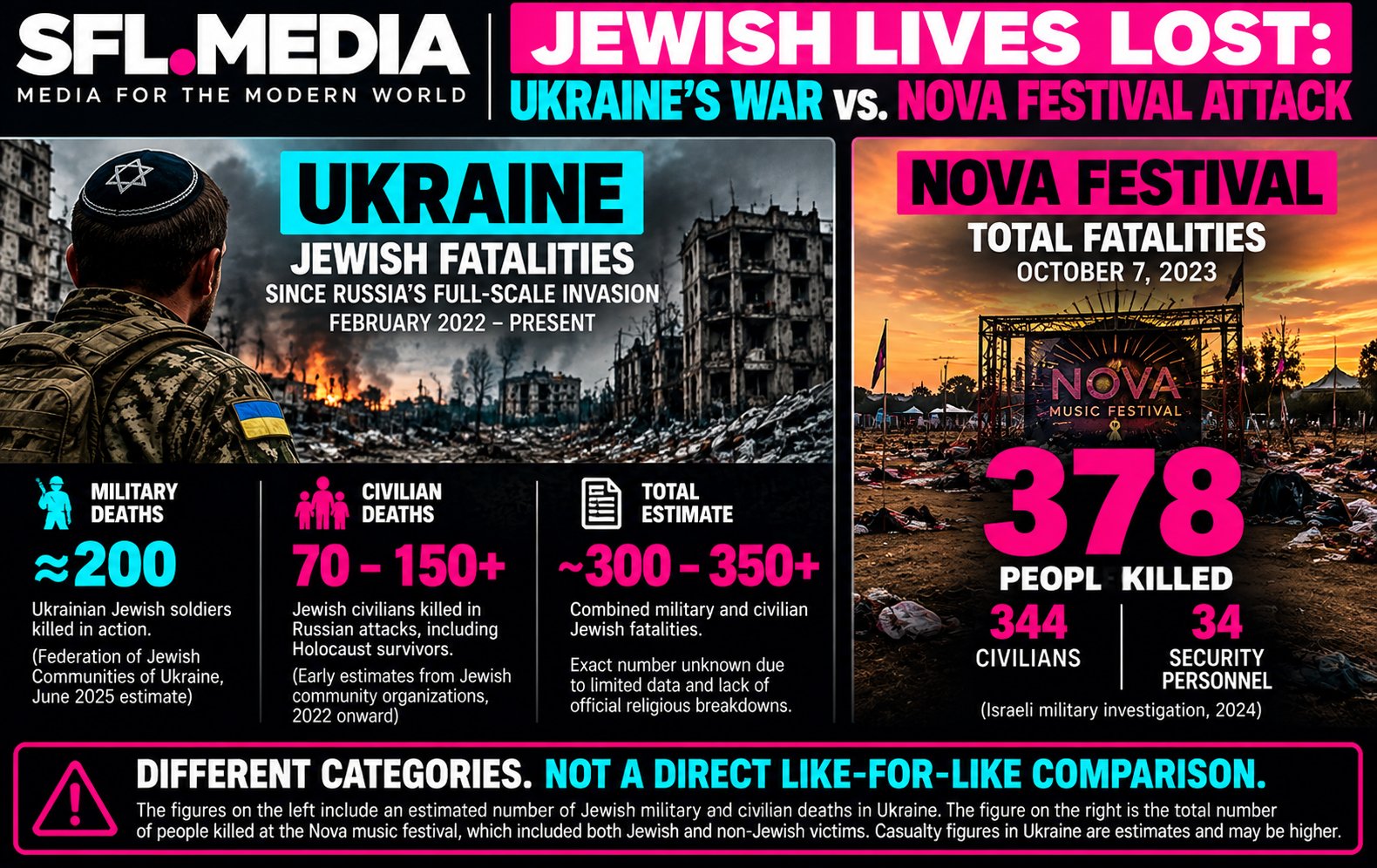
Have More Jews Died in Ukraine Than in Israel?
One particularly provocative argument surrounding Israel’s Ukraine policy is the suggestion that more Jewish people have died in Russia’s war against Ukraine than in Israel’s recent conflicts. That claim, however, cannot be established from the available casualty data and should not be presented as fact. Ukraine does not publish a comprehensive, independently verified accounting of wartime deaths categorized by Jewish identity. Military casualty records generally identify service members by nationality and military affiliation, while civilian casualty monitoring focuses on deaths, injuries and the circumstances of attacks.
Comparable difficulties arise when attempting to isolate Jewish casualties in Israel’s recent wars and attacks. The October 7, 2023, Hamas-led assault killed approximately 1,200 people in Israel, according to Israeli authorities, including Jews and non-Jews. Subsequent conflicts have produced additional casualties, but publicly available statistics do not consistently separate victims by religion. Consequently, there is no sound evidentiary basis for concluding that the Jewish death toll in Ukraine exceeds the Jewish death toll in Israel over a comparable period.
The larger question remains legitimate without relying on an unverified numerical comparison. Jewish Ukrainians are being killed and displaced, Israel possesses relevant defensive expertise, and its government has made a deliberate policy choice to restrict the military assistance Ukraine receives. The question for Israeli policymakers is whether that choice represents an unavoidable national security necessity or an overly cautious interpretation of Israel’s strategic interests.
What Israel Has Actually Done to Help Ukraine
Israel’s response to the invasion has included substantial humanitarian assistance, and any serious evaluation of its policies must acknowledge those contributions. In March 2022, Israel established the Kohav Meir, or Shining Star, field hospital in western Ukraine near the Polish border. According to Israel’s Ministry of Foreign Affairs, the facility treated approximately 7,000 patients, including local residents and people displaced from other parts of the country. Israeli medical initiatives also included treatment for Ukrainian children with cancer and rehabilitation assistance for wounded soldiers, while the government provided medical equipment, generators, protective gear and other nonlethal supplies.
Israeli government agencies and Jewish organizations helped evacuate vulnerable residents, while Israel accepted tens of thousands of Jewish and non-Jewish refugees during the early stages of the invasion. A Congressional Research Service assessment reported that approximately 46,000 refugees from Ukraine had entered Israel by 2023, a figure that included both Jewish and non-Jewish arrivals and should not be interpreted as the number of Ukrainian Jews who permanently immigrated. Israel also supported the development of a civilian air raid warning system intended to provide more precise alerts about incoming missiles and drones, with Israeli officials working alongside Ukrainian counterparts to adapt warning technology to Ukraine’s geography and existing military infrastructure.
Those efforts have humanitarian value. Medical treatment, evacuation assistance and timely warnings can save lives, but they do not provide the same protection as weapons capable of intercepting incoming missiles. That difference is central to Ukraine’s frustration: A warning system can tell civilians that an attack is approaching, while an effective air defense system may prevent the weapon from reaching its target. Israel’s humanitarian assistance has therefore addressed important consequences of the invasion without fully satisfying Ukraine’s requests for military capabilities intended to prevent those consequences.
Zelenskyy Has Repeatedly Asked Israel for Weapons, Not Just Humanitarian Aid
Zelenskyy has repeatedly urged Israel to provide advanced defensive weapons, arguing that the country’s military technology could help protect Ukrainian civilians from Russian attacks. In a March 2022 address to Israel’s parliament, the Knesset, Zelenskyy appealed directly to Israeli lawmakers and the public, invoking the country’s missile defense capabilities and its historic commitment to protecting Jewish lives. His remarks emphasized the need to protect Ukrainians, including Ukrainian Jews, from Russian bombardment and placed Israel’s military expertise alongside its moral responsibility to people facing attacks in another country.
In a September 2022 interview, Zelenskyy expressed frustration over Israel’s reluctance to provide weapons, questioning how a country with such strong historical and personal connections to Ukraine could maintain that position. His criticism reflected a broader concern within Ukraine that Israel was attempting to preserve its relationship with Moscow while other Western partners supplied Kyiv with increasingly sophisticated military equipment. Israeli officials rejected suggestions that their government was indifferent to Ukrainian suffering, emphasizing that Israel had condemned the invasion, supported humanitarian relief and faced distinct security constraints that other Western countries did not necessarily share.
Nevertheless, the underlying disagreement persisted. Ukraine wanted systems capable of destroying incoming threats, while Israel generally offered assistance focused on humanitarian protection and early warning. The distinction became increasingly significant as Russian missile and drone campaigns continued damaging Ukrainian infrastructure and exposing civilian populations to repeated attacks.
Why Iron Dome Became a Symbol of Israel’s Refusal
Iron Dome became the most recognizable symbol of Ukraine’s requests because of its reputation for intercepting rockets and other aerial threats directed at Israeli population centers. The system has played an important role in Israel’s layered air-defense network, but it is not designed to defeat every type of missile used by Russia. Iron Dome is primarily optimized for shorter-range threats, while ballistic missiles and other sophisticated weapons require different defensive capabilities. Ukraine’s enormous territory also creates practical challenges, since a limited number of batteries could protect selected locations but would not provide nationwide coverage. Interceptor supplies, radar integration, maintenance and personnel training would further complicate deployment.
Those limitations matter, but they do not fully explain Israel’s policy. Ukraine has sought a variety of defensive technologies, including anti-drone equipment, radar capabilities and other weapons that could complement the systems already provided by Western allies. In 2023, Israeli Prime Minister Benjamin Netanyahu publicly raised the possibility that advanced Israeli technology transferred to Ukraine could be captured by Russia and eventually reach Iran. His concern was that hostile states might study or reverse engineer sensitive systems, potentially undermining Israel’s own defenses.
That argument reflects a genuine security consideration, but it also raises questions about whether the risks could be reduced through restrictions on deployment, technological safeguards, joint arrangements with allied governments or transfers of less sensitive defensive equipment. A categorical refusal to provide particular systems is one policy option, but it is not necessarily the only possible response to the risks Israel has identified.
The Russia Factor: Why Israel Has Been Reluctant to Confront Putin
The most important explanation for Israel’s restrictive military policy toward Ukraine has been its relationship with Russia, particularly Moscow’s military presence in Syria. Beginning in 2015, Russia deployed substantial military forces to support Syrian President Bashar al-Assad, complicating Israel’s operations against Iranian backed forces, weapons transfers and military infrastructure inside Syria. Israel developed a system of military coordination with Moscow intended to reduce the risk of Israeli and Russian aircraft accidentally confronting one another, and Israeli officials regarded that arrangement as important to preserving their ability to conduct operations against threats associated with Iran and Hezbollah.
Supplying advanced weapons to Ukraine, Israeli leaders feared, could prompt Russian retaliation. Moscow might restrict Israeli military operations in Syria, transfer sophisticated equipment to Iranian forces or otherwise complicate Israel’s regional security environment. These concerns were especially significant during the early years of the invasion, when Russia maintained considerable influence over Syrian airspace and military installations. However, the geopolitical environment has changed since the collapse of Assad’s government in December 2024, which weakened the political structure supporting Russia’s position in Syria and altered the regional balance of power.
A 2025 analysis published by Stanford University’s Hoover Institution examined why Israel’s approach toward Ukraine had not fundamentally changed despite the reduced Russian role in Syria. The assessment raised questions about whether Israel’s reluctance could still be explained primarily by the conditions that prevailed during the first years of the invasion. The answer may involve diplomatic caution, concerns about Iran, defense production capacity and Israel’s wider strategic priorities, but the changing circumstances make the continued restrictions increasingly worthy of scrutiny. If the original security constraints have weakened, the Israeli government faces a legitimate question about why military cooperation with Ukraine has not expanded more substantially.
The Iran Connection Creates a Strategic Contradiction
Russia’s growing military relationship with Iran has further complicated Israel’s justification for withholding advanced defensive assistance from Ukraine. Iranian designed Shahed drones became a major component of Russia’s campaign against Ukrainian cities and energy infrastructure, allowing Moscow to launch repeated attacks intended to exhaust Ukrainian air defenses, damage essential services and place sustained pressure on civilian communities. Iran is also one of Israel’s principal regional adversaries, and Israeli officials have long warned about Iranian military capabilities, missile development and support for armed organizations operating near Israel’s borders.
The result is a striking overlap between Israeli and Ukrainian security concerns. Both countries face threats involving Iranian military technology, although the nature and scale of those threats differ. Ukraine has accumulated extensive operational experience identifying, tracking and intercepting Iranian designed drones, expertise that could potentially benefit Israel just as Israeli capabilities in radar systems, electronic warfare and missile defense could assist Ukraine. Nevertheless, the two countries have struggled to develop the level of military cooperation their shared concerns might otherwise suggest.
For Israeli policymakers, the fear remains that stronger support for Ukraine could encourage Moscow to deepen military cooperation with Tehran. Critics counter that Russia and Iran have already established substantial military ties, making it increasingly difficult to justify withholding assistance on the assumption that Moscow might otherwise refrain from supporting Israel’s adversaries. Neither position eliminates the risks, since Russia could still retaliate against Israeli interests and military technology transfers could create vulnerabilities. But the relationship between Moscow and Tehran has made the costs of Israel’s caution more visible and raises the question of whether maintaining that restraint continues to produce enough strategic benefit to justify the limitations placed on cooperation with Ukraine.
Russia’s Jewish Population Has Also Influenced Israeli Policy
Israel’s relationship with Moscow involves another consideration directly connected to its historic mission: the welfare of Jewish communities living in Russia. Russia has a substantial Jewish population, and Israeli officials have long regarded the ability of Russian Jews to emigrate as an important national interest. The Jewish Agency, which facilitates immigration to Israel, has operated within a political environment shaped by Russian government regulations and bilateral relations.
In 2022, Russian authorities pursued legal action affecting the Jewish Agency’s operations in the country, generating concern that deteriorating relations between Moscow and Jerusalem could interfere with Jewish emigration. From Israel’s perspective, the dispute created a difficult dilemma. More direct military support for Ukraine might help protect Ukrainian civilians, including Jews, but could also increase pressure on Jewish institutions and prospective immigrants inside Russia.
That consideration illustrates why the policy cannot be reduced to simple indifference toward Jewish suffering. Israeli leaders have had to weigh the interests of different populations under different forms of risk, and a decision intended to protect one Jewish population can leave another feeling abandoned. There is no automatic formula for resolving those competing obligations, but the Israeli government can reasonably be asked to explain how it evaluates them and whether the balance has changed as the war has continued.
Ukrainian Jews Are Not Simply Refugees Waiting to Leave
An important distinction in this debate concerns the relationship between Jewish identity and Ukrainian citizenship. Israel’s Law of Return provides qualifying Jews and certain family members with a pathway to Israeli citizenship, reflecting the country’s historic role as a refuge for Jews facing persecution and insecurity. However, Jewish Ukrainians are not necessarily seeking to leave Ukraine. Many regard Ukraine as their homeland, have built their families and careers there, and have chosen to defend its independence. For those citizens, evacuation to Israel is not necessarily an adequate substitute for military assistance that could help protect their homes.
The distinction challenges an assumption sometimes embedded in discussions of diaspora protection: that the primary responsibility of a Jewish state is to provide a destination for Jewish people who become endangered elsewhere. Refuge can be lifesaving, particularly for people who cannot safely remain in their communities, but it is not the same as helping those communities survive where they already exist. This is particularly relevant in Ukraine, where Jewish citizens have participated in the country’s democratic institutions, military defense and cultural life. Their interests cannot be reduced to their eligibility for Israeli citizenship, and protecting Jewish life in Ukraine may therefore involve supporting the country’s broader security, including the defense of non-Jewish Ukrainians who share the same neighborhoods, infrastructure and national institutions.
Is Israel Protecting Jewish Lives or Primarily Protecting Israeli State Interests?
The distinction between the security of Israel and the security of Jewish people worldwide lies at the center of this controversy. Israel is a sovereign state with legal obligations to its citizens, and its government must assess threats, maintain military readiness and make decisions about how to allocate limited defense resources. No government can be expected to transfer critical weapons without considering the consequences for its own population. Yet Israel also invokes a historical and moral identity that extends beyond ordinary national security considerations, with its leaders frequently describing the country as a refuge and protector for Jewish people around the world, drawing on the experience of the Holocaust and centuries of antisemitic persecution.
Those two identities are not necessarily incompatible, but Ukraine demonstrates that they can produce conflicting expectations. For an Israeli official responsible for protecting civilians from rockets and missiles, retaining advanced air-defense systems may be a compelling priority. For a Jewish family in Kharkiv facing Russian bombardment, the same decision may appear to place Israeli strategic calculations above their immediate safety. The disagreement does not mean that Israel has no legitimate security concerns or that Ukrainian Jews possess a greater claim to protection than other Ukrainians. It means the Israeli government’s stated commitment to Jewish security can be examined against the actual consequences of its foreign policy choices.
The central criticism is not that Israel has failed to eliminate every danger facing Jewish communities abroad. It is that the government has maintained substantial restrictions on military assistance even as the war has continued, Russia’s relationship with Iran has deepened and some of the original conditions underlying Israel’s caution have changed. That combination makes the policy a legitimate subject of sustained scrutiny rather than a question that can be settled simply by invoking national security.
Israel’s Regional Wars Raise Difficult Questions About Its Security Priorities
Israel’s Ukraine policy also deserves consideration alongside its broader military strategy in the Middle East. Since the Hamas led attacks of October 7, 2023, Israel has undertaken extensive military operations against Hamas and confronted threats involving Hezbollah, Iran and other regional actors. Israeli officials have described these operations as necessary to protect their population, prevent future attacks and weaken organizations that threaten the country. Critics, including human rights organizations, foreign governments and Israeli commentators, have questioned the humanitarian consequences, strategic effectiveness and long term security implications of particular military operations.
The characterization of those conflicts as wars of necessity or wars of choice is contested. Israel has faced genuine attacks and security threats, while decisions about the scale, duration and objectives of military responses remain subject to legitimate scrutiny. The comparison with Ukraine nevertheless exposes a significant difference in how Israel evaluates risk. Israeli governments have accepted substantial military, economic and diplomatic costs in pursuit of regional security objectives while remaining unwilling to accept certain risks associated with providing Ukraine with advanced defensive weapons.
That contrast does not prove that Israel’s military campaigns have made Jewish people less safe overall. Such a conclusion would require a broader assessment of attacks prevented, casualties suffered, deterrence achieved and the long-term consequences of military operations. It does, however, raise an important question about the consistency of Israeli policy: Why are some military risks considered necessary to protect Israeli security, while others are deemed unacceptable even when they could help defend Jewish communities elsewhere?
Israel’s Humanitarian Assistance Cannot Resolve the Military Debate
Supporters of Israel’s approach can point to legitimate achievements. The field hospital treated thousands of patients, refugee assistance provided shelter and civilian warning technology offered additional opportunities for people to protect themselves. These measures demonstrate that Israel has not abandoned Ukraine entirely, but humanitarian assistance and military defense serve different purposes. Medical treatment addresses injuries after they occur, evacuation removes people from danger and warning systems provide time to seek shelter. Air defense systems, by contrast, attempt to stop attacks before they reach their targets.
That difference explains why Ukrainian officials have continued seeking military equipment despite expressing appreciation for humanitarian support. It also reveals the limits of presenting the debate as a choice between helping Ukraine and protecting Israel. The relevant policy question is whether there are forms of additional defensive assistance that would meaningfully benefit Ukraine without creating unacceptable risks for Israeli civilians. Those possibilities might include expanded counter drone cooperation, technical training, electronic warfare assistance, licensed transfers through allies or defensive systems that do not expose Israel’s most sensitive technologies.
Each option would require its own security assessment, and none can be assumed to be risk free or immediately available. Nevertheless, a policy based on national security concerns should be subject to periodic reassessment as circumstances change. The reasons that justified withholding particular systems in 2022 may not carry the same weight in 2026, particularly given changes in Syria, the development of Russia’s relationship with Iran and Ukraine’s accumulated experience countering Iranian-designed weapons.
The Broader Question: Who Is Responsible for Jewish Security?
Israel’s reluctance to provide advanced weapons to Ukraine has exposed a fundamental distinction between the Israeli state and the worldwide Jewish community. Jewish people live in many countries, hold diverse political views and possess different national loyalties. They do not constitute a single political constituency represented exclusively by the Israeli government, and Israeli decisions therefore cannot be treated as expressions of the collective will of Jewish people. Nor should Jewish communities outside Israel be held responsible for those decisions.
At the same time, Israel’s historic mission creates expectations that extend beyond its territorial borders. When its government invokes the protection of Jewish people as a central national purpose, it invites scrutiny of how that commitment is applied during crises involving Jewish communities elsewhere. Ukraine presents an especially difficult test because its Jewish population is deeply integrated into a country fighting for its sovereignty against a larger invading power.
The issue is not whether Jewish Ukrainians deserve more protection than their fellow citizens. All civilians facing unlawful attacks deserve protection. The issue is whether Israel’s particular claims about Jewish security create an additional obligation to examine how its military and diplomatic policies affect those communities. Some observers will conclude that Israel’s first responsibility must remain the safety of its own citizens, while others will argue that the country’s moral commitments require a more expansive response when Jewish populations abroad face sustained violence. Both positions raise serious questions about the obligations of sovereign governments and the limits of international solidarity.
Israel’s Ukraine Policy Reveals the Limits of Its Promise to Protect Jews Worldwide
More than four years after Russia’s full-scale invasion, Ukraine’s Jewish communities remain part of a country confronting devastating military attacks, displacement and an uncertain future. Israel has provided medical assistance, humanitarian relief, refuge and civilian protection technology, and those contributions are real and have benefited people facing extraordinary hardship. Yet Israel has also maintained substantial restrictions on advanced military assistance despite repeated requests from Ukraine and growing evidence that Russia’s military relationships and the strategic environment in Syria have changed.
The resulting policy reflects a clear hierarchy of priorities. Israeli leaders have generally placed immediate national security considerations, regional military freedom of action and concerns about Russian retaliation above requests for greater defensive military support from Kyiv. That is a geopolitical choice, not an unavoidable consequence of Israel’s historic identity. Whether it is the correct choice remains open to debate, but it deserves examination precisely because Israel presents the protection of Jewish life as a foundational national principle.
A government may have compelling reasons to prioritize its citizens and preserve military capabilities, and it may also have legitimate reasons to refuse particular weapons transfers. Those considerations do not eliminate the obligation to explain why other defensive options remain unavailable or why earlier restrictions should continue unchanged. For Jewish Ukrainians who have chosen to remain in their homeland, the distinction between humanitarian relief and military protection is profound. Israel can offer refuge to those who leave, but it cannot fulfill every expectation of solidarity solely by helping people escape a country they wish to defend.
Ultimately, the war in Ukraine has demonstrated that the security interests of the Israeli state and Jewish communities around the world are not always identical. The challenge for Israel is whether it can reconcile those competing interests without reducing its historic promise of Jewish protection to a principle that applies most forcefully within its own borders.

Sources & Further Reading
- Congressional Research Service — U.S. Foreign Aid to Israel. February 2026. Documents Ukrainian requests for Iron Dome, Spike missiles and other military equipment, along with Israeli concerns about Syria, Iran, defense capacity and Jewish emigration.
https://www.congress.gov/crs_external_products/RL/PDF/RL33222/RL33222.45.pdf - Israel Ministry of Foreign Affairs — MASHAV: Summary of Activities, 2022–2026. Official account of Israeli humanitarian operations in Ukraine, including the Kohav Meir field hospital and medical assistance.
https://embassies.gov.il/ukraine/en/node/6301 - Congressional Research Service — Israel: Background and U.S. Relations. August 15, 2023. Background on Israeli humanitarian aid, refugee admissions, intelligence cooperation and relations with Russia.
https://www.everycrsreport.com/files/2023-08-15_R44245_8297dc105591b9241803f2d893c024aea6b39d9b.html - Hoover Institution — Walking the “Very Narrow Bridge”: Israel’s Calculus Between Russia and Ukraine. Daniel Rakov, October 10, 2025. Examines Israeli strategic calculations and the consequences of changes in Syria.
https://www.hoover.org/research/walking-very-narrow-bridge-israels-calculus-between-russia-and-ukraine - The Washington Institute for Near East Policy — Why Israel Is Hesitant About Supplying Ukraine With Air Defense Systems. Analysis of Russian military influence in Syria, Iranian threats and Israel’s concerns about escalation.
https://www.washingtoninstitute.org/policy-analysis/why-israel-hesitant-about-supplying-ukraine-air-defense-systems - The Washington Post — Facing Blackouts and Iranian-Made Drones, Ukrainian Jews Urge Israel to Help. December 18, 2022. Reporting on frustration within Ukrainian Jewish communities over Israel’s restrictions on military assistance.
https://www.washingtonpost.com/us-policy/2022/12/18/ukraine-israel-iran-russia-weapons/ - Jewish Telegraphic Agency — In Appeal to Israel, Zelensky Invokes the ‘Final Solution.’ March 20, 2022. Coverage of Zelenskyy’s appeal to Israel’s parliament.
https://www.jta.org/2022/03/20/politics/in-appeal-to-israel-zelensky-invokes-the-final-solution-you-cannot-mediate-between-good-and-evil - The Times of Israel — Netanyahu Rules Out Giving Ukraine Iron Dome Anti-Missile System. June 2023. Details Netanyahu’s concerns about Iranian access to Israeli technology.
https://www.timesofisrael.com/netanyahu-rules-out-giving-ukraine-iron-dome-anti-missile-system/ - Axios — Israeli Military to Test Civilian Early Warning System in Kyiv. April 20, 2023. Explains the proposed Israeli warning-system cooperation with Ukraine.
https://www.axios.com/2023/04/20/israel-test-civilian-early-warning-system-kyiv-ukraine - United Nations High Commissioner for Refugees — Ukraine Emergency. Humanitarian information concerning civilian casualties, displacement and the consequences of the Russian invasion.
https://www.unhcr.org/ukraine
Related SFL Media Reporting
Relevant coverage can be found through the SFL Media Ukraine, Israel and Russia reporting archives. Specific related article URLs have not been independently verified, so individual article links have not been invented.
















































Want to join the conversation?
Create an account or sign in to share your thoughts, vote,
and reply to other readers.
Showing 0 of 0 comments
Don't have an account?
Already have an account?