
Did Benjamin Netanyahu Know the October 7 Attack on Israel Was Coming? New Revelations Raise Explosive Questions About What the Prime Minister Knew Before the Hamas Assault
A New Investigation Reopens the Central Question of What Israel’s Leadership Knew
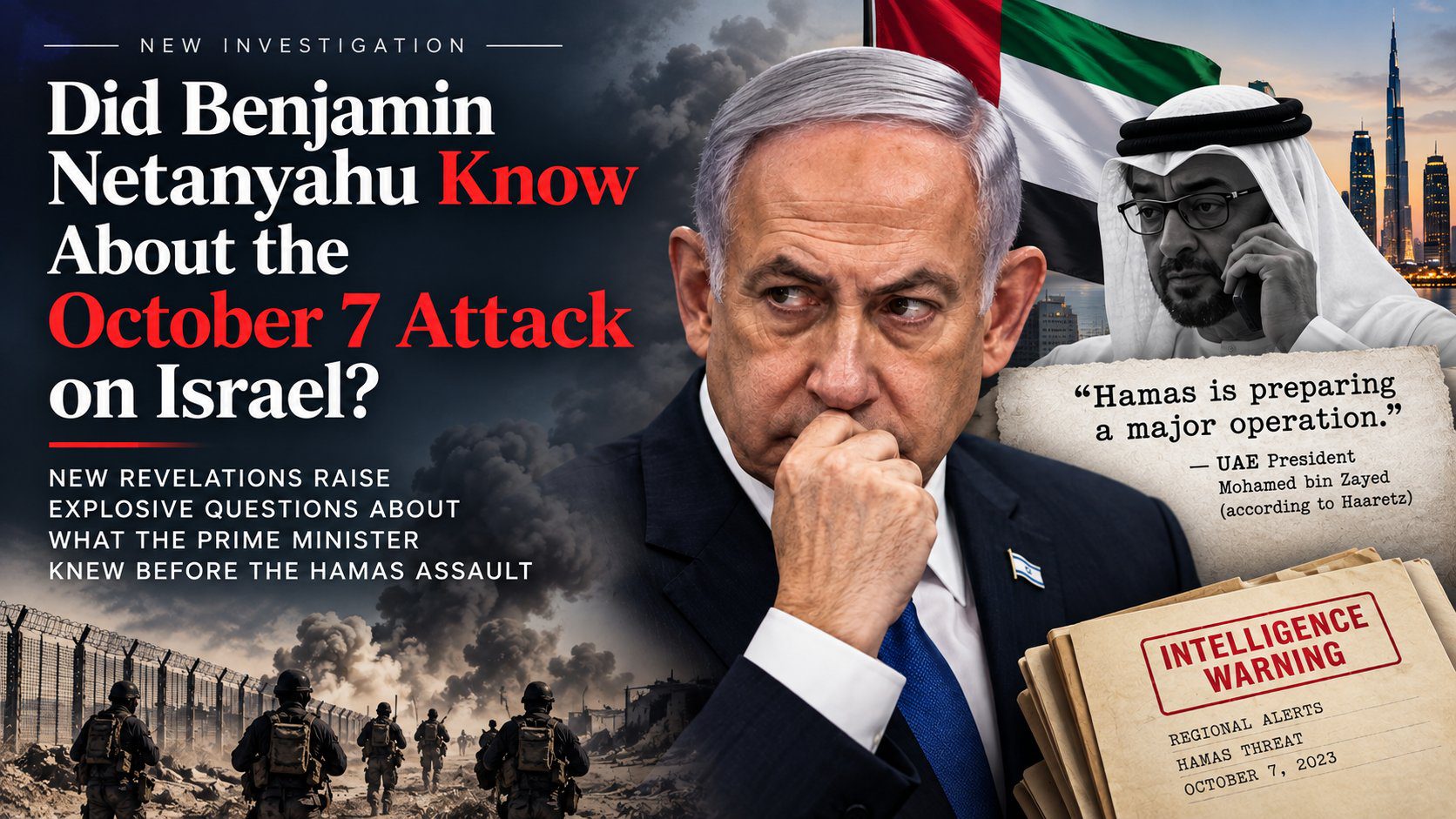
Nearly three years after Hamas led militants stormed across Israel’s border with Gaza on October 7, 2023, killing approximately 1,200 people and taking 251 hostages, new reporting has reopened one of the most consequential questions surrounding the deadliest attack in Israeli history: What did Prime Minister Benjamin Netanyahu know before the assault, and what did he do with the warnings that allegedly reached him? An investigation published by the Israeli newspaper Haaretz, based on reporting for a new book by journalists Shlomi Eldar and Ruth Yuval, alleges that United Arab Emirates President Sheikh Mohamed bin Zayed Al Nahyan personally warned Netanyahu approximately 10 days before October 7 that Hamas leader Yahya Sinwar was preparing a major operation against Israel.
According to the investigation, bin Zayed delivered the warning during an approximately 45-minute telephone conversation in late September 2023, telling Netanyahu that Sinwar was preparing an operation that could produce extensive bloodshed, destabilize the Middle East and potentially threaten the Abraham Accords that had normalized relations between Israel and several Arab states. Haaretz reported that Netanyahu reacted with “relative calm,” said Israel was prepared for different scenarios and suggested that a major threat was more likely to emerge from the occupied West Bank than Gaza. The newspaper further reported that Netanyahu did not subsequently inform the heads of the Israel Defense Forces or Shin Bet about the alleged warning. Netanyahu’s office has categorically rejected the account, saying that no such warning was given to the prime minister by the UAE before October 7 and disputing the reported conversation.
The allegation therefore remains contested, but subsequent reporting has made it more difficult to dismiss as nothing more than an isolated anonymous claim. Haaretz cited multiple senior foreign sources familiar with the alleged conversation, including an adviser to bin Zayed described as having direct knowledge of it, while an Emirati source later separately confirmed to The Times of Israel that Netanyahu had been warned about a planned Hamas attack. The UAE government itself stopped short of publicly confirming the conversation, saying that Israel and the Emirates maintain direct communications and share relevant intelligence when necessary. The result is an extraordinary factual dispute at the center of the October 7 story: Netanyahu’s office says the warning did not happen, while several sources familiar with the alleged exchange say that it did.
The Alleged UAE Warning Was Specific Enough to Demand Attention
According to Haaretz, the information behind bin Zayed’s alleged warning originated with increasingly threatening messages from Sinwar during the months before October 7. Sinwar reportedly spoke of preparing an enormous surprise for Israel and used language describing what was coming as an “earthquake.” Those warnings allegedly traveled through Palestinian and regional intermediaries before reaching the Emirati leadership, which considered the information serious enough for bin Zayed to personally contact Netanyahu. The reported warning did not contain the exact date, infiltration routes, target list or complete operational blueprint for October 7, and there is no public evidence that Netanyahu possessed such detailed information. The significance of the allegation is instead that an important regional ally may have specifically identified Sinwar and Hamas as preparing a major operation capable of causing substantial bloodshed shortly before the attack occurred.
That distinction is critical. Reporting that Netanyahu may have received a serious warning is not the same as establishing that he knew the precise October 7 attack was about to occur. There is currently no credible public evidence that Netanyahu possessed Hamas’s complete battle plan or intentionally allowed the attack to proceed. What the Haaretz investigation raises is a narrower but still extremely serious question: whether the prime minister personally received information significant enough that it should have been immediately distributed throughout Israel’s security establishment and incorporated into the country’s assessment of Hamas. If the alleged warning occurred and Netanyahu failed to relay it to senior military and intelligence officials, investigators would need to determine why. If Netanyahu’s denial is correct, diplomatic communications, telephone records and testimony from officials familiar with Israeli UAE contacts should help establish that as well.
The UAE allegation is also not the first report of a regional warning before October 7. Israeli media previously reported that Egyptian intelligence chief Abbas Kamel warned Netanyahu approximately 10 days before the attack that something unusual and potentially severe could be developing in Gaza. Netanyahu’s office denied that report too. Neither allegation establishes that Egypt or the UAE provided Israel with the exact October 7 battle plan, but together they contribute to a much larger question about whether warning signs from multiple sources were repeatedly discounted because Israeli leaders had become convinced that Hamas was deterred and that the more immediate security threat existed elsewhere.
Israel’s Own Investigations Have Already Established a Catastrophic Intelligence Failure
Whatever ultimately emerges regarding Netanyahu’s personal knowledge, Israel’s own military and intelligence investigations have already established that October 7 represented a profound institutional failure. The Israeli military concluded in its internal investigations that it drastically underestimated Hamas’s capabilities and intentions and failed in its fundamental mission to protect Israeli civilians. Israeli intelligence had obtained information years before the attack indicating that Hamas envisioned a large-scale cross-border operation, while surveillance soldiers stationed near Gaza repeatedly reported unusual Hamas training and activity. During the hours immediately preceding the attack, Israeli officials also detected troubling signals, including unusual activity involving Israeli SIM cards inside Gaza, yet senior commanders ultimately concluded that there was no immediate threat requiring the massive defensive mobilization that would soon prove necessary.
Shin Bet reached similarly damaging conclusions in its own investigation, acknowledging that the agency failed to correctly understand Hamas’s intentions, missed or misinterpreted warning signs and had been deceived into believing that Hamas did not want an all-out war. The problem, therefore, was not simply that Israel possessed no intelligence. Israel possessed pieces of intelligence that, viewed together after the attack, were deeply alarming. The institutional failure involved how those pieces were interpreted, prioritized and shared. A deeply entrenched assumption held that Hamas had become increasingly invested in governing Gaza, maintaining economic benefits and avoiding a devastating military confrontation with Israel. Measures allowing Gazans to work inside Israel were partly intended to reinforce those economic incentives, while Israeli officials believed the overwhelming military consequences of attacking Israel would continue to deter Hamas from attempting a large-scale invasion.
That assumption proved catastrophically wrong. Hamas had spent years developing an operation involving mass rocket fire, coordinated breaches of the Gaza border, attacks against military installations and civilian communities and the seizure of large numbers of hostages. When the assault began on October 7, Hamas-led militants overwhelmed sections of Israel’s border defenses, attacked military bases, kibbutzim, towns and the Nova music festival and exploited enormous gaps in Israel’s immediate military response. Approximately 1,200 people were killed and 251 were taken hostage. The attack exposed failures across virtually every level of Israel’s security architecture, from intelligence assessment and border surveillance to troop deployment, communications and the speed with which reinforcements reached communities under attack.
The Military Response Was Disastrously Slow, but That Does Not Prove a Deliberate Stand Down
The failures during the opening hours of October 7 have understandably generated intense scrutiny because Israeli soldiers, reservists, civilians and local security teams have described confusion, conflicting information and severe delays as Hamas fighters moved through southern Israel. Military investigations have subsequently acknowledged that forces were poorly positioned for the scale of the assault and that Israel struggled to establish an accurate picture of what was happening. Some communities waited hours for substantial military reinforcements while residents and local security personnel attempted to defend themselves. Those failures are documented and extraordinarily serious, but they should not be transformed into a different allegation without evidence.
There is currently no credible public evidence establishing that Netanyahu or another senior Israeli leader deliberately ordered the military to “stand down” and permit Hamas to attack Israeli civilians. Evidence that commanders misunderstood intelligence, deployed forces incorrectly, reacted too slowly or failed to appreciate the scale of an unfolding assault can establish catastrophic institutional and operational failure. It does not by itself establish intentional complicity. A deliberate decision to allow an enemy attack would require evidence of an entirely different magnitude. Serious journalism therefore has to separate the extraordinary failures Israel’s own institutions have acknowledged from theories that go substantially beyond the evidence currently available.
The distinction also makes the alleged UAE warning more important, not less. There is no need to rely on an unsupported stand-down theory to identify legitimate questions about October 7. Israel’s military has acknowledged that it failed. Shin Bet has acknowledged that it failed. Senior military officials have accepted responsibility, and then-IDF Chief of Staff Herzi Halevi resigned after acknowledging his responsibility for the catastrophe. The unresolved issue is how political decision-making interacted with those institutional failures and whether important information reached Netanyahu that was never incorporated into the security establishment’s assessment.
Netanyahu’s Personal Responsibility Remains the Unresolved Part of the October 7 Investigation
The newest allegations have become particularly significant because Netanyahu has argued that senior security officials failed to adequately alert him during the hours preceding the attack. That defense places enormous importance on determining exactly what information reached the prime minister before October 7. If Netanyahu was not given sufficiently serious intelligence, responsibility for that failure would rest heavily on the officials and institutions responsible for briefing him. If, however, he personally received a warning from bin Zayed approximately 10 days before the attack and failed to share it with Israel’s senior security leadership, the political accountability question would look substantially different.
That is why the Haaretz report matters even though it does not establish that Netanyahu knew the precise October 7 operation was coming. The allegation concerns information reportedly delivered directly to the prime minister rather than intelligence buried inside a military bureaucracy. According to the investigation, the president of an allied Arab country specifically warned Netanyahu that Sinwar was preparing a major operation capable of causing significant bloodshed and destabilizing the region. If true, investigators would need to establish how Netanyahu evaluated that warning, whether anyone in his office documented it, whether other Israeli officials were informed and why it apparently did not cause Israel to reconsider its assumptions about Gaza.
The report has predictably become part of Israel’s political debate, particularly with national elections approaching. Netanyahu’s political opponents have accused him of ignoring warnings and avoiding responsibility, while Netanyahu and his allies have argued that October 7 resulted from failures extending throughout Israel’s military, intelligence and political systems. Those political accusations should not substitute for evidence. The acknowledged failures of Israel’s military and intelligence agencies do not automatically absolve the political leadership, just as potential failures by Netanyahu would not erase mistakes made by the IDF or Shin Bet. October 7 was a systemic catastrophe, and understanding it requires examining every part of the decision-making chain rather than assigning responsibility based on political affiliation.
The Question Is Not Whether Netanyahu Had the Hamas Battle Plan, It Is Whether He Had Enough Information to Act
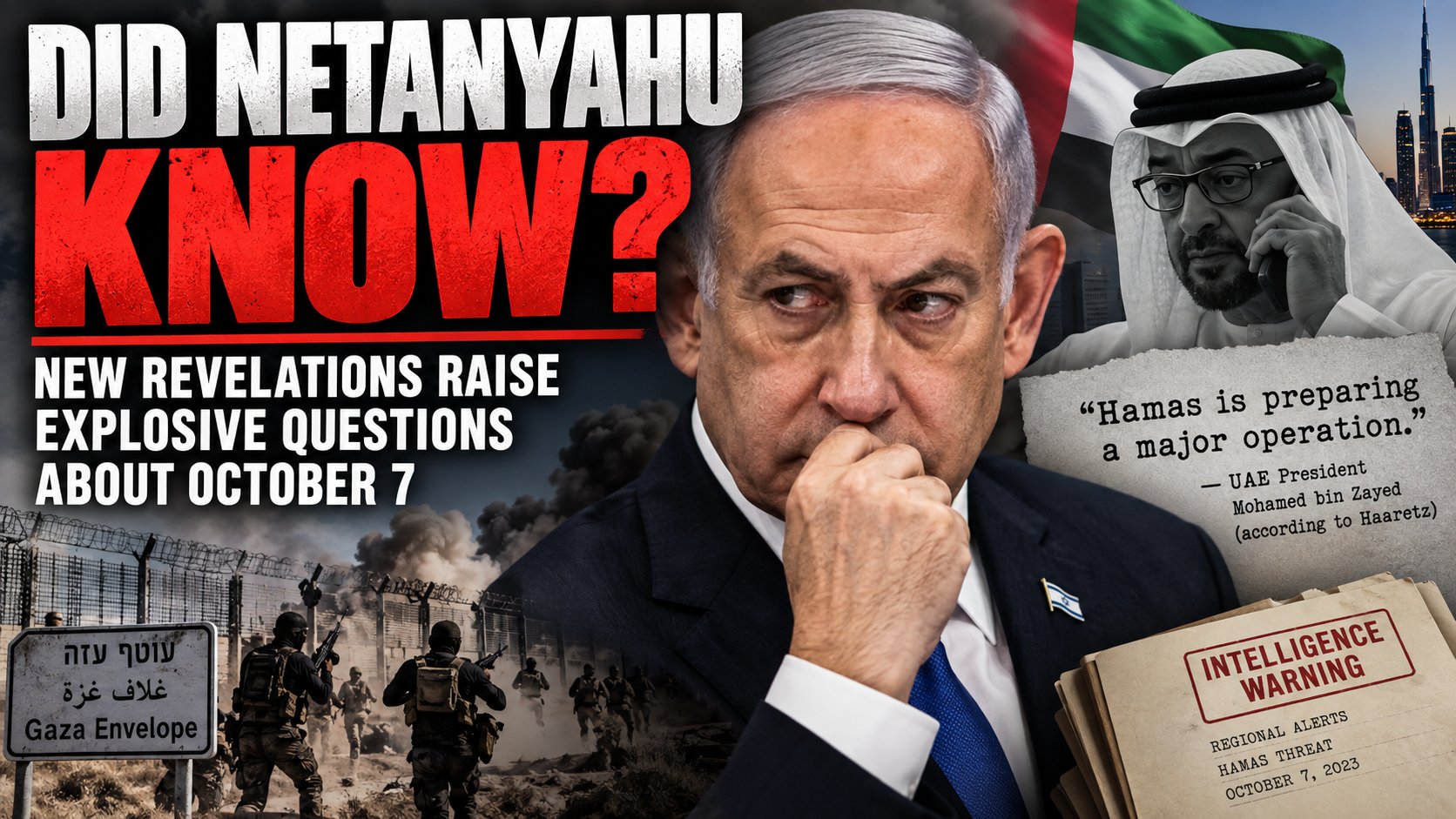
The most important factual distinction in the controversy is between knowing that Hamas was preparing something dangerous and knowing exactly what Hamas would do on October 7. The available reporting does not establish that Netanyahu knew the attack date, knew the targets or possessed a detailed operational plan. A headline declaring that Netanyahu definitively “knew about October 7” would therefore go beyond what the evidence currently establishes. What can legitimately be investigated is whether he received sufficiently serious information that a reasonable national-security response should have included alerting senior security officials, reevaluating assumptions about Hamas and potentially strengthening Israel’s defensive posture around Gaza.
That question becomes more significant when the alleged UAE warning is placed alongside everything Israel has subsequently learned about its prewar intelligence picture. Hamas had conducted visible training. Border surveillance soldiers had raised concerns. Israeli intelligence had previously obtained material describing a large-scale Hamas attack concept. Shin Bet has acknowledged that it misread Hamas’s intentions. The IDF has acknowledged that its fundamental understanding of the threat was wrong. If the prime minister simultaneously received a direct warning from a major regional leader identifying Sinwar and a potentially major Hamas operation, that information could have carried substantially greater significance when combined with the other signals already circulating through the Israeli security system.
Conversely, Netanyahu’s denial cannot simply be discarded because the allegation is politically explosive. His office says he received no UAE warning before October 7. The UAE government has not officially confirmed the reported conversation, even though an Emirati source separately confirmed it to The Times of Israel. The appropriate journalistic conclusion is therefore not that Netanyahu unquestionably knew the October 7 attack was coming. It is that there is now a specific, sourced and disputed allegation concerning a warning reportedly delivered directly to Israel’s prime minister shortly before the worst security disaster in the country’s history.
Israel Still Needs a Definitive Accounting of What Happened Before October 7
Nearly three years after the attack, Israel’s military and security agencies have conducted extensive internal investigations, but the country’s political leadership remains at the center of unresolved questions about responsibility. Families of victims, former security officials and political opponents of Netanyahu have demanded a broader independent inquiry capable of examining not merely battlefield failures but the decisions, assumptions and intelligence that reached Israel’s civilian leadership before the attack. Netanyahu’s government has resisted the traditional model of a state commission of inquiry, while lawmakers have pursued a differently structured investigation through the Knesset.
The latest allegations demonstrate why an authoritative investigation remains important. Determining whether bin Zayed actually warned Netanyahu should not ultimately depend on competing statements from politicians and anonymous officials. Investigators could examine telephone and diplomatic records, communications between the Israeli and Emirati governments, contemporaneous notes, intelligence assessments and testimony from officials reportedly familiar with the conversation. Similar scrutiny could determine whether Egyptian officials issued a warning, who received it and how it was handled. The same investigation could reconstruct the intelligence that reached Netanyahu from Israel’s own security agencies and compare it with the information available to military commanders before the attack.
October 7 should not be reduced to a simplistic choice between blaming Netanyahu or blaming Israel’s security establishment. The documented record already demonstrates that failures occurred throughout the system. Israel’s military misunderstood Hamas, Shin Bet misjudged the organization’s intentions, commanders failed to correctly interpret warning signs, defenses proved inadequate and reinforcements were disastrously slow to reach some communities. The unresolved question is whether political leadership added another layer to that failure by receiving significant information and failing to act on it.
The Haaretz investigation does not prove that Benjamin Netanyahu knew the October 7 attack was coming, and there is no credible evidence that he intentionally allowed it to happen. It does, however, present a highly specific allegation that deserves a definitive answer: that approximately 10 days before Hamas launched the deadliest attack in Israeli history, UAE President Mohamed bin Zayed personally warned Netanyahu that Yahya Sinwar was preparing a major operation and that Netanyahu did not pass that information to Israel’s senior security leadership.
Netanyahu says that warning never happened. Multiple sources cited by Haaretz say it did, and an Emirati source has separately confirmed the warning to another Israeli news organization. That contradiction is no longer a peripheral dispute. It goes directly to the question Israel has been struggling to answer since October 7: what did the country’s leaders know, when did they know it and what did they do with the information they had?
Only a comprehensive examination of the evidence can answer those questions. Until then, the responsible conclusion is neither that Netanyahu unquestionably knew October 7 was coming nor that the newest allegations can simply be dismissed. The evidence already establishes a historic intelligence and military failure. What remains unresolved is how far that failure extended into the office of Israel’s prime minister.

Sources & Further Reading
New Reporting on the Alleged UAE Warning
Associated Press — UAE Warned Netanyahu of Major Hamas Operation Days Before Oct. 7 Attack, News Report Says
https://apnews.com/article/935c2cd82d3204d6dc859d296fc866e3
The Guardian — Netanyahu Was Warned of 7 October Hamas Attacks, Book Claims
https://www.theguardian.com/world/2026/sep/08/netanyahu-warned-7-october-hamas-book-haaretz
The New Yorker — The Warning Benjamin Netanyahu Ignored
https://www.newyorker.com/news/the-lede/the-warning-benjamin-netanyahu-ignored
The Times of Israel — Days Before Oct. 7, UAE Leader Warned Netanyahu Hamas Was Planning War, Report Says
https://www.timesofisrael.com/liveblog_entry/days-before-oct-7-uae-leader-warned-netanyahu-hamas-was-planning-war-but-pm-did-nothing-with-info-report/
The Times of Israel — Emirati Source Confirms Netanyahu Was Warned of Planned Hamas Attack Ahead of Oct. 7
https://www.timesofisrael.com/liveblog_entry/emirati-source-confirms-to-toi-that-netanyahu-was-warned-of-planned-hamas-attack-ahead-of-oct-7/
AFP — Netanyahu Under Fire Over Report UAE Warned of October 7 Attack
https://www.afp.com/en/netanyahu-under-fire-over-report-uae-warned-october-7-attack
Israel’s October 7 Intelligence and Military Failures
Israel Defense Forces — The October 7 Inquiries
https://www.idf.il/en/mini-sites/710-the-inquiries/
The Washington Post — Israel Underestimated Hamas Before Oct. 7 Attack, Military Probe Finds
https://www.washingtonpost.com/world/2025/02/28/israel-hamas-oct7-gaza/
Reuters — Israel’s Top Security Agency Admits Failures in October 7 Hamas Attack
https://www.investing.com/news/world-news/israels-top-security-agency-admits-failures-in-october-7-hamas-attack-3906874
The Jerusalem Post — Shin Bet Ignored SIM Cards, Sensor Warning on Oct. 7, Probe Finds
https://www.jpost.com/israel-news/article-844712
Original Video Commentary
The Young Turks — Cenk Uygur and Anna Kasparian Discuss the Haaretz Investigation
https://www.youtube.com/watch?v=m-BFXWmBgfQ



















































Want to join the conversation?
Create an account or sign in to share your thoughts, vote,
and reply to other readers.
Showing 0 of 0 comments
Don't have an account?
Already have an account?