
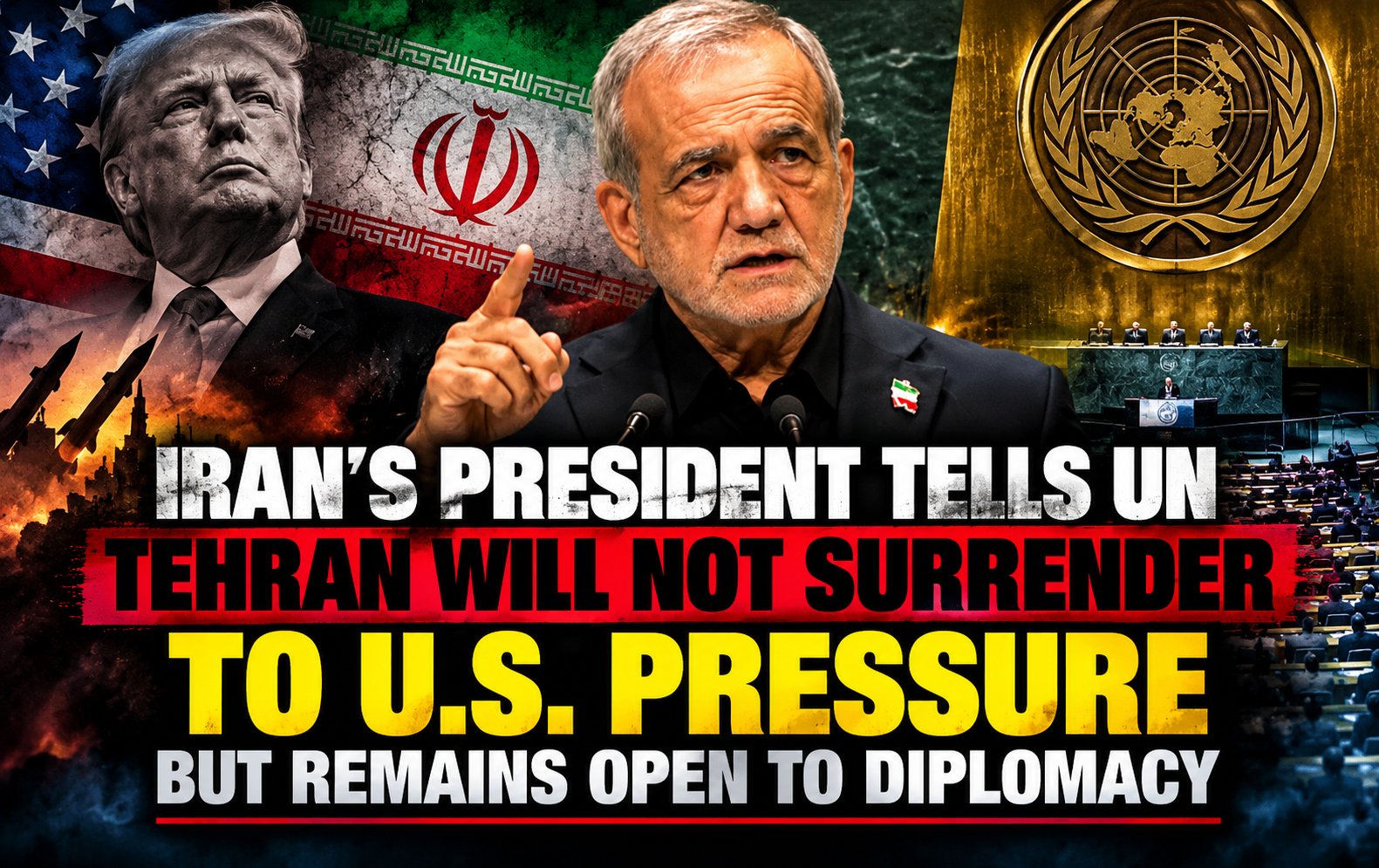
Iran’s President Tells United Nations Tehran Will Not Surrender to U.S. Pressure but Remains Open to Diplomacy
UNITED NATIONS — Iranian President Masoud Pezeshkian used a wartime address to the United Nations General Assembly to reject President Donald Trump’s threats against Tehran, accuse the United States and Israel of applying a double standard to Iran’s nuclear program and declare that his country will continue resisting military and economic pressure while remaining open to negotiations.
Speaking in New York, Pezeshkian delivered one of Iran’s most consequential international addresses since the outbreak of the war with the United States. His appearance came one day after Trump defended U.S. military action against Iran from the same U.N. podium and warned of further consequences if negotiations failed to produce an agreement. Pezeshkian responded that Iran would not “bend the knee,” but insisted Tehran remains prepared for diplomacy conducted with mutual respect and without threats or coercion.
The speech presented Iran’s case to the international community on several interconnected fronts: the war with the United States, Israel’s nuclear arsenal, Iran’s own nuclear program, economic sanctions, Gaza, regional security, the Strait of Hormuz and the possibility of renewed negotiations. It was both a defense of Tehran’s conduct and a direct challenge to the account Trump presented to world leaders a day earlier.
Pezeshkian Rejects Trump’s Characterization of Iran as a Terrorist State
Pezeshkian directly challenged Trump’s characterization of Iran as a leading sponsor of terrorism, arguing that Iranians themselves have been victims of terrorism and foreign military attacks. He accused Washington of labeling Iran the aggressor while the United States and Israel have conducted military operations against Iranian territory and argued that continued military and economic pressure would strengthen rather than break Iranian resistance.
His argument represents Tehran’s position and is sharply disputed by the United States, Israel and other governments, which have for decades accused Iran of supporting armed organizations throughout the Middle East. The United States has designated Iran a state sponsor of terrorism since 1984 and has designated several Iran-backed organizations as terrorist groups. Pezeshkian nevertheless sought to invert that accusation at the General Assembly, portraying Iran as a country defending itself against stronger military powers rather than the principal source of regional instability.
“They did hit us, but we did not bend the knee,” Pezeshkian said, encapsulating the broader message of his address: Iran says it will absorb economic and military pressure rather than surrender its core security and nuclear demands.
Iran Challenges the World Over Israel’s Nuclear Arsenal
One of Pezeshkian’s sharpest arguments concerned what he characterized as a fundamental contradiction in the international nuclear system: Iran is subjected to inspections and sanctions over its nuclear program while Israel, which is widely understood to possess nuclear weapons, remains outside the Nuclear Non Proliferation Treaty.
“The nuclear weapon is in Israel, but the inspectors are in Iran,” Pezeshkian told the General Assembly, arguing that Israel possesses weapons of mass destruction, does not participate in the NPT framework and has not subjected its nuclear facilities to the same comprehensive safeguards applied to Iran, yet continues receiving extensive military and diplomatic support from Western governments.
The underlying distinction is real, although Pezeshkian presented it through Iran’s political framing. Israel maintains a longstanding policy of nuclear ambiguity and neither confirms nor denies possessing nuclear weapons. Israel is not a party to the NPT and therefore is not subject to the same comprehensive International Atomic Energy Agency safeguards as Iran, which is an NPT member. Iran, however, has faced years of international concern over its uranium enrichment levels, previous undeclared nuclear activities and restrictions affecting international monitoring.
Pezeshkian argued that the disparity demonstrates a broader double standard in the international system, contrasting scrutiny of Iran’s nuclear program with the international treatment of Israel and arguing that sanctions and inspections have been applied selectively.
Pezeshkian Says Iran Will Not Give Up Peaceful Nuclear Technology
The Iranian president simultaneously reiterated Tehran’s position that it does not seek nuclear weapons while refusing to surrender what Iran considers its right to civilian nuclear technology. Pezeshkian argued that nuclear science has applications far beyond weapons, including medicine, agriculture, scientific research and energy production, and said Iran would not accept a system in which advanced nuclear knowledge effectively becomes the exclusive property of a small number of powerful states.
Iran maintains that its nuclear program is peaceful, while Western governments and Israel have challenged the credibility of that position because of Iran’s high level uranium enrichment, previous undeclared nuclear activities and disputes over international monitoring. Pezeshkian nevertheless insisted there is no military solution to the nuclear dispute and framed Tehran’s position around a straightforward principle: no nuclear weapons, but no prohibition on peaceful nuclear technology.
That distinction could become central to any future agreement. Washington has sought restrictions capable of preventing Iran from developing a nuclear weapon, while Tehran has repeatedly insisted that any settlement must preserve its ability to maintain a civilian nuclear program and exercise nuclear rights available to states participating in the nonproliferation system.
Iran Says It Will Continue Building Its Defenses
Pezeshkian also made clear that Iran does not intend to surrender its conventional defensive capabilities as part of an international settlement. He defended Iran’s right to maintain military deterrence and warned that attacks against Iranian territory would receive a response, reinforcing Tehran’s longstanding position that its missile and military programs are necessary because the country faces heavily armed regional adversaries and a substantial American military presence across the Middle East.
The United States, Israel and several regional governments have taken a different view, arguing that Iran’s ballistic-missile capabilities and support for armed groups have contributed to instability and attacks throughout the region. Those competing security doctrines remain one of the largest obstacles to any comprehensive settlement between Tehran and Washington because Iran views its missiles and regional alliances as essential deterrents while its adversaries view many of those same capabilities as threats.
Strait of Hormuz Remains at Center of War and Diplomacy
Pezeshkian also addressed one of the most dangerous pressure points in the conflict: the Strait of Hormuz, the narrow waterway connecting the Persian Gulf with the Gulf of Oman through which a significant share of the world’s petroleum trade normally passes. Iran has linked unrestricted navigation through the strait to the treatment of Iranian shipping and ports, arguing that foreign governments cannot expect Tehran to guarantee normal maritime commerce while simultaneously restricting Iranian access to regional waterways and economically isolating the country.
The issue has become directly connected to diplomatic efforts surrounding the conflict, with Tehran signaling that maritime access, sanctions, military pressure and Iranian shipping restrictions are interconnected negotiating issues. Pezeshkian framed the dispute as part of a larger principle of collective regional security, arguing that Middle Eastern states cannot expect permanent security while neighboring countries remain under attack or economically isolated.
“Either we will build security together, or we will endure insecurity together,” Pezeshkian said, presenting Iran’s position that regional security should ultimately be constructed by Middle Eastern governments rather than imposed through permanent foreign military intervention.
Gaza and Palestine Remain Central to Iran’s Argument
The Iranian president devoted another portion of his address to Gaza and the Israeli Palestinian conflict, describing Gaza as an unresolved wound exposing what Tehran sees as the failure of international institutions to protect civilians and enforce international law consistently. Pezeshkian defended what he described as resistance to occupation, arguing that military force cannot permanently eliminate political movements rooted in displacement, occupation and national identity.
That language reflects Iran’s longstanding support for Palestinian armed groups and its broader regional network of allied movements. Iran’s role remains highly contested: Tehran has provided financial, military and political support to organizations including Hamas and Hezbollah, while Israel and the United States argue that Iranian assistance has prolonged regional conflicts and enabled attacks on civilians. Iran describes those organizations as resistance movements confronting Israeli occupation and military power.
Pezeshkian used Gaza as part of his broader argument that military superiority cannot by itself produce lasting political settlements. His message was that bombardment can destroy infrastructure and kill fighters but cannot eliminate the underlying grievances, identities and political causes that sustain resistance movements.
Tehran Leaves the Door Open to Negotiations
Despite the confrontational language, one of the most important elements of Pezeshkian’s speech was what he did not rule out: negotiations with Washington. Iran and the United States remain far apart over the conditions necessary to end the conflict, but diplomatic contacts have continued even as both governments publicly exchange threats and defend their military actions.
Pezeshkian told the General Assembly that Iran remains prepared for dialogue, diplomacy and negotiations but would not accept talks conducted under military threats or what he characterized as the language of force and bullying. His message attempted to draw a distinction between negotiation and capitulation, presenting Tehran as willing to reach an agreement while insisting that military pressure cannot determine the terms of that agreement.
That combination, refusing surrender while preserving negotiations, appears to define Iran’s public diplomatic strategy. Tehran is attempting to demonstrate that military pressure will not force capitulation while simultaneously maintaining a diplomatic route capable of ending a costly conflict.
Two Competing Visions Presented From the Same U.N. Podium
The speeches by Trump and Pezeshkian, delivered approximately a day apart, presented world leaders with sharply different accounts of the same conflict. Trump portrayed Iran as a destabilizing power that must be prevented from obtaining a nuclear weapon and defended the use of American military and economic pressure, while Pezeshkian portrayed Iran as the victim of aggression, sanctions and an international double standard that tolerates Israel’s undeclared nuclear arsenal while subjecting Tehran’s nuclear activities to intense international scrutiny.
Pezeshkian defended Iran’s military deterrence, nuclear rights and regional positions while simultaneously maintaining that Tehran remains willing to negotiate. The United States has likewise maintained that diplomacy remains possible while insisting that Iran accept restrictions Washington considers necessary to prevent nuclear proliferation and address broader security concerns.
The competing addresses therefore exposed the central contradiction surrounding the conflict: both governments say diplomacy remains possible while simultaneously warning that they are prepared to continue using military power if their fundamental demands are not met. Whether those positions can be reconciled will depend on negotiations extending far beyond the rhetoric delivered from the General Assembly podium.
For now, Pezeshkian’s message to Washington and the international community was unmistakable, Iran says it remains prepared to negotiate, but it will not accept surrender as the price of negotiations.

Sources & Further Reading
- Reuters — Pezeshkian Says Iran Will Not Surrender but Remains Open to Diplomacy
https://www.reuters.com/world/middle-east/irans-president-says-tehran-will-not-surrender-war-with-us-but-believes-2026-09-23/ - PBS NewsHour — Iranian President Pezeshkian’s 2026 U.N. General Assembly Address
https://www.pbs.org/newshour/world/watch-live-iranian-president-pezeshkian-addresses-2026-un-general-assembly - Associated Press — Coverage of Trump, Iran and the 2026 U.N. General Assembly
https://apnews.com/article/trump-united-nations-unga-iran-ai-f7cb0b3ebc492446c0be97ed3a6843aa - Reuters — Iran and Strait of Hormuz Negotiations
https://www.reuters.com/world/middle-east/iran-ready-reopen-strait-hormuz-if-us-eases-military-pressure-lifts-blockade-2026-09-22/ - Euronews — Pezeshkian Says Iran Will Negotiate but Will Not Be Bullied
https://www.euronews.com/2026/09/23/pezeshkian-tells-un-iran-will-not-be-bullied-but-will-negotiate - The Independent — Iran President’s U.N. General Assembly Address
https://www.youtube.com/watch?v=o7238ovt9ys













































Want to join the conversation?
Create an account or sign in to share your thoughts, vote,
and reply to other readers.
Showing 0 of 0 comments
Don't have an account?
Already have an account?