
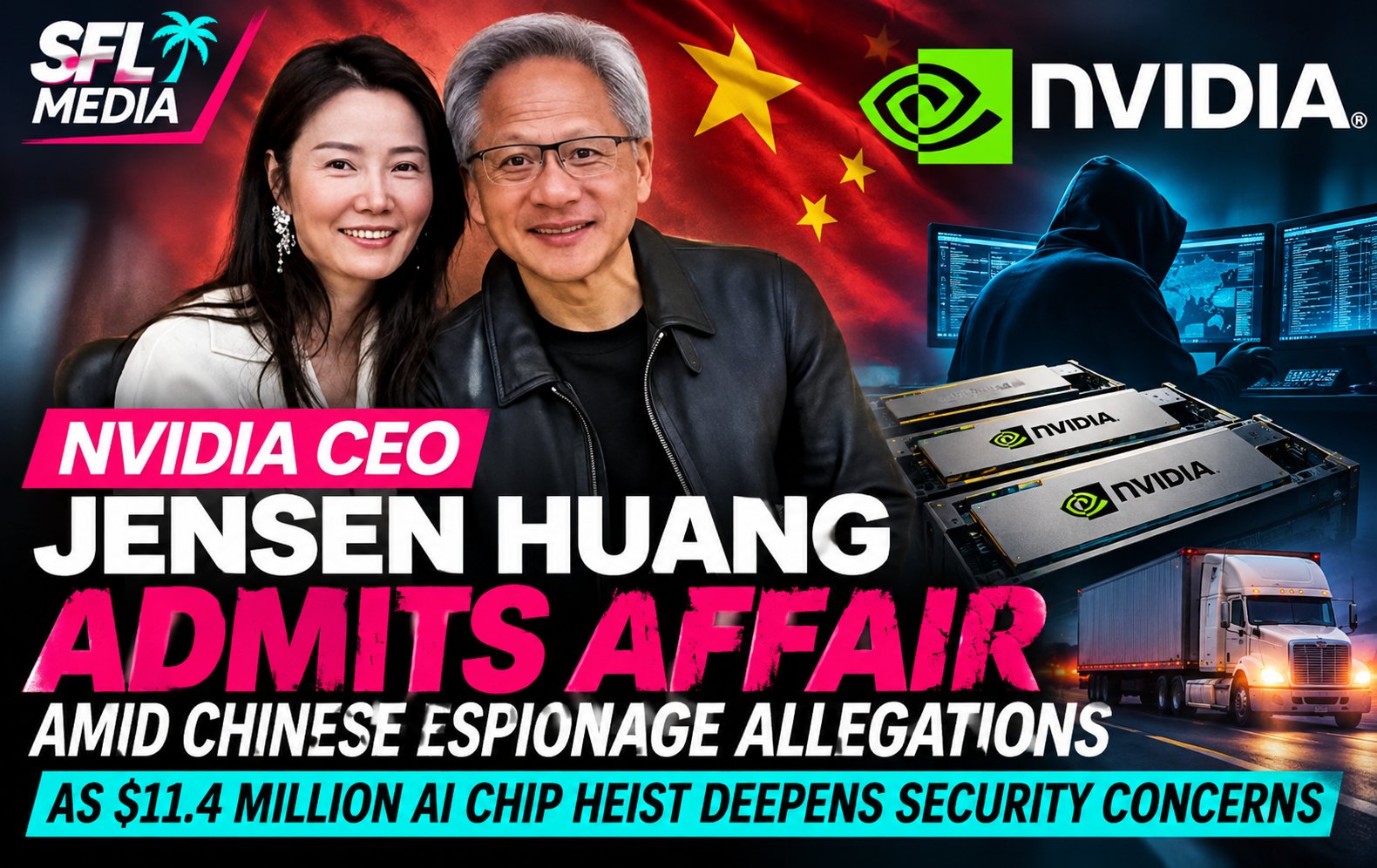
Nvidia CEO Jensen Huang Admits Affair Amid Chinese Espionage Allegations as $11.4 Million AI Chip Heist Raises New Security Concerns
The Nvidia chief executive faces an independent corporate investigation following revelations about his relationship with a Chinese technology executive reportedly scrutinized by U.S. intelligence officials. Meanwhile, the disappearance of millions of dollars in Nvidia hardware has raised separate questions about the security of America’s most valuable technology.
The billionaire chief executive of Nvidia, Jensen Huang, is confronting one of the most serious controversies of his career after acknowledging an extramarital affair with a Chinese technology executive whose alleged intelligence connections have drawn scrutiny from American officials. The revelations have triggered an independent investigation by Nvidia’s board of directors, intensified congressional interest in the company’s security practices, and raised questions about the vulnerability of America’s advanced artificial intelligence industry to foreign intelligence operations.
The scandal comes as authorities investigate the separate disappearance of approximately $11.4 million in Nvidia computing hardware from a shipment originating in Oakland, California. Although there is no established evidence connecting the cargo theft to Huang’s relationship or the alleged intelligence operation, the two developments have placed an extraordinary spotlight on the security of American semiconductor technology at a time when Washington and Beijing are competing for dominance in artificial intelligence.
Nvidia CEO Acknowledges Affair as Board Opens Investigation
Huang’s personal conduct became a corporate governance issue after reports emerged concerning his relationship with Alice Huang, also known as Huang Le, a Chinese technology executive associated with Singapore based Megaspeed International. According to the reported account, Huang subsequently acknowledged being unfaithful to his wife, Lori, in a communication to Nvidia employees, accepted responsibility for his conduct, and pledged to cooperate with an independent investigation into potential security concerns.
The reported apology represents a significant development because Nvidia had previously characterized Huang’s interactions with the executive as ordinary business engagements. His acknowledgment of a personal relationship raises questions about whether the company’s earlier explanations adequately described the nature of their association, although the affair itself does not establish that confidential information was shared or that either individual participated in espionage.
Nvidia’s board reportedly established an independent special committee supported by outside legal counsel to examine the circumstances surrounding the relationship and any potential implications for corporate security. The company has maintained that it has no reason to believe its proprietary information or American national security interests were compromised. Huang is expected to continue leading Nvidia while the investigation proceeds, placing considerable responsibility on independent directors to demonstrate that the inquiry will be conducted without interference from the company’s powerful chief executive.

Who Is Alice Huang, the Chinese Executive at the Center of the Controversy?
Alice Huang, also identified as Huang Le, has been described in investigative reporting as a Chinese national who previously worked in broadcasting and banking before entering the technology industry. She subsequently became associated with Megaspeed International, a Singapore based data center and cloud computing company whose operations involve acquiring advanced computing equipment and providing processing capacity to commercial customers.
Her professional background became particularly relevant after reports alleged that American intelligence officials had examined her possible connections to Chinese intelligence services. According to those accounts, officials suspected that she may have been involved in efforts to obtain information concerning Nvidia or influence access to American semiconductor technology. Such allegations, if substantiated, would raise significant questions about foreign intelligence targeting of executives whose companies control strategically important technology.
However, intelligence suspicions are not equivalent to proof of espionage. No publicly established criminal finding demonstrates that Alice Huang acted as a Chinese intelligence operative, and the allegations should be evaluated against independently verifiable evidence. The distinction is especially important because personal relationships, business contacts, and participation in international technology events are not inherently suspicious activities.
The Taipei Meetings That Became a National Security Controversy
The relationship reportedly developed through interactions in Taiwan, where Nvidia maintains extensive business relationships with semiconductor manufacturers, technology suppliers, and major commercial customers. Accounts have described social encounters involving Huang and Alice Huang during industry events in 2024 and 2025, including gatherings associated with Computex, one of Asia’s most influential technology exhibitions.
Those encounters initially appeared consistent with the networking and customer relationships commonly maintained by executives at multinational technology companies. Nvidia sells advanced computing hardware to an enormous range of businesses, making regular meetings between its leadership and international customers an ordinary part of its operations. The situation became more complicated when allegations surfaced that American intelligence officials were examining whether one of those relationships involved an individual with possible connections to Chinese intelligence.
The central investigative question is not simply whether Huang had a personal relationship with a customer executive, but whether that relationship created opportunities for unauthorized access to sensitive information, influenced commercial decisions, or bypassed established security procedures. Determining whether any such conduct occurred will require documentary evidence, communications records, internal compliance findings, and a credible assessment of what information was actually available to the individuals involved.
Megaspeed and the Billion Dollar AI Chip Pipeline
Megaspeed’s involvement has drawn attention because of the company’s position within the international market for advanced computing equipment. Businesses operating large data centers require substantial quantities of high performance processors, and Nvidia’s hardware has become essential to the development and operation of increasingly sophisticated artificial intelligence systems. Companies purchasing large volumes of these products therefore occupy a commercially valuable and strategically sensitive position in the global technology supply chain.
American authorities have scrutinized companies operating in the region over concerns that advanced computing equipment could be transferred to Chinese customers in violation of U.S. export restrictions. Reporting concerning Megaspeed and related operations has raised questions about semiconductor purchases, regional corporate structures, and whether equipment acquired through intermediaries ultimately reached prohibited destinations. Megaspeed has denied wrongdoing, while Nvidia has defended its commercial relationships and compliance practices.
The broader controversy reflects a persistent challenge for American policymakers. Restricting the direct export of advanced AI processors does not automatically prevent foreign buyers from obtaining access to computing power through cloud services, intermediaries, or overseas data centers. Effective enforcement requires identifying the ultimate users of restricted technology, monitoring transactions across multiple jurisdictions, and distinguishing legitimate international commerce from deliberate attempts to circumvent export controls.
Congress Demands Answers About Nvidia and Chinese Intelligence
The allegations have reportedly attracted congressional attention from lawmakers concerned about foreign intelligence activity and the security of America’s semiconductor industry. Congressional scrutiny is particularly consequential because Nvidia occupies a central position in the global AI economy, supplying processors used by major technology companies, research institutions, cloud computing providers, and government-related organizations.
Huang has also been an influential voice in debates over American semiconductor export policy, arguing that excessive restrictions could weaken the competitiveness of U.S. technology companies while encouraging Chinese businesses to develop alternatives. That argument has become an important part of Washington’s broader discussion about balancing economic competitiveness against national security concerns.
The reported relationship creates a legitimate reason to examine whether Huang’s commercial or policy positions were influenced by inappropriate external pressure. Nevertheless, there is no established public finding that his relationship with Alice Huang affected American export policy or that he knowingly assisted a foreign intelligence operation. Congressional oversight should focus on evidence, corporate safeguards, and the integrity of decision making rather than treating unproven allegations as established misconduct.
An $11.4 Million Nvidia Hardware Shipment Vanishes in California
As the controversy surrounding Huang attracted attention, another major security concern emerged involving the disappearance of approximately $11.4 million in Nvidia computing equipment. According to the reported police investigation, six pallets of hardware were collected from Oakland on August 29, 2026, for delivery to Fort Worth, Texas, but never reached their intended destination.
The shipment was reportedly collected by a truck displaying the markings of a food transportation company. Investigators examining the vehicle’s movements identified several unusual stops as it traveled through California before tracking information reportedly ended in San Bernardino County. The disappearance was subsequently reported to Oakland police in September, and details of the investigation became public in early November.
The value of the missing cargo makes the case particularly significant. Advanced Nvidia processors can represent enormous concentrations of financial value within relatively small shipments, making them attractive targets for sophisticated cargo theft operations. The stolen equipment could potentially be resold through unauthorized commercial channels, although investigators have not publicly established the identity of the thieves, the ultimate destination of the shipment, or whether the hardware left the United States.
Why Stolen Nvidia Chips Could Be Worth Even More on the Black Market
The market for advanced AI processors has created unusual incentives for organized criminal groups because demand for high-performance computing equipment extends across commercial industries, research institutions, and governments. Certain Nvidia processors are subject to American export restrictions, limiting the ability of some foreign buyers to obtain the most advanced technology through authorized distribution channels.
Those restrictions can create substantial price differences between legitimate domestic markets and unauthorized overseas resale networks. Security analysts have warned that sophisticated thieves may exploit these differences by targeting shipments containing valuable computing equipment, particularly when transportation contractors, logistics records, or tracking systems present opportunities for manipulation.
The reported Oakland theft illustrates how the security challenges facing the semiconductor industry extend beyond computer networks and corporate espionage. Physical transportation systems, freight brokers, warehouse operators, shipping contractors, and international resellers all represent potential points of vulnerability. Protecting sensitive technology requires more than preventing unauthorized access to digital information; it also requires ensuring that valuable hardware reaches its intended customers.
There is currently no verified evidence connecting the California cargo theft to Alice Huang, Megaspeed, Chinese intelligence, or Jensen Huang’s personal relationship. The timing of the public reporting does not establish a coordinated operation, and investigators would need substantial additional evidence before such a connection could responsibly be alleged.
Two Investigations Expose the Vulnerabilities of America’s AI Industry
Although the allegations involving Huang and the missing hardware shipment concern separate circumstances, they illustrate different security challenges confronting the same strategically important industry. One involves the possibility that foreign intelligence services could exploit personal or professional relationships to gain access to influential corporate executives. The other involves the physical security of expensive computing equipment as it moves through domestic and international supply chains.
Both issues are especially consequential because Nvidia’s technology plays a major role in the development of artificial intelligence systems used across the American economy. Advanced processors support scientific research, medical technology, financial services, cloud computing, autonomous systems, and applications relevant to national defense. The concentration of technical capability and commercial value within a relatively small number of semiconductor companies makes those businesses attractive targets for criminal organizations and foreign intelligence services.
The controversy also raises questions about whether existing American export controls are supported by sufficiently robust enforcement mechanisms. Restrictions on semiconductor sales may be undermined if authorities cannot reliably identify end users, monitor intermediary transactions, secure transportation networks, or detect attempts to obtain sensitive information through personal relationships with corporate decision-makers.
Nvidia’s Board Faces a Defining Test of Corporate Accountability
For Nvidia’s directors, the immediate challenge is determining what occurred, what the company knew, and whether its existing safeguards functioned as intended. A credible independent investigation should examine the timeline of Huang’s relationship, the company’s awareness of any intelligence concerns, the accuracy of earlier corporate statements, and whether appropriate security procedures were followed when evaluating business relationships involving sensitive technology.
The inquiry should also establish whether any confidential information was disclosed, whether corporate decisions were influenced by undisclosed personal interests, and whether Nvidia’s compliance systems adequately addressed risks involving customers operating across multiple jurisdictions. If investigators identify weaknesses, the board will need to explain what corrective measures are being implemented and whether additional oversight is necessary.
Huang’s position as Nvidia’s founder and longtime chief executive makes independent oversight particularly important. Corporate boards have an obligation to protect shareholders and the company itself, even when an investigation involves an executive whose leadership has been central to its success. Personal influence, financial performance, and the importance of a company’s products cannot substitute for effective governance.
The Bigger Picture: America’s Most Valuable Technology Has Become a National Security Target
The Nvidia controversy arrives at a moment when advanced semiconductor technology has become one of the most strategically important assets in the global economy. Governments increasingly view access to powerful AI processors as essential to economic competitiveness, scientific advancement, military modernization, and intelligence capabilities. That competition has transformed companies once regarded primarily as commercial technology suppliers into critical participants in international security policy.
The allegations surrounding Huang demonstrate why the personal conduct of powerful executives can become a legitimate corporate security concern when undisclosed relationships intersect with sensitive business interests. The California cargo theft, meanwhile, highlights the financial incentives driving criminal interest in the same technology. Neither development establishes a broader conspiracy, but both warrant serious examination because the potential consequences extend well beyond one corporation.
Ultimately, Nvidia must demonstrate that its security procedures, compliance practices, and corporate governance are capable of protecting the company’s technology regardless of the individuals involved. American authorities must likewise determine whether existing safeguards adequately protect valuable semiconductor equipment from theft, unauthorized diversion, and illicit international resale.
The outcome will depend on evidence rather than speculation. Investigators have not established that Huang knowingly participated in espionage, that Nvidia secrets were compromised, or that the missing hardware was connected to the allegations involving Alice Huang. Those distinctions remain essential as the investigations continue. For a company whose technology increasingly powers the world’s artificial intelligence infrastructure, however, the questions themselves are consequential. Nvidia’s board now faces the responsibility of providing credible answers, while law enforcement confronts the growing challenge of protecting American technology that has become extraordinarily valuable both commercially and strategically.

Sources & Further Reading
- SFL Media — Technology News, Investigations and Analysis
- Axios — Nvidia CEO Jensen Huang Admits Affair and Board Launches Investigation
- The Washington Post — Nvidia Investigates CEO’s Relationship With Suspected Chinese Spy
- Associated Press — China Rejects Allegations of Espionage Operation
- Channel News Asia — Timeline of the Jensen Huang and Alice Huang Controversy
- Fortune — Nvidia Board Investigation and Previous Corporate Statements
- ABC News — $11.4 Million Nvidia Hardware Shipment Stolen in California
- Ars Technica — Nvidia Hardware Worth $11.4 Million Vanishes Between Oakland and Texas

















































Want to join the conversation?
Create an account or sign in to share your thoughts, vote,
and reply to other readers.
Showing 0 of 0 comments
Don't have an account?
Already have an account?