
The Future of Trucking in America is Here
Something pretty significant is happening on the roads of central Ohio, and it could eventually have a much bigger impact on the American trucking industry than most people realize. Driverless electric trucks are now operating on public roads around Marysville, Ohio, moving actual freight without a human driver sitting behind the wheel. These aren’t trucks slowly crawling around a private testing facility while engineers watch from 20 feet away. They’re being used in real world logistics operations, which means the future of trucking has officially moved another step closer to the present.
The company behind the technology is Einride, a Swedish transportation technology company that has been developing electric and autonomous freight systems for years. Einride has partnered with EASE Logistics, a Columbus area logistics company, to put two autonomous electric trucks into daily freight operations in central Ohio. The vehicles are particularly eye catching because they don’t look like conventional tractor trailers. They’re cabless, purpose built autonomous trucks, meaning there isn’t a traditional driver’s seat, steering wheel or pedals sitting inside waiting for somebody to climb aboard.
These are Level 4 Vehicles… What Does That Mean?
What makes the Ohio deployment particularly interesting is that these are Level 4 autonomous vehicles. In simple terms, Level 4 means the truck can handle the entire driving task without a human driver inside the vehicle, provided it is operating within the conditions and geographic area for which the system has been designed. There are still humans involved, because apparently civilization isn’t quite ready to simply hand an 80,000 pound vehicle the keys and wish it luck. Remote operators can supervise the trucks and intervene when necessary, but the person isn’t physically sitting inside the vehicle.
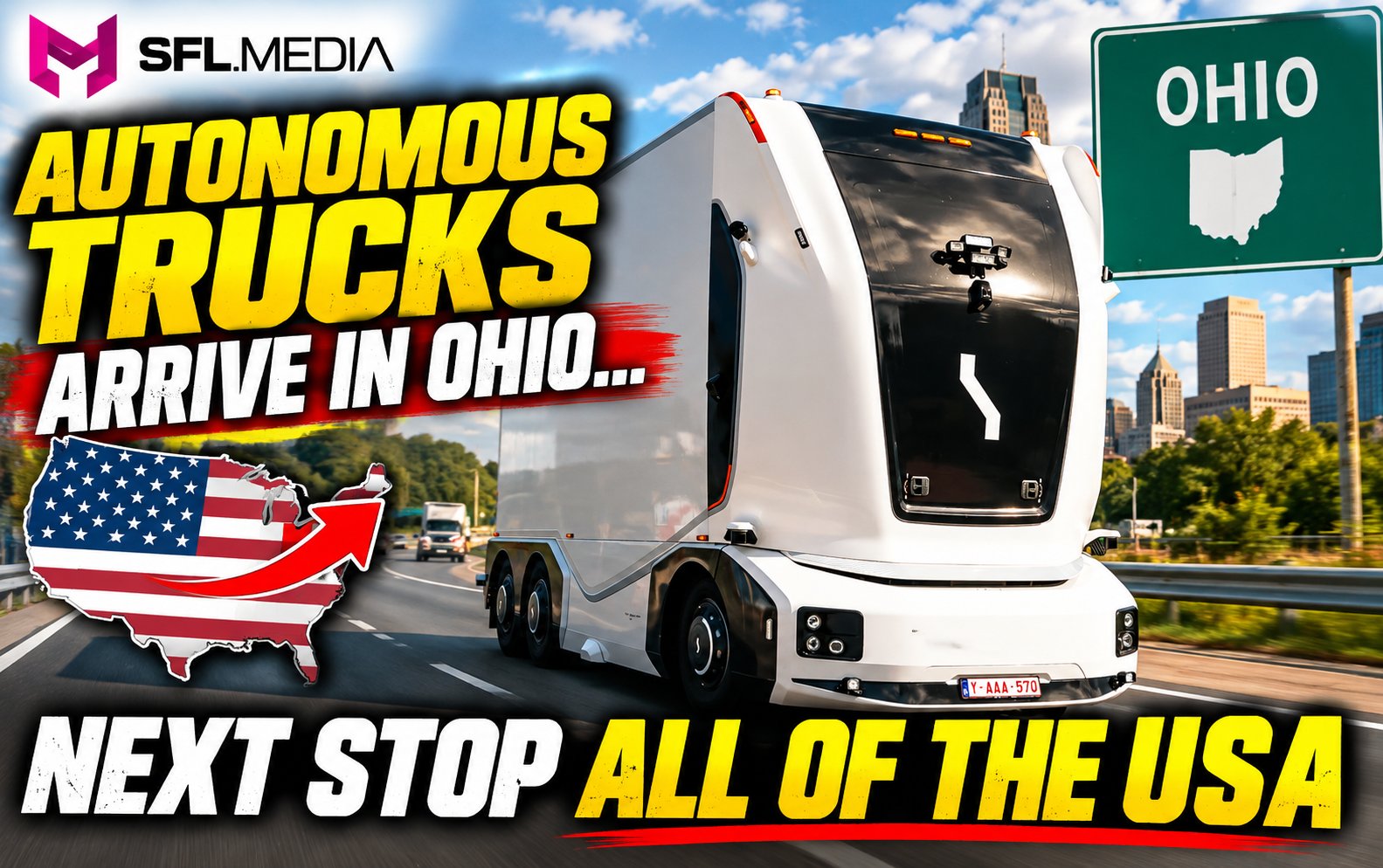
The partnership between Einride and EASE Logistics is part of a larger effort to develop automated freight transportation through the Midwest. Ohio and Indiana have been working on an automated trucking corridor that could eventually connect freight operations between the two states. The idea is to create predictable routes where autonomous trucks can repeatedly move cargo, allowing the technology to operate in an environment where the roads, routes and operating conditions are well understood.
This is important because autonomous trucking probably won’t arrive all at once. We’re unlikely to wake up one morning and discover that every tractor-trailer in America has suddenly fired its driver. The transition is much more likely to happen gradually. Trucks will initially operate on specific routes, between specific facilities and within carefully defined geographic areas. As the technology improves and regulators become more comfortable with it, those operating areas can expand.
Why the Trucking Industry is a Target for Automation
The trucking industry is an obvious target for automation because the economics are potentially enormous. A traditional long haul truck requires a professional driver, and that driver has to deal with federally mandated hours of service rules, rest periods, meals, hotels, parking and the simple biological inconvenience of being a human being who occasionally needs to sleep. An autonomous truck doesn’t have those limitations. It can potentially operate for much longer periods of time, provided it has the necessary charging infrastructure and maintenance support.
That could dramatically change the economics of freight transportation. The biggest expense associated with a traditional trucking operation isn’t the truck itself. It’s everything surrounding the operation, including labor, fuel, maintenance, insurance and the limitations imposed by having a human being behind the wheel. Electric trucks could eliminate much of the fuel expense, while autonomous technology could eventually eliminate the need for a driver in the vehicle itself. And that’s where things get really interesting.
The biggest question surrounding autonomous trucking may not be whether artificial intelligence can drive a truck. At this point, the technology is clearly progressing toward making that possible. The much bigger question is how many trucks one human operator could eventually supervise remotely. If a single operator could monitor multiple autonomous trucks simultaneously, the number of people required to move freight could decline dramatically.
That doesn’t necessarily mean human beings disappear from the trucking industry. Far from it. Someone will still need to maintain the trucks, manage the logistics, load and unload freight, handle emergencies, monitor systems and supervise autonomous operations. But the number of employees required to operate each individual truck could change dramatically. And that could have enormous consequences for the trucking workforce.
How Will This Affect Americans That Live Off the Trucking Industry?
Millions of Americans make their living directly or indirectly from the trucking and transportation industries. Long haul truck driving has traditionally been one of the occupations where a person can earn a respectable living without necessarily needing a four year college degree. If autonomous trucks eventually become capable of handling the majority of long distance freight routes, one of the largest employment categories in America could be fundamentally transformed.
There is another major advantage to autonomous electric trucking that doesn’t get nearly as much attention: utilization. A human driver can only drive for so many hours before the truck has to stop. An autonomous truck doesn’t get tired. It doesn’t need a hotel room. It doesn’t need to stop for dinner. It doesn’t need to take a weekend off. If the vehicle can recharge efficiently and maintenance can be scheduled properly, the same truck could potentially spend substantially more time moving freight. That means trucking companies could potentially move more cargo with fewer vehicles and fewer people.
The technology is still far from perfect, and there are enormous challenges ahead. Autonomous trucks have to deal with bad weather, road construction, accidents, emergency vehicles, unpredictable drivers and countless situations that aren’t easily programmed into a computer. Regulators also have to determine how autonomous vehicles should be certified, insured and held accountable when something goes wrong.
There is also the issue of public acceptance. Americans are already nervous enough about sharing the highway with human drivers who apparently believe turn signals are an optional subscription service. Convincing the public to trust a massive tractor-trailer traveling 70 miles per hour with nobody inside will be another challenge entirely. But the important point is that the technology is no longer purely theoretical.
This is Something We All Must Pay Attention To
The trucks operating around central Ohio today represent a relatively small deployment, but autonomous transportation rarely needs to start at massive scale. Technology tends to improve as it is used. More miles produce more data. More data improves the systems. Better systems allow more routes. More routes create greater economic incentives to deploy the technology. Eventually, the strange looking cabless trucks running around Ohio could become completely ordinary.
Imagine a future where a shipment leaves a warehouse in Ohio in the middle of the night, gets picked up by an autonomous electric truck, travels hundreds of miles along a designated freight corridor and arrives at another distribution center without a driver ever sitting inside the vehicle. A remote operator might oversee several trucks simultaneously, while automated systems handle the actual driving. That sounds like science fiction until you realize that part of it is already happening.
The question isn’t really whether driverless trucking is coming. It’s how quickly it will scale, how many jobs it will ultimately replace or transform, and how much cheaper freight transportation becomes when the truck no longer needs a human sitting behind the wheel. Central Ohio may just be one of the places where America gets its first real look at what that future actually looks like. Next “truck stop”, ALL OF AMERICA!



















































Want to join the conversation?
Create an account or sign in to share your thoughts, vote,
and reply to other readers.
Showing 0 of 0 comments
Don't have an account?
Already have an account?