

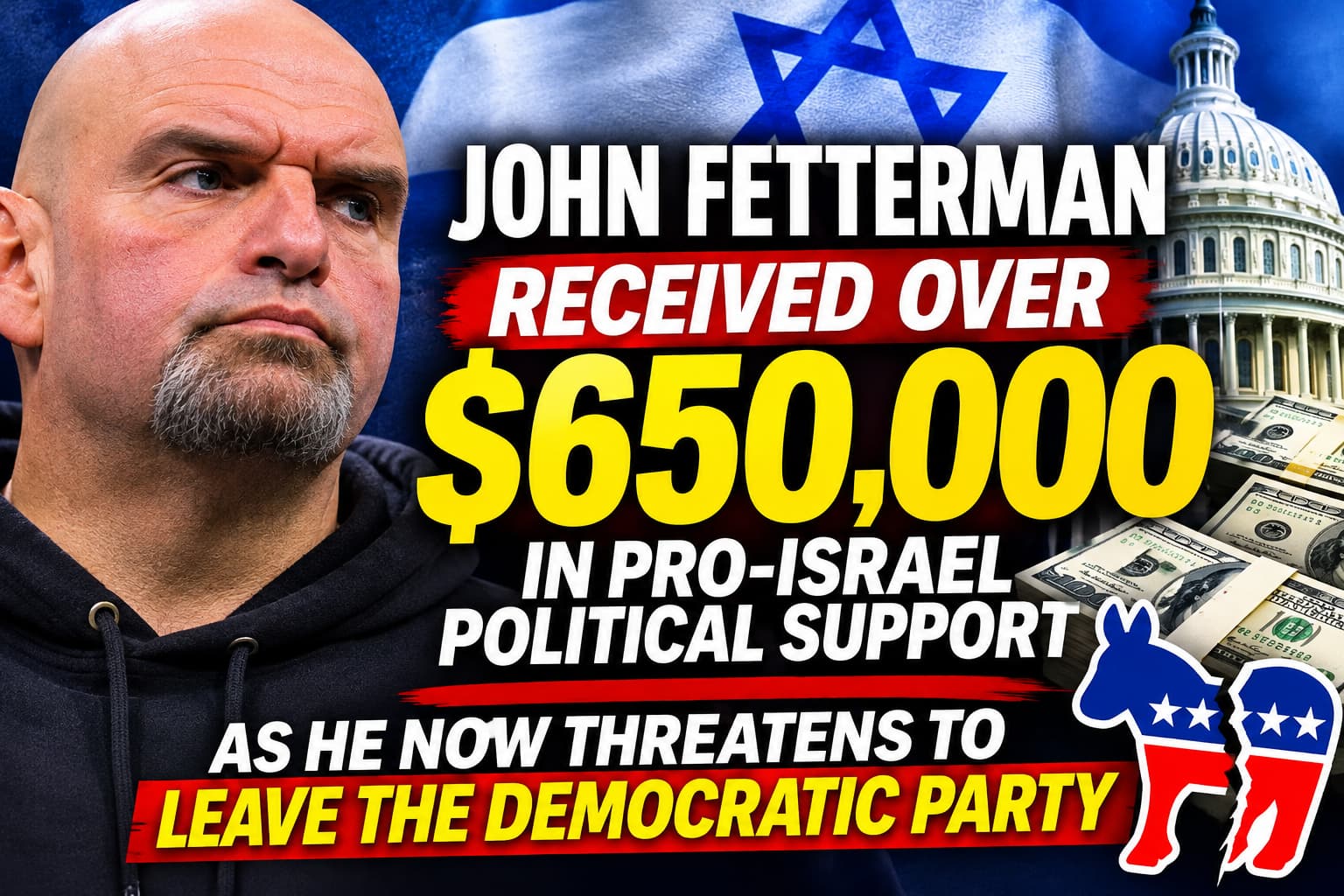
John Fetterman’s Israel Money Trail: Hundreds of Thousands in Political Support as He Threatens to Abandon the Democratic Party
Pennsylvania Sen. John Fetterman has become one of Israel’s most aggressive defenders in Washington, repeatedly clashing with progressive Democrats over Gaza, American weapons sales, and U.S. foreign policy. Now, as he raises the possibility of leaving the Democratic Party over its position toward Israel, campaign finance records reveal hundreds of thousands of dollars in contributions and independent political spending associated with American pro Israel organizations.
Pennsylvania Sen. John Fetterman arrived in Washington in 2023 as an unconventional Democratic populist, a former small town mayor and lieutenant governor whose political identity revolved around working class voters, organized labor, marijuana legalization, and an unmistakably casual personal style. His victory over Republican Mehmet Oz in the 2022 Senate election made him a national Democratic figure and helped preserve his party’s Senate majority.
Nearly four years later, Fetterman has become one of the most controversial members of his own party. His increasingly confrontational defense of Israel, opposition to restrictions on American military assistance, and willingness to attack progressive Democrats have placed him at odds with many of the voters and activists who helped elect him.
The political conflict escalated again on November 14, 2026, when Fetterman suggested during a Fox News interview that he could reconsider his Democratic affiliation if Maryland Sen. Chris Van Hollen, an outspoken critic of Israeli military policy, became the party’s Senate leader.
His remarks revived a question that has followed him throughout the war in Gaza: What financial support has Fetterman received from organizations associated with the American pro Israel political movement, and how does that support compare with his increasingly uncompromising political positions?
The answer is more complicated than the familiar accusation that Fetterman is simply an AIPAC funded politician. A review of available campaign finance records identifies direct contributions from several pro Israel political action committees, substantial individual donations routed through a pro Israel fundraising organization, and additional independent expenditures intended to help him win election. However, those categories represent different kinds of political activity, and combining them without explanation can produce misleading conclusions.
The records also reveal an important contradiction. Despite Fetterman’s exceptionally strong defense of Israel, a review of Federal Election Commission filings published in July 2026 found no direct campaign contributions from AIPAC’s political action committee and no individual donations earmarked through AIPAC’s candidate fundraising portal. That does not mean Fetterman has received no support from the broader pro Israel political network. It means the money trail requires a closer examination of the organizations involved, the actual amounts, and how the contributions and expenditures were reported.
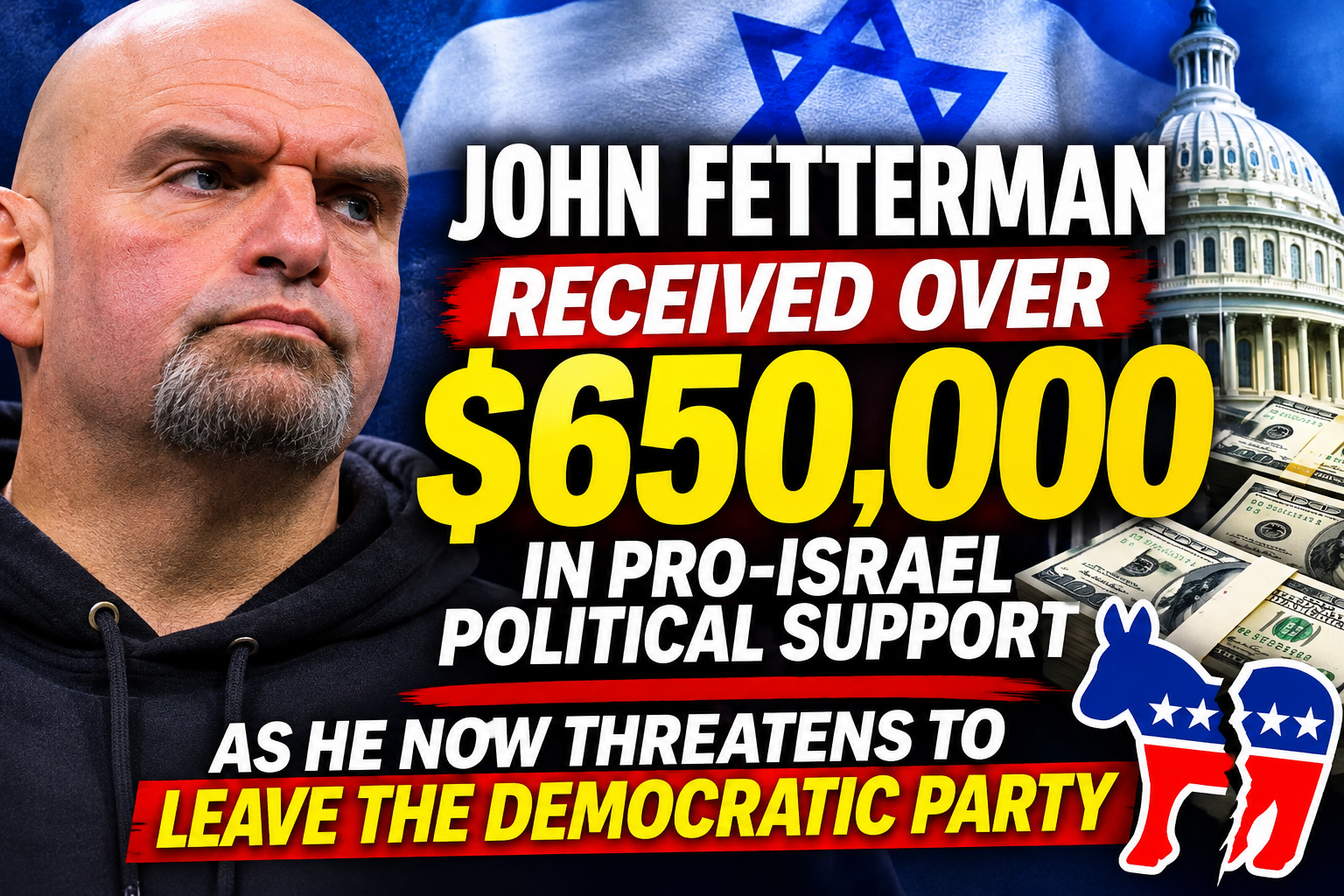
Following the Money: The Pro-Israel PACs That Contributed to Fetterman
Federal Election Commission records, compiled by the campaign finance database PoliTrack, identify $22,981 in direct contributions associated with five pro-Israel political action committees across Fetterman’s federal political career through November 15, 2026. The largest reported contributor was NORPAC, followed by Tzedek PAC, U.S. Israel PAC, Democratic Majority for Israel PAC, and J Street PAC.
An additional review of ProPublica’s FEC-derived campaign contribution records identified a $5,000 contribution from CHUTZ PAC dated April 11, 2024. That contribution was not included in PoliTrack’s five-committee total, demonstrating how the selection of organizations included in a political spending database can materially affect the resulting figures. The identifiable contributions are as follows:
| Organization | Reported contributions |
|---|---|
| NORPAC | $11,250 |
| Tzedek PAC | $6,600 |
| CHUTZ PAC | $5,000 |
| U.S. Israel PAC | $3,000 |
| Democratic Majority for Israel PAC | $2,000 |
| J Street PAC | $131 |
| Combined identified amount | $27,981 |
These figures represent contributions reported in campaign finance databases, not money originating from the Israeli government. They also do not represent the full value of individual donations associated with these organizations or independent political expenditures undertaken outside Fetterman’s campaign.
The distinction is particularly important because pro-Israel organizations are not politically interchangeable. J Street has advocated a two-state solution and frequently criticized Israeli government policies, while other organizations have taken different positions on military assistance, diplomatic negotiations, and Israeli security. Grouping every organization under a single political label can obscure substantial disagreements over American policy in the Middle East.
Nevertheless, the contributions establish that organizations operating within the American pro-Israel political sphere have financially supported Fetterman’s campaigns, even if the amounts of direct PAC contributions are comparatively modest.
The Larger Money Trail: Approximately $198,000 Bundled Through J Street
Direct PAC contributions tell only part of the story. Another campaign finance database, Money Behind the Ballot, identifies approximately $198,000 in individual contributions bundled through J Street PAC and directed toward Fetterman’s campaigns.
Bundled contributions differ from direct PAC checks. In these transactions, individual donors contribute their own money, while a political organization facilitates or earmarks those donations for a particular candidate. The money enters the campaign as individual contributions rather than corporate or PAC treasury funds, although the organization’s role in organizing the fundraising remains relevant.
This distinction substantially changes the financial picture. While J Street PAC’s directly identified contributions in PoliTrack total just $131, the much larger amount attributed to J Street-associated individual donors demonstrates how examining only direct PAC checks can understate the role of organized fundraising networks.
Combining the $27,981 in identified direct PAC contributions with approximately $198,000 in J Street-bundled individual donations produces a provisional figure of roughly $226,000. However, that calculation should not be treated as a fully reconciled total without confirming that the two databases classify and count the underlying transactions consistently. Any overlapping transactions must be removed before a definitive combined amount can be published.
The financial relationship is nevertheless substantial enough to warrant public scrutiny, particularly because Fetterman’s foreign policy positions have increasingly placed him at odds with progressive Democrats who favor restrictions on American military assistance to Israel.
It is also important to recognize that J Street’s policy agenda differs from Fetterman’s position on several major questions. The existence of J Street associated donations does not establish that its donors support his opposition to restricting weapons sales or his criticism of Democrats who challenge Israeli military policy.
Independent Spending: Another Major Source of Pro-Israel Electoral Support
Beyond contributions received by his campaign, Fetterman benefited from independent political spending during his successful 2022 Senate race against Republican Mehmet Oz. One of the organizations involved was JDCA PAC, the political action committee associated with the Jewish Democratic Council of America, which supported Democratic candidates through voter outreach and other electoral activities.
Campaign finance databases report different totals for JDCA PAC’s spending supporting Fetterman. MyRepTracker identifies approximately $233,547 in independent expenditures supporting his candidacy during the 2022 cycle, while other compilations have reported figures ranging from roughly $218,000 to $277,000. The differences may reflect how individual transactions, amendments, and allocated expenses are classified, but they cannot be conclusively reconciled without a transaction by transaction examination of the underlying filings.
The $233,547 figure provides a documented reference point for the organization’s reported activity, but it was not money deposited into Fetterman’s campaign account. Independent expenditures are made by outside organizations that operate separately from candidates and are prohibited from coordinating those expenditures with their campaigns.
Such spending can nevertheless provide a significant electoral advantage. Advertising, voter outreach, text messaging, and other campaign activities can help mobilize supporters or persuade undecided voters without requiring the candidate’s campaign to pay for those services. The distinction becomes especially important when examining the larger totals circulated by political advocacy organizations.
One Tracker Puts His Pro Israel Electoral Support at $656,018
A separate database maintained by AIP Action, an organization focused on documenting the influence of pro Israel political spending, estimates that Fetterman has benefited from approximately $656,018 in combined electoral support associated with pro Israel political interests.
The figure, compiled from FEC filings as of September 5, 2026, includes direct PAC contributions, earmarked individual donations, independent expenditures supporting Fetterman, and certain expenditures opposing his political opponents. Its methodology therefore extends beyond the narrower direct contribution figures reported by PoliTrack.
According to AIP Action, its calculation places Fetterman above the median among sitting senators in its database. The organization’s methodology also includes expenditures by outside groups that it identifies as substantially financed by donors associated with the pro Israel political movement.
That broader approach raises legitimate questions about how political influence should be measured. Money spent independently to help elect a politician can provide a political benefit, but it is not equivalent to a contribution the candidate receives or controls. Similarly, assigning outside spending to a particular political interest based on the identity of its donors requires judgments about which organizations and expenditures belong in that category.
The $656,018 estimate is therefore best understood as one advocacy organization’s calculation of combined electoral support, not as a verified total of money Fetterman personally accepted. It should not be added to the direct contributions or independent expenditures already discussed because those categories are included in the broader calculation and doing so would double count some of the same activity.
The various estimates nevertheless demonstrate that Fetterman’s political relationship with pro Israel organizations extends beyond a handful of direct PAC checks. They also show why any responsible accounting must distinguish campaign receipts from spending undertaken independently by outside groups.
What About AIPAC? The Records Tell a Different Story
The American Israel Public Affairs Committee, commonly known as AIPAC, has become one of the most closely scrutinized political organizations in Washington. Its political action committee and affiliated super PAC, United Democracy Project, have played prominent roles in congressional elections, particularly in contests involving candidates critical of Israeli government policies.
Given Fetterman’s outspoken defense of Israel, it might seem reasonable to assume that AIPAC has been a major financial supporter of his political career. However, the available evidence does not establish that relationship.
A July 31, 2026, Washington Examiner investigation reviewed Federal Election Commission filings dating back to Fetterman’s successful Senate campaign and found no direct contributions from AIPAC’s PAC and no individual donations earmarked for him through AIPAC’s fundraising portal. The investigation also found that Fetterman was not listed on the organization’s candidate fundraising platform.
That finding is important because accusations about AIPAC funding are frequently used as shorthand for the broader influence of pro Israel organizations. Although AIPAC is a major force in congressional politics, it does not represent every American organization advocating support for Israel, and its financial activity cannot automatically be attributed to unrelated PACs or individual donors.
The available records also do not establish that Fetterman received campaign money from the Israeli government. Foreign governments and foreign nationals are generally prohibited from contributing to American federal election campaigns, and there is no evidence presented in these records that Fetterman violated those restrictions.
The more meaningful question is not whether he secretly received Israeli government money, but how his political positions relate to the priorities of American advocacy organizations that have supported his campaigns or benefited his electoral prospects.
Fetterman Threatens to Leave Democrats Over Chris Van Hollen and Israel
The latest controversy erupted Saturday, November 14, when Fetterman appeared on Fox News and discussed the possibility of leaving the Democratic Party if its leadership moved further away from his position on Israel. The immediate focus was Maryland Sen. Chris Van Hollen, who is challenging New York Sen. Chuck Schumer for the party’s Senate leadership position following Democrats’ victories in the 2026 midterm elections. Van Hollen has been a vocal critic of Israeli military operations in Gaza and has supported restrictions on certain American weapons transfers. Asked whether there was a political red line that might cause him to abandon the Democratic Party, Fetterman replied:
“Yeah, absolutely.”
He then criticized the possibility of Van Hollen becoming Senate Democratic leader, describing the Maryland senator as hostile toward Israel and questioning why Democratic lawmakers were focusing on restricting assistance to Israel rather than confronting Iran, Hamas, and Hezbollah. Fetterman argued that Democrats seeking to withhold military assistance were directing their criticism toward the wrong government. He suggested that the party’s progressive wing had become increasingly disconnected from his understanding of American national security priorities and Israel’s position in the Middle East.
The comments followed an earlier warning in July 2026, when Fetterman said he would consider leaving the party if Democrats formally adopted what he regarded as an anti-Israel platform. At the time, he described his support for Israel as a matter of moral conviction rather than partisan convenience. Although Fetterman has repeatedly raised the possibility of leaving, he has not announced that he is becoming a Republican or formally abandoning his Democratic affiliation. He has continued to identify himself as a Democrat while emphasizing that he will not change his position on Israel simply to satisfy party leadership or progressive activists.
His distinction between remaining a Democrat and refusing to support certain Democratic positions has become increasingly difficult to sustain politically, particularly as more lawmakers call for conditions on American military assistance.
His Voting Record: Opposing Restrictions on American Weapons Sales
Fetterman’s legislative record provides some of the clearest evidence of his support for Israel. He has repeatedly opposed Senate resolutions intended to block specific American weapons sales to the country, including measures introduced by independent Vermont Sen. Bernie Sanders.
In July 2025, the Senate considered resolutions targeting proposed transfers of bombs and assault rifles to Israel. Supporters of the restrictions argued that the United States should not continue providing offensive weapons without stronger assurances that they would be used in accordance with international humanitarian law.
Fetterman voted against advancing both measures, joining Republicans and other Democrats who opposed restricting the transfers. The resolutions ultimately failed, but the votes highlighted a growing division within the Democratic caucus over Israel’s military campaign in Gaza and the United States’ responsibilities as a major supplier of weapons.
Fetterman has maintained that Israel must retain the military capabilities necessary to defend itself against Hamas, Hezbollah, Iran, and other regional threats. His critics argue that continued weapons transfers without meaningful conditions weaken American leverage and risk enabling additional civilian casualties. The disagreement reflects a broader debate about whether supporting Israel’s security requires unconditional military assistance or whether Washington should use its considerable financial and military influence to demand greater accountability.
For Fetterman, the issue has become a defining political priority. He has shown little willingness to compromise with Democrats seeking to restrict weapons transfers, even as the debate has intensified within his own party.
Fetterman’s Support for Netanyahu and the Gaza War
Fetterman’s public relationship with Israeli Prime Minister Benjamin Netanyahu has further distinguished him from progressive Democrats. He has met with Netanyahu on multiple occasions and publicly defended Israel’s military response to the Hamas led October 7, 2023, attacks. The attacks killed approximately 1,200 people in Israel, according to Israeli authorities, and resulted in the abduction of roughly 250 hostages. Israel’s subsequent military campaign devastated large portions of Gaza, caused extensive Palestinian civilian suffering, and generated international allegations of serious violations of humanitarian law.
Fetterman has consistently emphasized Hamas’s responsibility for the initial attacks and the importance of securing the release of Israeli hostages. He displayed photographs of hostages outside his Senate office and publicly confronted demonstrators who accused Israel of committing genocide. His approach has frequently involved defending Israeli military actions while criticizing activists and Democratic lawmakers who demand a ceasefire, stronger humanitarian protections, or restrictions on American assistance.
The legal and political controversy surrounding Israel’s conduct has extended well beyond American partisan politics. The International Criminal Court issued arrest warrants in November 2024 for Netanyahu and former Israeli Defense Minister Yoav Gallant over alleged war crimes and crimes against humanity. Israel has rejected the allegations and disputed the court’s jurisdiction. Those proceedings do not establish individual criminal guilt, but they illustrate the seriousness of the international scrutiny surrounding the war. Fetterman’s strong defense of Israel, even amid those controversies, has made him an increasingly isolated figure among progressive Democrats.
The Political Contradiction: Modest Direct PAC Checks, Extraordinary Loyalty to Israel
Perhaps the most striking aspect of Fetterman’s financial and political record is the disparity between his relatively modest identified direct PAC contributions and the intensity of his public advocacy for Israel. The documented direct PAC contributions represent a small fraction of the money raised by his campaigns. FEC records show that his authorized committees reported more than $76 million in total receipts for the 2022 election cycle, including approximately $69 million in contributions.
Even when broader pro Israel fundraising and independent spending are considered, those amounts remain substantially smaller than the total resources involved in his Senate campaign. That does not mean the financial relationships are irrelevant. Political influence is not always proportional to the size of a contribution, and organizations can provide value through fundraising networks, endorsements, voter mobilization, and access to politically active communities.
However, the available evidence does not establish that Fetterman adopted his positions because of financial support. His voting record and public statements demonstrate strong alignment with Israel’s defenders in Congress, but proving that campaign contributions caused those positions would require evidence beyond financial disclosures.
The more defensible criticism concerns political accountability. Fetterman has made support for Israel such a central feature of his public identity that he has repeatedly suggested he could abandon the Democratic Party if its leadership adopts policies he considers hostile to the country. For Democratic voters who supported him because of his populist image, progressive domestic policies, and promises to represent Pennsylvania’s working class, that development raises legitimate questions about his priorities.
Pennsylvania Democrats Are Increasingly Turning Against Him
Fetterman’s political transformation has coincided with a dramatic shift in his standing among Pennsylvania voters. An August 2026 New York Times poll found that approximately two in ten registered Pennsylvania Democrats viewed him favorably, down sharply from 74% in 2024. His favorability among Republicans, meanwhile, had increased from approximately 25% to 73% over the same period.
The numbers illustrate an extraordinary reversal for a Democratic senator elected with strong support from the party’s progressive and moderate wings. His willingness to criticize Democratic colleagues, cooperate with Republicans, and defend Israeli military policy has helped him cultivate support among conservative voters while alienating many of his original supporters.
Some Pennsylvania Democrats have openly questioned whether Fetterman should continue representing the party. Local Democratic officials have described growing frustration among voters, and prospective challengers have begun positioning themselves for the 2028 Senate election.
The political implications extend beyond Israel. Fetterman’s increasingly adversarial relationship with progressive Democrats has also involved disputes over immigration, the Trump administration, and the broader ideological direction of the party. Nevertheless, Israel remains one of the clearest dividing lines between Fetterman and many of his Democratic critics.
The Bigger Question: Who Does John Fetterman Represent?
The debate surrounding Fetterman’s campaign financing and foreign policy positions reflects a larger struggle over the role of organized political money in American democracy.
American pro Israel organizations have every legal right to advocate their positions, support candidates, and participate in elections within applicable campaign finance rules. Individual donors also have the right to contribute to politicians whose positions reflect their beliefs. At the same time, voters have a legitimate interest in understanding which organizations support their elected officials, how those organizations operate, and whether their policy priorities align with the interests of the people those officials represent.
In Fetterman’s case, the financial record reveals direct contributions from multiple pro-Israel PACs, substantial individual donations associated with J Street, and independent spending by organizations seeking to influence his electoral success. A broader advocacy database places the combined value of relevant electoral support at more than $650,000, although that estimate includes spending outside his campaign and relies on classifications that require careful interpretation.
None of those figures proves corruption, illegal coordination, or a political bargain. But they are legitimate subjects of public scrutiny, particularly when considered alongside his opposition to restrictions on American weapons sales and his repeated warnings about leaving the Democratic Party. Fetterman is entitled to his convictions. He is entitled to support Israel, defend Netanyahu’s government, oppose restrictions on American military assistance, and criticize Democrats who disagree with him. But Pennsylvania voters are equally entitled to examine his political financing, question his foreign-policy priorities, and decide whether his positions reflect the interests of the people who elected him.
The central story is not that John Fetterman secretly received money from Israel or that AIPAC purchased his loyalty. The available evidence does not establish either claim. It is that a Democratic senator who has benefited from substantial pro Israel political fundraising and electoral spending has made his support for Israel so uncompromising that he is publicly threatening to abandon his own party over it.
For a politician elected on a promise to represent Pennsylvania’s working class, that is a political transformation worth examining. And ultimately, it will be Pennsylvania voters, not political action committees or foreign-policy advocacy organizations, who decide whether John Fetterman’s priorities still deserve their support.
Sources & Further Reading

Campaign finance records and political spending
-
Federal Election Commission — John Fetterman’s Official Campaign Finance Records
-
PoliTrack — Direct Pro-Israel PAC Contributions to John Fetterman
-
ProPublica — Fetterman’s 2024 PAC Contributions, Including CHUTZ PAC
-
Money Behind the Ballot — Fetterman Campaign Finance and J Street Bundling
-
AIP Action — $656,018 Estimated Combined Pro-Israel Electoral Support
-
Washington Examiner — FEC Review Finds No Direct AIPAC Contributions to Fetterman
Fetterman’s Democratic Party threats and political positions
-
Common Dreams — Fetterman Attacks Progressives and Threatens Democratic Party Exit
-
Israel National News — Fetterman Criticizes Van Hollen and Warns Democrats
-
International Criminal Court — Official Proceedings and Statements
South Florida Media
– South Florida Media — Political News, Investigations, and Commentary










Loading comments…