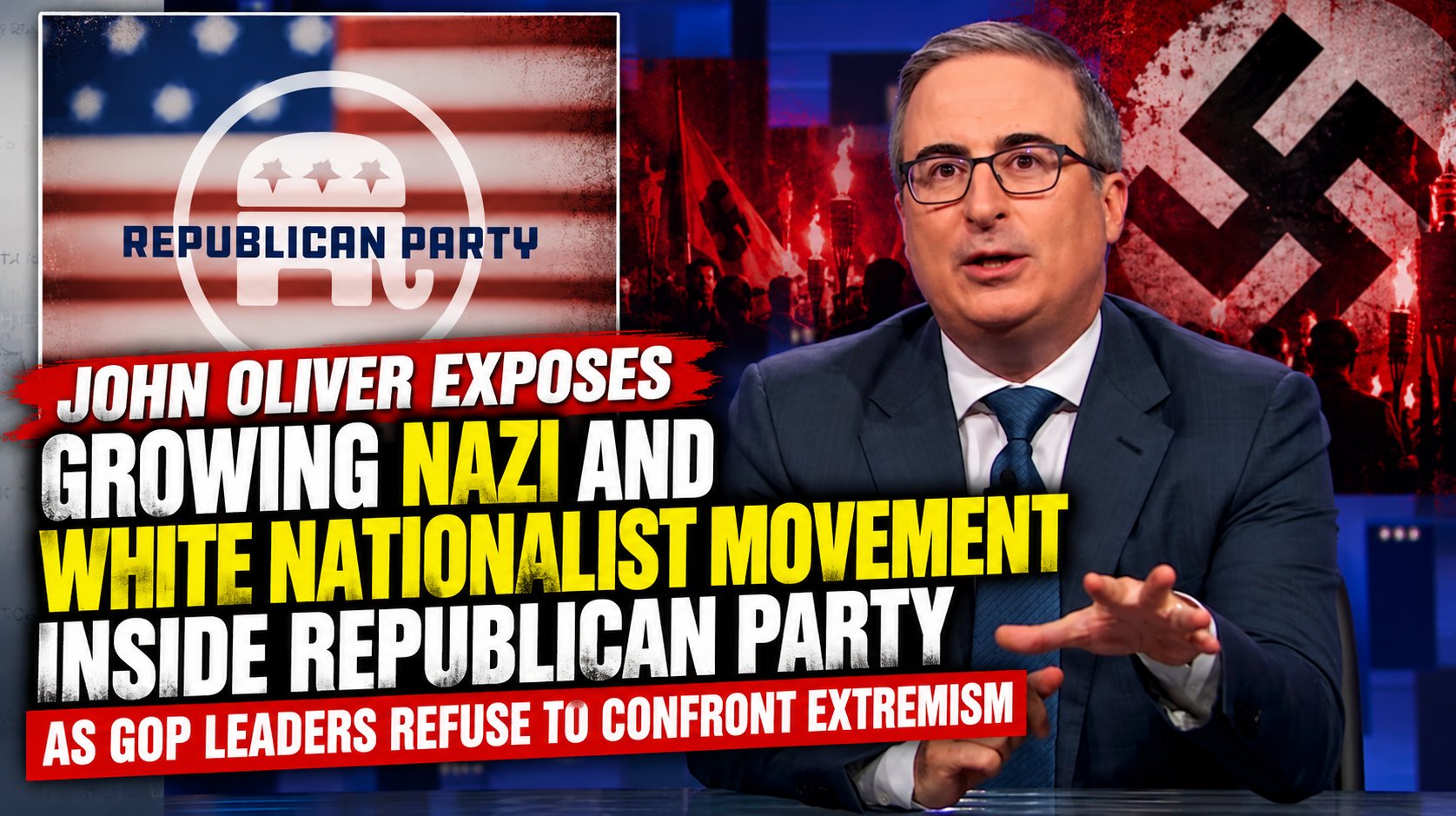
John Oliver Exposes Growing White Nationalist Movement Inside Republican Party as GOP Leaders Struggle to Confront Extremism
From Tucker Carlson giving white nationalist Nick Fuentes a massive conservative platform to leaked Republican group chats praising Adolf Hitler, John Oliver’s latest investigation examines the increasingly visible influence of neo-Nazism, antisemitism and far right extremism within segments of the Republican Party. With the 2026 midterm elections approaching, the HBO host argues that Republican leaders face a consequential test over whether they will confront extremist factions or continue accommodating their growing presence within conservative politics.
John Oliver Takes Aim at the Republican Party’s Growing Extremism Problem
The Republican Party is confronting an increasingly public struggle over the influence of white nationalism, antisemitism and far right extremism within its political coalition, and comedian John Oliver devoted the October 25 episode of HBO’s Last Week Tonight to examining how those movements are gaining visibility, attracting younger followers and testing the willingness of Republican leaders to condemn them.
In the roughly 33 minute investigation, Oliver connected a series of controversies involving conservative media personalities, Republican candidates, political organizations and young activists. His central argument was that extremist figures are no longer content to operate exclusively on the political fringes. Instead, some are actively seeking legitimacy through mainstream conservative media, relationships with influential Republicans and participation in the party’s political infrastructure.
The segment focused heavily on the growing visibility of Nick Fuentes, a white nationalist and Holocaust denier whose influence among sections of the online far right has expanded through livestreaming, social media and appearances on prominent conservative platforms. Oliver also examined Tucker Carlson’s decision to interview Fuentes, the Heritage Foundation’s response to the resulting backlash, disturbing messages exposed in Republican political group chats and the reluctance of some party leaders to establish clear boundaries against extremist rhetoric.
The investigation did not establish that the Republican Party as a whole endorses white nationalism. In fact, prominent conservatives have publicly condemned the ideology, and survey research indicates that most Republican voters reject openly racist and antisemitic political movements. Instead, Oliver examined a more specific problem: how political organizations respond when extremist figures seek influence among their members, audiences and candidates, and whether public condemnation is followed by meaningful consequences.
Tucker Carlson Gives White Nationalist Nick Fuentes a Major Conservative Platform
One of the central controversies in Oliver’s investigation involved former Fox News host Tucker Carlson and his October 2025 interview with Nick Fuentes, a figure whose history of antisemitic statements, Holocaust denial and white nationalist advocacy has made him one of the most controversial personalities in American far right politics.
Carlson’s decision to host Fuentes generated criticism from across the political spectrum, including prominent conservatives who argued that giving him an extended, largely conversational interview risked normalizing his ideology. Critics objected not simply to Fuentes being interviewed, but to the manner in which the discussion presented him to a broader audience without consistently challenging the extremist beliefs for which he is known.
During the conversation, Fuentes repeated rhetoric questioning the loyalty and influence of Jewish Americans, drawing on antisemitic conspiracy theories that have circulated for generations. His political message also reflected a broader rejection of mainstream conservative principles in favor of an exclusionary form of nationalism that places racial and cultural identity at the center of American political life.
For Fuentes, appearing on Carlson’s program represented a significant opportunity. Carlson remains an influential conservative media figure with access to an audience far larger than Fuentes’s original online following. The interview placed a previously marginalized extremist directly in front of viewers who might not otherwise encounter his message, while allowing Fuentes to present himself as a legitimate participant in conservative political debate.
Oliver used the controversy to examine a recurring question about media responsibility: At what point does interviewing an extremist become an opportunity for that extremist to gain legitimacy, particularly when the interviewer does not consistently confront the ideology being promoted? Extremist figures can be interviewed in ways that expose their beliefs and subject their claims to rigorous scrutiny. Critics of Carlson argued that his conversation with Fuentes failed to provide sufficient challenge and instead helped introduce his ideas to a wider conservative audience.
Nick Fuentes Has Already Established Connections With Influential Republicans
Fuentes’s growing visibility did not begin with Carlson’s interview. Oliver highlighted several earlier encounters between the white nationalist commentator and prominent Republican figures, demonstrating how his efforts to gain access to mainstream conservative politics have developed over several years.
Republican Rep. Paul Gosar delivered the keynote address at Fuentes’s America First Political Action Conference in 2021, while then Rep. Marjorie Taylor Greene appeared at the same event in 2022. Both appearances generated criticism because the conference was organized around Fuentes’s political movement, which has repeatedly promoted white nationalist and antisemitic ideas.
Fuentes also attended a November 2022 dinner at Donald Trump’s Mar-a-Lago estate alongside rapper Kanye West, now known as Ye, who had recently attracted widespread condemnation for antisemitic statements. Trump subsequently said he did not know who Fuentes was when the dinner took place. The encounter nevertheless generated criticism from Republicans who questioned how an openly extremist figure had gained access to a former president and leading political figure.
These incidents do not establish that every Republican who encountered Fuentes endorses his ideology. They do, however, document his access to prominent political figures and organizations, a central element of Oliver’s argument that extremists are seeking legitimacy through association with influential conservatives. The concern is not simply that Fuentes has an audience. It is that appearances alongside elected officials, interviews with major media personalities and access to political gatherings can help transform a fringe commentator into someone treated as an increasingly familiar presence within a larger political movement.
Heritage Foundation Faces Internal Revolt Over Carlson and Fuentes
The Carlson interview quickly developed into a major controversy for the Heritage Foundation, one of the most influential conservative policy organizations in Washington and a leading institution associated with Project 2025.
Heritage Foundation President Kevin Roberts initially defended Carlson against criticism over the interview, portraying the backlash as an effort to divide the conservative movement and silence influential voices. His response became particularly controversial because critics believed it minimized the significance of Carlson giving a platform to a known antisemite. Roberts also invoked language about outside forces attempting to divide conservatives, drawing additional criticism from those who argued that such rhetoric echoed familiar antisemitic conspiracy themes.
The dispute exposed divisions within the conservative movement over the difference between defending free expression and legitimizing extremist ideology. Some conservative figures argued that refusing to condemn the interview clearly enough risked damaging the movement’s credibility and undermining its stated opposition to antisemitism, while others maintained that controversial political personalities should not automatically be excluded from public discussion.
The backlash contributed to turmoil inside Heritage, including staff departures, resignations and public criticism of the organization’s leadership. Roberts subsequently sought to clarify his position, but the controversy had already become a test of whether an established conservative institution could maintain relationships with influential media personalities while distancing itself from the extremist figures those personalities were promoting.
Oliver portrayed the episode as an example of the political calculations confronting Republican aligned institutions. Condemning Fuentes directly was relatively straightforward for many conservatives, but criticizing Carlson, whose audience and influence remain valuable within the movement, presented a more complicated proposition. When extremist personalities become connected to influential media figures, political donors or activist networks, organizations may face competing incentives between protecting their reputations and maintaining relationships with important constituencies.
Leaked Young Republican Group Chats Reveal Racist and Antisemitic Messages
Oliver’s investigation also examined racist and antisemitic rhetoric circulating among younger conservative activists, including leaked private messages from Young Republican organizations and political networks.
The messages included racial slurs, antisemitic comments, references to Nazi ideology and remarks praising Adolf Hitler. Their disclosure generated public condemnation and raised questions about the political culture developing within certain youth oriented conservative organizations, particularly because some participants were adults involved in organized political activity rather than teenagers engaging in anonymous online discussions.
The significance of those disclosures extends beyond the offensive content itself. Political youth organizations frequently serve as recruiting grounds for future campaign staffers, legislative aides, party officials and elected leaders. When extremist rhetoric appears within those networks, the concern is not merely that individuals are making offensive jokes, but that such attitudes could become normalized among people seeking careers in public life.
Oliver challenged the argument that these incidents should automatically be dismissed as immature behavior or internet humor. His broader point was that repeated expressions of racist or antisemitic ideology deserve scrutiny, particularly when the individuals involved are participating in organized political activity or seeking positions of responsibility.
At the same time, the existence of extremist messages in particular group chats does not establish that those beliefs are representative of all young Republicans. The more consequential questions involve how widespread the attitudes are, whether organizations tolerate them and what consequences follow when they become public. Those distinctions are essential to understanding the difference between isolated misconduct, a permissive organizational culture and a broader ideological shift.
Manhattan Institute Polling Reveals Disturbing Holocaust Denial and Extremist Attitudes
Beyond controversies involving individual personalities, Oliver cited research from the conservative Manhattan Institute suggesting that extremist beliefs have found a measurable audience within portions of the Republican electorate, particularly among younger voters and people who entered the party during the Trump era.
The institute’s survey found that 37% of respondents in its defined current Republican coalition regarded the Holocaust as greatly exaggerated or believed it did not happen as historians describe. Among men younger than 50 within that coalition, the figure reached 54%. The findings are especially troubling given the overwhelming historical evidence establishing Nazi Germany’s systematic murder of approximately six million European Jews and millions of other victims during World War II.
The study defined its current Republican coalition broadly, including people who voted for Trump in 2024 as well as registered Republicans, rather than limiting the sample to longtime party members. That distinction matters because the research found substantial differences between traditional Republican voters and newer entrants to the coalition.
According to the Manhattan Institute, 83% of its defined Republican coalition did not meet the researchers’ classification for anti-Jewish attitudes, while 17% did. The institute also reported a slightly higher figure, 20%, among Democrats under the same classification, demonstrating that antisemitic attitudes are not exclusive to one political party. Its findings nevertheless identified particularly concerning patterns among newer Republican voters, including greater tolerance for racist and antisemitic rhetoric, conspiracy theories and political violence.
The research also found that 54% of newer Republican entrants said political violence could sometimes be justified, compared with 20% of longtime core Republicans. Those differences suggest that the party’s expanding coalition contains significant ideological divisions rather than a uniform movement toward extremism.
Polling responses about historical events can be influenced by question wording, respondents’ knowledge and survey methodology, and the institute’s classifications should not be confused with direct evidence that every respondent endorses organized white nationalism. Nevertheless, the findings provide empirical support for Oliver’s broader concern that extremist attitudes exist within identifiable segments of the conservative electorate and may influence the political environment in which Republican leaders operate.
JD Vance Faces Scrutiny for Dismissing Racist Republican Messages as Immature Behavior
Vice President JD Vance also came under criticism in Oliver’s segment over his response to leaked messages from Young Republican organizations that included racist language, antisemitic remarks and references to Nazi ideology. Vance argued that young people sometimes say offensive or foolish things, framing parts of the controversy as immature behavior rather than evidence of an organized extremist movement. His response drew criticism because several participants were adults in their 20s and 30s, including individuals active in political organizations and professional Republican networks.
Oliver challenged the distinction between supposedly harmless jokes and statements that normalize racial hatred. In his analysis, dismissing repeated expressions of Nazi admiration or antisemitism as youthful misconduct risks minimizing their seriousness, especially when those responsible are involved in political organizing or aspire to positions of influence.
The controversy illustrates a larger disagreement within Republican politics. Some conservatives argue that public outrage over offensive private messages can become disproportionate and that individuals should have opportunities to apologize and demonstrate changed behavior. Others contend that explicit racist or antisemitic statements reveal attitudes incompatible with responsible political leadership and should carry meaningful organizational consequences.
The debate is not simply about free speech. Individuals generally have the constitutional right to express offensive political views without government punishment, but political organizations and private employers can establish standards for membership, employment and leadership. The question is whether those standards are consistently enforced when influential factions or promising political operatives are involved.
Elon Musk, Nazi Imagery and Controversies Involving Republican Candidates
Oliver opened his investigation by revisiting several incidents involving Nazi imagery, gestures and references that have generated controversy among prominent conservative figures. One involved Elon Musk, whose extended arm gesture during a January 2025 event celebrating Donald Trump’s return to the White House was interpreted by critics as resembling a Nazi salute. Musk rejected that characterization, and the gesture’s intent remains disputed. Oliver nevertheless included the episode as part of his discussion of how Nazi associated imagery has become a recurring subject of controversy within Republican-aligned political spaces.
The program also examined Peter Oberacker, a Republican congressional candidate in New York’s 19th District, who previously posted a Veterans Day tribute featuring his grandfather wearing a German Wehrmacht uniform from the Nazi era. Oberacker explained that it was the only photograph he possessed of his grandfather, who died fighting for Germany during World War II. The incident generated criticism, although the family photograph alone does not establish that Oberacker supports Nazi ideology. Importantly, the uniform was associated with Nazi Germany’s regular armed forces, not specifically the SS, as some descriptions of the controversy have suggested.
Other examples were more explicit. Paul Ingrassia, a Trump administration nominee to lead the Office of Special Counsel, withdrew his nomination after messages surfaced in which he acknowledged having a Nazi streak. Republican congressional candidate Brandon Herrera also drew criticism over a video involving a German World War II firearm and footage of Nazi style marching.
Oliver connected these incidents to broader examples of inflammatory rhetoric from Republican political figures, including anti-Muslim statements and comments about immigration and American identity. The controversies differ significantly in their circumstances and evidentiary weight. A disputed gesture, a historical family photograph, an explicitly pro Nazi statement and inflammatory immigration rhetoric are not interchangeable. Oliver’s argument, however, was that their repeated appearance within Republican political discourse deserves examination rather than automatic dismissal.
Florida Republican Candidate’s Charlottesville History Raises Serious Questions
The investigation also reached Florida, where Oliver highlighted Marshall Rawson, the Republican nominee for Florida House District 10, whose documented presence at the deadly 2017 Unite the Right rally in Charlottesville, Virginia, has attracted scrutiny.
The Charlottesville gathering brought together white nationalists, neo-Nazis and other far-right organizations, many of whose participants carried racist and antisemitic symbols. The event became a defining moment in the modern American extremist movement after violence erupted and counterprotester Heather Heyer was killed when James Alex Fields Jr. drove his car into a crowd. Fields was subsequently convicted of murder and federal hate crimes.
According to reporting by The Washington Post and Talking Points Memo, archived video and photographs connected Rawson to the Charlottesville event, including footage appearing to show him marching while carrying a flag associated with the League of the South. The organization advocates Southern secession and has been identified by the Southern Poverty Law Center as a white nationalist hate group. Rawson has acknowledged previous involvement with the organization but has said his official participation ended more than a decade ago. However, subsequent reporting identified his attendance at a League of the South event in 2019 and an appearance at one of its conferences in 2021.
Rawson won the Republican primary for Florida House District 10 in August 2026, receiving approximately 55% of the vote. His nomination raised questions about how thoroughly political parties examine candidates’ past associations and whether those connections influence decisions about endorsements and organizational support.
Oliver also cited efforts to obtain responses from Republican officials about Rawson’s history, noting that relatively few responded to questions about whether they would condemn his associations with extremist organizations. The limited response became another example in the program’s examination of how party officials handle controversial candidates whose support may be politically useful.
Rawson’s presence at Charlottesville does not establish that he participated in the violence or committed a crime. Nevertheless, the documented evidence of his involvement with an organization associated with white nationalism raises legitimate questions about his political associations, public statements and suitability for positions of governmental authority.
Karl Rove and Other Conservatives Warn About Extremists Within the GOP
Not all criticism of the far right has come from Democrats, progressive commentators or late night television hosts. Oliver highlighted warnings from established Republican figures who have expressed concern about the growing visibility of extremist personalities within their own political movement.
Karl Rove, the longtime Republican strategist who helped engineer George W. Bush’s presidential victories, publicly criticized the presence of figures such as Nick Fuentes and Texas Republican candidate Bo French in conservative political circles. Rove’s comments reflected concern that openly racist and antisemitic rhetoric was gaining access to Republican networks that previously would have regarded such figures as politically unacceptable.
Other conservatives, including Republican Sens. Ted Cruz and Mitch McConnell, publicly criticized the normalization of antisemitic figures following Carlson’s interview with Fuentes. Their objections demonstrated that influential Republicans remain willing to challenge extremist rhetoric, even when doing so creates disagreements with prominent conservative media personalities or political organizations.
Those objections complicate any attempt to portray the Republican Party as uniformly accepting of extremist ideology. The backlash within Heritage, the departures of prominent conservative figures and criticism from established Republicans demonstrate that significant parts of the movement continue to oppose white nationalism and antisemitism.
Oliver’s central concern is whether that opposition can influence institutional behavior. Public condemnations may establish a rhetorical boundary, but their practical significance depends on how organizations respond when controversial figures seek endorsements, media exposure, employment or political office.
A Political Movement Confronting Its Own History
Oliver placed the present controversy within a longer history of far right organizing in American conservative politics, referencing the John Birch Society, the presidential campaigns of Barry Goldwater and Pat Buchanan, and the longstanding presence of conspiracy theories and exclusionary nationalism in parts of the political right.
These movements differed considerably in their ideologies, constituencies and relationships with the Republican Party. Nevertheless, their histories illustrate recurring tensions between mainstream conservatism and political factions that define American identity through restrictive ideas about race, religion, nationality or cultural belonging.
The modern difference is the speed and reach of digital media. Extremist personalities can build large audiences without traditional television networks, newspapers or political institutions. Social platforms, podcasts and livestreaming services allow them to distribute messages directly, cultivate communities and attract the attention of influential political figures.
That environment can also blur the boundaries between entertainment, provocation and ideological advocacy. Personalities who present themselves as comedians, provocateurs or anti-establishment commentators may use irony and deliberately offensive language while simultaneously advancing serious political arguments. Oliver argues that treating every extremist statement as merely another internet joke ignores the potential consequences when those ideas begin influencing political organizations and public policy debates.
Republican Party Faces a Defining Test Ahead of the 2026 Midterm Elections
The timing of Oliver’s investigation is significant. The November 3, 2026, midterm elections are approaching, and Republican candidates across the country are seeking support from a coalition that includes traditional conservatives, populists, libertarians, religious voters and newer activists shaped by online political movements.
That coalition contains substantial disagreements over immigration, foreign policy, Israel, government spending, cultural issues and the future direction of the party. The emergence of openly white nationalist figures within some conservative networks has introduced another source of conflict, particularly for leaders attempting to maintain broad political support while condemning racism and antisemitism.
Oliver concluded that the Republican Party is approaching a consequential moment in its political development. His concern extends beyond the results of individual races to the ideological direction of the party after Donald Trump’s presidency and the role younger conservative activists may play in shaping its future.
The evidence presented in the episode does not establish that white nationalism represents the majority position within the Republican Party. It does, however, document repeated instances of extremist rhetoric, controversies involving influential conservative figures, internal institutional conflicts and measurable pockets of support for antisemitic or historically revisionist beliefs.
Political parties are broad coalitions, and the existence of extremist factions does not mean every member shares their beliefs. But the willingness of party leaders, donors, media personalities and political institutions to challenge those factions can influence how much power they ultimately acquire. Oliver’s investigation leaves viewers with a question that extends beyond one election cycle: How does a major American political party respond when individuals promoting openly racist or antisemitic ideologies attempt to move from the political margins into its mainstream institutions?
For Republican leaders, that question is no longer hypothetical. It is already being contested within their media ecosystem, political organizations and electoral campaigns.

Sources and Further Reading
Original Broadcast and National Coverage
Research and Investigative Reporting
SFL Media — Related Coverage
– SFL Media — National Politics, Florida News and Investigative Reporting















Loading comments…