

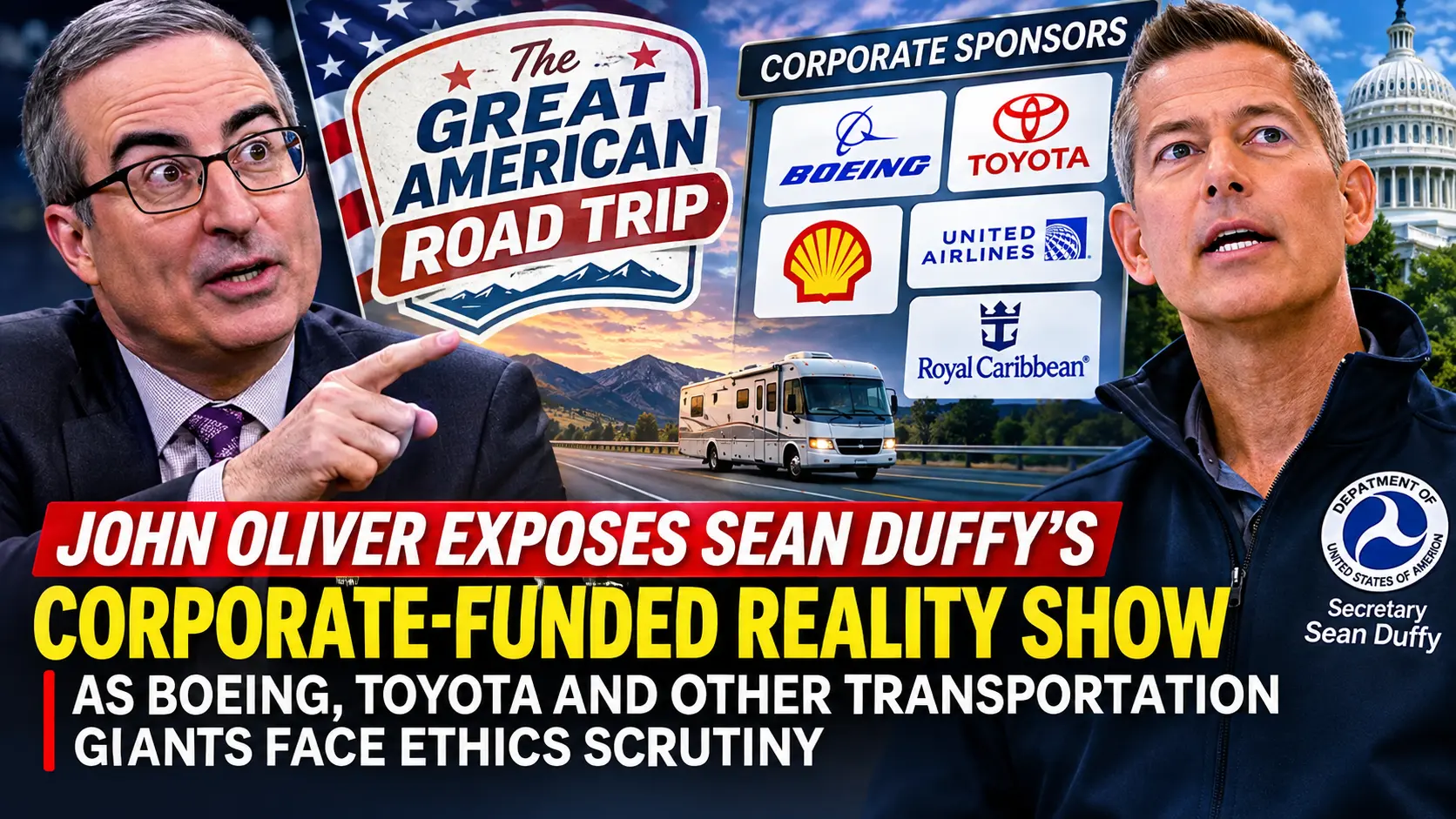
John Oliver Exposes Sean Duffy’s Corporate-Funded Reality Show, Raising Serious Ethics Questions About Trump’s Transportation Secretary
The “Last Week Tonight” host takes aim at Sean Duffy’s six-part family road trip, revealing how Boeing, Toyota and other companies overseen by his department helped finance a patriotic television production that critics say blurred the line between public service, corporate promotion and personal entertainment.
WASHINGTON — What happens when a former MTV reality television star becomes the United States secretary of transportation, takes his family on an elaborate cross country vacation, films the entire experience and gets some of America’s largest transportation companies to help pay for it? According to comedian John Oliver, the result is The Great American Road Trip, a bizarre intersection of government power, corporate sponsorship and reality television that raises considerably more serious questions than its cheerful, flag waving premise would suggest.
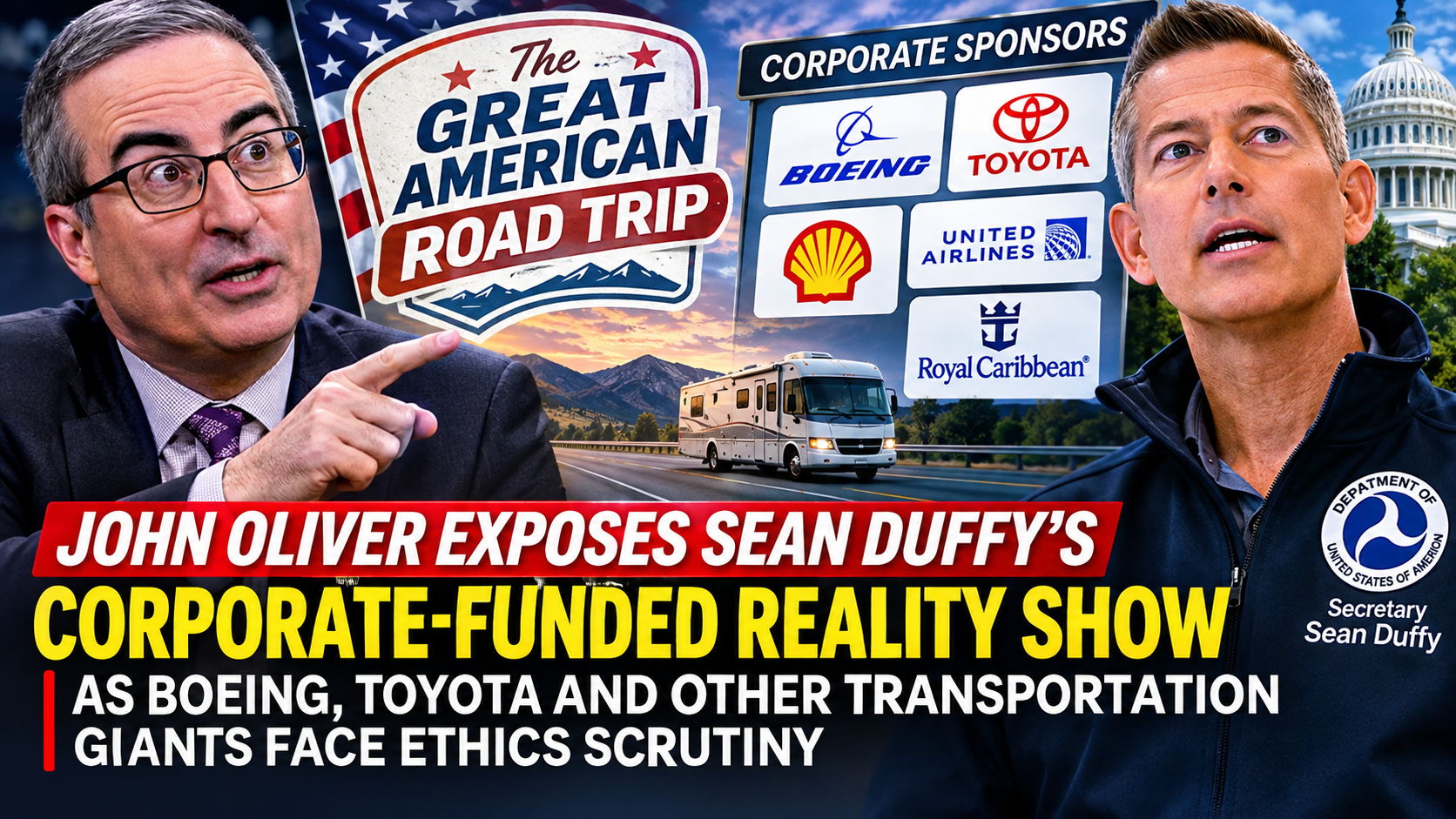
In an August 23 segment of HBO’s Last Week Tonight, Oliver examined Transportation Secretary Sean Duffy’s six-episode YouTube series, originally promoted as a celebration of America’s 250th anniversary. What viewers actually received, Oliver argued, was an extended family reality show featuring personal milestones, awkward domestic conversations, corporate product placements and occasional visits to American landmarks. The production, featuring Duffy, his wife Rachel Campos-Duffy and their nine children, was financed by a nonprofit organization supported by corporate sponsors including Boeing, Toyota, Shell, United Airlines and Royal Caribbean Group. Several of those companies operate in industries regulated or overseen by the very department Duffy leads.
That arrangement has attracted scrutiny from congressional Democrats, government ethics experts and the watchdog organization Citizens for Responsibility and Ethics in Washington, which filed a formal complaint requesting an investigation into potential violations of federal gift, travel and ethics rules. Duffy and the Department of Transportation have maintained that career ethics officials approved his participation, that his family received no salary or production royalties and that taxpayer funds were not used for his family’s personal expenses. The department has acknowledged paying for official government travel conducted during the trips, making the distinction between official and personal expenses central to the controversy.
But Oliver’s central criticism goes beyond whether the production complied with a particular government regulation. It concerns the appearance of powerful corporations financing a cabinet secretary’s personal entertainment project while those same businesses have significant interests before his department. The controversy raises fundamental questions about corporate influence, government accountability and whether an arrangement can technically satisfy ethics requirements while still undermining public confidence in the independence of federal regulators.
A Patriotic Road Trip That Looks Suspiciously Like a Family Reality Show
The series was promoted as a civic celebration intended to encourage Americans to explore their country, visit historic landmarks and reconnect with the nation’s cultural heritage during its 250th anniversary. Duffy presented the production as an opportunity to teach his children about American history while encouraging families to travel. Yet much of the series focuses on the Duffy family’s personal lives rather than the country’s transportation infrastructure or historical achievements. Oliver highlights storylines involving family celebrations, a gender reveal, a renewal of wedding vows and a daughter’s college decision, questioning how these private moments advance the public mission of the Department of Transportation.
The production was filmed over approximately 24 days spread across several months rather than one continuous cross country journey. According to Reuters and NPR, filming took place during shorter trips, including weekends and school vacation periods. The finished six-part series was eventually released in August after originally being scheduled for June, with Duffy acknowledging that the episodes required additional editing to address government ethics requirements. That delay raised questions about what material had initially been included and why producers needed to remove it before the public could watch.
The result, as Oliver portrays it, is a government official trying to occupy two very different roles simultaneously: a cabinet secretary responsible for overseeing America’s transportation system and the star of a privately financed family entertainment program. The distinction becomes particularly important when the companies funding the entertainment project are also subject to the regulatory authority of the government official appearing on screen.
Boeing, Toyota and Other Corporate Sponsors Helped Finance the Production
The most consequential issue surrounding The Great American Road Trip is not the quality of its television programming but the source of the money used to produce it. The project was financed through Great American Road Trip Inc., a nonprofit organization that solicited financial support from companies and industry groups. Reporting on the production described sponsorship arrangements offering corporate participants promotional opportunities, with some contributions reportedly reaching seven figures.
According to reporting cited in Oliver’s segment, Boeing and Toyota each contributed approximately $1 million to the project. Other sponsors included Shell, United Airlines, Royal Caribbean, Enterprise Rent-A-Car and organizations with commercial interests in transportation, travel and tourism. Those relationships create an obvious ethical concern because Duffy oversees a department with significant regulatory authority affecting many of the companies involved. The Federal Aviation Administration, part of the Department of Transportation, oversees aviation safety, while the National Highway Traffic Safety Administration regulates motor vehicle safety and investigates potentially dangerous defects.
Boeing has faced extensive federal scrutiny over aircraft manufacturing and safety practices, while Toyota operates within the automobile regulatory system overseen by Duffy’s department. Both companies therefore have substantial interests in the policies, enforcement priorities and regulatory decisions made by federal transportation officials. The nonprofit covered production expenses and costs including gasoline, vehicle rentals, lodging and activities, while Duffy maintained that he received no salary or royalties. Critics argue that the absence of direct compensation does not necessarily resolve whether valuable travel benefits, promotional exposure or access arrangements created an improper conflict of interest.
The central question is whether companies subject to federal oversight should be permitted to finance entertainment activities featuring the official ultimately responsible for leading that oversight. Even without evidence of an explicit exchange of regulatory favors, such arrangements can create the appearance that influential corporations enjoy privileged relationships with the officials charged with holding them accountable.
Congressional Lawmakers Demand an Investigation
The controversy moved beyond political commentary in May 2026, when Citizens for Responsibility and Ethics in Washington filed a formal complaint with the Department of Transportation’s Office of Inspector General. The watchdog organization requested an investigation into whether Duffy’s participation violated federal gift and travel regulations, whether government resources were improperly used and whether the project involved inappropriate promotional benefits for private companies.
On June 8, six Democratic senators, led by Sen. Patty Murray of Washington, requested an inspector general investigation into the arrangement. The group also included Sens. Elizabeth Warren, Tammy Duckworth, Ben Ray Luján, Mazie Hirono and Richard Blumenthal. Their letter raised concerns about potential conflicts of interest, the use of government resources and the possibility that companies were effectively purchasing access to the transportation secretary. The senators also questioned whether expenses associated with what appeared to be personal travel should have been accepted from a nonprofit financed by businesses subject to the department’s oversight.
During congressional testimony in May, Duffy defended the project as an official activity connected to the country’s 250th anniversary and the government’s efforts to promote travel and tourism. He rejected the criticism, while his department subsequently described the investigation requests as politically motivated and maintained that career ethics officials had approved his participation. Oliver uses the congressional exchanges to illustrate what he sees as Duffy’s central defense: portraying criticism of the financing arrangement as hostility toward celebrating America itself.
But the congressional objections were not directed at Americans visiting national parks or learning about their country’s history. They concerned whether a sitting cabinet secretary could accept substantial corporate-funded benefits while exercising authority over the same industries supplying the money. The inspector general’s office confirmed in May that it had received the watchdog complaint and was reviewing it, although that acknowledgment did not establish that a full investigation had been opened or that Duffy violated the law.
John Oliver Revisits Duffy’s MTV Past and an Uncomfortable Reality Television Reunion
Oliver also examines Duffy’s unusual journey from reality television personality to one of the most powerful transportation officials in the country, using archival MTV footage to contrast the secretary’s carefully managed public image with his earlier television appearances. Before entering politics, Duffy appeared on MTV’s The Real World: Boston in 1997 and later participated in Road Rules: All Stars in 1998, where he met Rachel Campos, another former Real World cast member. The couple eventually married, built a large family and developed careers in conservative media and Republican politics.
Duffy served in the U.S. House of Representatives from Wisconsin from 2011 until 2019, winning five elections before resigning during his fifth term. He subsequently worked in conservative media before President Donald Trump selected him to lead the Department of Transportation. His transition from reality television to Congress and eventually the cabinet provides Oliver with an unusually extensive archive of footage illustrating how Duffy’s public persona has evolved over nearly three decades.
In the HBO segment, Oliver revisits Duffy’s contentious relationship with fellow Real World cast member Kameelah Phillips, including their disagreements over affirmative action and race. During the new family road trip, Duffy returns to the former Real World residence in Boston and reportedly offers his children a considerably more flattering account of his relationships with his former roommates. Oliver then contrasts Duffy’s recollection with original MTV footage, including an exchange in which Duffy used a derogatory insult toward Phillips.
The sequence becomes a pointed illustration of how reality television can preserve the very behavior its former stars might prefer to forget. It also reinforces Oliver’s broader argument about Duffy’s political persona: A man who spent years cultivating an image through television now occupies a position where public credibility, judgment and accountability carry consequences far beyond entertainment.
The Harvard Debate Turns Into a Culture War Family Drama
Another segment that catches Oliver’s attention involves the Duffy family’s discussion about whether their daughter Paloma should attend Harvard University. The conversation, presented as a serious parental discussion, features Sean and Rachel expressing reservations about the university’s political and cultural environment. They suggest that attending an elite institution could undermine the values they worked to instill in their daughter, prompting Oliver to highlight the exchange as an example of how the series frequently drifts from its stated mission of celebrating American history into familiar conservative cultural grievances.
Harvard has become a frequent target of Republican criticism over campus politics, diversity initiatives and allegations of ideological bias. The Duffys’ discussion fits neatly into that broader political narrative, but its inclusion also raises questions about the series’ supposed civic purpose. Rather than examining the history of American higher education or the country’s scientific and academic achievements, the production devotes considerable attention to a private family disagreement over the political atmosphere at one university.
For Oliver, the scene is emblematic of the project’s larger identity crisis. The production repeatedly shifts between presenting itself as a patriotic educational program, a conservative family reality show and a promotional vehicle financed by corporate interests. Those competing identities make it increasingly difficult to determine where the government’s public mission ends and the family’s private entertainment project begins.
Boeing Factory Tours and Waymo Demonstrations Blur the Line Between Public Service and Advertising
Among the most consequential scenes highlighted by Oliver are Duffy’s visits to corporate facilities operated by companies connected to the show’s sponsorship network. During a stop in South Carolina, Duffy tours a Boeing manufacturing facility, providing the aerospace giant with favorable exposure in a program starring the federal official whose department includes the FAA. In Arizona, Duffy visits Waymo, the autonomous vehicle company owned by Alphabet, and praises the potential of self-driving technology to transform American transportation. These scenes are particularly sensitive because federal regulators have continuing responsibilities involving aircraft safety, automobile technology and autonomous vehicles.
The New York Times reported in August that the episodes included corporate visits framed as official government business, even as the companies involved received promotional exposure in a series financed by industry sponsors. Duffy’s department argued that the visits served legitimate government purposes and that career ethics officials approved the arrangement. The department also said regulatory decisions remained guided by career safety professionals, applicable laws and factual evidence.
Nevertheless, the visual effect is difficult to ignore. A cabinet secretary appears in a television production funded by transportation companies while touring their facilities and discussing their products in favorable terms. The series includes disclaimers stating that appearances by private companies do not constitute Department of Transportation endorsements, but a disclaimer does not necessarily eliminate concerns about preferential access or the appearance of government approval. The combination of corporate sponsorship, favorable exposure and federal regulatory authority creates precisely the kind of situation that government ethics standards are intended to examine.
Waymo’s Safety Investigations Make the Corporate Relationships More Sensitive
Oliver draws particular attention to Waymo because the company’s rapidly expanding autonomous vehicle operations have attracted federal safety scrutiny. The HBO segment discusses federal safety investigations involving Waymo vehicles, including incidents concerning a stopped school bus and a collision involving a child near a school. Those examples underscore the importance of independent oversight as autonomous vehicle companies expand their operations on public roads.
Federal safety investigations do not automatically establish wrongdoing by a manufacturer. They are designed to examine incidents, determine whether defects or unsafe practices exist and establish whether regulatory intervention is warranted. The concern raised by Oliver is therefore not that Duffy personally determined the outcome of a Waymo investigation, but that promotional appearances involving companies subject to federal oversight can undermine public confidence in the independence of that oversight.
When a cabinet secretary appears to endorse an emerging technology while the government examines its safety, even an otherwise lawful promotional arrangement can create questions about impartiality. The concern becomes especially important when the technology involves vehicles operating on public roads, where federal regulators are responsible for evaluating potential risks to motorists, pedestrians and other road users.
An Awkward Credit Card Promotion Reveals the Show’s Commercial Priorities
One of Oliver’s more absurd examples involves a scene featuring Naomie Olindo, a former cast member of Bravo’s Southern Charm, who appears during a family lunch and begins discussing the advantages of credit card rewards. The conversation, as presented in the HBO segment, appears unusually convenient given the participation of the Electronic Payments Coalition, an industry lobbying organization identified among the production’s sponsors. Oliver treats the scene as a particularly transparent example of commercial messaging being inserted into what viewers were told was a patriotic family travel program.
The Electronic Payments Coalition represents financial industry interests in debates over payment systems and credit card policies. Its participation is different from that of companies directly regulated by the Department of Transportation, but it raises a related question about the broader commercial purpose of the production. If a program celebrating American history also provides carefully positioned opportunities for sponsors to promote their industries, critics can reasonably question whether the audience is watching public education, entertainment or a sophisticated form of advertising.
The problem becomes more pronounced when the show’s principal personality is not an ordinary celebrity but a sitting member of the president’s cabinet. Unlike a conventional reality television personality, a cabinet secretary holds significant government authority, making the distinction between private sponsorship and public endorsement especially important.
Missing Celebrity Appearances Raise Questions About the Editing Process
Oliver also examines how the finished series differed from earlier promotional material. The original trailer featured appearances by musicians Kid Rock and John Rich, along with other celebrity and corporate-related scenes. Some of that material, including a Royal Caribbean cruise ship visit discussed in the HBO segment, reportedly did not appear in the finished episodes.
Duffy acknowledged that the release was delayed to allow additional editing related to ethics compliance. The New York Times confirmed that the series was originally scheduled for June before its eventual August release. The removal of particular scenes does not, by itself, establish that they violated government ethics rules, since producers routinely change programs between promotional trailers and final publication. However, the acknowledged compliance review raises legitimate questions about the original production plan, the standards applied by government ethics officials and whether corporate promotional arrangements were considered appropriate before filming began.
The larger issue is transparency. Without a complete public accounting of the production’s finances, contractual relationships and ethics approvals, it is difficult for independent observers to determine precisely how the government evaluated the project. The controversy illustrates why public disclosure is especially important when government officials participate in privately financed activities involving companies with interests before their agencies.
Duffy’s Transportation Record Extends Beyond Reality Television
Oliver’s criticism also comes against the backdrop of Duffy’s broader record as transportation secretary, including his response to the deadly January 2025 midair collision near Ronald Reagan Washington National Airport. The crash, involving an American Airlines regional jet and a U.S. Army helicopter, killed 67 people and prompted intense scrutiny of aviation safety, air traffic control staffing and procedures in the crowded Washington airspace.
Duffy’s tenure has also coincided with broader political controversy over diversity, equity and inclusion policies in aviation, including claims made by Trump administration officials following the collision. Such political arguments must be distinguished from evidence established by aviation investigators. The National Transportation Safety Board is responsible for determining the probable causes of aviation accidents, and political assertions about hiring policies should not be confused with investigative findings.
Oliver uses Duffy’s political and media background to argue that his approach to public office frequently resembles partisan television performance rather than the measured communication expected from the official overseeing the nation’s transportation systems. That distinction is especially important in a department responsible for aviation, highways, railroads and other infrastructure on which millions of Americans depend. While political communication is an unavoidable part of cabinet leadership, the department’s safety responsibilities require decisions grounded in evidence, technical expertise and independent oversight.
What Federal Ethics Rules Actually Require
The legal questions surrounding the production are more complicated than whether Duffy personally received a paycheck. Federal ethics regulations generally restrict government employees from accepting gifts from prohibited sources, including organizations that conduct business with or are regulated by their agencies. Additional rules govern official travel, use of government resources, outside activities and the endorsement of private products.
There are exceptions and procedures allowing agencies to accept certain gifts or outside support for official purposes. Whether the Duffy arrangement qualified for such an exception depends on the specific agreements, approvals, funding arrangements and circumstances involved. The Department of Transportation maintains that career ethics officials approved the project, a defense that is legally relevant and should not be dismissed without examining the underlying records.
But approval does not necessarily resolve every concern about public perception, corporate access or the appropriateness of a cabinet secretary participating in a privately financed entertainment production. Government ethics experts have repeatedly emphasized that public officials must consider not only whether an arrangement technically complies with the law but also whether it creates an appearance of favoritism toward private interests.
The distinction between an actual conflict of interest and the appearance of one is important. Neither congressional criticism nor Oliver’s commentary establishes that Duffy exchanged regulatory favors for corporate sponsorship. The public-interest question is whether the arrangement provided sponsors with unusual access, promotional value or other advantages that ordinary Americans and businesses would not receive.
The Bigger Picture: When Government Power Becomes a Corporate-Sponsored Reality Show
John Oliver’s examination of Sean Duffy’s Great American Road Trip succeeds because the underlying controversy is more consequential than the ridiculous television moments surrounding it. The family conversations, celebrity appearances and awkward promotional scenes provide plenty of material for comedy, but the real story concerns the relationship between corporate money and government authority.
Boeing and Toyota reportedly contributed approximately $1 million each to a production starring a cabinet secretary whose department exercises important oversight over their industries. Other companies with transportation interests also helped finance the project, while lawmakers and government watchdogs have sought answers about the arrangements, the benefits provided and the adequacy of the government’s ethics review.
The administration insists that the production was properly approved and that taxpayer money was not used to finance the family’s personal expenses. Critics counter that corporate funded benefits and promotional access deserve scrutiny regardless of whether the secretary received a conventional salary. Those competing claims cannot be resolved through comedy alone; they require documentation, independent oversight and a transparent accounting of the relationships involved.
For the American public, the principle is straightforward: Federal transportation policy should be guided by safety, evidence and the public interest, not by which corporations are willing to sponsor the secretary’s television appearances. The country’s 250th anniversary offers plenty of legitimate opportunities to celebrate American history, innovation and the transportation infrastructure that connects its communities. But a celebration of American democracy also ought to include one of its most fundamental principles: Public officials are entrusted with government authority to serve the people, not to provide special promotional opportunities to powerful corporate interests.
The unanswered question surrounding Sean Duffy’s road trip is not whether America deserves a birthday celebration. It is why some of the corporations overseen by his department were helping pay for the party.
Sources & Further Reading
-
Mediaite — John Oliver Skewers Sean Duffy’s Road Trip Reality Series
-
NPR — Transportation Secretary Duffy’s Reality Show Raises Ethics Questions
-
Reuters — Senators Seek Probe Into Corporate-Funded Road Trip
-
The New York Times — Duffy’s Road Trip Highlights America and Some of Its Sponsors
-
CREW — Formal Ethics Complaint Against Transportation Secretary Sean Duffy
-
U.S. Senate Appropriations Committee — Senator Murray Calls for Investigation
-
South Florida Media — National Politics, News and Commentary




Loading comments…