

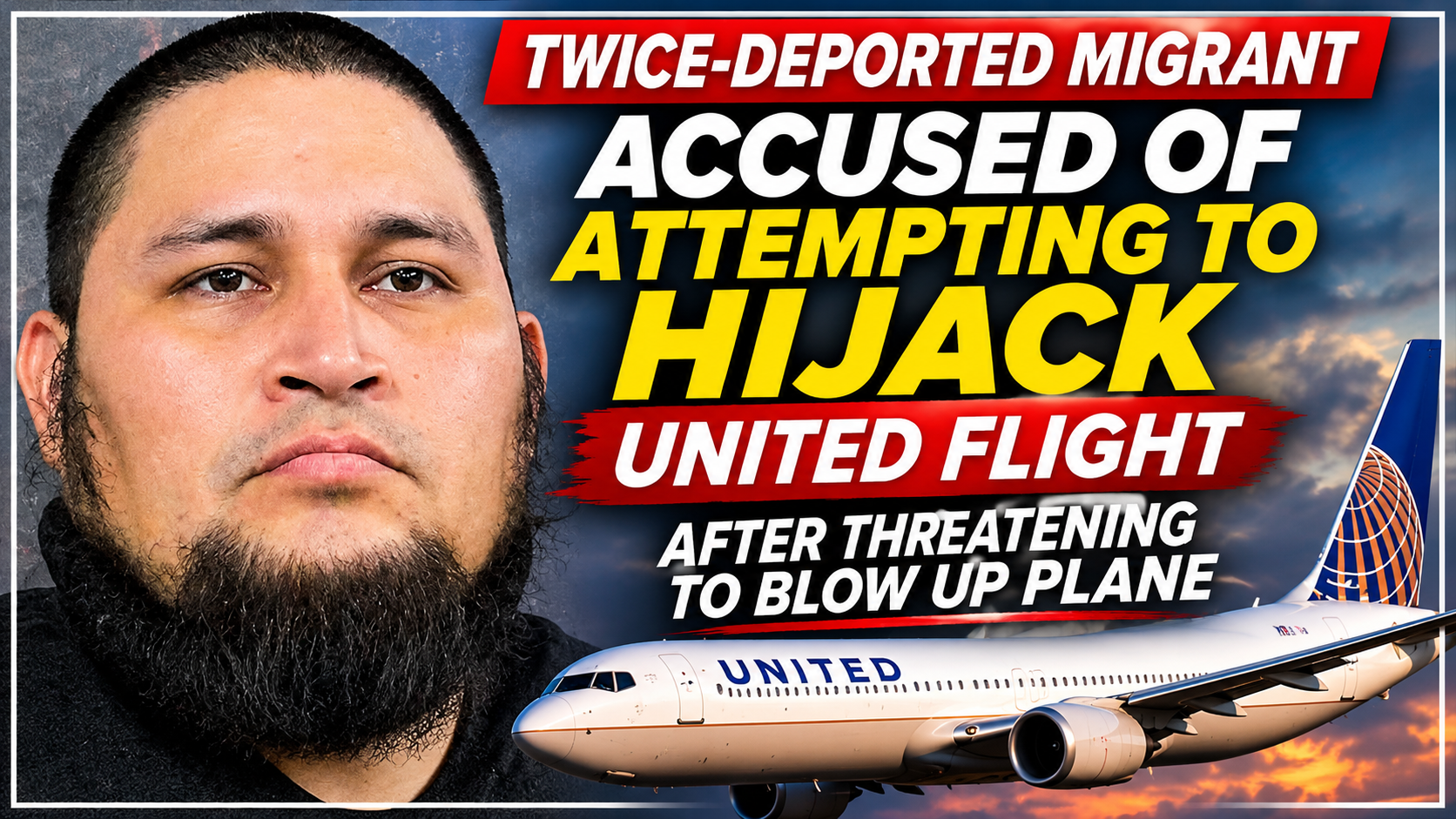
Twice Deported Honduran Migrant Accused of Attempting to Hijack United Airlines Flight After Threatening to Blow Up Plane
A 34 year old Honduran national who had previously been deported from the United States twice is accused of threatening to detonate a bomb and attempting to enter the cockpit of a United Airlines passenger jet traveling from Newark to New Orleans. The frightening incident triggered a reported aviation security alert and ended with the suspect in police custody, raising serious questions about airline security, immigration enforcement and the circumstances surrounding his asylum approval.
NEW ORLEANS — A United Airlines flight carrying 52 passengers and crew members became the scene of a frightening security emergency Monday night, November 9, 2026, when a passenger allegedly threatened to blow up the aircraft and attempted to force his way into the cockpit, prompting an aviation security response before the plane safely landed in Louisiana.
Federal authorities identified the suspect as Rony Alexander Gomez-Alberto, 34, a Honduran national who had previously been deported from the United States on two separate occasions. According to the Department of Homeland Security, Gomez-Alberto subsequently attempted to enter the country a third time in 2019, was released from immigration custody in 2020 and later received asylum after claiming that he feared persecution if returned to Honduras.
The incident occurred aboard United Airlines Flight 2174, a Boeing 737 MAX 9 traveling from Newark Liberty International Airport in New Jersey to Louis Armstrong New Orleans International Airport. The aircraft was carrying 46 passengers and six crew members when Gomez-Alberto allegedly began behaving erratically, claimed to possess an explosive device and attempted to reach the flight deck.
The pilots maintained control of the aircraft while the cabin crew worked to contain the disturbance. The plane landed safely in New Orleans at approximately 11:10 p.m., where law enforcement officers were waiting to take the suspect into custody. Authorities reported that the passengers were safely escorted off the aircraft, and no injuries were identified in the initial accounts.
The case has attracted national attention because of Gomez-Alberto’s immigration history, the seriousness of the alleged threat and questions about how an individual previously removed from the country twice ultimately obtained permission to remain in the United States.
Bomb Threat and Alleged Cockpit Breach Trigger Aviation Security Emergency
According to the Jefferson Parish Sheriff’s Office, the disturbance was reported at approximately 11:20 p.m. as Flight 2174 approached New Orleans. Gomez-Alberto allegedly began acting irrationally and told flight attendants that he had a bomb, creating an immediate security concern aboard the aircraft. Federal immigration authorities subsequently alleged that he also attempted to force his way into the cockpit, an action that would represent a particularly serious threat because unauthorized access to the flight deck could endanger everyone aboard.
Reports indicated that the pilots issued a Level 4 security alert, a designation associated with an attempted or actual cockpit breach. Other reporting described a hijacking alert, although the precise alert transmitted by the crew has not been independently confirmed through a public Federal Aviation Administration statement.
The available reporting does not establish that Gomez-Alberto successfully entered the cockpit or gained access to the flight controls. That distinction is critical: authorities have alleged an attempted breach, not a completed takeover of the aircraft. The cabin crew reportedly worked to keep the suspect away from the cockpit while the pilots completed the approach and landing. Emergency personnel and police were positioned to meet the aircraft once it reached the airport.
United Airlines confirmed that Flight 2174 landed safely following a disruptive passenger incident and that law enforcement met the aircraft upon arrival. The airline referred additional questions about the investigation to local authorities.
Suspect Arrested After Plane Lands Safely in New Orleans
Gomez-Alberto was taken into custody without incident by deputies with the Jefferson Parish Sheriff’s Office after the aircraft landed. He was subsequently booked into the Jefferson Parish Correctional Center on Louisiana charges of terrorizing and communicating false information of planned arson.
The charges stem from the alleged bomb threat and conduct aboard the aircraft. A bomb threat does not establish that an explosive device was actually present, and authorities have not publicly confirmed the discovery of a bomb.
Local reporting indicated that bond was set at $500,000 on each of the two principal charges, while an additional fugitive related hold carried no bond. Immigration and Customs Enforcement also lodged a detainer on November 10, requesting notification before he could be released from local custody.
The FBI was notified of the incident, and federal prosecutors in the Eastern District of Louisiana were expected to review the circumstances to determine whether additional federal aviation related charges were warranted. As of November 13, the reporting reviewed did not establish that federal hijacking charges had been formally filed. Gomez-Alberto remains accused of the conduct described by authorities, and the criminal allegations have not been adjudicated.
DHS Confirms Two Previous Deportations and a Third Immigration Arrest
The suspect’s immigration history has become a central element of the national discussion surrounding the case.
According to DHS records described to Fox News, Gomez-Alberto was first apprehended by U.S. Border Patrol in September 2011 after entering the country illegally near El Indio, Texas. He was removed from the United States following that encounter. Authorities apprehended him again in October 2014 near Columbus, New Mexico, after another unauthorized entry. He was subsequently deported a second time.
In 2019, Border Patrol encountered Gomez-Alberto for a third time near San Ysidro, California. Federal officials said he attempted to enter the United States without authorization but later sought protection under American asylum law.
ICE released Gomez-Alberto from immigration custody in January 2020 after an immigration judge ordered his release while proceedings continued. DHS subsequently confirmed that an immigration judge granted him asylum, allowing him to remain in the United States under a recognized form of humanitarian protection.
The sequence raises questions about the relationship between prior deportation orders, subsequent asylum proceedings and the government’s ability to assess applicants with complicated immigration histories. However, a previous deportation does not automatically establish that a later asylum grant was unlawful, because eligibility depends on the applicant’s circumstances and the applicable immigration rules.
Asylum Application Cited Fear of Persecution in Honduras
Additional reporting published November 11 revealed that Gomez-Alberto’s asylum application included claims that he feared persecution in Honduras because he was transgender.
DHS provided Fox News with an excerpt of the application in which Gomez-Alberto reportedly expressed fear of violence from private individuals and police if returned to his home country. The department subsequently confirmed that an immigration judge had granted asylum following his third immigration encounter.
DHS Secretary Markwayne Mullin criticized the decision, arguing that Gomez-Alberto had exploited weaknesses in the asylum system. The administration has cited the case as an example of what it considers failures in immigration screening and judicial oversight.
Those allegations require an important distinction. The existence of an asylum claim based on gender identity does not establish that the applicant fabricated the claim. Nor does a subsequent criminal accusation prove that an earlier immigration judge acted improperly.
U.S. asylum law permits applicants to seek protection when they can demonstrate a well-founded fear of persecution based on protected grounds, including membership in a particular social group. Claims involving persecution because of gender identity can qualify under certain circumstances, depending on the evidence and applicable legal standards.
The complete immigration court record has not been made publicly available in the reporting reviewed. Consequently, it is not possible to independently evaluate all the evidence presented to the judge or determine whether the asylum decision was legally justified. What is established through DHS statements is that Gomez-Alberto had been removed twice, was encountered again in 2019, was released from ICE custody in 2020 and subsequently received asylum before the alleged aviation incident.
Immigration Officials Demand Accountability Following the Flight Scare
The Department of Homeland Security has used the incident to renew criticism of immigration policies that permit individuals with previous deportations to pursue protection in the United States. Federal officials emphasized Gomez-Alberto’s prior immigration violations and described the alleged cockpit intrusion as an example of the potential consequences of inadequate screening and enforcement.
DHS Secretary Mullin characterized the suspect as a threat to public safety and criticized the immigration system that allowed him to remain in the country after his earlier removals. The department also highlighted what it described as a criminal history involving felony bomb threats, terroristic threats and disorderly conduct.
However, the publicly available information does not clearly distinguish every prior allegation from a criminal conviction. That distinction matters because an arrest, a criminal charge and a conviction carry different legal implications, particularly when evaluating whether a person should have been eligible for asylum.
The incident also raises questions about whether authorities had sufficient information to identify the suspect as a potential aviation security risk before he boarded the aircraft. Although immigration enforcement and airline security are separate government responsibilities, serious criminal convictions and certain active warrants can have implications for immigration eligibility and law enforcement screening.
There is currently no verified evidence that the Transportation Security Administration ignored a specific warning about Gomez-Alberto before the flight. Nor have authorities publicly established whether his alleged behavior began before boarding or developed only after the aircraft was airborne.
How Cockpit Security Prevented a Potential Aviation Disaster
The alleged attempt to enter the cockpit highlights the importance of security measures introduced following the September 11, 2001, terrorist attacks, when hijackers seized four commercial aircraft and killed nearly 3,000 people. Commercial passenger aircraft operating in the United States are equipped with reinforced cockpit doors designed to prevent unauthorized access to the flight deck. Airlines also train flight crews to respond to disruptive passengers, suspected weapons, bomb threats and attempted cockpit intrusions.
Security incidents are classified according to their severity, with the highest threat levels involving attempted or actual flight-deck breaches. Pilots can communicate emergencies to air traffic controllers using established aviation procedures, including transponder codes and radio communications.
In the case of Flight 2174, the pilots retained control of the aircraft, and the crew managed the disturbance without a confirmed cockpit breach. The plane completed its journey to New Orleans, where law enforcement personnel were prepared to respond.
The outcome demonstrates the importance of keeping the flight deck secure while managing a potentially dangerous passenger in the cabin. Although the allegations describe a serious threat, the available evidence does not establish that the suspect ever obtained control of the aircraft or possessed an explosive device.
Federal Investigation Could Bring Serious Additional Charges
The investigation now involves overlapping questions of criminal law, aviation security and immigration enforcement. Louisiana authorities have charged Gomez-Alberto in connection with the alleged bomb threat and disturbance, while federal investigators must determine whether his actions also violated statutes concerning interference with flight crews, threats involving aircraft or attempted aircraft piracy.
The distinction between threatening to hijack an aircraft and legally committing attempted aircraft piracy is significant. Prosecutors would need evidence supporting the elements of the applicable offense, including the suspect’s conduct and intent. Investigators are expected to examine statements from passengers and crew members, recordings of emergency communications, the aircraft’s security procedures and any evidence concerning the suspect’s alleged bomb claim.
Authorities must also determine whether Gomez-Alberto made specific threats against the pilots, attempted to force open the cockpit door or engaged in other actions that could support additional charges. The Federal Aviation Administration has confirmed that the flight landed safely following a passenger disturbance and indicated that it would investigate the incident. His immigration status presents a separate legal issue. Although DHS has confirmed that he received asylum, a serious criminal conviction could potentially affect his eligibility to retain that protection. Any revocation or removal proceedings would require the government to follow applicable immigration law and procedural requirements.
An ICE detainer, meanwhile, is a request to the agency holding a person in custody. It does not itself constitute a criminal conviction, establish guilt or automatically resolve the person’s immigration status.
A Frightening Flight Raises Questions About Security and Immigration Enforcement
The incident aboard United Airlines Flight 2174 ended without any reported injuries or loss of life, but the allegations describe a serious threat to the safety of dozens of people traveling on a routine domestic flight.
For the 46 passengers and six crew members, what should have been an ordinary journey from Newark to New Orleans became a potentially dangerous confrontation with a passenger accused of threatening to destroy the aircraft.
For federal authorities, the case raises two distinct questions. The first is whether aviation security procedures worked as intended when a passenger allegedly attempted to reach the cockpit. The second is whether immigration officials had sufficient information to evaluate the suspect’s eligibility for release and asylum after his previous deportations.
Those questions deserve scrutiny, but the answers cannot be established solely through political statements or the suspect’s immigration history. A legitimate asylum claim and a subsequent criminal allegation are separate legal matters, just as a previous deportation does not automatically establish that every later immigration decision violated the law. What authorities have confirmed is that Gomez-Alberto was previously removed from the United States twice, subsequently received asylum and is now accused of making a bomb threat and attempting to enter the cockpit of a commercial passenger jet.
The passengers and crew survived the incident, and the aircraft landed safely. Whether the case ultimately results in federal aviation charges, changes to the suspect’s immigration status or additional scrutiny of asylum screening procedures remains to be determined. For now, Gomez-Alberto remains in custody while investigators and prosecutors examine an incident that could have ended far more tragically.

Sources & Further Reading
-
WVUE / Gray News — Sheriff’s Office Account of Bomb Threat and Arrest
-
Fox News — DHS Confirms Two Previous Deportations and Cockpit Allegations
-
Fox News — DHS Confirms Asylum Approval and Details of Application
-
FOX 5 New York — Criminal Charges, ICE Detainer and Unconfirmed Hijack Alert
-
People — United Airlines Flight 2174 Security Alert and Landing
-
Accurate Parish Reporting — FAA Statement and Jefferson Parish Custody Records
-
Live and Let’s Fly — Aviation Security and Immigration Background Analysis
-
South Florida Media — National News, Aviation and Investigations
















Loading comments…