

The Girl Who Fell 10,000 Feet From a Plane and Survived 11 Days Alone in the Amazon Rainforest
On Christmas Eve 1971, a passenger plane broke apart over the Peruvian jungle, killing 91 people. Seventeen year old Juliane Koepcke survived the fall, then endured 11 days of hunger, injuries and isolation in one of the world’s most unforgiving environments. Her extraordinary ordeal remains one of aviation history’s most remarkable survival stories.
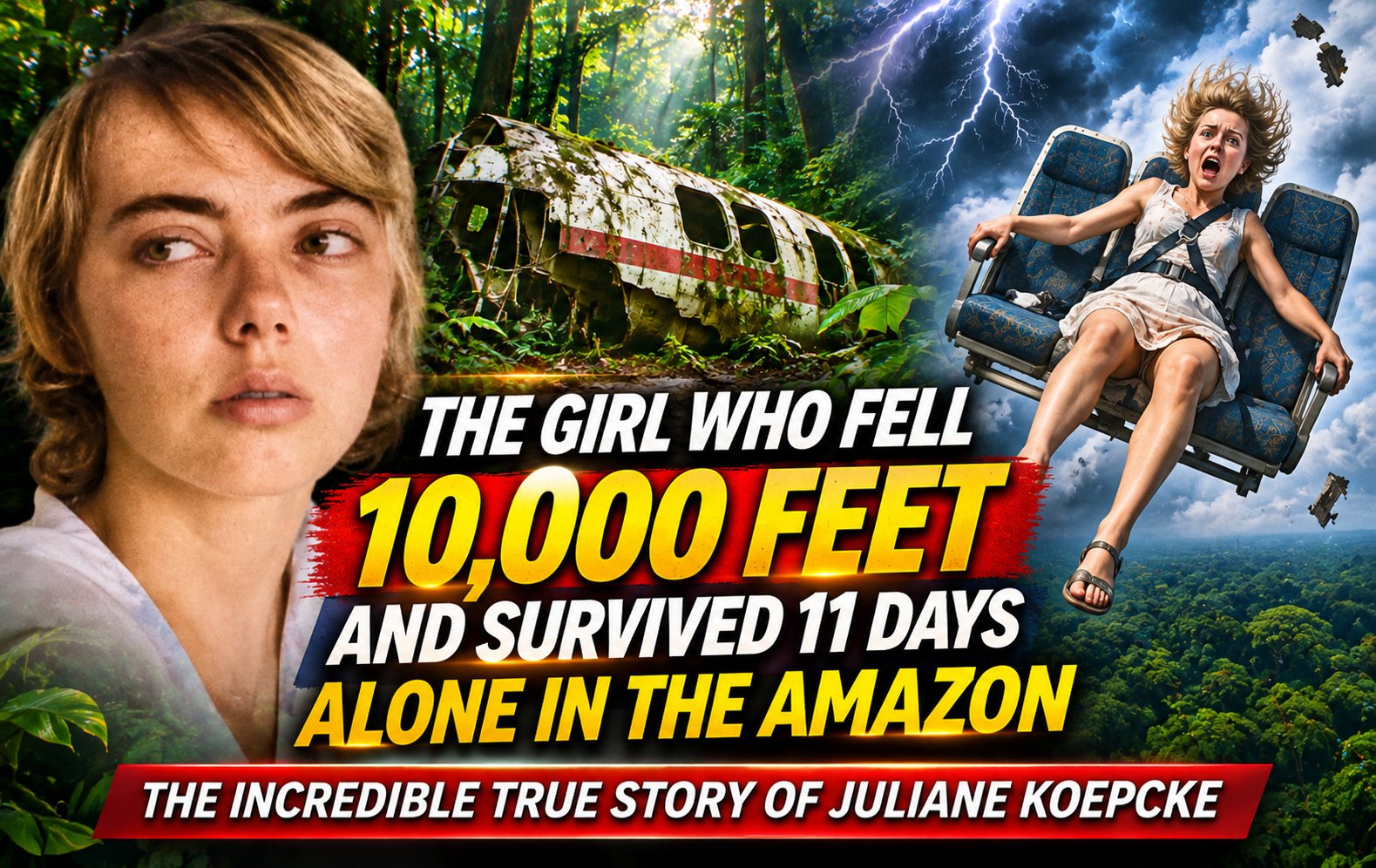
LIMA, PERU — On December 24, 1971, 17 year old Juliane Koepcke boarded a commercial flight with her mother, expecting to spend Christmas with her father at a remote biological research station in the Peruvian Amazon. Instead, she would become the sole survivor of a devastating aviation disaster, falling approximately 10,000 feet from a disintegrating aircraft before spending 11 days fighting for her life in the rainforest.
The aircraft, a Lockheed L-188A Electra operated by the Peruvian airline Líneas Aéreas Nacionales S.A. (LANSA), was traveling from Lima toward Pucallpa when it encountered a violent thunderstorm. The plane broke apart in midair, scattering wreckage and passengers across miles of dense jungle. Of the 92 people aboard, 91 died, leaving Koepcke as the only person to emerge alive from the disaster.
Her survival was extraordinary not simply because of the fall, but because of what happened afterward. Injured, nearly blind without her glasses, wearing a thin dress and missing one shoe, Koepcke found herself stranded in tropical wilderness with almost no food, no medical supplies and no practical way to contact rescuers. The rainforest canopy concealed her from search aircraft, while the surrounding terrain offered little indication of where she might find another human being.
Yet Koepcke possessed something most airline passengers would not have had: years of firsthand experience in the Amazon, where her parents, both zoologists, had taught her how to understand the forest, recognize its dangers and navigate its waterways. That knowledge would prove as important to her survival as the extraordinary circumstances that allowed her to survive the crash.
What followed was an 11 day ordeal involving severe injuries, hunger, dangerous wildlife, infected wounds and an increasingly desperate search for civilization. Her eventual rescue made international headlines and established her story as one of the most astonishing documented examples of survival following a commercial aviation disaster.
A Christmas Eve Flight Into a Deadly Thunderstorm
Juliane Koepcke was born in Lima in 1954 to German zoologists Hans-Wilhelm and Maria Koepcke, whose scientific work focused on the wildlife and ecosystems of Peru. The family spent considerable time at Panguana, a biological research station deep in the Amazon rainforest, where Juliane developed an unusually detailed understanding of the natural environment. Unlike most teenagers, she had grown up surrounded by tropical wildlife, remote waterways and scientists studying one of the world’s most biologically diverse ecosystems.
In December 1971, Juliane and her mother were traveling from Lima to Pucallpa, where they intended to continue to Panguana and reunite with her father for Christmas. Juliane had recently completed her secondary education, and the trip was supposed to mark the beginning of a family holiday. LANSA Flight 508 departed Lima on December 24 carrying 86 passengers and six crew members aboard a four engine Lockheed Electra, an aircraft model widely used in commercial aviation during that period.
The airline already had a troubled safety history. Previous fatal accidents had raised concerns about LANSA’s operations, including the 1970 crash of Flight 502 near Cusco, which killed nearly everyone aboard and two people on the ground. Despite those tragedies, the airline continued operating domestic passenger services in Peru.
Approximately half an hour into the journey, Flight 508 entered a powerful thunderstorm. The aircraft encountered severe turbulence and was struck by lightning, after which it suffered catastrophic structural failure. The right wing separated, and the plane began breaking apart thousands of feet above the rainforest, sending passengers, seats and debris toward the jungle below.
Koepcke later recalled the terrifying moment when the aircraft disintegrated around her. One moment she was seated beside her mother, and the next she was falling through open air, still strapped into her seat. The destruction happened so rapidly that she had little opportunity to comprehend what was occurring before losing consciousness.
Falling 10,000 Feet While Still Strapped Into an Airplane Seat
The circumstances of Koepcke’s fall remain one of the most extraordinary aspects of the disaster. She was still secured to a row of three seats when she fell from the aircraft, descending from approximately 10,000 feet toward the rainforest canopy. Koepcke later described seeing the forest spinning beneath her before losing consciousness, leaving her with almost no memory of the final moments before impact.
Several explanations have been proposed for how she survived. The seat assembly may have rotated during the descent, creating aerodynamic drag that reduced her falling speed, while storm currents and the dense rainforest canopy may have affected the descent and absorbed some of the impact. However, these remain hypotheses rather than scientifically established conclusions, and no complete reconstruction has demonstrated precisely how she survived a fall that would ordinarily be fatal.
When Koepcke regained consciousness on Christmas morning, she was lying alone on the jungle floor, seriously injured but alive. She had suffered a broken collarbone, a concussion, cuts and bruises, and an injury to her knee. One eye was swollen, her glasses were missing and she was left wearing only a short dress and a single sandal. Her limited vision made it difficult to identify hazards, while the combination of pain, disorientation and isolation placed her in immediate danger.
Despite those injuries, she discovered that she could still walk. That ability, combined with the survival knowledge she had acquired during her childhood, would become the foundation of her escape from the rainforest.
Alone in the Rainforest, With No Way to Call for Help
Koepcke initially searched the surrounding wreckage for her mother, Maria, who had been seated beside her aboard the aircraft. But the jungle was enormous, visibility was limited and the debris had been scattered across a wide area. With no sign of another survivor nearby, she faced a terrible decision: remain close to the crash site in the hope that rescuers would find her, or attempt to navigate the rainforest alone.
The Amazon’s dense canopy made aerial searches exceptionally difficult. Koepcke could hear aircraft searching overhead, but the vegetation prevented search crews from seeing her. Remaining in one location might have meant waiting indefinitely without food, medical attention or any guarantee of discovery. As the hours passed, she recognized that her chances of survival could depend on finding a route out of the forest herself.
Her parents had taught her that small streams eventually join larger waterways, where human settlements and river traffic become more likely. Drawing on that knowledge, she located a stream and began following it downstream, sometimes walking along the bank and sometimes moving through the water itself. Although she had no map or compass, the direction of flowing water provided a practical means of navigation through otherwise unfamiliar terrain.
The strategy was simple but physically punishing. Her injuries made walking painful, the ground was uneven and the tropical climate exposed her to persistent rain, humidity and insects. With no glasses, her ability to identify obstacles was severely limited, and her weakened condition made every additional mile increasingly difficult.
She had little food beyond a packet of sweets recovered near the wreckage. Although the rainforest contained abundant vegetation, Koepcke understood that eating unfamiliar plants or fruits could expose her to poisonous substances. Rather than gamble on food she could not confidently identify, she relied primarily on water and continued moving toward what she hoped would eventually be civilization.
Dangerous Wildlife, Relentless Rain and the Search for Her Mother
The rainforest presented hazards that would have challenged even experienced wilderness travelers. Venomous snakes, insects and aquatic animals inhabited the waterways, while the wet-season climate made it difficult to remain dry or recover from injuries. Koepcke’s knowledge of tropical wildlife helped her recognize potential dangers, particularly while moving through shallow streams where freshwater stingrays could be concealed beneath the riverbed.
She understood that many jungle animals were less dangerous when left undisturbed, an awareness that helped her avoid unnecessary confrontations. Rather than treating every movement in the forest as a threat, she relied on the practical lessons her parents had taught her about animal behavior and the importance of moving carefully through unfamiliar terrain.
One of the most disturbing moments occurred when she encountered three bodies still strapped into a section of aircraft seating. The wreckage had struck the ground with such force that the passengers were partially buried, and Koepcke approached because she feared one might be her mother. She examined the feet of a female passenger and noticed painted toenails, allowing her to conclude that the woman was not Maria, who did not wear nail polish.
The discovery brought the scale of the disaster into horrifying focus. Until then, Koepcke had known that the plane had crashed but had little understanding of how many people had died or whether anyone else remained alive. Seeing the bodies confirmed the catastrophic violence of the impact while intensifying her fear about her mother’s fate.
Despite the psychological trauma, she continued following the water downstream. Her father had taught her that the forest was not inherently hostile, but it demanded knowledge and respect. That upbringing helped her remain focused on practical decisions rather than allowing fear to dictate her movements.
A Wound Filled With Maggots and a Desperate Attempt to Survive
As the days passed, Koepcke’s physical condition deteriorated. She was increasingly weak from hunger, her injuries remained untreated and a deep wound near her shoulder became infested with fly larvae. The tropical climate, constant moisture and lack of medical supplies made the injury particularly concerning, while her exhaustion and malnutrition reduced her ability to continue traveling through the forest.
By approximately the tenth day, Koepcke reached a larger waterway and spotted a boat moored near a small shelter. After days of isolation, she initially struggled to believe the boat was real. She approached and touched it, confirming that she had finally reached a place used by other people. Nearby, she found a shelter where she could rest and wait for someone to return.
Inside, Koepcke discovered gasoline and remembered that her father had once used fuel to remove maggots from an injured animal. Desperate to treat the infestation, she poured some onto her wound, experiencing intense pain as the larvae reacted. She later recalled removing approximately 30 maggots before settling down to spend the night at the shelter.
The improvised treatment was hazardous and should not be mistaken for appropriate medical care. Gasoline can damage tissue and cause chemical injuries, but Koepcke had no access to antibiotics, antiseptics or professional treatment. In her weakened condition, the discovery of the shelter represented her first realistic opportunity to stop moving and wait for help.
The Moment Three Strangers Found the Girl Who Had Fallen From the Sky
The following day, Koepcke heard men’s voices near the shelter. Local Peruvian men had returned to the riverside location, and she emerged to confront the first people she had encountered since the aircraft broke apart. Her appearance startled them: she was a severely injured, exhausted teenager who had emerged from the rainforest after surviving a disaster in which everyone else aboard was presumed dead.
Koepcke spoke Spanish and was able to identify herself, explain that she had been aboard the missing LANSA flight and describe her ordeal. Her ability to communicate immediately helped the men understand the extraordinary circumstances of her appearance and the urgency of obtaining medical assistance.
The men provided help and arranged transportation along the river toward civilization. After hours of travel, Koepcke finally reached people who could arrange proper medical care and contact her family. Her rescue stunned authorities and the public because she had survived not only the destruction of the aircraft but also an extended period alone in remote tropical wilderness.
She was eventually reunited with her father, Hans-Wilhelm, who had feared that both his wife and daughter were dead. Their reunion brought enormous relief but also profound grief, because Maria Koepcke remained missing and the scale of the tragedy was becoming increasingly clear.
The Heartbreaking Discovery That Other Passengers May Have Survived the Initial Crash
Although Koepcke was the only person to emerge alive from the disaster, subsequent accounts suggested that some other passengers may initially have survived the aircraft’s breakup or their impact with the ground. Estimates vary, with some reports suggesting that approximately 14 people may have survived the initial impact before dying from their injuries or exposure. Those figures remain uncertain, however, and should not be treated as a definitive forensic finding.
Among those believed to have survived briefly was Koepcke’s mother, Maria. Juliane later learned information suggesting that her mother may have remained alive after the crash but was too seriously injured to escape the rainforest. The possibility that Maria survived the initial impact only to die before rescuers could reach her became one of the most painful aspects of Juliane’s experience.
The tragedy raised questions about whether a faster rescue operation might have saved additional lives, although the aircraft’s breakup over remote jungle terrain made locating survivors extraordinarily difficult. Dense vegetation concealed wreckage from aircraft, while the scattered debris field complicated efforts to determine where passengers had landed.
For Koepcke, surviving meant confronting the loss of her mother and 90 other people who had shared the same flight. The psychological consequences of that experience would remain with her for decades, even as she resumed her education and eventually returned to the scientific work that had shaped her childhood.
The Famous Filmmaker Who Nearly Boarded the Same Doomed Flight
One of the most unusual connections to the disaster involved acclaimed German filmmaker Werner Herzog, who was working in Peru while preparing his 1972 film Aguirre, the Wrath of God. Herzog later explained that he and members of his production team had intended to travel aboard LANSA Flight 508 but were unable to obtain seats, a circumstance that prevented them from being aboard the doomed aircraft.
Decades later, Herzog and Koepcke collaborated on Wings of Hope, a documentary released in 2000 that followed her return to the region where the plane had crashed. The film revisited the extraordinary circumstances of her survival while exploring the emotional consequences of losing her mother and confronting the site of the disaster.
For Koepcke, returning to the rainforest represented more than an opportunity to recount a famous survival story. The experience allowed her to revisit memories she had carried since adolescence and reflect on how the crash had shaped her relationship with her family, her scientific career and the natural environment.
Herzog’s documentary introduced her experience to new generations, emphasizing the importance of her upbringing in the rainforest and the extraordinary combination of knowledge, endurance and chance that allowed her to survive.
The Girl Who Survived the Amazon Became a Scientist Who Helped Protect It
Rather than allowing the disaster to permanently separate her from the rainforest, Koepcke eventually returned to the scientific world in which she had been raised. She studied biology in Germany, earned a doctorate and specialized in the study of bats, continuing the tradition of ecological research established by her parents.
Her scientific career eventually brought her back to Peru and Panguana, the biological research station where she had spent much of her childhood. Following her father’s death in 2000, Koepcke, later known by her married name Juliane Diller, assumed responsibility for the station and became deeply involved in protecting its surrounding rainforest.
Over the following decades, Panguana developed into an important center for tropical biological research and conservation. Koepcke worked to preserve the area’s biodiversity and support scientific studies while confronting environmental threats that included deforestation, habitat destruction and illegal resource extraction.
Her decision to dedicate her career to the Amazon represents one of the most remarkable aspects of her story. Although the rainforest had been the setting for the most traumatic experience of her life, she continued to regard it as an extraordinary natural environment deserving protection rather than a place defined by danger.
The knowledge she acquired there as a child had helped save her life, and her later work allowed her to contribute to the preservation of the same ecosystem for future generations.
How Did Juliane Koepcke Survive a Fall That Should Have Killed Her?
More than half a century after the disaster, the precise physical circumstances that allowed Koepcke to survive remain uncertain. Researchers and aviation observers have proposed several explanations, including the possibility that the row of seats rotated during the descent, creating aerodynamic drag, and that vegetation beneath the rainforest canopy absorbed some of the impact.
Atmospheric conditions during the thunderstorm may also have influenced her fall, although the available evidence is insufficient to establish exactly how those forces interacted. No definitive reconstruction has demonstrated why Koepcke survived when the other 91 people aboard ultimately died.
What is much easier to understand is how she survived afterward. Her upbringing gave her practical knowledge of tropical wildlife, unfamiliar vegetation and the importance of following waterways toward human settlements. Her ability to remain mobile despite her injuries, combined with access to drinking water and the eventual discovery of the riverside shelter, created the conditions necessary for her rescue.
Luck also played an undeniable role. Koepcke survived injuries that could have been fatal, avoided additional accidents and eventually encountered people who could transport her to medical care. Her story illustrates how environmental knowledge and sound decisions can improve the chances of survival under extreme circumstances, even when the initial event itself defies easy explanation.
One of Aviation History’s Most Extraordinary Survival Stories
The destruction of LANSA Flight 508 remains a devastating chapter in Peruvian aviation history. Ninety one people died, families were destroyed and the crash exposed serious concerns about the airline’s safety practices and its decision to operate in hazardous weather. The disaster also illustrated the enormous difficulties involved in locating survivors when aircraft crash in remote tropical terrain.
Yet the tragedy is remembered around the world largely because of the teenage passenger who survived it. Juliane Koepcke was 17 years old when she fell approximately 10,000 feet into the Amazon rainforest, and she emerged 11 days later after navigating rivers, enduring serious injuries and hunger, and relying on lessons learned from her scientist parents to find her way toward civilization.
Her later life added another extraordinary dimension to the story. She became a respected biologist and conservationist, dedicating much of her career to protecting the rainforest in which she had nearly died. Although she continued to mourn her mother and the other victims, she transformed her survival into a lifelong commitment to scientific research and environmental preservation.
Juliane Koepcke’s story is not simply about a girl who fell from an airplane and lived. It is about a teenager who survived an almost unimaginable catastrophe, found her way through the Amazon and spent the rest of her life protecting the wilderness that helped save her.

Sources & Further Reading
-
ABC News Australia — How Juliane Koepcke Survived the Crash and 11 Days in the Amazon
-
The Washington Post — How a Teenager Survived 11 Days in the Amazon After a Plane Crash
-
The Guardian — The Girl Who Came Back Alive: Contemporary Reporting From 1972
-
The New York Times — Juliane Diller’s Survival and Scientific Career
-
The Irish Times — Juliane Diller Reflects on the Crash and Her Conservation Work
-
How to Survive Show — She Fell 10,000 Feet and Survived the Jungle
-
South Florida Media — News, History and Extraordinary Stories








Loading comments…