

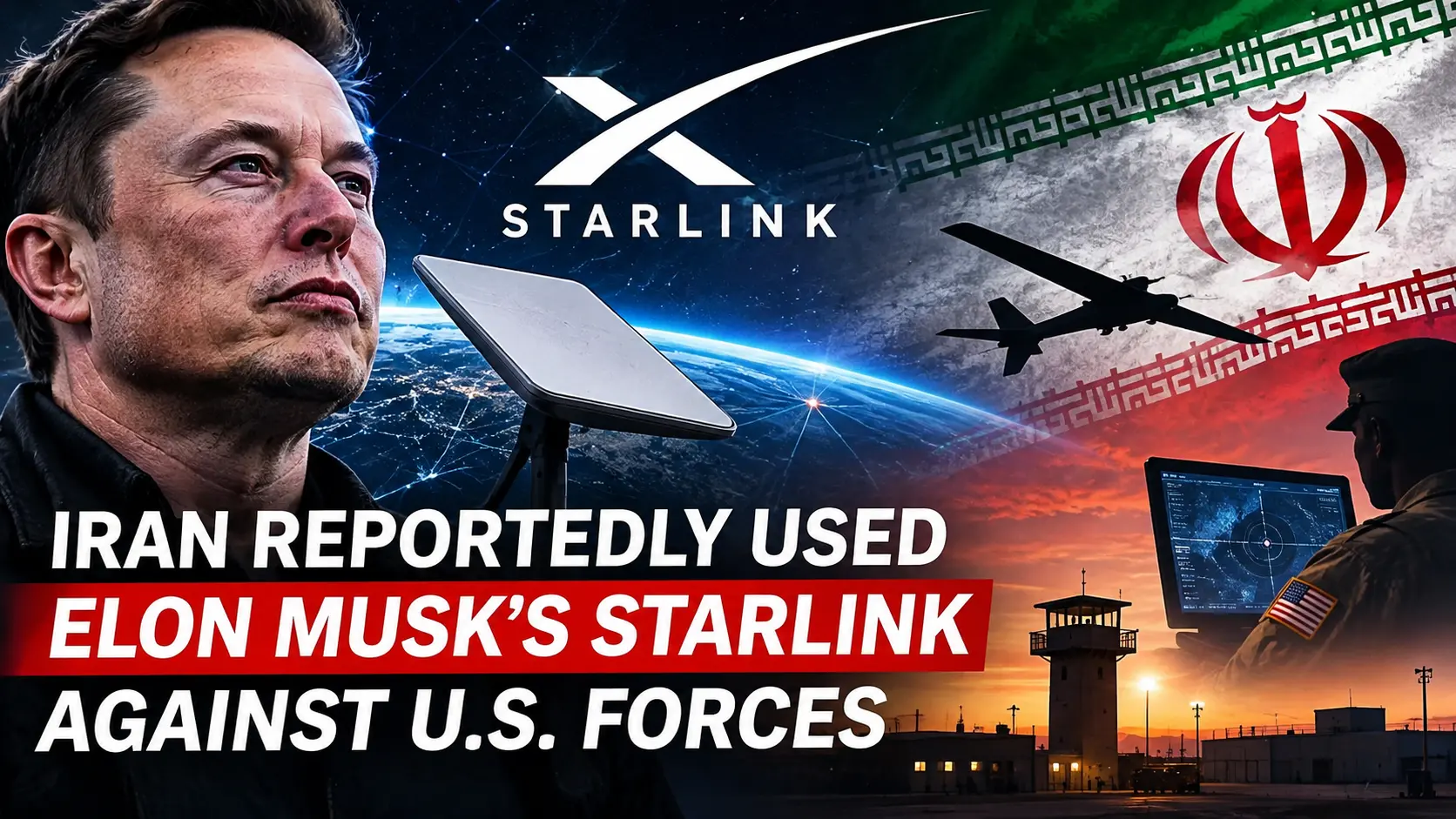
Iran Reportedly Used Elon Musk’s Starlink to Target U.S. Forces, Exposing a Dangerous National Security Vulnerability
American satellite technology designed to connect the world reportedly became a military asset for one of Washington’s most formidable adversaries, raising serious questions about corporate accountability, Pentagon oversight and the privatization of critical national security infrastructure.
An American satellite internet network operated by Elon Musk’s SpaceX was reportedly exploited by Iranian military forces during the opening stages of the U.S. and Israel war with Iran in March 2026, exposing a significant national security vulnerability in one of the world’s most powerful commercial communications systems. According to a November 28 investigation by The Washington Post, citing four people familiar with the military operations, Iranian forces reportedly used Starlink to maintain military communications and support drone operations against American forces stationed throughout the Middle East after their conventional communications infrastructure came under attack.
The revelations, subsequently reported by Reuters and other international news organizations, present an extraordinary national security dilemma for Washington. An American aerospace company with extensive relationships with the Pentagon and the U.S. intelligence community operates a commercial satellite network that was allegedly exploited by a foreign military engaged in hostilities against American personnel. The reported incidents expose the increasingly complicated relationship between private technology companies, government defense agencies and the geopolitical consequences of communications infrastructure operating beyond traditional national borders.
Iran Reportedly Turned American Technology Against American Troops
The United States and Israel launched military operations against Iran in late February 2026, triggering retaliatory attacks against American military installations and regional interests. As Iranian military communications infrastructure came under pressure, Tehran reportedly exploited commercially available satellite connectivity to sustain elements of its military campaign. A classified military assessment reportedly provided to Defense Secretary Pete Hegseth during the summer described Iranian military personnel using Starlink to support operational communications and drone activities.
Unlike conventional internet infrastructure, Starlink operates through a constellation of low Earth orbit satellites, reducing dependence on terrestrial telecommunications networks. That technological advantage has made the service particularly valuable in disaster zones, remote communities and active war zones. However, it also creates significant security challenges when access falls into unauthorized hands, particularly in countries subject to American sanctions and export restrictions.
The investigation raises questions about how Iranian military personnel obtained access to the network, how long that access remained available and whether American intelligence agencies understood the extent of the vulnerability before hostilities began. There is currently no publicly established evidence that SpaceX knowingly supplied Iranian military forces with Starlink services or deliberately facilitated attacks against American personnel.
Six American Service Members Killed in Kuwait
On March 1, 2026, an Iranian drone attack against a U.S. military facility in Port Shuaiba, Kuwait, killed six American service members, underscoring the deadly consequences of Iran’s retaliatory military campaign. Although the strike occurred during the period in which Iran was reportedly exploiting Starlink, The Washington Post did not establish that the satellite network was involved in that particular attack, and the Pentagon has not publicly confirmed such a connection or released the findings of its investigation.
That distinction is critical. While the reported military exploitation of Starlink warrants serious scrutiny, attributing the deaths of six American service members directly to Musk’s company would go beyond the available evidence. Nevertheless, the possibility that American-developed commercial technology supported broader Iranian military operations against U.S. personnel raises legitimate questions about export controls, defense contractor oversight and the effectiveness of existing corporate safeguards.
Elon Musk Reportedly Furious Over Unauthorized Military Use
According to The Washington Post, Musk reacted angrily after learning in early March that SpaceX personnel had identified apparent unauthorized uses of the company’s satellite network in connection with Iranian military operations. SpaceX subsequently introduced stronger customer verification requirements, tightened oversight of its distribution network and suspended its Indirect Reseller Program, which had permitted authorized distributors to sell equipment through additional resellers.
SpaceX restricts certain military applications of its commercial Starlink service and separately markets Starshield, a government oriented satellite communications platform developed to address national security and defense requirements. However, the Iranian allegations demonstrate the limitations of contractual restrictions when commercially available equipment reaches unauthorized users. Prohibiting military applications through terms of service is fundamentally different from possessing the technical and operational ability to prevent them.
For a satellite network operating across international borders, verifying who ultimately controls its equipment remains a substantial security challenge. The reported incidents suggest that existing safeguards were insufficient to prevent at least some suspected unauthorized military activity, despite the strategic importance of the technology and SpaceX’s extensive relationship with the American defense establishment.
Musk Also Reportedly Clashed With the Pentagon Over Starshield
The controversy extends beyond Iran’s alleged exploitation of commercial Starlink services. According to the investigation, Musk also objected to the American military’s use of Starshield for drone operations under a less expensive subscription arrangement intended for ground-based applications. The reported disagreement introduced another uncomfortable dimension to the relationship between Silicon Valley and the Pentagon: the intersection of commercial pricing disputes and active military operations.
Private defense contractors have supplied the American military with equipment, communications systems and technological infrastructure for decades. What distinguishes modern satellite networks is the degree of continuing operational control that can remain with the service provider even after military personnel have deployed the technology. When a private company retains authority over connectivity, subscription requirements and service restrictions, its commercial decisions can have implications extending well beyond its balance sheet.
The reported Starshield dispute raises questions about whether existing Pentagon contracts sufficiently protect military operations from commercial disagreements and whether the government maintains adequate independent communications alternatives. There is no publicly established evidence, however, that the reported pricing dispute directly resulted in American casualties or the failure of a specific military operation.
Pentagon Says It Is Unaware of Classified Military Assessment
Perhaps equally concerning is the Defense Department’s response to the allegations involving Iran. Despite reporting that a classified military assessment provided to Hegseth’s office during the summer addressed Iran’s exploitation of Starlink, the Pentagon told Reuters that it was unaware of the referenced document. In a statement provided to Reuters, the Defense Department said it:
“is not aware of the report to the (office of the defense secretary) pertaining to this subject.”
The statement does not establish that the reported Iranian activity never occurred, nor does it resolve the apparent discrepancy between accounts provided by individuals familiar with the military operations and the Pentagon’s publicly stated position. SpaceX and the Iranian Foreign Ministry did not immediately respond to Reuters’ requests for comment.
Congressional oversight could help determine whether the assessment exists, which officials received it, what intelligence supported its conclusions and what corrective measures were subsequently implemented. American military personnel and their families deserve a transparent accounting of technological vulnerabilities that may have placed service members at additional risk.
Starlink Has Also Become a Lifeline for Iranian Civilians
Complicating the national security controversy is the fact that Starlink has served an entirely different purpose for ordinary Iranians living under one of the world’s most restrictive governments. During widespread anti-government demonstrations in January 2026, Iranian authorities imposed a sweeping internet blackout amid a deadly crackdown on protesters. Conventional telecommunications services became largely inaccessible, restricting the population’s ability to communicate internationally, organize demonstrations and document human rights abuses.
Starlink provided some Iranians with an alternative connection to the outside world. In January, CNN reported that SpaceX had waived subscription fees for Iranian users with compatible equipment. However, access remained limited, and Iranian authorities actively attempted to disrupt satellite connectivity while targeting individuals possessing unauthorized communications equipment.
For journalists, political dissidents, human rights activists and ordinary families, the technology represents something considerably more important than commercial internet access. It provides a means of communicating outside the Iranian government’s traditional information controls, allowing evidence of government repression to reach international news organizations and human rights monitors.
The United States Helped Smuggle Thousands of Starlink Terminals Into Iran
Adding another layer of complexity to the controversy is the American government’s own role in expanding Starlink access inside Iran. In February 2026, The Wall Street Journal reported that the Trump administration had covertly facilitated the distribution of approximately 6,000 Starlink terminals inside the country following the government’s violent crackdown on nationwide demonstrations.
The State Department reportedly purchased nearly 7,000 terminals as part of the initiative, redirecting funding from other internet-freedom programs. Although President Donald Trump was reportedly aware of the operation, the newspaper said it remained unclear who formally authorized the deliveries.
The initiative followed earlier American efforts to expand communications access inside Iran. In 2022, the Biden administration eased certain sanctions-related restrictions on communications technology following demonstrations sparked by the death of Mahsa Amini in Iranian police custody. The objective was to help ordinary Iranians circumvent government censorship and maintain access to independent information.
There is no publicly established evidence that the equipment reportedly exploited by Iranian military forces originated from the American government’s distribution initiative. Nevertheless, the allegations illustrate the inherent risks associated with introducing advanced communications technology into hostile environments where the United States cannot independently monitor its distribution or ultimate ownership.
An Internet Freedom Initiative With Potentially Dangerous Consequences
The reported military exploitation of Starlink demonstrates the unintended consequences that can accompany otherwise legitimate efforts to promote internet freedom. Communications technology introduced to undermine authoritarian censorship can potentially be appropriated by the very government it was intended to circumvent. Once equipment enters a country where its distribution cannot be independently monitored, distinguishing civilian users from military personnel becomes considerably more difficult.
SpaceX could impose broader restrictions on access inside Iran, but doing so would risk disconnecting citizens already facing severe government repression. Iranian authorities have criminalized unauthorized satellite internet access, exposing users to equipment confiscation, imprisonment and other potentially severe consequences. Restricting Starlink across Iran would therefore risk reinforcing the government’s ability to suppress independent reporting and isolate its population from the international community.
The challenge facing Washington and SpaceX is preventing hostile military exploitation without effectively handing the Iranian government another instrument of censorship. That requires balancing American national security interests with the legitimate humanitarian and democratic objectives that helped justify expanding satellite connectivity in Iran in the first place.

The Growing National Security Risks of Elon Musk’s Satellite Empire
The controversy comes amid increasing international dependence on SpaceX’s satellite infrastructure. Starlink has become an important communications provider for governments, businesses, emergency responders and military organizations, giving the company an increasingly significant role in international affairs. Similar concerns have emerged during Russia’s war against Ukraine, where unauthorized Russian access to Starlink has prompted additional security measures from SpaceX.
These incidents illustrate a broader structural problem rather than an isolated controversy involving Iran. Commercial satellite communications systems are increasingly becoming dual use infrastructure, capable of supporting humanitarian missions, civilian connectivity, intelligence operations and military campaigns. As their strategic importance increases, governments must confront the implications of allowing essential communications infrastructure to become concentrated within a relatively small number of private corporations.
The issue is not simply whether Elon Musk exercises his authority responsibly. It is whether any individual corporate executive should possess such substantial influence over communications infrastructure upon which democratic governments, military organizations and vulnerable civilian populations increasingly depend, particularly when corporate interests and government objectives may not always align.
Congressional Oversight of Privatized Military Infrastructure
The reported Iranian exploitation of Starlink raises legitimate questions for congressional oversight regarding how the United States purchases, regulates and depends upon privately operated satellite communications services. Lawmakers have reason to examine export control enforcement, customer verification standards, unauthorized military access, contractual protections for American forces and the availability of independent military communications alternatives.
SpaceX’s technological achievements are substantial, and its satellite network has delivered considerable benefits around the world. Those achievements, however, do not exempt the company from scrutiny when its infrastructure becomes intertwined with American national security. The Pentagon also faces questions about what safeguards were in place, what it knew about potential Iranian access and whether its procurement policies adequately protected American military operations.
The controversy demonstrates why technological innovation must be accompanied by effective regulatory oversight, enforceable contractual protections and contingency planning. American military operations cannot depend exclusively on commercial infrastructure without adequate safeguards against unauthorized access, service interruptions or contractual disputes.
American Innovation Requires American Accountability
Starlink represents one of the most consequential technological developments of the modern communications era. Its ability to connect isolated communities, support democratic movements and maintain communications during emergencies demonstrates the extraordinary potential of American innovation. Its reported exploitation by Iran, however, demonstrates the other side of that technological revolution.
A network capable of helping protesters escape authoritarian censorship may also be exploited by authoritarian military forces. A company capable of strengthening American military capabilities may simultaneously face difficulties preventing adversaries from accessing its commercial infrastructure. These competing realities demand a national security framework that recognizes both the extraordinary benefits and inherent vulnerabilities of privately operated satellite networks.
The central question is no longer whether commercial satellite technology will shape modern warfare. It already has. The question is whether American regulatory institutions, military leadership and elected officials are prepared to govern that technology with the seriousness its strategic importance demands. Without adequate oversight and accountability, even America’s most advanced technological achievements can become liabilities in the conflicts they were intended to help address.
Sources and Further Reading

The Washington Post – Iran Used Elon Musk’s Starlink to Help Wage Attacks Against U.S.
Reuters – Iran Used Starlink in Attacks on U.S. Forces, Washington Post Reports
Fortune – Iran Used SpaceX’s Starlink to Command Its Forces and Oversee Drone Attacks
The Jerusalem Post – Iran Used Musk’s Starlink to Support Attacks on U.S. Forces
CNN – Access to Elon Musk’s Starlink Internet Service Is Now Free in Iran Amid Government Crackdown
Al Jazeera – Is Starlink Helping Iranians Break the Internet Blackout?
The Guardian – An Ecosystem of Smuggled Technology Holds Iran’s Last Link to the Outside World
South Florida Media – National and International News Coverage
















Loading comments…