
Elon Musk’s Millions Loom Over Texas Senate Race as James Talarico Challenges Ken Paxton
The billionaire’s political spending machine is once again a major force in Republican politics, raising questions about corporate influence, campaign finance transparency, and the growing power of America’s wealthiest political donors.
AUSTIN, TEXAS — The battle for a U.S. Senate seat in Texas has become a high stakes confrontation over political power, billionaire influence, and the future of a state that Republicans have dominated in statewide elections for decades. At the center of the controversy is Elon Musk, the world’s most prominent technology billionaire and an increasingly influential Republican political donor, whose political action committees have emerged as powerful financial vehicles in American elections.
The contest between Democratic nominee James Talarico and Republican Ken Paxton carries implications far beyond Texas. With control of the U.S. Senate at stake in the November 2026 midterm elections, both parties have powerful incentives to invest heavily in a state that has historically favored Republicans but has also experienced significant demographic, economic, and political change.
Claims circulating about Musk’s involvement suggest that his political contributions have surpassed $150 million and could be approaching $180 million. However, those figures require careful examination because contributions to political committees nationwide are not necessarily the same as money spent specifically to influence the Texas Senate race. Establishing how much Musk has contributed, which organizations received the money, and how much was actually spent supporting Paxton or opposing Talarico requires reviewing the underlying Federal Election Commission filings.
That distinction is essential. A billionaire’s overall political spending can be enormous without every dollar being directed toward a particular candidate, and conflating those figures risks exaggerating the financial intervention in an individual election.
Elon Musk’s $158 Million Intervention Reshapes the Texas Senate Race
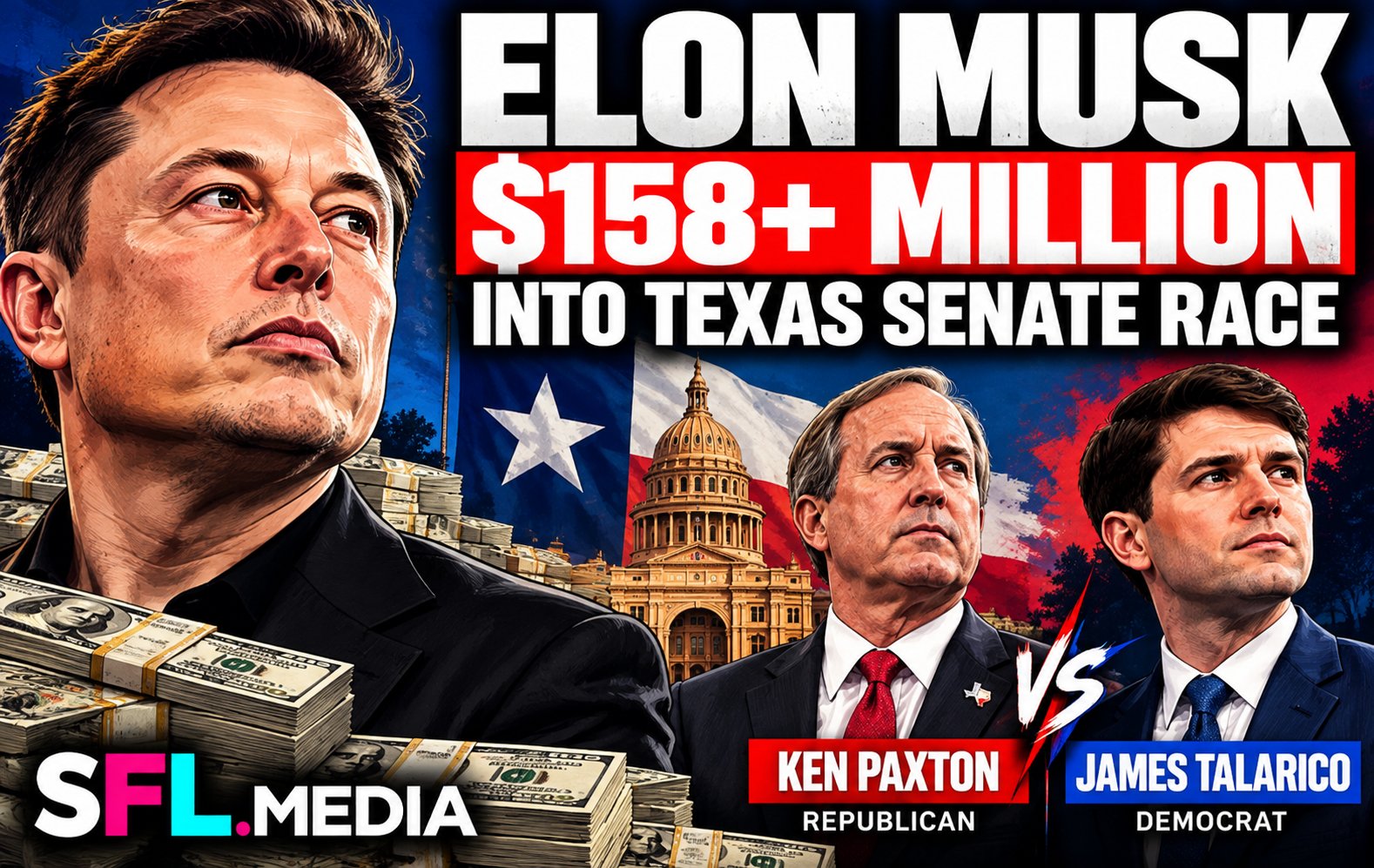
Newly disclosed federal campaign finance records have provided a clearer picture of the extraordinary financial intervention taking place in Texas. According to reporting by The Texas Tribune, CBS News, and The Associated Press, Musk contributed $158 million to the Senate Leadership Fund, the principal Republican Senate super PAC, during September 2026. The organization subsequently transferred matching amounts to Texas PAC, a political committee established to support Paxton’s campaign against Talarico.
The money arrived in two enormous installments. On September 9, Musk contributed $75 million to the Senate Leadership Fund, which transferred $75 million to Texas PAC the following day. On September 23, Musk contributed another $83 million to the Senate Leadership Fund, followed by an $83 million transfer to Texas PAC on September 24. The transactions, documented in federal disclosures, effectively provided Republican strategists with a massive financial reserve to support Paxton in the closing weeks of the campaign.
The Texas Tribune reported that Musk’s financial involvement in the Senate contest approached $190 million when additional support for pro-Paxton political organizations was included. The Associated Press separately reported that Musk contributed $10 million to Lone Star Liberty PAC, another organization supporting Paxton. Those figures represent distinct contributions and should not be confused with the total advertising expenditures of the committees receiving the money.
The scale of the intervention is remarkable even by the standards of modern American elections. Rather than making a conventional contribution to a candidate’s campaign, Musk directed substantial resources through independent political organizations legally permitted to raise unlimited sums, provided their expenditures comply with federal restrictions on coordination with candidates.
How Musk’s Money Flooded Texas Television and Digital Advertising
The financial consequences were immediate. According to The Texas Tribune, Senate Leadership Fund backed operations had spent more than $159 million on television, radio, and digital advertising in Texas by mid October, approximately twice the advertising expenditure attributed to Talarico’s campaign at that point. By the end of September, outside organizations supporting the Republican effort had collectively committed more than $217 million to advertising in the Senate contest.
The Republican advertising campaign included messages promoting Paxton’s record and attacking Talarico on cultural and political issues. One advertisement portrayed the Democrat as more concerned with gender identity politics than the interests of ordinary Texans, reflecting a broader Republican strategy of using divisive social issues to mobilize conservative voters and weaken Democratic support.
The enormous advertising investment followed months in which Talarico had demonstrated an unexpected financial advantage. His campaign’s fundraising strength allowed Democrats to compete aggressively in a state where Republican candidates have traditionally enjoyed substantial institutional support. Musk’s intervention helped reverse that advertising imbalance and ensured that Paxton could compete across the state’s expensive media markets during the final stretch of the election.
The spending also reveals how a single wealthy donor can transform a political contest almost overnight. While voters ultimately determine election outcomes, the ability to finance sustained advertising campaigns, voter-contact programs, and political messaging provides wealthy contributors with influence over which arguments dominate the public conversation.
Why Republicans Needed Musk to Rescue Ken Paxton
The Republican financial intervention was driven partly by concerns about Paxton’s ability to retain a Senate seat that the party has controlled for decades. Paxton emerged from a contentious Republican primary contest against incumbent Senator John Cornyn, leaving Republican strategists facing the possibility of an expensive and unusually competitive general election.
The Senate Leadership Fund had previously supported Cornyn during the primary and reportedly estimated that a Paxton nomination could require between $150 million and $200 million in additional spending to protect the seat. Musk’s contributions substantially addressed that concern, providing a dedicated source of funding without requiring the organization to divert comparable resources from other competitive Senate races.
Paxton entered the general election carrying both the advantages of Republican identification in Texas and a history of political and legal controversies. The former Texas attorney general survived impeachment proceedings in 2023 after the Texas Senate acquitted him of the charges, and his political career has repeatedly attracted scrutiny over ethics and legal matters. His supporters have defended him as an aggressive conservative who challenged federal authority, while critics have questioned his judgment and fitness for higher office.
Talarico, meanwhile, presented Democrats with an opportunity to compete beyond their traditional urban strongholds. The former Texas state representative built his campaign around economic concerns, public education, religious messaging, and criticism of the political influence exercised by wealthy donors and powerful corporations.
For Republican strategists, the prospect of losing Texas would represent far more than the defeat of a single candidate. It would threaten a longstanding pillar of the party’s national electoral coalition and complicate its efforts to maintain control of the United States Senate.
Polling Shows Talarico and Paxton Locked in a Competitive Race
Despite the enormous Republican spending advantage, public polling continued to show a closely contested election in late October. The RealClearPolling average covering surveys conducted between October 8 and October 21 placed Talarico at 48.5% and Paxton at 46.7%, giving the Democrat a narrow 1.8-percentage-point advantage.
Individual surveys produced varying results. A Fox News poll conducted in mid October showed the candidates tied at 49%, while an Emerson College survey placed Talarico slightly ahead. Other surveys showed somewhat larger Democratic advantages, although the differences between polls underscored the uncertainty surrounding the race.
These numbers are particularly significant because Texas has not elected a Democrat to statewide office since 1994. A Democratic victory in the Senate race would therefore represent a major political breakthrough, although a narrow polling advantage does not guarantee an election victory.
The campaign’s financial competition has also reached extraordinary levels. Federal Election Commission records covering Talarico’s campaign through October 14 showed approximately $146.3 million in total receipts and $136.4 million in expenditures. The Texas Tribune reported that Talarico raised $64 million during the third quarter alone, an exceptional fundraising performance for a Senate candidate.
Those figures demonstrate that the election is not simply a contest between a wealthy Republican donor and an underfunded Democratic challenger. Both sides have assembled substantial financial operations, although Musk’s contributions have dramatically expanded the resources available to Republican aligned outside organizations.
Why Elon Musk Has So Much at Stake in Texas
Musk’s involvement in Texas politics takes place against the backdrop of his extensive business interests in the state. Tesla relocated its corporate headquarters to Austin, SpaceX established its Starbase operations in South Texas, and Musk announced the relocation of X’s headquarters from California to Texas. The billionaire has increasingly concentrated major elements of his business empire in a state whose political leadership has promoted relatively low taxes, business expansion, and comparatively limited regulation.
Those business interests create an important context for evaluating Musk’s political activity, particularly because companies associated with him operate in industries affected by government policy, infrastructure decisions, environmental regulation, transportation oversight, and public contracts.
However, the existence of those business interests does not establish that Musk’s contributions were made in exchange for specific regulatory decisions or political favors. No such arrangement is demonstrated by the campaign finance disclosures reviewed for this article. The documented facts establish the scale of Musk’s political spending and the organizations receiving his contributions, not an unlawful agreement between the donor and the candidate.
The broader issue is whether extraordinary concentrations of private wealth create political influence that ordinary voters and smaller contributors cannot realistically match. That concern extends beyond Musk and applies to wealthy donors supporting candidates and causes across the political spectrum.
America’s Super PAC System Allows Billionaires to Spend Without Traditional Contribution Limits
The legal framework enabling Musk’s contributions emerged from major changes to federal campaign finance law, particularly the Supreme Court’s 2010 decision in Citizens United v. Federal Election Commission and subsequent judicial rulings involving independent political expenditures.
Under the current system, super PACs can accept unlimited contributions from individuals and certain organizations to finance independent political activities. They are prohibited from making contributions directly to federal candidates and from coordinating their independent expenditures with campaigns in ways that violate federal law.
The distinction allows wealthy donors to provide sums that would be prohibited as direct contributions to candidates. A donor cannot simply transfer $158 million into a federal candidate’s authorized campaign account, but the same donor can legally contribute that amount to a properly structured independent expenditure only political committee.
Supporters of the system argue that independent political spending is a form of constitutionally protected political expression and that organizations should be permitted to advocate for candidates and issues without government-imposed expenditure limits. Critics argue that the arrangement gives wealthy individuals and corporations disproportionate influence over elections, allowing a small number of donors to dominate political messaging and potentially shape the priorities of elected officials.
Musk’s financial intervention in Texas provides an unusually dramatic example of that debate. The transactions are publicly disclosed, but the amounts involved are so substantial that they raise fundamental questions about the relationship between democratic representation, political competition, and concentrated private wealth.
Musk’s Spending Extends Far Beyond the Texas Senate Race
The Texas Senate contest is only one component of Musk’s expanding financial role in the 2026 midterm elections. According to The Associated Press, Musk contributed more than $276 million to Republican-aligned political organizations beginning in July, including $158 million to the Senate Leadership Fund and approximately $76 million to America PAC, the political organization he established to support conservative electoral efforts.
Those contributions marked a significant return to large-scale political spending after Musk previously suggested that he intended to reduce his involvement in campaign financing. His renewed activity also followed a period of public tension with President Donald Trump, whose 2024 election effort Musk had supported with extraordinary financial resources.
America PAC has focused heavily on voter outreach and turnout operations, demonstrating that Musk’s political investments extend beyond advertising. Such organizations can support campaigns through voter registration, canvassing, digital outreach, and other efforts intended to identify and mobilize sympathetic voters.
The distinction between national spending and Texas-specific spending remains important. Musk’s contributions to America PAC and other Republican organizations cannot automatically be counted as expenditures against Talarico unless those funds are actually deployed in the Texas race. Nevertheless, the combined totals demonstrate the enormous financial capacity Musk has brought to Republican electoral politics.
Can Elon Musk’s Money Deliver a Republican Victory?
The central political question is whether the financial intervention will be enough to help Paxton defeat Talarico in a race that remains highly competitive despite Texas’ Republican history.
Advertising can influence voter awareness, define opponents, and increase turnout, but money alone does not determine election outcomes. Candidate quality, political conditions, demographic changes, voter enthusiasm, and the effectiveness of campaign messaging all contribute to the final result.
For Republicans, Musk’s contributions have provided a powerful means of countering Talarico’s fundraising success and reinforcing conservative messaging across Texas. For Democrats, the spending offers an opportunity to argue that their opponent depends on wealthy political benefactors and that the election represents a broader struggle over who exercises influence in American government.
The political significance extends beyond the candidates themselves. If Paxton wins, Republicans may view Musk’s intervention as evidence that massive outside spending can help preserve vulnerable seats. If Talarico wins despite the financial onslaught, the result could demonstrate the limits of even extraordinary campaign expenditures when voters are motivated by other considerations.
With Election Day scheduled for November 3, 2026, the Texas contest has become one of the clearest examples of how money, political identity, and public dissatisfaction are colliding in the modern American electoral system.
The Bigger Question: Who Really Controls American Elections?
The extraordinary financial intervention in Texas illustrates a structural reality of American politics: wealthy individuals can legally invest sums in elections that vastly exceed what most voters will earn in a lifetime. Musk’s $158 million contribution to the Senate Leadership Fund, followed by matching transfers into Texas PAC, demonstrates how quickly a single donor can alter the financial balance of a major political contest.
Yet the outcome remains uncertain. Talarico’s fundraising strength and competitive polling suggest that money cannot automatically overcome the political challenges facing a candidate, even when that candidate benefits from enormous outside support.
For Texas voters, the choice between Talarico and Paxton will ultimately be made at the ballot box rather than in the offices of super PACs or billionaire donors. But the financial battle surrounding that choice raises an enduring question about American democracy: how much influence should any single individual be able to exercise over an election simply because they possess the resources to spend hundreds of millions of dollars?
Whatever happens on November 3, the 2026 Texas Senate race will stand as a major case study in the growing power of billionaire-funded political organizations and the continuing debate over whether America’s campaign finance system adequately protects political equality.
Sources & Further Reading

Campaign Finance and Investigative Reporting
- The Texas Tribune — Elon Musk Is the Donor Behind Senate Republicans’ Massive Rescue Mission for Ken Paxton
- CBS News — Elon Musk Donates Over $150 Million to Senate GOP Group, Assisting Ken Paxton
- Associated Press — Elon Musk Becomes Biggest Known Donor in Midterm Contests
- ABC News — How Elon Musk Is Bankrolling GOP Hopes in the Texas Senate Race
Official Election Records and Polling
- Federal Election Commission — Campaign Finance Database
- Federal Election Commission — James Talarico 2026 Campaign Finance Records
- RealClearPolling — Texas Senate Race: Talarico vs. Paxton
Related SFL Media Coverage













































Want to join the conversation?
Create an account or sign in to share your thoughts, vote,
and reply to other readers.
Showing 0 of 0 comments
Don't have an account?
Already have an account?