
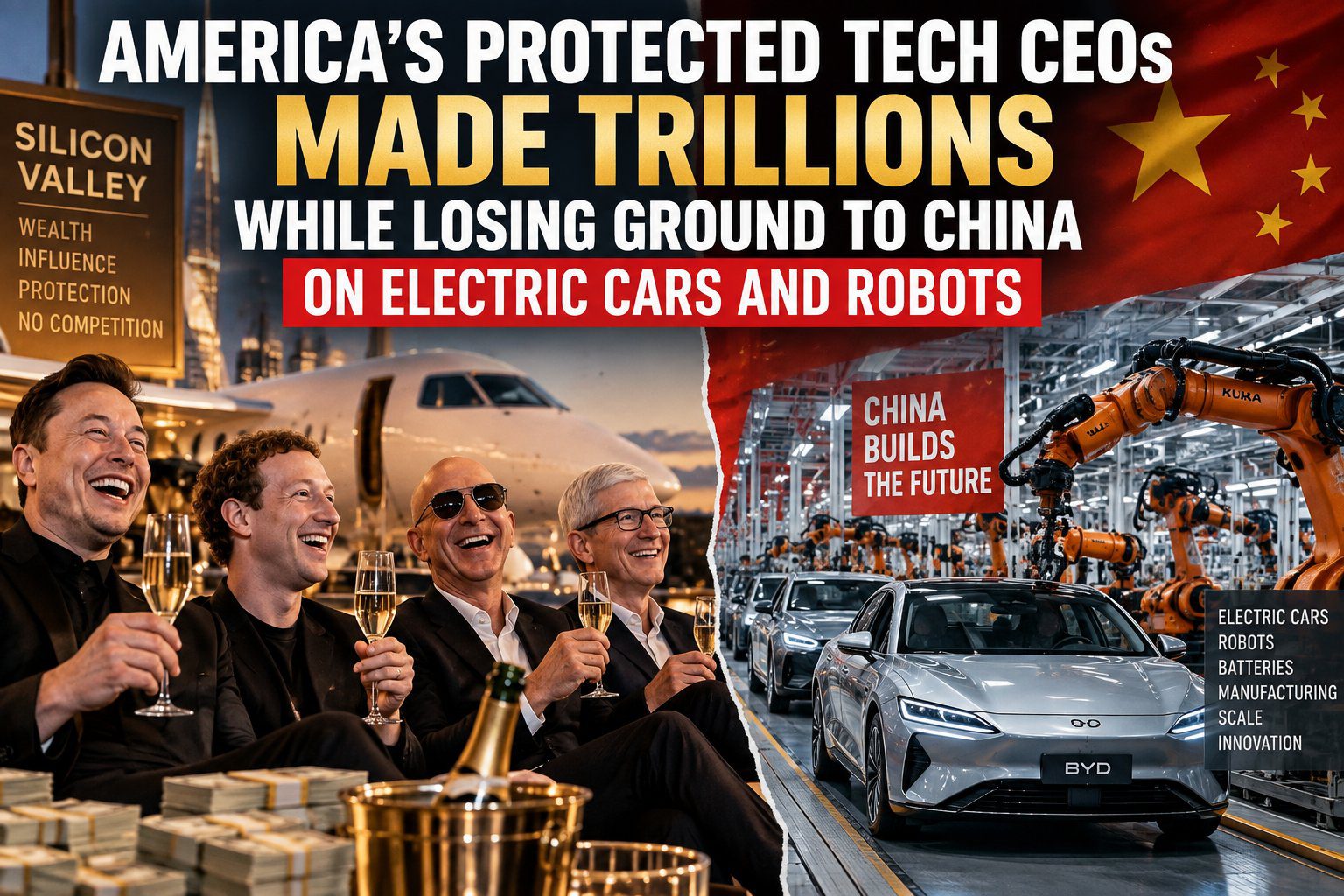
America Protected Big Tech to Beat China, Instead, Its Corporate Giants Are Falling Behind
For years, Washington operated under a relatively straightforward theory of technological power: protect America’s most important companies, preserve their scale, restrict strategic Chinese competitors, subsidize domestic production and allow U.S. technology giants to accumulate enough capital to compete with anyone on Earth. The problem is that scale and protection do not automatically produce innovation.
Across electric vehicles, batteries, industrial robotics and increasingly artificial intelligence, China is demonstrating something uncomfortable for the United States. American companies can possess extraordinary amounts of capital, enormous domestic markets, world class universities and some of the planet’s most valuable brands and still lose ground when corporate leadership becomes complacent, distracted or more interested in defending existing market power than building the next generation of products.
The numbers do not support the simplistic conclusion that China has already defeated the United States technologically. America remains extraordinarily strong in semiconductors, software, aerospace, AI investment, research, cloud computing and frontier-model development, and U.S. private investment in artificial intelligence remains dramatically larger than China’s. But the trend lines in several strategically important industries should be setting off alarms. The emerging problem is not that America suddenly forgot how to innovate; it is that the country’s economic system has become remarkably good at creating gigantic technology companies and considerably less reliable at forcing those companies to remain hungry once they become dominant.
China’s EV Industry Has Already Reached a Different Scale
The electric vehicle market provides perhaps the clearest warning. According to the International Energy Agency’s Global EV Outlook 2026, nearly 55% of new vehicles sold in China during 2025 were electric, compared with just under 10% in the United States. China sold more than 13 million electric cars during the year, accounted for roughly six out of every 10 EVs sold worldwide and produced nearly 75% of the world’s electric cars in 2025. That is no longer a niche-market advantage. It is industrial scale.
Chinese manufacturers are competing intensely against one another on batteries, software, manufacturing efficiency, charging technology, vehicle design and price, producing a brutally competitive domestic ecosystem capable of manufacturing enormous volumes of increasingly sophisticated vehicles. That competition is now moving outward. Chinese electric car exports surpassed 2.5 million vehicles in 2025, while Chinese made EVs have captured significant shares of emerging markets where American manufacturers face fewer of the protective barriers that insulate them at home.
The United States has largely insulated itself from direct Chinese EV competition. Washington raised the Section 301 tariff on Chinese electric vehicles to 100% in 2024 while also increasing tariffs on EV batteries and other strategic products. Those measures were justified partly around China’s industrial policies, technology transfer practices and concerns that heavily supported Chinese producers could overwhelm American manufacturers. There are legitimate national security and industrial policy arguments for preventing strategic industries from becoming dependent on China, but protection creates another risk: companies protected from their most aggressive competitors can lose some of the market pressure that forces them to become better. American automakers do not merely need protection from China’s EV industry; they ultimately need to build vehicles capable of competing with it.
Tesla Became a Warning About What Happens When Leadership Overshadows the Product
No American company better demonstrates the contradiction than Tesla. The company helped force the global automobile industry into the electric era and proved that EVs could be desirable, fast and technologically sophisticated rather than small compliance vehicles produced primarily to satisfy regulators. Then the competitive environment changed.
China’s BYD surpassed Tesla in annual battery electric vehicle sales in 2025, while Tesla’s worldwide deliveries fell 8.6% to approximately 1.64 million vehicles. Tesla’s difficulties cannot reasonably be attributed to one cause: increased competition, changing U.S. EV policy, an aging core product lineup, pricing pressures and the company’s strategic shift toward robotaxis and humanoid robotics have all played roles. Musk’s increasingly prominent political activity has created an additional challenge by making the company’s chief executive inseparable from the Tesla brand for many consumers.
Claims about Musk’s motives, personality or mental state are speculative and unnecessary to understanding the business consequences. His public political activity, however, can be measured against consumer behavior. Research by Yale economists circulated through the National Bureau of Economic Research estimated that what the researchers called the “Musk partisan effect” cost Tesla between roughly 1 million and 1.26 million potential U.S. vehicle sales between October 2022 and April 2025, with the researchers estimating that Tesla sales would have been substantially higher without the effect associated with Musk’s increasingly partisan political profile.
That finding does not mean politics explains every Tesla problem. Competition, pricing, interest rates, product cycles, government incentives and changing consumer preferences all matter. What it demonstrates is something extraordinary about modern American corporate governance: the public behavior of one chief executive can become economically entangled with a company employing more than 100,000 people and competing in one of the most strategically important industries on Earth. Tesla spent years building a customer base heavily concentrated among environmentally conscious and technology oriented consumers before Musk became one of America’s most visible political figures. Whatever anyone thinks about his politics, turning the CEO of a mass market consumer company into a polarizing political identity carries measurable commercial risk. That is not fundamentally an ideological argument; it is a corporate governance argument.
The Robotics Numbers Are Even More Alarming
If electric vehicles reveal China’s manufacturing momentum, industrial robotics demonstrates the scale of the country’s automation strategy. The International Federation of Robotics reported that China installed approximately 295,000 industrial robots in 2024, 54% of every industrial robot installed worldwide that year, and had more than 2 million industrial robots operating in its economy, the largest installed base anywhere in the world. The United States installed approximately 34,200 industrial robots in 2024, meaning China installed more than eight times as many industrial robots as the United States during that year alone.
There is an important nuance: raw installation totals reflect China’s enormous manufacturing workforce and industrial base, and the United States performs considerably better when automation is measured relative to manufacturing employment. The United States has roughly 307 industrial robots for every 10,000 manufacturing workers, placing it eighth globally under the latest IFR figures. Nevertheless, the absolute industrial capacity being created in China matters enormously, particularly because China is increasingly producing the machines responsible for that automation.
Chinese manufacturers supplied 57% of robots installed in their domestic market in 2024, up from roughly 28% a decade earlier. The International Federation of Robotics says the United States, by contrast, imports most of its industrial robots from Japan and Europe and has relatively few domestic robot manufacturers, although America maintains a substantial network of domestic system integrators. China is therefore not simply buying automation; it is increasingly building the machines that automate its factories. Beijing’s 2026-2030 Five Year Plan has also placed robotics at the center of its modern industrial strategy, further connecting artificial intelligence, advanced manufacturing and physical automation in the type of manufacturing ecosystem the United States once dominated.
Artificial Intelligence Is More Complicated and Potentially More Important
Artificial intelligence requires considerably more nuance because America remains enormously powerful. Stanford University’s 2026 AI Index found that U.S. private AI investment reached approximately $285.9 billion in 2025, compared with about $12.4 billion in China, an advantage of more than 23 to one. The United States also produced far more newly funded AI companies, with 1,953 receiving funding during 2025. America therefore cannot reasonably be described as “behind China” across artificial intelligence as a whole.
Another Stanford finding, however, should concern American technology executives: the performance gap is disappearing. Stanford reported that the U.S. China model performance gap had effectively closed, with American and Chinese models trading the lead on major benchmarks since early 2025. DeepSeek-R1 briefly matched the leading U.S. model in February 2025, and as of March 2026 Anthropic’s leading model held only a 2.7% advantage in Stanford’s cited comparison.
The United States still produces more top tier AI models and maintains major advantages in infrastructure and private capital, while China leads in AI publication volume, citations, patent output and industrial robot installations. Chinese developers have also become formidable competitors in open-weight AI, with companies including DeepSeek and Alibaba producing models that developers can download, modify and deploy without remaining permanently dependent on a proprietary American cloud platform. Chinese AI companies are accomplishing this while operating with tighter capital and semiconductor constraints than their American counterparts, yet they remain competitive in model performance and increasingly aggressive on efficiency and price.
That creates a remarkable economic question: if American companies are investing vastly more private capital, operating the world’s largest AI data center infrastructure and possessing privileged access to much of the world’s leading AI talent, why are Chinese laboratories remaining this competitive? America still possesses enormous advantages, but money alone is not the same thing as technological efficiency, and spending more than everyone else is not victory if competitors can produce increasingly comparable results with fewer resources.
America Has a Capital Allocation Problem
This leads to a broader question about American corporate culture. The United States does not suffer from a shortage of money; it suffers from disagreement over where that money should go and what kinds of corporate behavior its financial system rewards. American technology companies can spend billions buying back shares, acquiring competitors, lobbying governments, constructing defensive ecosystems and protecting established revenue streams. None of those activities is inherently irrational, and some are perfectly legitimate uses of capital, but an economy becomes vulnerable when protecting yesterday’s business model becomes easier than building tomorrow’s industry.
China’s model has enormous problems of its own, including state intervention, opaque subsidies, industrial overcapacity, political control, weak domestic consumption and the possibility that investment is being directed toward production the world does not actually need. This is not an argument that China’s economic system is universally superior; it clearly is not. The issue is whether America’s system is still producing enough competitive pressure inside its largest corporations to ensure that extraordinary financial power continues translating into extraordinary technological performance.
Protectionism Can Buy Time, It Cannot Manufacture Competitiveness
Tariffs can protect an industry, export controls can slow a competitor, subsidies can encourage factories to be built and government procurement can create markets, but none of those policies can make a badly managed company innovative. That distinction matters because the United States increasingly faces a temptation to define technological leadership by the survival of incumbent American corporations rather than by the competitiveness of American technology itself. Those are not necessarily the same thing.
If an American automaker requires permanent protection from foreign EVs because it cannot manufacture a comparably attractive vehicle at a competitive price, keeping the competitor outside the United States does not solve the technological problem; it merely hides it domestically. The same principle applies to batteries, robotics, semiconductors, drones, renewable-energy equipment and eventually artificial intelligence. Trade restrictions may be justified when national security is genuinely at stake, but they become dangerous when they evolve from temporary strategic defenses into permanent insulation from competition. Protected companies can survive long after competitive companies would have been forced to change.
China Is Competing in the Physical World
One of the most important differences emerging between the two technology ecosystems may be where innovation is being deployed. Silicon Valley remains exceptional at software, cloud computing, digital platforms and artificial intelligence, while China has increasingly concentrated on technologies that collide directly with the physical economy: batteries, solar panels, electric vehicles, drones, industrial robots, manufacturing equipment and increasingly AI-powered machines.
That distinction matters because software creates extraordinary wealth, but industrial power still depends on physical infrastructure. Factories, power systems, transportation networks, electrical equipment, robots, batteries, vehicles, ships and machines determine whether an economy can convert intellectual property into real world productive capacity. China’s enormous robot deployments are particularly important because automation compounds manufacturing advantages: a country producing robots can deploy those robots into factories that produce batteries, vehicles, electronics and eventually more robots, creating an industrial feedback loop.
America risks creating a different loop in which extraordinarily valuable technology companies generate enormous financial returns while an increasing percentage of the physical technology underlying the global economy is manufactured somewhere else. That does not erase America’s enormous software and research advantages, but it raises a fundamental question about whether financial dominance can indefinitely substitute for manufacturing scale.
The Real Threat Is Complacency
The greatest danger to American technological leadership may therefore not be China itself, but the assumption that American leadership is guaranteed because American companies possess enormous market capitalizations. Corporate valuation is not industrial capacity, stock performance is not technological superiority, a protected domestic market is not global competitiveness, and having the world’s richest technology executives does not automatically mean having the world’s best-managed technology companies.
The United States still possesses perhaps the strongest collection of technological assets of any country on Earth: elite universities, enormous capital markets, leading semiconductor designers, dominant cloud platforms, world class software companies, aerospace expertise, entrepreneurial culture and the ability to attract talent from around the world. Those advantages are real, but advantages can be wasted. China does not need to outperform America everywhere; it needs to dominate enough strategically important industries that the world’s supply chains, factories and developers increasingly depend on Chinese technology.
Electric vehicles are already providing one warning, industrial robotics is providing another, and artificial intelligence may become the largest test of all. America spent decades building a system designed to allow its technology companies to become enormous because scale was supposed to make them unbeatable internationally. The uncomfortable question now is what happens when companies become so large, protected and financially powerful that the pressure to remain competitive begins to disappear.
If American policy protects corporations instead of protecting competition, the United States may eventually discover that it preserved its champions while losing the race they were supposed to win.

Sources & Further Reading
- International Energy Agency — Global EV Outlook 2026: Trends in Electric Cars — China sold more than 13 million EVs in 2025, EVs reached nearly 55% of Chinese new-car sales, and China represented roughly six in 10 EVs sold globally. (IEA)
- International Energy Agency — Global EV Outlook 2026: Executive Summary — China produced nearly 75% of the world’s electric cars in 2025 and exported more than 2.5 million EVs. (IEA)
- International Energy Agency — EV Manufacturing and Trade — Chinese imports accounted for 55% of EV sales outside Europe and the United States in 2025, with Chinese imports exceeding 80% in many Latin American, Middle Eastern and African markets. (IEA)
- International Federation of Robotics — World Robotics 2025 — China installed about 295,000 industrial robots in 2024, representing 54% of global installations. Chinese robot manufacturers also captured 57% of their domestic market. (IFR International Federation of Robotics)
- Stanford Institute for Human-Centered AI — 2026 AI Index: Investment and Infrastructure — U.S. private AI investment reached $285.9 billion in 2025 versus $12.4 billion in China, confirming that America’s challenge is not simply a lack of capital. (Stanford HAI)
- U.S. Trade Representative — Section 301 Tariffs on Chinese EVs and Strategic Technology — Primary government source documenting the decision to increase tariffs on Chinese EVs to 100% and EV lithium-ion batteries to 25%. (United States Trade Representative)
- Reuters — Yale/NBER Research on Musk’s Politics and Tesla Sales — Covers research estimating that the “Musk partisan effect” cost Tesla roughly 1 million to 1.26 million potential U.S. vehicle sales between October 2022 and April 2025. (Reuters)
















































Want to join the conversation?
Create an account or sign in to share your thoughts, vote,
and reply to other readers.
Showing 0 of 0 comments
Don't have an account?
Already have an account?