
The Octagon is Said to be 39 Times Bigger Than the Pentagon in the US
Egypt has officially unveiled one of the most ambitious military projects in modern history with the inauguration of The Octagon, the country’s new State Strategic Command Headquarters located in Egypt’s New Administrative Capital east of Cairo. Presided over by President Abdel Fattah El-Sisi, the massive command complex represents far more than just a new military headquarters. It is a statement to the world that Egypt intends to play a larger strategic role in the Middle East while modernizing both its armed forces and its economy.
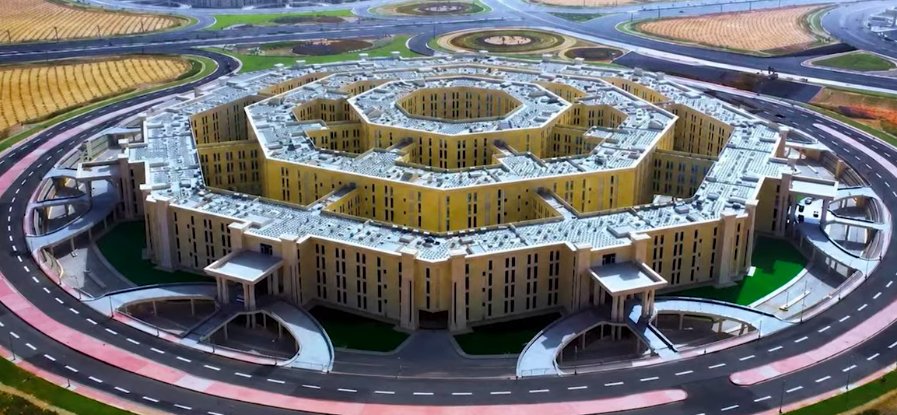
During the inauguration ceremony, El-Sisi described the facility as a transformational leap forward in military command and control while simultaneously outlining his government’s post-IMF economic roadmap, signaling that national security and economic reform are now being presented as two sides of the same national strategy.
The Details of the Complex
The Octagon has quickly attracted worldwide attention because of its astonishing size. Covering roughly 22,000 acres (approximately 34 square miles), the complex is considered the largest military headquarters ever constructed. Reports have compared it to the U.S. Pentagon, with many outlets noting that the overall complex is approximately 39 times larger than the entire Pentagon reservation, while others have emphasized that it dwarfs the Pentagon’s building footprint by an even greater margin. Regardless of which comparison is used, the message is unmistakable. Egypt has built a military command center on a scale never before seen.
The facility is named “The Octagon” because of its unique architectural design. Eight interconnected outer buildings symbolize the various branches of the Egyptian Armed Forces, while central command structures coordinate operations across the military and government. The headquarters is designed as an integrated strategic command center equipped with advanced communications, intelligence gathering, emergency management, telecommunications control, weather monitoring, logistics, and national crisis coordination. Rather than functioning as a traditional Ministry of Defense office building, the complex serves as a centralized nerve center capable of coordinating military, civil, and emergency operations across the nation.
A New Administrative Capital is Born
The headquarters is one of the centerpiece projects within Egypt’s massive New Administrative Capital, a multi-billion-dollar development intended to reduce congestion in Cairo while relocating key government ministries, military leadership, and national institutions into a purpose-built modern city. The new capital itself has become one of the largest urban development projects in the Middle East, featuring government buildings, financial districts, diplomatic quarters, residential communities, and some of Africa’s tallest skyscrapers. The Octagon reinforces the military’s central role within this new national vision.
The timing of the inauguration is equally significant. The Middle East remains one of the world’s most volatile regions, with ongoing conflicts in Gaza, instability in Sudan and Libya, Houthi attacks affecting Red Sea shipping, and increasing geopolitical competition among regional powers. By unveiling one of the world’s most sophisticated military command facilities now, Egypt appears to be signaling that it intends to strengthen its ability to respond to rapidly changing regional security challenges while protecting its strategic interests, including the Suez Canal, border security, and regional stability. Analysts also view the project as part of Cairo’s effort to reinforce its status as one of the Arab world’s leading military powers.
Military Stability is a Foundation for Long-Term Economic Growth
President El-Sisi also used the ceremony to emphasize Egypt’s broader economic direction following years of financial restructuring tied to International Monetary Fund assistance. His administration has pledged continued economic reforms, infrastructure investment, industrial development, and efforts to attract foreign investment while maintaining national security as a top priority. Linking the inauguration of The Octagon with his economic roadmap underscores how Egypt views military stability as a foundation for long-term economic growth and investor confidence.
Supporters argue that projects like The Octagon demonstrate Egypt’s emergence as a technologically advanced regional power capable of coordinating modern warfare, intelligence, cybersecurity, and disaster response from a single integrated command center. Critics, however, question whether such enormous government construction projects are appropriate at a time when many Egyptians continue to face inflation, rising living costs, and economic hardship. The debate reflects a familiar question facing many nations: how to balance national security investments with domestic economic priorities.
*****Editor’s Note*****
Whether it is seen as an engineering marvel, a strategic military asset, or a symbol of national ambition, there is little doubt that The Octagon has changed the conversation about military infrastructure worldwide. In sheer scale, it surpasses anything previously built for defense leadership and stands as one of the defining architectural and strategic projects of modern Egypt. As tensions continue to shape the Middle East, The Octagon is likely to become one of the region’s most recognizable symbols of military modernization, geopolitical influence, and Egypt’s vision for its future.
The question must also be raised about how the region feels about The Octagon. Do they feel threatened? How do they feel? What does this truly mean for the region? Time will tell. Allegiances will be formed. Stay tuned to this one.



















































Want to join the conversation?
Create an account or sign in to share your thoughts, vote,
and reply to other readers.
Showing 0 of 0 comments
Don't have an account?
Already have an account?