
Trump Considers Using the Mother of All Bombs Against Iran, but Military Experts Warn It May Be Powerless Against Deep Nuclear Bunkers
As the Trump administration considers another major military escalation against Iran, Pentagon planners are reportedly examining the possibility of deploying one of America’s most powerful conventional weapons. But military experts warn that the Mother of All Bombs, despite its enormous destructive force, may be incapable of reaching Iran’s most heavily fortified underground nuclear facilities, raising serious questions about the effectiveness, strategic purpose, and consequences of another American attack.
America’s Most Powerful Conventional Air-Blast Bomb Faces a Major Limitation in Iran
WASHINGTON, D.C. — President Donald Trump’s administration is reportedly considering the use of the GBU-43/B Massive Ordnance Air Blast bomb, commonly known as the Mother of All Bombs, as part of potential future military operations against Iran. The weapon is capable of producing an enormous conventional explosion, but defense specialists warn that its destructive power may offer surprisingly little advantage against nuclear installations buried deep beneath mountains and reinforced underground structures.
According to CNN reporting, American military planners have examined potential strike packages involving the weapon as Washington evaluates additional military options against Iranian nuclear and strategic infrastructure. The discussion has prompted renewed scrutiny of the technical limitations of the GBU-43/B, particularly its inability to penetrate deeply buried facilities protected by hundreds of feet of solid rock. Although the bomb is designed to devastate exposed targets and certain cave complexes, its effectiveness against heavily fortified subterranean installations is considerably more limited.
Seth Jones, a senior defense and security expert at the Center for Strategic and International Studies, explained that the GBU-43/B is primarily an air-blast weapon rather than a deep penetration munition. Its destructive force is generated by an enormous explosion intended to damage targets across a broad area, making it fundamentally different from specialized bunker-busting weapons designed to penetrate hardened structures before detonating. That distinction could prove decisive against facilities such as Iran’s Pickaxe Mountain complex, where extensive underground construction and substantial geological protection present extraordinary challenges for conventional military operations.
The central question facing American military planners is therefore not simply whether the United States possesses enough explosive power to attack Iranian nuclear facilities. It is whether the weapons under consideration can reach the infrastructure that matters most, penetrate the geological barriers protecting it, and inflict sufficient damage to achieve a meaningful military objective. A spectacular explosion above ground does not necessarily translate into the destruction of sensitive equipment, underground laboratories, or strategic installations located deep inside a mountain.
What Exactly Is the Mother of All Bombs?
The GBU-43/B is one of the largest conventional aerial bombs ever developed by the United States. Weighing approximately 21,600 pounds and carrying roughly 18,700 pounds of explosive material, the weapon was designed to generate an immense blast over a broad area. Developed during the early 2000s, the bomb is delivered from a modified military cargo aircraft rather than a conventional fighter jet, reflecting its extraordinary size and specialized deployment requirements.
Unlike traditional bunker-busting bombs, the MOAB is not engineered to penetrate deeply into the earth before exploding. Its destructive effects primarily come from the enormous pressure generated by its detonation, which can devastate exposed structures, military positions, and certain tunnel or cave systems. The extent of the damage depends on terrain, construction materials, distance from the explosion, and other environmental conditions. While the weapon is frequently described as capable of destroying enormous areas, its effectiveness against any particular target depends on considerably more than the size of the explosion.
The weapon became internationally famous in April 2017 when the Trump administration authorized its first combat use against an Islamic State tunnel complex in Afghanistan’s Nangarhar province. The strike demonstrated the bomb’s ability to produce an extraordinary explosion against a cave based military target, but it did not establish that the weapon could destroy deeply buried nuclear installations protected by thick layers of reinforced concrete and solid rock.
That distinction is central to the current debate over its potential use against Iran. A weapon can possess enormous explosive power without being capable of reaching a target located deep underground. Military engineers distinguish between bombs designed to generate widespread blast damage and those specifically constructed to penetrate hardened structures before detonating. The Mother of All Bombs belongs primarily to the first category, making its potential effectiveness against Iran’s most deeply buried facilities highly questionable.
Iran’s Pickaxe Mountain Presents an Extraordinary Military Challenge
One of the most significant potential targets discussed in the reporting is Pickaxe Mountain, a heavily fortified underground complex near Iran’s Natanz nuclear facility. The installation has attracted growing attention because of concerns that Iran could use extensive subterranean infrastructure to protect sensitive nuclear-related activities from aerial attack. Unlike conventional industrial facilities located above ground, deeply buried installations can benefit from substantial natural protection provided by surrounding rock formations.
Satellite imagery examined by the Center for Strategic and International Studies has documented construction activity involving tunnel entrances, road networks, protective structures, and other improvements associated with the underground complex. Analysts have identified extensive efforts to reinforce the facility and expand its infrastructure, although the precise purpose of every section remains uncertain. Publicly available imagery has not conclusively established that uranium enrichment is currently taking place inside Pickaxe Mountain, making it important to distinguish documented construction activity from assumptions about the installation’s operational role.
The mountain’s geology creates a particularly difficult military problem. Facilities protected by substantial layers of granite present challenges that cannot be solved simply by increasing the explosive yield of a bomb. Even specialized penetration weapons may struggle to reach installations located at exceptional depths, particularly when the surrounding rock is dense and the underground configuration is not fully understood.
An enormous surface explosion could damage entrances, access roads, ventilation systems, electrical connections, and exposed support infrastructure without necessarily destroying equipment located deep inside the mountain. Military planners must therefore distinguish between temporarily disrupting access to an installation and permanently disabling whatever strategic capabilities might exist within it. Those are fundamentally different objectives, and achieving one does not guarantee the other.
The uncertainty surrounding Pickaxe Mountain also complicates assessments of potential military success. Iran could potentially repair damaged entrances, develop alternate access routes, or relocate sensitive equipment if portions of the facility remained intact. Consequently, even a successful strike against visible infrastructure might produce only temporary disruption rather than the permanent elimination of a nuclear-related capability.
The GBU-57: America’s Actual Deep. Penetration Bunker Buster
For deeply buried and heavily reinforced installations, the United States possesses a different weapon: the GBU-57 Massive Ordnance Penetrator. Weighing approximately 30,000 pounds, the GBU-57 is specifically engineered to penetrate hardened underground structures before detonating, making it fundamentally different from the Mother of All Bombs.
The weapon relies on a reinforced casing, considerable mass, and delayed detonation technology to deliver destructive force beneath the surface. Public estimates indicate that it can penetrate substantial depths of earth or reinforced material, although its effectiveness depends heavily on geology, target construction, and other conditions. Penetrating ordinary soil is not equivalent to penetrating thick layers of granite, and publicly available specifications cannot establish with certainty how the weapon would perform against every underground installation.
The GBU-57 has already been used against Iranian nuclear facilities. During Operation Midnight Hammer in June 2025, American B-2 stealth bombers deployed Massive Ordnance Penetrators against targets associated with Iran’s nuclear program, including Fordow and Natanz. The operation demonstrated the United States’ willingness to employ its most sophisticated conventional bunker-busting weapons against deeply protected Iranian installations.
However, the long term effects of those attacks remain a subject of intelligence analysis and public debate. Destroying or damaging underground facilities does not necessarily eliminate scientific expertise, nuclear materials, or the ability to reconstruct equipment. Intelligence assessments must distinguish between confirmed physical destruction and assumptions about capabilities that may have survived. Even when an underground installation sustains substantial damage, determining whether the broader nuclear program has been permanently disabled requires additional evidence.
Another concern involves the availability of these specialized weapons. Defense analysts have warned that the United States maintains a limited inventory of GBU-57 penetrators and that replenishing them requires substantial industrial capacity and time. Exact stockpile figures are not publicly confirmed, but the potential scarcity of such weapons complicates decisions about additional strikes, particularly when military planners must preserve capabilities for other possible contingencies.
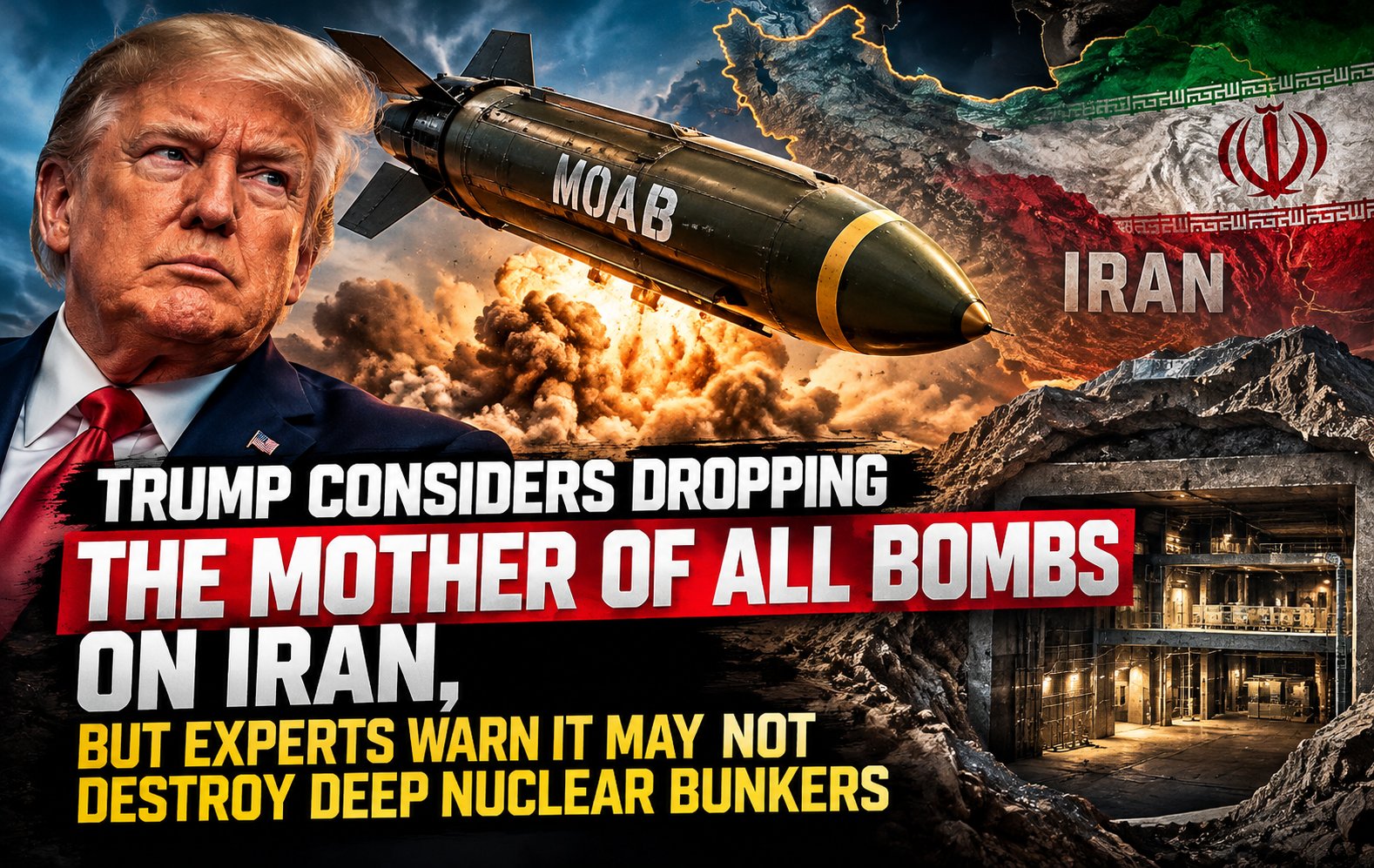
Pentagon Develops New Strike Options, but Trump Has Not Ordered the MOAB Used
CNN reported that American military planners have developed potential strike packages involving the Mother of All Bombs as the administration considers additional military options against Iran. The planning reflects continuing uncertainty over the conflict and Washington’s search for ways to pressure Tehran if diplomatic efforts fail or military tensions escalate.
The existence of military strike plans does not mean a decision to attack has been made. Pentagon planners routinely prepare options for different scenarios, and the development of a proposed operation is distinct from presidential authorization to carry it out. Reuters reported that it could not independently verify CNN’s account, while CBS News subsequently reported that the White House and Pentagon had prepared plans involving the weapon.
The military debate reportedly extends beyond whether the MOAB could physically damage Iranian targets. Officials and analysts have questioned whether deploying such a large weapon would meaningfully advance American strategic objectives, particularly if the most important underground installations survived the attack. A dramatic explosion might demonstrate military capability and signal determination, but those effects are different from eliminating a nuclear facility or compelling a negotiated settlement.
That distinction matters because using the MOAB against Iran would represent a significant military escalation without necessarily guaranteeing a corresponding strategic advantage. If the weapon destroyed surface infrastructure but failed to reach the protected underground facilities, Washington could find itself confronting the political and military consequences of a major strike without achieving its intended objective.
The Risk of Escalation Extends Far Beyond Iran’s Nuclear Facilities
Any renewed American strikes against Iranian nuclear or energy infrastructure would carry substantial regional consequences. Iran possesses military capabilities and relationships across the Middle East, and additional attacks could provoke retaliation against American forces, regional infrastructure, commercial shipping, or other strategic interests. The potential consequences would depend on the targets selected, the scale of the operation, and Tehran’s response.
Energy facilities present additional concerns because damage to petroleum infrastructure could disrupt international supplies, intensify price volatility, and create environmental hazards. Attacks near civilian populations would also raise serious questions under international humanitarian law, which requires military operations to distinguish between military objectives and civilian objects and prohibits attacks expected to cause excessive civilian harm relative to the anticipated concrete and direct military advantage.
The Mother of All Bombs’ enormous blast effects make those considerations particularly important. Its use near populated areas or infrastructure serving civilian communities could produce extensive damage beyond an intended military target. The legality of any strike would depend on the nature of the target, the expected civilian consequences, and the precautions taken to minimize harm.
There is also a broader diplomatic risk. Even if a strike successfully damaged a nuclear-related installation, it could encourage Iran to accelerate efforts to disperse sensitive activities, harden additional facilities, or reduce cooperation with international monitoring organizations. Military force can damage physical infrastructure, but preventing nuclear proliferation also requires reliable intelligence, verification, and sustained international engagement.
Iran maintains that its nuclear activities serve peaceful purposes, while Western governments have raised concerns about uranium enrichment, nuclear transparency, and the potential military applications of advanced nuclear technology. Those disagreements cannot necessarily be resolved through the destruction of individual facilities, particularly when scientific expertise, nuclear materials, and industrial capabilities may exist at multiple locations.
An Enormous Explosion Is Not the Same as a Military Victory
The debate over the Mother of All Bombs exposes a fundamental challenge facing American military planners. The United States possesses extraordinary conventional firepower, but the effectiveness of any weapon depends on whether it is suited to the target and the strategic objective. A weapon designed to devastate a broad surface area cannot automatically substitute for a specialized penetrator when the intended target is located deep beneath a mountain.
The MOAB is capable of destroying exposed positions and damaging certain cave complexes. The GBU-57 is designed to attack deeply buried hardened facilities. Neither weapon can guarantee the permanent elimination of a dispersed nuclear program, particularly when sensitive materials, technical expertise, and infrastructure may exist at multiple locations. The challenge becomes even greater at facilities such as Pickaxe Mountain, where the precise underground configuration remains uncertain. A strike could damage entrances and surface infrastructure while leaving deeper installations intact. Conversely, even a technically successful penetration might fail to achieve a lasting strategic result if Iran retained the capacity to rebuild or relocate its activities.
That uncertainty is why defense analysts emphasize the importance of clearly defining the military objective before selecting a weapon. A mission intended to disrupt access to an underground installation is different from one intended to destroy equipment, eliminate nuclear material, or compel a political concession. Each objective requires different capabilities, different intelligence, and different evidence of success. The United States has already demonstrated its willingness to use the GBU-57 against Iranian nuclear facilities. The latest reports suggest that Washington is now considering whether the MOAB could provide another military option. Yet the weapon’s immense explosive power does not resolve the underlying question of whether another round of strikes would produce a durable strategic outcome.
Washington Faces a Decision With Consequences Beyond the Battlefield
The possibility of using the Mother of All Bombs against Iran comes as the Trump administration faces difficult choices over military escalation, diplomatic negotiations, and the long term objectives of American policy toward Tehran. CNN’s reporting indicates that the Pentagon has been preparing options rather than executing a newly authorized MOAB strike, leaving the ultimate decision with the president. The technical limitations of the weapon are central to that decision. A bomb designed to create an enormous surface blast cannot automatically substitute for a specialized penetrator when the intended target is buried beneath a mountain. Nor can the destruction of a single facility establish that a country’s broader nuclear capabilities have been eliminated.
For American policymakers, the challenge is determining whether additional military action would accomplish a clearly defined objective at an acceptable cost, including the risks of retaliation, civilian harm, regional instability, and further conflict. For international inspectors and diplomats, the unresolved issue remains how to establish verifiable limits on Iran’s nuclear activities and determine what capabilities remain after previous attacks.
The debate also raises broader questions about the relationship between military technology and strategic success. Modern weapons can deliver extraordinary destructive power, but the ability to destroy a target is only one component of military effectiveness. Intelligence accuracy, operational planning, target selection, and the political consequences of an attack all influence whether the use of force achieves its intended purpose. The Mother of All Bombs may be capable of producing one of the largest conventional explosions in the American arsenal. But the central question facing Washington is not how big an explosion it can create. It is whether that explosion could actually reach the targets the United States wants to destroy — and whether destroying them would bring the conflict any closer to an end.





















































Want to join the conversation?
Create an account or sign in to share your thoughts, vote,
and reply to other readers.
Showing 0 of 0 comments
Don't have an account?
Already have an account?