

Pentagon’s Story Unravels: Admiral Says Drug Boat Survivors Never Called for Backup Before U.S. Military Killed Them
WASHINGTON, D.C. — A senior U.S. Navy admiral’s testimony to Congress has undermined a central justification previously offered by Pentagon officials for a controversial American military strike that killed two shipwrecked survivors in the Caribbean Sea. The revelation has intensified allegations that the Trump administration unlawfully used military force against suspected drug traffickers and renewed questions about Defense Secretary Pete Hegseth’s responsibility for an operation that legal experts warn may constitute a war crime.
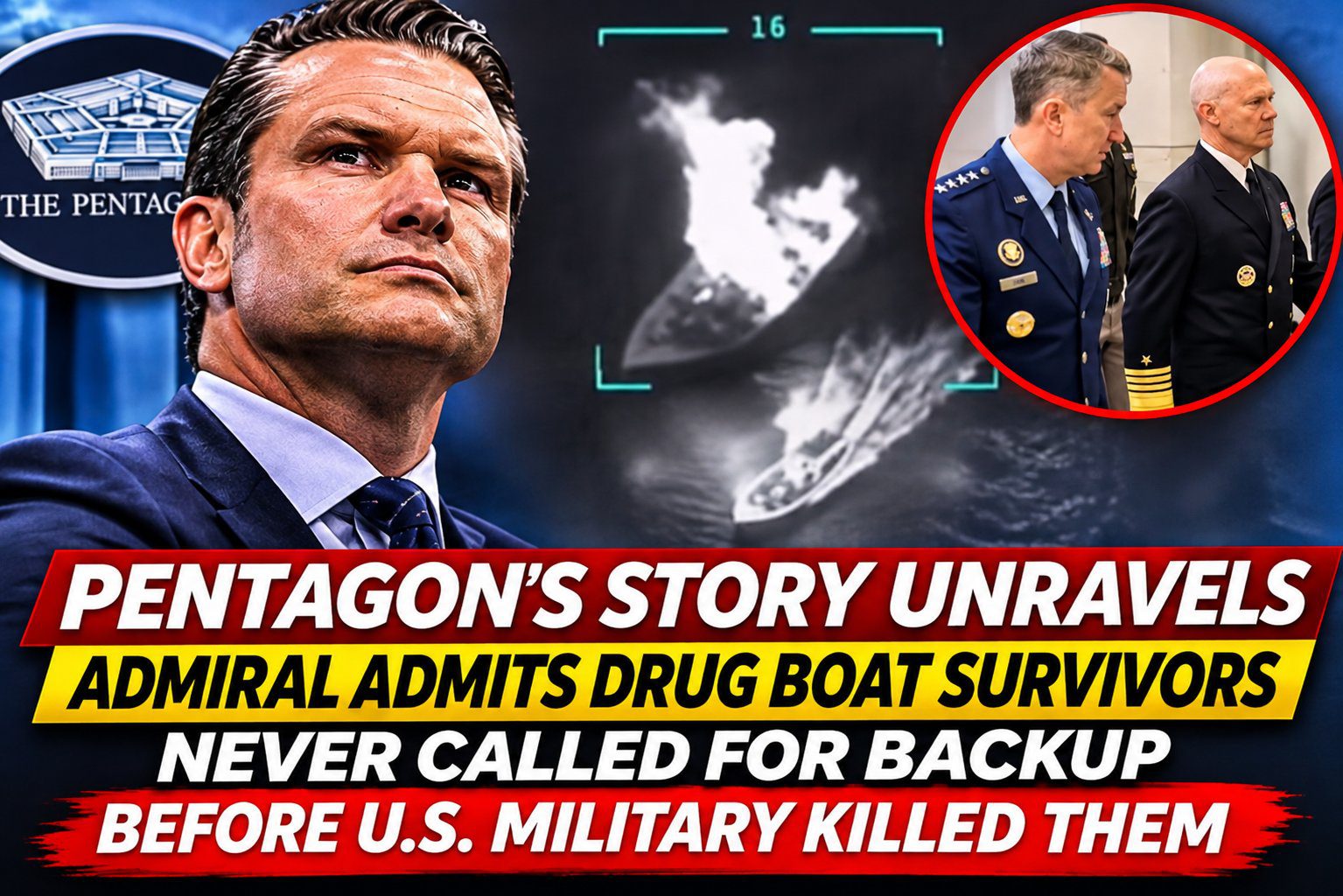
Admiral Frank “Mitch” Bradley, who oversaw the September 2, 2025, attack on an alleged drug smuggling vessel, told lawmakers during classified briefings that the two men who survived the initial strike did not appear to possess radios or other communications equipment. His account directly contradicted an explanation previously circulated by defense officials suggesting that the survivors were attempting to contact reinforcements and could therefore be considered continuing threats.
The distinction is critical because the men were no longer operating an intact vessel when American forces struck them again. According to lawmakers who reviewed classified surveillance footage, the initial attack had destroyed their boat, leaving the two survivors clinging to overturned wreckage in open water. Rather than attempting to escape an active firefight or launch another attack, the men appeared to be struggling to remain afloat when the military fired a second strike that killed them.
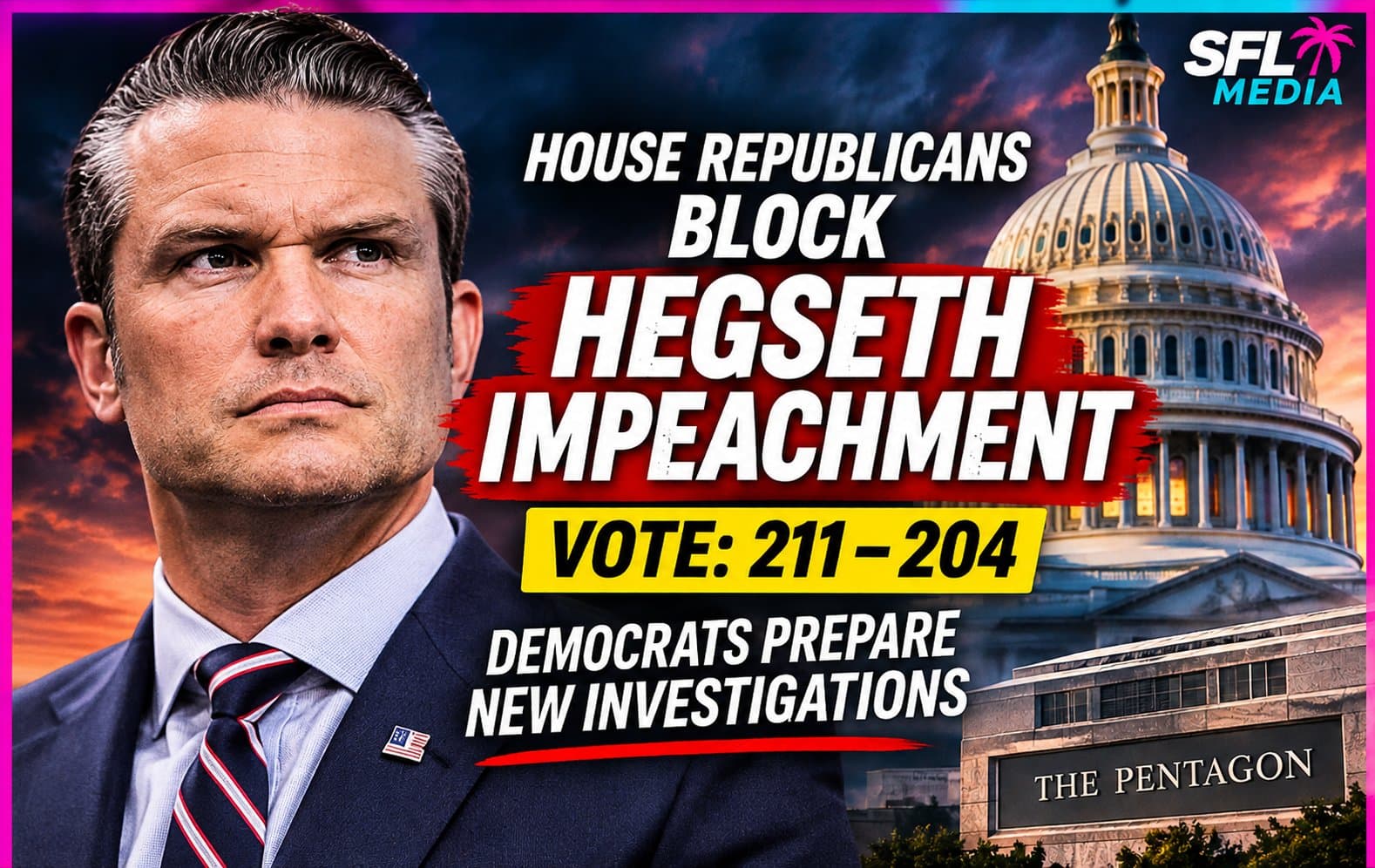
The incident has become a central controversy in the impeachment effort against Hegseth, whose broader military campaign against suspected drug-trafficking vessels has killed more than 240 people. On November 10, the Republican controlled House voted 211–204 to refer eight articles of impeachment introduced by Republican Rep. Thomas Massie of Kentucky to the Judiciary Committee, effectively sidelining the effort for the remainder of the current Congress.
Admiral’s Testimony Contradicts Earlier Pentagon Explanation
The controversy surrounding the September 2 operation intensified after CNN reported that Bradley had acknowledged during closed door congressional briefings that the survivors did not appear to have communications equipment. According to sources familiar with the classified testimony, defense officials had previously suggested that the men were attempting to call for assistance, an explanation used to argue that they remained legitimate military targets despite the destruction of their vessel.
Bradley’s account presented a substantially different picture. The initial strike killed nine people and left two survivors clinging to a partially submerged section of the boat. Military personnel monitored the wreckage for approximately 41 minutes before Bradley ordered another strike, which killed both men. According to accounts of his testimony, Bradley believed the floating wreckage still contained cocaine and that the survivors might eventually reach safety, recover the drugs, and resume trafficking activities.
That reasoning has become a central point of contention. The possibility that suspected criminals might escape, recover contraband, or commit another offense does not automatically authorize military forces to kill them. Legal experts have questioned whether the United States had a lawful basis to treat suspected drug traffickers as enemy combatants in the first place, much less attack survivors who were no longer operating their vessel.
The classified footage has not been publicly released in full, leaving Americans dependent on descriptions from lawmakers and officials who have viewed it. Nevertheless, Bradley’s reported acknowledgment that the men were not calling for backup significantly weakens one of the explanations previously offered for the follow up strike.
Lawmakers Describe Disturbing Footage of Men Clinging to Wreckage
Rep. Jim Himes, a Connecticut Democrat and senior member of the House Intelligence Committee, described the classified recording as “one of the most troubling things” he had witnessed during his congressional service. Himes said the men were clinging to wreckage, lacked the apparent means to continue their trafficking operation, and were in no position to threaten American military personnel.
Republican Sen. Tom Cotton of Arkansas offered a sharply different interpretation after reviewing the footage, defending the strikes as lawful and arguing that the survivors were attempting to overturn their vessel and continue their mission. Cotton maintained that the military had acted appropriately in targeting a boat believed to be transporting illegal narcotics.
The competing descriptions expose the fundamental disagreement surrounding the operation. Supporters of the strikes argue that drug trafficking organizations represent a national security threat and that the military can use lethal force to disrupt their operations. Critics counter that suspected drug smuggling is ordinarily a law-enforcement matter and that possessing narcotics, even in large quantities, does not by itself make someone a lawful military target.
Even accepting the government’s characterization of the passengers as suspected traffickers, the legal questions surrounding the second strike remain. The men were reportedly unarmed, their vessel had been disabled, and no evidence presented publicly establishes that they were attempting to attack American forces or engage in other hostilities when they were killed.
Drug Trafficking Is Not Automatically an Armed Conflict
The administration’s legal justification rests heavily on its characterization of drug cartels and trafficking networks as hostile organizations engaged in an armed conflict with the United States. That position has faced substantial criticism from military lawyers, international law specialists, and lawmakers who argue that the executive branch cannot transform ordinary criminal activity into warfare simply by declaring suspected traffickers to be enemies.
Rep. Jake Auchincloss, a Massachusetts Democrat and former Marine officer with experience in counternarcotics operations, has argued that drug interdiction is fundamentally a law enforcement mission. Under that framework, suspected traffickers can be intercepted, searched, arrested, and prosecuted, while lethal force is generally limited to circumstances involving an immediate threat to life or other narrowly defined legal justifications.
The law of armed conflict operates under a different framework, permitting attacks against lawful military objectives and certain combatants during an actual armed conflict. But even under that framework, international humanitarian law provides specific protections for shipwrecked individuals who are in distress and refrain from hostile acts.
That distinction makes the September 2 operation particularly controversial. If the United States was conducting a law enforcement mission, the deliberate killing of survivors who posed no imminent threat would face extraordinarily serious legal obstacles. If the administration’s armed conflict theory were accepted, the survivors could still qualify for protection as shipwrecked persons unless their conduct removed that protection.
A suspicion that they might eventually recover drugs or resume criminal activity would not, standing alone, establish that they were actively participating in hostilities. The government’s legal theory therefore faces scrutiny regardless of which framework is applied.
Who Ordered the Second Strike, and What Did Hegseth Know?
The chain of command has become another major focus of the investigation. Earlier reporting by The Washington Post described an alleged directive from Hegseth to “kill everybody,” an account the defense secretary has denied. Subsequent testimony and statements from officials have identified Bradley as the commander who made the specific tactical decision to conduct the follow up strike.
Hegseth has acknowledged authorizing the broader military operation but maintains that he watched the initial attack before leaving for other meetings and learned about the second strike afterward. Accounts from lawmakers briefed by Bradley have not established that Hegseth personally ordered the killing of the two survivors, and that allegation should not be presented as a proven fact.
However, the distinction between issuing a specific order and bearing command responsibility is legally significant. Senior officials can face scrutiny over the rules of engagement they approve, the operational policies they establish, and their knowledge of potentially unlawful conduct by subordinate commanders. Whether those principles create legal liability in this case depends on evidence concerning the orders, command structure, applicable law, and what officials knew at the relevant times.
The administration has defended Bradley’s actions and maintained that the military campaign is lawful. Hegseth has also rejected the impeachment effort, describing it as a political stunt while insisting that American forces are carrying out legitimate presidential orders against dangerous trafficking organizations.
Hegseth Impeachment Effort Raises Stakes for Pentagon
The controversy has now moved beyond the legality of a single strike. Massie’s eight articles of impeachment accuse Hegseth of multiple abuses of military authority, including unauthorized operations involving Iran, Yemen, Venezuela, and suspected drug-trafficking vessels in the Caribbean and eastern Pacific.
One article specifically challenges the Pentagon’s campaign against alleged traffickers, accusing Hegseth of overseeing extrajudicial killings and unlawful attacks on survivors at sea. The resolution also raises broader concerns about the administration’s interpretation of presidential war powers and its treatment of legal restrictions governing military operations.
On November 10, House Republicans succeeded in referring the impeachment resolution to committee by a 211–204 vote. The procedural maneuver prevented an immediate vote on impeachment itself, while the absence of 11 Democratic lawmakers contributed to the failure of the effort to advance. Seven Republicans were also absent, and the vote did not constitute a finding that Hegseth’s conduct was lawful.
Massie’s effort nevertheless established that opposition to the defense secretary’s conduct extends beyond the Democratic Party. The Kentucky Republican has argued that Congress must enforce constitutional limits on military power regardless of which party controls the White House. With Democrats preparing to take control of Congress in January 2027, the September 2 strike and the broader maritime campaign could face renewed oversight, additional hearings, and further demands for classified operational records. Any subsequent impeachment would still require a House majority, while removal from office would require conviction by a two-thirds majority in the Senate.
The Central Question: Can the U.S. Military Kill People Who Are No Longer a Threat?
The September 2 strike has exposed a fundamental question about the limits of American military power: Does the government have the authority to kill suspected criminals at sea without attempting to arrest them, and can it launch another strike against survivors after their vessel has already been destroyed?
The administration argues that its operations are necessary to combat trafficking organizations responsible for transporting dangerous narcotics. Yet the existence of a serious criminal threat does not automatically eliminate constitutional restrictions, international legal obligations, or the distinction between law enforcement and warfare. Bradley’s testimony has made those questions more difficult for the Pentagon to dismiss. The earlier suggestion that the survivors were calling for backup has been contradicted by the admiral’s reported account, while the subsequent justification that they might recover cocaine does not resolve whether they were lawful targets at the moment the second strike was ordered.
The full classified video, operational orders, intelligence assessments, and legal authorizations remain essential to determining exactly what happened and who bears responsibility. Until those materials are subjected to meaningful independent scrutiny, important questions about the operation will remain unanswered. The Pentagon may argue that destroying drug-smuggling vessels protects American lives. But preventing narcotics trafficking and deliberately killing shipwrecked survivors are two fundamentally different acts, and the legality of one cannot simply be assumed to justify the other.
The ultimate issue is not whether the men aboard the vessel were suspected criminals. It is whether the United States government had lawful authority to kill them after they were left helpless in the water. That question now stands at the center of a growing confrontation between the Pentagon, Congress, and the legal principles governing the use of military force.

Sources & Further Reading
- CNN — Admiral Says Drug Boat Survivors Did Not Radio for Backup
- CNN — Congressional Briefings and the September 2 Strike
- CNN — Video Report on the Survivors and Legal Controversy
- The Washington Post — How Admiral Bradley Decided to Kill Two Boat Strike Survivors
- Reuters — House Blocks Effort to Impeach Defense Secretary Hegseth
- CBS News — Massie Introduces Eight Articles of Impeachment Against Hegseth
- NBC News — Republican-Led House Refers Hegseth Impeachment Resolution to Committee
- PolitiFact — Legal and Constitutional Questions Surrounding Hegseth’s Impeachment
- South Florida Media — News and Political Reporting


Loading comments…