

Amazon and Jeff Bezos Bent the Knee to Trump, Here’s Where Americans Can Shop Instead
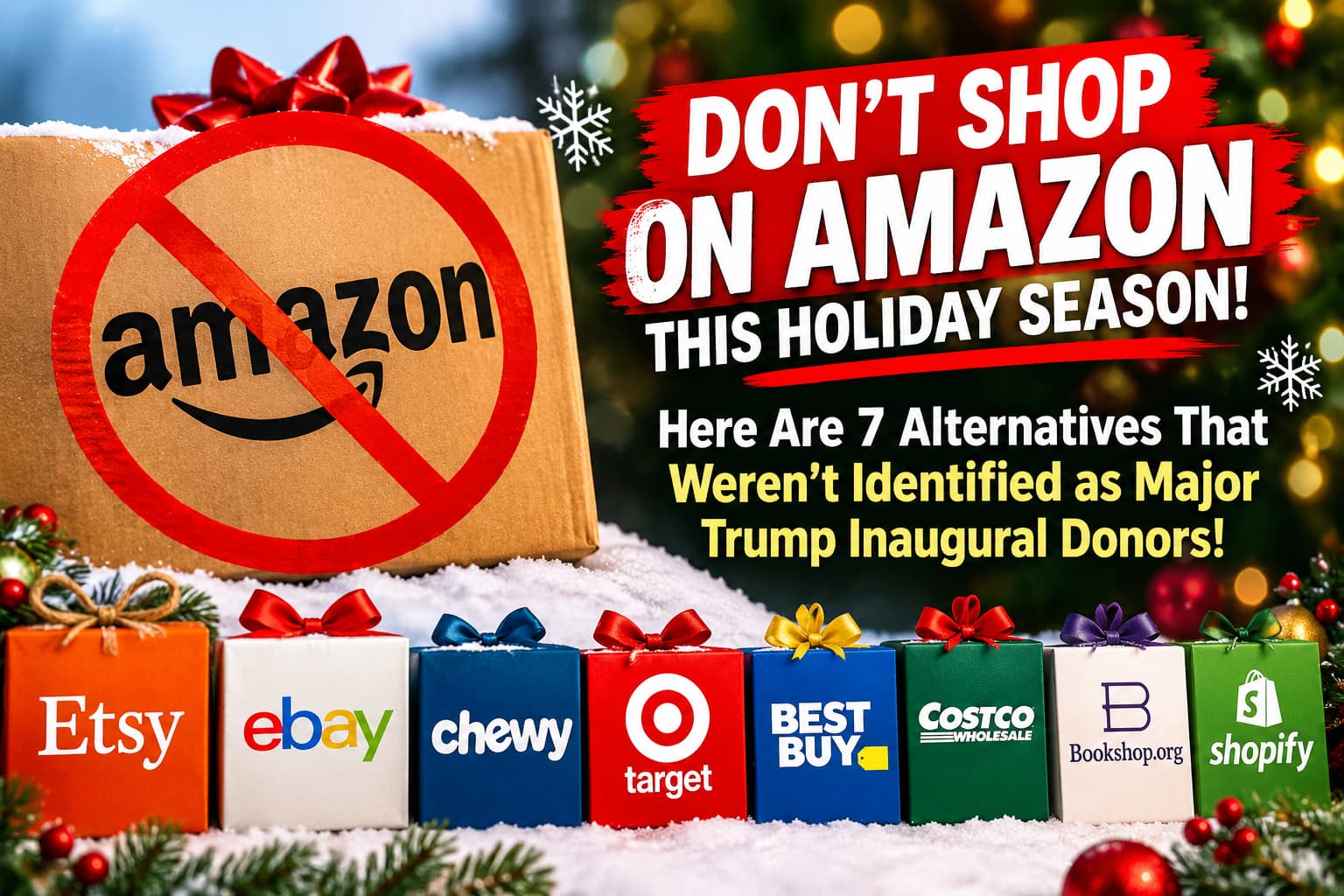
Amazon helped bankroll Donald Trump’s return to the White House with a $1 million inaugural contribution and an additional $1 million in streaming services. As Jeff Bezos and other technology billionaires strengthen their relationships with Washington, consumers looking to take their business elsewhere have alternatives, including independent marketplaces, bookstores, and retailers that have not been publicly identified among Trump’s major inaugural donors.
For years, Amazon founder Jeff Bezos cultivated an image as one of America’s most ambitious entrepreneurs, transforming a modest online bookstore into a global commercial empire. Along the way, Amazon became an essential part of American consumer life, delivering everything from household necessities and electronics to groceries and prescription medications. But the company’s financial support for Donald Trump’s second presidential inauguration has reignited a question that extends far beyond convenience and free shipping: Should Americans continue rewarding corporations that help finance political leaders whose policies they oppose?
In December 2024, Amazon announced that it would contribute $1 million to Trump’s 2025 inaugural fund while providing an additional $1 million worth of inauguration coverage through its Prime Video streaming platform. The combined commitment, valued at approximately $2 million, placed Amazon among the major technology companies seeking to establish relationships with the incoming administration. Meta, Google’s parent company Alphabet, and several other powerful corporations also contributed to the inauguration, part of an extraordinary wave of corporate financial support surrounding Trump’s return to Washington.
The donations were legal, but their political implications were impossible to ignore. Amazon faces substantial federal scrutiny involving competition, labor practices, and other regulatory matters, while its Amazon Web Services division conducts extensive business with government agencies. For a corporation with billions of dollars potentially affected by federal policy, maintaining access to the White House is more than a ceremonial concern. Although there is no established evidence that Amazon’s inaugural contribution purchased favorable government treatment, the financial relationship raises legitimate questions about corporate influence and the incentives encouraging America’s wealthiest businesses to cultivate presidential relationships.
Jeff Bezos, Donald Trump, and the Washington Post Controversy
Amazon’s financial support for Trump’s inauguration followed another controversial decision involving Bezos, this time at The Washington Post, the newspaper he purchased personally in 2013. In October 2024, less than two weeks before the presidential election, the newspaper announced that it would not endorse a candidate, abruptly ending a decades-long practice of presidential endorsements. The decision prevented publication of a planned endorsement of Democratic nominee Kamala Harris and sparked immediate backlash among journalists, subscribers, and prominent figures associated with the publication.
The Washington Post subsequently reported that Bezos himself made the decision to discontinue presidential endorsements. Several journalists publicly criticized the move, and columnist Robert Kagan resigned in protest. Reuters reported that more than 200,000 digital subscribers had canceled their subscriptions in the immediate aftermath, reflecting widespread anger among readers who viewed the decision as a retreat from the newspaper’s editorial responsibilities at a critical moment in American politics.
Bezos defended the decision, arguing that presidential endorsements contributed to public perceptions of media bias and undermined confidence in journalism. He also denied that the decision was connected to political pressure or a meeting between Trump and the chief executive of Blue Origin, Bezos’s aerospace company. Nevertheless, the controversy placed the billionaire’s overlapping business interests under intense scrutiny, particularly as Amazon subsequently joined other major corporations in contributing to Trump’s inauguration.
For critics, the sequence of events created the appearance of a billionaire businessman becoming increasingly accommodating toward a political figure who had previously attacked both Amazon and The Washington Post. That interpretation remains a political judgment rather than proof of an improper agreement, but it illustrates why Bezos’s influence across commerce, media, and government contracting has become such a consequential issue.
Trump’s $239 Million Inauguration and the Corporate Money Behind It
The scale of corporate involvement in Trump’s second inauguration was extraordinary. According to Federal Election Commission disclosures analyzed by The Washington Post and the Brennan Center for Justice, Trump’s 2025 inaugural committee raised approximately $239 million in its initial fundraising period, more than double the previous inaugural fundraising record established during his first presidential inauguration in 2017. The contributors included major technology companies, financial institutions, energy businesses, cryptocurrency interests, and wealthy individuals with substantial interests in federal policy.
Amazon’s $1 million cash contribution was part of a broader pattern. Meta contributed $1 million, Google’s parent company Alphabet contributed $1 million, and Uber and its chief executive Dara Khosrowshahi each contributed $1 million. Apple CEO Tim Cook personally contributed $1 million, an important distinction because his contribution was not a corporate donation from Apple. These financial commitments illustrate the willingness of some of America’s most powerful business interests to support the ceremonies surrounding a president whose administration would exercise considerable authority over their industries.
The Brennan Center for Justice found that technology interests collectively contributed approximately $44.6 million to Trump’s inauguration. The organization also noted that many inaugural donors had not financially supported Trump’s presidential campaign through the same channels, highlighting the difference between contributing to a candidate’s election and supporting an administration after its victory. The motivations of individual donors cannot be established from financial disclosures alone, but the extraordinary sums involved underscore the importance of transparency surrounding political access and corporate influence.
For Americans uncomfortable with this relationship between corporate wealth and political power, one response is to reconsider where they shop. Amazon may dominate online retail, but it does not have a monopoly on consumer choice.
Where to Shop Instead of Amazon: Seven Alternatives Worth Considering
Consumers looking to reduce their dependence on Amazon have several established options, ranging from independent marketplaces and specialty retailers to major warehouse stores. However, these businesses should not automatically be described as politically progressive or entirely disconnected from Republican politics. The more defensible distinction is between companies with documented contributions to Trump’s 2025 inauguration and alternatives for which comparable corporate contributions have not been established in the reporting reviewed for this article.
1. Etsy: Supporting Independent Artists and Small Businesses
Etsy offers one of the most recognizable alternatives to Amazon for handmade merchandise, personalized gifts, artwork, jewelry, vintage goods, and home decorations. Rather than operating primarily as a conventional mass-market retailer, Etsy provides a marketplace where independent sellers can reach customers around the world, giving consumers an opportunity to support individual entrepreneurs and smaller businesses.
Etsy was not among the major corporate contributors identified in the reviewed reporting on Trump’s 2025 inauguration. That does not establish that every executive, employee, or merchant associated with the platform opposes Trump, nor does it constitute a complete audit of political contributions. Nevertheless, Etsy’s marketplace model provides a practical alternative for shoppers interested in directing more of their purchases toward independent sellers rather than Amazon.
2. eBay: An Established Marketplace for New and Used Merchandise
eBay remains one of the largest online marketplaces for electronics, collectibles, refurbished equipment, automotive parts, clothing, and secondhand merchandise. Its extensive network of independent sellers makes it particularly useful for consumers who want to purchase products without relying on Amazon’s retail and fulfillment operations.
Politically, eBay presents a more complicated picture. The company operates a registered federal political action committee, the eBay Inc. Committee for Responsible Internet Commerce, which participates in congressional politics. Federal Election Commission records show that the committee made $178,000 in contributions to other committees between January 2025 and August 2026. Those contributions should not be confused with corporate inaugural donations, but they demonstrate why eBay cannot accurately be characterized as a company that avoids political spending altogether.
3. Costco: A Major Retailer That Defended Its Diversity Policies
Costco offers a substantial alternative to Amazon for groceries, electronics, appliances, furniture, household essentials, and bulk purchases. Its membership-based warehouse model allows consumers to shop online or in physical stores, making it particularly attractive for families and businesses seeking competitive prices on everyday necessities.
The company also distinguished itself during the national backlash against corporate diversity, equity, and inclusion programs. In January 2025, Costco shareholders overwhelmingly rejected a proposal challenging the company’s DEI policies, with more than 98% of votes cast opposing the measure. Costco’s board had unanimously recommended rejecting the proposal, arguing that its diversity initiatives supported business performance and customer satisfaction.
The decision stood in contrast to companies that reduced or abandoned diversity initiatives amid political pressure. Although Costco’s position on workplace diversity does not establish its complete political-donation history, it provides consumers with a documented example of a major corporation publicly defending policies that had become targets of the Trump administration and conservative activists.
4. Bookshop.org: An Alternative Designed to Support Independent Bookstores
For readers seeking an alternative to purchasing books through Amazon, Bookshop.org offers one of the most compelling options. The online marketplace was created to support independent bookstores, allowing consumers to purchase books while helping sustain smaller retailers that have struggled to compete with Amazon’s enormous commercial reach.
Unlike traditional online marketplaces that prioritize a single corporation’s retail operations, Bookshop.org’s business model is designed to direct financial support toward independent bookstores. Customers can also choose specific participating bookstores to support, making the platform particularly appealing to readers who value independent businesses, literary culture, and community-based commerce.
The company’s mission is not proof of any particular political affiliation, but its independent bookstore model offers a clear economic alternative to Amazon’s dominance of online book sales.
5. Chewy: A Specialized Alternative for Pet Owners
Chewy has developed into a major online retailer specializing in pet food, medications, toys, grooming products, and other supplies. Its recurring delivery options and extensive product selection make it a practical substitute for Amazon’s pet department, particularly for customers who regularly purchase food and other necessities for their animals.
Chewy was not identified among the major corporate inaugural contributors in the reporting reviewed for this article. However, the available information does not establish a comprehensive record of political donations by the company’s executives, employees, or affiliated interests. Consumers should therefore view Chewy as a convenient alternative to Amazon rather than a verified politically neutral retailer.
6. Best Buy: Electronics Without Relying on Amazon
Best Buy remains a major competitor in consumer electronics, offering computers, televisions, smartphones, appliances, gaming equipment, and home entertainment products through its website and physical retail locations. Its combination of online ordering, local pickup, technical support, and product installation services gives customers options that do not require purchasing directly through Amazon.
Best Buy was not among the prominent inaugural contributors identified in the reviewed reporting, although that absence does not establish that the company or its affiliated political interests have never supported Trump or Republican candidates. For consumers focused primarily on reducing their dependence on Amazon, however, Best Buy provides an established alternative for major electronics purchases.
7. Independent Stores Using Shopify: Buying Directly From Smaller Businesses
Shopify operates differently from the other businesses on this list because it is primarily an e-commerce technology platform rather than a centralized online department store. Its software allows independent merchants to operate their own websites, process transactions, manage inventory, and sell merchandise directly to consumers.
For shoppers looking to move away from Amazon, buying directly from a small business operating on Shopify can be particularly valuable. Instead of purchasing through Amazon’s marketplace, customers can transact with independent retailers that maintain greater control over their branding, customer relationships, and business operations. Shopify still earns revenue through its software and payment services, and its merchants represent a wide variety of political perspectives, but the platform gives consumers access to businesses outside Amazon’s retail ecosystem.
One Major Retailer That Does Not Belong on the List: Target
Target is frequently included in online discussions about alternatives to Amazon, but its political contributions make it unsuitable for a list specifically identifying retailers that avoided financially supporting Trump’s 2025 inauguration.
Federal Election Commission records confirm that Target contributed $1 million to Trump’s inaugural committee on January 10, 2025. The Minnesota Star Tribune reported that the contribution represented Target’s first donation to a presidential inaugural fund, a notable development for a retailer that had previously cultivated a reputation for supporting diversity and inclusion initiatives.
The donation became particularly controversial because Target subsequently announced changes to its DEI programs, including the rollback of certain diversity goals. The company said its political engagement was intended to maintain relationships with elected officials across government, but critics questioned whether its corporate priorities were shifting in response to the new administration.
Walmart also contributed $150,000 to Trump’s inauguration, according to the same reporting. Consequently, neither Target nor Walmart should be presented as a retailer that declined to financially support the president’s inaugural celebration.
These examples demonstrate why politically motivated shopping guides require careful verification. A retailer’s public image, employee political preferences, or historical support for social causes cannot substitute for actual financial disclosures.
The Difference Between Corporate Donations and Employee Political Contributions
One of the most persistent problems with politically motivated consumer boycotts is the failure to distinguish between different types of political spending. Under federal campaign finance law, corporations generally cannot use treasury funds to contribute directly to federal candidates. They can, however, participate in certain political activities, support independent expenditures under applicable rules, establish eligible political action committees, and contribute to presidential inaugural committees.
Individual executives and employees also have the right to make personal political contributions, which are often aggregated by employer in campaign finance databases. Those records can reveal political patterns within an organization, but they do not necessarily represent the official position of the company itself.
This distinction is especially important when evaluating online claims that a particular retailer supports or opposes Donald Trump. A donation from an employee does not mean the employer authorized it, just as a contribution from a corporate PAC to a Republican congressional candidate does not automatically establish direct support for Trump’s presidential campaign. Conversely, a documented corporate contribution to Trump’s inaugural committee provides clear evidence that company resources were used to financially support his inauguration.
Consumers who want to make informed decisions should therefore examine corporate inaugural contributions, PAC activity, executive donations, and public policy positions separately rather than treating them as interchangeable evidence.
Why Consumer Spending Still Matters
Amazon’s enormous commercial success was built on consumer behavior. Millions of Americans embraced the convenience of online ordering, rapid delivery, competitive pricing, and an extensive product catalog, helping transform the company into one of the world’s most powerful corporations. That success also contributed to the extraordinary personal wealth of Bezos, who remains Amazon’s executive chairman and one of its major shareholders.
Individual purchases do not directly finance particular political contributions, and it would be inaccurate to suggest that buying a household product from Amazon automatically sends money to Trump. Nevertheless, consumer spending contributes to corporate revenue, profitability, and market strength, all of which can increase the resources available to large companies and their executives.
When shoppers choose independent businesses or competing retailers, they redirect economic activity away from Amazon. The effect of any individual purchase may be small, but widespread changes in consumer behavior can influence corporate performance and business decisions over time.
For South Florida residents, that choice also extends beyond national websites. Independent bookstores, neighborhood boutiques, specialty retailers, and locally owned businesses throughout Fort Lauderdale, Miami, and Palm Beach County offer opportunities to support regional commerce rather than concentrating additional spending within the country’s largest online retail platforms.
Buying locally does not guarantee that a business shares a customer’s political beliefs, but it can help distribute economic activity across a wider range of merchants and communities.
The Bigger Problem: Billionaires, Political Access, and Corporate Power
The controversy surrounding Bezos and Amazon reflects a larger issue in American politics: the extraordinary concentration of economic and political influence among a relatively small group of billionaires and multinational corporations.
Bezos controls significant interests across several industries. In addition to his position at Amazon, he owns The Washington Post and founded Blue Origin, a company involved in aerospace technology and government contracting. Amazon itself operates a vast cloud computing business with major public-sector customers, while also facing regulatory scrutiny concerning competition and labor practices.
These overlapping interests create legitimate questions about the relationship between corporate executives and the government officials responsible for regulating their businesses. A presidential inauguration may appear ceremonial, but contributions to inaugural committees provide opportunities for corporations and wealthy individuals to demonstrate support for an incoming administration.
The Brennan Center’s analysis of Trump’s 2025 inaugural fundraising highlights the extent to which industries facing significant federal policy decisions participated in the fundraising effort. Although donations alone do not prove improper influence, the unprecedented scale of the contributions raises important concerns about transparency, political access, and the potential for conflicts of interest.
For Americans concerned about those relationships, consumer choice represents one of several ways to express disagreement. Voting, political organizing, shareholder activism, and public advocacy remain important mechanisms for influencing corporate and government behavior, but spending decisions can also communicate consumer priorities.
Americans Have More Choices Than Amazon Wants Them to Remember
Amazon’s rise transformed American shopping, but its convenience does not obligate customers to remain loyal to the company. Consumers who object to its financial support for Trump’s inauguration can choose independent marketplaces, specialty retailers, bookstores, and local businesses without abandoning online shopping altogether.
The alternatives are not politically identical, and none should be described as completely free of political influence without comprehensive evidence. What they offer is something more practical: an opportunity to direct consumer spending away from Amazon while evaluating businesses according to their documented conduct rather than their marketing.
Jeff Bezos has every right to make decisions about his businesses, his newspaper, and his relationships with elected officials. Americans have an equally important right to decide whether those decisions deserve their continued financial support.
Amazon may have built its empire on convenience, but convenience is not loyalty. And when billionaires use their enormous financial power to cultivate relationships with politicians, consumers are entitled to reconsider whose businesses they want to support.
The checkout button will never replace the ballot box. But it remains one place where Americans can make their priorities known.

Sources & Further Reading
-
Reuters — Amazon’s $1 Million Inaugural Contribution and Prime Video Coverage
-
The Washington Post — Trump’s $239 Million Inauguration and Its Major Donors
-
Brennan Center for Justice — Million-Dollar Donors Flooded Trump’s Second Inauguration
-
Minnesota Star Tribune — Target’s $1 Million Trump Inaugural Donation and Walmart’s Contribution
-
Federal Election Commission — Official Filing Documenting Target’s $1 Million Contribution
-
Reuters — Bezos Defends Washington Post Endorsement Decision Amid Subscriber Backlash
-
The Washington Post — Decision to End Presidential Endorsements
-
Federal Election Commission — eBay PAC Official Financial Records
-
Federal Election Commission — Trump-Vance 2025 Inaugural Committee Filings











Loading comments…