

Is Ro Khanna and Congress Protecting Americans or Just Trying to Control the Betting Business?
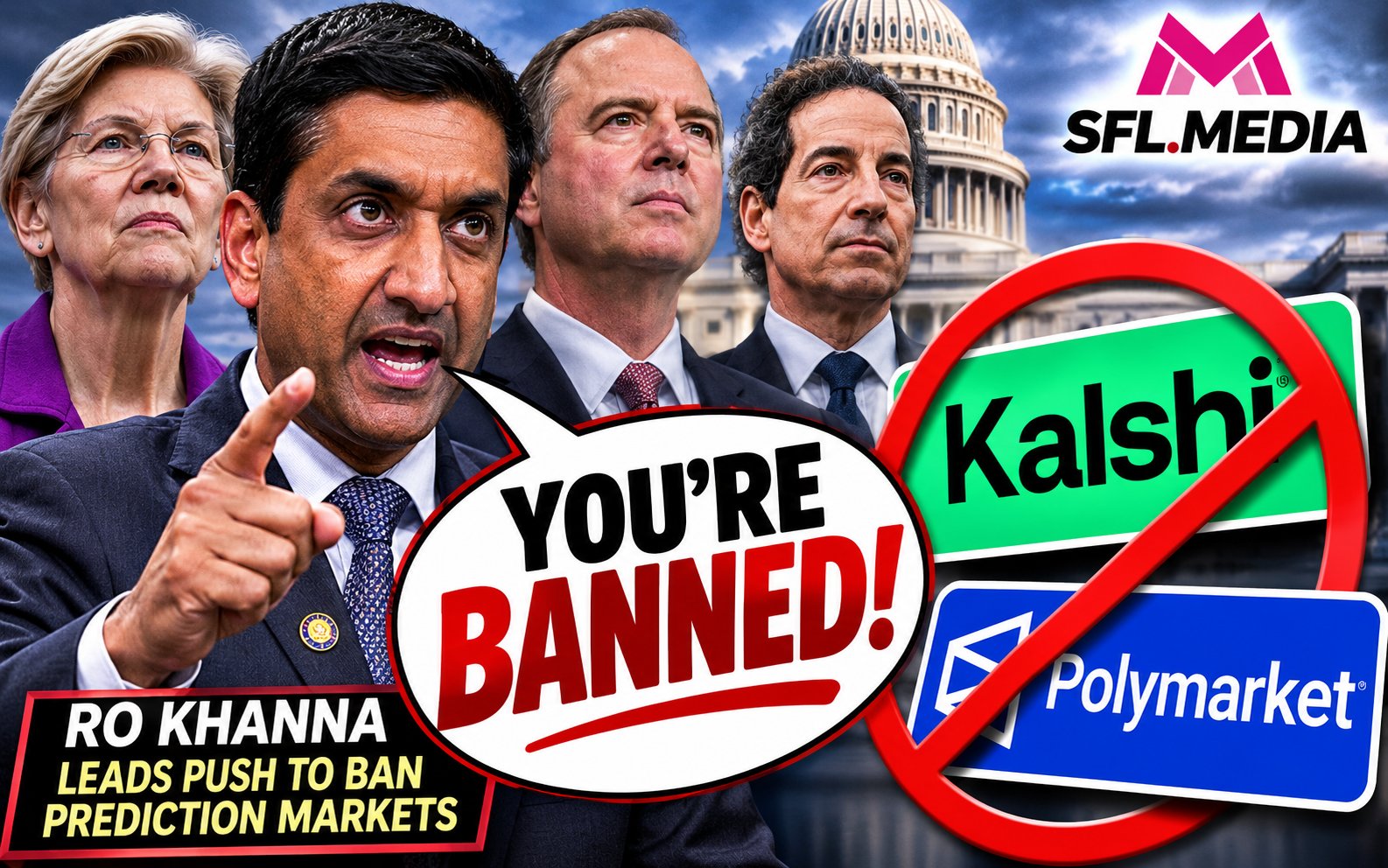
Apparently, Americans have found another way to spend their money that Washington doesn’t particularly like. This time, it isn’t cryptocurrency, online poker, sports betting apps or the stock market. It’s prediction markets. And California Democrat Congressman Ro Khanna is now calling on Congress to put an end to at least one major part of the rapidly expanding industry: sports prediction markets.
On Tuesday, November 10th, 2026, Khanna publicly called for Congress to ban sports prediction markets, like Polymarket and Kalshi, arguing that these platforms are essentially sports betting disguised as financial trading. In a post on X, Khanna claimed that the platforms circumvent state and tribal gambling laws, take tax revenue away from states, encourage gambling addiction and expose younger Americans to public health risks without the same consumer protections required of traditional sportsbooks.
Khanna’s argument is that companies shouldn’t be able to get around state gambling regulations simply by calling their products financial contracts instead of bets. It’s an interesting argument, although it raises another question. If the government is so concerned about Americans gambling their money away, why has it spent years allowing traditional sports betting to expand across the country?
What Exactly Are Prediction Markets?
For anyone unfamiliar with the concept, prediction markets are online platforms where people can buy and sell contracts based on the likelihood of future events. Instead of simply placing a traditional bet, participants purchase contracts that increase or decrease in value depending on how an event unfolds. Platforms such as Kalshi and Polymarket have turned this concept into a massive business, allowing users to speculate on everything from presidential elections and economic indicators to sporting events, celebrity news, political decisions and international conflicts.
For example, someone might purchase a contract predicting whether the Miami Dolphins will win their next game. If the contract pays $1 when the prediction is correct, a trader might purchase it for 40 cents, potentially making a 60 cent profit if the outcome goes their way. If the prediction is wrong, the contract becomes worthless.
The difference between these platforms and traditional sportsbooks is largely how the transactions are structured and regulated. Prediction markets generally operate under federal oversight from the Commodity Futures Trading Commission (CFTC), while traditional sports betting is primarily regulated through state gaming authorities. That distinction has become the center of an increasingly heated political and legal battle.
And here’s where things get interesting. Prediction markets aren’t simply another version of FanDuel or DraftKings. They have the potential to become real time indicators of public expectations about economic, political and geopolitical developments. Critics see gambling. Supporters see information markets that can reveal what people collectively believe is likely to happen. Apparently, Washington isn’t entirely comfortable with people having another place to put their money without asking permission first.
Ro Khanna Isn’t the Only Politician Coming After Prediction Markets
Khanna’s latest comments aren’t happening in a vacuum. There has been a growing bipartisan effort in Congress to restrict or eliminate certain types of prediction market contracts. One of the most significant efforts came from Democratic Senator Adam Schiff of California and Republican Senator John Curtis of Utah. In March 2026, the two introduced bipartisan legislation aimed at preventing federally regulated prediction market exchanges from offering contracts based on sporting events and casino style games. The legislation, known as the Prediction Markets Are Gambling Act, was designed to make it clear that sports betting and casino gambling shouldn’t be permitted simply because a company operates through a federally regulated financial exchange.
The effort also received support from Democratic Senator Catherine Cortez Masto of Nevada, a state with a substantial casino and gaming industry. In July, Democratic Congressman Steven Horsford of Nevada and Republican Congressman Mark Amodei introduced a companion bill in the House. The legislation would prevent federally regulated trading platforms from offering sports betting and casino style gambling under the guise of financial products.
Then there is Democratic Senator Jeff Merkley of Oregon, who introduced the STOP Corrupt Bets Act alongside a House version introduced by Democratic Congressman Jamie Raskin of Maryland. This proposal goes considerably further than simply targeting sports contracts. It seeks to prohibit prediction market contracts involving elections, sporting events, government actions and military operations. Massachusetts Senator Elizabeth Warren is among the legislation’s supporters.
Warren has also been pushing for greater scrutiny of prediction markets, particularly concerning insider trading, market manipulation and whether people with access to confidential government information could use that information to profit from trades. Other lawmakers have also targeted the possibility of government officials profiting from information obtained through their public positions. Republican Congressman Adrian Smith of Nebraska and Democratic Congresswoman Nikki Budzinski of Illinois previously introduced legislation addressing insider trading involving prediction markets.
In other words, Khanna has plenty of company in Washington. The growing opposition isn’t strictly a Democratic effort either. Republican lawmakers have joined Democrats in several proposals, although they don’t necessarily agree on how far government intervention should go.
Elizabeth Warren, Adam Schiff and the Growing Washington Power Play
Senator Elizabeth Warren has been particularly vocal about the need for greater oversight of prediction markets. Her concerns extend beyond sports betting and into the possibility that political insiders could profit from knowing what is happening behind closed doors. Consider the potential problems. What happens when someone with advance knowledge of a government announcement, military operation, regulatory decision or political development can place a trade before the public knows what’s coming?
That isn’t an unreasonable concern. Insider trading and market manipulation are legitimate issues that deserve attention. However, there is a difference between preventing people from exploiting confidential information and prohibiting ordinary Americans from participating in a legal marketplace. Adam Schiff has also challenged the federal government’s approach to regulating these platforms, particularly the authority of the CFTC to oversee prediction markets nationwide. Meanwhile, Senator John Curtis, a Republican, has joined Schiff in arguing that sports and casino-style prediction contracts should be treated differently from legitimate financial derivatives.
There is also an important development worth noting: In April 2026, the Senate adopted a rule prohibiting senators, Senate officers and Senate employees from participating in prediction markets. That restriction is already in place within the Senate, although it does not amount to a nationwide ban on prediction markets. It seems Washington is increasingly interested in establishing rules for an industry that some of its own members are no longer allowed to participate in.
Could Prediction Markets Actually Be Banned? Here’s Where Things Stand
Despite the growing political opposition, Americans shouldn’t expect prediction markets to disappear tomorrow. There is currently no established nationwide shutdown date, and Khanna’s November 10 statement is a call for congressional action, not an enacted law or an immediate regulatory order. Several proposals are already circulating through Congress, but they have different objectives.
The Prediction Markets Are Gambling Act, introduced by Schiff and Curtis, would specifically target sports and casino style contracts. The bipartisan effort from Horsford and Amodei seeks to accomplish a similar objective in the House. The STOP Corrupt Bets Act, sponsored by Merkley and backed by Warren, would go further by targeting contracts involving elections, sports, government decisions and military actions.
Another proposal, the Prediction Markets Security and Integrity Act of 2026, would establish a different regulatory framework involving the federal government and individual states. Among other things, it would require state authorization and impose additional consumer protections, including restrictions involving users under 21. These are not all identical bills, and they should not be confused with a single piece of legislation that would eliminate every prediction market in America.
The Congressional Research Service’s August 17th, 2026 report on prediction market legislation provides an extensive breakdown of the proposals and their potential consequences. For any nationwide legislative ban to become law, the proposals would need to advance through Congress and receive presidential approval. Regulatory changes and ongoing court battles could also affect what these platforms are permitted to offer in the meantime.
There is another political complication. President Donald Trump appointed CFTC Chairman Michael Selig, whose administration has generally taken a more permissive approach toward prediction markets. Selig has signaled support for the industry’s development and has defended the federal regulator’s authority over these exchanges.
That creates a significant obstacle for lawmakers seeking a sweeping crackdown. Even if Congress manages to pass restrictions, the administration’s willingness to enforce them and the inevitable legal challenges could determine how much actually changes.
The Part Nobody Seems to Want to Talk About: Competition and Money
There is something rather curious about the political outrage surrounding prediction markets. Traditional sports betting has exploded across the United States since the Supreme Court overturned the federal sports wagering prohibition in 2018. Today, major companies such as DraftKings and FanDuel operate enormous businesses, spending billions on advertising, sponsorships and customer acquisition.
Sports betting is everywhere. It’s on television, inside professional sports arenas, across social media and even integrated into sports broadcasts. Yet prediction markets are suddenly being portrayed as an especially dangerous threat to American society. There are legitimate differences between the two industries, particularly when it comes to licensing, taxes, consumer safeguards and regulatory oversight. Those differences deserve to be examined.
But if the argument is that Americans are vulnerable to gambling addiction, why should the solution be to eliminate competition rather than establish consistent protections across the entire industry? The Congressional Research Service itself identifies an important potential consequence of banning sports prediction contracts: Some consumers could simply move their activity back to traditional sportsbooks. Others could turn to offshore, unregulated platforms where consumer protections are even weaker.
That raises a rather inconvenient question for the politicians leading this charge. Would a ban actually reduce gambling, or would it simply redirect customers toward the businesses that already dominate the sports betting market? The casino and gaming industries also have a financial interest in this fight. Traditional gaming operators and labor organizations have warned that prediction markets could undermine established gaming businesses, employment and state tax revenues. Those concerns aren’t necessarily illegitimate. But protecting an existing industry from competition is not the same thing as protecting consumers. And Americans should be able to recognize the difference.
Prediction Markets May Be Bigger Than Sports Betting
Perhaps the biggest mistake politicians could make is treating prediction markets as nothing more than another sports gambling app. The technology has applications that extend well beyond sporting events. Businesses can use prediction markets to evaluate economic expectations. Investors can gauge sentiment surrounding financial developments. Researchers can examine how collective expectations change as new information becomes available.
Political markets can also provide a snapshot of what participants believe will happen during elections, legislative battles and major policy decisions. There are certainly ethical questions surrounding markets tied to deaths, assassinations, military operations and other disturbing events. There are also legitimate questions about manipulation and whether individuals with privileged information can exploit the system. Those issues deserve serious attention. But banning sports contracts, restricting political markets and eliminating the entire prediction market industry are three very different things. Congress needs to be honest about which one it actually wants.
At the End of the Day…
Ro Khanna and his allies are making it increasingly clear that prediction markets have become a political target. With Democrats and Republicans supporting various restrictions, the industry faces a serious challenge heading into the next congressional session. Some regulation is inevitable, particularly when it comes to insider trading, underage participation and consumer protections. Nobody should be defending corruption or allowing government insiders to profit from confidential information.
But there is a substantial difference between preventing fraud and deciding that Americans shouldn’t be allowed to participate in an emerging marketplace. If Congress believes sports betting is harmful, perhaps it should take a closer look at the entire sports gambling industry rather than singling out the newest competitors. Americans are already surrounded by gambling advertisements, sportsbook promotions and betting opportunities. Now politicians want to draw a line between which companies are allowed to offer those opportunities and which aren’t.
The real question isn’t whether prediction markets need reasonable rules. They probably do. The question is whether Washington is interested in protecting consumers, protecting established gambling interests, or simply protecting its own control over an industry that is becoming increasingly difficult to regulate. And given Washington’s track record, Americans would be wise to keep an eye on who benefits when the politicians start talking about protecting them.

1. The Hill: Khanna Calls on Congress to Ban Sports Prediction Markets (November 10, 2026). Also reported by The Hill report syndicated by AOL.
2. Congressional Research Service: Prediction Markets Legislation in the 119th Congress (August 17, 2026). Particularly useful for identifying proposed legislation, existing restrictions and potential consequences of a ban.
3. Axios: New Senate bill would ban prediction markets on sports, politics and military (March 26, 2026). Details the Merkley, Warren, Schiff and Curtis efforts.
4. Congressman Steven Horsford: Bipartisan Bill to Ban Sports Prediction Market Contracts and Protect Jobs (July 23, 2026).
5. The Block: Tribal gaming regulators and senators push for prediction market restrictions (August 4, 2026).








Reader discussion
Join the conversation
Want to join the conversation?
Create an account or sign in to share your thoughts, vote and reply to other readers.
No comments yet. Be the first to share your thoughts.
No comments