
The 1789 Capital Pipeline: How Trump’s Sons, Political Access and Billions in Pentagon Contracts Created a Growing Government Corruption Scandal
WASHINGTON, D.C. — A sprawling network of politically connected investment firms, defense contractors, financial intermediaries and technology startups has emerged around President Donald Trump’s family, raising increasingly serious questions about whether billions of dollars in federal contracts, loans and government backed investments are creating extraordinary private financial opportunities for the president’s sons and their business associates.
At the center of the controversy is 1789 Capital, a Palm Beach based investment firm co-founded by financier Omeed Malik, conservative activist Chris Buskirk and Republican megadonor Rebekah Mercer. Donald Trump Jr. joined the firm shortly after his father’s 2024 election victory, placing the president’s eldest son inside an investment operation with interests spanning military technology, artificial intelligence, advanced manufacturing, critical minerals, drones and other industries heavily dependent on federal policy and spending.
The financial stakes are enormous. An investigation by The Washington Post identified 15 companies associated with investments by Donald Trump Jr. and Eric Trump that had received approximately $3.2 billion in federal contracts, investments and loans, much of it following Trump’s return to office. Additional future contracting opportunities could substantially increase the value of government business involving those companies. The figures represent government commitments to businesses in which the brothers have financial interests, not direct payments to the brothers themselves.
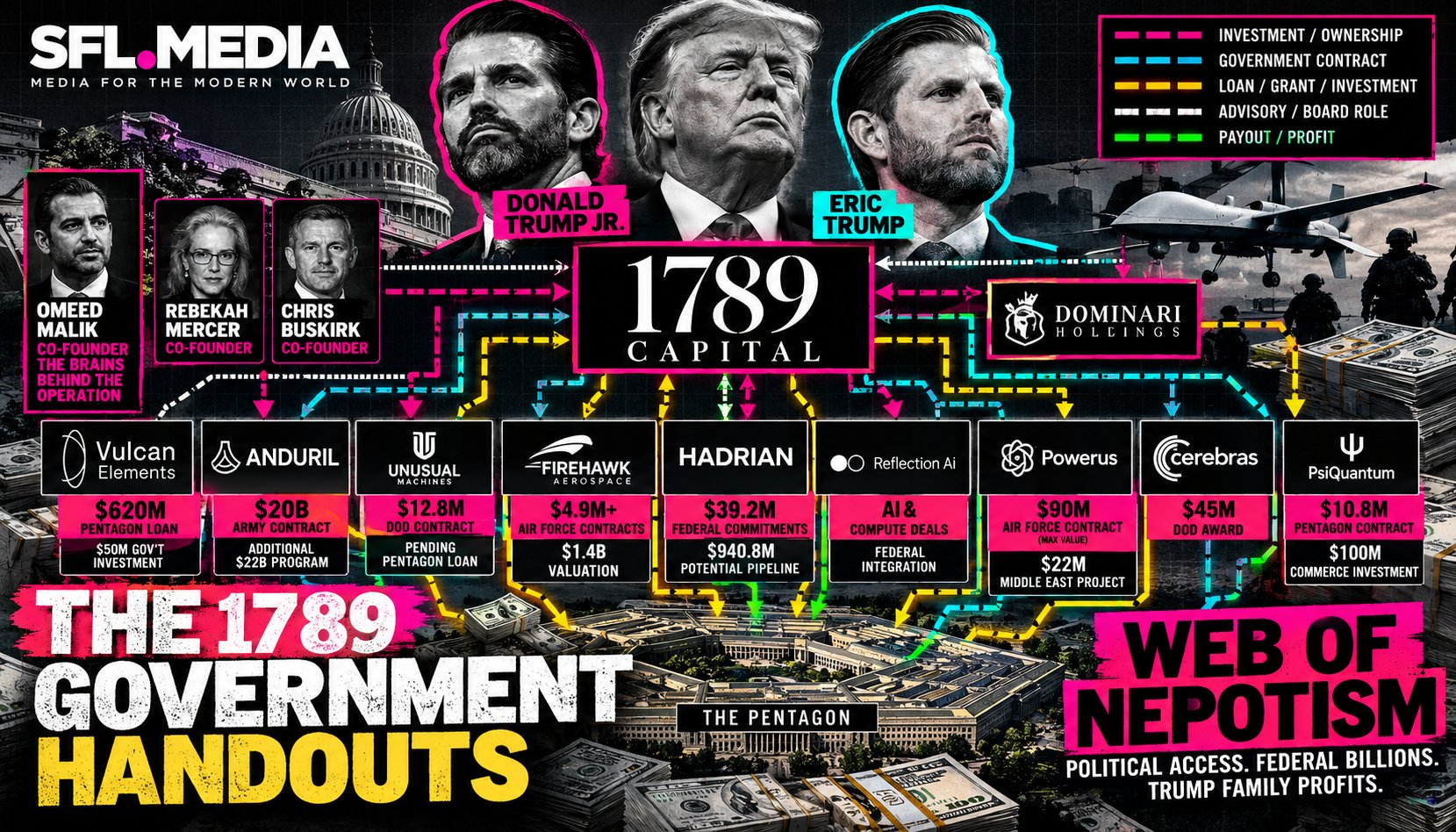
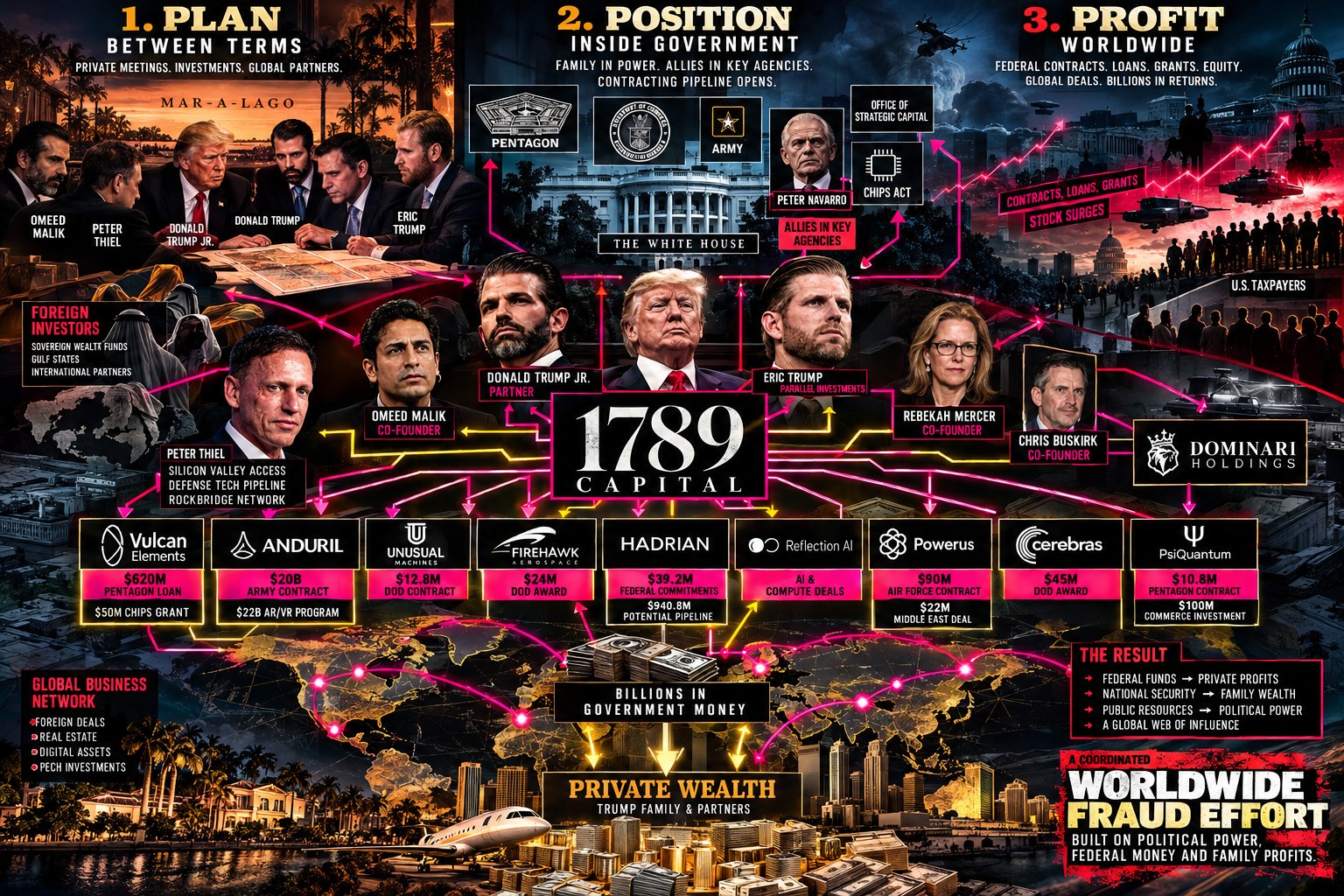
The most troubling documented example involves Vulcan Elements, a relatively small North Carolina rare earth magnet manufacturer that secured a $620 million conditional Pentagon loan commitment approximately three months after 1789 Capital acquired an ownership stake. ProPublica subsequently revealed that senior White House adviser Peter Navarro, a close associate of Donald Trump Jr., initiated the financing request and that Pentagon officials were directed to accelerate the process. The company’s estimated valuation increased from approximately $200 million to $2 billion around the federal financing announcement, potentially delivering an extraordinary increase in the paper value of its investors’ holdings.
The controversy has triggered congressional investigations, demands for internal communications and calls for independent review of the Pentagon’s contracting procedures. Lawmakers want to know whether the president’s family is benefiting from preferential treatment, whether federal officials have circumvented normal safeguards and whether taxpayer-funded national security programs are being used to generate private wealth for politically connected investors.
The documented relationships raise substantial conflict of interest concerns. They do not, however, establish that the Trump sons stole government funds or committed criminal fraud. No criminal finding cited in the public record establishes such conduct. The distinction is critical because the most consequential questions involve what federal officials knew, whether government decisions were improperly influenced and whether investors obtained financial advantages unavailable to businesses without political connections.
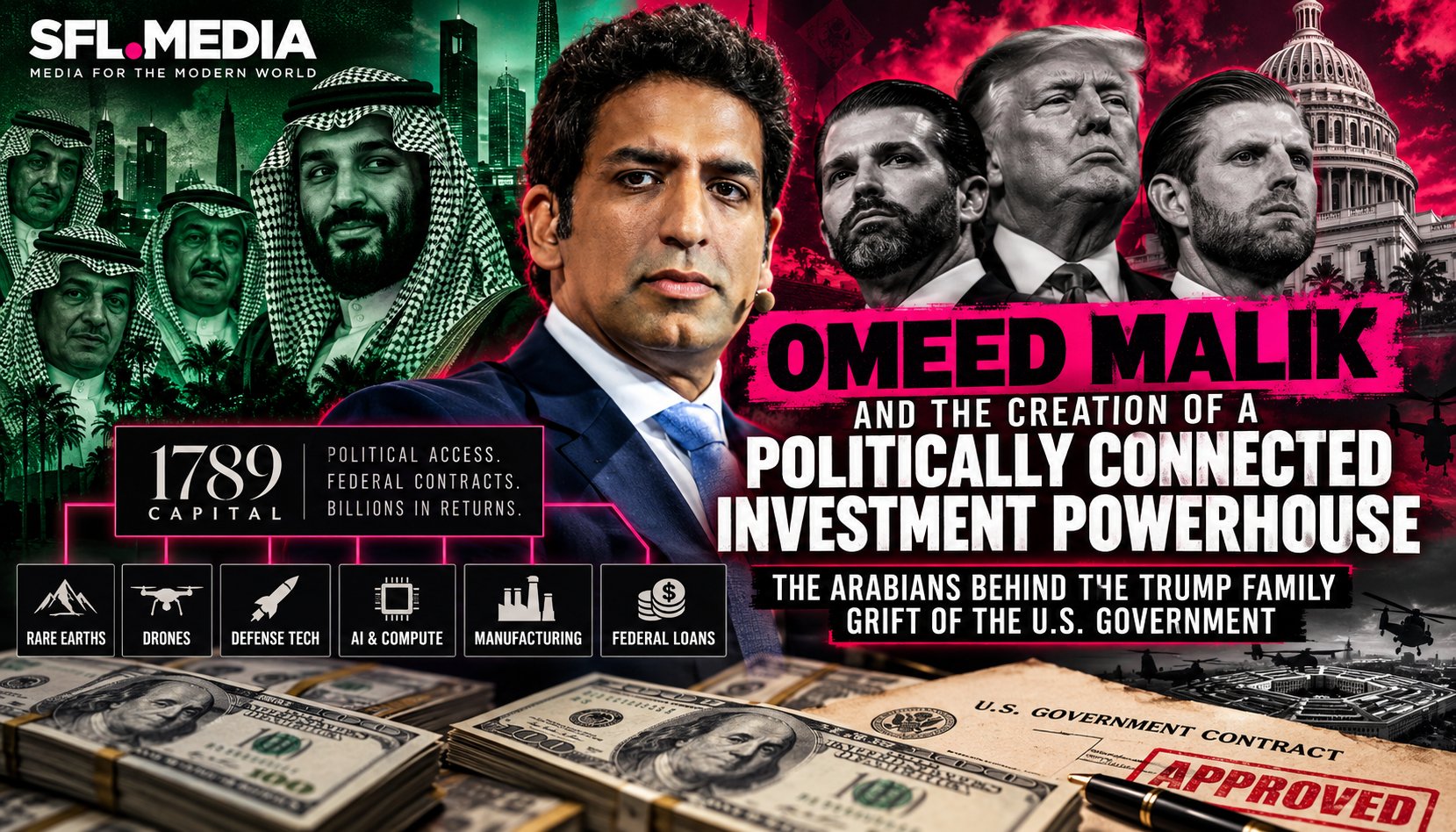
Omeed Malik and the Creation of a Politically Connected Investment Powerhouse
Omeed Malik is not a newcomer to sophisticated financial transactions. Before founding 1789 Capital, he worked as a senior executive at Bank of America Merrill Lynch, established the investment bank Farvahar Partners and became involved in special purpose acquisition companies, including the Colombier entities. His experience spans capital markets, hedge funds, investment banking and corporate transactions.
1789 Capital emerged as an alternative to traditional Silicon Valley venture capital, promoting investment strategies aligned with entrepreneurship, American industrial development and conservative opposition to environmental, social and governance investment priorities. Its connections to Republican donors and political figures helped distinguish it from conventional venture firms competing for emerging technology investments.
The firm’s political significance increased dramatically when Donald Trump Jr. joined as a partner following the 2024 election. His arrival created a conspicuous overlap between a private investment company and the family occupying the White House, particularly as the administration expanded federal support for domestic manufacturing, military modernization and strategically important technologies.
Malik’s other financial interests, including Farvahar Partners and the Colombier acquisition vehicles, illustrate the range of investment and corporate structures operating around his business activities. However, their existence does not establish that they were created as shell companies for illicit transfers or that they were used to conceal government payments. The central issue is whether investment opportunities, government relationships and material nonpublic information remained appropriately separated.
The Vulcan Elements Deal: A $620 Million Pentagon Loan and Direct White House Intervention
Among the transactions attracting congressional scrutiny, the Vulcan Elements financing provides the clearest documented sequence linking a Trump family-connected investment to intervention by a senior White House official.
In July 2025, Vulcan representatives met with 1789 Capital. By August, the investment firm had acquired an ownership stake in the magnet manufacturer, which employed approximately 30 people at the time. Within weeks, senior officials in Washington were pushing the Pentagon to prioritize federal financing for the company. In November 2025, the Defense Department announced a $620 million conditional loan commitment through its Office of Strategic Capital, the largest such commitment in that office’s history at the time.
The broader transaction also included a separate $80 million conditional loan commitment for Vulcan’s supply chain partner, ReElement Technologies, and federal support involving a $50 million Commerce Department equity investment in Vulcan. The government’s equity participation is important because it means the transaction was not simply a conventional grant to a private company. The financing was intended to expand domestic rare earth magnet production, an industry considered strategically important because of American dependence on foreign suppliers, particularly China.
ProPublica’s investigation found that Navarro, a close associate of Donald Trump Jr., initiated the loan request. According to officials familiar with the process, Pentagon personnel were subsequently instructed to move rapidly, completing work in weeks on a transaction of exceptional size. The reporting identified Vulcan as the only company among dozens under consideration whose financing request originated with a senior White House aide.
The timing also carried significant financial implications. Estimates of Vulcan’s valuation rose from approximately $200 million around the time of 1789 Capital’s investment to roughly $2 billion following the federal announcement. The precise value of 1789 Capital’s ownership interest and any realized profit for its partners have not been publicly established. Nevertheless, the tenfold increase in the company’s estimated valuation illustrates how federal financial backing can substantially benefit existing private investors.
The Pentagon has defended its decisions, maintaining that political affiliations do not influence funding awards. Trump Jr.’s spokesperson said he did not discuss Vulcan with Navarro or other federal officials, while 1789 Capital denied participating in the loan approval process or receiving advance knowledge of the decision. Those denials are important: the documented White House intervention raises legitimate questions about the independence of the financing process, but it does not by itself prove that Trump Jr. requested the intervention or knew about it in advance.
1789 Capital’s Explosive Growth: From $150 Million to Billions Under Management
The financial transformation of 1789 Capital is itself a major focus of the congressional investigation. According to figures cited by House Judiciary Committee Ranking Member Jamie Raskin, the firm managed approximately $150 million before Donald Trump Jr. joined. By 2026, its assets under management had surpassed $3 billion, with reports based on securities filings placing the figure around $3.5 billion by May.
Its main investment fund reportedly generated returns approaching 200% as of June 30, 2026, approximately ten times the average for comparable venture capital funds established in 2023. Raskin questioned whether such extraordinary performance reflected ordinary investment success, privileged political access or a combination of factors requiring further examination.
The figures are striking, but assets under management are not the same as profits, and a fund’s investment returns are not equivalent to cash paid to its partners. The increase cannot automatically be counted as personal wealth accumulated by Donald Trump Jr. Still, the speed and scale of the expansion warrant scrutiny when the investment portfolio includes businesses affected by decisions made by his father’s administration.
Reporting on the firm’s financing also identified substantial foreign investment, raising additional questions about whether overseas investors might see proximity to the president’s family as a commercially valuable advantage. Foreign investment in American venture capital is legal, but potential conflicts become more consequential when investment holdings intersect with national security decisions, sensitive technology and federal contracting.
Anduril Industries: A $20 Billion Army Agreement and the Rise of Defense Technology
One of the most consequential companies connected to 1789 Capital’s investment portfolio is Anduril Industries, the defense technology business founded by Palmer Luckey. The company develops autonomous weapons systems, surveillance platforms, military software, counter drone technology and other equipment intended to modernize American military capabilities.
Anduril is an established defense contractor with a substantial history of government work predating Trump’s second administration. Its technology addresses real military requirements, and its federal business cannot reasonably be attributed solely to political relationships. Nevertheless, the scale of its federal expansion makes it a central company in any examination of the intersection between Trump family investments and Pentagon spending.
In March 2026, the Army announced an enterprise agreement with Anduril carrying a maximum potential value of $20 billion over ten years. The agreement consolidated more than 120 procurement actions into a unified contracting framework, allowing federal agencies to purchase Anduril technologies under established terms. The $20 billion figure is a contract ceiling, not $20 billion already paid to Anduril, and actual expenditures depend on orders placed during the contract period.
Anduril has also assumed a larger role in the military’s augmented reality and battlefield visualization programs, including work associated with the Army’s Integrated Visual Augmentation System. The original Microsoft arrangement had a potential value of approximately $22 billion, but that figure should not be presented as a separate $22 billion payment handed directly to Anduril.
The relationship between Anduril’s investors, Silicon Valley defense financing and conservative political networks deserves examination, particularly where investment decisions and government procurement announcements overlap. But there is no verified basis for concluding that the entire $20 billion enterprise agreement was awarded because of 1789 Capital’s political connections.
Unusual Machines: Donald Trump Jr.’s Florida Drone Investment Wins Pentagon Business
Florida based Unusual Machines provides another example of how Trump family investments intersect with the federal government’s rapidly expanding demand for domestically manufactured military technology. The company manufactures drone components and related hardware, operating in an industry that has become strategically important as the Pentagon attempts to reduce reliance on Chinese made systems and components.
Donald Trump Jr. became an investor and adviser to Unusual Machines shortly after the 2024 presidential election. His involvement generated immediate market attention, with the company’s stock price reportedly doubling following the announcement. Unusual Machines subsequently received a reported $12.8 million Army order for drone components, a significant development for a relatively small manufacturer.
The company’s connections extend into Dominari Holdings, the financial services business associated with both Trump sons. Dominari helped bring Unusual Machines into public markets, and its executive Kyle Wool played a role in connecting Trump Jr. with the company’s leadership.
Unusual Machines CEO Allan Evans has defended the relationship, explaining that Trump Jr.’s public profile and support for domestic manufacturing made him an attractive investor and adviser. That is a recognizable commercial rationale, but it also illustrates the underlying ethics problem: the president’s son can bring substantial business value to companies whose future depends partly on decisions made by federal agencies.
The company’s federal business does not independently establish procurement fraud. However, its ownership disclosures, government orders and political relationships provide concrete records for investigators to examine.
Firehawk Aerospace: Federal Rocket Propulsion Funding and Private Investment
Firehawk Aerospace, also identified in recent financing announcements as Firehawk Defense, develops rocket propulsion systems and manufacturing technology for military applications, including advanced propellants and production methods intended to increase the speed and capacity of American weapons manufacturing.
The company has attracted investment from 1789 Capital and has received federal contracts supporting propulsion development. A January 2026 letter from Senators Elizabeth Warren, Richard Blumenthal and Andy Kim identified a $4.9 million Air Force contract awarded to Firehawk in August 2025 among several transactions raising questions about investments associated with Trump Jr.
Firehawk’s federal contracting history, however, did not begin with Trump’s second administration. Some awards predate the current administration, meaning it would be inaccurate to attribute all of the company’s government business to Trump’s return to office.
The relevant questions are whether federal awards were competitively justified, whether politically connected investors received advance knowledge of procurement decisions and whether normal contracting safeguards remained in place.
Firehawk’s New $1.4 Billion Valuation Adds Another Dimension to the Investigation
The financial stakes surrounding Firehawk became even more significant in late October 2026. Reuters reported on October 28 that the company had reached a valuation exceeding $1.4 billion after raising $150 million in a financing round co-led by Advent International and Rochefort Asset Management.
Firehawk is developing manufacturing techniques designed to produce solid rocket propellant components in hours rather than weeks, addressing a genuine bottleneck in American military production. The company plans to expand manufacturing operations in Oklahoma and Mississippi, with ambitions to substantially increase its production of artillery motors and other propulsion components.
The valuation provides another example of the potential financial rewards available to investors positioned inside rapidly growing defense technology businesses. However, the reported financing does not establish how much 1789 Capital invested, what percentage of Firehawk it owns or how much profit its partners have realized. It also does not substantiate the claim that Firehawk has already received $8.9 billion in federal contracts.
Hadrian: Automated Defense Manufacturing and Nearly $1 Billion in Potential Federal Business
Hadrian, an advanced manufacturing company using automation to produce precision components, represents another significant investment at the intersection of venture capital and defense industrial policy.
The Pentagon faces longstanding challenges involving production capacity, supply-chain vulnerabilities and the time required to manufacture complex military equipment. Hadrian’s business model seeks to address those problems by using highly automated factories to produce precision parts more efficiently.
A Washington Post investigation identified approximately $39.2 million in federal commitments to Hadrian following relevant Trump family linked investments, alongside approximately $940.8 million in potential future contract value.
Those amounts should not be conflated. The nearly $1 billion figure represents possible contracting opportunities rather than money already disbursed. Nevertheless, the size of the available contracting pipeline illustrates the financial opportunities created when federal agencies increasingly depend on private technology companies to expand military production.
Hadrian’s presence in the broader investment network reinforces the need to examine how politically connected venture funds select companies operating in sectors prioritized by federal spending programs.
Reflection AI, Cerebras and PsiQuantum: The Next Frontier of Federal Technology Spending
The investigation also extends into artificial intelligence, advanced computing and quantum technology, sectors where relatively small private companies can become strategically important federal suppliers.
Reflection AI develops advanced artificial intelligence systems, while companies such as Cerebras Systems and PsiQuantum work on specialized computing technologies. Their inclusion in discussions of the broader 1789 Capital investment network reflects the growing overlap between private technology financing and national security spending.
In January 2026, Senators Warren, Blumenthal and Kim identified a $45 million Defense Department award to Cerebras Systems and a $10.8 million award to PsiQuantum among the transactions they believed warranted closer scrutiny. The financial incentives are substantial. Federal contracts can provide early stage technology companies with revenue, credibility, customer relationships and opportunities to raise additional private capital. For investors holding equity before those contracts are announced, the resulting increase in a company’s perceived value can be considerable.
The precise ownership arrangements, investment timing and federal awards involving Reflection AI require additional documentation before assigning it a specific government funding total.
PsiQuantum’s Additional $100 Million Federal Investment Raises New Questions
The PsiQuantum relationship extends beyond the $10.8 million Pentagon contract identified by lawmakers. In June 2026, Senators Warren, Blumenthal and Mazie Hirono, together with Representatives Jason Crow and Mike Levin, questioned a separate $100 million Commerce Department equity investment in the quantum computing company.
That transaction expanded the financial questions surrounding 1789 Capital beyond the Pentagon. Federal equity investments can provide companies with capital and credibility while increasing the potential value of existing private holdings, even when the government receives an ownership interest in exchange.
The concern is not that the government should avoid investing in quantum computing. The technology has significant national security implications, and the United States faces serious international competition. The concern is whether companies associated with presidential relatives receive the same scrutiny, competitive consideration and financial terms as other businesses seeking federal support.
The publicly available evidence does not establish that the $100 million investment was improperly approved or that Trump Jr. influenced it. It does establish another substantial federal financing decision involving a company identified by lawmakers as connected to his investment network.
Eric Trump, Dominari and the Expansion Beyond 1789 Capital
Although Donald Trump Jr.’s partnership at 1789 Capital has attracted the most direct congressional attention, Eric Trump’s business activities form part of the broader debate over the Trump family’s investments in federally supported industries.
A July 2026 Washington Post investigation examined how the brothers had invested in more than a dozen companies involved in defense technology, robotics, artificial intelligence, aerospace and related industries. The businesses included both established contractors and smaller startups seeking access to rapidly expanding federal procurement programs.
Their investments were made through several arrangements, including venture capital funds, direct equity holdings and other financial relationships. Dominari Holdings, the New York based financial services business associated with both brothers, is one of the entities relevant to tracing those connections.
According to the Post’s analysis, companies linked to the brothers had received at least $3.2 billion in federal contracts, investments and loans. The newspaper also identified additional potential future contract values. These amounts are not equivalent to billions of dollars in payments to the Trump family. They represent government business involving companies in which family members have investment interests, sometimes indirect or relatively small ones.
The figures cannot be used to establish that the brothers personally received billions of dollars in government money. What they establish is that the family’s private financial interests increasingly overlap with industries receiving significant federal support.
Powerus: Another Trump Backed Drone Company Secures Major Military Opportunities
One of the most important additions to the broader financial picture is Powerus, a drone technology company backed through investments associated with both Donald Trump Jr. and Eric Trump.
Powerus has pursued military and international contracts while positioning itself to benefit from the Pentagon’s growing emphasis on American made drones, interceptors and other unmanned systems. The company is connected to Dominari Holdings, whose American Ventures investment operation has provided another financial channel through which the Trump family participates in defense technology.
An October 31 Wall Street Journal investigation reported that Powerus had secured an Air Force contract with a maximum potential value of $90 million and a separate $22 million infrastructure defense project in the Middle East. The company had also pursued additional international business while expanding through acquisitions and efforts to consolidate drone related technologies.
The Journal reported that Dominari’s Trump linked investment operation had already realized at least $6 million from its Powerus investment while retaining additional shares and warrants. That figure is particularly important because it represents reported realized investment proceeds to the investment operation, rather than merely a speculative increase in a startup’s valuation. It does not establish how much of those proceeds, if any, were personally distributed to either Trump brother.
The investigation also examined the backgrounds of Powerus executives, including founders with limited conventional defense industry experience and connections to businesses that previously settled fraud allegations without admitting wrongdoing. Those historical allegations should not be confused with proof that Powerus itself committed fraud or obtained its military contracts illegally.
The company has faced commercial and technical setbacks, including a reported failed defense competition and a significant decline in its share price. Those difficulties complicate any suggestion that political connections guarantee business success. Nevertheless, the combination of Trump family financial interests, military contracting opportunities and realized investment proceeds makes Powerus an important subject for further scrutiny.
The Trump Family’s Expanding Artificial Intelligence and Data Center Investments
The defense contracting controversy is not limited to weapons, drones and military manufacturing. The Trump sons have also expanded their involvement in artificial intelligence, data centers and other technology businesses whose financial prospects are heavily influenced by federal regulation, infrastructure policy and government spending.
A September Washington Post investigation identified investments associated with the brothers in companies including Cerebras Systems, Perplexity, xAI and Space Eyes. Donald Trump Jr.’s connections primarily run through 1789 Capital, while Eric Trump’s investments include businesses associated with Dominari’s American Ventures operation.
The brothers also participated in the launch of American Data Centers, an initiative that subsequently became connected to American Bitcoin, a digital asset mining business majority owned by Hut 8. These ventures intersect with industries affected by federal energy policy, digital asset regulation, computing infrastructure development and the administration’s approach to artificial intelligence.
The existence of these investments does not prove that government policy was designed to benefit them. It does, however, broaden the potential conflicts beyond Pentagon procurement. When a presidential family maintains private financial interests across numerous industries affected by federal decision making, the challenge of identifying and preventing preferential treatment becomes substantially more complex.
The Trump Sons’ Growing International Business Network Adds Another Layer of Concern
The financial relationships also extend beyond the United States. An October 28 Financial Times investigation documented the Trump sons’ expanding international business network, reporting that Donald Trump Jr. and Eric Trump had participated in at least 18 meetings with foreign leaders and senior officials since January 2025 despite holding no formal government positions.
Their international interests include real estate, digital assets, financial services, technology and other businesses operating in markets where government decisions can significantly affect commercial outcomes. The Trump Organization and family representatives maintain that the activities are legitimate private business and that the brothers do not act as government emissaries.
The distinction between private business and official diplomacy is particularly important when foreign governments or sovereign wealth funds participate in transactions involving businesses associated with the president’s family. A foreign investor may have entirely legitimate commercial reasons to invest, but the potential for perceived political access creates additional ethical and national security concerns.
These international relationships do not establish that the brothers exchanged government favors for money. They do demonstrate that the broader network of Trump family financial interests is considerably larger than 1789 Capital and the Pentagon contracting controversy alone.
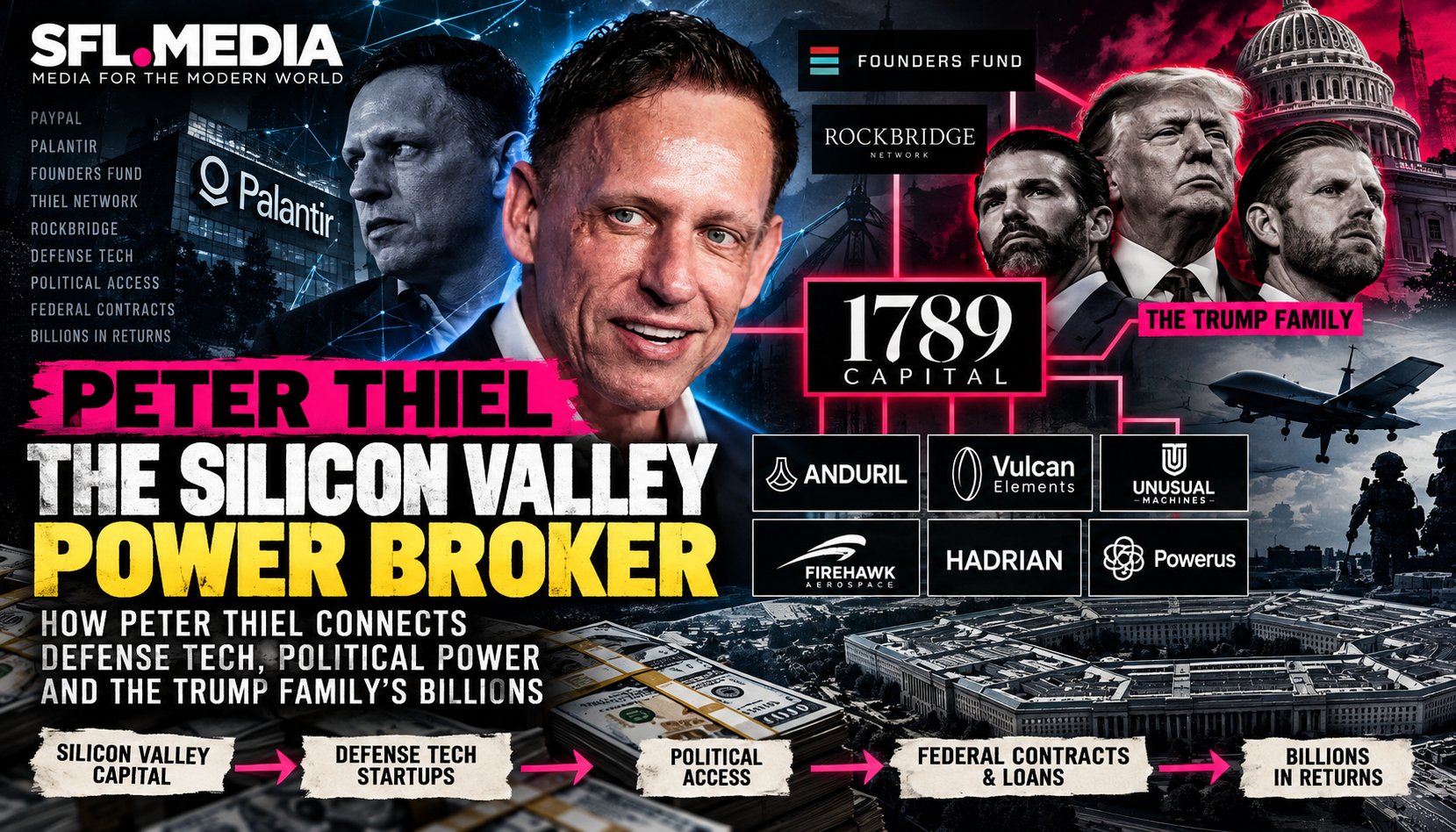
The Political Access Question: Peter Thiel, Conservative Networks and Defense Capital
The broader network also includes Silicon Valley investor Peter Thiel, whose financial and political influence has helped shape the modern defense technology industry. Thiel was an early backer of Anduril and has supported technology companies seeking to challenge established defense contractors.
Conservative investment networks, including Rockbridge, have also helped connect wealthy donors, technology entrepreneurs and political figures. These relationships illustrate how political influence and private investment can coexist within the same professional circles. But the existence of those connections does not establish that Thiel directed federal contracts to 1789 Capital or coordinated an illegal procurement scheme. Such allegations would require evidence of specific communications, financial arrangements or government interventions.
The legitimate concern is structural. When investors have relationships with political decision makers, and their companies depend on government contracts, traditional conflict of interest safeguards become especially important.
Congress Demands Answers About the Investment Network
Congressional scrutiny of 1789 Capital intensified throughout 2026, with Democratic lawmakers seeking records about investment timing, government communications and federal contracting decisions.
On August 27, House Judiciary Committee Ranking Member Jamie Raskin launched an investigation into the firm, questioning its dramatic financial growth and the benefits received by several portfolio companies following Donald Trump Jr.’s arrival. Raskin requested information from company leadership about investments, financial relationships and communications involving federal officials. His inquiry included concerns about companies benefiting from government contracts, financing arrangements and regulatory decisions.
Separately, Senators Warren, Blumenthal and other lawmakers pressed the White House and Pentagon for information about the Vulcan Elements financing. Their questions included whether Navarro acted independently, whether President Trump knew about the intervention and whether similar communications occurred involving other family-connected businesses.
The investigations also highlight a limitation in congressional oversight: lawmakers can demand records and request explanations, but the existence of an inquiry does not constitute a finding of wrongdoing.
1789 Capital has strongly rejected Raskin’s allegations. In September, the firm’s lawyers accused the committee of conflating separate business entities, mischaracterizing transactions and making accusations without sufficient evidence. The firm declined to provide the requested materials under the terms of that inquiry, while maintaining that it welcomed legitimate oversight.
The dispute leaves several central questions unresolved, including what federal officials knew about the ownership interests of politically connected investors and whether any confidential procurement information reached private investment firms.
Pentagon Officials Face Questions About Whether Conflict-of-Interest Safeguards Actually Work
The concerns raised by lawmakers extend beyond any single investment firm. In August 2026, Senators Elizabeth Warren, Richard Blumenthal and Tammy Duckworth, together with Representative Robert Garcia, called on the Pentagon’s inspector general to investigate federal contracts and financing involving companies associated with the president’s sons.
Their request followed reporting that businesses connected to the brothers had received billions of dollars in government commitments. The lawmakers questioned whether the Defense Department had adequate procedures to identify potential conflicts involving politically connected investors and whether officials had applied those procedures consistently.
The administration and Pentagon have rejected accusations of preferential treatment. Trump family representatives have emphasized that the brothers are private citizens and that their investments do not give them authority over government contracting decisions. A Trump Organization spokesperson told The Washington Post that the brothers were passive minority investors in the companies at issue and did not participate in awarding or managing federal contracts.
Those statements establish the administration’s position, but they do not eliminate the need for independent examination of government records. A contracting process can raise legitimate ethics concerns even without evidence that an investor personally signed a procurement document or ordered a payment.
The essential questions concern who made the decisions, what information they considered, whether ordinary procedures were followed and whether political relationships affected the treatment of applicants.
Government Loans, Contract Ceilings and Private Wealth: Following the Actual Money
Understanding the financial consequences requires separating four different categories: money actually paid by federal agencies, conditional loan commitments, maximum potential contract values and increases in privately held equity valuations.
A government loan can finance a company’s expansion without representing a direct grant or a personal payment to its investors. A contract ceiling establishes how much an agency may spend under an agreement, not how much it has already spent. And a rising private valuation may increase the estimated value of an investor’s holdings without generating any immediate cash proceeds.
These distinctions are especially important when discussing the Trump sons’ personal wealth. Estimates that Donald Trump Jr.’s net worth increased from $50 million to $300 million, or that Eric Trump’s wealth rose from $40 million to $400 million, cannot be reliably attributed to defense contracting without independently verified financial records. Private equity holdings are often difficult to value, and the brothers have interests outside the defense industry.
The larger concern does not depend on proving those particular net worth estimates. It concerns whether federal decisions that benefit private companies are being made independently of the financial interests of politically connected investors.
Why the Pentagon’s Conflict of Interest Safeguards Matter
The United States has legitimate reasons to invest heavily in domestic rare earth production, drone manufacturing, advanced computing and defense technology. American dependence on foreign supply chains, particularly for strategically important materials and components, presents genuine national security challenges.
The problem arises when those necessary investments overlap with private financial interests tied to the president’s family. A company may deserve a government contract because it has the best technology, the most competitive price or the strongest manufacturing capabilities. It may also have investors with political connections. Neither circumstance alone establishes corruption.
But when senior White House officials intervene in financing decisions involving companies backed by presidential relatives, the government has a responsibility to demonstrate that the decisions were justified by documented national security and economic considerations.
The Vulcan Elements transaction is particularly consequential because investigators have identified direct White House involvement rather than merely a coincidental relationship between an investor and a government contractor.
In June, the watchdog organization Citizens for Responsibility and Ethics in Washington formally urged the Defense Department inspector general and White House counsel to investigate the loan. The organization emphasized that the available reporting raised concerns about preferential treatment, while acknowledging that it did not establish that Trump Jr. personally discussed the transaction with government officials.
That distinction defines the next stage of accountability: determining whether the evidence supports administrative misconduct, ethics violations, criminal wrongdoing or no violation at all.
The Unanswered Questions at the Center of the 1789 Capital Investigation
The most important questions are now documentary rather than rhetorical. Investigators need the internal records showing who initiated financing requests, how investment opportunities were evaluated, which government officials participated in procurement decisions and whether those officials knew about the financial interests of presidential relatives.
They also need to establish whether any investors obtained material nonpublic information about upcoming government decisions, whether agency personnel faced inappropriate pressure and whether the federal government received fair value for its commitments.
An independent examination would also need to determine whether similar financing decisions were made for companies without political connections. Without that comparison, it is difficult to establish whether the treatment received by 1789 Capital backed companies was exceptional or consistent with broader defense industrial policy.
The public record currently supports substantial questions about conflicts of interest and procurement independence. It does not establish a coordinated criminal conspiracy involving every company or individual in the network.
The Larger Scandal Is the System That Makes These Conflicts Possible
The story of 1789 Capital is ultimately about the increasingly narrow boundary between political power and private investment. A president’s family can invest in businesses that benefit from federal policy. Those businesses can receive government contracts. Their valuations can rise, and their investors can become wealthier. Under existing law, that sequence is not automatically criminal. But the arrangement becomes deeply troubling when the same administration responsible for awarding contracts and approving financing has close personal relationships with investors positioned to benefit from those decisions.
The Vulcan Elements case demonstrates why the distinction matters. A company backed by the president’s son’s investment firm received an extraordinary federal financing commitment after intervention by a senior White House adviser. The company’s estimated valuation subsequently increased dramatically, benefiting its existing investors on paper. Investigators are still seeking the complete explanation for how and why the decision was made.
The Powerus case adds another dimension, with a Trump linked investment operation reportedly realizing millions of dollars in proceeds while retaining additional financial interests in a company pursuing substantial military business. Meanwhile, investments associated with the brothers extend across drones, rocket propulsion, artificial intelligence, quantum computing, rare-earth minerals and advanced manufacturing.
Taken together, these relationships reveal a financial network positioned to benefit from some of the largest and most strategically important areas of federal spending. That is not proof of a criminal conspiracy. It is a compelling reason for aggressive congressional oversight, independent investigation and full disclosure of the financial interests involved. The American public deserves to know whether federal dollars are being allocated according to national security priorities, objective financial analysis and competitive procurement standards or whether political relationships are creating advantages unavailable to businesses without access to the White House.
The central question is not whether the Trump family has the legal right to invest in American companies. It is whether the federal government can credibly guarantee that those investments receive no special treatment while the family’s patriarch occupies the presidency. Until the relevant records are disclosed and independently examined, that question remains unresolved.
Sources & Further Reading

Federal investigations, congressional oversight and government records
Investigative journalism and independent reporting
Related SFL Media investigations and political accountability coverage















































Want to join the conversation?
Create an account or sign in to share your thoughts, vote,
and reply to other readers.
Showing 0 of 0 comments
Don't have an account?
Already have an account?