

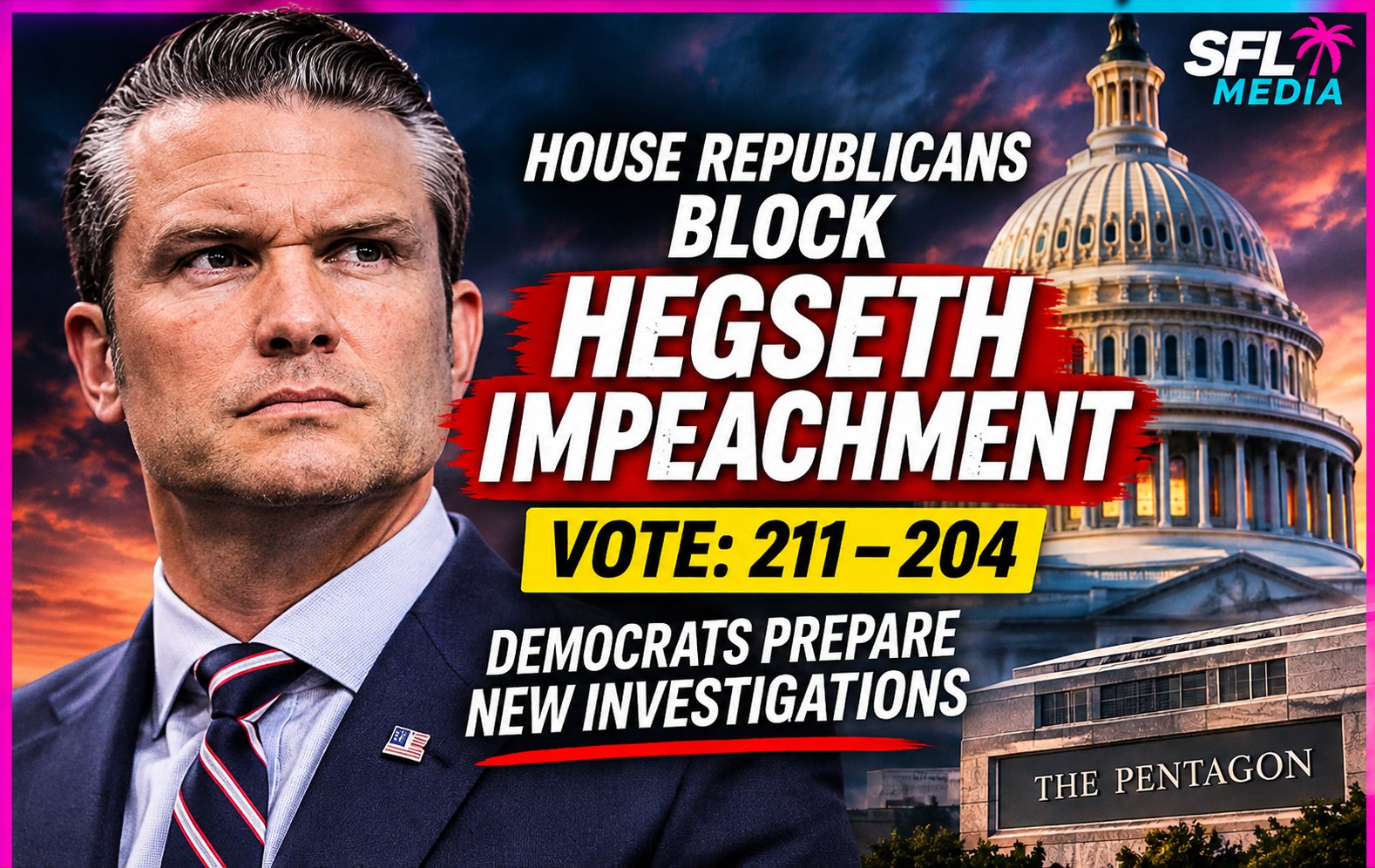
House Republicans Block Pete Hegseth Impeachment in 211–204 Vote as Democrats Prepare New Investigations
Republicans rally behind Trump’s embattled defense secretary, blocking eight articles of impeachment involving the Iran war, military strikes, and allegations of abuse of power. But with Democrats preparing to take control of Congress, Hegseth’s political and legal troubles may be far from over.
WASHINGTON, D.C. — House Republicans narrowly blocked an effort to impeach Defense Secretary Pete Hegseth on Tuesday, voting 211–204 to send eight articles of impeachment to the House Judiciary Committee rather than allow an immediate vote on allegations involving unauthorized military operations, civilian casualties, and potential abuses of executive power.
The procedural victory provided a temporary reprieve for one of President Donald Trump’s most controversial Cabinet officials, but it also exposed a growing constitutional confrontation over the administration’s conduct of the war against Iran and the limits of presidential military authority. With Democrats preparing to assume control of Congress in January, the impeachment fight could soon return under dramatically different political circumstances.
The impeachment effort was led by Republican Rep. Thomas Massie of Kentucky, a frequent critic of the administration’s foreign policy and executive power. Massie was the only Republican to oppose sending the resolution to committee, joining 203 Democrats in an unsuccessful attempt to keep the impeachment effort moving. The remaining Republicans who participated in the vote stood together to protect Hegseth from an immediate confrontation on the House floor.
Although the vote effectively halted the impeachment effort for the remainder of the current congressional session, it did not clear Hegseth of wrongdoing or resolve the serious allegations contained in the resolution. Instead, lawmakers chose to avoid an immediate decision on whether the defense secretary’s conduct warranted impeachment, leaving the underlying questions for future congressional investigations.
Republicans Close Ranks as Impeachment Resolution Falls Seven Votes Short
The House voted on a motion to refer House Resolution 1655 to the Judiciary Committee, a procedural maneuver that allowed Republican leadership to prevent an immediate vote on the impeachment articles themselves. The final tally included 210 Republicans and one independent supporting referral, while 203 Democrats and Massie opposed it. Eighteen lawmakers did not vote, including 11 Democrats and seven Republicans.
The distinction between referring an impeachment resolution to committee and voting directly on impeachment is significant. Tuesday’s action did not amount to a formal acquittal, nor did it establish that the allegations against Hegseth were unfounded. It simply prevented the House from proceeding directly to a vote on the charges, effectively shelving the measure under the current Republican majority.
Massie’s opposition was especially notable because the impeachment effort originated within Trump’s own party rather than from Democratic leadership. The Kentucky congressman has repeatedly challenged the administration over military intervention and the constitutional separation of powers, arguing that Congress has surrendered too much of its authority to the executive branch.
The vote also illustrated the political calculations facing Republicans following the November 3 midterm elections. Despite the party’s electoral setbacks and the approaching transfer of congressional power, Republican lawmakers overwhelmingly chose to defend Hegseth rather than allow an impeachment vote that could have placed additional pressure on the White House.
Eight Articles of Impeachment Target Iran War, Civilian Deaths, and Military Operations
Massie’s resolution contained eight articles of impeachment accusing Hegseth of misconduct involving military operations, violations of congressional war powers, and alleged abuses of his position as defense secretary. Four articles focused on the administration’s war against Iran, challenging the legal authority under which the conflict began and continued.
Among the central allegations was that Hegseth participated in launching and conducting military operations without sufficient congressional authorization, disregarded statutory restrictions on the use of force, and failed to comply with congressional efforts to limit the conflict. The resolution also raised concerns about the military’s responsibility to protect civilians, including allegations involving a February 28 strike on an Iranian elementary school that reportedly killed more than 100 people, many of them children.
Other articles addressed U.S. military strikes against suspected drug trafficking vessels in the Caribbean and eastern Pacific, operations involving Venezuela and Yemen, and allegations that Hegseth improperly retaliated against Democratic Sen. Mark Kelly of Arizona. Kelly, a former Navy pilot and astronaut, had participated in a video reminding military personnel of their obligation to refuse unlawful orders, prompting a confrontation with administration officials.
The allegations involving maritime strikes are particularly consequential because they raise questions about whether the administration treated suspected criminal activity as sufficient justification for lethal military force. International humanitarian law, domestic criminal law, and the laws governing armed conflict impose different standards depending on the circumstances, making the legal classification of those operations central to determining whether the strikes were lawful.
None of the impeachment allegations constitutes a criminal conviction or an established judicial finding of wrongdoing. Hegseth and the Trump administration have disputed the accusations and defended the legality of the military operations. Nevertheless, the resolution presents a substantial set of questions concerning civilian protection, congressional authorization, and the boundaries of executive authority that lawmakers could examine through formal investigations.
Hegseth Calls Impeachment a Political Stunt as Trump Defends His Pentagon Chief
Hegseth forcefully rejected the impeachment effort during a Pentagon news conference Tuesday morning, characterizing the allegations as politically motivated attacks against the administration’s military policies. He argued that the accusations did not meet the constitutional standard for impeachment and accused his critics of attempting to politicize the armed forces.
The defense secretary defended the military operations conducted under his leadership and maintained that his decisions were lawful and consistent with the president’s orders. His response reflected the administration’s broader position that disagreements over military strategy and national security policy should not automatically become grounds for removing a Cabinet official from office.
Trump also defended Hegseth and attacked Massie, whose opposition to the administration has made him a recurring target of presidential criticism. The president celebrated the House vote as a defeat for the impeachment effort, while Vice President JD Vance dismissed the suggestion that Hegseth had committed impeachable offenses.
The administration’s defense, however, does not eliminate Congress’s responsibility to investigate potential misconduct. Impeachment is a constitutional mechanism for addressing serious abuses of public office, and the House possesses broad authority to examine executive branch decisions even when the president and his Cabinet maintain that their actions were lawful.
Democrats Prepare to Investigate Hegseth When the New Congress Takes Office
The impeachment defeat comes at a politically sensitive moment for the Trump administration. Democrats are preparing to assume control of the House in January following the 2026 midterm elections, potentially transforming the congressional oversight environment surrounding the Pentagon and other federal agencies.
House Democratic leader Hakeem Jeffries has indicated that Hegseth could face renewed pressure once Democrats control the chamber. Rep. Alexandria Ocasio-Cortez has also emphasized the importance of congressional investigations and oversight, signaling that the incoming majority may pursue a broader examination of administration conduct.
Unlike the outgoing Republican controlled House, a Democratic majority would have greater power to establish investigative priorities, organize committee hearings, request government documents, and issue subpoenas. Lawmakers could seek testimony from Pentagon officials, military commanders, legal advisers, and others involved in decisions concerning the Iran war and other controversial operations.
Such investigations could examine the administration’s legal justifications for military action, intelligence assessments used to authorize strikes, internal warnings about civilian casualties, and communications between the Pentagon and White House. They could also provide an opportunity to determine whether the allegations presented in Massie’s impeachment resolution are supported by documentary evidence and sworn testimony.
Democratic control of the House would make renewed impeachment proceedings procedurally easier, but it would not guarantee Hegseth’s removal. Impeachment requires a simple majority in the House, while conviction and removal require a two-thirds vote of senators present. Even with Democrats taking control of the Senate, securing enough votes to remove a Cabinet secretary could remain a substantial challenge.
The Iran War Has Reignited a Constitutional Fight Over Presidential Power
At the center of the Hegseth controversy is a constitutional question that has challenged American administrations for decades: How much military authority can a president exercise without explicit congressional approval? Article I of the Constitution gives Congress the power to declare war, authorize military spending, and establish rules governing the armed forces. Article II designates the president as commander in chief, creating a division of responsibilities that has repeatedly produced disputes over military interventions.
The War Powers Resolution of 1973 was enacted to strengthen congressional participation in decisions involving U.S. military forces, particularly when troops are introduced into hostilities without a formal declaration of war. Although presidents of both parties have disputed aspects of the law and asserted broad commander in chief authority, Congress retains significant constitutional powers to investigate, restrict funding, and legislate concerning military operations.
Massie’s impeachment effort places those longstanding tensions at the center of the debate over Hegseth’s leadership. His resolution argues that the defense secretary exceeded lawful authority in carrying out military operations and disregarded restrictions intended to prevent unilateral executive action.
The administration rejects that interpretation, maintaining that the military campaign and related operations fall within lawful executive authority. Determining the strength of those competing arguments would require examining the relevant authorizations, statutory provisions, operational decisions, and evidence concerning the specific actions identified in the impeachment articles. The stakes extend beyond the current administration. How Congress responds to these allegations could influence the balance of military power between the legislative and executive branches long after Trump and Hegseth leave office.
A Republican Victory Today Could Become a Democratic Investigation Tomorrow
Tuesday’s vote demonstrated that Republican leadership could still protect Hegseth from immediate impeachment despite significant criticism of his leadership and the administration’s military policies. The 211–204 result gave the defense secretary an important political victory, but it did not resolve the questions surrounding his conduct. The coming transition in congressional leadership could substantially alter that equation. Democrats will have opportunities to examine evidence that Republican-led committees have not pursued, demand explanations from administration officials, and determine whether the impeachment allegations warrant further action.
There is also an important distinction between political accountability and criminal liability. Congress may investigate and impeach executive officials for serious abuses of office, but determining whether particular actions violated criminal law requires separate legal analysis and, where appropriate, action by investigators and prosecutors. The failure of an impeachment effort does not establish innocence, just as the introduction of impeachment articles does not establish guilt.
For Hegseth, the immediate danger of impeachment has receded. For the Trump administration, however, the vote may represent a temporary political victory rather than a permanent resolution of the controversy. The central issue remains whether Congress will exercise its constitutional oversight authority to examine the Pentagon’s conduct and whether the evidence ultimately supports the serious allegations raised against the defense secretary. House Republicans have succeeded in stopping an immediate impeachment vote. They have not answered the questions that prompted it. And with a new Congress approaching, those questions may soon become considerably harder for the administration to avoid.












Reader discussion
Join the conversation
Want to join the conversation?
Create an account or sign in to share your thoughts, vote and reply to other readers.
No comments yet. Be the first to share your thoughts.
No comments