
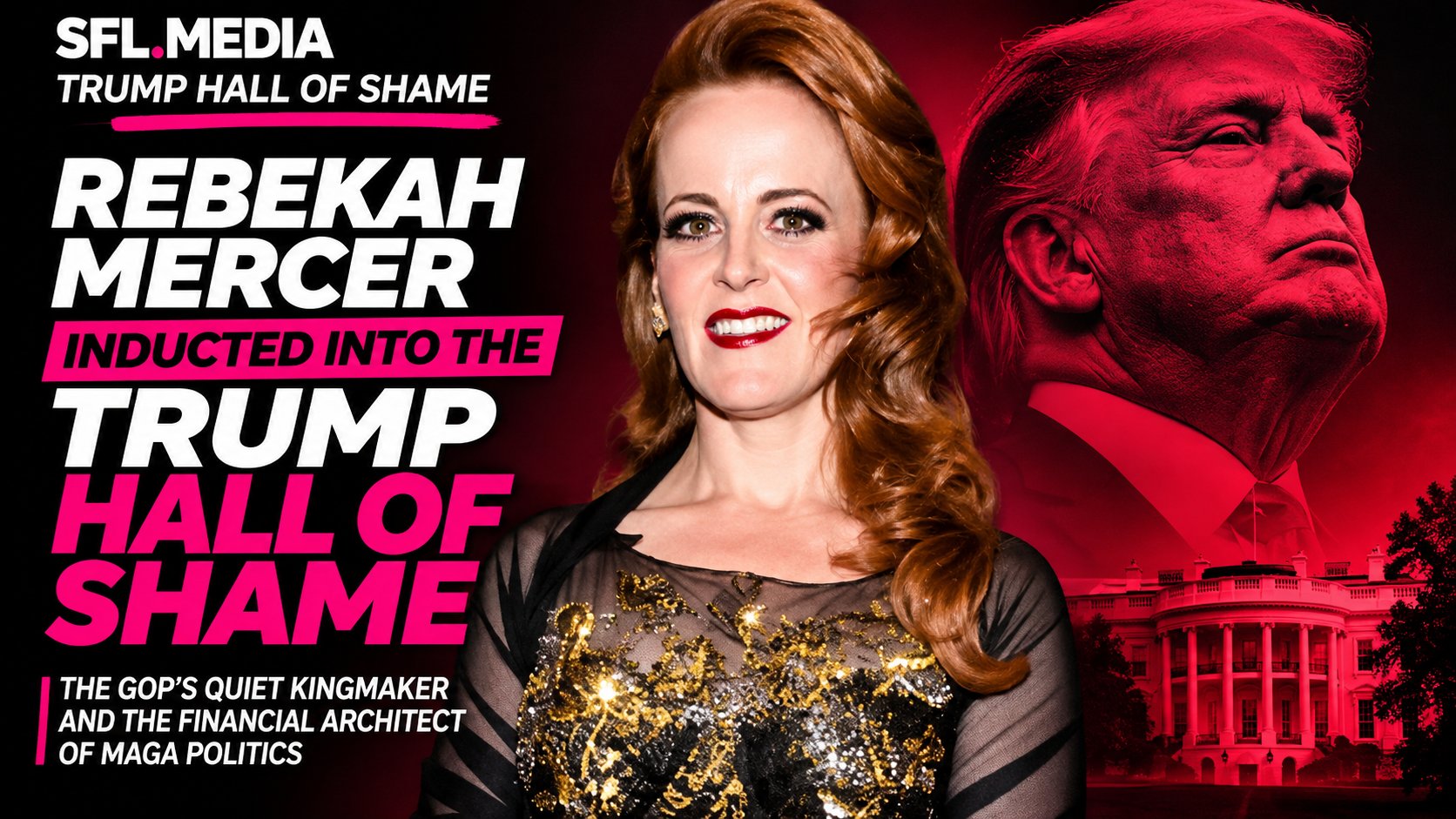
Rebekah Mercer Enters the Trump Hall of Shame: The Billionaire Who Helped Bankroll Breitbart, Cambridge Analytica, Steve Bannon, and the MAGA Machine
Donald Trump may be the public face of MAGA, but his political rise depended on wealthy donors, powerful media organizations, and sophisticated political operatives working behind the scenes. Few figures played a more consequential role in financing that infrastructure than Rebekah Mercer. From supporting Breitbart News and Steve Bannon to backing Cambridge Analytica and helping launch Parler, Mercer helped build an interconnected political ecosystem that reshaped American conservatism. A decade after Trump’s first presidential victory, her involvement in conservative political and financial networks raises an enduring question: Who holds the billionaires who help finance America’s political upheavals accountable?
Donald Trump did not build the MAGA movement by himself. Long before his political rallies became national spectacles, before his first administration began challenging established political norms, and before the January 6, 2021, attack on the United States Capitol, a network of extraordinarily wealthy donors, conservative media executives, political strategists, and technology investors was working to reshape the Republican Party. Their efforts helped create the political environment in which Trump could transform his celebrity into presidential power, and their influence extended far beyond conventional campaign contributions.
Among the most consequential figures in that network was Rebekah Mercer, the daughter of billionaire hedge fund investor Robert Mercer and a major conservative political donor whose family fortune helped support some of the organizations and personalities that propelled Trump into the White House. Unlike Trump, Steve Bannon, or the outspoken personalities who dominate conservative television and social media, Mercer has generally operated away from public attention. She rarely grants extensive interviews, does not depend on campaign rallies to establish her influence, and has never needed to win an election to help shape the political direction of the country.
Her influence has instead flowed through political financing, organizational relationships, media investments, and access to the people responsible for constructing the modern conservative movement. The Mercer family’s money helped sustain Breitbart News during its transformation into an aggressive nationalist media operation. Rebekah Mercer supported Bannon, the Breitbart executive who became chief executive of Trump’s 2016 presidential campaign. She also served on the board of Cambridge Analytica, the controversial political consulting company that became internationally notorious for improperly obtaining Facebook user data.
Years later, Mercer helped launch Parler, a social media platform that attracted conservatives frustrated with mainstream technology companies and became a gathering place for election denial narratives surrounding the 2020 presidential election. Her subsequent involvement in 1789 Capital, a Palm Beach-based investment firm that brought Donald Trump Jr. into its leadership, illustrates how the political and financial networks associated with Trump’s rise have continued evolving during his second administration.
These were not isolated relationships. Taken together, they demonstrate how wealthy political patrons can finance media organizations, campaign operations, research institutions, and technology platforms that reinforce one another, amplifying political messages far beyond what traditional campaign contributions alone can accomplish.
Mercer did not invent right wing populism, create every conspiracy theory promoted by conservative media, or single handedly elect Donald Trump. But her documented involvement in several critical institutions makes her one of the most important figures in understanding how the MAGA movement acquired financial resources, political influence, and institutional staying power. For SFL.MEDIA’s Trump Hall of Shame, that record deserves scrutiny.
The Mercer Fortune: How Hedge Fund Wealth Became Political Power
Rebekah Mercer’s political influence is inseparable from the fortune accumulated by her father, Robert Mercer, a computer scientist and former co-chief executive of Renaissance Technologies, one of the world’s most successful quantitative investment firms. Robert Mercer amassed extraordinary wealth through sophisticated mathematical trading strategies, providing the family with the financial resources to become major supporters of Republican candidates, conservative advocacy organizations, political action committees, and media ventures.
The family’s political spending became particularly consequential during the 2016 presidential election cycle, when Republican donors were searching for a candidate capable of defeating Democratic nominee Hillary Clinton. Initially, the Mercers supported Texas Senator Ted Cruz, whose presidential campaign benefited from substantial financial backing through outside political groups. After Cruz withdrew from the race, the family shifted its attention toward Trump, who had already transformed the Republican presidential contest through an unconventional combination of celebrity, populist messaging, anti-immigration rhetoric, and relentless attacks on the political establishment.
That transition mattered because the Mercers brought considerably more than campaign contributions. They were connected to political strategists, media organizations, research operations, and data-analysis companies that could support a presidential campaign struggling to build a conventional national political organization. Rebekah Mercer emerged as an influential participant in those relationships, helping connect Trump’s campaign with political operatives who would become central to his eventual victory.
A September 2016 Washington Post investigation found that Robert Mercer had contributed at least $36.5 million to federal Republican candidates and super PACs since 2010, while Rebekah had personally contributed another $814,500. The family’s foundation also distributed nearly $35 million to conservative think tanks and policy organizations over a five-year period. Those figures were historical snapshots, not a complete accounting of the family’s political spending through 2026, but they established the scale of the resources available to the Mercer political network.
The broader lesson is difficult to ignore. America’s campaign finance system allows wealthy individuals and families to spend enormous sums influencing elections, particularly through super PACs and other organizations legally separated from candidate campaigns. Ordinary voters get one ballot, while billionaire donors can finance entire political ecosystems that influence which candidates gain momentum, which political narratives dominate public debate, and which organizations possess the resources to survive.
That distinction does not mean wealthy donors automatically control the politicians they support. It does, however, give them opportunities to influence political outcomes without submitting themselves to the public scrutiny or electoral accountability required of the people who eventually hold office.
Breitbart News: The Media Machine That Helped Normalize MAGA
One of the Mercer family’s most consequential political investments involved Breitbart News, the conservative media organization founded by Andrew Breitbart in 2007. Contrary to a frequently repeated misconception, Rebekah Mercer did not establish Breitbart. The publication existed years before the family became financially involved, and its founder died in 2012. The Mercers’ significance was in helping finance and sustain the organization as it expanded its political influence, particularly under Steve Bannon’s leadership.
Following Andrew Breitbart’s death, Bannon became executive chairman and helped transform the publication into an increasingly confrontational political operation. Breitbart promoted nationalist and anti establishment messaging, attacked Republican leaders considered insufficiently conservative, and developed a reputation for sensational coverage of immigration, cultural conflict, and political controversies. Its editorial approach increasingly reflected the populist grievances that Trump would later exploit during his presidential campaign.
During the 2016 election, Bannon described Breitbart as a platform for the alt-right, a statement that attracted widespread criticism because of the movement’s associations with white nationalism, racism, and antisemitism. Although Bannon subsequently sought to distinguish his political philosophy from openly racist elements of the movement, the controversy highlighted Breitbart’s role in bringing ideas once confined to the political fringes into mainstream national debate.
The Mercer family’s investment helped provide the financial foundation for Breitbart’s expansion. Reporting by The Washington Post documented approximately $10 million in Mercer family investment in the publication beginning in 2011, illustrating how private wealth helped sustain an ideological media enterprise at a critical moment in American politics.
For Trump, that media environment proved valuable. Breitbart’s editorial approach frequently aligned with his attacks on immigration, established Republican leadership, political elites, and mainstream news organizations. The website helped reinforce themes that became central to his presidential campaign, creating an audience already receptive to his argument that America’s political establishment had betrayed ordinary citizens.
Breitbart was not the only media organization responsible for Trump’s rise, and its audience was not uniformly composed of extremists. Nevertheless, its role in legitimizing aggressive nationalist messaging and challenging traditional Republican leadership was significant. The important question is not whether Mercer personally approved every Breitbart headline, because there is no public evidence establishing that level of editorial control. The issue is that her family’s money helped support a media operation whose political direction and influence were already apparent.
When wealthy donors finance media organizations that advance their political preferences, they can influence public debate without appearing on ballots, attending campaign rallies, or answering questions from the people whose political decisions they hope to shape. That form of influence deserves substantially more public attention.
Steve Bannon: The Political Connection That Helped Reshape Trump’s Campaign
If Breitbart helped establish the ideological environment surrounding Trump’s campaign, Steve Bannon helped translate that environment into electoral strategy. In August 2016, with Trump trailing Clinton in many national polls and facing mounting questions about his campaign’s organization, Bannon was appointed chief executive of the Trump presidential campaign. Republican pollster Kellyanne Conway was simultaneously named campaign manager, bringing two prominent figures from the Mercer family’s political network into positions of extraordinary influence.
Rebekah Mercer was widely reported to have played an important role in encouraging the campaign to bring Bannon into its leadership structure. Her relationship with Bannon, developed through conservative political and media circles, placed her among the wealthy supporters whose advice carried considerable weight during a critical stage of the election.
Bannon’s arrival marked a turning point in the campaign’s leadership. Rather than attempting to transform Trump into a conventional Republican presidential candidate, Bannon embraced the candidate’s combative instincts and intensified the populist message that had already attracted millions of supporters. The campaign focused heavily on immigration, trade, political corruption, economic nationalism, and opposition to the established political order, while Trump continued attacking Clinton, mainstream media organizations, and members of his own party.
The strategy ultimately succeeded in the Electoral College, although Clinton won the national popular vote by nearly 2.9 million ballots. Following the election, Bannon became White House chief strategist, bringing the ideological priorities associated with his political movement directly into the executive branch. His tenure was turbulent and ended in August 2017, but his influence on Trump’s political identity had already been established.
Mercer cannot reasonably be credited with every decision Bannon made or every policy Trump pursued. Nevertheless, her reported role in supporting Bannon’s appointment demonstrates how political donors can influence not only campaign financing but also the personnel responsible for shaping a presidential candidate’s strategy. In American politics, choosing the people who advise a president can sometimes matter almost as much as choosing the president himself.
Cambridge Analytica: The Data Operation That Turned Facebook Information Into Political Intelligence
Perhaps the most troubling chapter of the Mercer family’s political investment history involves Cambridge Analytica, the now defunct political consulting company that became synonymous with one of the largest consumer data scandals in modern American politics. The family financially backed the company, while Rebekah Mercer served on its board and promoted its services within conservative political circles.
Cambridge Analytica marketed sophisticated political advertising and voter profiling services, claiming it could combine personal information, psychological characteristics, and political behavior to help campaigns identify and persuade voters. The company worked for Ted Cruz’s presidential campaign before providing services to Trump’s 2016 campaign, making its operations particularly consequential during an election decided by narrow margins in several battleground states.
The controversy extended far beyond ordinary campaign analytics. In 2019, the Federal Trade Commission concluded that Cambridge Analytica had engaged in deceptive practices to obtain personal information from Facebook users. The agency documented how data had been collected through a personality-testing application and extended to tens of millions of Facebook users, including many people who had never knowingly consented to having their information collected for political profiling.
The FTC ordered Cambridge Analytica to delete improperly obtained personal information and imposed restrictions designed to address the company’s violations. The scandal also triggered major scrutiny of Facebook, which faced separate regulatory consequences over its handling of consumer data. For Americans who had never knowingly participated in political research, the controversy exposed how their personal information could be transformed into a commercial and political resource without meaningful consent.
Mercer’s role as an investor and board member placed her within the company’s financial and governance structure. However, the FTC’s findings against Cambridge Analytica did not establish that Mercer personally directed the deceptive data collection, and the agency did not find her individually responsible for the violations. That distinction is essential to understanding the documented record without exaggerating her personal legal responsibility.
There is another important limitation. Although Cambridge Analytica promoted its psychological-targeting capabilities, the effectiveness of those methods in changing votes remains disputed. There is no conclusive evidence demonstrating that Cambridge Analytica independently determined the outcome of the 2016 election or that its advertised psychological profiling performed as successfully as the company’s executives claimed.
That uncertainty does not diminish the seriousness of the documented privacy violations. The company’s conduct was troubling regardless of whether its political advertising proved effective, and the scandal exposed fundamental weaknesses in the systems governing personal information and digital political campaigns.
The larger issue is that the Mercer family’s political investment strategy extended beyond financing candidates and supporting conservative media. It included a company seeking to convert enormous quantities of personal information into political influence, raising fundamental questions about privacy, consent, and the role of private technology firms in democratic elections.
The Government Accountability Institute: Financing Political Investigations and Opposition Research
Another important component of the Mercer political network was the Government Accountability Institute, a conservative research organization co-founded by Steve Bannon and associated with author Peter Schweizer. The institute presents itself as an organization dedicated to investigating government corruption, conflicts of interest, and political misconduct, and its research has informed books, documentaries, and news coverage targeting prominent political figures.
One of its most prominent projects was Clinton Cash, Schweizer’s book examining financial relationships involving the Clinton Foundation and individuals or organizations with interests before the federal government. The book became a major political talking point during the 2016 presidential election and was adapted into a documentary supported by the Mercer linked production company Glittering Steel.
The Mercer family helped finance the Government Accountability Institute, while Rebekah Mercer held a leadership role in the organization. Her biography at 1789 Capital identifies her as the institute’s board chair, demonstrating the continuing connection between her political activities and organizations devoted to investigative research.
Investigating political corruption is legitimate journalism and an essential part of democratic accountability. The issue is not that conservative organizations investigate Democrats, any more than it would be improper for progressive organizations to investigate Republicans. The concern arises when wealthy political donors finance research organizations, media companies, and campaign operations that can promote overlapping political narratives while presenting themselves as independent sources of information.
Such arrangements deserve transparency because readers and voters should understand the financial relationships connecting research organizations, political donors, media outlets, and electoral campaigns. For the Mercers, these relationships formed part of a broader network in which political advocacy, media production, and campaign messaging could reinforce one another.
Parler: Building an Alternative Social Media Platform for the MAGA Movement
After Trump’s first presidential victory and the Cambridge Analytica scandal, Mercer remained involved in ventures associated with the conservative political ecosystem. In 2020, she publicly identified herself as a co-founder of Parler, the social media platform that attracted conservatives frustrated with content moderation on Facebook, Twitter, and other major technology services.
Parler, originally launched in 2018, marketed itself as a free-speech alternative to established social networks. Mercer defended the project as an effort to protect open expression and user privacy, an explanation consistent with her publicly stated support for the venture. The platform rapidly became popular among conservative commentators, Trump supporters, and political activists who believed mainstream technology companies were unfairly restricting right wing speech.
However, Parler also attracted users promoting conspiracy theories, election misinformation, and extremist political content. Following Trump’s defeat in the 2020 presidential election, the platform became one of several online environments where false claims about widespread election fraud circulated. It received intense scrutiny after the January 6, 2021, attack on the Capitol, when investigators and researchers examined how participants and extremist groups had used social media to communicate and organize.
Parler was not the only platform involved in the events surrounding January 6. Facebook, Twitter, YouTube, and other online services also hosted election related misinformation and content connected to the attack. Nor does the presence of extremist users establish that Mercer personally supported political violence or knowingly facilitated the attack.
Nevertheless, Parler’s rise demonstrated how alternative technology platforms could become important components of the broader MAGA information environment, particularly when political communities sought spaces with fewer restrictions on controversial content. A February 2021 Washington Post investigation reported that Mercer held a majority ownership stake in Parler and controlled two of the company’s three board seats, giving her substantial influence over the platform during a period of intense public controversy.
For Mercer, the venture represented another significant investment in political communication infrastructure. Having helped support a conservative news organization and a political data company, she was now associated with a social network designed to serve an audience that substantially overlapped with Trump’s political base. The pattern illustrates how media ownership, political financing, data technology, and social platforms can reinforce one another, even when the businesses operate independently.
When Bannon and Trump Split, Mercer Chose Trump
One of the clearest documented indications of Mercer’s political loyalties came in January 2018, when the relationship between Donald Trump and Steve Bannon collapsed. After Bannon made comments critical of Trump and his family that appeared in Michael Wolff’s book Fire and Fury, the president publicly attacked his former chief strategist, creating a confrontation that threatened to divide the political network that had helped bring Trump to power.
Mercer faced a choice between Bannon, the longtime political strategist associated with her family’s media and political investments, and Trump, the president whose election those investments had helped support. She chose Trump, publicly declaring her support for the president and the political platform on which he had been elected.
The statement was particularly revealing because it demonstrated that Mercer’s support for Trump was not merely an extension of her relationship with Bannon. When the two men became political adversaries, she publicly sided with the president, distancing herself from the strategist whose rise she had helped facilitate.
That decision complicates any suggestion that Mercer was simply following the political judgment of the advisers surrounding her. By 2018, she had become an influential conservative figure capable of making her own decisions about which political leaders and organizations deserved continued support.
Her subsequent involvement in conservative political and financial networks provides further evidence that she remained active within the broader movement, although public records do not establish that she personally endorsed every policy or controversy associated with Trump’s presidency.
1789 Capital: The Mercer Network Moves to Palm Beach and Into the Trump Family’s Business Empire
One of the most consequential developments in Mercer’s recent business history brings the story directly into South Florida. Mercer is a founder of 1789 Capital, a Palm Beach based investment firm established in 2022 with financier Omeed Malik and conservative entrepreneur Christopher Buskirk. The firm initially positioned itself as an alternative to investment strategies emphasizing environmental, social, and governance considerations, promoting what it called a focus on entrepreneurship, innovation, and growth.
The business was built around the idea that investors could profit by supporting companies aligned with conservative economic and cultural preferences. Its early investments included a $15 million commitment to Tucker Carlson’s media company in 2024, illustrating how the political networks associated with the MAGA movement were expanding into private investment opportunities.
The relationship became considerably more significant after Trump’s victory in the 2024 presidential election, when Donald Trump Jr. joined 1789 Capital as a partner. Reuters confirmed the move in November 2024, reporting that Trump Jr. would help identify investments and raise capital for the firm. Its current leadership roster identifies Mercer as a founder and Trump Jr. as a partner.
For anyone examining the intersection of political influence and private wealth, the arrangement deserves attention. Mercer helped finance institutions that contributed to Trump’s first presidential victory. Years later, she became associated with an investment firm employing the president’s eldest son and pursuing opportunities in industries significantly affected by federal economic, regulatory, and national-security policy.
That relationship is not inherently illegal, and there is no established finding that Mercer or Trump Jr. obtained improper government benefits through their association with 1789 Capital. Nevertheless, the overlapping political and financial interests create legitimate questions about conflicts of interest, preferential access, and whether the public has sufficient information to evaluate relationships between presidential family businesses and federal decision-makers.
Those questions have become more urgent as 1789 Capital has expanded beyond its original conservative-oriented investment strategy into defense technology, aerospace, manufacturing, artificial intelligence, and real estate. By August 2026, the firm had closed a $1.2 billion real estate development fund focused primarily on fast-growing Sun Belt markets, including Florida, Texas, Tennessee, Georgia, and the Carolinas.
Axios reported that Trump Jr. would serve on the investment committee for the new real estate fund, giving him a role in decisions involving projects across some of the country’s fastest-growing markets. The publication also reported that approximately 40% of the firm’s capital came from foreign investors, according to regulatory filings cited in earlier reporting.
That foreign investment is not itself evidence of wrongdoing. International capital is common in private equity, venture capital, and real estate. But when a firm employing the president’s son attracts substantial overseas investment while pursuing opportunities in industries affected by federal policy, transparency becomes especially important.
For South Florida residents, the geography is impossible to overlook. Palm Beach has become a center of political and financial influence surrounding Trump’s presidency, while the region’s investment firms, developers, and business executives increasingly operate within networks connected to national Republican politics.
The same region that attracts wealthy investors from around the world is now home to an investment firm linking one of Trump’s most influential early political backers with the president’s eldest son. That is a development worth watching closely.
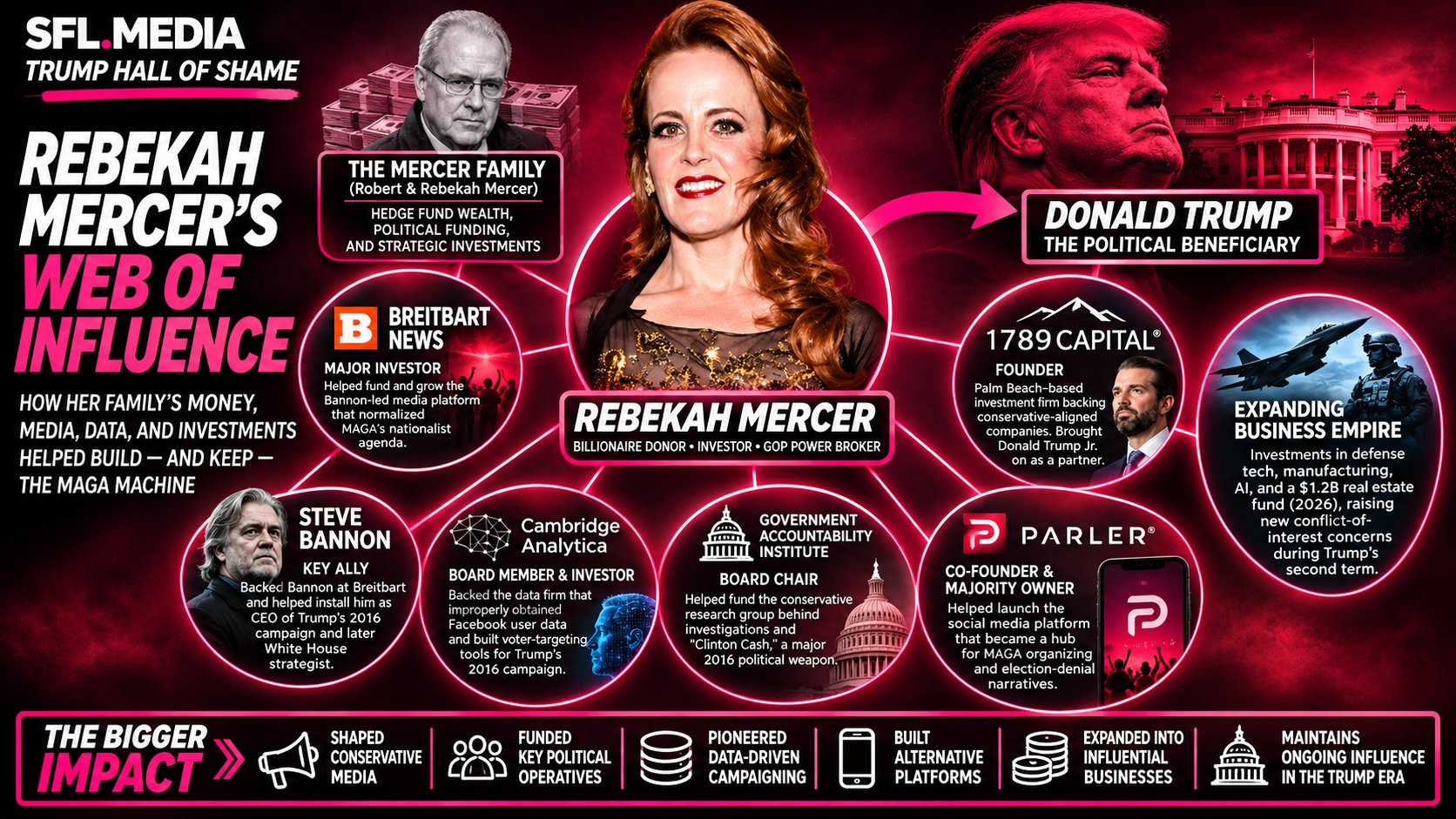
Defense Contracts, Pentagon Advisers, and the New Politics of Private Investment
The most serious questions surrounding 1789 Capital concern its growing exposure to companies involved in defense technology and federal contracting. In August 2026, The Guardian reported that two appointees to the Pentagon’s Defense Policy Board had business relationships connected to investments also held by 1789 Capital.
One appointee, venture capitalist Marc Andreessen, co-founded Andreessen Horowitz, a major technology investment firm that shares investments with 1789 Capital in several companies operating in defense and aerospace. Another appointee, Blake Masters, serves on boards associated with business ventures connected to 1789 Capital co-founder Omeed Malik.
The Defense Policy Board advises senior Pentagon leadership on national security strategy and defense policy. It does not directly award government contracts, but its members can gain insight into military priorities and influence strategic discussions affecting industries in which private investors hold substantial financial interests.
The Guardian identified overlapping investments involving Anduril Industries, Hadrian, and SpaceX, companies operating in sectors where federal contracts and national-security spending can significantly affect valuations. The report also examined the broader expansion of 1789 Capital’s investment portfolio and the potential ethical concerns associated with advisers who maintain relationships with companies seeking or receiving federal business.
One especially notable investment involved Vulcan Elements, a rare earth magnet manufacturer that received a $620 million Pentagon loan after 1789 Capital had invested in the company. That sequence does not establish improper influence, but it illustrates why the relationship between private investment and federal decision making deserves independent scrutiny.
The issue is not whether defense technology companies should receive government contracts. The United States relies heavily on private manufacturers and technology businesses to develop military equipment, communications systems, aerospace technology, and national security infrastructure. The issue is whether politically connected investors have access to information or relationships that could provide advantages unavailable to competitors.
There is no established finding that Mercer personally influenced Pentagon procurement decisions or directed federal contracts toward 1789 Capital investments. Her role as a founder should not be confused with evidence of operational involvement in every transaction or government relationship associated with the firm.
Nevertheless, the structure creates a legitimate accountability question. When an investment firm founded by a major presidential donor employs the president’s son, holds stakes in defense related companies, and operates within networks that include federal policy advisers, the public has reason to demand transparency about financial interests, conflicts, and safeguards.
Americans should not have to assume that government decisions are independent of private financial interests. They should be able to examine records demonstrating that independence.
From Breitbart to Defense Technology: How the Political Business Model Evolved
The evolution of Mercer’s political and financial relationships reveals an important transformation in the modern conservative movement. During the 2016 election, the Mercer network concentrated heavily on political media, campaign operations, research organizations, and data analytics. Those investments helped create the infrastructure through which conservative political ideas could be developed, amplified, and translated into electoral influence.
A decade later, some of the same political networks have expanded into private investment, technology development, defense manufacturing, and real estate. The financial opportunities associated with political influence have grown alongside the movement’s institutional power.
That transformation does not mean every investment was politically motivated or that every company receiving funding shares the ideology of its investors. Businesses frequently accept capital from investors with diverse political views, and successful technology companies can attract funding for commercial reasons entirely separate from politics.
But the continuity of the relationships is significant. Mercer helped finance organizations that supported Trump’s rise, and she is now associated with an investment firm employing his son during a presidential administration whose decisions affect industries in which that firm invests.
This is precisely the kind of overlap that requires sustained investigative journalism rather than casual assumptions of either innocence or guilt. The relevant questions concern ownership, financial disclosures, investment timing, government contracts, regulatory decisions, and whether public officials have complied with applicable ethics requirements.
Those questions apply equally to Democratic and Republican administrations. Political influence should not become a private financial asset that can be converted into preferential government treatment, regardless of which party holds power.
The Missing Accountability: How Much Political Power Can One Billionaire Family Buy?
Rebekah Mercer’s political history illustrates a structural problem that extends beyond Donald Trump and the Republican Party. American democracy allows extraordinarily wealthy individuals to accumulate influence through campaign contributions, super PACs, advocacy organizations, media investments, and private business relationships. Much of that activity is lawful and protected by the First Amendment, and individuals have legitimate rights to support candidates and causes they believe in.
But those rights do not eliminate the public’s interest in understanding how political power is financed and exercised. A donor who contributes to a campaign participates in the political process. A donor who finances media outlets, research organizations, campaign infrastructure, and politically connected investment firms can exercise influence across multiple institutions that shape public policy and public opinion.
Mercer’s record is particularly noteworthy because her family’s financial resources helped support several institutions that became central to the modern conservative movement. Breitbart provided an influential media platform, Cambridge Analytica marketed political data services, the Government Accountability Institute produced investigative research, and Parler offered an alternative social network attractive to conservative audiences. Her later involvement with 1789 Capital placed her within an investment network that includes Trump’s eldest son.
These activities are individually distinct, and they should not be combined into a blanket allegation of criminal wrongdoing. But collectively, they demonstrate how political influence can accumulate through institutions that most voters rarely examine.
Trump’s political career has generated enormous controversy over immigration policy, democratic institutions, presidential conduct, government ethics, foreign affairs, and the relationship between public office and private financial interests. Mercer is not personally responsible for every Trump policy, every scandal involving his associates, or every consequence of his administration’s decisions. Assigning her responsibility for all of them would go beyond the evidence.
What the historical record establishes is that she helped finance and organize institutions that contributed to his political rise, publicly supported him during his confrontation with Bannon, and remains associated with conservative financial networks that include his family. That is a substantial record of political influence, even without exaggeration.
Why Rebekah Mercer’s Role Matters More Than Her Public Profile
The public’s attention naturally gravitates toward politicians who make outrageous statements, television personalities who dominate political debates, and billionaires who cultivate enormous social media followings. Rebekah Mercer represents a different kind of political power, one exercised through institutional relationships and financial resources rather than constant public appearances.
Her influence is particularly important because the organizations associated with her political history operated at different stages of the political process. Some helped develop political narratives, others helped distribute those narratives, and still others provided campaign services or financial support. Together, they formed parts of a broader conservative ecosystem that existed independently of any single candidate.
That ecosystem helped Trump capitalize on public frustration with established political institutions and consolidate support among voters who believed the Republican Party had failed to represent their interests. It also contributed to a political environment characterized by intense polarization, hostility toward mainstream institutions, and increasingly aggressive ideological conflict.
Mercer was not alone in financing that transformation. Numerous wealthy donors, political strategists, media executives, and advocacy organizations played important roles. Nor should every conservative organization or political investment be treated as inherently illegitimate.
The central concern is accountability. The people who finance powerful political movements should be subject to serious scrutiny, particularly when their financial interests intersect with the business activities of elected officials and their families.
Democracy requires more than transparent elections. It also requires public visibility into the financial relationships and institutional networks that influence which candidates gain power, what messages voters hear, and whose interests receive attention after elections are over.
The Verdict: Rebekah Mercer Belongs in the Trump Hall of Shame
Rebekah Mercer did not create Donald Trump, invent right wing populism, or single handedly transform the Republican Party. Millions of voters, numerous political organizations, conservative media companies, and generations of ideological conflict contributed to the movement that eventually carried Trump into the White House.
But Mercer played a consequential and unusually well-financed role in that transformation. Her family’s investments helped support Breitbart News during its emergence as a major nationalist media platform. Her political relationships helped connect Trump with Steve Bannon and other influential campaign operatives. Her involvement with Cambridge Analytica linked her to a company later found to have violated federal consumer-protection law through deceptive personal-data collection. Her role in founding Parler helped establish another platform serving conservative political audiences, while her involvement with 1789 Capital now connects her to an investment firm employing Donald Trump Jr.
These are documented relationships, not speculation. They reveal a political donor whose influence extended well beyond writing campaign checks and attending fundraisers.
Mercer and her supporters would argue that she has exercised her constitutional rights, supported causes consistent with her beliefs, and invested in businesses she considers beneficial to the country. Those arguments deserve acknowledgment. Political participation, private investment, and support for conservative causes are not inherently improper.
But democratic accountability is not limited to identifying criminal conduct. It also involves examining the people who finance powerful political movements, the institutions they help build, and the consequences of the political systems they support.
Mercer helped finance the infrastructure that elevated Trump from celebrity businessman to president of the United States. Nearly a decade after his first election, she remains connected to conservative donor and business networks surrounding his political movement.
She has enjoyed extraordinary opportunities to influence American politics without ever having to stand before voters and defend her record in a national election. And while the public has spent years debating Trump’s statements, scandals, policies, and political conduct, the wealthy individuals who helped build the infrastructure supporting his movement have often received far less attention.
That imbalance is precisely why this series exists.
Donald Trump became the face of MAGA. Rebekah Mercer helped finance the machinery behind it.
For her documented role in building and sustaining the political infrastructure that helped bring Trump to power, SFL.MEDIA inducts Rebekah Mercer into the Trump Hall of Shame.















































Want to join the conversation?
Create an account or sign in to share your thoughts, vote,
and reply to other readers.
Showing 0 of 0 comments
Don't have an account?
Already have an account?