
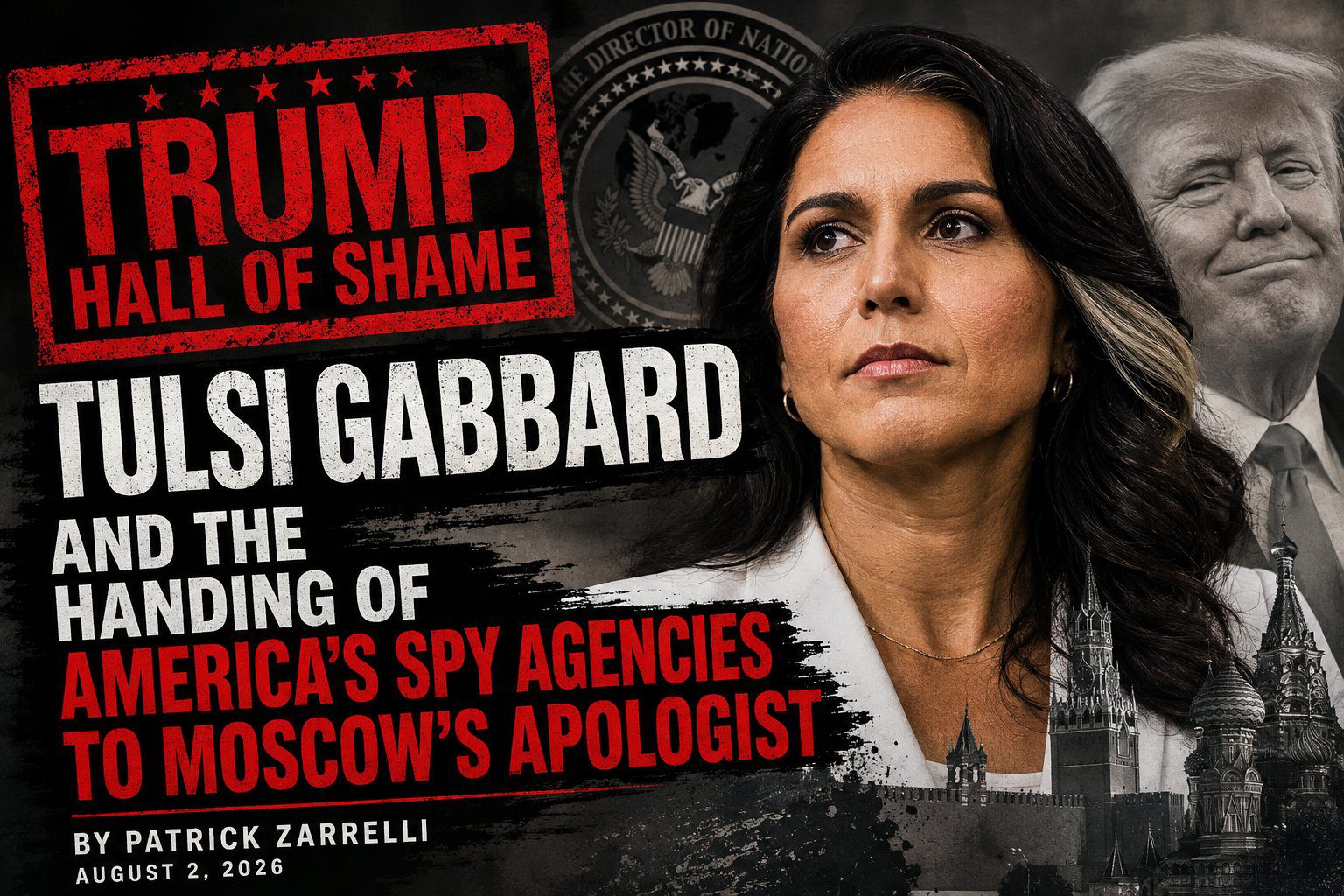
Tulsi Gabbard’s Journey From Democratic Insurgent to Trump’s Intelligence Warrior
There are Trump loyalists who arrived in Washington already wearing MAGA hats, and then there is Tulsi Gabbard.
Her political transformation is one of the strangest in modern American politics. Gabbard went from Democratic congresswoman and vice chair of the Democratic National Committee to Bernie Sanders supporter, Democratic presidential candidate, Fox News fixture, Donald Trump surrogate and ultimately Trump’s Director of National Intelligence, the official charged with coordinating the vast American intelligence apparatus responsible for warning presidents about threats from Russia, China, Iran, terrorist organizations and hostile intelligence services around the world.
That journey alone would make Gabbard politically fascinating. What makes it alarming is the record she carried with her. Before Trump entrusted Gabbard with some of the most sensitive intelligence in the United States government, she had met personally with Syrian dictator Bashar al-Assad, questioned conclusions surrounding chemical attacks attributed to his regime, argued that Russia’s invasion of Ukraine could have been prevented by addressing what she called Russia’s “legitimate security concerns,” and promoted claims about U.S. supported biological laboratories in Ukraine that became useful material for Russian propaganda.
“Nearly 100 former American national security and foreign policy officials were sufficiently concerned about her record that they publicly urged the Senate to scrutinize her nomination. Trump put her in charge anyway.” – Patrick Zarrelli
Once there, Gabbard went beyond merely defending the president who appointed her. She used the Office of the Director of National Intelligence to advance some of Trump’s most politically explosive claims about the intelligence community, revoked security clearances from dozens of current and former intelligence professionals at Trump’s direction, dramatically reduced the size of her own office and helped reopen the political war over Russia’s interference in the 2016 presidential election. Her tenure ended in June 2026 after barely more than a year.
For the combination of her extraordinary political transformation, her history of controversial positions involving authoritarian governments and her willingness to turn the nation’s highest intelligence office toward Trump’s political grievances, Tulsi Gabbard earns her place in the South Florida Media Trump Hall of Shame.
From Democrat to Trump Loyalist
It is worth remembering just how unlikely this story once appeared. Gabbard represented Hawaii in Congress as a Democrat from 2013 until 2021. She served as a vice chair of the Democratic National Committee before resigning during the 2016 presidential campaign and endorsing Bernie Sanders over Hillary Clinton. Four years later, she ran for the Democratic presidential nomination herself. She was not simply a registered Democrat occupying a congressional seat. She was once considered a rising figure within the party.
Then came the transformation.
Gabbard left the Democratic Party in 2022, increasingly appearing in conservative media and attacking the political establishment she once belonged to. By August 2024, she formally endorsed Donald Trump. Her usefulness to Trump was obvious. Gabbard could stand before audiences not as a lifelong Republican but as someone who could say she had seen the Democratic Party from the inside and rejected it. She was a military veteran, former Democratic presidential candidate and former congresswoman who could appeal to independents, veterans and disaffected Democrats in a way conventional MAGA surrogates could not.
Trump brought her into his political operation. Gabbard helped him prepare for his debate against Kamala Harris, someone Gabbard had famously confronted during the 2020 Democratic presidential primaries. She campaigned for Trump and became part of the coalition surrounding his return to power. The reward was extraordinary. Trump nominated her to become Director of National Intelligence.
The Assad Meeting That Never Stopped Following Her
Long before Gabbard joined Trump’s administration, one episode had already defined much of the national security criticism surrounding her: Syria.
In 2017, while serving in Congress, Gabbard traveled to Syria and met with President Bashar al-Assad. The meeting was deeply controversial because Assad’s government had been accused by international investigators and human rights organizations of widespread atrocities during the Syrian Civil War, including torture, indiscriminate attacks on civilians and chemical weapons use. Gabbard defended the meeting on the grounds that leaders should be willing to engage adversaries in pursuit of peace. Meeting an enemy is not inherently disqualifying; diplomacy frequently requires talking to terrible people.
The controversy went much further than the meeting itself. Gabbard repeatedly challenged the conventional Washington consensus surrounding Syria and questioned whether Assad’s government was responsible for certain chemical attacks attributed to it. Her skepticism placed her in direct conflict with much of the U.S. foreign policy establishment and made her enormously useful to people arguing that Washington was manufacturing justification for another Middle Eastern war.
Her defenders saw an anti-interventionist willing to question intelligence claims after the disastrous experience of Iraq. Her critics saw something else, an American politician repeatedly providing rhetorical cover for an authoritarian ruler protected by Vladimir Putin’s Russia. That argument would follow her all the way to her DNI confirmation.
Then Came Russia and Ukraine
Gabbard’s approach to Russia created an even larger problem. When Russia launched its full scale invasion of Ukraine in February 2022, Gabbard argued that the war could have been avoided if the United States and NATO had addressed Russia’s concerns over Ukraine potentially joining the alliance. Russia had spent years portraying NATO expansion as an existential threat. Putin used that argument repeatedly while justifying Moscow’s confrontation with Ukraine and the West.
There is a legitimate foreign policy debate over NATO enlargement, Western strategy after the Cold War and whether different diplomatic choices could have reduced tensions with Moscow. Serious scholars have argued about those questions for decades.
But there is also an unavoidable fact: Russia made the decision to invade Ukraine. Putin ordered Russian troops across the border. Ukraine did not invade Russia. NATO did not invade Russia. Russia invaded Ukraine. Gabbard’s framing therefore infuriated critics who believed she was shifting responsibility from the government that launched the invasion toward the Western alliance Putin blamed for provoking him. Then came the biolab controversy.
The Ukrainian “Biolab” Claims
Shortly after Russia invaded Ukraine, Gabbard publicly discussed what she described as more than two dozen U.S. funded biological laboratories in Ukraine and warned about dangerous pathogens potentially escaping if those facilities were attacked.
There was a kernel of reality underneath the controversy: the United States had supported biological threat reduction and public health laboratory programs in Ukraine. That is radically different, however, from Russia’s much broader allegation that the United States was secretly operating biological weapons laboratories there.
Gabbard denied claiming that Ukraine possessed biological weapons. But her presentation was rapidly seized upon by Russian propaganda outlets and officials because it appeared to validate Moscow’s narrative that something sinister was happening inside Ukrainian laboratories. This distinction matters.
The responsible criticism of Gabbard is not that she literally said every word Russian propagandists later attributed to her. She did not. It is that one of America’s most prominent political figures repeatedly adopted framings of Russia and Ukraine that Moscow could readily exploit. For an ordinary commentator, that would be controversial. For someone later selected to oversee the American intelligence community, it became a national security question.
Nearly 100 Former National Security Officials Sounded the Alarm
When Trump nominated Gabbard for DNI, the criticism was not confined to Democrats attacking a Republican president’s nominee. Nearly 100 former national security and foreign policy officials signed a letter raising concerns about her qualifications and judgment, specifically citing her positions involving Russia and Syria.
The concern was obvious. The Director of National Intelligence sits at the center of the American intelligence system. The office coordinates intelligence produced across the government and serves as a critical conduit between intelligence professionals and the president. This is not supposed to be a position for ideological warfare. The job is to tell the president what the intelligence says, especially when the president does not want to hear it.
Gabbard’s supporters argued that this was precisely why she was needed. They believed intelligence agencies had become politicized, bureaucratically bloated and hostile to Trump. They viewed Gabbard as an outsider capable of confronting institutions they believed had abused their authority. Her critics feared Trump was installing someone who shared his grievances against the intelligence community and would use the office to validate them. What followed gave those critics plenty to talk about.
Gabbard Took Trump’s War on the Intelligence Community Inside the Building
Once confirmed, Gabbard did not behave like a caretaker. She began reshaping the Office of the Director of National Intelligence. In August 2025, Gabbard announced a restructuring that would cut ODNI personnel by more than 40% and, according to her office, save more than $700 million annually. Among the changes was the elimination of the Foreign Malign Influence Center as a standalone entity, with the administration arguing that its functions were duplicated elsewhere in the intelligence community. Supporters called it overdue bureaucratic reform.
Critics saw something much more dangerous: the dismantling of institutions created specifically to monitor foreign influence at a time when Russia, China and other adversaries were aggressively attempting to manipulate American politics and public opinion. The timing was particularly striking because Gabbard was simultaneously escalating her own political confrontation over the intelligence community’s assessment of Russian interference in the 2016 election.
The Russia Investigation Became a Political Weapon Again
In 2025 and 2026, Gabbard used her position to declassify and publicize documents that she argued demonstrated misconduct surrounding intelligence assessments of Russia’s interference in the 2016 election. She went extraordinarily far. Gabbard characterized the actions of Obama-era officials as part of a “treasonous conspiracy” against Trump and referred materials to the Justice Department. Trump seized on the claims and went further, publicly accusing former President Barack Obama of treason.
That accusation was explosive. It was also disputed by Democrats, former intelligence officials and subsequent intelligence reviews that continued to support the central conclusion that Russia conducted an influence campaign during the 2016 election.
The distinction that repeatedly gets lost in partisan arguments is critical: evidence that Russia attempted to influence the election is not the same thing as evidence that Russia altered vote totals, and neither is identical to the separate question of whether Trump personally conspired with Moscow.
Those are different claims. But in Trump’s political mythology, they have frequently been blended together into one enormous grievance called the “Russia hoax.” Gabbard, now occupying the nation’s highest intelligence position, helped bring that grievance directly into the machinery of American intelligence.
Security Clearances Became Another Battlefield
The confrontation did not stop with declassification. In August 2025, Gabbard revoked the security clearances of 37 current and former intelligence professionals whom she accused of politicizing or manipulating intelligence. She said she acted at Trump’s direction. For Trump’s supporters, this was accountability. For critics, it looked like retaliation.
Security clearances are not constitutional rights, and presidents possess enormous authority over access to classified information. But using clearance decisions against officials accused of political disloyalty creates an obvious danger inside an intelligence system whose analysts must be willing to reach conclusions the president may hate.
Intelligence becomes worthless when analysts begin asking what the president wants to hear before deciding what the evidence actually says. That is how intelligence failures are manufactured.
Edward Snowden Was Another Warning Sign
Gabbard’s earlier positions regarding Edward Snowden also became a major issue during her confirmation. Snowden disclosed massive quantities of classified National Security Agency information in 2013 before eventually receiving asylum and later citizenship in Russia. Gabbard had previously introduced legislation calling for charges against Snowden to be dropped. Her supporters viewed Snowden as a whistleblower who exposed unconstitutional mass surveillance. Many national security officials viewed him as someone who stole extraordinarily sensitive intelligence and fled into the protection of an adversarial government.
Gabbard’s refusal during her confirmation process to straightforwardly label Snowden a traitor became one of the most contentious moments of her hearing. Again, the underlying debate is legitimate. Americans should debate surveillance, privacy and the enormous powers of the national security state. But the Director of National Intelligence does not operate in an academic seminar. The DNI is responsible for protecting some of the most sensitive secrets the United States possesses. Gabbard’s history guaranteed that every previous position she had taken on intelligence leaks would receive extraordinary scrutiny.
Even Her Surveillance Position Changed
Another controversy emerged around Section 702 of the Foreign Intelligence Surveillance Act, one of the most important and controversial surveillance authorities available to the U.S. government. Gabbard had previously opposed aspects of the surveillance system and supported stronger privacy protections. During her confirmation process, however, she moved toward supporting Section 702 after changes to the law and safeguards she said addressed some of her concerns.
Her critics called it a confirmation conversion. Her defenders argued that the law itself had changed and that an incoming intelligence chief was entitled to reconsider her position based on new safeguards and classified briefings. Either interpretation reinforces the same central theme of Gabbard’s career: dramatic political transformation. On issue after issue, the Tulsi Gabbard who eventually entered Trump’s Cabinet looked remarkably different from the politician who first arrived in Washington as a Democrat.
The Science of Identity Controversy Requires More Care Than Political Attacks Suggest
Gabbard’s upbringing within the Science of Identity Foundation has also attracted intense scrutiny. The Hawaii based religious organization was founded by Chris Butler, whom Gabbard has previously referred to as her spiritual teacher or guru. Former members have described the organization as authoritarian and cult like and have alleged that Butler exercised extraordinary influence over followers.
The organization and its supporters dispute many of those characterizations. This is an area where responsible journalism needs to be especially careful. Religious affiliation is not evidence of disloyalty. Unconventional religious beliefs do not make someone a national security threat. And allegations made by former members should not automatically be treated as established facts.
The legitimate public interest question is narrower: whether any outside individual or organization exercised undisclosed influence over a person entrusted with America’s most sensitive intelligence. Gabbard has rejected suggestions that she was beholden to Butler or anyone else, telling senators during her confirmation process that her loyalties were to her conscience, God and the Constitution. The controversy nevertheless persisted throughout her rise because the stakes surrounding the DNI position were extraordinary.
Then the Relationship With Trump Began to Crack
For all the talk about Gabbard as a Trump loyalist, her tenure also demonstrated one of the recurring realities of serving Donald Trump: loyalty frequently travels in only one direction. Gabbard occasionally found herself at odds with the president she had worked so hard to elect.
One of the most striking examples involved Iran. In 2025, Gabbard publicly testified about the intelligence community’s assessment regarding Iran’s nuclear program. Trump later dismissed her assessment, saying he did not care what she had said. It was an extraordinary moment. The president had selected Gabbard to become his chief intelligence adviser. Then, when her intelligence assessment conflicted with his position, he publicly brushed it aside. That moment exposed the fundamental problem underlying the entire experiment.
The United States does not need an intelligence chief whose job is to agree with the president. It needs one whose job is to tell the president when he is wrong.
Gabbard Resigns After Barely More Than a Year
In May 2026, Gabbard announced that she would resign as Director of National Intelligence, effective June 30. She cited her husband’s diagnosis with a rare form of bone cancer and the need to focus on her family. That is a serious and understandable personal reason, and it should be treated as such. Reuters nevertheless reported that questions had circulated about dissatisfaction inside the White House involving Gabbard’s positions and management of intelligence matters, although the official explanation for her departure remained her family circumstances.
Her tenure was over almost as quickly as it began. Jay Clayton was subsequently nominated and confirmed as her successor. But Gabbard’s brief time at the top of American intelligence left behind something larger than personnel changes. It demonstrated how easily the intelligence community itself can become another battlefield in America’s partisan wars.
Why Tulsi Gabbard Belongs in the Trump Hall of Shame
Tulsi Gabbard’s story is not simply about Russia. It is not simply about Syria. It is not simply about Donald Trump. It is about what happens when distrust of institutions becomes the governing philosophy of the institutions themselves.
Gabbard entered Trump’s orbit presenting herself as an independent thinker willing to challenge Washington orthodoxy. There is nothing inherently shameful about that. American foreign policy has made catastrophic mistakes, intelligence agencies have abused their power before, and skepticism toward the national-security establishment is not only legitimate, it is necessary in a democracy.
But skepticism is not the same thing as reflexive contrarianism. Questioning intelligence is not the same thing as bending intelligence toward political objectives. And reforming intelligence agencies is not the same thing as converting them into instruments for relitigating the president’s personal grievances. That is where Gabbard crossed the line.
She went from attacking the establishment to running one of its most powerful institutions. Once there, she used the office to pursue allegations central to Trump’s political narrative, revoked security clearances at Trump’s direction and helped reopen political warfare over intelligence assessments that had already been investigated repeatedly. Meanwhile, the controversies that followed her into office, Assad, Russia, Ukraine, Snowden and her unusual political evolution, never disappeared. They became more consequential because she suddenly possessed enormous power.
From Bernie Sanders to Donald Trump’s Spy Chief
Perhaps nothing captures Tulsi Gabbard’s extraordinary political journey better than its endpoints. In 2016, she resigned from the Democratic National Committee and endorsed Bernie Sanders. Eight years later, she endorsed Donald Trump. Months after that, Trump placed her atop the American intelligence community. That is not a normal ideological evolution. It is one of the most dramatic political transformations of the modern era.
Gabbard would argue that the Democratic Party changed and that she remained committed to principles including opposition to unnecessary wars, civil liberties and resistance to an entrenched Washington establishment. Her critics see something very different, a politician who discovered that attacking her former party, embracing Trump and validating some of MAGA’s deepest suspicions about American institutions created an entirely new path to power.
Whatever interpretation history ultimately chooses, the result is already written. For more than a year, one of the most politically unconventional and controversial figures in Washington controlled the office responsible for coordinating the United States Intelligence Community. She arrived there after years of controversy over Assad, Putin, Ukraine, Snowden and American intelligence itself. And once inside, she helped turn the intelligence apparatus into another front in Donald Trump’s political war.
For South Florida Media, that record earns Tulsi Gabbard her place in the Trump Hall of Shame.









































Want to join the conversation?
Create an account or sign in to share your thoughts, vote,
and reply to other readers.
Showing 0 of 0 comments
Don't have an account?
Already have an account?