
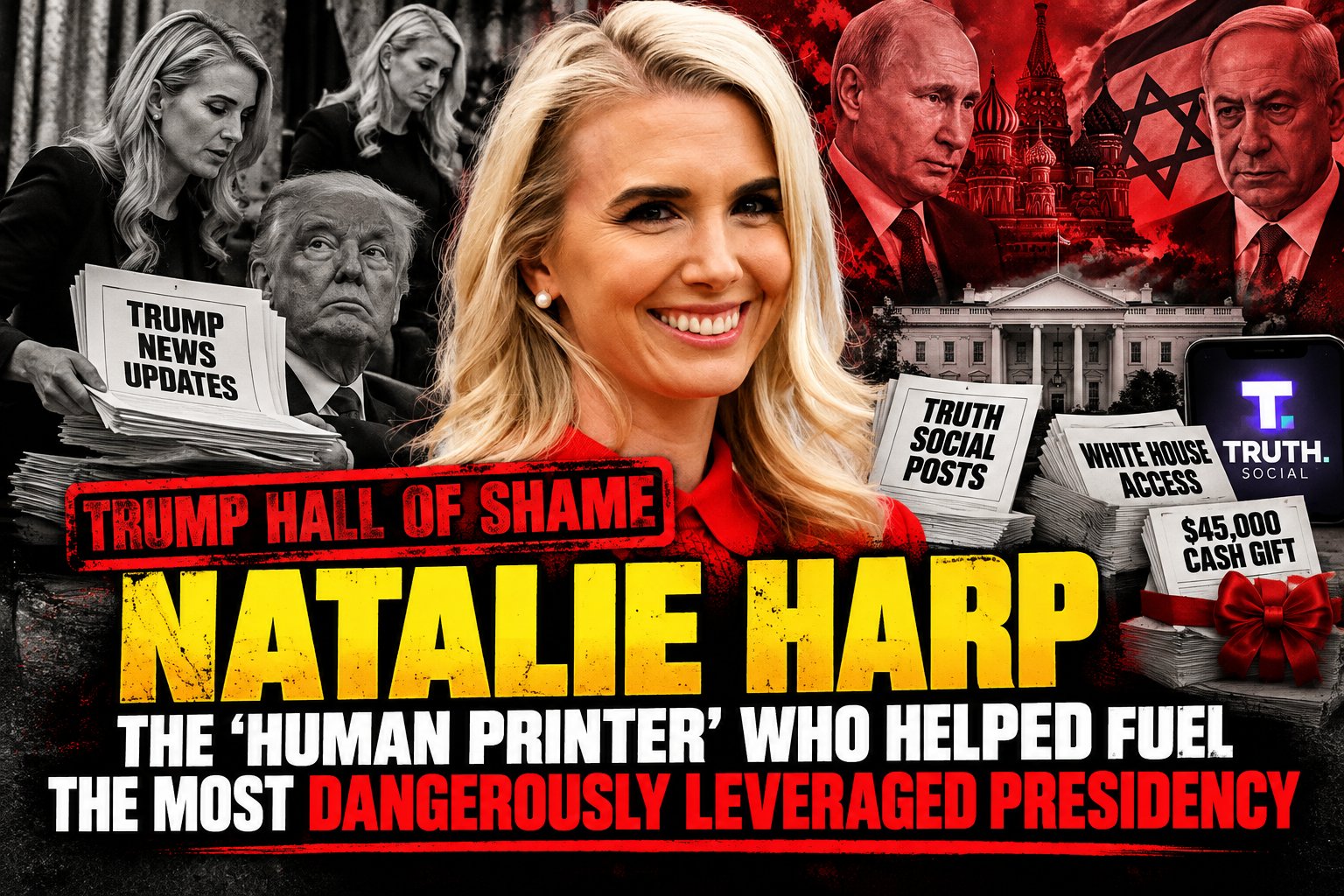
Trump Hall of Shame: Natalie Harp, the ‘Human Printer’ Who Became One of Donald Trump’s Most Powerful Enablers
From amplifying Trump’s political messaging to handling his Truth Social posts and feeding information directly to the Oval Office, Natalie Harp has become a symbol of the extraordinary personal loyalty surrounding the president. Her role raises serious questions about political accountability, presidential decision-making, government ethics, and the dangers of an administration built around one man’s demands.
Natalie Harp Enters the Trump Hall of Shame
Every president surrounds himself with trusted advisers, political loyalists, and personal assistants. But few aides have developed a relationship with the presidency quite like Natalie Harp, the former One America News Network personality who rose from Donald Trump campaign surrogate to one of the most consistently present figures in his inner circle. Widely nicknamed the “human printer,” Harp has become known for delivering printed news articles, social media posts, and other information directly to Trump while assisting with his communications and maintaining extraordinary personal access to the president.
Her inclusion in SFL Media’s Trump Hall of Shame is an editorial judgment about the responsibilities that accompany that access. Harp is not the architect of Trump’s political movement, nor does the public record establish that she independently directs presidential policy. Her significance lies in her role helping a president communicate, consume information, and maintain the highly personalized political operation that has become central to his administration.
The criticism goes beyond the fact that Harp is loyal to Trump. Loyalty is common in government, and presidents are entitled to hire assistants they trust. The concern is that Harp’s proximity to Trump places her inside an unusually powerful information pipeline at a time when his administration faces serious questions about the accuracy of its public statements, the treatment of political opponents, the independence of federal institutions, and its approach to authoritarian governments abroad. When an aide helps deliver the material a president reads and the messages he publishes, the responsibilities involved extend far beyond ordinary clerical work.
From One America News to the Center of Presidential Power
Harp’s rise began well before her White House appointment. She became a prominent Trump supporter during his first presidency and delivered a highly personal speech at the 2020 Republican National Convention, crediting the administration’s Right to Try legislation with helping her obtain access to experimental cancer treatment. She compared Trump to George Bailey, the protagonist of It’s a Wonderful Life, presenting him as a public figure whose actions had profoundly affected her life.
The speech helped establish Harp as a recognizable political surrogate and reinforced her relationship with Trump. She subsequently worked for One America News Network, a conservative outlet that became notorious for promoting false and misleading claims about the 2020 presidential election. The network’s coverage repeatedly amplified allegations of widespread election fraud despite the absence of evidence sufficient to overturn the certified results, and its programming helped sustain narratives that Trump continued advancing after leaving office.
Harp’s association with that media environment is relevant to understanding her later responsibilities. She entered Trump’s political operation not as a neutral civil servant or independent policy specialist but as an outspoken supporter whose public identity was closely connected to defending the president. Her political advocacy was lawful, but it provides important context for questions about the independence and judgment of someone who later became a direct source of information for the Oval Office.
The ‘Human Printer’ and the Power to Control the President’s Information Diet
Harp’s most recognizable responsibility is also the source of the greatest concern about her influence. Major news organizations have documented her habit of carrying a portable printer and supplying Trump with physical copies of articles, polling information, social media reactions, and other material. She has also helped draft and publish messages on Truth Social, frequently working directly from the president’s instructions.
This arrangement places Harp in an unusual position within the administration. Traditional White House communications systems involve press officers, policy specialists, legal advisers, intelligence officials, and senior staff who are expected to provide context and verify information before it reaches the president or becomes an official statement. Harp’s working relationship is more personal and immediate, giving her an opportunity to deliver information without necessarily passing through those established channels.
That does not prove she deliberately conceals negative coverage or manufactures a favorable picture of reality. Such accusations require evidence about what she selects, what she excludes, and whether she knowingly misleads the president. Nevertheless, her position creates a legitimate question about whether Trump’s information environment contains sufficient independent scrutiny, particularly when reports involve political opponents, national security issues, international crises, or claims that have not been verified.
The distinction matters because presidential decisions affect millions of people. An assistant who prints favorable coverage for a private individual performs a routine personal service. An assistant who helps determine what the president of the United States sees, reads, and responds to occupies a position with potentially substantial public consequences, even without formal policymaking authority.
January 6 and the Election Denial Movement
Harp’s history as a Trump supporter also intersects with the effort to overturn the 2020 election. Reporting about her activity on January 6, 2021, described numerous social media posts supporting Trump’s election claims and urging his followers to continue fighting for his political cause. Accounts of approximately 150 messages have appeared in profiles of Harp, although her former account is not publicly available for a complete independent review of every post.
The broader historical record is clear. Joe Biden won the 2020 presidential election, the results were certified, and efforts to overturn them through litigation failed. Trump nevertheless continued promoting false claims about widespread election fraud, and the January 6 attack on the Capitol occurred as Congress was meeting to certify the Electoral College vote. Harp’s participation in the political messaging surrounding that period is relevant because it shows that her support for Trump’s disputed election narrative preceded her later government appointment.
There is an important legal distinction between promoting election denial and participating in violence. The reporting reviewed here does not establish that Harp personally joined the Capitol attack or committed a crime in connection with it. The accountability issue is instead political and professional: whether a person who publicly supported discredited election claims should be trusted to help manage presidential information and communications without strong institutional safeguards.
The Truth Social Pipeline and the Question of Who Controls Presidential Messaging
Harp’s involvement with Trump’s Truth Social account has made her more than a passive distributor of printed articles. Reporting has described her typing messages dictated by Trump, helping prepare posts, and working with him on communications outside ordinary business hours. Her responsibilities place her close to one of the administration’s most consequential channels for presidential announcements, political attacks, and responses to national and international developments.
That position carries unusual significance because Trump’s social media statements are not merely personal commentary. They can affect financial markets, diplomatic relationships, federal agencies, and the reputations of individuals named in presidential posts. When a president makes allegations about political opponents, announces policy changes, or comments on international conflicts, the public has a legitimate interest in knowing whether those statements were reviewed, whether supporting information was accurate, and who participated in their preparation.
The evidence does not establish that Harp independently writes every inflammatory message or makes the final decision about what appears on Trump’s account. Trump remains responsible for his own statements, including those dictated to assistants. But Harp’s role makes her part of the machinery through which presidential communications are produced and distributed, and that machinery deserves scrutiny when messages contain falsehoods, unsupported accusations, or statements with significant governmental consequences.
Russia, Putin, and the Danger of Presidential Information Bubbles
One of the most consequential areas of concern surrounding Trump’s presidency involves his relationship with Russian President Vladimir Putin and his administration’s approach to Russia’s war against Ukraine. Trump has repeatedly faced criticism for statements that appear sympathetic to Putin, for his public treatment of Ukrainian leaders, and for positions that critics argue have weakened Western unity against Russian aggression. Supporters of his approach maintain that direct engagement with Moscow and pressure on both sides of the conflict are necessary to negotiate an end to the war.
These disputes have serious national security implications, but they also require precise distinctions. Claims that Trump is personally controlled or blackmailed by Putin have not been established as fact in the material reviewed for this article. Similarly, there is no verified evidence that Harp knowingly acts on behalf of Russia, coordinates with Russian officials, or intentionally delivers Kremlin directed information to the president.
The legitimate concern about Harp is more specific. If the president relies heavily on a personally loyal aide to deliver news and commentary, the quality and diversity of that information become especially important when dealing with a hostile foreign power. A president should receive rigorous intelligence, competing policy assessments, and accurate reporting rather than material selected primarily for its political appeal. Harp’s documented proximity makes the operation of that information system a valid subject of public scrutiny, even though responsibility for foreign policy ultimately belongs to Trump and his authorized advisers.
Israel, Netanyahu, and the Limits of Presidential Independence
Trump’s close political relationship with Israeli Prime Minister Benjamin Netanyahu has likewise generated debate over American foreign policy, military assistance, diplomatic commitments, and the extent to which U.S. decisions reflect Israeli government priorities. Critics argue that successive American administrations, including Trump’s, have sometimes failed to apply sufficient pressure to Israeli leaders over military operations and civilian harm. Supporters contend that close cooperation with Israel serves important American security interests and helps deter regional adversaries.
Those arguments are part of a legitimate national policy debate. They do not establish that Netanyahu controls Trump or that Harp has any improper relationship with Israeli officials. There is no substantiated evidence in the reporting examined here that Harp has acted as an agent of Israel, accepted instructions from its government, or knowingly manipulated presidential information on its behalf.
Her role remains relevant for a narrower reason: presidential decisions concerning Israel, Gaza, Iran, and the wider Middle East should be informed by verified intelligence, diplomatic analysis, humanitarian reporting, and independent assessments. The more dependent any president becomes on a small circle of personally devoted assistants, the more important it is that those assistants do not displace the institutions responsible for providing accurate and balanced information.
A $45,000 Cash Gift and the Question of Government Ethics
One of the most concrete controversies involving Harp emerged in September 2026, when financial disclosures revealed that Trump had given her a $45,000 cash gift during the previous year. Other close aides also reported substantial gifts, including Margo Martin and Chamberlain Harris, who each disclosed $45,000, and Walt Nauta, who reported receiving $20,000. The disclosed payments totaled $155,000 across the four employees.
Harp’s gift was particularly notable because it represented approximately 30% of her reported $150,000 annual government salary. The payments were described as holiday gifts, but their size prompted questions about whether unusually large financial transfers from a president to his own government employees could constitute improper supplementation of federal compensation.
Federal ethics restrictions generally prohibit certain payments that supplement government salaries for the performance of official duties. Whether a particular personal gift violates those restrictions depends on its purpose, the relationship between the parties, and the circumstances of the transfer. The Campaign Legal Center filed a complaint seeking ethics scrutiny of the payments, while former government ethics officials publicly questioned their propriety.
The White House rejected allegations of wrongdoing, maintaining that Trump had a longstanding practice of giving personal holiday gifts and that the payments were unrelated to government employment. No finding that Harp unlawfully accepted compensation has been established. Nevertheless, the episode raises a serious accountability question because substantial private financial gifts from a president to subordinates can create concerns about professional independence, even when the gifts are described as personal.
The $100,000 a Month Truth Social Access Controversy
Harp’s responsibilities also intersect with litigation concerning Truth API, a paid service introduced by Trump Media that offered subscribers accelerated access to posts from prominent Truth Social accounts, including presidential communications. Reporting in 2026 described subscription prices reaching $100,000 per month, raising concerns that paying customers could receive potentially consequential information before the general public.
Government transparency organizations and media plaintiffs challenged the arrangement in federal court, arguing that official presidential announcements should not be subject to a private paid access system that potentially advantages wealthy subscribers. The litigation raised questions about public access, equal treatment, and the commercial distribution of official government communications.
Harp’s connection to the controversy arises from her documented involvement in helping manage Trump’s Truth Social messages. Reporting also identified her in litigation related to the service. But the existence of those proceedings does not establish that she designed the paid subscription model, determined its prices, personally profited from the program, or committed insider trading. Those would be separate allegations requiring specific evidence.
The controversy nevertheless demonstrates why the mechanics of presidential communications matter. When official statements can affect markets or government policy, the distinction between public information and commercially privileged access becomes a legitimate concern. Harp’s role in preparing and distributing presidential messages places her within that broader system, even though responsibility for its business arrangements cannot simply be assumed.
Susie Wiles, Internal Power Struggles, and the Informal White House Hierarchy
Reporting about Trump’s second administration has described recurring tensions among senior aides, including disputes over staffing, messaging, and access to the president. White House Chief of Staff Susie Wiles occupies the formal position responsible for coordinating the president’s staff and managing the administration’s internal operations, while Harp’s influence stems from her personal relationship with Trump and her ability to reach him directly.
This creates a potentially complicated institutional arrangement. A chief of staff may establish procedures for reviewing decisions, coordinating policy, and managing access, but a trusted personal aide can communicate with the president outside those processes. That does not necessarily mean the aide is undermining the chief of staff or intentionally creating conflict. It does mean that the administration’s formal hierarchy may not fully describe how information reaches the president or how decisions develop.
Reports about Harp’s involvement in internal controversies have sometimes suggested that material she presented to Trump contributed to disagreements over personnel or messaging. Such accounts should be distinguished from proof that she orchestrated firings, secretly controlled appointments, or manipulated the president into particular decisions. The available evidence supports describing her as an unusually close aide with significant informal access, not as an independently established decision maker responsible for every dispute inside the West Wing.
The Difference Between Loyalty and Enabling
Harp’s defenders describe her as a dedicated assistant who works long hours, understands Trump’s communication style, and helps him navigate an unusually demanding schedule. White House allies have praised her professionalism and argued that the attention surrounding her position exaggerates the influence of someone carrying out the president’s instructions. Those defenses deserve consideration because loyalty is not inherently unethical, and personal assistants do not automatically become responsible for every action taken by their employers. A president can lawfully rely on trusted aides, and an employee should not be accused of misconduct merely for helping prepare messages or deliver requested information.
The ethical question becomes more serious when loyalty is treated as a substitute for independent judgment. Government employees serve the public through their official responsibilities, even when their immediate duties involve assisting an elected president. If an aide knowingly spreads false information, conceals material facts, circumvents legal restrictions, or facilitates an unlawful act, the defense that the president requested it would not necessarily resolve that aide’s responsibility.
There is no established finding that Harp committed those acts. The criticism underlying her Trump Hall of Shame profile is that her documented position places her close to a presidency repeatedly criticized for its treatment of factual accuracy, political opposition, institutional independence, and democratic norms. That proximity makes her conduct and responsibilities a legitimate subject of sustained scrutiny.
The Authoritarian Comparison: Why Historical Accuracy Matters
Critics of Trump have frequently drawn comparisons between aspects of his political movement and authoritarian movements of the twentieth century, citing his attacks on political opponents, efforts to overturn the 2020 election, rhetoric about immigrants, and demands for personal loyalty from government officials. Defenders reject those comparisons as exaggerated and argue that Trump’s policies and political style should be judged within the American constitutional system.
Historical comparisons can illuminate the dangers of concentrated power, personality driven politics, and the suppression of dissent, but they can also obscure important distinctions when used without care. Nazi Germany was a genocidal dictatorship responsible for systematic mass murder and a world war. Calling Trump “Hitler Jr.” or equating Harp with an official of the Nazi regime would be a polemical analogy rather than an established historical or legal conclusion.
The more useful comparison concerns institutional behavior: the dangers that arise when leaders demand personal allegiance, when information is filtered to reinforce their preferences, and when aides prioritize pleasing those leaders over supplying accurate assessments. Those dynamics have appeared in different political systems and deserve examination without assuming that every modern government reproduces the crimes or structures of a particular historical dictatorship.
Harp’s role makes these questions especially relevant because she helps operate a direct information and communications channel to the president. Whether that channel promotes accurate decision making or reinforces a closed political environment is a matter that should be investigated through evidence about its operation, not settled through historical labels alone.
Why Natalie Harp Belongs Under Public Scrutiny
Natalie Harp’s rise from conservative television personality to one of Trump’s closest White House aides illustrates how personal loyalty can become a significant source of political access. Her responsibilities place her near presidential communications, the flow of information into the Oval Office, and the internal relationships through which decisions are discussed and implemented.
Her public record also includes support for Trump’s disputed election narrative, a substantial personal cash gift from the president that prompted an ethics complaint, and involvement in communications connected to litigation over paid early access to Truth Social posts. None of those facts establishes that she has committed a crime, acted as a foreign agent, or independently directed presidential policy. They do establish reasons for journalists and the public to examine her role carefully.
For SFL Media’s Trump Hall of Shame, the central criticism is that Harp has chosen to become an exceptionally close participant in a political operation whose conduct has repeatedly generated controversy over truthfulness, institutional accountability, and the boundaries of executive power. Her work may be administrative in title, but the public consequences of presidential communications and information management are anything but trivial.
The president remains responsible for his own statements and decisions. Harp remains responsible for her conduct as a government employee. The closer an aide stands to the center of presidential power, the greater the public interest in understanding what that aide does, how that work is supervised, and whether the institutions designed to protect the public interest are functioning as intended.
The lasting question surrounding Natalie Harp is not whether she is sufficiently loyal to Donald Trump. By every public account, that loyalty is already well established. The question is whether her extraordinary access is being exercised with the independence, accuracy, and accountability that service in the White House demands.

Sources & Further Reading
- The New York Times — Profile of Natalie Harp and her relationship with Donald Trump, August 2026.
- The Washington Post — Reporting on Harp’s White House responsibilities, presidential access, and communications work, August 2026.
- CBS News — Background reporting on Natalie Harp’s rise from campaign surrogate to presidential aide.
- Los Angeles Times — Reporting on Harp’s upbringing, political development, and relationship with Trump, August 2026.
- The Washington Post — Reporting on Trump’s $45,000 cash gifts to Harp and other White House aides, September 2026.
- CBS News — Financial disclosures concerning gifts to presidential aides, September 2026.
- The Guardian — Ethics concerns and complaints arising from the cash gifts, September 2026.
- American Oversight — Federal litigation challenging the Truth API paid-access arrangement, September–October 2026.
- Yale Law School — Litigation seeking to restrict paid early access to presidential Truth Social communications, September 2026.
- The Washington Post — Reporting on White House staffing disputes and internal tensions, October 2026.











































Want to join the conversation?
Create an account or sign in to share your thoughts, vote,
and reply to other readers.
Showing 0 of 0 comments
Don't have an account?
Already have an account?