
America’s Doomsday Plan and What It Could Mean for Ordinary Americans
What happens if the United States suddenly finds itself in a major war, its military installations are cut off from normal supply chains, overseas bases become inaccessible, and the country can no longer rely on the global infrastructure that keeps its military operating? Apparently, the Pentagon has been thinking about that possibility.
A reported military contingency strategy known as the U.S. Doomsday Plan, along with an initiative referred to as FORTRESS, has drawn attention after details reportedly surfaced in reporting by Fox News (it was leaked). Among the most concerning aspects of the reported planning is the suggestion that military installations could be expected to sustain themselves for as long as 90 days without outside assistance.
That raises some obvious questions. Why 90 days? What exactly would military bases be expected to do? Is this preparation for a conventional war, a nuclear conflict, a cyberattack, or the collapse of critical supply chains? And perhaps most importantly, what happens to the American population if the same crisis affecting military installations also disrupts the civilian economy?
There is an important distinction to make from the outset: contingency planning is not proof that the government expects an imminent catastrophe. Militaries routinely prepare for extreme scenarios. But the existence of plans addressing prolonged isolation, disrupted infrastructure, and national emergencies is worth examining, particularly when those plans could have implications extending well beyond the military.
What exactly is the FORTRESS Initiative?
The Pentagon’s five pillar resilience strategy FORTRESS stands for: Federal Operations for Resilience, Troop Resources, Energy, Supply, and Survivability.
This is not simply a plan to stockpile food and ammunition. It is a broader effort to make America’s military infrastructure less dependent on the civilian electrical grid, municipal water systems, commercial transportation networks, foreign suppliers, and vulnerable communications systems. Defense Secretary Pete Hegseth publicly introduced FORTRESS on September 30th, 2026, during remarks in Quantico, Virginia. The initiative brings together existing defense programs and new resilience requirements under a common strategy.
According to the Pentagon’s publicly described framework, FORTRESS has five principal pillars:
1. Energy independence. Military bases are expected to develop the ability to generate and distribute their own electricity, including through microgrids, battery storage, alternative energy sources and potentially portable nuclear reactors.
2. Supply chain and defense industrial resilience. The military wants to reduce dependence on foreign manufacturers and vulnerable international supply routes for essential defense components. That includes semiconductors, rare earth materials, specialty metals, electronics and weapons components.
3. A strategic defense reserve. The Pentagon wants reserves of critical materials, ammunition, fuel, spare parts and medical supplies so military operations can continue if ordinary distribution networks are interrupted.
4. Installation hardening and cyber resilience. Military installations need better protection against cyberattacks, sabotage, infrastructure failures and other attacks that could disable essential systems.
5. Resilience in space and the electromagnetic spectrum. The military is preparing for situations in which GPS, satellites, communications and other electronic systems are jammed, disrupted or destroyed.
These five pillars are important because they reveal the thinking behind the initiative. The Pentagon is not simply worried about running out of electricity. It is considering what happens when several systems fail simultaneously. A military installation might have generators, but what happens when it runs out of diesel? What happens when its communications go down? What happens when the factory producing replacement components is destroyed or inaccessible? What happens when satellites can no longer provide reliable navigation? FORTRESS attempts to address those vulnerabilities before a crisis begins.
The 90 Day Requirement: Why Military Bases are Preparing to Operate Alone
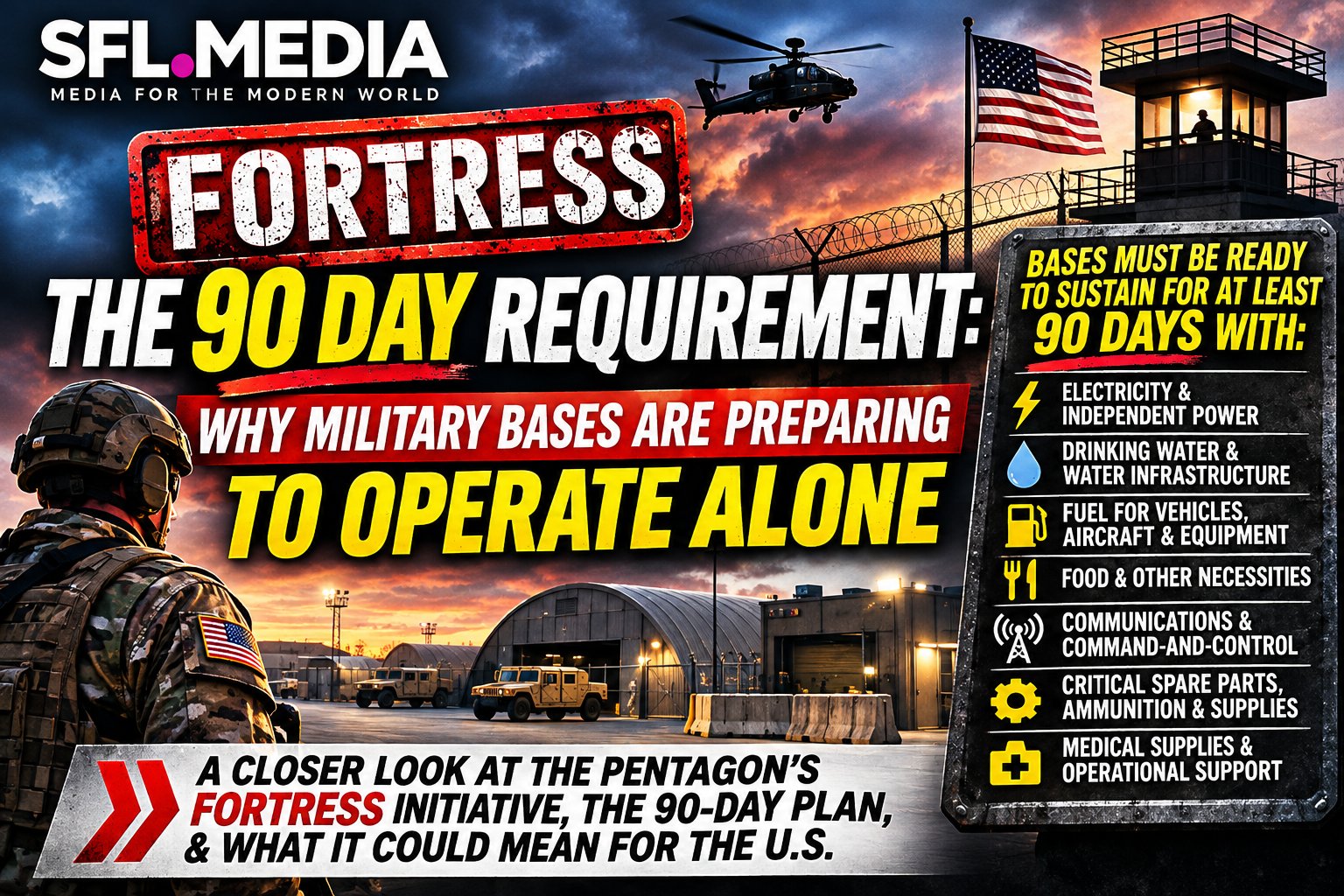
This is the part of the story that has attracted the most attention. According to Fox News Digital’s October 25th investigation, the Pentagon is preparing major military installations in the continental United States to maintain essential operations independently for at least 90 days without outside support. Think about what that means.
A military installation normally depends on an enormous network of outside services. Electricity comes from utility companies. Water comes from municipal systems or other external sources. Fuel arrives through commercial distribution networks. Food, medicine, spare parts and ammunition move through transportation and logistics systems. The 90 day concept is intended to reduce that dependence.
Under the reported standard, major installations would need to maintain access to:
Electricity and independent power generation.
Drinking water and essential water infrastructure.
Fuel for vehicles, aircraft, generators and equipment.
Food and other necessities needed to sustain personnel.
Communications and command-and-control systems.
Critical spare parts, ammunition and military supplies.
Medical supplies and essential operational support.
The idea is that a base should not become useless simply because the surrounding region loses power, commercial deliveries stop or the civilian infrastructure supporting it is damaged. Why 90 days? There is a strategic reason for choosing a period measured in months rather than days.
A major international conflict could interrupt shipping, air transportation, fuel distribution, manufacturing and international trade for an extended period. The military cannot assume that replacement supplies will arrive within a few days. 90 days provides a substantial window in which the military could continue essential operations while the government attempts to restore supply routes, mobilize domestic industry and establish alternative distribution networks. It also gives military planners time to respond to a prolonged emergency without immediately depending on outside deliveries.
One important qualification: Fox’s reporting describes the 90 day standard based on internal documents it reviewed. The Pentagon’s public announcement establishes the broader FORTRESS initiative, but the precise 90 day requirement has not been independently established as a fully implemented, department wide mandate. Snopes also examined the claim and distinguished the confirmed initiative from the less fully confirmed details of the 90-day requirement. This is a significant distinction. The government has announced the initiative. That does not mean every military installation already has 90 days of supplies sitting in warehouses.
What Happens if the Electrical Grid Goes Down?
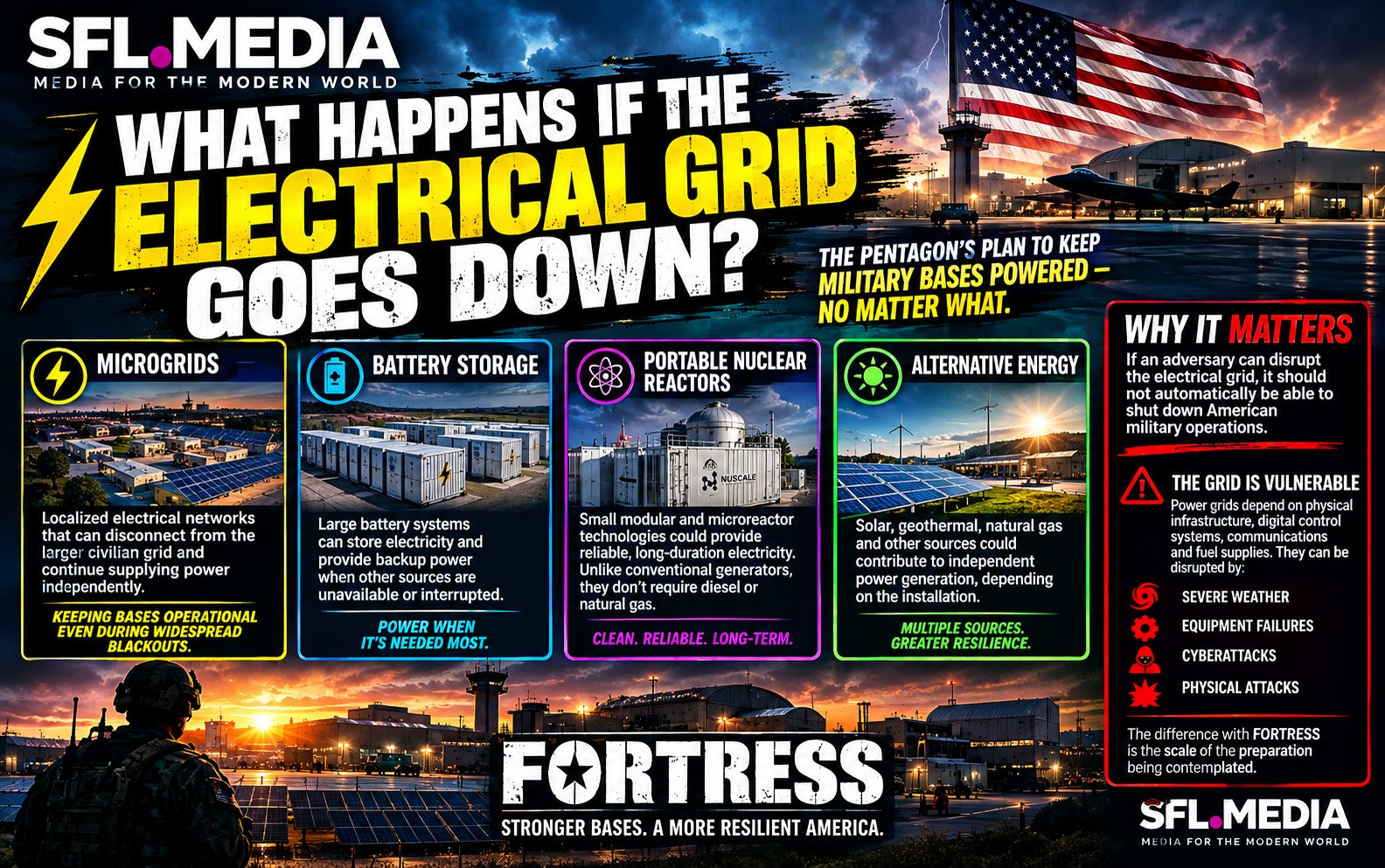
Electricity is arguably the most important component of the entire strategy. Modern military installations are essentially small cities with aircraft, radar systems, communications networks, computer systems, weapons facilities, hospitals, housing, fuel infrastructure and thousands of personnel. Without electricity, many of those systems stop functioning. The Pentagon’s plan envisions several technologies to address this problem.
Microgrids: These are localized electrical networks that can disconnect from the larger civilian grid and continue supplying power independently. A properly equipped base could remain operational even if the regional utility system experienced a widespread blackout.
Battery storage: Large battery systems could store electricity and provide backup power when other sources are unavailable or temporarily interrupted.
Portable nuclear reactors: Small modular and microreactor technologies are being considered as potential sources of reliable, long-duration electricity. Unlike conventional generators, nuclear reactors do not require a continuous supply of diesel or natural gas to produce electricity.
Alternative energy: Depending on the installation, solar, geothermal, natural gas and other sources could contribute to independent power generation.
The Pentagon’s reasoning is straightforward: if an adversary can disrupt the electrical grid, it should not automatically be able to shut down American military operations.
And this is not an entirely hypothetical vulnerability. Power grids are interconnected systems that depend on physical infrastructure, digital control systems, communications and continuous fuel supplies. They can be disrupted by severe weather, equipment failures, cyberattacks and physical attacks. The difference with FORTRESS is the scale of the preparation being contemplated.
The Military is Preparing to Manufacture its Own Weapons and Supplies During a War
The initiative incorporates the Civil Reserve Manufacturing Network, which is designed to identify commercial factories that could transition to military production during an emergency. Rather than waiting until a war begins to figure out which factories can manufacture defense equipment, the Pentagon wants to establish those relationships in advance. That involves identifying manufacturing capabilities, developing technical specifications, establishing cybersecurity requirements, arranging potential contracts and creating procedures for converting production lines.
It also calls for industrial stress tests and mobilization exercises. Imagine a major conflict in which the United States suddenly needs substantially more ammunition, drones, electronic components, aircraft parts and military vehicles than its existing defense contractors can produce. Under this concept, certain civilian manufacturing facilities could be redirected toward meeting those military requirements.
The other important provision is supply chain redundancy. FORTRESS calls for at least two qualified production or supply pathways for critical defense dependencies. In other words, the Pentagon does not want a single factory, foreign supplier or transportation route to become a point of failure.
This is particularly important for semiconductors, rare earth elements, specialty metals, electronics and other materials that are essential to modern weapons systems. The underlying concern is that a major conflict involving multiple countries could disrupt international trade so severely that the United States would struggle to obtain components it normally purchases from overseas. The strategy is therefore about more than military readiness. It is also about preparing the American industrial economy for a potential wartime mobilization.
How Did the Plan Leak to Fox News?
The October 25th, 2026, Fox News investigation was written by national security reporter Morgan Phillips and published under the headline: Inside the Pentagon’s Doomsday Plan to Keep America Fighting if Global War Erupts.
Fox described the report as an exclusive, using the designation “FIRST ON FOX.” According to the article, Fox News Digital reviewed internal Pentagon documents detailing the 90 day self sufficiency concept and other elements of FORTRESS. The report also included extensive comments from Sean Parnell, the Pentagon’s chief spokesperson, who was identified as the official leading the FORTRESS initiative.
Parnell discussed the vulnerabilities the Pentagon was trying to address, including dependence on civilian infrastructure, electricity, transportation and global supply chains. He also explained why the military wanted to prepare before a major international conflict rather than attempt to develop emergency arrangements after one had already started.
One particularly revealing statement attributed to Parnell was that the next major conflict would likely involve multiple fronts and that global supply chains would break. He also described electricity as a central element of modern warfare, explaining that without power, communications, water, logistics, assembly lines and military command structures could all be affected.
But was this an unauthorized leak? That is where the story requires some precision. Fox reported that it had reviewed internal documents. However, its published investigation does not identify the individual who provided those documents, establish whether they were classified, or explain precisely how they were obtained.
There is also no publicly established evidence that the information was stolen through a cyberattack or that an unauthorized disclosure occurred. In fact, much of the broader initiative had already been publicly announced by Hegseth on September 30th. Fox’s exclusive added details about the reported 90 day operating standard and the internal planning behind it. So the most accurate description is that Fox obtained and reported details from internal Pentagon documents. Calling it a confirmed classified-information leak would go beyond the available evidence.
Interestingly, Parnell shared Fox’s report on social media. That demonstrates that the Pentagon spokesperson was willing to circulate the reporting, but it does not independently establish that every detail in the article, particularly the exact 90-day requirement, had been formally confirmed by the department. That distinction was also highlighted in an October 26 fact-check by the NCIJ Network.
What Does All of This Mean for the American Public?
This is arguably the most important part of the entire story. The military is preparing to maintain essential operations for 90 days without relying on normal civilian infrastructure. But what about the people who live outside those installations? Does FORTRESS mean Americans should expect to be left without electricity, food, water or emergency services in a major crisis?
Not necessarily. The initiative does not announce a policy of abandoning civilians, nor does it establish that military installations would receive supplies while the public was deliberately denied them. However, there is a very real distinction between protecting the continuity of national defense and protecting the day-to-day lives of the civilian population. The Pentagon’s five pillars are focused primarily on military readiness. They do not establish a corresponding nationwide 90 day survival requirement for households, municipalities or civilian businesses.
That leaves several important potential consequences worth examining.
A. Electricity: Military bases could keep running while surrounding communities experience blackouts
Consider a scenario in which a coordinated cyberattack or physical attack damages several regional power grids. Under FORTRESS, a military installation with an operational independent microgrid could disconnect from the civilian network and continue supplying its own critical facilities with electricity.
The surrounding community, however, would remain dependent on whatever electricity its utility could provide. That could mean a military installation maintaining its command center, communications, medical facilities and essential operations while nearby homes, businesses and public buildings experience prolonged outages. There is nothing inherently unusual about a hospital or military installation having backup generators. The difference is the scale and duration of the resilience being contemplated.
And there is an important technical distinction: a military base operating independently does not necessarily mean it can disconnect from the grid and take electricity away from its neighbors. A properly designed microgrid can operate independently without depriving surrounding communities of power. Nevertheless, the civilian population would still face the consequences of the original grid disruption.
B. Water: One of the biggest vulnerabilities in a prolonged emergency
Most Americans take clean drinking water for granted. Turn on the faucet and water comes out. Unfortunately, that system depends on electricity, pumps, treatment facilities, chemicals, distribution networks and functioning infrastructure. A widespread electrical outage could disrupt water treatment and distribution.
Some municipal systems have backup generators, but those generators require fuel, maintenance and functioning equipment. If fuel deliveries are interrupted or treatment facilities are damaged, the consequences could become serious. The military’s effort to establish independent water capabilities at its installations is intended to prevent those same vulnerabilities from shutting down essential military operations. For civilians, there is no equivalent 90-day guarantee established by FORTRESS.
C. Food: Grocery stores could become vulnerable very quickly
The American food distribution system depends on transportation, refrigeration, electricity, fuel, warehouses, payment systems and commercial supply chains. A prolonged national emergency could disrupt several of these systems simultaneously. Even if farms continue producing food, that does not mean grocery stores will receive it.
Refrigeration failures could destroy perishable inventory. Fuel shortages could interrupt trucking. Distribution centers could experience disruptions. Payment networks could become unreliable. This is particularly important because modern Americans generally do not maintain large household food reserves. The Pentagon’s strategic reserves are designed to protect military operations. They are not a national civilian food distribution program.
D. Fuel shortages could affect transportation, emergency services and everyday life
A major conflict that disrupts international shipping, domestic refineries, pipelines or fuel distribution could create shortages of gasoline, diesel and aviation fuel. The consequences would extend beyond the military.
Police departments, fire departments, ambulance services, hospitals, trucking companies, public transportation systems and ordinary motorists all depend on fuel. A military installation with protected fuel reserves could maintain critical operations while civilian fuel distribution becomes increasingly strained.
This does not mean military bases would necessarily be given priority over every civilian emergency service. It does mean the military has a specific resilience strategy for its own fuel requirements, while civilian fuel availability depends on separate infrastructure and emergency arrangements.
E. Hospitals and medical supplies could face enormous pressure
A major war could disrupt the production and transportation of medications, medical equipment, replacement parts and other essential supplies. Hospitals generally have emergency power arrangements, but backup electricity does not solve every problem.
A hospital cannot operate indefinitely without adequate staffing, medications, oxygen, sterile equipment, water and functioning supply chains. Hegseth specifically discussed medicine and blood as part of the strategic defense reserves. That is significant because it demonstrates that the Pentagon is thinking beyond ammunition and weapons. It recognizes that sustaining a military during a prolonged conflict requires medical resources as well. The civilian healthcare system, however, would face its own supply-chain challenges.
F. Banking, communications and the internet could be affected
A sophisticated attack on American infrastructure might target more than electrical utilities. Telecommunications, internet infrastructure, financial networks, satellite services and digital payment systems could all become potential vulnerabilities. A disruption could affect ATM access, credit card transactions, online banking, business operations and communications between emergency responders.
FORTRESS specifically addresses military communications, navigation and space-based capabilities, including the possibility of GPS jamming and satellite disruption. It is important to understand that GPS disruption does not automatically mean the entire internet or banking system stops working. These systems have different dependencies. But a sufficiently broad crisis could affect several of them at once. For the average American, the practical consequences could be much more immediate than the military implications: being unable to communicate reliably, purchase necessities electronically, obtain medication or access transportation.
Could This Become a National Emergency Involving Multiple Countries?
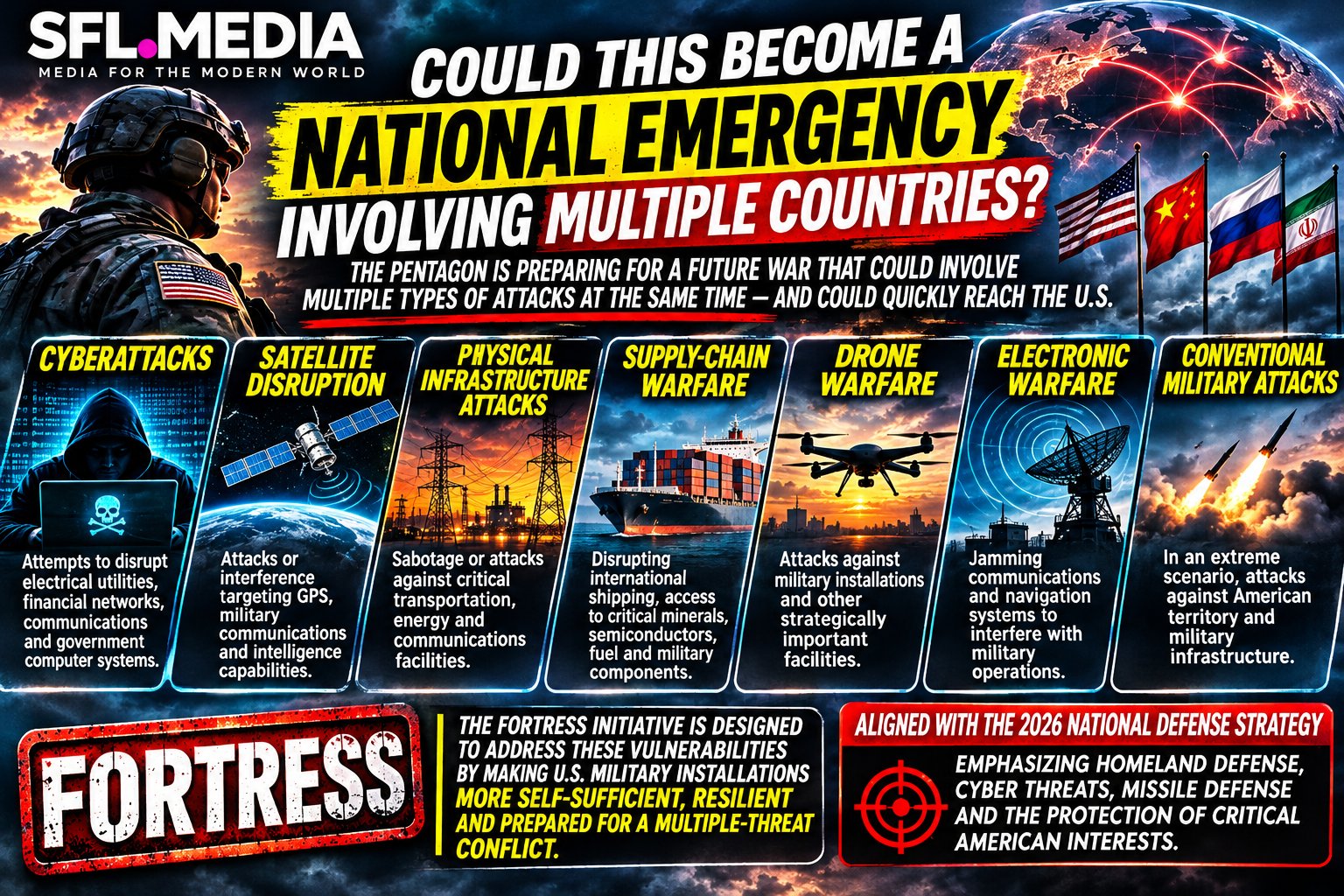
One reason the Pentagon is taking these vulnerabilities seriously is that a future major war might not resemble the wars Americans have experienced over the past several decades. A conflict between major powers could involve several different types of attacks simultaneously. Consider a hypothetical situation involving a confrontation between the United States and another major military power. The conflict could begin overseas, but the consequences might quickly reach American territory.
Potential threats could include:
Cyberattacks: Attempts to disrupt electrical utilities, financial networks, communications and government computer systems.
Satellite disruption: Attacks or interference targeting GPS, military communications and intelligence capabilities.
Physical infrastructure attacks: Sabotage or attacks against critical transportation, energy and communications facilities.
Supply-chain warfare: Disrupting international shipping, access to critical minerals, semiconductors, fuel and military components.
Drone warfare: Attacks against military installations and other strategically important facilities.
Electronic warfare: Jamming communications and navigation systems to interfere with military operations.
Conventional military attacks: In an extreme scenario, attacks against American territory and military infrastructure.
These are not all equally likely, and FORTRESS does not establish that any particular adversary is preparing to execute such an attack. They are examples of the types of vulnerabilities the initiative is designed to address. The important development is that the Pentagon is treating the American homeland as part of the modern battlefield rather than assuming that oceans and geographic distance will automatically protect the country. This is consistent with the broader 2026 National Defense Strategy, which emphasizes homeland defense, cyber threats, missile defense and the protection of critical American interests.
Is the Government Preparing Civilians for the Same Scenario?
Here is where the comparison becomes particularly interesting. The Pentagon has a defined initiative for military resilience. But there is no equivalent FORTRESS program establishing a 90 day self sufficiency requirement for American households. The federal government does, however, have an existing civilian emergency preparedness program called Ready.gov. Its guidance encourages Americans to maintain emergency supplies, establish family communication plans and understand the types of disasters that could affect their communities.
FEMA’s basic emergency supply recommendations include:
Several days of drinking water and nonperishable food.
Flashlights and extra batteries.
A battery-powered or hand-crank radio.
First-aid supplies.
Prescription medications and essential medical equipment.
Backup phone chargers and batteries.
Cash in case electronic payment systems are unavailable.
Hygiene and sanitation supplies.
Supplies for children, elderly family members and pets.
FEMA also recommends approximately one gallon of water per person per day for drinking and sanitation in its preparedness guidance. These recommendations are intended to help households survive an emergency while public services and assistance are disrupted. They are not a declaration that the government expects a 90 day national shutdown.
There is an important difference between preparing the military to survive a catastrophe and preparing the public to survive one. The military has dedicated budgets, personnel, facilities, logistical networks and access to resources that ordinary Americans do not. A household cannot simply build a microgrid, stockpile aviation fuel or maintain an independent water treatment plant.
For civilians, preparedness generally means having enough essential supplies to get through an interruption in normal services, knowing where to obtain emergency information and understanding when to evacuate or shelter in place. The Pentagon’s initiative does not provide a guarantee that civilian communities will receive uninterrupted services during a major conflict.
What We Still Don’t Know About FORTRESS
Despite the attention surrounding the Fox News report, several important questions remain unanswered. The actual cost: The Pentagon has not published a comprehensive FORTRESS budget identifying the total cost of upgrading military installations, developing independent power systems, building reserves and preparing civilian factories.
The implementation timeline: There is no publicly established department-wide deadline demonstrating when every major installation will meet the reported 90 day standard. The precise requirements: We know the broad categories of resources involved, but the public reporting does not provide a complete installation by installation breakdown of required food, water, fuel, ammunition and medical reserves.
The level of readiness: The existence of the initiative does not mean all military installations currently possess the infrastructure necessary to operate independently for three months. Civilian coordination: It remains unclear how the initiative’s military infrastructure improvements will be coordinated with civilian utilities, state governments, hospitals, emergency management agencies and local communities during a widespread crisis.
The 90 day mandate itself: This deserves repeating. Fox News reported the requirement after reviewing internal documents, but the precise department-wide requirement has not been publicly confirmed in the same way as the initiative’s five strategic pillars. These are not minor details. They determine whether FORTRESS is primarily a long term infrastructure modernization program, a formal readiness requirement with measurable deadlines, or some combination of the two.
Does This Mean the Government Expects World War III?
Not necessarily. But it does tell us something about how military planners are assessing the future. There is a tendency to think of war as something that happens somewhere else. American troops deploy overseas, aircraft fly missions, ships patrol international waters and conflicts remain geographically separated from ordinary American life. That assumption becomes much less reliable when considering modern warfare.
A country does not necessarily have to invade the United States to cause enormous damage to its economy or disrupt the lives of its citizens. Cyberattacks, attacks against infrastructure, satellite interference and disruptions to international supply chains could have consequences without a single foreign soldier setting foot on American soil. FORTRESS is designed around that reality.
It is also important not to confuse contingency planning with an imminent warning. Governments prepare for extreme scenarios precisely because they cannot afford to wait until those scenarios become reality. The United States has maintained civil defense, nuclear continuity, military mobilization and emergency preparedness programs for decades. FORTRESS represents a new effort to address vulnerabilities in modern military infrastructure and industrial supply chains.
But the 90 day concept deserves attention because it raises a legitimate question: if the Pentagon believes its military installations need to be capable of surviving three months without outside support, how resilient is the infrastructure supporting everyone else?

1. Fox News, October 25, 2026: Inside the Pentagon’s Doomsday Plan to Keep America Fighting if Global War Erupts. Original investigation by Morgan Phillips.
2. NCIJ Network, October 26, 2026: What We Know About Pentagon’s FORTRESS Initiative. Fact-check examining what has been confirmed and what remains uncertain.
3. Department of Defense: FORTRESS America: September 30, 2026 memorandum.
4. FEMA: Ready.gov Emergency Supply Kit.
5. 2026 National Defense Strategy: Read the National Defense Strategy.
Similar Articles at SFL.MEDIA:
1. Pete Hegseth’s Trip to Panama: SFL.MEDIA Takes a Closer Look – October 26, 2026
An examination of Hegseth’s Panama trip, the anti-cartel mission and allegations surrounding his personal conduct.
2. Pete Hegseth Throws ‘Weirdos and Wimps’ Out of the Military – October 2, 2026
Hegseth’s military overhaul, warrior ethos and Project Meridian.
3. Pete Hegseth Promised a Warrior Ethos. The USS Abraham Lincoln Crisis Shows America’s Warriors Need More Than Tough Talk – August 20, 2026
Examines the USS Abraham Lincoln deployment and questions surrounding the treatment of American sailors.
His confirmation, background and vision for the Pentagon.
Hegseth discusses the Iran war, American military strategy and possible escalation.
6. Trump and Hegseth Left the USS Abraham Lincoln at Sea for 250 Days, Now Sailors Are Breaking Down and Trying to Jump Overboard – August 2026
An examination of the carrier’s extended deployment and reported crew welfare concerns.
Former Defense Secretary Robert Gates discusses America’s nuclear position and growing international threats.
A growing collection of government UAP records, military reports and unexplained aerial encounters, including a statement from Hegseth.
9. How the Government Allegedly Used Program Immaculate Constellation to Enforce a Military-Wide Secret Protocol to Keep UFO and Alien Intelligence From the American People – August 30, 2026
An examination of alleged government efforts to collect and conceal UAP information.
10. U.S. and Iran Wage First Ever Meme War as Hegseth Melts Down Over Media Coverage – April 16, 2026
The Iran conflict, military messaging and Hegseth’s confrontation with the press.



















































Want to join the conversation?
Create an account or sign in to share your thoughts, vote,
and reply to other readers.
Showing 0 of 0 comments
Don't have an account?
Already have an account?