
FBI Seizes Eric Swalwell’s Phone and Laptop as Federal Investigation Into Sexual Misconduct Allegations Escalates
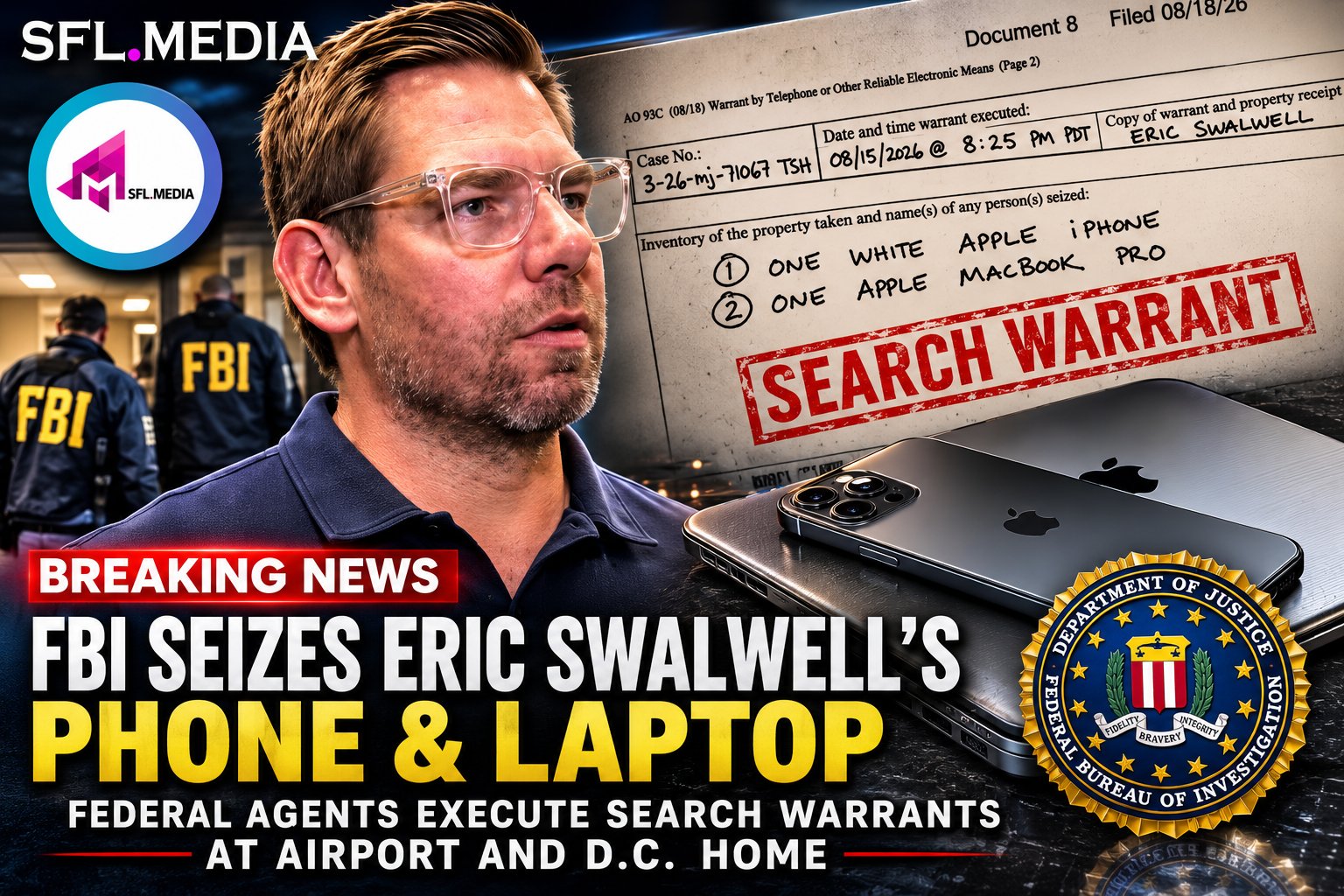
Federal investigators have dramatically escalated their investigation into former Democratic Congressman Eric Swalwell, seizing his iPhone and MacBook Pro at San Francisco International Airport and searching his Washington, D.C., residence under court authorized search warrants. The searches represent one of the most significant developments since Swalwell resigned from Congress in April following multiple allegations of sexual misconduct and sexual assault. Swalwell has denied the assault allegations, and as of Thursday, August 20, he has not been criminally charged.
According to multiple reports, FBI agents approached Swalwell at San Francisco International Airport on Saturday, August 15, and seized electronic devices belonging to him. The San Francisco Standard reported that records identify the seized property as an Apple iPhone and Apple MacBook Pro. The following day, federal agents searched Swalwell’s residence in Washington, D.C. The development is important because federal investigators have moved beyond interviews and preliminary fact gathering to obtaining judicial authorization to search property for potential evidence.
Federal Judge Found Probable Cause for the Searches
A search warrant is not proof that Swalwell committed a crime, nor does it mean prosecutors will ultimately bring charges. But federal investigators generally cannot simply seize someone’s computer or cellphone because they want to examine it. To obtain a federal search warrant, investigators must present a sworn application establishing probable cause to a federal magistrate judge and identify the places or property to be searched and the evidence they expect to find.
Court records reportedly show that the federal government applied for the California warrant on August 13 in the U.S. District Court for the Northern District of California. The underlying affidavit describing investigators’ evidence and reasoning remains sealed, leaving a critical part of the case outside public view. That means the public knows federal agents obtained and executed the warrants, but not the full evidentiary basis prosecutors presented to the court.
CBS News independently reported that FBI agents executed search warrants targeting Swalwell over the weekend and seized electronic devices as part of a criminal investigation into allegations of sexual misconduct.
Why Swalwell’s Electronics Could Matter
Smartphones and laptops can contain enormous amounts of potentially relevant evidence: text messages, emails, photographs, videos, cloud account information, location records, deleted files, browser activity and communications through encrypted messaging applications.
Exactly what investigators are seeking from Swalwell’s devices is not publicly known because portions of the warrant materials remain sealed. That distinction is important. It would be premature to claim investigators have discovered incriminating communications or images. What can be established is that federal authorities persuaded a judge to authorize the seizure and examination of electronic property as part of the investigation.
The unusual circumstances of the seizure have also attracted attention. Rather than requesting that Swalwell voluntarily turn over the devices or serving a subpoena for records, agents intercepted the former congressman at an airport and physically took possession of his electronics. The following day’s search of his Washington residence demonstrates that the operation was not limited to the airport encounter.
Section 242 Raises Major Questions About the Direction of the Investigation
Reporting on the warrant indicates investigators cited 18 U.S.C. § 242, the federal criminal civil-rights statute prohibiting willful deprivation of constitutional or federal rights while acting “under color of law.” That phrase is crucial. Section 242 generally concerns misconduct committed through governmental authority. Swalwell was a member of Congress during periods covered by some of the allegations against him, meaning investigators could potentially be examining whether official power or governmental authority played a role in alleged misconduct.
However, because the supporting affidavit remains sealed, it is not yet possible to establish precisely how prosecutors believe Section 242 applies to Swalwell or what conduct they are investigating under the statute. That is one of the biggest unanswered questions surrounding the federal case. The public evidence currently establishes that federal investigators obtained search warrants and seized property. It does not establish that prosecutors have concluded Swalwell violated Section 242.
Swalwell’s Political Career Collapsed in April
The federal searches come roughly four months after Swalwell’s political career unraveled with extraordinary speed. Swalwell, who had represented California in Congress since 2013 and briefly ran for president in 2019, had been pursuing the Democratic nomination for governor of California when multiple women publicly accused him of sexual misconduct. He suspended his gubernatorial campaign on April 12 and announced the following day that he would resign from Congress amid growing bipartisan pressure and the possibility of an expulsion effort.
Swalwell acknowledged making what he described as “mistakes in judgment,” but denied the serious sexual-assault allegations. The House Ethics Committee had also opened an investigation concerning allegations that Swalwell may have engaged in sexual misconduct, including toward an employee under his supervision. Importantly, the committee specifically cautioned that opening an investigation did not mean a violation had occurred. Swalwell formally left Congress in April.
Multiple Women Have Accused Swalwell of Misconduct
The allegations against Swalwell involve several women and different alleged incidents. One former congressional employee accused Swalwell of sexually assaulting her in a New York City hotel following a night out in 2024. The Manhattan District Attorney’s Office subsequently opened an investigation into the allegation. Other women accused Swalwell of inappropriate sexual communications, including allegedly sending unsolicited explicit photographs or messages.
A separate woman, Lonna Drewes, publicly accused Swalwell in April of raping her at a West Hollywood hotel in 2018. Drewes alleged that she became incapacitated before Swalwell raped and choked her. Her attorney said evidence would be provided to law enforcement rather than released through the media. The Washington Post reported at the time that it had not independently reviewed the evidence supporting her allegation.
Swalwell has denied the accusations against him.
The Associated Press reported Thursday that federal agents’ searches are connected to an investigation involving multiple allegations of sexual misconduct, while Reuters reported that federal scrutiny has expanded alongside investigations by other law enforcement agencies.
The Investigation Has Now Entered a More Serious Phase
There is an important legal difference between allegations becoming public and federal agents executing search warrants. Search warrants indicate investigators have developed enough information to persuade a judge that probable cause exists to search particular property for evidence connected to a suspected federal offense. They do not establish guilt. They also do not guarantee an indictment.
Investigators could examine Swalwell’s devices and ultimately determine there is insufficient evidence to prosecute. Alternatively, digital evidence recovered through forensic analysis could lead investigators toward additional witnesses, communications, locations or other evidence. That process can take weeks or months, particularly when investigators are examining modern smartphones and computers containing enormous quantities of data. The sealed affidavit is therefore likely to become one of the most important documents in the case if it is eventually made public.
No Federal Charges Have Been Filed
Despite the extraordinary nature of the airport seizure and Washington search, Swalwell has not been indicted or charged with a federal crime. That fact needs to remain central to coverage of the case. The accusations against him are allegations, the government’s investigation remains ongoing and prosecutors would still have to prove any criminal case beyond a reasonable doubt if charges are ultimately filed.
But the trajectory of the investigation has unquestionably changed. What began months ago as a political scandal involving allegations from multiple women has developed into overlapping law-enforcement investigations and now a federal operation involving court-authorized searches of a former member of Congress’s home and personal electronic devices.
For Swalwell, the immediate question is no longer simply whether the allegations destroyed his political career. That already happened when he abandoned his campaign for California governor and resigned from Congress. The much larger question now is what federal investigators believe happened and what, if anything, they find on the devices they seized.
Sources
Associated Press — Federal agents seize devices from former Rep. Eric Swalwell
Reuters — FBI searches Swalwell home in sexual misconduct investigation
CBS News — FBI executes search warrants targeting Swalwell
San Francisco Standard — Federal authorities confiscate Swalwell’s iPhone and MacBook
House Committee on Ethics — Statement regarding Eric Swalwell investigation
Roll Call — Swalwell resigns and denies sexual assault allegations
















































Want to join the conversation?
Create an account or sign in to share your thoughts, vote,
and reply to other readers.
Showing 0 of 0 comments
Don't have an account?
Already have an account?