
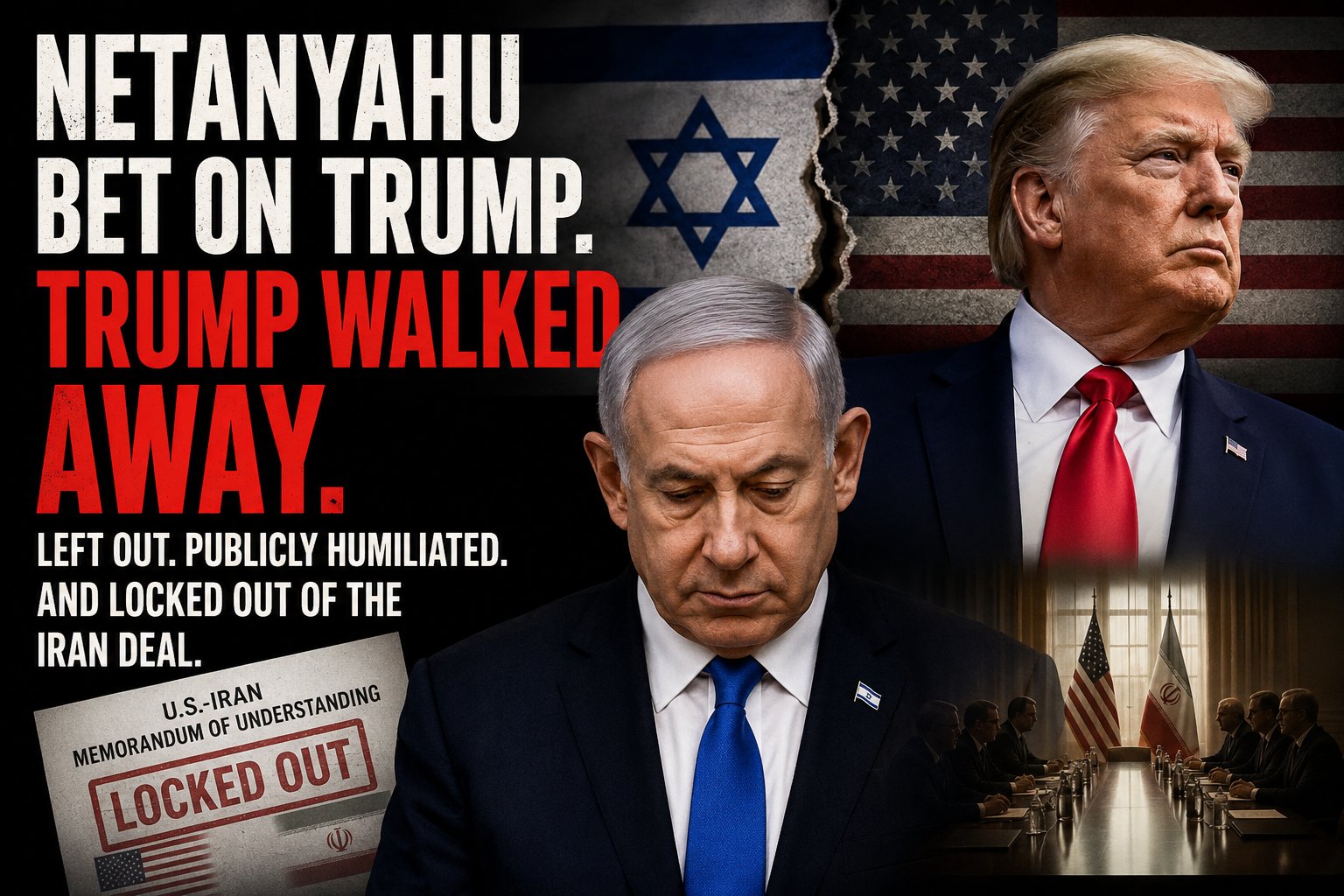
Netanyahu Bet on Trump, Then Trump Walked Away…
The Israeli Prime Minister Hitched His Political Future to Donald Trump. Now He Finds Himself Locked Out, Publicly Humiliated, and Watching Washington Negotiate With Iran Without Him.
For years, Israeli Prime Minister Benjamin Netanyahu made a calculated political gamble. While other world leaders carefully balanced relationships across the American political spectrum, Netanyahu increasingly tied Israel’s strategic future to a single man: Donald Trump.
The bet appeared logical at the time. Trump moved the U.S. Embassy to Jerusalem, recognized Israeli sovereignty over the Golan Heights, withdrew from the Obama-era Iran nuclear agreement, and consistently positioned himself as Israel’s strongest ally in modern American politics.
Netanyahu spent years alienating many Democrats while cultivating a uniquely close relationship with Trump’s Republican base. The assumption was simple, if Trump returned to power, Israel would receive unprecedented freedom to pursue its regional military objectives.
Instead, Netanyahu is discovering a hard truth about transactional politics. Donald Trump is loyal to Donald Trump. And when Netanyahu’s war began colliding with Trump’s political ambitions, the alliance quickly started to fracture.
The Public Blowup
What was once whispered behind closed doors has now erupted into public view. Reports detailing tense phone calls between Trump and Netanyahu have painted a picture of a relationship under serious strain.
According to multiple reports, Trump became increasingly furious over Israeli military actions that threatened ongoing American negotiations with Iran. The disagreements escalated from diplomatic friction into personal confrontation. The fallout became impossible to ignore when Trump publicly acknowledged making harsh comments about the Israeli leader. The language represented a remarkable departure from years of mutual praise and public solidarity.
For Netanyahu, the political damage wasn’t simply that Trump was angry. It was that Trump was angry in public. Every rebuke reinforced the perception that Israel’s most important international relationship was no longer operating on Netanyahu’s terms.
A Collision of Political Agendas
At the center of the conflict is a fundamental disagreement over what comes next. Trump increasingly appears focused on securing a historic agreement with Iran that could reduce regional tensions, stabilize energy markets, and provide a signature foreign policy achievement.
Netanyahu sees the situation differently. For Israel’s leadership, the current conflict represents an opportunity to permanently weaken Iran’s regional influence and dismantle the network of proxy organizations that have threatened Israeli security for decades.
Those objectives are not easily compatible. Trump wants a deal. Netanyahu wants victory. Trump wants stability. Netanyahu wants strategic dominance. As negotiations have advanced, the two leaders have found themselves moving in opposite directions.
Locked Out of the Room
Perhaps the most revealing development is not what has been said publicly, but what has reportedly happened behind the scenes. According to multiple reports, Israel was denied access to portions of the developing U.S.-Iran agreement before its completion. That decision represented a stunning reversal of traditional diplomatic practice.
For decades, Israeli governments have maintained extraordinary visibility into American negotiations involving Iran due to the direct security implications for the Jewish state. Now Netanyahu reportedly finds himself in the unusual position of waiting to learn details of an agreement after it is finalized. The symbolism is difficult to miss.
For years, Netanyahu portrayed himself as the world leader most capable of managing Donald Trump. Today, Washington appears increasingly willing to move forward without Israeli approval. The shift signals a dramatic change in leverage.
The Irony of the Alliance
The political irony is impossible to ignore. Netanyahu spent years surviving friction with Democratic administrations by arguing that Republicans, and particularly Trump, would provide stronger support for Israeli security objectives. That strategy helped cement his standing among conservative voters both in Israel and the United States. But the very political figure he counted on has become the source of some of the sharpest criticism his government has faced.
The Biden administration often expressed disagreements through careful diplomatic language and private conversations. Trump has chosen public pressure. The result may be more politically damaging. Every public criticism reinforces the perception that Netanyahu no longer enjoys the unquestioned support he once expected from Washington.
America First Means America First
The deeper lesson emerging from the dispute is that Trump’s foreign policy worldview has remained remarkably consistent. Many foreign leaders interpreted Trump’s support as ideological alignment. Increasingly, it appears Trump viewed the relationship through a transactional lens. If an ally advances American interests, the partnership flourishes.
If an ally becomes an obstacle, the relationship changes. For Netanyahu, that reality is creating an uncomfortable political situation. He appears to have assumed that a second Trump presidency would provide a blank check for Israeli military operations throughout the region. Instead, he is confronting a White House focused on domestic political priorities, economic stability, and securing a major diplomatic achievement with Iran. Those goals do not necessarily align with Israel’s current military strategy.
A Dangerous Turning Point
The consequences extend far beyond the personal relationship between two leaders. The United States and Israel remain deeply interconnected military and intelligence partners. Any sustained breakdown between Washington and Jerusalem carries implications for regional security, energy markets, and ongoing diplomatic negotiations throughout the Middle East.
For Netanyahu, the challenge is becoming increasingly clear. He built a political strategy around a uniquely close partnership with Donald Trump. Now that partnership appears strained at precisely the moment Israel faces some of the most consequential security decisions in its modern history. The Israeli prime minister spent years convincing voters that no world leader understood Trump better than he did.
Today, he finds himself watching the United States negotiate with Iran, publicly criticized by the American president, and increasingly uncertain about where Israel fits into Washington’s plans. Netanyahu gambled that Trump would always be his strongest ally. The problem is that Trump has never promised loyalty to anyone except himself.









































Want to join the conversation?
Create an account or sign in to share your thoughts, vote,
and reply to other readers.
Showing 0 of 0 comments
Don't have an account?
Already have an account?