
Before Project Blue Book: Inside the 1947 FBI Files That Show America’s UFO Investigation Taking Shape
In the summer of 1947, the United States was simultaneously becoming the most powerful military and intelligence state on Earth and confronting a bizarre new problem in its skies. World War II had ended less than two years earlier. The atomic bomb had transformed warfare. Relations with the Soviet Union were deteriorating rapidly. American military planners were suddenly forced to contemplate long-range bombers, guided missiles, nuclear weapons, radar, captured German technology and whatever secret systems Moscow might be developing behind the Iron Curtain.
Then Americans began reporting discs…
On June 24, civilian pilot Kenneth Arnold reported seeing nine unusual objects moving near Mount Rainier in Washington. His account exploded into the national press and helped ignite what became the first great American “flying saucer” wave. Within weeks, reports were pouring in from pilots, police officers, military personnel and ordinary citizens. Buried inside a remarkable 69 page collection of declassified FBI records is evidence that the government response was considerably more organized than simply laughing off stories about “little green men.” The documents show Army Air Corps Intelligence mobilizing scientists, alerting military installations, interrogating witnesses and attempting to determine whether the objects represented an unknown natural phenomenon, foreign technology, psychological warfare or something else entirely.
The FBI was then asked to join the investigation.
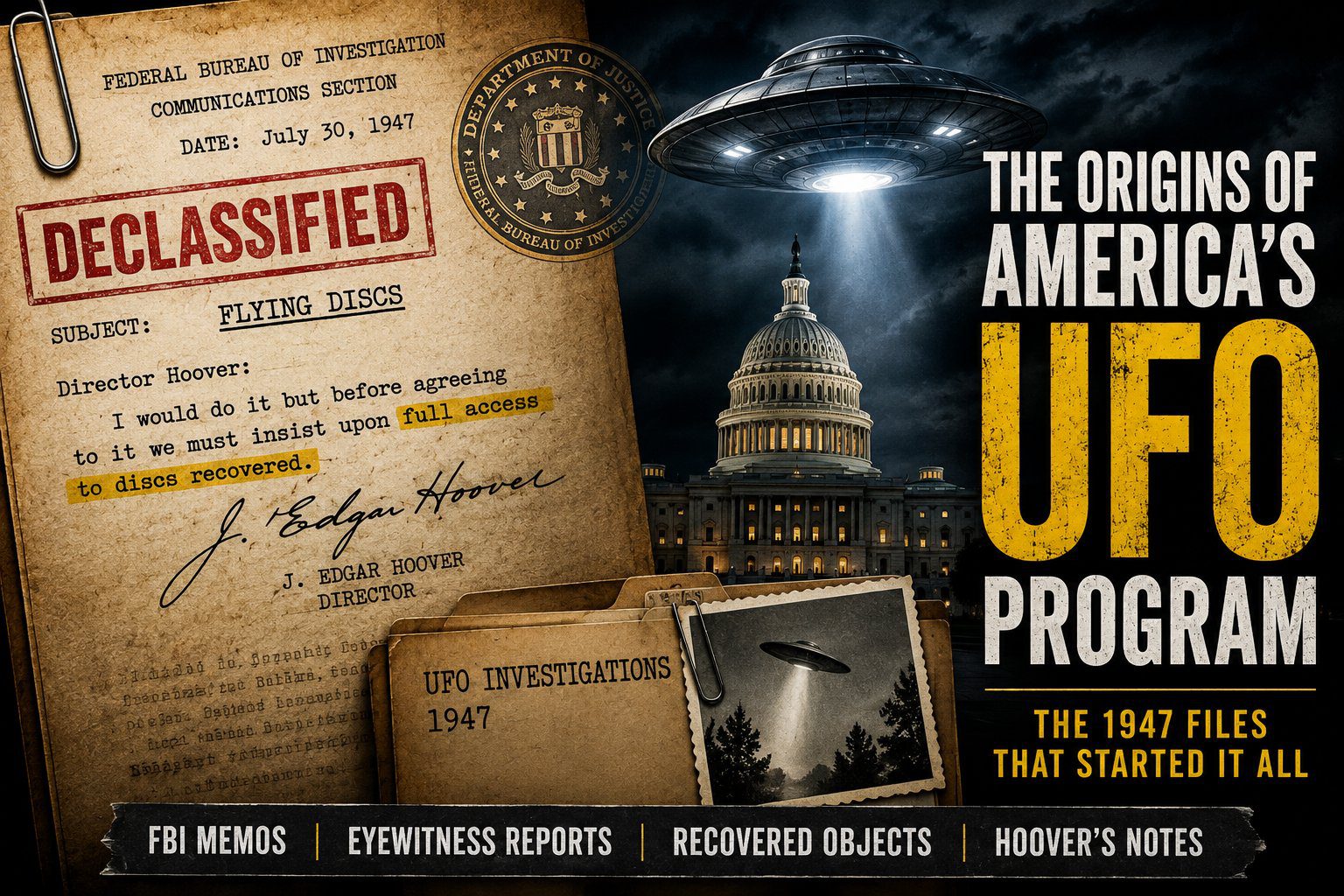
What followed looks strikingly like the embryonic architecture of the American UFO investigative system that would soon become Project Sign, then Project Grudge and eventually Project Blue Book. That does not prove the government recovered extraterrestrial spacecraft in 1947. It proves something historically important in its own right: by July 1947, elements of the U.S. government were treating the flying disc phenomenon as a legitimate intelligence problem serious enough to involve military intelligence, scientists, FBI field offices and nationwide information-sharing procedures. And one sentence handwritten by FBI Director J. Edgar Hoover remains especially difficult to ignore.
Hoover Wanted Access to Whatever the Military Recovered
The most consequential passage in the file concerns a request from Brigadier General George F. Schulgen of Army Air Corps Intelligence for FBI assistance investigating flying discs. Hoover was willing to cooperate, but he attached a condition. According to the memorandum, Hoover wrote:
> “I would do it but before agreeing to it we must insist upon full access to discs recovered.”
He then complained that in an earlier case the Army had taken possession of an object and had not permitted the FBI even a cursory examination. That wording deserves careful treatment. Hoover did not write that the Army possessed an extraterrestrial spacecraft. “Recovered discs” was the terminology being used for objects associated with flying-disc reports, some of which subsequently proved to be hoaxes, junk or conventional devices.
But the rest of the exchange is equally important. Schulgen reportedly assured Hoover that the FBI would receive cooperation, that recovered discs would be made available to FBI agents and that the results of scientific studies would periodically be shared with the Bureau. This is not a newspaper columnist speculating about flying saucers. It is an internal federal memorandum describing negotiations between the FBI and Army Air Corps Intelligence over investigative jurisdiction, scientific information and physical evidence.
The Military Was Already Running a Research Operation
Another memorandum is arguably even more revealing. According to the FBI record, Schulgen explained that the Air Corps had decided “every effort” should be undertaken to determine whether flying discs actually existed and, if they did, to learn everything possible about them. The document says Air Corps Intelligence was utilizing its scientists to determine whether the phenomenon could occur and was considering at least two broad possibilities: a celestial phenomenon or a mechanically engineered and controlled foreign object.
More importantly, this was apparently not confined to one office. Schulgen told the FBI that Air Corps installations had been alerted to investigate reported sightings and obtain information for the research effort. The memorandum also describes an Air Corps pilot who claimed to have seen one of the objects and was subsequently interrogated by Schulgen, scientists and a psychologist. According to the document, the pilot remained adamant that he had seen a flying disc.
That is an extraordinary snapshot of the government response only weeks after the phenomenon entered American popular consciousness. The infrastructure was primitive, but the basic methodology is already recognizable: reports come in, witnesses are located, credibility is evaluated, military installations gather data, scientists examine possible mechanisms, intelligence officers consider foreign technology, psychologists examine witnesses, physical objects are recovered when possible and information moves between agencies. This is essentially the skeleton of the UFO investigative system that would become formalized over the following months.
Then the FBI Created a Nationwide Reporting Network
On July 30, 1947, FBI Bureau Bulletin No. 42 converted the issue into a field office responsibility. The bulletin states that the Bureau had agreed, at the request of Army Air Forces Intelligence, to cooperate in investigating flying discs.
Agents were instructed to investigate reported incidents and determine whether they represented bona fide sightings, imaginary reports or pranks. They were also instructed to consider whether witnesses were seeking publicity or attempting to cause hysteria. The information was not supposed to remain locally filed. Reported sightings and investigative results were to be transmitted rapidly to FBI headquarters. Cases appearing to have merit required additional detailed reporting, while information developed by the Bureau was then supposed to be passed to the Army through established liaison channels.
The physical evidence issue appeared again as well. The Army Air Forces had promised cooperation, the bulletin said, and if military personnel failed to provide information or make recovered discs available for FBI examination, agents were instructed to notify headquarters. By modern standards, this was rudimentary. By July 1947 standards, it was the beginning of a national collection system.
Washington Was Worried About Russia as Much as Martians
To understand these documents, however, it is necessary to remove 80 years of UFO mythology and return to the world in which they were written. The national security establishment of 1947 was not primarily asking, “Are aliens visiting Earth?” It was asking something potentially more frightening to officials at the time: what if somebody else has built something we do not understand?
The Soviet Union was becoming America’s principal geopolitical adversary. German engineers had already demonstrated that revolutionary weapons such as the V-2 could appear with frightening speed. Captured scientists and technology were being absorbed by both East and West. Nuclear weapons had shown that apparently impossible military capabilities could become reality almost overnight.
The FBI documents make that fear explicit. Schulgen reportedly considered the possibility that early sightings could have been fabricated by individuals with Communist sympathies to create fear of a secret Russian weapon and trigger mass hysteria. Bureau Bulletin No. 42 similarly records Air Forces concern that reports could have been generated by subversive individuals attempting to create mass hysteria. That sounds paranoid today. In 1947 Washington, it was practically the job description.
The Government Was Also Testing Conventional Explanations
One of the strongest reasons to take this archive seriously is that investigators were clearly not accepting every saucer story as genuine. They were aggressively eliminating bad cases. In Black River Falls, Wisconsin, authorities encountered a 19 inch disc made from material resembling cardboard coated with silver airplane paint. It contained a wooden rudder, a photoelectric tube, a small motor and a tiny propeller. Officials suspected that juveniles had constructed it.
In North Hollywood, FBI agents investigated a roughly two foot metal contraption that reportedly landed in a woman’s garden and caught fire. Agents photographed and physically examined the approximately 20 pound device, which contained steel discs, a galvanized fin, pipe and what appeared to be a radio tube.
The files contain other dead ends, questionable witnesses, speculative theories and obvious attempts to capitalize on the hysteria. This matters because it destroys the simplistic interpretation that “the FBI investigated UFOs, therefore the FBI believed UFOs were alien spacecraft.”
It did not.
The documents show something much more interesting: a sorting operation. Hoaxes were supposed to be identified as hoaxes. Imaginary sightings were supposed to be separated from credible ones. Witness motivations were investigated. Physical debris was examined. Reports judged potentially significant were escalated. That is intelligence triage.
Some Reports Were Harder to Dismiss
At the same time, investigators were receiving reports from people considerably harder to write off as pranksters. The archive contains pilot reports, military observations and police sightings.
The Portland reports are particularly interesting because multiple officers described unusual objects, and the file notes that some of the informants were private pilots. One FBI summary describes witnesses reporting round discs with a white or metallic appearance, rapidly fluttering or oscillating, with no evidence of conventional propulsion, vapor trails or sound. The objects were estimated at extremely high altitude.
Whether those estimates were correct is impossible to establish from eyewitness testimony alone. But this distinction became fundamental to the government’s UFO problem. A homemade metal disc sitting in a fire station could be examined. A distant object observed by an experienced pilot performing apparently unusual maneuvers was a much harder intelligence problem. And the government increasingly needed a system for separating one from the other.
One Scientist Feared Orbiting Atomic Weapons
The archive also demonstrates how profoundly the atomic age shaped interpretations of the phenomenon. A scientist who contacted the FBI said he worked in the physics division of American Cyanamid Research Laboratories and had previously worked at MIT’s Radiation Laboratory during the war.
His theory was extraordinary. He suggested that flying saucers might be radio controlled germ or atomic bombs orbiting Earth, capable of being directed toward designated targets.
There is no evidence in the file that the FBI endorsed his theory. Its importance is contextual. Americans had entered an era in which atomic bombs, radar, ballistic missiles and high altitude aircraft were no longer science fiction. The technological boundary between absurdity and classified reality had become dangerously difficult to identify. That uncertainty hangs over almost every page of the archive.
And Then There Was the “Etheric” Explanation
Other submissions went much further. The FBI file preserved material advancing what would today sound remarkably similar to some modern interdimensional interpretations of UAP. A submission associated with Mead Layne and the Round Robin group argued that the occupants of flying discs were not necessarily arriving from another conventional planet. Instead, the theory proposed an “etheric” realm interpenetrating the physical world, with craft capable of transitioning or materializing into physical matter.
There is an absolutely critical distinction here: the presence of a theory inside an FBI file does not mean the FBI believed it. Federal investigative archives routinely preserve correspondence, tips, theories and allegations because somebody submitted them, not because the government authenticated them. But historically, the document is fascinating. The idea that UFOs might represent something crossing between different states or levels of physical reality, rather than spacecraft simply traveling from another planet, was already circulating around the phenomenon in 1947. That concept did not originate with today’s UAP debate.
1947 Was Also the Year America’s Secret State Was Being Rebuilt
There is another piece of historical timing that makes this archive extraordinary. While FBI agents and Army intelligence officers were exchanging UFO information, President Harry Truman signed the National Security Act on July 26, 1947. The legislation reorganized the American military establishment, created the National Security Council, established the Central Intelligence Agency and created the institutional framework for an independent United States Air Force. In other words, the first major American flying saucer wave erupted at almost exactly the same historical moment that the modern U.S. national security apparatus was being constructed.
That does not establish a causal connection, but it helps explain why the response quickly became fragmented among organizations whose jurisdictions, secrecy rules and responsibilities were themselves evolving. The Army Air Forces had intelligence. The FBI had domestic investigative authority. The Navy had its own intelligence service. Atomic-energy installations created another security domain. Soon the newly independent Air Force and newly created CIA would become additional pieces of the postwar intelligence system. The bureaucratic environment surrounding UFOs was being created almost simultaneously with the phenomenon itself.
Within Months, the Informal Investigation Became a Formal Program
This is where the historical record becomes especially important. The government did not simply investigate a few sightings during the summer and forget about the subject. It institutionalized the investigation. By the end of 1947, the Air Force created Project Sign to formally collect and evaluate UFO reports. Sign was followed by Project Grudge and later Project Blue Book, which continued investigating reports until 1969.
That lineage matters because the FBI records appear to capture the stage immediately before the system became formalized. The July 1947 material shows the mechanisms already being assembled: information intake, witness interviews, scientific review, military liaison, recovered object examination, headquarters reporting and threat assessment. This is why the archive feels less like a random collection of strange stories and more like a bureaucratic birth certificate.
So Was This the Beginning of a Secret UFO Program?
Here the evidence has to be handled carefully. The documents provide strong evidence that a real government investigation existed. They show military intelligence requesting FBI cooperation, scientists being used, military installations being alerted, pilots being interrogated, psychologists becoming involved, FBI field offices receiving investigative instructions, rapid reporting to headquarters, interagency intelligence-sharing and procedures for examining recovered objects.
Within months, those efforts developed into formal Air Force UFO programs. What these particular documents do not establish is that the government had recovered extraterrestrial vehicles, discovered nonhuman bodies or created a successful reverse-engineering program. Those are separate claims requiring separate evidence. But it is reasonable to describe these papers as showing the early infrastructure from which America’s documented UFO investigation developed.
What Happened Behind the Classified Curtain Remains the Bigger Question
The fascinating historical question is not whether Project Blue Book existed. We know it existed. The more difficult question is whether publicly acknowledged UFO programs represented the entire government effort. That remains controversial nearly eight decades later. Modern UAP investigations once again involve the Pentagon, intelligence agencies, military pilots, radar systems, classified sensors and congressional oversight. The terminology has changed, but the institutional pattern is familiar.
That does not prove a continuous hidden alien retrieval program running from 1947 to the present. There is no support for making that leap from this document alone. What it does show is continuity in the national security problem itself. From the beginning, officials were asking whether unusual objects represented foreign technology, unknown natural phenomena, psychological operations, misidentification or something genuinely unexplained. The modern UAP system is far larger and more technologically sophisticated, but the basic investigative DNA is already visible in these faded pages.
The “Full Access” Line Is Still Remarkable
Strip away Roswell mythology, alien autopsies, Area 51 stories, congressional whistleblowers and nearly 80 years of speculation. Return to July 1947. The director of the FBI is being asked by a senior Army Air Corps intelligence official to place federal agents into a nationwide investigation of mysterious objects being reported over the United States. The military is using scientists. Military installations are collecting reports. Witnesses are being interrogated. The FBI is being asked to determine which witnesses are credible. Physical objects are being recovered and examined. And Hoover’s concern is not that the entire subject is ridiculous. His concern is access.
> “We must insist upon full access to discs recovered.”
Maybe every recovered object was conventional. Maybe the extraordinary sightings ultimately had ordinary explanations. Maybe classified American technology, Soviet fears, balloons, astronomical phenomena, psychological effects and hoaxes collectively explain the entire 1947 wave. The documents themselves cannot answer that question.
What they can tell us is that almost from the moment the modern UFO phenomenon entered American history, the United States government began building machinery to investigate it. And that machinery did not disappear. It evolved. Project Sign became Project Grudge. Grudge became Project Blue Book. Decades later, UFOs were renamed UAP, Congress reopened the issue and the Pentagon created another office to investigate anomalous objects in American airspace.
The terminology changed. The technology changed. The bureaucracy changed. But the fundamental national security question visible in these 1947 FBI pages remains almost exactly the same: What is operating in our skies, who controls it, and what happens if it isn’t ours?
The Classified Government Documents:
Sources
National Archives — Project BLUE BOOK: Unidentified Flying Objects
National Archives — Public Interest in UFOs Persists 50 Years After Project Blue Book
U.S. Air Force — Unidentified Flying Objects and Project Blue Book
Air Force Office of Special Investigations — Project Blue Book Part 1
U.S. Department of State — National Security Act of 1947
U.S. Department of State — Creation of the Central Intelligence Agency
These official sources support the article’s core historical structure: the FBI confirms it worked with the military on the 1947 wave, the National Archives dates Project Sign to December 1947, and the Air Force documents the later Sign → Grudge → Blue Book investigative lineage. (FBI)


















































Want to join the conversation?
Create an account or sign in to share your thoughts, vote,
and reply to other readers.
Showing 0 of 0 comments
Don't have an account?
Already have an account?