
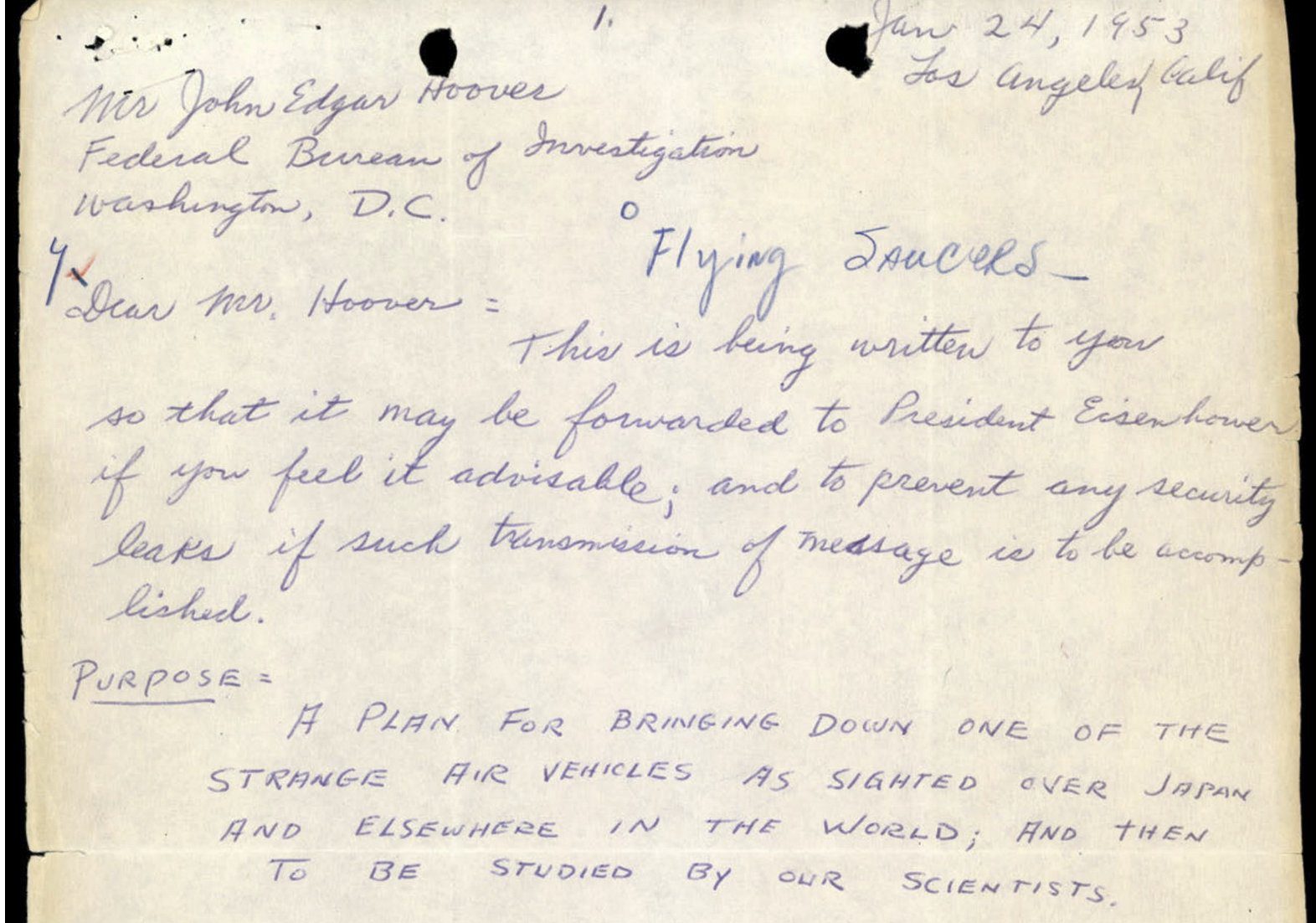
Newly Surfaced 1953 Letter to J. Edgar Hoover Reveals Early U.S. Interest in Shooting Down UFOs for Study
For decades, the UFO debate has lived in the shadows of American history, buried under classified programs, Cold War paranoia, government denials, and grainy witness accounts dismissed as fantasy. But a newly resurfaced handwritten letter addressed directly to FBI Director J. Edgar Hoover is reigniting one of the oldest and darkest questions in modern history:
Did elements of the U.S. government seriously consider bringing down an unidentified flying object for scientific analysis as early as 1953?
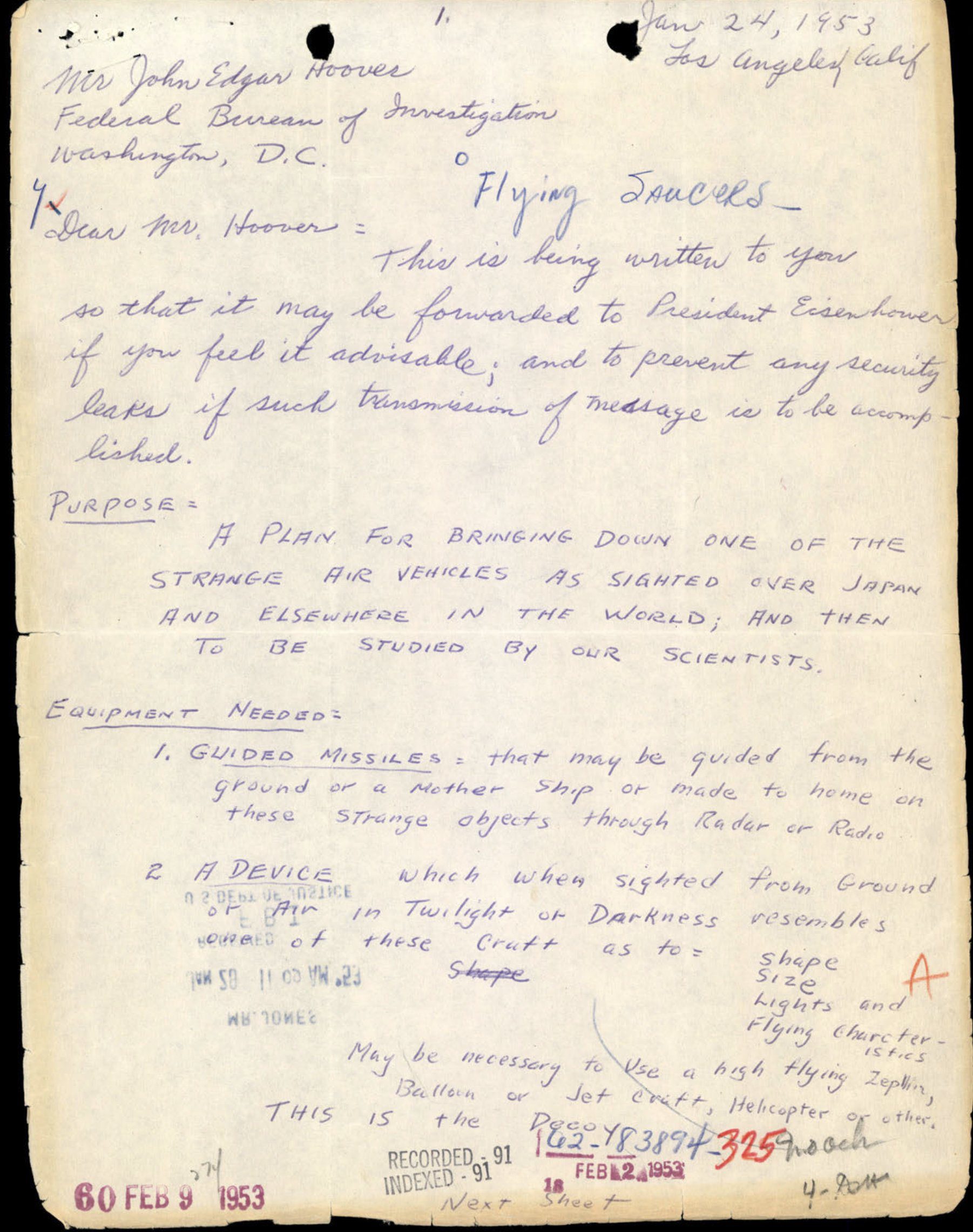
The document, dated January 24, 1953, from Los Angeles, California, appears to outline a direct proposal for “bringing down one of the strange air vehicles” seen “over Japan and elsewhere in the world” so that it could “be studied by our scientists.”
That line alone is explosive.
Not because it proves extraterrestrials visited Earth, it does not, but because it demonstrates that within the highest levels of Cold War-era intelligence culture, unidentified aerial craft were being discussed as tangible physical objects worthy of military interception and scientific recovery.
The handwritten letter was addressed to Hoover at the Federal Bureau of Investigation in Washington, D.C., and prominently titled:
“Flying Saucers”
The author then wrote:
“A plan for bringing down one of the strange air vehicles as sighted over Japan and elsewhere in the world; and then to be studied by our scientists.”
That is not the language of ridicule or dismissal. It is operational language. The document goes further, listing “equipment needed,” including guided missiles capable of homing in on the objects “through radar or radio,” as well as observational decoy craft intended to mimic UFO flight characteristics during nighttime conditions. The letter even speculates about deploying high flying zeppelins, balloons, jets, or helicopters as part of the operation. In modern terms, it reads less like science fiction and more like an early conceptual draft for a covert retrieval program.
The Timing Matters More Than the Letter Itself
The date on the document may be the most important part. January 1953 was not a random moment in American history. The Cold War was intensifying. The Korean War was nearing its conclusion. Nuclear tensions with the Soviet Union were escalating. And across military and intelligence circles, unexplained aerial phenomena were already causing concern.
Just months earlier, the famous 1952 Washington D.C. UFO incidents had rattled the nation after radar operators and military personnel tracked unexplained objects over the U.S. capital. Fighter jets were scrambled. The press exploded. Americans demanded answers.
Behind the scenes, the CIA had already begun taking the phenomenon seriously enough to organize what became the Robertson Panel in 1953, a secretive scientific review of UFO reports ordered amid fears that mass sightings could trigger public panic or be exploited by foreign adversaries.
That broader historical context changes how this letter should be viewed. This was not written in a vacuum. It emerged during a period when unidentified aerial phenomena were being actively tracked by military radar, discussed within intelligence agencies, and increasingly viewed as a potential national security issue.
The Language Is Strikingly Modern
Perhaps the most unsettling aspect of the document is how familiar it sounds compared to current UAP discussions happening inside the Pentagon today. The modern U.S. government no longer officially uses the term “UFO.” Instead, it uses “UAP” Unidentified Anomalous Phenomena. Yet the underlying concerns remain almost identical:
• Unknown craft
• Extraordinary flight behavior
• National security implications
• Retrieval and scientific analysis
• Radar tracking
• Potential foreign or non-human technology
In 2026, those ideas dominate congressional hearings and Pentagon briefings. In 1953, they were apparently being handwritten in letters sent to Hoover. That continuity is difficult to ignore.
Does This Prove Aliens? No. But It Proves Something Else
There is an important distinction journalists and researchers need to make carefully. This letter does not prove extraterrestrial visitation. What it does prove is that serious individuals in the early Cold War period believed unidentified aerial craft existed in a physical enough form to justify military interception and recovery efforts. That alone is historically significant.
For decades, skeptics argued the government never genuinely treated UFOs as real objects. Documents like this directly challenge that narrative. The author clearly believed these “air vehicles” could potentially be tracked, targeted, and recovered technologically. Whether those objects were secret Soviet craft, experimental U.S. technology, misidentified atmospheric phenomena, or something more extraordinary remains unknown. But the intent behind the proposal is undeniable.
The Hoover Connection Raises New Questions
The fact that the letter was addressed to Hoover is also notable. During the early Cold War, Hoover’s FBI often intersected with military intelligence investigations involving national security threats, espionage, and unexplained aerial incidents. Although the Air Force publicly handled most UFO investigations through Project Blue Book, the FBI maintained its own involvement in collecting and sharing information.
That overlap has fueled decades of speculation about compartmentalized programs operating beyond public oversight. This document will likely intensify those questions. Especially because modern whistleblowers and declassified materials continue to allege that crash retrieval programs may have existed for decades in various classified forms.
Again, none of those claims have been definitively proven. But historically, the paper trail is growing. And every newly uncovered document adds another layer to a story that refuses to disappear.
A Forgotten Piece of Cold War History Reenters the Public Eye
Whether this letter ultimately becomes viewed as a curiosity, a forgotten proposal, or evidence of something far larger, it represents a remarkable historical artifact from a period when fear, secrecy, and technological uncertainty shaped nearly every corner of American intelligence operations.
For nearly 100 years, the UFO story has existed somewhere between conspiracy theory and classified reality. Now, piece by piece, old documents are dragging that hidden history back into public view. And on what many are now calling “Alien Disclosure Day,” this handwritten letter to Hoover may become one of the most fascinating rediscovered documents yet.


















































Want to join the conversation?
Create an account or sign in to share your thoughts, vote,
and reply to other readers.
Showing 0 of 0 comments
Don't have an account?
Already have an account?