
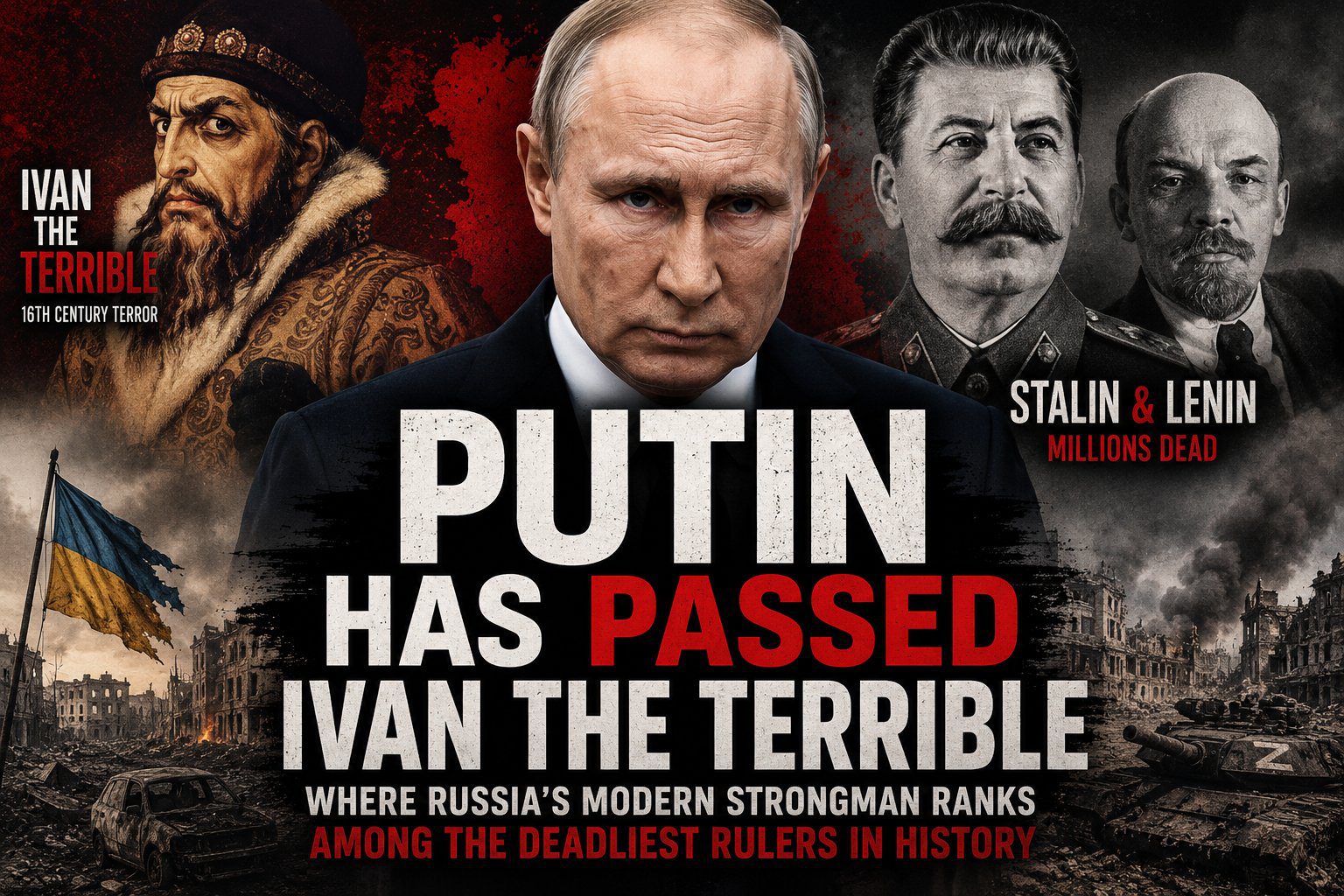
Putin Has Passed Ivan the Terrible: Where Russia’s Modern Strongman Ranks Among the Deadliest Rulers in Russian History
Vladimir Putin, the Butcher of Moscow.
Vladimir Putin has spent more than a quarter century constructing an image of himself as the latest in a long line of powerful Russian rulers, a leader willing to use extraordinary force to protect the state, expand its territory and punish those he considers enemies. History may ultimately remember him for something much darker.
After the destruction of Chechnya, the invasion of Georgia, Russia’s devastating military intervention in Syria, the invasion and attempted subjugation of Ukraine, enormous Russian battlefield losses and more than two decades of increasingly severe political repression, Putin has accumulated a human toll that places his rule alongside some of the bloodiest periods of Russian history. His methods are different from those of the medieval tsars and Soviet dictators who came before him, but the result is increasingly familiar: ruined cities, dead civilians, sacrificed soldiers, imprisoned opponents and neighboring countries forced to live under the threat of Russian military power.
Historical comparisons of this kind require caution. There is no credible spreadsheet assigning every death in every Russian war to a single ruler, and estimates become dramatically less reliable the farther back in history we travel. Battlefield deaths are also fundamentally different from people deliberately executed, tortured, starved, deported or murdered by their own governments. But those qualifications should not obscure the larger reality. Putin personally made or controlled the political decisions that launched, expanded and sustained wars responsible for an enormous number of deaths. By the scale of warfare conducted under his authority, his era has moved far beyond the level of destruction traditionally associated with Ivan IV, Ivan the Terrible.
That does not place Putin anywhere close to Joseph Stalin, whose machinery of repression and forced social transformation killed millions. But Putin does not need to equal Stalin to occupy a place among the most destructive rulers in Russian history. The more relevant question is how far Putin has already climbed — and how much higher the final toll could rise before his rule ends.
Putin vs. Ivan the Terrible
Ivan IV ruled Russia from 1547 until 1584 and became synonymous with brutality centuries before Vladimir Putin entered the Kremlin. Ivan’s reputation was earned through extraordinary personal cruelty, political terror and paranoia. He created the Oprichnina, a separate political and territorial system enforced by the Oprichniki, an elite force personally loyal to the tsar that confiscated property, terrorized perceived enemies and carried out executions against people Ivan considered disloyal.
The most infamous episode came in 1570, when Ivan’s forces descended upon Novgorod after the tsar became convinced that prominent residents were plotting against him. Thousands may have been killed, although historians continue to debate the precise toll. Ivan’s violence was also intensely personal. According to the traditional historical account, he fatally struck his own son and heir, Ivan Ivanovich, during an argument in 1581, helping destabilize the succession that followed his reign.
Putin’s violence operates differently. He does not need to personally wield the weapon, supervise the torture chamber or order victims thrown into a freezing river. He commands a modern state equipped with ballistic missiles, cruise missiles, drones, artillery, intelligence services, prisons, surveillance systems, propaganda networks and one of the world’s largest militaries. Where Ivan’s terror was often intimate and theatrical, Putin’s violence is bureaucratic, technologically advanced and administered through institutions powerful enough to kill people hundreds of miles away at the push of a button.
That distinction makes direct comparisons difficult, but it also explains why the potential scale of Putin’s destruction is so much greater. Ivan could terrorize a city with soldiers and executioners. Putin can unleash missiles and drones against cities across an entire sovereign nation while simultaneously sending hundreds of thousands of Russian troops into a grinding industrial war.
Putin’s Body Count Is Primarily the Product of War
Unlike Stalin, whose most notorious atrocities were directed overwhelmingly against people living inside the Soviet Union, much of the death associated with Putin’s rule has resulted from military conflicts beyond Russia’s internationally recognized borders. The largest by an overwhelming margin is Ukraine.
Russia launched its full-scale invasion on February 24, 2022, after eight years of conflict that began with Moscow’s seizure of Crimea and support for separatist forces in eastern Ukraine in 2014. Putin’s government made the decision to invade. Putin publicly justified the war, commanded the state prosecuting it and repeatedly rejected opportunities to end the conflict on terms requiring Russia to abandon its territorial ambitions. Whatever final casualty number historians eventually establish, the consequences of those decisions belong permanently to his record.
The resulting war has killed enormous numbers of Russians and Ukrainians, and no authoritative final toll exists while the fighting continues. Military losses are disputed by governments, thousands of soldiers remain missing, and deaths in Russian-occupied Ukrainian territory are extraordinarily difficult for independent investigators to document. The United Nations therefore treats its civilian figures as verified minimums rather than a complete accounting.
Those minimums alone reveal the scale of the catastrophe. Ukrainian civilians have been killed in apartment buildings, railway stations, shopping centers, hospitals, shelters and homes. Entire communities have been shattered. Millions of people have been displaced, children have grown up under air-raid sirens, and cities such as Mariupol have become global symbols of what modern siege warfare can do to a civilian population.
This is not abstract geopolitical maneuvering. These are human beings killed in a war launched by the Russian state under Vladimir Putin’s leadership.
Putin Has Also Sacrificed Russians on an Extraordinary Scale
One of the darkest realities of Putin’s war is that Ukrainians are not the only people paying for it. Russians are dying in enormous numbers as well.
Whatever the final battlefield toll, Russia has sustained extraordinary military losses in pursuit of Putin’s decision to invade and attempt to dominate Ukraine. That complicates the traditional distinction between rulers who slaughter foreigners and rulers who destroy their own people. Putin has not carried out a Stalin style Great Purge against the Russian population, and modern Russia has not recreated the Gulag system on anything approaching Soviet scale. But Russian soldiers are still Russian citizens, and their deaths are no less real because they occurred on a battlefield outside Russia.
A ruler who repeatedly sends his country’s citizens into a war of choice cannot simply remove those deaths from his historical ledger because enemy fire ultimately killed them. Putin made the political calculation that Russian lives could be spent in extraordinary numbers to achieve his territorial and ideological objectives. Thousands of Russian families have buried sons, fathers and brothers because of that decision.
That is where the comparison with Ivan becomes particularly revealing. Ivan devastated Russia through internal terror, economic destruction and disastrous wars. Putin has inflicted a different kind of damage, combining authoritarian repression at home with an imperial war abroad that consumes Russian lives on a massive scale. The mechanisms are different, but the autocratic indifference to human suffering is disturbingly recognizable.
Chechnya Was the Beginning
Ukraine did not emerge from nowhere. The pattern began much earlier.
Putin’s rise to national power coincided with the Second Chechen War, which began in 1999 and helped create the political persona that would define his presidency: uncompromising, militaristic and willing to employ overwhelming force against anyone perceived as threatening Moscow’s authority.
Grozny became the symbol of that approach. Russian forces subjected the Chechen capital to devastating bombardment during fighting that left enormous portions of the city destroyed. Human rights organizations documented widespread civilian suffering, disappearances, torture and abuses throughout the conflict. The war ultimately restored Moscow’s control over Chechnya and helped establish Putin domestically as a leader capable of imposing order after the instability and humiliation many Russians associated with the 1990s.
It also taught Putin a potentially catastrophic political lesson: overwhelming military violence could work. It could destroy resistance, consolidate domestic power and strengthen the image of the ruler who ordered it.
Georgia Showed Russia’s Neighbors What Was Coming
In 2008, Russia fought a short war with neighboring Georgia following escalating tensions surrounding the separatist territories of South Ossetia and Abkhazia. The circumstances leading to the war were more complicated than Russia’s later full scale invasion of Ukraine, and international investigations assigned responsibility for different stages of the escalation to multiple actors. But the conflict nevertheless demonstrated Moscow’s growing willingness to use military force to maintain dominance over former Soviet republics moving politically toward the West.
Russia subsequently recognized South Ossetia and Abkhazia as independent states and entrenched its military presence there. The message to Moscow’s neighbors was increasingly clear: the Kremlin considered the political orientation of former Soviet republics a Russian security interest whether those independent countries agreed or not.
That doctrine would reach its most violent expression in Ukraine.
Syria Took Putin’s War Machine Beyond the Former Soviet Union
Russia’s military intervention in Syria beginning in 2015 demonstrated that Putin’s willingness to use overwhelming force extended far beyond Russia’s immediate neighborhood. Moscow intervened to support the government of Bashar al-Assad during the Syrian Civil War, helping stabilize Assad’s regime and giving Russia an opportunity to project military power across the Middle East.
The intervention also produced substantial civilian casualties. Independent organizations including Airwars documented thousands of civilian deaths connected to Russian military activity, while broader local allegations run considerably higher. As with Ukraine, precise attribution is difficult in a chaotic multi-sided war, and responsible reporting must distinguish between confirmed or strongly supported incidents and allegations that remain contested.
But the larger picture is unmistakable. Russian aircraft bombed densely populated areas. Cities already devastated by years of civil war endured another layer of destruction. Putin’s Russia demonstrated that it was prepared to use massive military power to preserve an allied authoritarian government even when the civilian cost was severe.
By then, the pattern was established: Grozny, Georgia, Syria. Ukraine would become the culmination.
Ukraine Changed Putin’s Historical Category
Whatever judgment historians might eventually have rendered about Putin’s authoritarianism, Chechnya, Georgia, Syria or domestic repression, the February 2022 invasion moved his presidency into a fundamentally different historical category.
This was not a limited border operation or temporary intervention. Russia attempted to overthrow the government of a sovereign European country with a population of tens of millions. Russian armored columns moved toward Kyiv. Cities were surrounded. Mariupol was devastated. Millions fled their homes. Russian authorities announced the annexation of occupied territory. Missiles and drones repeatedly struck Ukrainian cities hundreds of miles from the frontline.
The war exposed the ideological core of Putin’s worldview: that Ukraine’s sovereignty is conditional, that Russia possesses historical rights over territory beyond its borders and that Moscow can use force when neighboring countries choose political futures the Kremlin considers unacceptable.
That worldview has produced a vast graveyard.
Ukrainian soldiers have died defending their country. Ukrainian civilians have died under Russian bombardment. Russian soldiers have died invading another country. Families on both sides have been permanently shattered. Cities have been reduced to ruins so that one ruler’s imperial vision can be pursued.
This is why sanitized phrases such as “geopolitical competition” and “security concerns” can become morally inadequate. Whatever strategic theories surrounded the conflict, the ultimate instrument Putin chose was war, and war means human beings being blown apart, crushed under buildings, burned inside vehicles and buried by their families.
Has Putin Really Passed Ivan the Terrible?
If the question is whether Putin has personally behaved more sadistically than Ivan IV, probably not. Ivan’s reign involved forms of intimate brutality that belong to another age: torture, executions, collective punishment and violence sometimes carried out under the direct gaze or authority of an absolute monarch.
But if the question is how many human beings have died in wars and campaigns conducted under each ruler, the technological and demographic difference becomes overwhelming. Putin commands a 21st-century military capable of killing at a scale Ivan could never have imagined.
A 16th century army could massacre a town. A modern military can bombard cities across a country simultaneously. One missile can kill dozens. Artillery batteries can fire millions of shells. Drones can attack infrastructure hundreds of miles from the battlefield. A ruler can order an invasion from a secure room in Moscow and unleash destruction across thousands of square miles.
For that reason, Putin has almost certainly surpassed Ivan in the absolute human toll associated with wars conducted under his authority.
But Putin is not Russia’s deadliest ruler.
Not even close.
Stalin Remains in a Category of His Own
Any serious examination of lethal Russian and Soviet rulers eventually reaches Joseph Stalin, and at that point the scale changes completely. Stalin’s government presided over forced collectivization, catastrophic famine, mass executions, ethnic deportations, the Gulag labor-camp system and the Great Terror. Historians continue debating precisely how deaths should be categorized and which should be attributed directly to Stalinist policies, but the broad conclusion is indisputable: millions of people died.
No credible assessment places Putin remotely close to Stalin’s historical death toll.
That distinction is important because turning Russian history into a simplistic body count competition would obscure radically different forms of state violence. Stalin constructed a domestic machinery capable of destroying entire social classes, ethnic populations and perceived political enemies. Putin constructed an authoritarian state capable of invading neighboring countries, leveling cities, suppressing meaningful political opposition and absorbing enormous casualties in pursuit of his geopolitical ambitions.
Both systems concentrated extraordinary power around one man. Both treated individual lives as expendable when they interfered with the objectives of the state. But they killed differently.
Lenin Is Another Difficult Comparison
Vladimir Lenin also presents a complicated case. His government initiated the Red Terror, authorized political repression and governed during the Russian Civil War, one of the most catastrophic periods in the country’s modern history. Millions died during that era from warfare, disease, starvation and economic collapse.
Attributing every Russian Civil War death personally to Lenin would be historically indefensible because the conflict involved Bolsheviks, White armies, foreign intervention forces, nationalist movements, peasant rebellions and competing armed factions.
The same methodological discipline should be applied to Putin. Not every Russian or Ukrainian soldier killed in Ukraine can literally be described as personally murdered by Putin. But Putin made the decision to launch the full-scale invasion, he controls the Russian state prosecuting it and he has repeatedly chosen to continue the war despite its staggering cost.
The distinction between pulling the trigger and ordering the war matters legally. It does not erase political responsibility.
Nicholas II Shows Why Raw Death Totals Can Mislead
Nicholas II offers another warning against simplistic historical rankings. Millions of Russian soldiers and civilians died during World War I while Nicholas was tsar, but describing Nicholas as a greater killer than Putin merely because more Russians died during his reign would confuse wartime mortality with deliberate state violence and political responsibility.
Russia entered a gigantic multinational conflict involving Germany, Austria-Hungary, France, Britain, the Ottoman Empire and numerous other powers. Responsibility for that catastrophe was distributed across governments, armies and decades of geopolitical instability.
Putin’s invasion of Ukraine presents a clearer question of personal political agency. Russia launched the full scale attack. Putin was the ruler who announced it, justified it and commanded the state carrying it out.
That does not mean every death can be legally or historically counted as an individual murder committed by Putin. It does mean that the war’s enormous human toll cannot be separated from his legacy.
Putin’s Russia Is Rehabilitating Russia’s Strongmen
Perhaps the most revealing dimension of this story is the way Putin-era Russia increasingly talks about authoritarian rulers from its own past.
Figures once remembered primarily for terror and repression have increasingly been reframed through the language of strength, territorial expansion, national unity and resistance to foreign enemies. Ivan the Terrible has undergone this transformation. So has Stalin.
New monuments have appeared. Officials have highlighted state building achievements alongside atrocities. Historical narratives increasingly emphasize the supposedly heroic necessity of powerful rulers confronting enemies within and outside Russia.
There is an obvious political utility to that interpretation of history. If brutal rulers are remembered primarily because they expanded Russia, defeated foreign adversaries and strengthened the state, their victims become secondary. Human suffering becomes the price of greatness.
That may ultimately be the historical bargain Putin expects Russians to accept about his own rule.
He restored Russia’s power, the argument will say. He confronted the West. He defended Russian civilization. He reclaimed territory. He refused to allow Moscow to be humiliated. And beneath that mythology will be the bodies.
The Russian Strongman Cycle
Ivan the Terrible, Peter the Great, Stalin and Putin emerged in radically different centuries under radically different political systems, yet Russian political history repeatedly returns to the same dangerous argument: that the country is too large, too threatened, too complicated or too surrounded by enemies to be governed without extraordinary centralized power.
That argument has repeatedly justified repression. It has justified censorship, territorial expansion, political imprisonment and war. And again and again it has produced enormous human suffering.
Putin has spent decades cultivating the image of the indispensable ruler, the man standing between Russia and chaos, Western encirclement, terrorism, separatism and national humiliation. Politically, the formula has been extraordinarily effective.
History, however, does not judge rulers exclusively by how long they remained in office or how effectively they centralized power. It also measures what that power cost.
For Putin, that cost is increasingly written in graves.
Putin Has Passed Ivan, But Stalin Still Towers Above Them Both
There is no scientifically precise leaderboard of Russia’s deadliest rulers, and pretending otherwise would reduce complicated history to propaganda. But broad historical judgments are possible.
Ivan the Terrible remains one of Russia’s most notoriously brutal rulers because of the intimate, domestic and frequently sadistic nature of his terror. Stalin remains in an entirely different category because his system produced industrialized repression and death measured in millions.
Putin occupies another category: the modern authoritarian ruler who used the extraordinary technological power of a 21st century state to wage repeated wars, crush political opposition and pursue an imperial vision that has already cost an immense number of lives.
Calling him a mass murderer is ultimately a moral characterization rather than a settled legal judgment. International courts and future historians will determine the precise legal and historical terminology attached to individual crimes and command responsibility. But no semantic debate can erase the fundamental reality that Putin deliberately chose wars whose predictable consequences included mass death, and he continued those wars as the bodies accumulated.
He did not personally fire the artillery shells that destroyed Ukrainian homes. He did not personally pilot the aircraft over Syria or stand behind every soldier accused of atrocities. Autocrats rarely kill that way.
They give orders.
They create systems.
They decide that other people’s lives are an acceptable price for their ambitions.
By that measure, Vladimir Putin has already secured a place among the most destructive rulers in Russian history. He has almost certainly surpassed Ivan the Terrible in the scale of deaths associated with wars conducted under his authority, while remaining far below the catastrophic toll of Stalin.
And unlike Ivan, Lenin, Nicholas II or Stalin, Putin’s final number has not yet been written.






































Want to join the conversation?
Create an account or sign in to share your thoughts, vote,
and reply to other readers.
Showing 0 of 0 comments
Don't have an account?
Already have an account?