

Paraguay’s President Impeached and Arrested After Massive Bank Collapse as Investigators Discover Secret Vault Inside Luxury Mansion
ASUNCIÓN, PARAGUAY — A spectacular banking collapse has plunged Paraguay into its worst political crisis in more than a decade, toppling President Santiago Peña, freezing the savings of nearly three million customers, exposing hundreds of millions of dollars in public funds, and leading investigators to a secret, high security vault concealed behind a false wall inside the former president’s luxury mansion.
The scandal erupted on November 2, 2026, when Paraguay’s central bank intervened in Ueno Bank, one of the country’s largest financial institutions, after regulators discovered severe solvency problems and questionable lending practices involving companies connected to its ownership. Within days, public outrage over frozen accounts and potentially endangered pension funds had transformed a financial emergency into a political catastrophe, forcing Peña from office and triggering criminal proceedings against the former president, senior banking executives, and a former central bank chief.
The investigation took an extraordinary turn when prosecutors searched Peña’s vacation property in San Bernardino, a resort community outside the capital, and discovered a concealed passage leading to an armored vault reportedly protected by sophisticated biometric security technology. Investigators initially struggled to open the chamber and considered extraordinary methods of entry before eventually gaining access on November 10. Inside, they reportedly found no cash or valuables, deepening public speculation about the room’s purpose and whether anything had previously been removed.
Peña, who served as president from August 2023 until his impeachment on November 6, has denied criminal wrongdoing. Prosecutors are examining whether his financial relationships with Ueno’s ownership and his administration’s handling of public deposits contributed to the bank’s collapse. The allegations remain unproven, but the scandal has already exposed serious questions about political influence, financial regulation, and the protection of public money in one of South America’s fastest-growing digital banking markets.
Ueno Bank’s Collapse Freezes Nearly Three Million Accounts
Ueno Bank had become one of Paraguay’s most prominent financial success stories, expanding rapidly through mobile banking, digital payments, and consumer lending while attracting customers who had previously lacked access to traditional banking services. By November 2026, the institution served nearly three million customers in a country of approximately 6.5 million people, making its payment infrastructure an important part of everyday economic activity for households, workers, and businesses.
Behind that extraordinary growth, however, regulators uncovered mounting financial problems. Ueno had accumulated substantial lending exposure to companies connected to its ownership structure, raising concerns about related party transactions, inadequate collateral, and whether its reported financial strength accurately reflected the risks on its balance sheet. On November 2, the Central Bank of Paraguay initiated formal resolution proceedings after determining that the lender’s capital had fallen below half the required regulatory minimum, effectively suspending access to customer deposits and disrupting affiliated investment operations.
The consequences were immediate. Millions of Paraguayans suddenly found themselves unable to withdraw savings, make digital payments, or use bank cards, while businesses dependent on Ueno’s financial services struggled to complete ordinary transactions. Public anger intensified as customers demanded access to their money and authorities scrambled to reassure the population that the collapse was isolated rather than evidence of a wider banking crisis.
Hundreds of Millions in Public Money Were Exposed
The scandal became considerably more serious when attention turned to Ueno’s enormous holdings of government deposits. According to Reuters and Fitch Ratings, the bank held approximately $850 million in public sector funds as of June 2026, including money associated with state institutions and pension programs. Lawmakers questioned why such substantial public resources had been concentrated in a privately controlled bank with politically connected ownership, particularly as concerns about its lending practices and financial condition were emerging.
Public pension funds became a major source of anger, with teachers and other government employees demanding assurances that their retirement savings would be protected. Paraguayan educators organized demonstrations and a national strike over approximately $60 million in pension assets held at Ueno, while investigators examined allegations that other state pension deposits had exceeded applicable legal limits. The exposure raised questions about whether officials responsible for managing public money had properly assessed the bank’s financial risks or allowed political relationships to influence their decisions.
Depositing government money in a commercial bank is not inherently improper, and the presence of public funds at Ueno does not independently establish corruption. The central questions are whether the deposits complied with financial regulations, whether officials ignored warning signs, and whether anyone improperly benefited from concentrating public resources at the institution. Those issues have become central to an investigation extending beyond Ueno’s executives into the highest levels of Paraguay’s former government.
Peña’s Financial Ties to Ueno Raise Conflict of Interest Questions
Peña’s political position deteriorated rapidly because of his previous financial relationship with Grupo Vázquez, the business group associated with Ueno’s ownership. The former president had held shares in the corporate structure connected to the bank before divesting his interests in 2025, a transaction he has cited in denying allegations that he improperly benefited from the institution’s subsequent activities.
His administration also appointed Carlos Carvallo, a former Ueno executive, to lead the Central Bank of Paraguay, placing someone with previous professional ties to the lender in charge of the institution responsible for regulating it. Although former banking executives frequently serve as financial regulators, the arrangement became politically explosive once Ueno collapsed amid allegations of inadequate supervision and preferential treatment.
Lawmakers accused Peña of allowing public pension funds to remain exposed to Ueno beyond legal limits, while prosecutors began examining whether political influence had interfered with regulatory decisions or helped the bank attract government deposits. Peña has rejected the accusations, maintaining that his financial interests had been divested and that he committed no crime. His former shareholding and Carvallo’s appointment establish potential conflicts requiring scrutiny, but neither fact alone proves criminal misconduct.
Congress Removes Peña as Criminal Investigations Accelerate
The political fallout unfolded with remarkable speed. As demonstrations spread and members of the governing Colorado Party began distancing themselves from the president, Peña submitted his resignation on November 5, arguing that his departure would help preserve national stability. Lawmakers refused to allow the resignation to settle the crisis, instead moving forward with impeachment proceedings that could carry different constitutional consequences for the former president’s status and privileges.
Paraguay’s Chamber of Deputies voted 78–0 to advance impeachment charges, and the Senate subsequently removed Peña from office on November 6. His defense challenged the speed of the proceedings, arguing that he had insufficient time to review the accusations and prepare a response, but lawmakers proceeded despite those objections. Vice President Pedro Alliana assumed the presidency that evening, inheriting a government confronting widespread public anger, financial uncertainty, and investigations involving senior officials.
Criminal proceedings followed Peña’s removal, with prosecutors alleging breach of trust and improper use of public office for personal benefit. The former president was initially placed under house arrest and subsequently held in pretrial detention while investigators examined his financial dealings and relationships with Ueno. Carvallo and several banking executives also faced allegations connected to the institution’s failure, including questions about lending practices, regulatory decisions, and financial documentation.
The criminal investigation remains separate from the impeachment proceedings. Peña’s removal was a constitutional and political decision, while establishing criminal liability requires prosecutors to prove specific offenses in court. The former president has denied wrongdoing and retains the presumption of innocence.
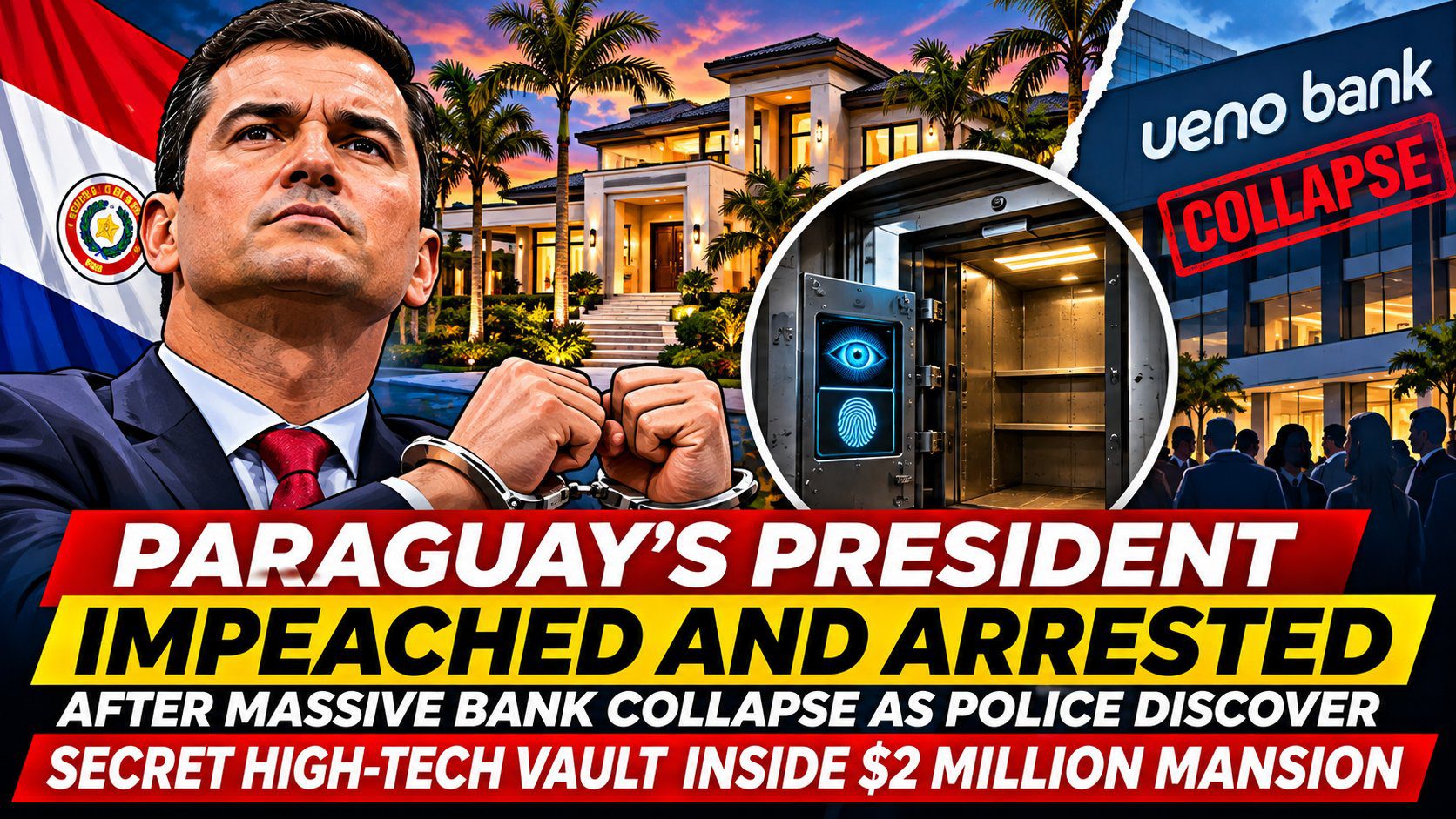
Police Discover a Secret Vault Inside Peña’s Luxury Mansion
The investigation took a dramatic turn on November 8 when Paraguayan prosecutors and police raided Peña’s luxury vacation residence in San Bernardino, a resort city east of Asunción. The property, reportedly valued at approximately $2 million, had already attracted investigators’ attention because of questions surrounding its financing and the former president’s relationship with Ueno. During the search, authorities discovered a concealed passage behind a false wall leading to a heavily fortified security chamber protected by two separate doors.
Investigators opened the first door but encountered a more sophisticated locking system on the second. According to Paraguayan newspaper ABC Color, the vault reportedly incorporated Israeli origin security technology requiring electronic access codes and biometric verification, including iris recognition. The manufacturer and precise technical specifications have not been independently established, and the reported origin of the equipment does not suggest involvement by the Israeli government or intelligence services.
The security system initially prevented investigators from entering the chamber, prompting discussions about using specialized equipment, obtaining assistance from people familiar with the property’s security arrangements, or potentially conducting a controlled explosive breach. Prosecutors ultimately gained access on November 10 without a publicly confirmed explosive operation, reportedly after Peña’s attorney helped authorities locate a physical access key. The discovery was anticlimactic: Investigators found no cash, valuables, or immediately useful evidence inside the room.
The empty vault nevertheless became one of the scandal’s most recognizable symbols, particularly after local reports described footage allegedly showing items being moved from the property before the search. Authorities have not established what those items contained, whether they originated inside the vault, or whether their removal involved any criminal activity. Peña’s defense has characterized the chamber as a panic room, and its existence alone does not establish wrongdoing. Investigators must determine whether the room or any previously stored contents have a demonstrable connection to the banking investigation.
Mansion Loans Raise Questions About Peña’s Personal Finances
The San Bernardino property has attracted additional scrutiny because of loans Peña reportedly obtained from Ueno while serving as president. According to ABC Color, the bank approved two loans totaling approximately 3.548 billion Paraguayan guaraníes in May 2024 to help finance construction of the residence, whose total reported cost reached approximately 7.7 billion guaraníes. The monthly repayment obligations were reportedly around 239 million guaraníes, roughly six times Peña’s official presidential salary of 37.9 million guaraníes.
That apparent disparity has prompted questions about the former president’s income, assets, collateral, and whether the lender applied ordinary underwriting standards. A public official can legitimately possess investments, savings, family wealth, or other income beyond a government salary, so the difference between Peña’s reported earnings and loan payments does not independently establish financial misconduct. Nevertheless, the financing arrangements warrant scrutiny because they involved a sitting president obtaining substantial credit from a bank connected to his previous business interests and regulated by an agency led by one of its former executives.
Prosecutors are examining financial documentation, loan agreements, and transactions involving Ueno and politically connected individuals to determine whether preferential treatment occurred. The investigation has also extended to additional business locations and financial records associated with the lender, with authorities seeking to reconstruct the movement of money and identify any violations of banking or public corruption laws.
Paraguay Begins Reimbursing Depositors as Financial Markets React
While investigators pursue the political and criminal dimensions of the scandal, the government’s immediate challenge is restoring access to money belonging to ordinary Paraguayans. Authorities activated the country’s deposit guarantee system and began reimbursing eligible customers, reporting that approximately $160 million had been distributed to nearly 1.2 million savers during the initial recovery effort. Smaller accounts have received priority under deposit protection rules, while larger deposits, institutional holdings, and public pension assets face more complicated recovery questions.
The banking collapse has also damaged confidence in Paraguay’s financial stability. The guaraní reportedly weakened by approximately 8% against the U.S. dollar during the initial crisis, while government bonds came under pressure as investors assessed the possible consequences for public finances and economic growth. On November 11, Fitch Ratings placed Paraguay’s BB+ sovereign credit rating on negative watch, citing concerns about political instability, banking-sector exposure, and the government’s ability to manage the fallout.
Fitch nevertheless indicated that it did not currently anticipate a broader systemic banking crisis because other major Paraguayan banks remained comparatively well capitalized and liquid. That distinction is important: Ueno’s collapse represents an enormous shock to its customers and the public institutions exposed to its losses, but it does not establish that Paraguay’s entire banking system is insolvent. Restoring confidence will require authorities to demonstrate that depositors are being protected, public money is being recovered wherever possible, and financial regulations can be enforced independently of political influence.
International Investigators Examine Potential Financial Connections Abroad
The investigation has also raised questions about whether money connected to Ueno’s financial operations moved through foreign accounts, overseas companies, or assets outside Paraguay. Authorities have reportedly sought international cooperation in tracing relevant transactions, although the precise scope of requests involving the United States, Argentina, and Luxembourg has not been independently confirmed.
Cross border financial investigations commonly involve requests for banking records, corporate ownership information, and transaction histories to establish whether funds were improperly transferred or concealed. The existence of overseas accounts or international business relationships does not itself establish money laundering or other criminal activity, and prosecutors must demonstrate the connection between particular transactions and alleged offenses.
For Paraguay, identifying the location and ownership of assets connected to the failed institution could prove essential to recovering money and determining whether its collapse resulted from reckless lending, fraudulent financial practices, regulatory negligence, political interference, or some combination of those factors.
A Presidential Downfall That Could Reshape Paraguay
Peña’s removal represents one of Paraguay’s most consequential political upheavals since the end of Alfredo Stroessner’s dictatorship in 1989. The country has experienced presidential impeachment before, including the removal of Fernando Lugo in 2012, but the combination of a major banking failure, frozen household savings, endangered public funds, criminal proceedings against a former president, and the discovery of a concealed vault has made the Ueno scandal especially extraordinary.
President Pedro Alliana now faces the difficult task of stabilizing the financial system while preserving the independence of investigations involving his predecessor and other politically connected figures. His administration must also confront broader questions about the relationship between Paraguay’s governing establishment and private financial institutions, particularly whether longstanding political connections weakened the safeguards designed to protect depositors and public resources.
For Peña, the reversal has been remarkable. A president who entered office promising economic modernization and greater prosperity has been removed from power and placed in pretrial detention while prosecutors examine financial arrangements involving one of the country’s most prominent banks. The hidden vault inside his luxury mansion has become the scandal’s most sensational detail, but the evidence investigators recover from banking records, public deposit agreements, and financial transactions may ultimately prove far more consequential.
The secret vault was reportedly empty when investigators finally opened it. But for nearly three million Ueno customers and a country struggling to recover from a financial disaster, the unanswered questions about political influence, public money, and regulatory accountability remain enormous. The real test of Paraguay’s institutions will not be whether prosecutors discover hidden cash behind a mansion wall. It will be whether they can establish what happened to the money, recover funds wherever legally possible, hold responsible individuals accountable through fair judicial proceedings, and rebuild the public trust that collapsed alongside Ueno Bank.

Sources & Further Reading
-
Reuters — How a Digital Bank’s Collapse Toppled Paraguay’s President
-
Reuters — Fitch Places Paraguay’s Credit Rating on Negative Watch
-
Reuters — Prosecutors Expand Investigation to Presidential Residence
-
Associated Press — Teachers Strike Over Pension Funds Following Bank Collapse
-
Associated Press — Peña’s Impeachment Proceedings and Political Crisis
-
ABC Color — Investigators Open Hidden Vault at Peña’s Mansion
-
ABC Color — Mansion Raid, Biometric Security, and Property Financing
-
Central Bank of Paraguay — Official Banking and Regulatory Information
-
South Florida Media — International News and Investigative Reporting
























Loading comments…