

PayPal’s Collapse of Consumer Trust: A $3,000 Payment, an Unfulfilled Written Commitment and a Corporate Culture Under Scrutiny
A longtime PayPal customer says the financial technology giant tied up thousands of dollars, failed to honor its own written payment clearance date and extended the delay without notification, costing seven travelers their vacation accommodations. The incident raises broader questions about corporate accountability, consumer protection and a company with a documented history of federal regulatory intervention.
For decades, PayPal positioned itself as a safer, faster and more convenient alternative to traditional banking. It built a global financial empire by convincing consumers that they could entrust the company with their money, conduct international business and complete transactions without the bureaucratic complications historically associated with financial institutions. Today, however, serious questions remain about whether the company is living up to the very principles upon which its reputation was built.
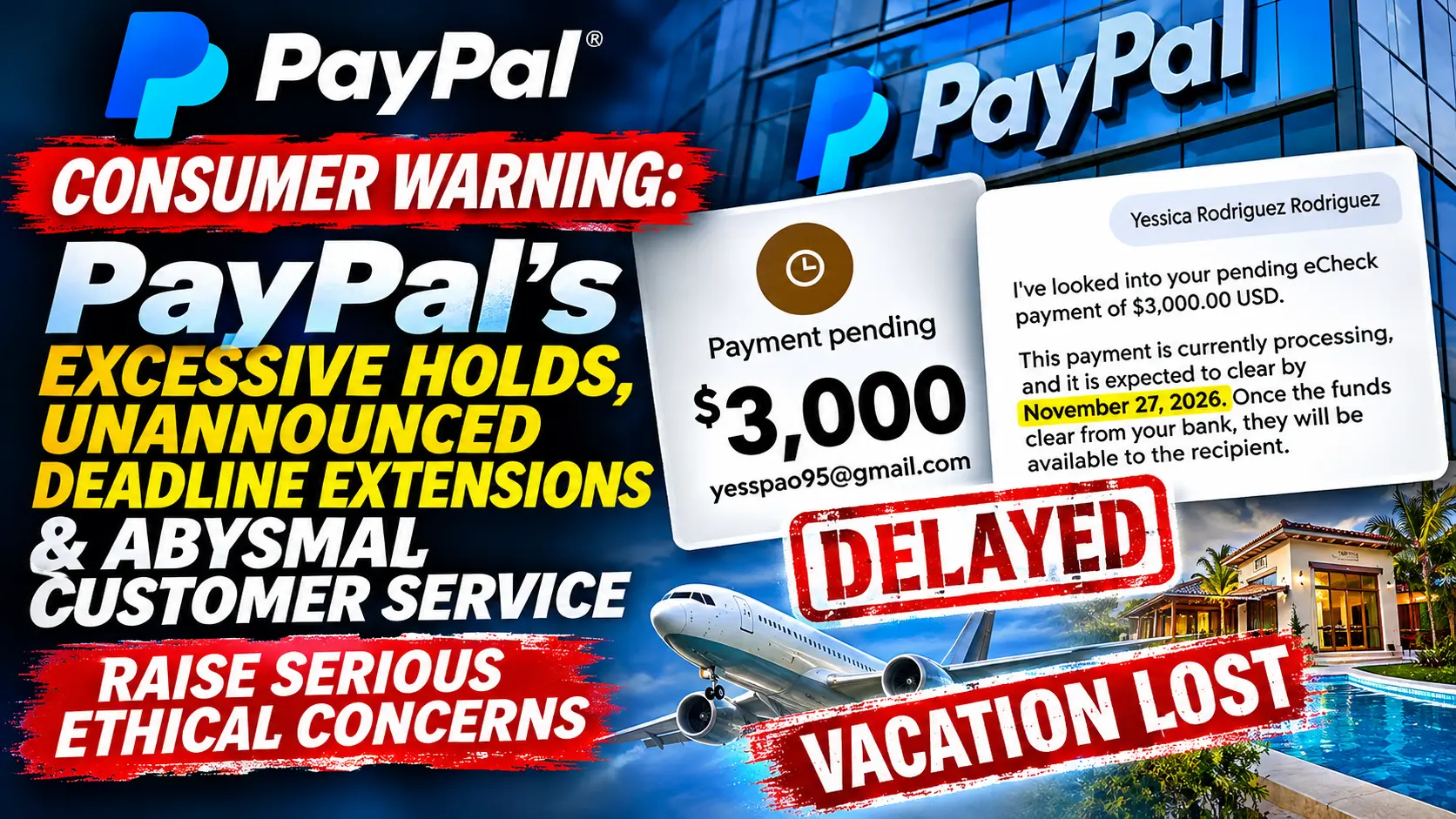
South Florida Media CEO Patrick Zarrelli, a PayPal customer of more than 10 years, recently experienced what he describes as a catastrophic breakdown in the company’s payment processing, communication and customer service operations. A $3,000 payment intended to secure an international birthday vacation rental was placed into pending status, given a specific anticipated clearance date in writing and subsequently delayed beyond the customer’s reservation deadline, according to his account.
The consequences were substantial. The property owner reportedly rented the residence to another party after agreeing to hold it based on PayPal’s written representation. Seven travelers had already purchased airline tickets, leaving the group without its original accommodations while the $3,000 transaction remained unresolved.
The experience is particularly troubling because PayPal did not merely delay a financial transaction. Its customer service system provided specific written information that a consumer relied upon to make consequential financial decisions. When that information reportedly changed, the company failed to communicate the change or provide an effective alternative. For a corporation whose entire business model depends on consumers trusting it with their money, that is a fundamental failure of its core product.
PayPal Put Its Payment Clearance Date in Writing
The transaction involved a $3,000 payment to a recipient who, according to Zarrelli, had successfully received nearly 50 previous payments from his PayPal account. The recipient was an established financial contact, not an unfamiliar account involved in a first-time transaction. A separate $100 payment sent to the same recipient at approximately the same time reportedly processed immediately, while the larger transaction was classified as an electronic check, or eCheck, and placed into pending status.
When Zarrelli contacted PayPal regarding the delay, the company’s customer service system responded with a specific written explanation and anticipated clearance date.
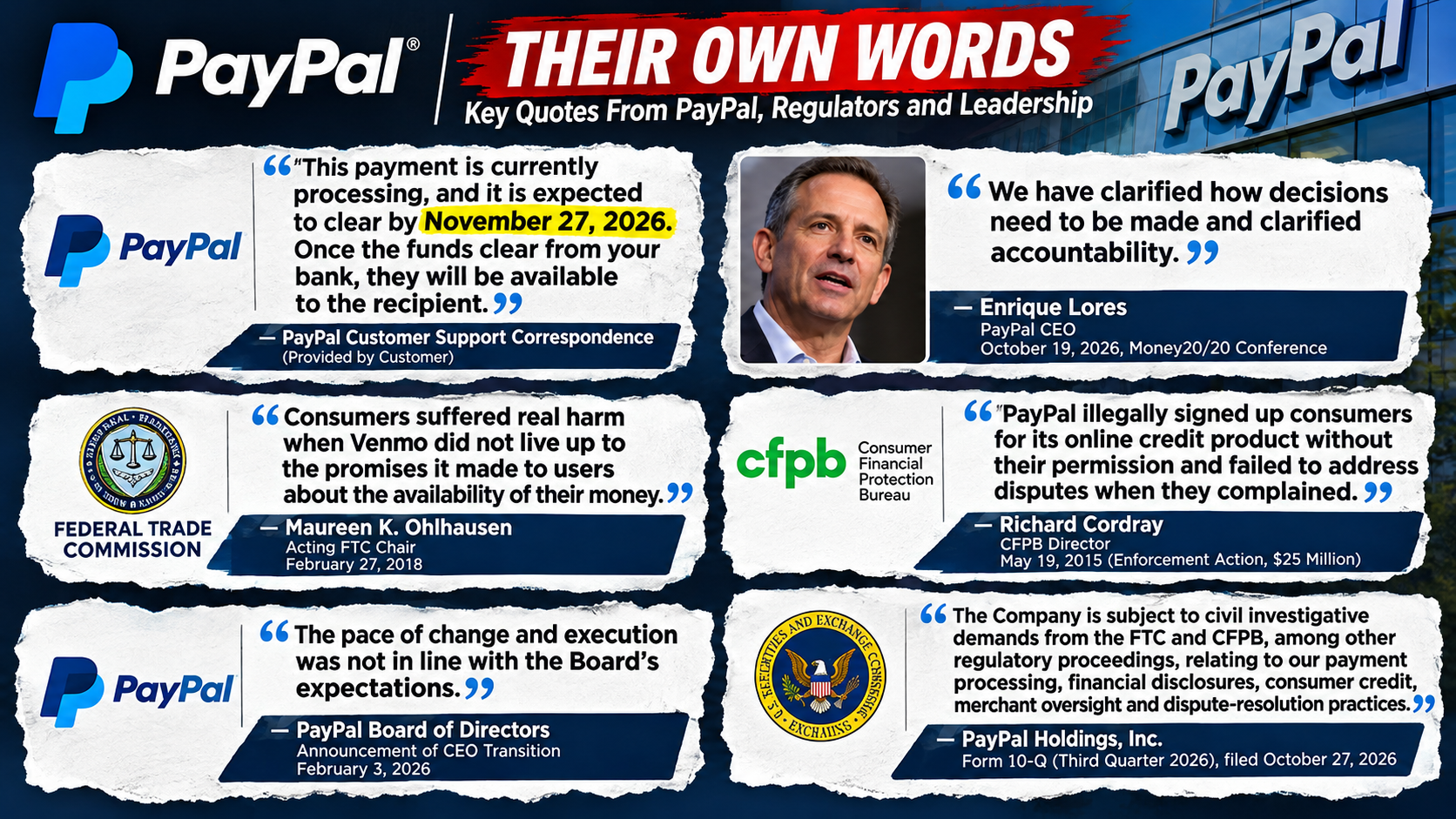
“This payment is currently processing, and it is expected to clear by November 27, 2026. Once the funds clear from your bank, they will be available to the recipient.” — PayPal customer support correspondence, documented in screenshots provided to South Florida Media.
The screenshots establish both the pending $3,000 transaction and PayPal’s written representation concerning its anticipated clearance date. According to Zarrelli, the funds had already been withdrawn from his bank account several days earlier, yet the recipient remained unable to access them.
The distinction between an estimated clearance date and a contractual guarantee is legally important, but it does not eliminate PayPal’s responsibility to communicate accurate financial information. Consumers routinely make contractual commitments, negotiate payment deadlines and organize business and personal arrangements based on representations made by financial service providers. When those representations change, customers deserve immediate notification, a meaningful explanation and a practical resolution.
Zarrelli says PayPal extended the anticipated processing period without sending an email, text message or other advance notification. The company had provided information in writing that he relied upon, but reportedly failed to alert him when that information was no longer reliable. That discrepancy is at the center of this controversy. Written financial representations should carry meaningful weight, particularly when they concern thousands of dollars belonging to a customer.
No Warning Before Sending Thousands of Dollars and No Notification When the Date Changed
One of the most concerning aspects of the incident is the alleged absence of meaningful disclosure before PayPal accepted the transaction. Zarrelli maintains that the company did not present a prominent warning explaining that his payment would be processed as an eCheck, potentially remain unavailable for several business days and be subject to significant cancellation restrictions. Had that information been presented before he authorized the transfer, he says he would have immediately selected another payment provider.
PayPal maintains published policies addressing eCheck processing, but making general information available in an online help center is fundamentally different from providing a clear, transaction-specific warning before accepting a customer’s money. A consumer should not discover that a supposedly convenient digital payment has significant processing restrictions only after authorizing the transaction.
PayPal has the technological infrastructure to distribute marketing emails, security alerts, promotional offers and transaction confirmations to millions of customers. The company should be equally capable of notifying customers when thousands of dollars are unavailable or when a previously communicated clearance date changes. Failing to deliver those notifications transfers the consequences of corporate processing decisions directly onto consumers, who may have no practical ability to reverse their transactions. The appropriate time to disclose a multi-day payment delay is before the customer presses send, not after the money has become inaccessible.
Seven Travelers Lose Their Vacation Accommodations
The $3,000 transaction was intended to secure a vacation rental in Cartagena, Colombia, for a birthday celebration involving seven travelers. According to Zarrelli, the property owner was already frustrated by the original processing delay but agreed to hold the residence until November 27 after being presented with PayPal’s written clearance estimate. When the money failed to become available by the property’s reservation deadline, the owner reportedly rented the residence to another party. Seven travelers had already purchased airline tickets, and considerable time had been invested in coordinating accommodations, organizing the celebration and arranging international travel.
The incident illustrates the disconnect between how financial technology corporations categorize payment delays and how those delays affect their customers. To PayPal, an unresolved eCheck may represent an ordinary processing issue. To a consumer, it can mean losing a vacation rental, missing a contractual deadline, failing to pay an employee or being unable to respond to a family emergency. The financial consequences of delayed transactions do not disappear simply because a corporation classifies those transactions as pending. Companies entrusted with moving other people’s money must account for the foreseeable damage that unreliable processing information can cause.
PayPal’s Cancellation Restrictions Leave Consumers Without Control of Their Money
When Zarrelli attempted to resolve the situation, he says PayPal’s system did not provide an available cancellation option, preventing him from reversing the transaction and sending the money through a competing provider. He had experienced a similar incident previously, but on that occasion was able to recover the funds and complete an alternative transfer through Remitly within seconds.
PayPal’s published eCheck procedures generally direct customers to contact their banks to attempt to stop pending electronic check payments. Once a payment has cleared, consumers may need to seek a refund from the recipient. That arrangement creates an additional administrative burden for customers who initiated their transactions through PayPal and reasonably expect the company to assist them when processing problems arise.
There are legitimate technical reasons why an electronic bank payment cannot always be immediately reversed. However, those limitations make upfront disclosure even more important. Customers should understand the restrictions before authorizing a transaction, rather than discovering them when an unexpected delay threatens their financial commitments. A payment processor that cannot deliver a customer’s money within its communicated timeframe should provide an effective escalation process and explain precisely what options are available. According to Zarrelli, PayPal failed to provide a satisfactory resolution on either front.
Artificial Intelligence Is Becoming a Barrier to Financial Accountability
The experience also highlights a growing problem across the financial services industry: corporations replacing effective human customer service with automated systems that can describe financial problems but cannot necessarily resolve them. Zarrelli describes PayPal’s automated customer service as frustrating, repetitive and incapable of addressing basic questions about the whereabouts and availability of his money. The company’s system was capable of identifying the pending transaction, explaining that it was classified as an eCheck and supplying a written clearance estimate. What it apparently could not provide was an effective resolution when that information became unreliable.
Artificial intelligence offers enormous potential for fraud detection, financial security and customer service. However, when deployed primarily to reduce labor costs and limit consumers’ access to employees with actual decision-making authority, automation risks becoming a corporate shield against accountability. Financial customer service must ultimately be evaluated by whether it resolves financial problems, not by how efficiently a chatbot can repeat information about them. That distinction is particularly relevant given PayPal’s corporate restructuring, which places significant emphasis on artificial intelligence, automation and operating cost reductions.
PayPal Discloses Multiple Federal Investigations in Its Own SEC Filings
The most significant evidence that concerns about PayPal’s consumer protection practices extend beyond one customer’s experience can be found in the company’s own corporate disclosures. In its third quarter 2026 Form 10-Q, filed with the Securities and Exchange Commission on October 27, PayPal disclosed multiple civil investigative demands from the Federal Trade Commission and the Consumer Financial Protection Bureau, alongside international regulatory proceedings examining aspects of its business practices.
The investigations concern payment processing, financial disclosures, consumer credit, merchant oversight, transaction dispute resolution and potential unfair or deceptive business practices. These are not allegations originating solely from dissatisfied customers or anonymous internet complaints. They are matters of regulatory scrutiny that PayPal itself has formally disclosed to federal securities regulators and shareholders.
Although civil investigative demands do not establish that a company has committed wrongdoing, their existence demonstrates that regulators are examining issues central to PayPal’s operations and its relationships with consumers. PayPal states that it is cooperating with the agencies involved.
September 2026: FTC Investigates Potentially Deceptive PayPal Financial Practices
In September 2026, approximately two months before Zarrelli’s payment dispute, PayPal received another civil investigative demand from the Federal Trade Commission. According to the company’s quarterly SEC filing, the investigation concerns whether PayPal engaged in deceptive, unfair or unlawful practices involving fees, purchase protection and the marketing or administration of financial products and services.
The investigation is particularly important because it addresses the reliability of the financial protections and representations associated with PayPal’s products. Consumers using a payment platform frequently rely on the company’s representations concerning transaction security, financial protection and their ability to obtain assistance when something goes wrong.
PayPal’s September disclosure does not establish that the FTC is investigating Zarrelli’s particular transaction or eCheck delays specifically. Nevertheless, the existence of this investigation provides significant context for consumer concerns about the company’s business practices and the accuracy of its financial representations.
Federal Regulators Are Examining PayPal’s Financial Error Resolution Procedures
PayPal’s October SEC filing also disclosed civil investigative demands from the Consumer Financial Protection Bureau involving its obligations under Regulation E, including financial error investigations, dispute resolution procedures and transactions submitted to customers’ linked bank accounts. Regulation E implements major provisions of the Electronic Fund Transfer Act and establishes consumer protections involving qualifying electronic financial transactions.
This area of regulatory scrutiny is especially relevant to customers who experience unexpected payment delays, disputed withdrawals or difficulties obtaining meaningful assistance from financial service providers. While Zarrelli’s particular payment has not been established as part of the CFPB’s investigation, the company’s disclosure confirms that federal regulators are examining its compliance with important consumer financial protection obligations.
In August 2024, PayPal also received a separate CFPB investigative demand concerning PayPal Credit and the use of backup funding methods associated with purchases made through digital wallets. Taken together, these disclosures raise legitimate questions about whether PayPal’s existing compliance systems, consumer disclosures and dispute-resolution procedures are adequate for a company operating at its enormous financial scale.
FTC Investigates PayPal’s Oversight of Potentially Deceptive Merchants
PayPal’s regulatory exposure extends beyond its direct dealings with individual consumers. In February 2022, the company received an FTC investigative demand concerning its practices involving commercial customers that process charges on behalf of other merchants and sellers. In August 2025, the FTC issued another investigative demand examining whether PayPal’s merchant onboarding, due diligence and related practices facilitated deceptive schemes or other unlawful merchant activities.
The investigation concerns the effectiveness of PayPal’s oversight of businesses operating through its payment infrastructure. Financial technology companies have considerable influence over which merchants gain access to their platforms, how transactions are monitored and what measures are implemented when suspicious commercial activity is identified.
These inquiries do not establish that PayPal knowingly facilitated unlawful activity. However, they underscore the importance of examining whether a company that imposes significant restrictions on ordinary consumers is exercising sufficient oversight over the commercial operations generating revenue through its network. A sophisticated risk management system should protect legitimate customers while effectively identifying potentially unlawful activity. Excessive restrictions on established consumers, combined with inadequate merchant oversight if ultimately established by regulators, would represent a serious failure of that balance.
PayPal’s $25 Million Federal Consumer Credit Enforcement Action
Concerns about PayPal’s financial disclosures are not new. In May 2015, the Consumer Financial Protection Bureau announced an enforcement action against PayPal involving its online financing product, PayPal Credit, formerly known as Bill Me Later. Federal regulators alleged that PayPal enrolled consumers in credit products without proper authorization, advertised promotional benefits it subsequently failed to honor, redirected transactions to credit products instead of customers’ preferred payment methods and mishandled billing disputes. The enforcement action called for $15 million in consumer restitution and a $10 million civil penalty, totaling $25 million. Then CFPB Director Richard Cordray publicly addressed the company’s conduct.
“PayPal illegally signed up consumers for its online credit product without their permission and failed to address disputes when they complained.” — Richard Cordray, CFPB director, May 19, 2015.
The enforcement action is particularly relevant because it involved allegations of unreliable financial representations, inadequate consumer disclosures and ineffective dispute resolution. More than a decade later, similar categories of concern continue to appear in PayPal’s regulatory disclosures, although the current investigations involve separate matters and have not necessarily reached conclusions. The question for consumers is whether the company has fundamentally improved its approach to transparency and accountability since that enforcement action, or whether some of the same institutional weaknesses continue to appear in different products and services.
Venmo’s Frozen Funds Scandal: Federal Regulators Previously Addressed the Availability of Customer Money
Perhaps the most striking historical parallel to Zarrelli’s experience involves Venmo, the peer to peer payment service owned by PayPal. In 2018, the Federal Trade Commission finalized a settlement with PayPal over allegations that Venmo misrepresented the availability of consumer funds and failed to adequately disclose that transactions remained subject to review, freezing or reversal even after users were notified that money had reached their accounts.
According to the FTC, consumers relied on these notifications when conducting financial transactions, only to discover that their money was subsequently unavailable. Some customers reported being unable to pay rent or other bills, while others suffered losses after delivering valuable merchandise in reliance on Venmo’s payment notifications. Acting FTC Chair Maureen K. Ohlhausen summarized the financial consequences for consumers.
“Consumers suffered real harm when Venmo did not live up to the promises it made to users about the availability of their money.” — Maureen K. Ohlhausen, acting FTC chair, February 27, 2018.
The resulting settlement restricted PayPal from misrepresenting important conditions and limitations associated with its payment services. The FTC also addressed allegations involving Venmo’s privacy disclosures and information security practices.
The similarities to Zarrelli’s experience are significant, even though the transactions involved different payment products and processing arrangements. In both circumstances, consumers relied on information supplied by a PayPal-owned financial service concerning the availability of money and reportedly experienced financial harm when that information proved unreliable. Federal regulators have already recognized that inaccurate representations about when customers can access their money can produce serious real world consequences. PayPal’s leadership should not require another generation of consumer complaints to understand that principle.
New York Regulators Fine PayPal $2 Million Over Cybersecurity Failures
Financial transparency is not the only area in which PayPal has faced regulatory intervention. In January 2025, the New York State Department of Financial Services announced a $2 million settlement with PayPal following an investigation into a cybersecurity incident involving sensitive customer information.
According to the department’s investigation, PayPal implemented changes to its tax reporting systems in 2022 that exposed unmasked personal information, including customers’ names, dates of birth and full Social Security numbers. Cybercriminals subsequently exploited compromised login credentials to access sensitive tax documents. Investigators determined that employees responsible for implementing the changes had not received adequate training in PayPal’s systems and software development procedures. The department concluded that the necessary internal safeguards had not been properly followed before the changes were deployed.
As part of the settlement, PayPal agreed to corrective measures involving employee training, internal policies and software monitoring. The enforcement action raises broader concerns about corporate oversight and operational discipline. Consumers entrust payment processors not only with their money, but also with sensitive banking credentials, tax information and personal identifying data. Failures in employee training and internal quality control can have consequences extending far beyond temporary transaction delays, and the 2025 settlement was another documented instance in which financial regulators intervened over shortcomings in PayPal’s operations.
PayPal Faces International Investigations Into Potentially Anticompetitive Practices
PayPal’s regulatory challenges are not confined to the United States. In May 2026, Britain’s Financial Conduct Authority publicly confirmed that it was investigating PayPal, Mastercard and Visa over suspected anticompetitive conduct connected to the funding and use of PayPal’s digital wallet. The investigations were initiated under Britain’s Competition Act 1998 and involve contractual arrangements affecting digital wallet transactions. The FCA emphasized that it had not reached a conclusion regarding whether competition laws had been violated.
PayPal has also disclosed an administrative proceeding initiated by Germany’s Federal Cartel Office in January 2023 concerning its contractual restrictions on German merchants, including provisions governing additional payment charges and how merchants present PayPal relative to competing payment methods.
These proceedings raise important questions about the influence large payment companies exert over the financial technology marketplace. Consumers and merchants benefit from meaningful competition, transparent pricing and the ability to select alternative payment methods. Contractual restrictions that potentially interfere with that competition warrant careful examination by regulators. PayPal says it is cooperating with both authorities, and the investigations should not be characterized as findings of anticompetitive misconduct unless regulators ultimately establish violations.
PayPal Credit: When Financial Companies Withdraw Credit but Leave Consumers With the Debt
Another area of concern involves PayPal Credit and the consequences consumers experience when previously available credit lines are reduced or terminated while existing balances remain outstanding. Zarrelli criticizes the practice of aggressively expanding consumer credit availability and subsequently withdrawing that purchasing power, leaving borrowers responsible for accumulated debt without the financial flexibility they previously possessed.
PayPal Credit is issued in the United States by Synchrony Bank, which is an important distinction when determining responsibility for individual credit decisions. Financial institutions generally possess contractual authority to reduce credit limits or close accounts under certain circumstances. However, these decisions can increase consumers’ credit utilization ratios, potentially damage credit scores and create additional financial pressure.
The ethical question is whether financial institutions that encourage consumers to incorporate their credit products into their financial lives subsequently exercise their power to withdraw those products responsibly. Consumers remain obligated to repay outstanding balances regardless of whether their access to additional credit is terminated, creating a significant imbalance between the rights of lenders and the financial expectations of borrowers.
Although the allegation that PayPal Credit has recently terminated credit lines belonging to millions of customers has not been independently verified, the CFPB’s August 2024 investigative demand confirms that PayPal’s credit operations have again attracted federal regulatory scrutiny following the company’s $25 million enforcement action in 2015.
PayPal’s Leadership Shake Up Reveals Deeper Corporate Problems
PayPal’s corporate leadership has undergone significant changes in 2026 as the company struggles to improve execution, strengthen its competitive position and reverse years of disappointing shareholder performance. On February 3, 2026, PayPal announced that former HP chief executive Enrique Lores would replace Alex Chriss as president and CEO, effective March 1. Lores had already served on PayPal’s board for nearly five years and had been its chairman since July 2024, making him an established participant in the company’s corporate governance rather than an entirely independent outsider brought in to address its problems. In announcing the leadership transition, PayPal’s board acknowledged that the company’s progress had failed to meet expectations.
“The pace of change and execution was not in line with the Board’s expectations.” — PayPal Holdings, February 3, 2026.
David W. Dorman was appointed independent board chairman as part of the leadership transition. The appointments followed a corporate evaluation of PayPal’s competitive position and operational performance, reflecting concern within the company’s own leadership about its ability to compete effectively in a rapidly changing financial technology marketplace.
The significance of Lores’ appointment extends beyond ordinary executive turnover. Having previously served as board chairman, he now bears executive responsibility for addressing operational weaknesses that developed during a period in which he already held a senior corporate governance position. That does not establish personal misconduct by Lores. It does, however, make questions about his oversight, strategic priorities and commitment to consumer protection entirely appropriate.
PayPal’s CEO Publicly Acknowledged Problems With Corporate Accountability
In October 2026, speaking at the Money20/20 financial technology conference in Las Vegas, Lores discussed structural problems within PayPal that had contributed to slow decision-making and inadequate execution. According to reporting by Payments Dive, the CEO acknowledged that the company needed fewer management layers, faster decision-making and clearer accountability. Lores also acknowledged that important PayPal businesses, including Venmo and Braintree, had not received sufficient investment or attention under the company’s previous organizational structure.
“We have clarified how decisions need to be made and clarified accountability.” — Enrique Lores, PayPal CEO, October 19, 2026.
Those remarks are particularly relevant to customers encountering unresolved financial problems. If PayPal’s own chief executive recognizes that excessive management layers and unclear accountability have impeded corporate performance, it is reasonable to question whether those same institutional weaknesses have affected customer service, financial dispute resolution and payment processing. The CEO’s public acknowledgment of these shortcomings reinforces the argument that PayPal’s operational problems cannot simply be dismissed as dissatisfaction among individual consumers.
PayPal Expands Artificial Intelligence While Cutting Costs and Restructuring Operations
On November 20, 2026, just one week before Zarrelli’s payment dispute reached its critical deadline, PayPal announced another major executive restructuring designed to advance its three-year corporate strategy. The company announced the appointment of Claire Bramley as its incoming chief financial officer, Kartik Mani to oversee consumer financial services and Venmo, and Suzan Kereere to lead payment services and cryptocurrency operations. PayPal also announced that Juan Rio would join the company on November 30 to oversee artificial intelligence transformation, cost reduction and operational effectiveness.
Perhaps equally significant was the announced departure of Chief Risk Officer Aaron Webster. Ratinder Bedi was selected to lead the risk organization temporarily while PayPal searches for a permanent successor. The company also appointed Brian J. Lee, a former Goldman Sachs chief risk officer, to its board of directors.
According to Reuters, PayPal’s restructuring strategy includes a target of at least $1.5 billion in annualized gross cost savings over approximately two to three years. Artificial intelligence and automation are expected to contribute roughly 40% of those savings. The strategy raises a fundamental ethical question: Will PayPal use artificial intelligence to improve the consumer experience, or primarily to reduce the cost of providing customer service?
For customers dealing with missing payments, inaccessible funds and unreliable processing information, the difference is substantial. Artificial intelligence can improve financial services when it gives consumers faster access to accurate information and meaningful solutions. It becomes problematic when it replaces accountable employees with automated systems incapable of resolving consequential financial disputes. PayPal’s leadership should demonstrate that its cost-cutting ambitions will not come at the expense of effective consumer protection.
PayPal’s Former Executives Faced Securities Litigation Over Allegedly Misleading Investors
PayPal’s history of legal scrutiny also includes allegations concerning the accuracy of information provided to its own shareholders. In October 2022, a proposed securities class action was filed against PayPal and several former executives. The litigation, subsequently consolidated as In re PayPal Holdings, Inc. Securities Litigation, concerned allegations that the company made misleading public statements about growth in active customer accounts and failed to adequately disclose problems involving accounts created illegitimately through promotional incentive programs. The plaintiffs alleged that these representations artificially inflated PayPal’s stock price and sought damages on behalf of affected investors.
The procedural history is essential to understanding the case fairly. In January 2025, the court dismissed the claims without prejudice. Following an amended complaint, the court dismissed the claims with prejudice on March 31, 2026. The plaintiffs filed an appeal with the U.S. Court of Appeals for the Third Circuit on April 30, according to PayPal’s latest quarterly filing.
The allegations therefore should not be presented as established misconduct. The defendants prevailed at the district court level, and the plaintiffs subsequently appealed that decision. Nevertheless, the litigation represents another documented example of disputes surrounding the accuracy of PayPal’s corporate representations, this time involving shareholders rather than payment customers.
Is PayPal Experiencing Financial Pressure, and Does It Benefit From Holding Customer Funds?
Zarrelli questions whether competitive pressure, outdated financial infrastructure, excessive risk management or financial incentives could contribute to PayPal’s handling of delayed transactions. He also questions whether the company financially benefits from retaining access to customer related funds for extended periods.
PayPal’s latest financial disclosures provide important context for those concerns. In its third quarter 2026 earnings report, released October 27, the company reported approximately $8.6 billion in quarterly revenue, $1.07 billion in net income, $15.1 billion in cash, cash equivalents and investments, and $13.5 billion in debt. Those results do not establish that PayPal is experiencing a solvency crisis. However, they do reveal financial and operational pressures beneath its enormous revenue figures. Compared with the same quarter in 2025, operating income declined approximately 8%, net income declined 14%, operating cash flow declined 19% and free cash flow fell 17%.
Importantly, PayPal’s financial statements also separately identify the contribution of interest earned on customer balances. During the third quarter of 2026, the company reported approximately $3.95 billion in transaction margin dollars, compared with approximately $3.66 billion when excluding interest on customer balances. The difference amounts to approximately $289 million. That establishes a legitimate economic interest in customer balances as part of PayPal’s broader business model. It does not, however, establish that PayPal earned interest on Zarrelli’s pending transaction or that the company deliberately extends eCheck processing periods to generate additional revenue. Customer balances and pending bank-funded transfers are not necessarily treated identically.
Determining whether any financial institution benefited from the delayed $3,000 payment would require additional transaction records and an explanation of where the funds were located throughout the processing period. What consumers deserve is sufficient transparency to understand that distinction, rather than being left to speculate about the financial incentives of the corporation controlling their transactions.
Billions for Shareholders While Customers Struggle to Recover Their Money
While PayPal continues to face operational challenges and regulatory investigations, the company has maintained substantial financial commitments to its shareholders. During the third quarter of 2026, PayPal spent approximately $1.5 billion repurchasing its own shares, bringing total share repurchases over the preceding 12 months to approximately $6 billion. The company also announced a quarterly dividend of 14 cents per share, scheduled for December 24. Meanwhile, PayPal reported that quarterly spending on customer support and operations declined from $447 million in the third quarter of 2025 to $434 million in the corresponding quarter of 2026.
Share repurchases and dividends are ordinary corporate financial activities and do not independently establish unethical conduct. Similarly, reduced customer service expenditures could theoretically reflect improved efficiency rather than deteriorating service quality. However, the juxtaposition raises legitimate questions about corporate priorities. A corporation capable of returning billions of dollars to shareholders should also possess the operational resources necessary to provide reliable payment processing, accurate written communications and responsive financial dispute resolution.
Consumers should not be expected to accept ineffective customer service as an unavoidable consequence of corporate restructuring while shareholders continue receiving billions of dollars in capital returns.
PayPal Has Lost Hundreds of Billions of Dollars in Market Value Since Its Peak
PayPal’s competitive challenges are reflected in its dramatic decline in market capitalization since the pandemic-era technology boom. According to November 2026 reporting by Reuters, PayPal’s market valuation had fallen to approximately $47 billion, compared with roughly $360 billion at its 2021 peak. That represents a decline of approximately 87%, or more than $300 billion in market value.
The decline is not exclusively attributable to consumer dissatisfaction or payment processing problems. Changing economic conditions, investor expectations, competition, growth forecasts and corporate strategy have all influenced the company’s valuation. Nevertheless, the figures illustrate the extraordinary competitive pressure facing an organization that once dominated the digital payments conversation.
PayPal must now compete against smartphone integrated payment services, international money transfer specialists, digital banks and financial technology platforms capable of delivering services once considered PayPal’s exclusive competitive advantage. For established customers who discover that competing providers can complete certain transactions substantially faster, continued loyalty to PayPal becomes increasingly difficult to justify.
Could PayPal’s Payment Delays Violate Federal Consumer Protection Laws?
The circumstances surrounding Zarrelli’s transaction also raise questions about the application of federal consumer financial protection laws, particularly the Electronic Fund Transfer Act and Regulation E. Qualifying international remittance transfers are subject to disclosure requirements, cancellation protections and error-resolution procedures. Under applicable regulations, failure to deliver funds by the disclosed availability date can constitute a remittance transfer error, subject to certain exceptions.
Consumers generally have 180 days from the applicable disclosed availability date to report qualifying remittance transfer errors. Financial service providers generally have up to 90 days to investigate such complaints and must communicate their findings to the customer.
PayPal’s own user agreement also addresses certain processing errors and circumstances in which the company may be responsible for losses directly resulting from its failure to complete transactions correctly or on time. The agreement contains limitations and exceptions, however, and not every payment delay qualifies for compensation. Whether these protections apply to Zarrelli’s particular transaction depends on the payment method, the regulatory classification of the transfer, the original transaction disclosures and the circumstances surrounding the delay. A customer service chatbot’s anticipated clearance date is not necessarily equivalent to the legally required availability date disclosed on a qualifying remittance transfer receipt.
The incident nevertheless raises questions that warrant investigation. Financial regulators should examine whether consumers receive sufficient warnings before authorizing potentially delayed transactions, whether changing delivery estimates are adequately communicated and whether available cancellation and dispute-resolution procedures provide meaningful protection.
PayPal’s Outdated Payment Experience Is Driving Customers Toward Competitors
PayPal originally became successful because it addressed problems traditional financial institutions had failed to solve. It simplified online transactions, accelerated digital commerce and gave consumers greater confidence in sending and receiving money electronically. Today, competing financial technology platforms are addressing many of the same shortcomings that increasingly frustrate PayPal customers.
International transfer providers such as Remitly and Wise offer alternative payment methods and delivery estimates, with certain eligible transactions capable of processing almost immediately. Zarrelli says he has personally experienced that difference. During a previous PayPal payment delay, he was able to recover his money and complete an alternative transfer through Remitly within seconds.
Although delivery speeds depend on numerous factors, including funding methods, banking hours, recipient institutions and regulatory requirements, the competitive implications are clear. Consumers no longer have to accept prolonged processing periods from a familiar payment provider simply because that company was an early pioneer of digital financial services.
PayPal’s own documentation acknowledges that eChecks ordinarily require four to seven business days to clear and sometimes take longer. For consumers using a digital payment platform precisely because they need to move money quickly, discovering those restrictions after initiating a transaction can fundamentally undermine the value of the service. The company must compete not only on transaction security but also on speed, predictable delivery, customer control and the reliability of its financial representations.
Enrique Lores and PayPal’s Board Must Answer for the Consumer Experience
PayPal’s current executive leadership should address why established customers can reportedly authorize substantial payments without receiving sufficiently prominent warnings that their transactions may become inaccessible for multiple business days. The company should also explain why customers may receive specific written clearance estimates that subsequently change without direct notification, and why its automated customer service systems cannot consistently provide meaningful resolutions.
CEO Enrique Lores and the company’s board should clarify which financial institutions control pending funds, whether PayPal benefits financially from extended processing periods and what oversight exists to prevent inaccurate payment representations. The company should also explain how it measures the financial consequences experienced by customers who rely on its written communications.
PayPal’s leadership must demonstrate that its restructuring, workforce changes and artificial intelligence investments will strengthen consumer protections rather than weaken them. Given the company’s history of regulatory actions and its disclosed federal and international investigations, corporate assurances about accountability deserve to be accompanied by measurable operational improvements.
The company has substantial financial resources, technological capabilities and institutional experience with which to address these problems. The question is whether consumer protection receives the same organizational priority as profitability, shareholder returns and operating cost reductions. PayPal’s specific explanation for Zarrelli’s transaction has not been obtained, and the company’s written customer support correspondence remains the primary documented representation concerning the individual payment.
A Warning to South Florida Consumers and International Businesses
For South Florida residents, entrepreneurs and families conducting financial transactions throughout Latin America and the Caribbean, reliable international payment systems are particularly important. Whether securing vacation accommodations in Colombia, paying overseas employees, supporting family members or conducting international business, consumers must be able to make financial decisions based on accurate processing information.
Zarrelli’s experience demonstrates why customers should not automatically assume that a PayPal transaction will process immediately simply because similar payments to the same recipient have previously been successful. Consumers sending substantial or time-sensitive payments should verify the funding method, expected delivery timeframe, cancellation restrictions and available dispute-resolution procedures before authorizing the transaction.
Customers should retain screenshots of payment confirmations, transaction identification numbers, written delivery estimates, bank withdrawals and all communications concerning processing delays. Those records may become important when pursuing refunds, filing regulatory complaints or documenting financial damages. Consumers experiencing unresolved disputes can submit complaints to the Consumer Financial Protection Bureau and relevant state financial regulators, including the Florida Office of Financial Regulation where applicable.
For payments involving strict commercial or personal deadlines, customers should carefully consider whether PayPal’s processing restrictions and cancellation procedures are compatible with their financial obligations.
The Real Collapse at PayPal Is a Collapse of Trust
PayPal’s greatest asset has never been its software, corporate headquarters, stock market valuation or executive leadership. Its greatest asset has been the confidence consumers place in the company every time they authorize a financial transaction. That confidence depends on the reasonable expectation that PayPal will handle customers’ money responsibly, communicate accurately and provide effective assistance when something goes wrong. In Zarrelli’s case, more than a decade of customer loyalty was undermined by a single $3,000 transaction, an unreliable written clearance estimate and an alleged failure to communicate a subsequent delay.
The written correspondence remains the central issue. PayPal gave a customer a specific date upon which he relied when making financial arrangements. According to his account, the company subsequently changed its processing timeframe without warning, while restricting his ability to reverse the transaction and seek an alternative solution.
The incident is particularly concerning when viewed alongside PayPal’s documented regulatory history. Federal authorities have previously intervened over unwanted credit products, misleading financial disclosures and representations concerning the availability of consumer funds. State authorities have imposed penalties over cybersecurity failures, and the company’s regulatory disclosures describe inquiries into consumer financial services, error-resolution obligations, merchant oversight and potentially deceptive business practices.
None of those investigations independently proves that PayPal intentionally misled Zarrelli. They do, however, establish that concerns about the company’s financial transparency and consumer protection practices deserve serious scrutiny rather than dismissal as isolated customer dissatisfaction.
PayPal cannot restore confidence through executive reorganizations, artificial intelligence initiatives, corporate press releases or shareholder distributions alone. It must restore confidence by providing accurate information, delivering reliable financial services and accepting responsibility when its representations produce foreseeable harm. When a financial technology company puts a payment clearance date in writing, consumers should be able to rely upon it or receive an immediate and meaningful explanation when circumstances change. Otherwise, written financial communications become little more than corporate disclaimers disguised as customer service.
In the financial services industry, trust is not an optional feature, a marketing slogan or a public relations strategy. Trust is the product itself. When a payment processor loses that trust, it begins to lose the very foundation upon which its business was built.
Sources & Further Reading

Primary Evidence and Corporate Financial Disclosures
-
Original PayPal transaction screenshot documenting the pending $3,000 payment, provided by Patrick Zarrelli.
-
Original PayPal customer service correspondence identifying November 27, 2026, as the anticipated payment clearance date.
-
PayPal Investor Relations — Quarterly Financial Results and Earnings Reports
Federal and International Regulatory Investigations
-
Federal Trade Commission — Final Approval of PayPal and Venmo Settlement
-
New York State Department of Financial Services — Regulatory Enforcement and Consumer Protection
-
United Kingdom Financial Conduct Authority — Competition Enforcement and Investigations
Corporate Leadership and Competitive Performance
-
PayPal — Appointment of Enrique Lores as CEO and David W. Dorman as Independent Board Chairman
-
Reuters — Corporate Finance and Financial Technology Reporting
-
Payments Dive — Payment Industry and Corporate Leadership Reporting
PayPal Policies and Consumer Financial Rights
-
PayPal — United States User Agreement and Financial Error Resolution Policies
-
Consumer Financial Protection Bureau — International Money Transfer Error Resolution Rights
-
Consumer Financial Protection Bureau — Regulation E and Electronic Fund Transfer Protections
-
Consumer Financial Protection Bureau — File a Consumer Complaint
Additional Media Coverage















Loading comments…