

FCC Approves Elon Musk’s Million Satellite Starmind Constellation, Raising Monopoly Fears and Alarming Scientists Over Space Pollution
Federal Regulators Open the Door to an Unprecedented Expansion of Musk’s Corporate Empire Into Space Based Artificial Intelligence.
WASHINGTON, D.C. — The Federal Communications Commission has authorized Elon Musk’s SpaceX to develop an orbital data center constellation of up to one million satellites, opening the door to an unprecedented industrial expansion into Earth’s orbital environment and raising serious questions about corporate concentration, regulatory accountability, environmental protection and the future of artificial intelligence infrastructure.
The authorization, issued on November 25, 2026, covers SpaceX’s proposed Starmind system, a massive network of solar powered satellites designed to process artificial intelligence workloads in space. The project represents a dramatic expansion of Musk’s ambitions beyond satellite internet, commercial spaceflight, social media and terrestrial artificial intelligence, creating another opportunity for one of America’s most powerful technology executives to establish a dominant position in an emerging industry.
The decision comes amid broader concerns about the concentration of critical technological infrastructure under a handful of powerful corporations. The central question is not simply whether America can build orbital data centers, but whether the country should allow a single corporation to establish such an enormous presence in a shared orbital environment before comprehensive environmental protections and competitive safeguards are in place.
What the FCC Approved: One Million SpaceX Satellites
The FCC’s Space Bureau issued its authorization under order DA 26-1273, granting SpaceX conditional permission to deploy its SpaceX Orbital Data Center System, known as Starmind. The constellation is designed to use solar energy to power orbital computing infrastructure, with laser-based communications allowing satellites to exchange information and radio-frequency systems supporting backup communications, satellite tracking and emergency commands.
The authorization covers orbital altitudes ranging from 500 to 1,002 kilometers, a reduction from SpaceX’s original proposal, which sought permission to operate satellites at altitudes reaching 2,000 kilometers. Although the authorization does not guarantee that SpaceX will ultimately deploy all one million satellites, it establishes an extraordinary regulatory ceiling. According to reporting by Ars Technica, a fully deployed Starmind constellation could increase the number of satellites orbiting Earth by approximately 50 times compared with current levels.
Under the FCC’s deployment schedule, SpaceX must have at least one operational satellite in its assigned orbit by November 2033, followed by 100,000 satellites by November 2035, 500,000 by November 2038 and the full one-million-satellite constellation by November 2040 to retain its entire authorization. The schedule effectively gives SpaceX a 14 year regulatory runway to develop the technology, expand manufacturing capabilities and establish the launch infrastructure necessary to pursue one of the most ambitious commercial space projects ever authorized.
Elon Musk’s Expanding Control Over Critical American Infrastructure
The Starmind authorization raises significant competition concerns because SpaceX is not an ordinary startup attempting to enter an emerging technology market. The company already possesses substantial advantages in commercial rocket launches, reusable spacecraft technology and satellite broadband communications through Starlink. Musk’s broader business interests also extend into artificial intelligence, social media, electric vehicles, energy storage and other strategically important industries, creating opportunities to integrate technologies that could become increasingly essential to businesses, governments and consumers.
Under such a model, SpaceX could manufacture satellites, launch them aboard its own rockets, connect them through proprietary communications infrastructure and sell computing capacity to artificial intelligence developers. That combination could provide substantial cost advantages over competitors that must independently acquire launch services, communications infrastructure and orbital computing technology.
While vertical integration can produce legitimate efficiencies and accelerate technological innovation, it can also create formidable barriers to entry, particularly when competitors depend on infrastructure controlled by the same company they are attempting to compete against. The FCC’s authorization does not legally establish a monopoly or prohibit competitors from developing orbital data centers. Nevertheless, the scale of the authorization raises questions about whether meaningful competition will be possible if SpaceX establishes an overwhelming early presence in the emerging orbital computing industry.
Rather than waiting until another strategically important technology market becomes highly concentrated, federal regulators have an opportunity to examine the competitive implications of orbital computing before the industry reaches commercial maturity.
Trump Appointed FCC Chairman Brendan Carr Celebrates the Decision
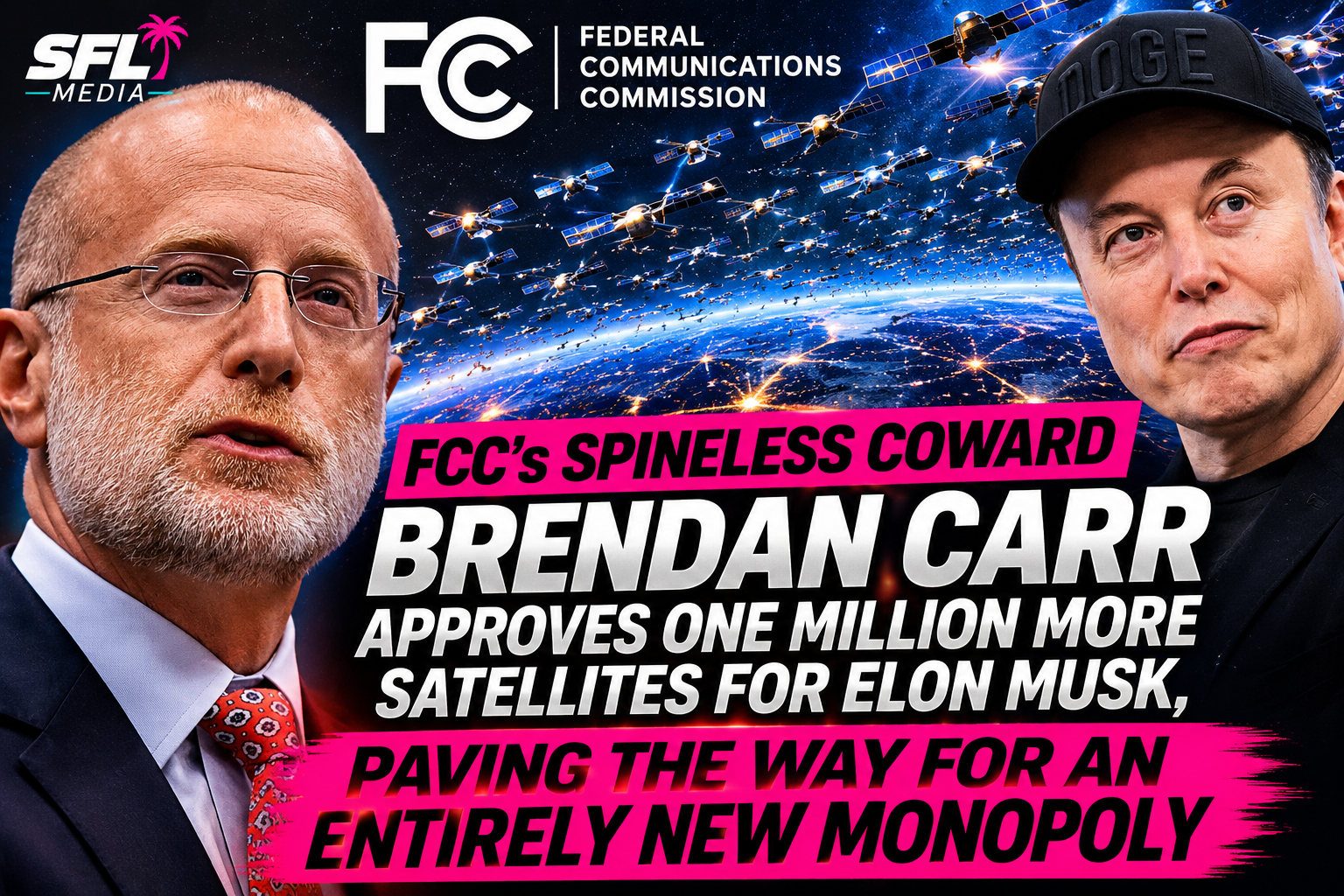
FCC Chairman Brendan Carr, appointed to lead the commission by President Donald Trump, celebrated the authorization as a significant advancement in America’s artificial intelligence capabilities, framing the decision as an opportunity to strengthen American technological leadership.
“This action opens a bold new frontier for the computing infrastructure needed to power America’s leadership and growth.”
— FCC Chairman Brendan Carr
Musk publicly welcomed the decision, which represents a major regulatory victory for SpaceX and its long-term artificial intelligence ambitions. Supporters argue that the United States must move aggressively to maintain its technological advantage in the global AI race, particularly as international competitors invest heavily in computing infrastructure, semiconductor manufacturing and commercial space technology.
However, technological competition does not eliminate the government’s responsibility to examine environmental consequences, market concentration and potential conflicts of interest. Musk’s previous involvement in the Trump administration and his extensive federal contracting relationships make transparency surrounding major regulatory decisions especially important. Those relationships warrant public scrutiny, although they do not independently establish corruption, improper influence or unlawful favoritism in the Starmind authorization.
The FCC Declines Comprehensive Environmental Review
Among the most controversial aspects of the authorization is the FCC’s treatment of environmental objections raised by scientists, industry organizations and members of the public. According to reporting by Ars Technica, the commission received approximately 1,500 public comments concerning SpaceX’s application, with critics raising concerns about rocket emissions, atmospheric contamination, satellite collisions, orbital debris and interference with astronomical research.
Rather than conducting a comprehensive environmental assessment of the proposed constellation, the FCC determined that several of those concerns fell outside its regulatory jurisdiction. The commission also relied on its interpretation of environmental review obligations under the National Environmental Policy Act, limiting the scope of its examination of activities conducted in outer space.
That distinction is consequential because, although satellites operate beyond Earth’s surface, their manufacture, launch, atmospheric reentry and eventual disposal can have environmental consequences on Earth. The absence of a comprehensive environmental assessment should not be confused with scientific evidence that the project presents no significant environmental risk. The decision exposes a potentially serious regulatory gap at a time when private companies are proposing space infrastructure projects on a scale that existing environmental laws were never designed to address.
American Astronomers Warn of Extensive Night Sky Pollution
The American Astronomical Society, one of the country’s leading professional organizations representing astronomical researchers, issued a sharply critical response to the FCC’s decision. The organization described itself as “disheartened and dismayed” by the authorization, warning that the proposed constellation could undermine astronomical research and the public’s ability to observe the natural night sky.
Unlike conventional communications satellites, orbital data centers could require substantial solar collection and thermal management infrastructure. Astronomers warn that these larger spacecraft could reflect more sunlight, remain visible for longer periods and interfere with sensitive scientific instruments. The concerns extend beyond visible light pollution, as radio emissions could disrupt observations conducted by radio telescopes, while heat radiated by orbital computing equipment could interfere with infrared astronomy.
These consequences could affect research facilities supported by billions of dollars in public investment, potentially diminishing the effectiveness of instruments used to study distant galaxies, planetary systems, asteroids and other astronomical phenomena. The American Astronomical Society has previously worked with SpaceX to reduce the brightness of Starlink satellites, acknowledging that the company implemented design modifications that partially addressed earlier concerns. However, the organization argues that Starmind’s proposed scale creates a fundamentally different challenge.
The night sky is not a privately owned commercial asset but a shared natural, cultural and scientific resource. Decisions that fundamentally alter its appearance carry consequences extending well beyond the financial interests of any individual satellite operator, particularly when those decisions could affect generations of scientific research and humanity’s ability to observe the universe.
One Million Satellites and the Growing Threat of Orbital Debris
Space debris is already a significant concern for commercial satellite operators, government agencies and international space programs. Defunct spacecraft, discarded rocket components and fragments from previous collisions travel through orbital environments at velocities capable of severely damaging operational satellites. Introducing hundreds of thousands of additional spacecraft would dramatically increase the number of objects that satellite operators must track and coordinate, creating substantial cumulative risks even if individual satellites maintain exceptionally low failure rates.
Scientists have long warned about a theoretical collision cascade known as Kessler syndrome, in which collisions generate fragments that increase the likelihood of additional collisions, potentially making certain orbital regions increasingly hazardous to spacecraft. A constellation of one million satellites would introduce an unprecedented level of operational complexity into an environment that is already becoming increasingly congested.
The FCC determined that SpaceX’s proposed debris mitigation procedures met applicable requirements in relevant operating regions. However, regulatory compliance does not eliminate collision risks, particularly when the proposed deployment is vastly larger than any satellite constellation previously operated. The commission also declined to immediately approve certain alternative disposal methods proposed for satellites operating above 600 kilometers, citing insufficient information and requiring additional regulatory clearance for those arrangements.
A severe orbital debris event could threaten infrastructure that has nothing to do with artificial intelligence, including weather monitoring, communications, scientific research and emergency response systems. For South Florida, where satellite-based forecasting is essential to hurricane monitoring and disaster preparedness, protecting the orbital environment is a matter of public safety as well as scientific preservation.
Atmospheric Pollution From Rocket Launches and Satellite Reentries
The environmental consequences of Starmind would not necessarily end when satellites are retired from service. Large satellite constellations require ongoing replacement as individual spacecraft fail, become technologically obsolete or reach the end of their operational lifespans. Satellites designed to burn up during atmospheric reentry can release metallic particles and chemical compounds into the upper atmosphere, prompting researchers to investigate the potential cumulative effects of these materials, including aluminum oxides, on atmospheric chemistry and ozone protection.
The magnitude of those effects remains an active area of scientific research, and the environmental consequences of maintaining a constellation of one million computing satellites have not been established through real-world operations. Rocket launches introduce additional concerns involving emissions, fuel consumption and the environmental impacts associated with manufacturing and operating launch infrastructure.
SpaceX argues that orbital data centers could reduce the environmental burden of terrestrial computing facilities by using solar energy and decreasing dependence on land, electricity grids and water-intensive cooling systems. Those potential benefits deserve examination, but they must be weighed against the environmental costs of producing, launching, maintaining and replacing an unprecedented number of spacecraft. Moving industrial infrastructure into orbit does not automatically eliminate pollution; it changes where that pollution occurs, how it is measured and which communities or ecosystems may ultimately bear its consequences.
Amazon and Viasat Push Back Against SpaceX’s Expansion
SpaceX’s application faced formal opposition from Amazon’s satellite communications business, Kuiper Systems, now associated with Amazon Leo, as well as satellite communications company Viasat and the American Astronomical Society. Amazon questioned whether SpaceX could realistically deploy the enormous constellation within its proposed schedule, while other objections addressed technical feasibility, orbital congestion and the adequacy of SpaceX’s proposed safeguards.
The commercial interests of competing satellite operators should be considered when evaluating their objections. Amazon and Viasat operate in markets where SpaceX’s expansion could affect their businesses, giving them financial incentives to challenge the authorization. Nevertheless, those competing interests do not invalidate legitimate technical or environmental questions, particularly when independent scientific opposition demonstrates that concerns surrounding Starmind extend beyond conventional corporate rivalry.
The broader competition issue is whether orbital computing will develop as an open market with multiple viable participants or become an industry dominated by companies that already control the infrastructure necessary to enter it. Once a corporation establishes a substantial technological and logistical advantage in a strategically important market, introducing effective competition can become considerably more difficult than protecting competition during the industry’s initial development.
Can Elon Musk Actually Build One Million AI Satellites?
The FCC’s authorization removes a significant regulatory obstacle, but it does not solve the enormous engineering and economic problems associated with operating artificial intelligence infrastructure in space. Modern AI data centers generate substantial amounts of heat, and although outer space is commonly associated with extremely cold temperatures, the vacuum of space prevents conventional convective cooling. Orbital computing equipment must instead rely heavily on radiating excess heat, potentially requiring extensive thermal management systems that increase spacecraft size, weight and manufacturing complexity.
Computing hardware must also withstand radiation exposure, operate reliably without routine physical maintenance and communicate efficiently with other satellites and terrestrial infrastructure. Launching, replacing and upgrading that hardware could create significant financial and operational challenges, particularly as artificial intelligence processors continue to evolve at a rapid pace. Astrophysicist and author Adam Becker has publicly questioned the feasibility of Musk’s million-satellite vision, joining other critics who remain skeptical of the project’s proposed scale.
SpaceX is counting in part on advances in its reusable Starship launch system to reduce transportation costs and make large-scale orbital infrastructure economically viable. Whether Starship and associated manufacturing systems can achieve the necessary launch frequency, reliability and affordability remains uncertain. The authorization therefore represents permission to pursue an ambitious technological concept rather than proof that the underlying business model will succeed.
America Faces a Growing Regulatory Challenge as Corporate Power Expands Into Space
The Starmind decision highlights a growing challenge for American regulators: private technology companies are developing infrastructure faster than the government is establishing comprehensive rules to oversee it. Artificial intelligence, satellite communications, commercial spaceflight and digital information networks are increasingly interconnected, and traditional regulatory approaches that examine individual markets in isolation may fail to account for the cumulative power created by controlling multiple layers of critical infrastructure.
Congress and federal regulators face important questions about competition safeguards, environmental assessments, mandatory astronomical protections, satellite disposal standards, corporate liability and international coordination. These questions become particularly urgent when a single authorization permits a private corporation to increase the number of satellites orbiting Earth by orders of magnitude, potentially transforming a shared orbital environment into an increasingly industrialized commercial marketplace.
Supporters of orbital computing believe the technology could deliver abundant solar-powered computing capacity, reduce pressure on terrestrial energy infrastructure and strengthen American technological leadership. Critics argue that those potential benefits cannot justify proceeding without a comprehensive understanding of the environmental and competitive consequences. Both the potential innovation and the potential risks are substantial enough to warrant serious independent examination.
The FCC’s decision gives SpaceX the opportunity to establish an extraordinary commercial presence in Earth’s orbital environment. Whether the project ultimately produces a technological breakthrough, an environmental burden or a dangerously concentrated infrastructure market will depend heavily on how effectively governments regulate its development. The challenge facing American policymakers is ensuring that the next frontier of technological innovation remains compatible with scientific discovery, environmental preservation, meaningful competition and the public interest, because once a million satellites are in orbit, addressing the consequences will be considerably more complicated than addressing them before launch.

Sources & Further Reading
-
Federal Communications Commission — SpaceX Starmind Authorization, Order DA 26-1273
-
Reuters — U.S. Authorizes SpaceX to Deploy One Million Satellites for Data Centers in Space
-
American Astronomical Society — Response to FCC Approval of SpaceX’s Orbital Data Center System
-
Associated Press — FCC Says SpaceX Can Deploy One Million Satellites; Scientists Are Skeptical
-
Ars Technica — FCC Authorizes SpaceX to Deploy One Million Satellites
-
Diplomacy and Law — Data Centers in Space and the Legal Limits of the FCC’s Starmind Order
-
South Florida Media — Independent News, Technology and Political Coverage

















Loading comments…