
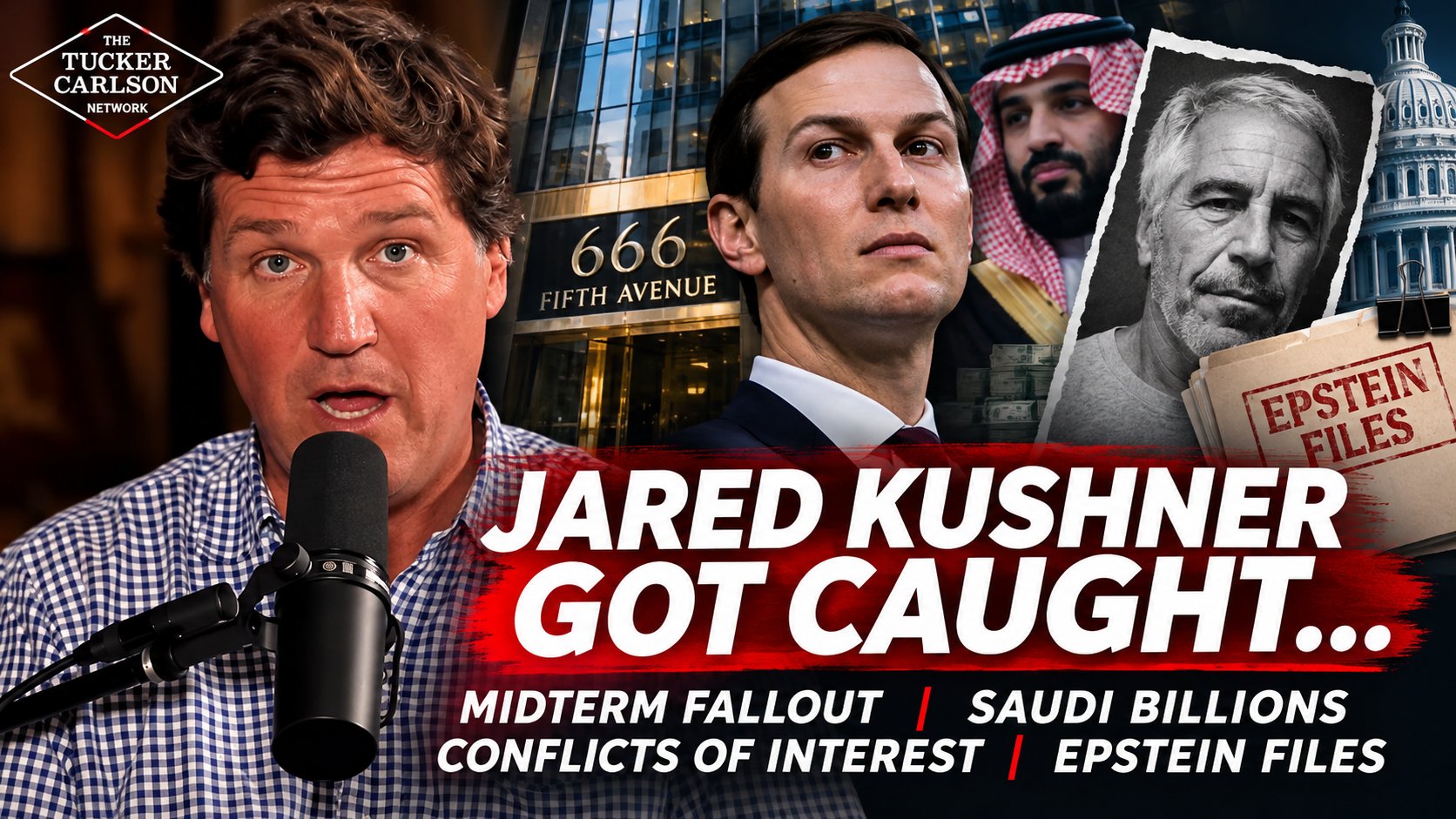
Tucker Carlson Targets Jared Kushner’s Saudi Billions, Questions Trump-Era Conflicts of Interest and Challenges Democrats to Release Epstein Files
Following the 2026 midterm elections, conservative commentator Tucker Carlson is turning his criticism toward some of the most powerful figures in Donald Trump’s political orbit. In a commentary titled “Jared Kushner Got Caught…,” Carlson raises questions about Kushner’s Middle Eastern financial relationships, the influence of foreign governments, and the unresolved battle over Jeffrey Epstein’s records. His central argument is that Washington’s political establishment cannot credibly demand accountability from ordinary Americans while shielding powerful insiders from comparable scrutiny.
WASHINGTON — The Republican Party’s midterm defeat has intensified a political reckoning within the conservative movement, and Tucker Carlson is directing some of his sharpest criticism toward the financial relationships connecting former and current government officials, wealthy investors, and foreign governments.
In a video published by the Tucker Carlson Network, Carlson argues that the election results reflect more than voter frustration with Republican messaging. He portrays the defeat as evidence of growing public resentment toward political corruption, foreign military intervention, and a system in which well connected figures can move between government service and extraordinarily lucrative private business arrangements.
At the center of his criticism is Jared Kushner, President Donald Trump’s son in law and former senior White House adviser. Kushner’s financial relationships with Saudi Arabia and other Middle Eastern investors have attracted congressional scrutiny, particularly following his departure from the first Trump administration and the subsequent investment of Saudi sovereign wealth in his private equity firm.
Carlson also raises questions about Commerce Secretary Howard Lutnick and argues that the incoming Democratic congressional majorities will face a test of their commitment to accountability: whether they investigate powerful political insiders and pursue greater transparency surrounding the Jeffrey Epstein files, regardless of party affiliation.
The allegations require important distinctions. Kushner’s foreign investments and past real estate transactions are legitimate subjects of public scrutiny, but the existence of those transactions does not establish bribery, criminal corruption, or an unlawful exchange of official favors. Carlson’s commentary presents a political argument for further investigation, not proof that the individuals he criticizes committed crimes.
Kushner’s Saudi Investment Deal Remains a Major Conflict of Interest Question
The most consequential issue surrounding Kushner is his relationship with Saudi Arabia’s Public Investment Fund, the kingdom’s sovereign wealth investment vehicle. After leaving the White House in January 2021, Kushner founded Affinity Partners, a private investment firm that subsequently received a reported $2 billion commitment from the Saudi fund. The timing attracted immediate attention because Kushner had played a central role in the first Trump administration’s Middle East policy, maintaining a close relationship with Saudi Crown Prince Mohammed bin Salman while participating in diplomatic initiatives involving Israel and Arab governments.
The Saudi investment was particularly controversial because reporting indicated that officials involved in evaluating the proposed investment had raised concerns about Affinity’s limited investment track record, its management experience, and the size of the proposed commitment. The investment nevertheless proceeded. That sequence raises a significant ethical question: Why would a foreign government invest such a large sum with a newly established firm led by a former American official who had recently exercised substantial influence over U.S. policy toward that government?
The question is not equivalent to a criminal finding. Sovereign wealth funds routinely invest in private equity firms, and foreign investment in a business founded by a former government official is not automatically unlawful. Establishing a corrupt arrangement would require evidence linking the investment to an improper agreement, official action, or other legally prohibited conduct. Nevertheless, the circumstances justify examination of communications, investment terms, beneficial interests, management fees, and any relationship between Kushner’s government responsibilities and subsequent financial opportunities.
The 666 Fifth Avenue Deal Adds Another Layer of Scrutiny
Carlson also revisits the history of 666 Fifth Avenue, the Manhattan office tower purchased by Kushner’s family business in 2007 for approximately $1.8 billion. The transaction became a major financial burden after the commercial real estate market deteriorated, leaving the family facing substantial debt and refinancing challenges.
In 2018, while Kushner served as a senior White House adviser, Brookfield Asset Management entered into a 99 year lease arrangement involving the property, providing a financial solution for the heavily indebted investment. The transaction attracted attention because Qatar’s sovereign wealth fund held an investment in Brookfield related entities, creating questions about whether foreign financial interests could indirectly benefit a business associated with a senior administration official.
The relationship requires precision. The existence of Qatari investment in Brookfield related funds did not establish that Qatar directed the transaction, and Brookfield maintained that the deal was commercially justified. Public reporting did not establish that Kushner arranged an official favor in exchange for the lease agreement. Still, the broader issue remains significant. Senior government officials with substantial family financial interests can create difficult ethical questions when those interests overlap with foreign governments affected by American diplomatic, military, and economic policy.
Carlson uses the transaction as part of a broader argument that financial relationships involving politically connected families deserve the same level of scrutiny applied to other public officials.
Congressional Investigators Found Tens of Millions in Foreign Management Fees
The financial questions surrounding Affinity Partners extend beyond the initial $2 billion Saudi commitment. In 2024, Senate Finance Committee investigators reported that the firm had collected as much as $157 million in fees from foreign clients, including approximately $87 million attributable to Saudi Arabia, while generating no investment returns for its investors through the period examined.
Investigators also reported that approximately 99% of Affinity’s managed capital came from foreign sources, primarily investors connected to Saudi Arabia, the United Arab Emirates, and Qatar. The firm’s fee structure allowed it to collect substantial annual management fees regardless of whether its investments generated profits. Those findings prompted Senator Ron Wyden and Representative Jamie Raskin to request a Justice Department investigation into possible violations of the Foreign Agents Registration Act, which regulates certain political activities conducted on behalf of foreign principals.
The congressional findings establish the scale of the financial relationships, but they do not establish that Kushner violated federal law. Foreign Agents Registration Act obligations depend on the nature of a person’s activities, their relationship with a foreign principal, and applicable statutory exemptions. Receiving investment capital from a foreign government does not, by itself, make someone an unlawful foreign agent.
The controversy has continued into Trump’s second term. In 2026, Wyden and Representative Robert Garcia announced further scrutiny of Kushner’s efforts to raise money from Middle Eastern governments while participating in U.S. foreign policy negotiations. The renewed investigation raises an additional question beyond Kushner’s first term activities: whether an individual with substantial financial relationships involving foreign governments can participate in diplomacy affecting those same governments without creating conflicts that undermine public confidence.
The Abraham Accords and the Business of Middle East Diplomacy
Kushner’s diplomatic record provides essential context for understanding Carlson’s criticism. During Trump’s first administration, Kushner helped negotiate the Abraham Accords, which established or normalized diplomatic relations between Israel and several Arab countries, including the United Arab Emirates and Bahrain.
The agreements were significant diplomatic achievements that altered regional relationships and opened opportunities for trade, investment, and security cooperation. Their existence, however, does not answer the separate ethical questions surrounding Kushner’s subsequent business activities.
Carlson’s argument centers on the intersection of those two roles. Kushner cultivated relationships with influential Middle Eastern leaders while serving as a senior American official and later used his international network to establish a private investment business financed overwhelmingly by foreign capital.
The arrangement illustrates the difficulty of distinguishing legitimate post-government business activity from the monetization of political access. Former officials frequently enter consulting, investment, and advisory businesses, and their experience can have genuine commercial value. But when billions of dollars originate from governments that previously benefited from an official’s diplomatic decisions, public scrutiny becomes especially important.
Congressional investigators have already raised those concerns. The unresolved issue is whether additional documents, communications, and testimony could establish an improper relationship between official actions and private financial benefits, or instead demonstrate that the transactions were legitimate investments independent of government policy.
Carlson Accuses Washington of Protecting Powerful Insiders
Carlson’s criticism extends beyond Kushner to the broader political establishment, including Commerce Secretary Howard Lutnick. His argument is that high-ranking officials and politically connected business figures are often better positioned to avoid consequences than lower-level employees who may have played much smaller roles in controversial government decisions.
The commentary presents that disparity as a central feature of Washington’s political culture. Senior officials can retain influential attorneys, maintain powerful financial relationships, and rely on political allies, while junior staff members may face expensive investigations, public scrutiny, or career-ending controversy.
That argument has obvious political appeal, but the legal questions involving individual officials must be evaluated separately. Carlson’s criticism of Lutnick does not establish misconduct by the commerce secretary, just as the controversy surrounding Kushner’s investment firm does not prove an unlawful arrangement.
The appropriate standard is consistent accountability based on evidence. Congressional investigators can examine whether officials improperly influenced government decisions, concealed financial relationships, violated disclosure obligations, or used public office to obtain private benefits. They cannot responsibly treat political connections, personal wealth, or association with controversial individuals as proof of criminal wrongdoing.
The distinction matters because investigations lose credibility when they begin with predetermined conclusions rather than documented evidence.
The Epstein Files Become a Test of Democratic Oversight
Carlson also places the Jeffrey Epstein case at the center of his argument about political double standards. He criticizes the government’s handling of records connected to Epstein, the convicted sex offender and financier who died in federal custody in August 2019 while awaiting trial on sex trafficking charges.
The case has generated years of public demands for transparency because Epstein maintained relationships with wealthy business executives, politicians, academics, and other influential figures. His death in custody, failures in jail supervision, and the history of his earlier federal nonprosecution agreement intensified questions about how powerful people are treated by the justice system.
Carlson revisits Trump’s dismissive response to questioning about Epstein-related jail footage and argues that the government’s handling of the case has damaged public confidence. He challenges Democrats to demonstrate that their commitment to transparency extends beyond using the scandal against political opponents.
However, the claim that approximately two million pages remain entirely unreleased requires qualification. On January 30, 2026, the Justice Department announced that it had released more than three million additional pages of Epstein related material, bringing the total public production to approximately 3.5 million pages. The release included thousands of videos and more than 180,000 images, with the department asserting that it had complied with the Epstein Files Transparency Act.
That disclosure did not end the transparency debate. The Justice Department acknowledged withholding or redacting material under legal exceptions, including privilege, protection of victims, and restrictions involving certain graphic content. Questions remain about the completeness of the disclosures, the consistency of redactions, and whether the government has adequately explained its decisions.
The existence of a person’s name in Epstein-related documents is not proof of criminal wrongdoing. Investigative records can include witness statements, correspondence, contact information, allegations, and material that has never been substantiated. Any responsible congressional review must protect victims, distinguish verified evidence from unsupported claims, and avoid treating mere association as guilt.
Why South Florida Has a Direct Stake in the Epstein Investigation
The Epstein scandal has a particularly important connection to South Florida, where Epstein’s Palm Beach residence became central to the original criminal investigation and where federal prosecutors reached the controversial 2007 nonprosecution agreement that helped him avoid federal charges at the time.
The handling of that agreement became a defining example of the unequal treatment that can arise when wealthy defendants have access to exceptional legal and political resources. Victims spent years seeking accountability, and subsequent reporting exposed serious failures in how their allegations were handled.
For South Florida residents, the case is therefore not simply another national political controversy. It is a local story involving victims, law enforcement, federal prosecutors, and a justice system whose decisions had consequences far beyond Palm Beach County.
Congressional oversight should focus on the institutional failures that enabled Epstein’s abuse, the circumstances surrounding the original prosecution agreement, the conduct of officials who handled the investigations, and whether additional evidence supports further lawful action. The objective should be a complete and credible accounting of government decisions, not a politically convenient list of prominent names.
Democrats Face a Choice Between Genuine Accountability and Political Theater
Carlson’s challenge arrives at a moment when Democrats are preparing to exercise expanded congressional oversight powers following the 2026 midterm elections. The change in congressional control could allow committees to revisit financial arrangements, foreign-policy decisions, and government records that previously received limited scrutiny.
A serious investigation of Kushner would begin with the financial evidence already developed by congressional investigators. Committees could seek investment agreements, correspondence with sovereign wealth funds, records of diplomatic contacts, management fee disclosures, and communications involving officials who participated in decisions affecting Saudi Arabia, Qatar, and the United Arab Emirates. Investigators could then determine whether the evidence supports additional legislative reforms, ethics referrals, or criminal inquiries by the appropriate authorities.
The Epstein investigation requires a similarly disciplined approach. Congress can demand a detailed accounting of withheld records, review the legal basis for redactions, and examine whether government officials failed to pursue credible evidence against individuals who facilitated abuse. Any additional disclosures must also protect victims’ identities and comply with applicable court orders.
Neither investigation should begin with a presumption of guilt. The objective should be to determine what happened, who made the relevant decisions, whether existing laws were violated, and whether the law itself needs strengthening.
Carlson’s broader argument is that Democrats will undermine their own credibility if they pursue only politically convenient targets while avoiding influential figures whose relationships cross party lines. That criticism also applies to Republicans, whose demands for accountability must be measured against their willingness to scrutinize members of their own political coalition.
The Iran War and the Political Cost of Foreign Intervention
Carlson connects his corruption argument to growing opposition to American military intervention, particularly the war in Iran. He contends that voters rejected a political establishment willing to commit American military resources to foreign conflicts while failing to provide convincing explanations of the costs, objectives, and long term consequences.
The criticism reflects a longstanding division within the conservative movement. Carlson has frequently challenged interventionist foreign policy positions, arguing that American leaders should prioritize domestic economic stability and national interests over expansive military commitments abroad.
His criticism of Democrats is that opposition to Trump does not necessarily translate into a fundamentally different foreign policy. In Carlson’s view, political leaders from both parties have supported military intervention, regime change strategies, and security commitments without adequately explaining their consequences to voters.
That interpretation remains Carlson’s political assessment rather than an established explanation of the election results. Voters can oppose a governing party for many reasons, including inflation, immigration, economic uncertainty, foreign conflicts, and dissatisfaction with political leadership. Establishing the relative importance of those factors requires credible polling and election analysis.
Nevertheless, the debate over Iran raises legitimate oversight questions about presidential war powers, congressional authorization, military expenditures, civilian casualties, and the administration’s strategy for preventing further escalation. Those questions deserve scrutiny regardless of which political party controls the White House.
The Bigger Problem: Political Access Has Become a Valuable Financial Asset
The controversies surrounding Kushner illustrate a broader weakness in American government ethics: the extraordinary financial value that can attach to political relationships after an official leaves public service.
Federal ethics laws regulate financial conflicts, certain post employment activities, foreign representation, and the disclosure of particular interests. But the rules do not categorically prohibit former officials from accepting investment capital from foreign governments or entering businesses that benefit from relationships developed during public service.
That creates an environment in which arrangements can be legally permissible while still raising substantial ethical concerns. A foreign sovereign wealth fund may have legitimate investment reasons for supporting a private firm, but it may also value the political relationships and diplomatic access associated with that firm’s leadership. Determining whether those interests improperly influenced official conduct requires evidence, not speculation.
Congress has several potential avenues for reform, including stronger post employment restrictions, expanded disclosure requirements for foreign-backed investment firms, clearer rules governing unpaid presidential advisers, and more transparent reporting of financial relationships involving former senior officials. The challenge is designing rules that address actual conflicts without treating every former official’s business relationship as inherently corrupt.
Carlson’s Warning Is Ultimately About the Rule of Law
The significance of Carlson’s commentary extends beyond the political fortunes of Jared Kushner, Donald Trump, or the Republican Party. It reflects a growing distrust of institutions that are supposed to apply the law consistently, regardless of wealth, political influence, or personal relationships.
Kushner’s Saudi investment arrangements have already generated substantial documentary evidence and formal congressional scrutiny. The Epstein case has exposed serious failures in the justice system and continues to raise questions about transparency and accountability. The war in Iran has intensified arguments about presidential authority and the consequences of foreign intervention.
These are separate controversies, but Carlson connects them through a common question: whether powerful people operate under the same rules as everyone else.
For Democrats assuming greater oversight authority, the opportunity is substantial, but so is the responsibility. Investigations should be comprehensive, evidence driven, transparent where legally possible, and willing to examine politically inconvenient facts. Congressional hearings designed primarily to generate headlines would do little to restore public confidence.
For Republicans, the challenge is equally important. A party that demands investigations of its opponents cannot credibly dismiss scrutiny of its own influential figures simply because they are politically connected.
The central question is not whether Jared Kushner, Howard Lutnick, or anyone else should be presumed guilty. It is whether their financial relationships and official conduct will receive the same independent examination that the American justice system is expected to apply to every citizen.
If the answer depends on who controls Congress, who occupies the White House, or who can afford the most influential lawyers, then the problem Carlson describes is larger than either political party. It is a problem with the credibility of American government itself.
Sources & Further Reading

Primary Commentary
Tucker Carlson Network — Jared Kushner Got Caught…
Congressional Investigations and Financial Records
Epstein Files and Government Transparency
South Florida Media Related Coverage













































Want to join the conversation?
Create an account or sign in to share your thoughts, vote,
and reply to other readers.
Showing 0 of 0 comments
Don't have an account?
Already have an account?