
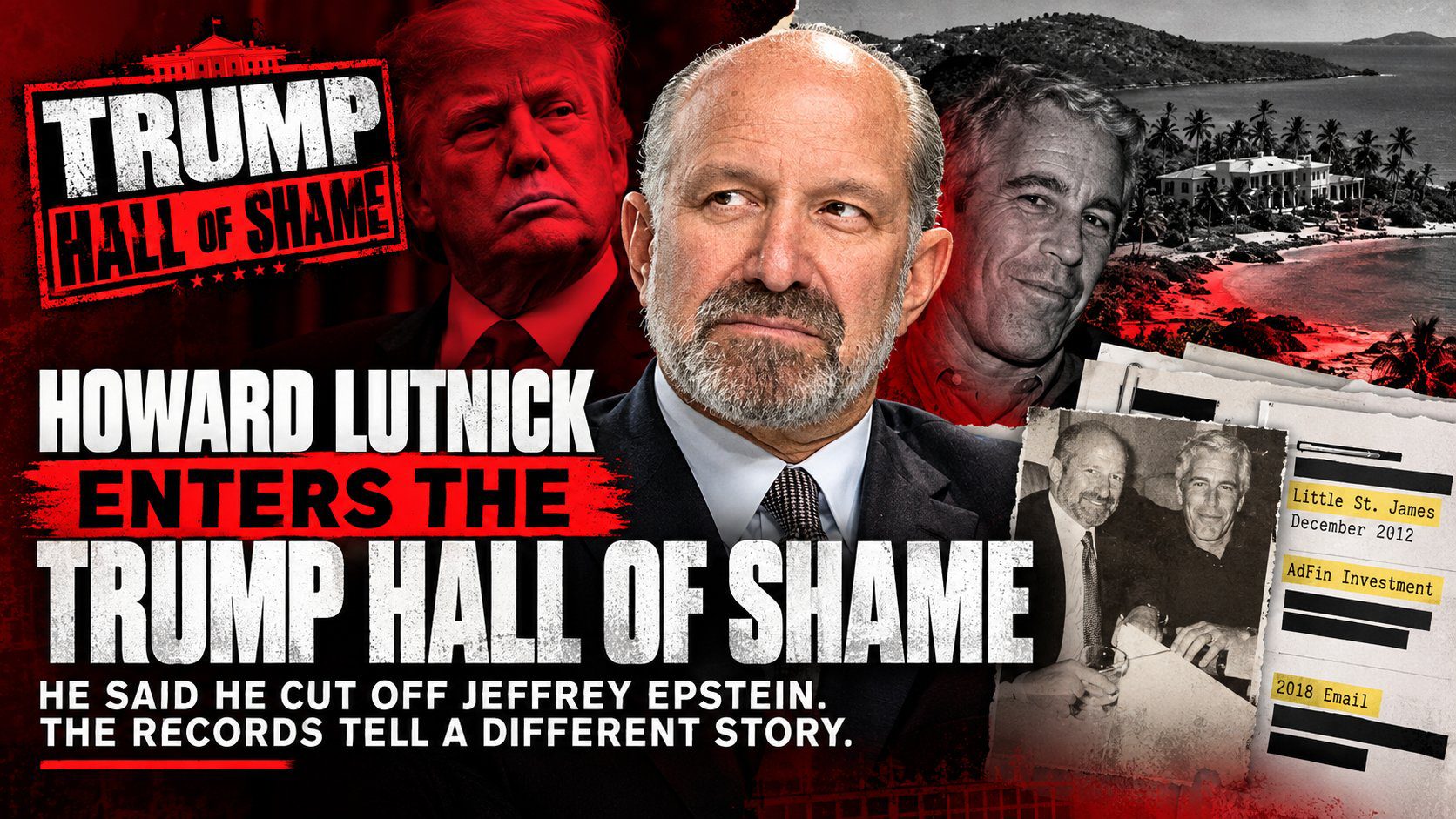
Howard Lutnick Enters the Trump Hall of Shame: He Said He Cut Off Jeffrey Epstein. The Records Tell a Different Story.
Howard Lutnick has spent Donald Trump’s second presidency as one of the administration’s most powerful economic officials, helping implement the president’s tariff agenda, defending Trump’s economic policies and serving as a prominent public face of a White House that has made loyalty one of its defining political currencies. Before becoming Commerce secretary, Lutnick was co-chair of Trump’s presidential transition operation, helping assemble the administration he would eventually join. Now he earns another distinction: a place in the SFL Media Trump Hall of Shame.
The case against Lutnick is not that his name simply appears somewhere in the enormous collection of documents associated with convicted sex offender Jeffrey Epstein. Appearing in Epstein’s records does not establish criminal conduct, and there is no evidence that Lutnick participated in Epstein’s sexual abuse or sex-trafficking operation. Lutnick has not been accused of doing so. The problem is considerably more straightforward: Lutnick gave the American public an extraordinarily categorical account of his relationship with Epstein, only for records subsequently released by the federal government to reveal a much longer and more complicated history.
Lutnick portrayed Epstein as a man who disgusted him so thoroughly during a 2005 encounter that he and his wife decided they wanted nothing more to do with him. He said he would never again be in a room with Epstein and described himself as having no subsequent social, business or philanthropic relationship with him. The documentary record, however, shows later contacts spanning years, including meetings at Epstein’s Manhattan home, a family lunch on Epstein’s private Caribbean island after Epstein was already a convicted sex offender, overlapping investments, political and philanthropic connections, and direct communications continuing into 2018.
When Lutnick was confronted about those discrepancies during a Senate hearing in February 2026, he acknowledged the island visit while continuing to minimize the relationship. Sens. Chris Van Hollen and Jeff Merkley subsequently accused him of having previously lied about the extent and nature of his Epstein relationship and demanded additional records. Months later, Lutnick voluntarily appeared before the House Oversight Committee for an extensive transcribed interview in which lawmakers again pressed him to reconcile his sweeping earlier statements with the documentary record. Lutnick’s defense increasingly became not that the later encounters never occurred, but that his earlier words did not mean what critics said they plainly appeared to mean. For a Cabinet secretary entrusted with helping manage the economic affairs of the United States, that is not a minor distinction. It is a question of credibility.
Lutnick Told America He Wanted Nothing More to Do With Epstein
The controversy begins with Lutnick’s own words. During an October 2025 appearance on the New York Post’s “Pod Force One,” Lutnick described visiting Epstein’s Manhattan townhouse with his wife in 2005, after Lutnick had moved into the property next door. According to Lutnick, Epstein showed the couple through the house and made a disturbing sexual remark while showing them a massage room. Lutnick recalled asking how often Epstein received massages, at which point Epstein moved closer and referred suggestively to receiving the “right kind” of massage.
Lutnick said he and his wife were disgusted, left the house and made a decision during the short walk back to their own home: he would never again be in a room with Epstein. Lutnick went considerably further than simply saying the two men were never close friends, saying he was never subsequently in a room with Epstein socially, for business or even philanthropy. The unmistakable impression was that the disturbing 2005 encounter had caused Lutnick to sever meaningful contact with his neighbor. The records released afterward made that account extremely difficult to reconcile with what actually followed.
The Documentary Trail Continued Years After Lutnick Says He Walked Away
The later contacts did not begin with Lutnick’s now infamous 2012 trip to Little St. James. Records released and subsequently examined by news organizations showed indications of contact years earlier, including communications involving Lutnick and Epstein’s offices and later encounters at Epstein’s Manhattan residence.
By 2011, the documentary trail becomes considerably clearer. Epstein’s calendar recorded drinks with Lutnick at Epstein’s home, and Lutnick later acknowledged another encounter at the townhouse involving scaffolding installed around the property. During his congressional questioning, Lutnick characterized the approximately hour-long interaction as essentially meaningless and inconsequential. That characterization may describe Lutnick’s view of the encounter, but it does not erase the encounter itself, which happened approximately six years after the 2005 incident that Lutnick publicly described as the moment he decided he would never again be in a room with Epstein.
Then Lutnick Took His Family to Epstein’s Island
The most politically damaging encounter came in December 2012. Emails released through the Epstein files showed Lutnick and Epstein’s staff coordinating a meeting while Lutnick was traveling through the Caribbean with his wife, children and others. Lutnick sought Epstein’s precise location so his boat captain could find it and discussed getting together. Epstein proposed lunch at Little St. James, his private island in the U.S. Virgin Islands, and the visit happened.
Lutnick eventually acknowledged before Congress that he, his wife, children and their nannies visited Epstein on Little St. James and ate lunch there for approximately an hour. A photograph subsequently included in the released Epstein materials also showed Lutnick and Epstein together with other men during the island visit. The timing is critical because this was not an encounter from the early 2000s, before Epstein’s criminal conduct became publicly established. Epstein had pleaded guilty in Florida in 2008 to state prostitution-related charges, including soliciting prostitution from a minor, and had served jail time under the deeply controversial plea arrangement that permitted extensive work release. By December 2012, Epstein’s status as a convicted sex offender was a matter of public record.
Lutnick has said he did not know for years that Epstein was a registered sex offender and has maintained that nothing inappropriate occurred during the family visit. He told lawmakers that his family remained together, that he witnessed nothing improper and that he could not remember precisely why they decided to visit Epstein. There is no evidence establishing that Lutnick participated in any criminal activity during the visit, but that is not the credibility question confronting him. The question is why a man who told the public that he and his wife were so disgusted by Epstein in 2005 that he decided he would never again be in a room with him was eating lunch on Epstein’s private island seven years later.
Four Days Later Came the AdFin Investment
The documentary record becomes more difficult to dismiss because the island visit was followed almost immediately by a financial connection. On December 28, 2012, only four days after the Christmas Eve island lunch, entities represented by Lutnick and Epstein signed documents connected to investments in AdFin Solutions, an advertising-technology company.
Epstein signed on behalf of Southern Trust Company, while Lutnick signed for an entity associated with Cantor Fitzgerald. Other shareholders were involved, meaning the transaction should not be mischaracterized as a private two-man business partnership between Epstein and Lutnick. Lutnick has maintained that he did not know Epstein was another investor when the agreement was executed, and there is no evidence establishing that Lutnick entered the transaction because Epstein was involved.
The connection nevertheless continued beyond the original paperwork. Cantor increased its involvement in AdFin, and records show Epstein and Lutnick remained connected to the company as it developed. Years later, Epstein communicated directly with Lutnick about AdFin, asking in 2018 what he thought the company’s prospects were, and Lutnick responded with an assessment of the business. That exchange matters because it represents business-related communication between the two men approximately 13 years after Lutnick said he had decided never again to be in a room with Epstein for business, socially or philanthropically.
Political and Philanthropic Connections Further Complicated Lutnick’s Story
The released records also contain political and philanthropic connections that further undermine the simplicity of Lutnick’s original account. In 2015, Lutnick invited Epstein to what he described as an intimate Hillary Clinton fundraising event at Cantor Fitzgerald’s offices. The invitation does not establish that Epstein attended, and available campaign finance reporting has not established that Epstein personally contributed to Clinton as a result of the invitation, but the communication itself provides another documented post-2005 interaction.
Another connection surfaced in 2017, when Epstein contributed $50,000 through his foundation to an event honoring Lutnick that was sponsored by UJA Federation of New York. Correspondence connected to the fundraising effort reportedly described Epstein as a “close friend of the Lutnicks” while soliciting his support. That description did not come from Lutnick himself and therefore cannot fairly be treated as proof that Lutnick personally regarded Epstein as a close friend, but it provides additional context for why his later insistence that there was effectively no social, business or philanthropic relationship drew such intense scrutiny.
Each individual connection can be explained in isolation. An invitation does not prove attendance, a donation does not prove friendship, neighboring property owners sometimes communicate, and investment vehicles can contain investors who barely know one another. The problem for Lutnick is the cumulative record. As more post-2005 contacts emerged, it became increasingly difficult to reconcile them with the sweeping story he originally told the public.
Epstein’s Records Even Contained a Lutnick Nanny’s Résumé
One of the stranger episodes involved a nanny employed by the Lutnick family. Records showed that a résumé belonging to a Lutnick nanny reached people in Epstein’s orbit and that Epstein apparently expressed interest in meeting her. The documents do not establish why Epstein wanted to meet the woman, whether such a meeting occurred or exactly how her résumé reached Epstein’s associates.
Lutnick denied knowing how it happened and told lawmakers he did not recall having anything to do with the episode. There is no evidence establishing that Lutnick personally provided the résumé, and suggesting otherwise as fact would go beyond the documentary record. The episode nevertheless became another subject of congressional questioning as lawmakers attempted to determine how extensive the connections between Epstein and people surrounding Lutnick actually were.
Lutnick and Epstein Were Still Communicating in 2018
The documentary trail continued into 2018, when Lutnick contacted Epstein regarding expansion plans involving the Frick Collection near their neighboring Manhattan properties, expressing concern that construction could affect their views and asking what they should do about it. Their communications included discussion of attorneys addressing the issue.
There is nothing inherently improper about neighboring property owners communicating over a development proposal that could affect both homes. The importance is chronological: this communication occurred approximately 13 years after the encounter Lutnick had described as ending his willingness to associate with Epstein and roughly a decade after Epstein’s criminal conviction. By this point, the public record contained interactions spanning social encounters, property matters, investments, political invitations and philanthropy. That is why the controversy ultimately became less about whether Lutnick was Epstein’s “friend” and more about whether his original account accurately described the historical record.
Lutnick Was Confronted During a Senate Hearing
The Epstein disclosures turned Lutnick’s credibility problem into a congressional issue on February 10, 2026, when he appeared before the Senate Appropriations Subcommittee on Commerce, Justice, Science, and Related Agencies. The hearing was formally focused on Commerce Department broadband funding, but Democratic senators used the appearance to question Lutnick about his relationship with Epstein.
Sen. Chris Van Hollen confronted Lutnick with the contradiction between his previous public statements and the newly released records. Lutnick acknowledged that he had visited Epstein’s island with his family and continued to maintain that he barely had anything to do with Epstein, while Sen. Jeff Merkley also pressed him about the relationship. The documented accusation from Van Hollen and Merkley was that Lutnick had previously lied about the extent and nature of his relationship with Epstein. The evidence reviewed for this article does not establish that Lutnick committed perjury during the February hearing, and SFL Media will not turn a political accusation into a criminal allegation without evidence.
What the hearing indisputably did was force a sitting Cabinet secretary to publicly acknowledge a post-2005 encounter that was extraordinarily difficult to reconcile with the categorical account he had previously given Americans. Van Hollen asked whether Lutnick would provide Congress with his own records concerning Epstein so lawmakers could establish a fuller history. Lutnick said he would consider the request and declared that he had “nothing to hide.”
Senators Accused Lutnick of Lying and Demanded His Records
The matter did not end when the hearing adjourned. On February 27, Van Hollen and Merkley sent Lutnick a formal follow-up letter explicitly accusing him of having previously lied about the extent and nature of his relationship with Epstein and describing the discrepancies as a violation of public trust. The senators cited Lutnick’s categorical 2025 description of cutting off Epstein and contrasted it with the subsequently released evidence, including the 2012 Little St. James visit and the AdFin investment.
The senators requested communications, records concerning meetings and visits, information about the AdFin investment and answers concerning the nanny whose résumé appeared in the Epstein materials. Their letter also emphasized a crucial distinction that should not be lost in the political noise: the issue they were raising was not evidence that Lutnick participated in Epstein’s sex crimes, but whether a senior public official had given the American people a truthful account of his own relationship with Epstein.
The Scrutiny Eventually Reached House Oversight
The controversy eventually expanded to the House Oversight Committee, where Lutnick voluntarily appeared for a transcribed interview on May 6, 2026. He was not subpoenaed, and the appearance should not be characterized as Congress forcing him to return to correct sworn testimony. It was a separate House investigation into Epstein and the federal government’s handling of the case, conducted after the Senate confrontation had intensified questions about Lutnick’s previous statements.
According to the Commerce Department, Lutnick answered nearly 400 questions from lawmakers and committee staff. House Oversight later released the transcript publicly, providing Americans with an unusually detailed record of how Lutnick attempted to reconcile his original description with the meetings, emails, island visit and financial connections documented afterward. Rather than making those contradictions disappear, the interview demonstrated how heavily Lutnick’s defense had come to depend on redefining what he meant when he originally described his break with Epstein.
Lutnick’s Defense Became an Argument Over the Meaning of His Own Words
House lawmakers repeatedly returned to Lutnick’s declaration that after the disturbing 2005 encounter he was never again in a room with Epstein socially, for business or philanthropy. By the time of the House interview, Lutnick had acknowledged later physical encounters, including the approximately hour long 2011 meeting and the family lunch on Little St. James in 2012. Lutnick argued that those encounters did not amount to the kind of personal or professional relationship he had been describing and maintained that occasional interactions did not constitute a meaningful relationship with Epstein.
Democratic lawmakers were openly incredulous, accusing Lutnick of manipulating ordinary language to preserve the technical accuracy of a statement whose plain meaning was contradicted by the documentary record. Republican Oversight Chairman James Comer defended Lutnick and accused Democrats of twisting his words for political purposes. Readers can judge the semantic dispute for themselves, but the underlying facts are no longer seriously disputed: Lutnick said he would never again be in a room with Epstein, yet later acknowledged that he was; he said there was no subsequent social, business or philanthropic relationship, while records documented social contact, business related communications, a family island lunch, overlapping investments, a political invitation, a philanthropic donation and property related communications.
Lutnick’s defense ultimately became that none of those individual interactions amounted to the relationship he meant when he made the original statement. Whether that explanation is persuasive is a political judgment. The existence of the interactions is a matter of record.
Lutnick Also Backed Away From His Epstein Blackmail Claims
The House interview exposed another credibility problem. During the same 2025 podcast appearance in which Lutnick described cutting Epstein out of his life, he made sensational claims about Epstein supposedly operating an extraordinary blackmail operation, speculating that powerful people had been compromised through sexual encounters and portraying blackmail as central to Epstein’s activities.
When House investigators asked what evidence he personally possessed for those allegations, Lutnick backed away from the certainty of his earlier rhetoric. He acknowledged that he had no personal information establishing the blackmail claim and said he had been speculating during the podcast. That matters because Howard Lutnick is not an anonymous social-media personality or cable-news pundit; he is the United States secretary of Commerce. The same official who offered an emphatic account of how completely he had rejected Epstein also offered dramatic allegations about Epstein’s supposed blackmail operation, only to acknowledge when questioned by Congress that those allegations were speculation rather than information he personally possessed. The pattern reinforces the central problem: certainty in public followed by qualification under scrutiny.
Republicans Also Began Asking Questions
Criticism of Lutnick did not remain exclusively Democratic. Republican Rep. Thomas Massie of Kentucky, one of the lawmakers most closely associated with congressional efforts to force greater disclosure of the Epstein files, publicly called for Lutnick to resign. Other Republicans expressed concern about the disclosures and the need for people appearing in the files to explain themselves.
That bipartisan dimension matters because it prevents the controversy from being dismissed entirely as another partisan attack on the Trump administration. Democrats were the most aggressive in accusing Lutnick of misleading the public, but they were not alone in concluding that the documentary record raised legitimate questions about whether a sitting Cabinet secretary had accurately described his history with Epstein. The White House nevertheless continued backing him.
Trump Says He Didn’t Know Lutnick Went to Epstein’s Island
Donald Trump was eventually asked whether he knew his Commerce secretary had visited Little St. James. Trump said he did not, telling reporters in February 2026 that he had been unaware of the visit and had not discussed it with Lutnick. Trump noted that, from what he understood, Lutnick had traveled there with his wife and children before emphasizing that he himself had never visited Epstein’s island.
The White House nevertheless continued standing behind Lutnick, with Press Secretary Karoline Leavitt publicly describing him as an important member of Trump’s team and making clear that he retained the president’s support. That decision is significant because Lutnick is hardly a peripheral administration figure. He served as co-chair of Trump’s presidential transition operation before Trump nominated him to run the Commerce Department, and after the Senate confirmed him in February 2025, he became one of the administration’s principal economic surrogates and a central figure in implementing Trump’s tariff and trade policies. Trump therefore did not merely inherit Lutnick; he elevated him, entrusted him with enormous economic authority and continued supporting him after the contradictions surrounding his Epstein history became public.
The Evidence Does Not Show Lutnick Participated in Epstein’s Crimes
Any responsible examination of these records requires drawing a bright line around what they do not establish. There is no evidence presented here that Howard Lutnick participated in Jeffrey Epstein’s sexual abuse, sex trafficking or exploitation of minors; no evidence that Lutnick knew about criminal activity occurring during his visit to Little St. James; no evidence that the AdFin investment was connected to Epstein’s sex crimes; and no evidence establishing that Lutnick personally provided his nanny’s résumé to Epstein or knew why Epstein apparently wanted to meet her.
Those distinctions are not technicalities. They are fundamental to responsible journalism. Epstein cultivated an enormous network of wealthy, famous and politically connected people, and appearing in his records is not proof that someone participated in his crimes. But that principle cannot become an excuse for ignoring documented contradictions from one of the highest ranking officials in the United States government. The case against Lutnick does not require accusing him of Epstein’s crimes because his own words and the documentary record create a substantial credibility issue on their own.
The Problem Is What Lutnick Told the American Public
Strip away the celebrity names, private island, Manhattan mansions and political spectacle surrounding the Epstein files, and the central issue becomes remarkably simple. Howard Lutnick told Americans that after a disturbing encounter with Jeffrey Epstein in 2005, he essentially wanted nothing more to do with him. He described the break in categorical language and said he was never subsequently with Epstein socially, for business or philanthropy. The documentary record subsequently showed years of additional interactions, including post-2005 contacts and meetings, an acknowledged encounter at Epstein’s Manhattan townhouse in 2011, lunch with Epstein on Little St. James in 2012, investment documents signed days later involving AdFin, subsequent business-related communications, a political fundraising invitation, a major philanthropic donation to an event honoring Lutnick and communications concerning their neighboring Manhattan properties in 2018.
When those records became public, Lutnick did not demonstrate that the meetings, emails, island visit or financial connections were fabricated. Instead, he disputed what those interactions meant, whether they constituted a genuine “relationship” and whether critics were interpreting his earlier words too literally. When lawmakers separately challenged his dramatic assertion that Epstein had operated as a great blackmailer, Lutnick acknowledged that he had been speculating rather than speaking from personal evidence. None of that demonstrates that Howard Lutnick participated in Jeffrey Epstein’s crimes, but it does raise something directly relevant to his current position: a serious question about the credibility and precision of statements made by a sitting Cabinet secretary.
Howard Lutnick Belongs in the Trump Hall of Shame
Howard Lutnick does not belong in the Trump Hall of Shame because he once lived next door to Jeffrey Epstein, merely because he visited Epstein’s island or because of some unsupported allegation that he participated in Epstein’s sexual crimes. He belongs here because he is one of the most powerful officials in the United States government, because he offered Americans an extraordinarily clean version of an uncomfortable history and because government records subsequently revealed a substantially more extensive pattern of interaction than his original account suggested.
He was confronted about those discrepancies before a Senate committee, after which senators formally accused him of previously lying about the relationship and demanded his records. He later voluntarily appeared for an extensive House Oversight interview, where lawmakers spent hundreds of questions examining the gap between his public statements and the documentary record. His explanations increasingly depended not on denying that the later contacts occurred, but on narrowing what he said he had originally meant. There is currently no established basis in the record reviewed by SFL Media to accuse Lutnick of perjury, and this publication will not invent a felony to make an already damaging story sound worse. What the evidence does establish is that a sitting Cabinet secretary made categorical public statements about Jeffrey Epstein that were later challenged by documentary evidence, acknowledged additional encounters when confronted by Congress and defended himself by offering a narrower interpretation of his original words.
Donald Trump selected Lutnick to help build his administration, placed him at the center of American economic policy and continued backing him after those discrepancies became public. The White House treated the controversy as another political attack rather than confronting the simpler question underneath it: Did one of the president’s most powerful Cabinet officials give Americans an accurate and complete account of his history with one of the most notorious convicted sex offenders in modern American history?
The Epstein files do not establish that Howard Lutnick participated in Jeffrey Epstein’s crimes. They establish something narrower but still profoundly important for a public official: Lutnick told America one story about the extent of that relationship, while the records revealed a substantially more complicated history. Congress began asking questions, Lutnick acknowledged encounters that did not fit comfortably with the impression created by his original account, and his defense became increasingly dependent on distinctions over what constituted a social, professional or philanthropic “relationship.”
For a Cabinet secretary, credibility matters. For an administration that demands extraordinary trust while routinely attacking the credibility of its investigators, critics and the press, it matters even more. Howard Lutnick had years to describe his relationship with Jeffrey Epstein accurately and completely, but the version he initially offered was far cleaner than the documentary record that eventually emerged.
He chose the cleaner story. The records supplied the rest.
Welcome to the Trump Hall of Shame.

Sources & Further Reading
U.S. Senate Committee on Appropriations — “A Review of Broadband Deployment Funding at the Department of Commerce,” February 10, 2026
https://www.appropriations.senate.gov/hearings/a-review-of-broadband-deployment-funding-at-the-department-of-commerce
U.S. Sens. Chris Van Hollen and Jeff Merkley — Follow-Up Letter to Commerce Secretary Howard Lutnick Regarding Jeffrey Epstein, February 27, 2026
https://www.vanhollen.senate.gov/imo/media/doc/epstein_files_follow-up_letter_to_seclutnick.pdf
Sen. Jeff Merkley — “Van Hollen, Merkley Press Lutnick for Answers on Epstein Ties,” February 27, 2026
https://www.merkley.senate.gov/van-hollen-merkley-press-lutnick-for-answers-on-epstein-ties/
U.S. House Committee on Oversight and Government Reform — “Oversight Committee Releases Waitt and Lutnick Transcripts,” May 13, 2026
https://oversight.house.gov/release/oversight-committee-releases-waitt-and-lutnick-transcripts/
U.S. House Committee on Oversight and Government Reform — Howard Lutnick Transcribed Interview, May 6, 2026
https://oversight.house.gov/wp-content/uploads/2026/05/Lutnick-Transcript.pdf
PBS NewsHour — “Read the Full Transcript of Howard Lutnick’s Testimony About Jeffrey Epstein,” May 13, 2026
https://www.pbs.org/newshour/politics/read-the-full-transcript-of-howard-lutnicks-testimony-about-jeffrey-epstein
CBS News — Coverage of Howard Lutnick’s Epstein testimony and evolving statements
https://www.cbsnews.com/news/howard-lutnick-jeffrey-epstein-testimony/
Associated Press — Coverage of Lutnick’s House Oversight interview and his retreat from previous Epstein blackmail claims, May 13, 2026
https://apnews.com/article/51283ede04b8dd2f6d72be495d6ebb7b
The Washington Post — Coverage of Lutnick’s House Oversight interview and congressional scrutiny, May 6, 2026
https://www.washingtonpost.com/politics/2026/05/06/lutnick-epstein-congress-interview/
New York Post — Howard Lutnick’s October 2025 “Pod Force One” Interview Discussing Jeffrey Epstein
https://nypost.com/2025/10/01/us-news/howard-lutnick-calls-ex-neighbor-jeffrey-epstein-greatest-blackmailer-ever/








































Want to join the conversation?
Create an account or sign in to share your thoughts, vote,
and reply to other readers.
Showing 0 of 0 comments
Don't have an account?
Already have an account?