

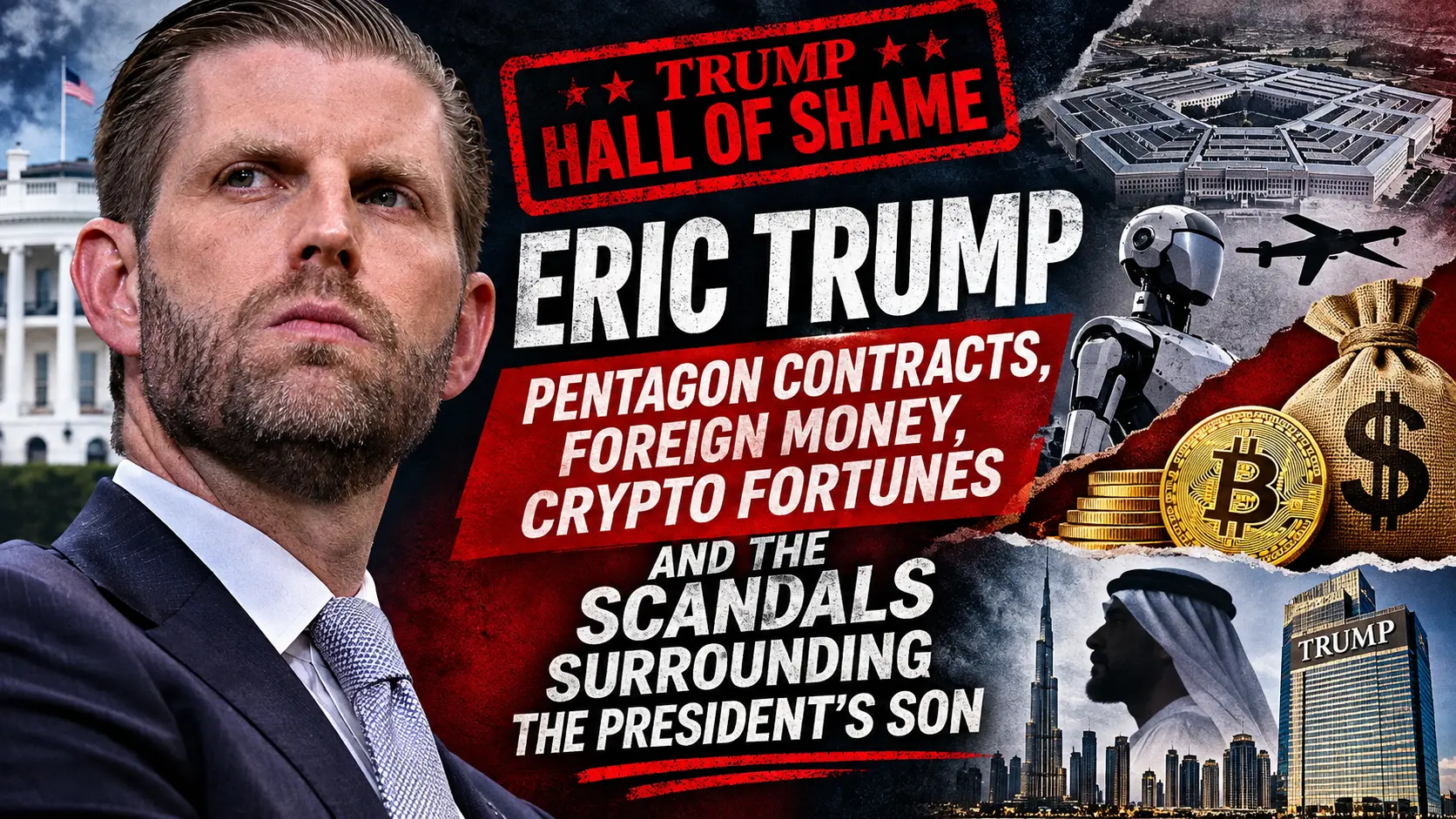
Eric Trump’s Empire of Influence: Pentagon Contracts, Foreign Money, Crypto Fortunes and the Scandals Surrounding the President’s Son
From military robots and government-backed businesses to a $500 million foreign cryptocurrency investment, controversial charity spending and sweeping federal tax protections, Eric Trump’s financial activities reveal an expanding network of potential conflicts of interest surrounding the American presidency.
WASHINGTON — Eric Trump has spent much of his adult life helping manage his father’s real estate empire, overseeing luxury hotels, golf courses and international development projects. But during Donald Trump’s second presidency, the president’s middle son has expanded his financial interests into a far more politically sensitive collection of industries, including military robotics, defense drones, cryptocurrency, infectious disease surveillance and critical minerals.
The transformation has placed Eric Trump at the intersection of private family wealth and federal government power. Companies connected to his investments have received or pursued substantial government contracts, foreign investors have committed hundreds of millions of dollars to Trump family ventures, and the administration has made regulatory and policy decisions affecting industries in which the president’s relatives hold financial interests.
The most serious questions concern whether those opportunities have been available on equal terms to competitors without connections to the White House. Federal procurement decisions, regulatory approvals, foreign investment reviews and presidential clemency are supposed to serve the public interest, not the financial interests of politically connected families.
Not every transaction involving Eric Trump is evidence of wrongdoing. A government contract awarded to a company in which he invests does not automatically establish favoritism, and a foreign business relationship does not prove that American foreign policy was improperly influenced. But the overlapping financial interests, combined with documented legal controversies and increasingly substantial government-connected transactions, present legitimate questions about transparency, accountability and conflicts of interest.
The record extends well beyond his recent investments. Eric Trump was personally named in New York’s landmark civil fraud case against the Trump Organization, acknowledged negotiating a $2 million severance agreement restricting a former executive’s voluntary cooperation with investigators, and previously faced scrutiny over charitable fundraising that directed money to Trump owned properties. More recently, he became a beneficiary of a federal settlement restricting certain historical tax claims against the president and his family.
For South Florida Media’s Trump Hall of Shame, the central issue is whether the Trump family’s commercial empire has become so deeply intertwined with the presidency that the American public can no longer confidently distinguish between government decisions made for the country and those benefiting the president’s relatives.
Pentagon Contracts and Eric Trump’s Entry Into the Military Robotics Industry
One of the most significant developments in Eric Trump’s expanding investment portfolio involves Foundation Future Industries, a robotics startup developing humanoid machines for military and industrial applications. Eric Trump became an investor and chief strategy adviser in 2026, entering an industry in which federal contracts, military procurement decisions and national security priorities can determine whether emerging companies become enormously valuable.
The company developed the Phantom series of humanoid robots, designed for applications ranging from industrial operations to military logistics and reconnaissance. In April 2026, Foundation received a reported $24 million Department of Defense contract, attracting scrutiny because the award came after Eric Trump’s involvement with the company. A May 8 letter from House Oversight Committee Democrats specifically questioned the relationship between his business position and the federal award.
By November, the Financial Times reported that Foundation and an acquired business had received more than $70 million in U.S. military contracts and funding, according to a company co-founder. That broader figure should not be confused with the original $24 million contract, nor should the entire amount be described as money personally received by Eric Trump. The company’s reported total includes awards and funding attributed to related businesses, while Eric Trump’s individual financial return depends on the value and terms of his investment.
The company has also pursued international military opportunities. According to Financial Times reporting published November 11, Foundation was in preliminary discussions with the Israel Defense Forces about potentially supplying as many as 1,000 humanoid robots for operations involving underground tunnels in Gaza. The proposal raises additional questions about the use of autonomous systems in military environments, particularly where machines could eventually perform dangerous or potentially lethal functions.
Eric Trump’s spokesperson has maintained that he does not participate in the company’s government contracting or day to day operations. Company representatives have similarly denied that his family connections were responsible for federal awards. Those denials are important, but they do not eliminate the need to examine procurement records, competing bids, internal communications and whether political relationships provided advantages unavailable to other contractors.
The fundamental concern is straightforward: A president’s son holds an ownership interest in a defense technology company while his father’s administration oversees the military agencies purchasing that technology. Even without proof of direct intervention, that arrangement creates a potential conflict requiring unusually strong independent oversight.
Powerus, Military Drones and a $90 Million Air Force Award
Foundation Future Industries is not the only military related company connected to Eric Trump’s investment network. Through relationships involving Dominari Holdings and its American Ventures investment fund, Eric Trump and Donald Trump Jr. have also been linked to Powerus, a Florida based drone manufacturer pursuing government business in the expanding market for unmanned aircraft and counter drone systems.
Powerus received an Air Force contract worth up to $90 million after the Trump brothers’ involvement with the company became public, according to reporting by ProPublica. The timing drew attention because the brothers’ investment interests had been announced only months before the award, while the administration was promoting policies intended to strengthen American drone manufacturing and reduce dependence on foreign suppliers.
The contract’s maximum value should not be confused with actual payments or profits received by the company, much less Eric Trump’s personal earnings. Nevertheless, the relationship raises questions about whether political connections affected the company’s access to federal procurement opportunities, whether competing manufacturers received equivalent consideration and whether government officials knew about the presidential family’s investment interests.
The brothers’ broader investment relationships have also included Israeli drone manufacturer XTEND and Unusual Machines, adding to concerns about the family’s growing exposure to defense related businesses. These investments place the president’s relatives in industries where Pentagon purchasing decisions, export approvals, military assistance and international security relationships can dramatically influence company valuations.
A spokesperson for the brothers told ProPublica that they are passive investors and do not participate in obtaining government contracts. Dominari’s chief executive also denied that either brother used his family name to influence procurement decisions. Those statements are important to the factual record, but congressional investigators have reason to examine the underlying contracts and communications independently.
Nearly $40 Million in Federal Disease Screening Contracts After a Trump Linked Investment
One of the strongest recent examples of government business intersecting with Eric Trump’s financial interests emerged in a November 9, 2026, investigation by ProPublica. The nonprofit newsroom reported that XpresTest, a subsidiary of XWELL, received approximately $38.8 million in federal contracts for infectious-disease screening just months after American Ventures, an investment fund connected to Eric Trump and Donald Trump Jr., invested approximately $30 million in its parent company.
The awards included $18.8 million from the Centers for Disease Control and Prevention and $20 million from the State Department. One contract involved disease surveillance at American airports, while the other concerned infectious disease operations in the Democratic Republic of Congo, where an Ebola outbreak had created a serious public-health emergency.
The unusual aspect of the arrangement was the contractor’s background. XWELL was historically associated with airport spas and wellness services, including massages and beauty treatments, although its XpresTest subsidiary had developed legitimate experience conducting COVID-19 and other disease-screening programs at American airports. The company had not previously performed Ebola surveillance or operated comparable biosecurity programs overseas.
XWELL chief executive Ezra Ernst acknowledged that the international work represented a new challenge for the company and expressed uncertainty about its ability to complete the assignment. Former federal public-health officials questioned why the government selected a contractor without extensive international outbreak response experience when established humanitarian and disease-control organizations already operated in that field.
According to ProPublica, XWELL had been financially distressed before the investment, with its chief executive describing the company as close to bankruptcy. American Ventures’ investment gave the fund an initial ownership stake of approximately 10%, along with additional financial rights. The government contracts subsequently awarded to XpresTest were worth roughly seven times the total value of the company’s previous direct federal contracts.
The company maintained that both awards resulted from competitive bidding. The State Department defended its selection by pointing to XpresTest’s previous airport disease-screening experience, while representatives for the Trump brothers said they had no knowledge of or involvement in negotiating the government awards. Those explanations do not establish misconduct. But the combination of a financially struggling company, an investment connected to the president’s sons, a dramatic increase in government business and questions about the contractor’s qualifications makes the awards an important subject for congressional oversight.
Kazakhstan Tungsten Mining and a Proposed $1.6 Billion in Federal Financing
Eric Trump and Donald Trump Jr. have also acquired indirect financial interests in a proposed tungsten mining venture in Kazakhstan, a country with strategically important mineral resources. Tungsten is used in military equipment, aerospace manufacturing and industrial applications, making its supply a significant national security concern as the United States attempts to reduce dependence on China for critical materials.
The proposed venture involved Cove Kaz Capital Group and discussions with two American government financing institutions. Preliminary plans contemplated up to $900 million from the Export Import Bank and approximately $700 million from the U.S. International Development Finance Corporation, creating a potential financing package worth $1.6 billion.
However, Reuters reported on November 10, 2026, that federal lenders were no longer actively pursuing the financing. The preliminary letters of interest were nonbinding, the project had not advanced through the agencies’ approval processes, and the developer said it had not formally applied for government funding. The Trump brothers’ indirect ownership interest was reported to be less than 1%.
That update is critical because it establishes that the proposed $1.6 billion was not an approved government loan or a taxpayer payment to Eric Trump. The project nevertheless remains relevant to the broader investigation because it demonstrates how Trump family investment vehicles have entered industries dependent on American industrial policy, diplomatic relationships and federal financing.
Congressional Investigators Question the Trump Family’s Defense Investments
The expanding collection of defense related investments has attracted attention from congressional Democrats, including lawmakers concerned about procurement integrity and potential conflicts involving the president’s relatives.
In a May 8, 2026, letter to the Department of Defense inspector general, House Oversight Democrats raised questions about the Trump brothers’ involvement in military-related companies, specifically identifying Foundation Future Industries and Powerus. The letter highlighted Eric Trump’s public promotion of Foundation’s reported $24 million Pentagon award and the brothers’ entry into defense businesses despite their limited prior experience in the industry.
The investigation’s significance lies in the difference between commercial success and preferential government treatment. A company may legitimately receive federal contracts because it offers competitive technology, reasonable pricing or urgently needed capabilities. But the public deserves assurance that procurement decisions were made independently, particularly when a bidder’s investors are members of the president’s immediate family.
The relevant evidence would include contract solicitations, bid evaluations, ownership disclosures, agency communications, political contacts and any changes in procurement requirements that favored particular companies. Until such records establish improper influence, the documented relationships should be described as potential conflicts rather than proven contracting corruption.
The Eric Trump Foundation and the Children’s Cancer Charity Scandal
Long before his involvement in military technology and cryptocurrency, Eric Trump faced serious questions about the financial practices of the charitable foundation he established to support St. Jude Children’s Research Hospital. The Eric Trump Foundation began raising money in 2007, principally through annual golf tournaments held at Trump National Golf Club Westchester in New York. Eric Trump promoted the events as highly efficient fundraisers, explaining that his family’s golf facilities and other services were provided without charge so donations could support children receiving cancer treatment.
A 2017 Forbes investigation found that those representations did not match the foundation’s financial records. The Trump Organization received substantial payments connected to the charity’s events, while reported tournament expenses increased sharply over several years. According to the foundation’s tax filings, expenses for the principal golf event rose from approximately $46,000 in 2010 to $322,000 in 2015, despite Eric Trump’s public statements emphasizing donated facilities and minimal costs.
Forbes also reported that more than $500,000 was directed to charitable organizations other than St. Jude, including organizations with connections to Trump family interests or events held at Trump-owned properties. A separate $100,000 transaction involving the Donald J. Trump Foundation raised questions about how charitable funds ultimately generated revenue for Trump businesses.
The foundation did provide substantial legitimate support to St. Jude. Forbes reported that Eric Trump’s fundraising efforts had directed more than $11 million to the hospital, and the organization helped finance important pediatric cancer research and medical facilities. The controversy was not that the foundation failed to support sick children, but that its public fundraising representations and financial transactions raised serious questions about donor transparency and conflicts of interest.
The distinction is especially important because charitable organizations have obligations to use donations consistently with their stated purposes and representations. When donors are told that proceeds will benefit a particular hospital, undisclosed transfers to other organizations or payments to businesses associated with the charity’s leadership can undermine public trust, even when some expenditures are otherwise lawful.
Eric Trump disputed the implication that he had improperly benefited from the foundation’s activities. The available record does not establish a criminal conviction against him for charity fraud. Nevertheless, the documented financial practices represent one of the earliest and most consequential controversies involving his management of organizations connected to the Trump family.
New York’s Civil Fraud Case: A Court Finds Eric Trump Liable
Eric Trump’s involvement in the Trump Organization’s financial operations became the subject of direct legal findings in New York Attorney General Letitia James’ civil fraud case against Donald Trump, his adult sons and their family business. The lawsuit alleged that the Trump Organization repeatedly used misleading financial statements and inflated asset valuations to obtain favorable financing and insurance terms. The disputed valuations involved properties including golf courses, commercial real estate and the Seven Springs estate in Westchester County, where Eric Trump had significant management responsibilities.
In February 2024, Justice Arthur Engoron ruled against the defendants, finding that the company had engaged in persistent financial misrepresentation. Eric Trump was personally subject to financial penalties and restrictions on serving as an officer or director of New York corporations. The judgment followed extensive testimony and documentary evidence concerning the preparation and use of the Trump Organization’s statements of financial condition.
The case subsequently changed on appeal. In August 2025, a divided New York appellate court left the underlying fraud findings in place while overturning the enormous monetary disgorgement awards as excessive. The appellate decision therefore did not amount to a complete exoneration, but neither did it leave Eric Trump’s original monetary penalty intact. The distinction matters because the legal record establishes judicial findings against Eric Trump, while the financial remedies have been affected by appellate review. It would be inaccurate to describe his original multimillion dollar penalty as an unquestionably outstanding obligation without accounting for the subsequent ruling.
Eric Trump and his co-defendants denied wrongdoing and argued that the financial statements involved legitimate valuation judgments rather than fraud. Nevertheless, the case remains a central part of his public record because it involved findings made by a court after reviewing the company’s financial practices, not merely accusations from political opponents.
The $2 Million Allen Weisselberg Severance Agreement
Another consequential episode emerged from Eric Trump’s handling of a severance agreement for Allen Weisselberg, the Trump Organization’s longtime chief financial officer. Weisselberg had extensive knowledge of the company’s internal financial practices and had pleaded guilty to tax-related offenses before becoming a significant figure in subsequent litigation.
In January 2023, the Trump Organization agreed to pay Weisselberg approximately $2 million in severance over two years. The agreement contained confidentiality and non-disparagement provisions, along with restrictions affecting his ability to voluntarily cooperate with investigations or legal proceedings involving the company, while preserving obligations to comply with legally compelled testimony.
During the New York civil fraud trial, Eric Trump acknowledged that he personally negotiated and signed the agreement. The arrangement attracted scrutiny because Weisselberg possessed potentially important information about the company’s financial practices while receiving substantial payments subject to restrictive contractual terms.
Prosecutors in Donald Trump’s separate New York criminal proceedings also examined the agreement’s potential effect on Weisselberg’s willingness to testify. The concern was that a former executive facing criminal exposure might have financial incentives to avoid voluntarily providing information damaging to the company.
Eric Trump maintained that the agreement was an ordinary severance arrangement for a longtime employee. The available record does not establish that he committed witness tampering or bribery by signing it. Nevertheless, the documented agreement raises serious questions about whether restrictive financial arrangements involving key witnesses can undermine transparency and accountability in corporate investigations.
The IRS Settlement That Gave Eric Trump Extraordinary Tax Protections
One of the most consequential developments in Eric Trump’s legal history occurred in May 2026, when the Justice Department entered into a settlement resolving a lawsuit brought by Donald Trump, Eric Trump, Donald Trump Jr. and the Trump Organization against the Internal Revenue Service and Treasury Department. The lawsuit arose from the unlawful disclosure of Trump family tax information by former IRS contractor Charles Littlejohn. The unauthorized release represented a genuine violation of federal tax confidentiality protections, and the plaintiffs were entitled to pursue legal remedies.
But the settlement went considerably further than addressing the disclosure. According to the published agreement and a subsequent Justice Department document, the government agreed to sweeping restrictions on pursuing certain historical tax claims involving the president, his sons and the Trump Organization. The restrictions covered claims connected to tax returns filed before the settlement’s May 18, 2026, effective date and related matters that could have been raised. Reuters and CBS News reported that the arrangement permanently barred specified historical IRS actions against the named plaintiffs, while the Justice Department maintained that it did not prevent audits of future tax filings.
The settlement did not provide Eric Trump with unlimited immunity from every criminal offense, and it did not establish that he had committed tax fraud. Nevertheless, it delivered an extraordinary legal benefit to the president’s immediate family through an agreement negotiated by an administration headed by that same president. The Justice Department also established a separate compensation mechanism associated with claims of political targeting, reportedly involving approximately $1.8 billion. That fund should not be confused with money paid directly to Eric Trump; the published settlement specified that the named plaintiffs would not receive monetary damages as part of the agreement.
The ethical concern is therefore not that Eric Trump received a $1.8 billion taxpayer payout. It is that federal officials serving under his father entered into an agreement limiting the government’s ability to pursue certain historical tax claims against the president and members of his family. For an administration that has repeatedly emphasized aggressive enforcement and accountability for political opponents, the breadth of those protections creates an especially serious question about whether the same legal treatment would have been available to ordinary taxpayers.
World Liberty Financial and the $500 Million UAE Investment
Eric Trump’s involvement in cryptocurrency has produced some of the most serious foreign-influence questions surrounding the Trump family’s business empire. World Liberty Financial, launched in 2024 with the involvement of Trump’s sons and members of the family of presidential adviser Steve Witkoff, operates in a sector directly affected by federal banking policy, securities regulation, anti money laundering enforcement and international financial oversight.
In January 2025, four days before Donald Trump’s second inauguration, Eric Trump signed an agreement selling a 49% stake in World Liberty Financial to investors connected to Sheikh Tahnoon bin Zayed Al Nahyan, the United Arab Emirates’ national security adviser and a member of the country’s ruling family. The transaction was valued at approximately $500 million and was not publicly disclosed until reporting in February 2026 exposed the arrangement.
The financial terms were particularly significant. Reporting indicated that approximately $250 million was paid upfront, with substantial proceeds directed to Trump family entities and additional funds going to businesses connected to the Witkoff family. The arrangement established a direct financial relationship between the American president’s family and an influential foreign official whose government had major diplomatic, technological and security interests before Washington.
The timing created additional concerns because the UAE was seeking expanded access to advanced American artificial intelligence technology, including high performance semiconductors subject to national-security restrictions. The Trump administration subsequently supported measures facilitating greater technology cooperation with the Emirates, raising questions about whether commercial relationships involving the president’s family could influence official policy.
The relationship expanded further in 2026. The Wall Street Journal reported in August that Sheikh Tahnoon and associated investors also held a major stake in the corporate structure behind World Liberty Financial’s planned banking operation. That month, the Office of the Comptroller of the Currency granted preliminary conditional approval for a national trust bank associated with the venture, intended to support the issuance, redemption and custody of its USD1 stablecoin.
The reported transactions prompted Sens. Elizabeth Warren and Andy Kim to request a national-security review of the foreign investment. Their concerns centered on whether the ownership arrangement warranted examination by the Committee on Foreign Investment in the United States, particularly given the investor’s senior position in a foreign government.
There is no conclusive public evidence establishing that the UAE investment was exchanged for semiconductor approvals, banking authorization or other favorable federal decisions. President Trump has maintained that his sons manage the family’s business activities independently. But the combination of a large foreign investment, Eric Trump’s direct involvement in the agreement and subsequent government decisions affecting the investor’s interests represents a substantial potential conflict of interest.
Binance, a $2 Billion Stablecoin Transaction and the Changpeng Zhao Pardon
World Liberty Financial also became involved in controversy surrounding Binance, the international cryptocurrency exchange founded by Changpeng Zhao. Zhao pleaded guilty in 2023 to violating American anti money laundering requirements and served a federal prison sentence before receiving a presidential pardon from Donald Trump in October 2025. The pardon attracted scrutiny because of a separate $2 billion investment transaction involving Binance and MGX, an Abu Dhabi-backed investment company. The arrangement used World Liberty Financial’s USD1 stablecoin, potentially creating significant commercial benefits for the Trump family’s cryptocurrency venture.
The distinction between the underlying transactions is important. The $2 billion investment was not a direct payment of that amount to Eric Trump, nor does the use of USD1 establish that Eric Trump personally negotiated the Binance transaction. Nevertheless, a major financial institution’s adoption of a stablecoin can benefit its issuer through increased circulation, commercial credibility and associated financial opportunities.
The subsequent presidential pardon raised questions about whether business relationships involving World Liberty Financial played any role in the clemency decision. Investigators would need to examine communications between Binance representatives, lobbyists, administration officials and the Trump family’s business associates to determine whether any improper influence occurred. The available evidence does not establish that Eric Trump personally requested Zhao’s pardon or negotiated clemency on his behalf. The concern is instead the appearance of a conflict when a president grants extraordinary legal relief to an individual connected to a business relationship that may benefit the president’s relatives.
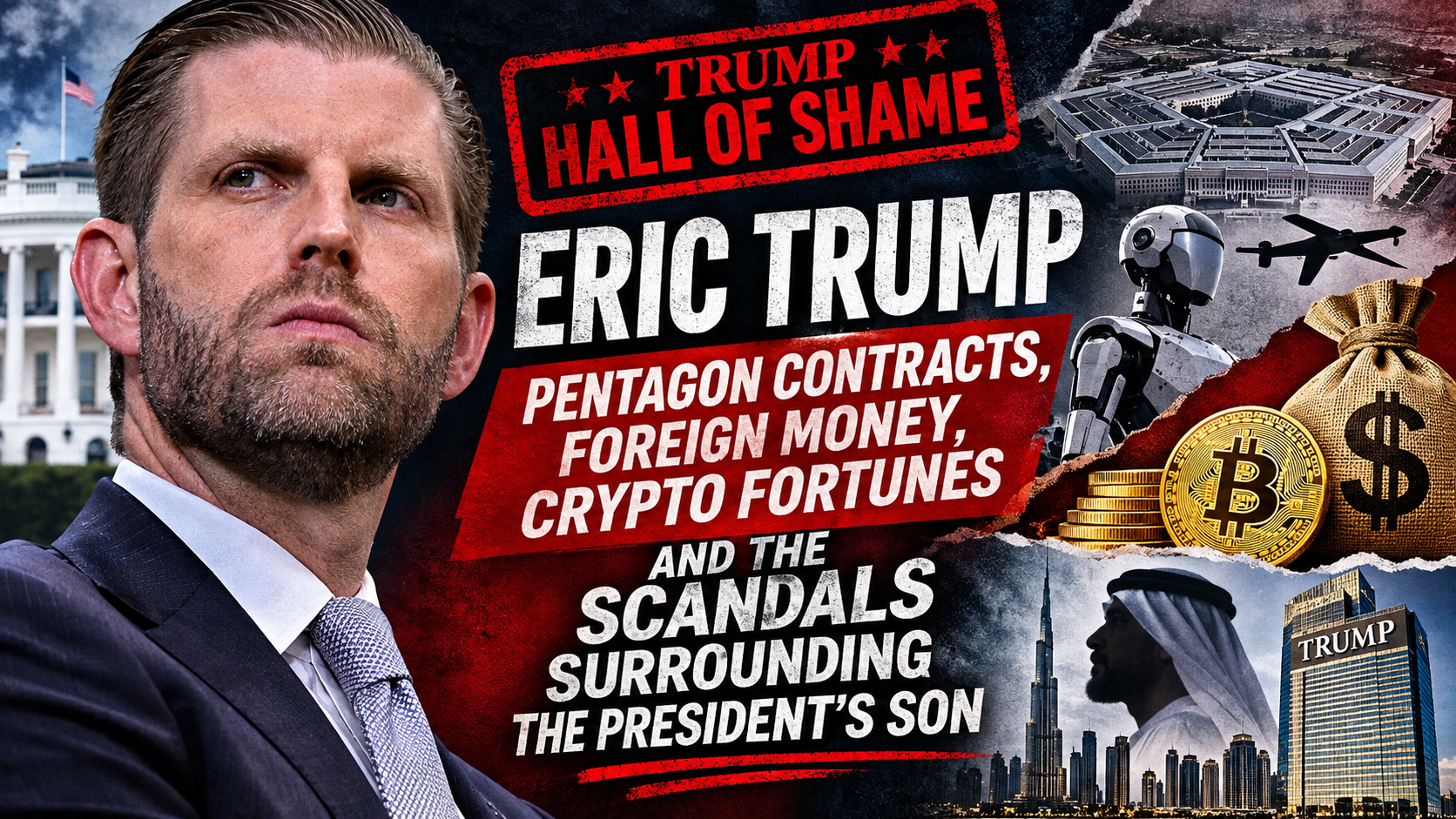
Justin Sun, SEC Enforcement and the Trump Family’s Cryptocurrency Investors
World Liberty Financial’s relationships with major cryptocurrency investors have also raised questions about the independence of federal financial regulators. Among those investors is Justin Sun, founder of the Tron blockchain network, who committed substantial funds to the Trump family venture while facing civil enforcement proceedings brought by the Securities and Exchange Commission.
The SEC had accused Sun and associated entities of securities-law violations involving unregistered offerings and alleged market manipulation. Sun disputed the allegations, while the Trump administration subsequently adopted a more favorable regulatory approach toward the cryptocurrency industry.
The timing of investments and enforcement developments generated concerns that wealthy cryptocurrency figures might gain favorable treatment through financial relationships with businesses associated with the president’s family. However, the existence of an investment and a change in regulatory posture does not independently establish that Eric Trump influenced the SEC or that agency officials acted improperly.
The broader issue is that the Trump family’s cryptocurrency holdings create potential financial interests in decisions made by agencies responsible for regulating those same markets. That relationship warrants disclosure and independent examination, especially when investors in family associated ventures are simultaneously seeking favorable treatment from federal regulators.
American Bitcoin, Chinese Mining Equipment and the Crypto Expansion
Eric Trump has also become a prominent participant in American Bitcoin, a cryptocurrency mining and accumulation venture developed in cooperation with Hut 8. The business expanded the family’s involvement beyond cryptocurrency tokens and stablecoins into the infrastructure required to mine, acquire and hold Bitcoin. American Bitcoin became publicly traded through a transaction involving Gryphon Digital Mining, attracting attention from investors interested in both the cryptocurrency market and the Trump family’s commercial activities. Eric Trump’s involvement included strategic responsibilities and public promotion of the venture.
The company operates in a volatile industry where profitability depends on Bitcoin prices, electricity costs, mining difficulty, financing arrangements and the market value of digital assets. Consequently, fluctuations in its valuation or reported losses should not be confused with evidence of financial misconduct. The precise accounting treatment of cryptocurrency holdings is essential when evaluating the company’s performance. The supplied research also identifies questions involving American Bitcoin’s relationship with Bitmain, a major Chinese manufacturer of specialized cryptocurrency mining equipment. Such arrangements may involve substantial hardware purchases, supplier financing and obligations secured by future Bitcoin production.
These relationships become particularly sensitive when the federal government is considering restrictions affecting Chinese technology companies or cryptocurrency infrastructure. A presidential family member’s financial exposure to businesses affected by those policies creates a potential conflict, although establishing improper influence would require evidence connecting specific government decisions to the family’s commercial interests.
Taxpayer Funded Secret Service Protection and Trump Family Business Trips
Eric Trump’s private business activities have also generated substantial taxpayer expenses because of the Secret Service protection provided to members of the president’s immediate family. A Government Accountability Office investigation released in 2019 found that the Secret Service spent approximately $396,000 protecting Eric Trump, Donald Trump Jr. and their spouses during three international trips in early 2017. The travel included visits to Uruguay, the Dominican Republic and the United Arab Emirates, where the family had commercial interests.
The same GAO report estimated that federal agencies spent approximately $13.6 million on four presidential trips to Mar-a-Lago during a separate period in early 2017. Those presidential travel costs should not be attributed personally to Eric Trump, but they illustrate the broader public expense associated with protecting a president and his family while they maintain extensive private business interests.
A separate investigation by Citizens for Responsibility and Ethics in Washington reported that Eric Trump’s January 2019 business trip to Uruguay cost taxpayers at least $80,786 in security-related expenses. The trip involved a Trump branded development in Punta del Este, and the watchdog organization questioned the appropriateness of substantial public expenditures associated with private commercial promotion.
Secret Service protection is a legitimate government responsibility, and the costs of protecting eligible family members are not inherently improper. The concern is that private commercial activities can create significant public expenses while the family businesses involved may simultaneously benefit from the publicity and business relationships generated by those trips.
Additional scrutiny has focused on federal payments to Trump-owned properties, including lodging charges incurred by protective agents. Those payments can create a financial benefit for the president’s business interests when taxpayer funds are spent at family owned hotels or resorts. Determining whether particular charges were excessive requires examination of invoices, applicable government lodging rates and the operational requirements of the protective detail.
Saudi Arabia: Trump Branded Resorts and Government-Connected Developers
Eric Trump’s role in the Trump Organization has increasingly involved international licensing and development projects, particularly in the Middle East. Saudi Arabia has become an important market through relationships with Dar Global, a developer associated with the Saudi real estate industry. The projects include Trump branded luxury residences, towers and golf related developments in Jeddah and the Diriyah area near Riyadh. These developments place the Trump brand within a rapidly expanding luxury property market shaped by Saudi Arabia’s economic diversification plans and substantial government backed infrastructure investment.
The potential conflict arises because Saudi Arabia is simultaneously a major participant in American foreign policy, military cooperation, arms sales and regional diplomacy. Decisions made by the Trump administration can have enormous consequences for Saudi interests, while development partnerships involving politically connected investors may generate substantial private revenue for the president’s family.
It is essential to distinguish the advertised value of these developments from the income received by the Trump Organization. A multibillion-dollar development does not mean Eric Trump or his family personally received billions of dollars. Licensing and management agreements typically generate a smaller portion of the overall project value, depending on their contractual terms.
The appropriate questions involve the ownership of development partners, the sources of financing, the fees paid to Trump entities, the role of government approvals and whether any official American decisions were influenced by those financial relationships.
Qatar, Dubai and Oman: Foreign Real Estate Deals and American Diplomacy
The Trump Organization’s international expansion has also included major projects in Qatar, the United Arab Emirates and Oman. These ventures involve luxury residential towers, hospitality developments, golf facilities and resort properties, often in markets where major real estate projects depend on government approvals and relationships with influential local investors.
Qatar presents particular sensitivities because of its military and diplomatic relationship with the United States. The country hosts important American military facilities and plays a prominent role in regional negotiations, making decisions by the White House potentially consequential for Qatari government interests.
The UAE presents a more direct financial concern because of the separately documented World Liberty Financial investment involving Sheikh Tahnoon. The overlap between cryptocurrency, banking, technology policy and Trump-branded real estate creates multiple channels through which private business relationships and official government interests may intersect.
Oman has also become part of the Trump Organization’s international development portfolio through luxury resort and golf-related projects. Although such developments can be legitimate commercial enterprises, the political prominence of the family involved makes transparency about ownership, financing and government approvals especially important.
There is no established evidence that each of these projects involved illegal payments or improper policy exchanges. Nevertheless, the volume of foreign business activity during Donald Trump’s presidency creates an unusually complex set of potential conflicts that would not exist for a president whose family had fully separated itself from international commercial ventures.
Vietnam, India and the Global Expansion of the Trump Brand
Beyond the Middle East, the Trump Organization has pursued international development opportunities in Vietnam, India and other markets. These projects generally involve licensing arrangements in which local developers provide capital and manage construction while paying to use the Trump brand.
Vietnam has attracted particular scrutiny because large golf and resort developments can require extensive land acquisition, infrastructure construction and government approvals. The supplied research raises questions about relocation arrangements and public assistance associated with a Trump-branded development, although the precise financial terms and government obligations require additional verification.
India has long been an important market for Trump branded luxury residential projects, demonstrating how the family can generate international revenue through licensing arrangements without directly financing the entire development. Such agreements may be commercially legitimate, but they create potential ethical concerns when foreign governments have significant diplomatic or economic interests before the American presidency.
The fundamental investigative questions are consistent across these markets: Who owns the development, who provides the financing, what fees does the Trump Organization receive, which public officials approve the project and whether those officials or their governments seek favorable treatment from Washington.
January 6 and Eric Trump’s Political Activities
Eric Trump’s political involvement has extended beyond campaign fundraising and appearances supporting his father. He participated in the January 6, 2021, rally in Washington before supporters of Donald Trump attacked the U.S. Capitol, and his communications became relevant to congressional inquiries into the effort to overturn the 2020 presidential election.
The House January 6 committee examined communications and activities involving individuals associated with the former president’s political operation. Eric Trump’s role as a prominent advocate for his father’s election claims made his activities relevant to the investigation’s broader examination of political organizing and efforts to challenge the certified election results.
Participation in the rally does not establish that Eric Trump directed the Capitol attack or committed a criminal offense. Nevertheless, his position as both a family business executive and a political surrogate demonstrates how closely the Trump Organization’s leadership has remained connected to Donald Trump’s political activities. That overlap is significant because Eric Trump has simultaneously participated in political messaging, managed family commercial interests and invested in businesses affected by federal decisions. The combination complicates efforts to distinguish his private financial role from his access to the president and the administration.
Presidential Pardons and the Limits of the Evidence
Eric Trump’s name has appeared in discussions about presidential clemency, particularly during the closing weeks of Donald Trump’s first term, when reports indicated that advisers considered preemptive pardons for members of the president’s family.
Those discussions attracted attention because presidential pardons can provide protection against federal criminal liability for covered past conduct. However, the available evidence does not establish that Eric Trump received such a pardon, and no verified public record reviewed for this article demonstrates that he personally arranged the clemency granted to Changpeng Zhao or other cryptocurrency executives.
The distinction matters. A business relationship between a presidential relative and a pardon recipient can create legitimate questions about influence, but it does not prove that the relative participated in the clemency process. Establishing such involvement would require communications, financial records, testimony or other evidence connecting the individual to the decision.
The appropriate focus is therefore on the transparency of the pardon process, the financial relationships involving recipients and Trump-connected businesses, and whether clemency decisions were influenced by considerations unrelated to the traditional purposes of presidential mercy.
What Federal Investigators and Congress Should Examine
The expanding financial network surrounding Eric Trump presents several areas where congressional oversight and independent investigation could clarify whether government decisions were made impartially.
Defense procurement records should establish whether companies connected to his investments received competitive treatment and whether political appointees influenced contracting decisions. Public-health procurement records should explain why XpresTest was selected for major international disease-response work despite its limited experience overseas. Financial disclosures should identify the size and structure of Eric Trump’s interests in companies benefiting from government policy.
The World Liberty Financial transactions warrant particular attention because they involve foreign investors with direct interests in American technology, banking and national security decisions. Investigators should determine whether the UAE investment received appropriate regulatory review, whether government officials had knowledge of the family’s financial relationships and whether those relationships were considered when making decisions affecting the investors.
The IRS settlement presents a different accountability issue: whether federal officials appropriately protected the government’s interests when negotiating extraordinary legal restrictions benefiting the president and his relatives. The New York civil fraud case and Weisselberg severance agreement also remain relevant because they provide documented evidence about Eric Trump’s role in managing sensitive financial and legal matters inside the Trump Organization.
None of these inquiries should begin with the assumption that every contract or investment is illegal. Their purpose should be to establish whether the same decisions would have been made under the same conditions for businesses without direct family connections to the president.
Why Eric Trump Belongs in South Florida Media’s Trump Hall of Shame
Eric Trump’s public record is not defined by a single questionable transaction or isolated political controversy. It encompasses years of documented financial disputes, significant taxpayer expenses, judicial findings in a civil fraud case, controversial charitable transactions and an increasingly complex network of businesses operating in industries heavily influenced by federal government decisions.
The Eric Trump Foundation investigation raised serious questions about the handling of charitable contributions intended to help children with cancer. The New York civil fraud case resulted in judicial findings against him, although the original financial penalties were subsequently overturned on appeal. His role in negotiating Allen Weisselberg’s restrictive $2 million severance agreement is documented, as are the substantial public expenses associated with protecting him during international business travel.
His more recent financial activities have introduced additional concerns. Companies connected to his investment network have received significant federal contracts, while his cryptocurrency ventures have attracted substantial foreign capital from politically influential investors. The $500 million UAE transaction is especially consequential because Eric Trump personally signed an agreement linking the family business to a foreign national security official whose government had major interests before the White House.
The May 2026 IRS settlement adds another extraordinary dimension. While the underlying tax-information leak was unlawful, the resulting agreement provided broad protections against certain historical tax claims for the president and his family, including Eric Trump, through an administration controlled by his father.
These facts do not establish that every business venture is corrupt or that Eric Trump personally directed federal officials to award contracts, grant pardons or change regulatory decisions. But they demonstrate a concentration of potential conflicts that would demand serious scrutiny in any administration committed to transparent government and equal treatment under the law.
The central question is whether presidential power has become an advantage for the Trump family’s private businesses, and whether the institutions responsible for preventing conflicts of interest remain sufficiently independent to investigate them.
For South Florida Media’s Trump Hall of Shame, Eric Trump’s inclusion rests on the documented record and the unresolved questions it raises. The public should not have to rely on assurances from the president’s family that their financial interests have no influence on government decisions. Those assurances should be tested against contracts, financial disclosures, agency records and independent oversight.
The ultimate standard is simple: Would these same contracts, investment opportunities, regulatory decisions and legal protections have been available to an ordinary American business executive without the Trump name?
Until the public can answer that question with confidence, Eric Trump’s growing business empire will remain a significant test of presidential ethics, government accountability and the separation of public power from private family wealth.

Sources & Further Reading
Government records, court documents and congressional oversight
-
House Oversight Democrats — May 2026 Letter Concerning Trump Family Defense Contracts
-
U.S. Department of Justice — Trump v. IRS Settlement Agreement
-
CBS News — IRS Settlement Restricts Historical Tax Claims Against Trump and His Sons
-
New York State Courts — People v. Trump, August 2025 Appellate Decision
-
Government Accountability Office — Presidential and Trump Family Travel Expenses
Investigative reporting and financial records
-
ProPublica — Trump Sons-Linked Company Receives Nearly $40 Million in Federal Biosecurity Contracts
-
Financial Times — Eric Trump-Backed Robotics Company in Talks With Israeli Military
-
Forbes — How Children’s Cancer Charity Money Flowed Into Trump Businesses
-
Forbes — Eric Trump Foundation Donations Directed to Other Organizations
-
The Washington Post — UAE Investors Purchase Major Stake in Trump Family Crypto Business
-
Reuters — Federal Lenders Not Pursuing $1.6 Billion Kazakhstan Mining Financing
-
Reuters — IRS Settlement Bars Specified Historical Tax Claims Against Trump Family
-
CBS News — Eric Trump Foundation Golf Course Billing Controversy
-
South Florida Media — Political Investigations and Trump Hall of Shame


Loading comments…