
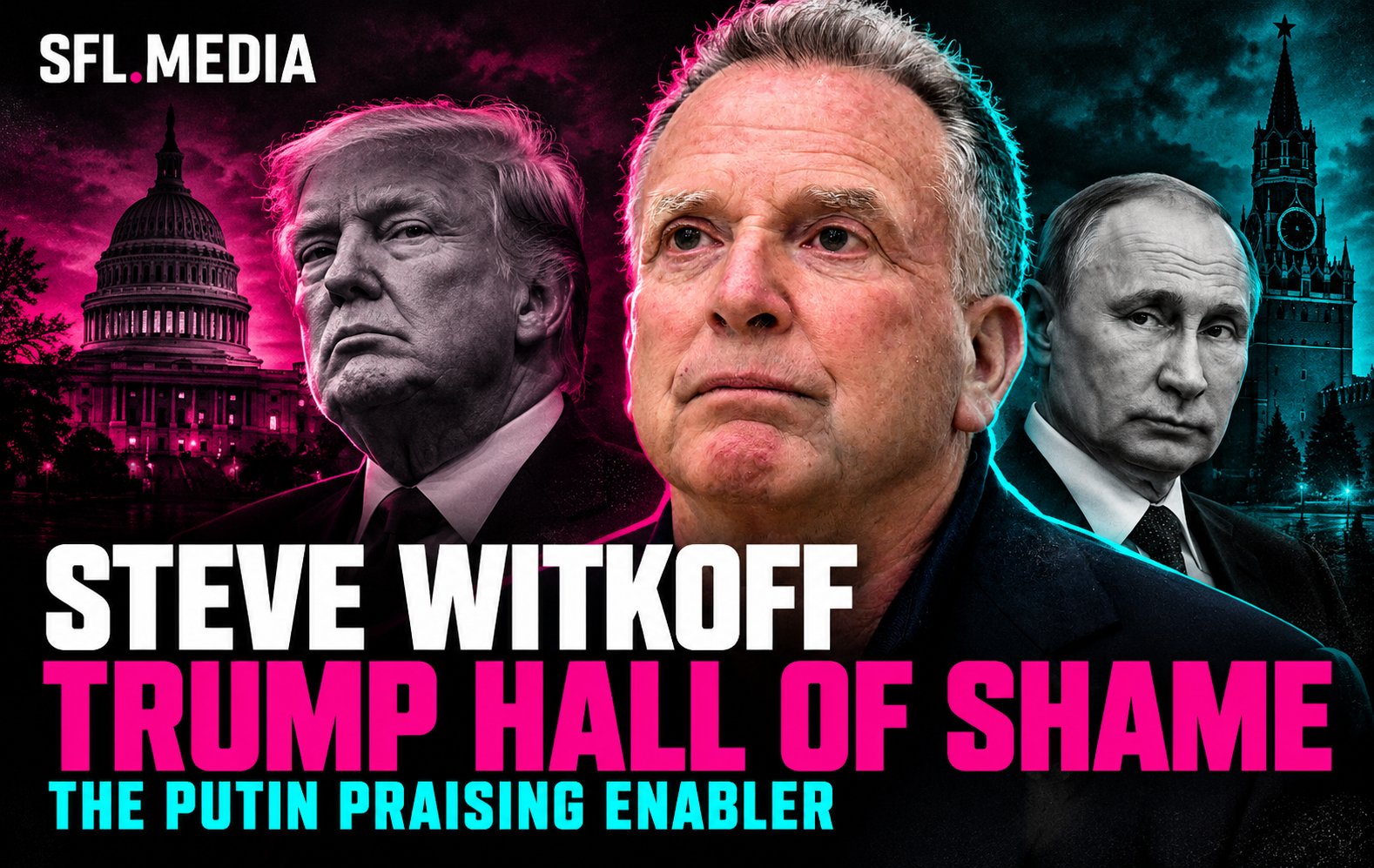
Trump Hall of Shame: Steve Witkoff, the Trump Enabler Who Called Putin a “Humanitarian”
Steve Witkoff enters South Florida Media’s Trump Hall of Shame for helping turn Donald Trump’s deeply personal approach to power into American diplomacy. A longtime presidential friend and real-estate associate, Witkoff has carried Trump’s transactional worldview into negotiations involving war, territorial sovereignty and authoritarian governments while his family’s business relationships have generated substantial questions about foreign influence and conflicts of interest.
His defining contribution to that record came on October 21, 2026, when he called Vladimir Putin a “humanitarian.” The remark followed Russia’s release of a wrongfully detained American, but its implications extended well beyond that welcome development. An American envoy had offered a sweeping compliment to the Russian leader whose invasion devastated Ukraine and whose alleged responsibility for the unlawful transfer of Ukrainian children prompted an International Criminal Court arrest warrant.
Witkoff’s induction is an editorial judgment about his conduct as a Trump enabler. His record shows how personal loyalty, accommodating treatment of authoritarian power and overlapping family financial interests can converge around an American president. The criticism does not depend on inventing a criminal conviction or declaring an unproven bribe. It rests on what Witkoff has said, how he has negotiated and the financial relationships that have followed his family into the orbit of public power.
From Trump’s Inner Circle to the Global Negotiating Table
Witkoff’s relationship with Trump developed over decades. He has recounted buying Trump a sandwich during an early encounter, later testified for the defense in Trump’s 2023 New York civil fraud trial and remained close enough to be golfing with him in West Palm Beach during the September 2024 assassination attempt.
Those episodes establish proximity, not wrongdoing. Their importance is that Witkoff’s route to diplomatic authority ran through personal trust and business world familiarity rather than a career in foreign service. Trump elevated a friend whose experience centered on real estate into a role involving some of the world’s most dangerous conflicts. The problem is not that an outsider can never negotiate effectively. It is that the responsibilities of representing the United States require more than confidence in a dealmaker’s instincts. They require preparation, independent judgment, reliable institutional support and credible boundaries between public duties and private interests. Witkoff’s record raises questions in each of those areas.
The Putin Compliment That Exposed the Problem
During his October 21 meeting with Putin in St. Petersburg, Witkoff welcomed the release of Stephen Hubbard, a 74 year old American whom Washington had designated wrongfully detained. He then told the Russian president:
“You are a humanitarian also, sir, and I salute that. I commend you.”
Hubbard’s freedom deserved celebration. Extending that gratitude into a public endorsement of Putin’s humanitarian character was Witkoff’s choice, and it illustrates the indulgent approach to authoritarian leaders that has drawn criticism of Trump’s foreign policy. Republican Sen. Thom Tillis responded, “WTF, Steve?” and called the comment embarrassing and outrageous. The distinction should have been obvious to an American envoy. Securing a detained citizen’s release is an achievement; rehabilitating the reputation of the leader whose government imprisoned him is an unnecessary concession. Witkoff supplied the praise anyway.
The Record Behind Putin’s Carefully Managed Image
The International Criminal Court issued an arrest warrant for Putin in March 2023 over alleged war crimes involving the unlawful deportation and transfer of Ukrainian children. That warrant is not a conviction, but it reflects a judicial finding of reasonable grounds to believe he bears criminal responsibility. Putin’s record also includes Britain’s public inquiry into the killing of Alexander Litvinenko, who died after being poisoned with radioactive polonium 210 in London. The inquiry concluded in 2016 that the Russian security service operation was probably approved by Putin.
An envoy does not need to recite every allegation at every meeting. He should, however, understand the difference between maintaining a negotiating channel and granting an authoritarian leader a moral endorsement. Witkoff’s language blurred that distinction in Putin’s favor.
Giving Kremlin Arguments an American Voice
Witkoff’s favorable language about Putin did not begin with Hubbard’s release. In his March 2025 interview with Tucker Carlson, he said, “I don’t regard Putin as a bad guy,” and recounted delivering a portrait of Trump commissioned by the Russian president. More significantly, Witkoff invoked Russian organized referendums as evidence that residents of occupied Ukrainian territories wanted Russian rule. That presentation gave credibility to a central Kremlin argument for retaining territory seized from Ukraine.
The United Nations General Assembly had already rejected the legal validity of the 2022 occupation referendums and Russia’s attempted annexations. Treating those exercises as persuasive evidence of popular consent obscures the coercive circumstances and sovereignty violations surrounding them. This is where Witkoff’s role as an enabler becomes consequential. An American representative who repeats Moscow’s preferred framing helps make that framing sound like an acceptable foundation for American policy. Understanding an adversary’s position is necessary. Lending it legitimacy without adequately confronting its foundations weakens the distinction between negotiation and accommodation.
Helping Moscow Navigate Trump
A leaked telephone conversation provided another troubling example. Bloomberg published a transcript of an October 14, 2025, call in which Witkoff advised Putin aide Yuri Ushakov on approaching Trump, including using praise of Trump’s Gaza diplomacy as an opening. Reuters subsequently reported Moscow’s objections to the leak. Trump defended the approach as ordinary negotiating practice. Nevertheless, the episode showed an American envoy helping a Kremlin official frame an appeal to the American president.
For the Hall of Shame, the significance is the personalized system it revealed: foreign diplomacy conducted partly through an understanding of what flatters Trump. The call does not prove espionage. It raises a serious question about whether Witkoff’s access was advancing American objectives or helping Moscow navigate the president’s preferences.
Negotiating Without an Independent Interpreter
Witkoff’s negotiating practices also attracted scrutiny. NBC News reported in May 2025 that he relied on Kremlin provided interpretation during meetings with Putin instead of bringing his own American interpreter. CNN subsequently examined the arrangement. Independent interpretation helps protect the accuracy of discussions and a government’s ability to maintain its own reliable account. Depending on the opposing government’s interpretation creates an avoidable vulnerability.
There is no established finding that an interpreter deliberately altered a particular statement. The documented concern is the decision to dispense with an important safeguard in negotiations where wording, nuance and competing interpretations can have substantial consequences.
Foreign Money and the Trump Witkoff Business Connection
The financial questions surrounding Witkoff make those concerns more serious. The Wall Street Journal reported that an Abu Dhabi backed investment vehicle agreed to purchase 49% of World Liberty Financial for $500 million on January 16, 2025, four days before Trump’s inauguration. At least $31 million was slated to flow to entities affiliated with the Witkoff family. The investment was linked to Sheikh Tahnoon bin Zayed Al Nahyan, the United Arab Emirates’ national security adviser. Subsequent American decisions concerning Emirati access to advanced artificial-intelligence chips intensified scrutiny of the relationship between private investment and public policy.
Rep. Ro Khanna sought records about the transaction and its national security implications. The investment’s timing warrants examination, but it does not independently establish that an American policy decision was purchased. The enabling relationship extends beyond political loyalty: the Trump and Witkoff families helped build a private financial venture while their most prominent members acquired extraordinary public authority. That overlap demands transparency and independent scrutiny.
The Separate $2 Billion Stablecoin Transaction
A different transaction brought another foreign backed institution into contact with the families’ venture. In May 2025, Zach Witkoff announced that World Liberty’s USD1 stablecoin had been selected to settle Emirati investment firm MGX’s $2 billion investment in Binance. The money was invested in Binance using World Liberty’s product. It was not a $2 billion personal payment to Steve Witkoff. Sens. Elizabeth Warren and Jeff Merkley nevertheless sought records concerning the arrangement and its potential benefits to the families. The question is why a major foreign backed transaction was routed through a financial product associated with the president’s family and the family of his Middle East envoy. That is a legitimate accountability issue without misrepresenting the transaction as a proven payoff.
Extraordinary Income and Disputed Financial Boundaries
Bloomberg reported in September 2026 that Witkoff disclosed approximately $107 million in 2025 income from a holding company that had owned his World Liberty stake. The disclosure did not provide sufficient detail to establish how much came from World Liberty itself.
ABC News also examined the disclosure. The White House told the network that Witkoff had fully divested from World Liberty and that his previous commercial activities were unrelated to his diplomacy.
That response must be included. It does not eliminate questions about when the separation occurred, how it was structured or what interests existed during earlier negotiations. Those questions require records and independent examination, not assumptions that every dollar represented wrongdoing.
Lawmakers Demanded Independent Scrutiny
On January 8, 2026, Reps. Gregory Meeks, Gabe Amo and Robert Garcia requested investigations by the acting inspectors general of the Commerce and State departments into potential conflicts of interest and ethics violations involving Witkoff. Their concerns included his relationship with World Liberty, its foreign connections and disclosures that appeared inconsistent with earlier statements about stepping away.
Reuters separately reported that Sens. Warren and Chris Murphy had questioned possible financial conflicts in November 2025 and sought information about Witkoff’s holdings and ethics arrangements. Those were oversight requests, not findings of criminal guilt. They demonstrate that the financial questions had developed into formal demands for government accountability.
Gulf Fundraising While His Father Conducted Diplomacy
The New York Times reported in September 2025 that Alex Witkoff sought Gulf investment for a real-estate fund while his father conducted Middle East diplomacy. Subsequent coverage said the proposed fund sought approximately $4 billion, Qatar declined to invest and the initiative was shelved. The White House and Witkoff Group disputed the reporting. The reported overlap raises a concern about diplomatic access and family business opportunities. It should not be rewritten as a completed foreign payment, but neither should the question disappear because the proposed investment did not materialize.
Witkoff also had significant earlier financial ties involving Qatar. Qatar Investment Authority purchased Manhattan’s Park Lane Hotel from a venture involving Witkoff and Mubadala for approximately $623 million in 2023, before his envoy appointment. That transaction establishes a substantial prior business relationship; it does not, by itself, establish bribery.
Why Steve Witkoff Belongs in the Trump Hall of Shame
Trump’s exercise of power depends on people willing to carry his preferences into institutions that are supposed to serve the public. Witkoff’s importance lies in his ability to translate presidential friendship into diplomatic authority, to make Trump’s personal relationships part of America’s negotiating machinery and to operate amid financial entanglements that demand more scrutiny than assurances from the White House can provide.
His induction rests on that conduct: praising Putin, lending credibility to Kremlin territorial arguments, advising Moscow on approaching Trump, accepting avoidable negotiating vulnerabilities and serving while his family’s business relationships generated serious conflict questions. The United States can pursue peace without flattering authoritarian leaders. It can appoint unconventional negotiators while requiring expertise, safeguards and financial transparency. Witkoff’s record shows the cost of treating those expectations as secondary to the president’s confidence in a friend. For South Florida Media, that is what makes him a Trump enabler and why he earns a place in the Trump Hall of Shame.
Sources & Further Reading
- The Wall Street Journal — Witkoff’s “humanitarian” praise of Putin www.wsj.com
- CBS News — Republican backlash to Witkoff’s remarks www.cbsnews.com
- International Criminal Court — Putin arrest warrant concerning Ukrainian children www.icc-cpi.int
- British Government — Findings of the Litvinenko inquiry www.gov.uk
- Detector Media — Transcript of Witkoff’s March 2025 Carlson interview detector.media
- United Nations — Rejection of Russia’s attempted annexations press.un.org
- Reuters — Leaked call involving Witkoff and Putin aide Yuri Ushakov www.investing.com
- CNN — Examination of Kremlin-provided interpretation transcripts.cnn.com
- The Wall Street Journal — $500 million Emirati investment in World Liberty Financial www.wsj.com
- Rep. Ro Khanna — Records request concerning the UAE investment democrats-selectcommitteeontheccp.house.gov
- Reuters — USD1 selected for MGX’s $2 billion Binance investment www.reuters.com
- Senate Banking Committee Democrats — Warren and Merkley’s records request www.banking.senate.gov
- Bloomberg — Witkoff’s holding-company income disclosure news.bloomberglaw.com
- ABC News — Financial disclosure and White House divestment response abcnews.com
- House Foreign Affairs Committee Democrats — Request to investigate potential Witkoff conflicts democrats-foreignaffairs.house.gov
- Reuters — Senators question possible financial conflicts www.reuters.com
- The Times of Israel — Gulf fundraising report, outcome and denials www.timesofisrael.com
- Commercial Observer — Qatar’s Park Lane Hotel purchase commercialobserver.com
- Courthouse News — Witkoff’s testimony in Trump’s civil fraud trial api.courthousenews.com
- ABC News — Witkoff’s presence during the West Palm Beach assassination attempt abcnews.com

























Want to join the conversation?
Create an account or sign in to share your thoughts, vote,
and reply to other readers.
Showing 0 of 0 comments
Don't have an account?
Already have an account?