

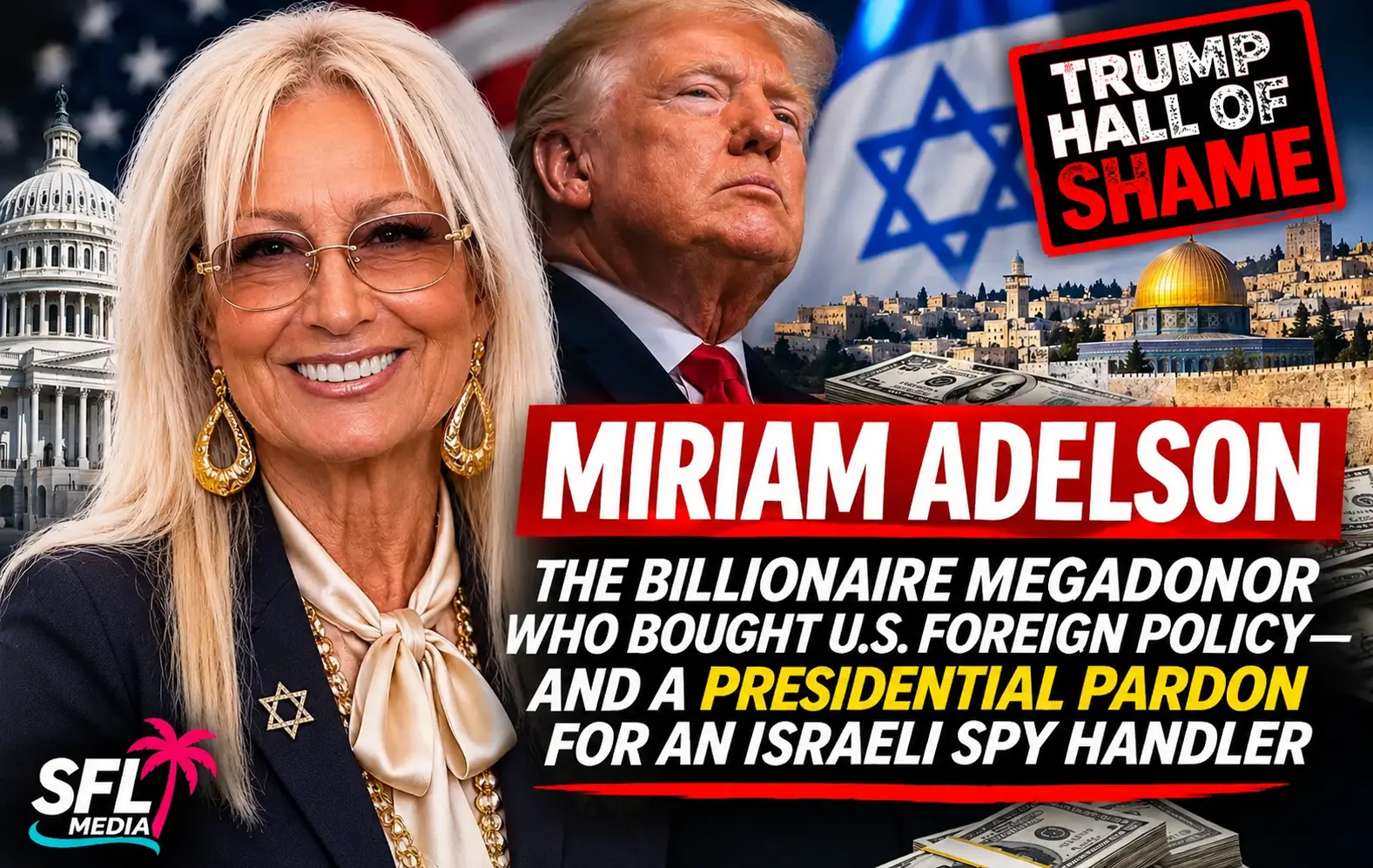
Miriam Adelson: The Billionaire Trump Megadonor Whose Political Fortune Reaches From the White House to Israel
Miriam Adelson has poured hundreds of millions of dollars into Republican politics alongside her late husband and, more recently, as one of Donald Trump’s most important individual financial supporters. Her influence extends beyond campaign advertising into debates over American foreign policy, Israeli territorial ambitions, presidential clemency, and the role of private wealth in democratic government. One of the most revealing episodes in that relationship came when the Trump White House explicitly named Adelson among the supporters of a presidential pardon for an Israeli intelligence officer implicated in one of America’s most notorious espionage scandals.
The billionaire physician, casino investor, newspaper publisher, and political donor became the principal steward of the Adelson family’s political empire following the death of her husband, Las Vegas Sands founder Sheldon Adelson, in January 2021. Together, the couple had become among the Republican Party’s largest financial benefactors, supporting presidential campaigns, congressional candidates, conservative advocacy organizations, and causes closely associated with Israel. Since her husband’s death, Adelson has continued that political activity independently, contributing approximately $100 million to a pro-Trump super PAC during the 2024 presidential election and at least $67.6 million to federal political committees during the 2026 midterm cycle.
Unlike many wealthy donors whose political involvement remains largely behind the scenes, Adelson has openly advocated specific foreign policy outcomes, maintained relationships with Republican leaders, and received the Presidential Medal of Freedom from Trump in 2018. Her political activities have also extended into Israeli affairs through ownership of the newspaper Israel Hayom, financial support for pro-Israel organizations, and advocacy concerning the occupied West Bank.
Her defenders characterize this record as lawful political participation rooted in strongly held convictions about Israel, American national security, and conservative economic policy. Critics argue that it illustrates a deeper structural problem in American democracy: a campaign-finance system that allows extraordinarily wealthy individuals to gain sustained access to elected officials while advocating policies with consequences far beyond the United States. The available record establishes Adelson’s extensive political spending and access, but it does not establish that she illegally purchased government decisions.
From Physician to Political Power Broker
Born Miriam Farbstein in Tel Aviv in 1945, Adelson trained as a physician and developed a medical career involving addiction treatment and research. She married Sheldon Adelson in 1991, becoming part of a family whose casino and resort company, Las Vegas Sands, expanded into a major international business with substantial operations in Macau and Singapore. Following her husband’s death, Adelson retained significant business and investment interests while becoming the family’s most prominent political representative. Her holdings include a major ownership interest in Las Vegas Sands, the family’s controlling stake in the NBA’s Dallas Mavericks, and ownership of the Israeli newspaper Israel Hayom. The Mavericks transaction, completed in late 2023, valued the basketball franchise at approximately $3.5 billion and brought the Adelson family into the center of Texas professional sports and business politics.
Adelson’s wealth has fluctuated with financial markets and the value of the family’s holdings, consistently placing her among the world’s wealthiest women. Her political significance, however, comes less from any single net worth estimate than from the enormous resources she can direct toward campaigns, advocacy organizations, and political initiatives. Through super PACs and other organizations, Adelson has contributed sums far exceeding the limits imposed on direct donations to federal candidates. Those contributions are generally permitted under federal campaign finance law, provided applicable disclosure and independence requirements are followed, but the scale of the spending has intensified questions about whether ordinary voters and billionaire donors possess anything approaching equal political influence.
Hundreds of Millions in Republican Political Contributions
The Adelson family’s financial relationship with Trump began during the 2016 presidential election, when Miriam and Sheldon Adelson supported organizations working to elect the Republican nominee. Their political spending expanded substantially during Trump’s first presidency, with major contributions supporting Republican congressional candidates and the president’s reelection campaign.
During the 2018 midterm elections, the couple contributed more than $100 million to Republican political organizations, making them among the party’s largest financial supporters. Their giving coincided with significant changes in American Middle East policy, including the relocation of the U.S. Embassy to Jerusalem and withdrawal from the Iran nuclear agreement, both of which aligned with positions the Adelsons had advocated.
In 2020, the couple contributed approximately $90 million to Preserve America PAC, a super PAC supporting Trump’s reelection campaign. Following Sheldon’s death, Miriam Adelson continued the family’s political spending, providing more than $100 million to Preserve America during the 2024 presidential election cycle. Federal Election Commission disclosures reported in October 2024 showed that she had already contributed $100 million through a series of installments, demonstrating the extraordinary scale of her independent financial support for Trump’s return to office.
Her political activity continued during the 2026 midterms, when Federal Election Commission records reviewed by Front Office Sports showed that Adelson contributed at least $67.6 million to federal political committees. The spending included $30 million to the Senate Leadership Fund, $10 million to the Congressional Leadership Fund, and $25 million to MAGA Inc., along with contributions to other Republican organizations. The total made her the largest political spender among major American professional sports team owners during the election cycle.
These figures establish the scale of Adelson’s political activity, although lifetime totals require careful accounting because some estimates combine donations from both spouses while others count Miriam Adelson’s individual contributions. Claims that she personally donated exactly $441.9 million across 83 transactions have not been independently reconciled against the complete Federal Election Commission record and should not be treated as a definitive total.
Trump Once Criticized the Adelsons’ Political Influence
The relationship between Trump and the Adelson family carries an irony dating to the 2016 Republican presidential primary. Before securing the nomination, Trump criticized rival Marco Rubio’s connections to Sheldon Adelson, suggesting that the casino billionaire’s financial support would make Rubio beholden to a wealthy political benefactor. The criticism reflected one of Trump’s central campaign arguments: that major donors exercised excessive influence over conventional politicians while he, as a wealthy businessman, could operate independently of their financial support. After securing the Republican nomination, however, Trump accepted substantial assistance from Adelson-backed political organizations, and the relationship developed into one of the most financially important alliances of his political career.
For the Adelsons, Trump offered an opportunity to advance conservative domestic policies and a more confrontational American approach toward Iran, while supporting Israeli territorial and diplomatic priorities. For Trump, the family’s financial resources helped support expensive national campaigns. The alliance demonstrates how political relationships can change when electoral interests and policy preferences converge, even when those relationships appear inconsistent with earlier campaign rhetoric.
The Iran Nuclear Deal and the Adelsons’ Foreign Policy Agenda
The Adelsons were prominent supporters of a hardline American approach toward Iran and opponents of the 2015 Joint Comprehensive Plan of Action, the nuclear agreement negotiated by the Obama administration alongside Britain, France, Germany, Russia, China, and the European Union. The agreement imposed restrictions and international monitoring requirements on Iran’s nuclear program in exchange for sanctions relief, but Republican critics argued that it failed to adequately address Tehran’s regional military activities and would eventually allow Iran to expand its nuclear capabilities.
Sheldon Adelson had advocated an especially confrontational approach toward Iran before Trump’s election, while Miriam Adelson continued supporting political leaders who opposed the agreement. In May 2018, Trump withdrew the United States from the nuclear deal and reinstated sanctions under a policy of maximum economic pressure. The decision aligned with the Adelsons’ publicly expressed preferences and marked a major departure from the diplomatic approach pursued by the previous administration.
The withdrawal generated substantial international controversy. European allies sought to preserve the agreement, while critics argued that abandoning its restrictions would make it more difficult to contain Iran’s nuclear program and increase the risk of regional confrontation. Supporters countered that economic sanctions and diplomatic pressure were necessary to confront Iran’s government and its activities throughout the Middle East.
The Adelsons’ financial contributions and advocacy demonstrate that they supported the direction Trump adopted. They do not establish that Trump withdrew from the agreement in exchange for campaign donations, and the available evidence does not support treating the policy decision as a proven financial transaction.
Jerusalem, the Golan Heights, and the Presidential Medal of Freedom
Another major priority for the Adelsons was relocating the American Embassy in Israel from Tel Aviv to Jerusalem, a move they had advocated for years. Trump formally recognized Jerusalem as Israel’s capital in December 2017, and the embassy opened there in May 2018, fulfilling a longstanding objective of conservative pro Israel organizations and Republican political donors.
The decision was celebrated by the Israeli government and many American supporters of Israel, who argued that Jerusalem’s status as the country’s capital should be formally recognized by Washington. Palestinian leaders and numerous international governments opposed the unilateral recognition, maintaining that Jerusalem’s final status should be resolved through negotiations rather than determined in advance by the United States.
In March 2019, Trump also recognized Israeli sovereignty over the Golan Heights, territory Israel captured from Syria during the 1967 war and effectively annexed in 1981. Most of the international community continues to regard the territory as occupied Syrian land, making the American recognition another significant departure from longstanding diplomatic positions.
Between those decisions, Trump awarded Miriam Adelson the Presidential Medal of Freedom on November 16, 2018. The White House cited her medical career, addiction research, philanthropy, and humanitarian activities, while critics questioned whether the honor also reflected her extraordinary financial support for Trump’s political operation.
The Presidential Medal of Freedom is the nation’s highest civilian honor, and presidents possess broad discretion over its recipients. There is no established finding that Adelson received the award in exchange for political contributions. Nevertheless, the combination of major campaign donations, presidential access, and a prestigious national honor intensified scrutiny of the relationship between the administration and one of its most important financial supporters.
The West Bank Annexation Controversy
Adelson’s advocacy regarding Israeli sovereignty over the occupied West Bank has generated some of the sharpest criticism of her political influence. The territory, captured by Israel during the 1967 war, remains central to the Israeli-Palestinian conflict and international proposals for establishing an independent Palestinian state alongside Israel.
Adelson has supported Israeli settlement institutions and organizations operating in the West Bank, including educational and philanthropic initiatives associated with the settlement movement. Her financial support reflects a longstanding commitment to Israeli nationalist priorities that extend beyond conventional American support for Israel’s security.
During the 2024 presidential campaign, reports circulated suggesting that Adelson’s substantial financial support for Trump was linked to expectations that he would support Israeli annexation of the West Bank. The reports raised questions about whether American foreign policy commitments were being shaped by the preferences of a major political donor, but Adelson’s spokesperson denied that her support was conditioned on Trump’s endorsement of annexation.
That denial is important. Her opposition to Palestinian statehood and support for Israeli sovereignty claims are documented, but the available record does not establish a binding arrangement in which Trump accepted $100 million in exchange for an annexation commitment.
The stakes extend far beyond American domestic politics. The International Court of Justice and numerous international bodies have concluded that Israel’s settlement policies in the occupied Palestinian territories violate international law, while Israeli governments and settlement supporters dispute aspects of those legal interpretations. Formal annexation would raise additional questions about Palestinian self-determination, regional stability, and the future of a negotiated two state solution.
The Presidential Pardon of an Israeli Espionage Figure
One of the most revealing episodes in Adelson’s relationship with Trump occurred during the final hours of his first presidency, when the White House explicitly identified her as a supporter of a presidential pardon involving one of the most notorious espionage cases in American Israeli relations.
On January 19, 2021, Trump granted a full and unconditional pardon to Aviem Sella, a former Israeli Air Force officer indicted in connection with the espionage activities of Jonathan Pollard, a U.S. Navy intelligence analyst who provided classified American information to Israel during the 1980s. Pollard pleaded guilty to conspiracy to commit espionage and received a life sentence in 1987, eventually leaving prison in 2015 after serving approximately 30 years.
Sella was accused of recruiting and directing Pollard’s espionage activities but remained outside American custody and never stood trial in the United States. Trump’s pardon eliminated the federal criminal exposure covered by the clemency grant, despite the absence of a trial or conviction. The official Justice Department pardon document identifies the charges covered by the decision, while the White House announcement specifically named Israeli Prime Minister Benjamin Netanyahu, Israeli Ambassador Ron Dermer, U.S. Ambassador David Friedman, and Miriam Adelson as supporters of Sella’s request.
The administration stated that Israel had apologized for the espionage episode and sought the pardon as a step toward closing a difficult chapter in relations between the two countries. Adelson’s inclusion in the official announcement provides direct documentary evidence of her involvement in advocating a presidential clemency decision involving national security, distinguishing the episode from broader allegations about donor influence that rely on political interpretation.
The record does not establish that Adelson purchased the pardon or that Trump granted it in exchange for political contributions. It does establish that one of the president’s largest financial supporters joined senior Israeli officials in advocating clemency for a man charged in an espionage case involving the transfer of American secrets to a foreign government. The significance lies in the documented access and advocacy surrounding a consequential presidential decision, not in an unsupported allegation of criminal bribery.
Trump, Adelson, and the $250 Million Third Term Remark
The relationship between Trump and Adelson produced another extraordinary moment during a White House Hanukkah reception on December 16, 2025, when the president publicly acknowledged the scale of her political contributions and discussed receiving additional financial support if he pursued another term in office. Trump told attendees that Adelson had contributed approximately $250 million to his political campaigns, directly and indirectly, and invited her to address the gathering. During her remarks, Adelson referenced a conversation with attorney Alan Dershowitz about the possibility of Trump serving four additional years despite the constitutional prohibition against being elected president more than twice.
Trump then told the audience that Adelson had offered “another $250 million” if he pursued the idea. Adelson responded, “I will give.” The exchange drew laughter but also highlighted the extraordinary financial resources available to one of Trump’s closest political supporters and the willingness of those supporters to publicly discuss extending his presidency beyond established constitutional limits.
The 22nd Amendment prohibits a person from being elected president more than twice, and no ordinary legal mechanism permits Trump to seek a third elected term under the existing constitutional framework. Although the exchange occurred in a celebratory setting and did not constitute a formal campaign announcement or binding financial commitment, it remains a striking illustration of the relationship between presidential power and billionaire political financing.
The official transcript confirms the exchange, but it does not establish that Adelson transferred another $250 million or that Trump formally accepted a future campaign contribution. Trump’s description of her previous donations is also his own characterization, rather than an independently reconciled accounting of her individual contributions.
Israel Hayom and the Power of Media Ownership
Adelson’s political influence extends through her family’s ownership of Israel Hayom, a major Israeli newspaper long associated with conservative and pro Netanyahu political positions. Founded with financial backing from Sheldon Adelson, the publication became one of Israel’s most widely distributed newspapers, offering free circulation that helped it compete with established commercial news organizations.
Critics have described the newspaper as a platform for promoting political priorities favorable to Netanyahu and the Adelson family’s ideological interests. Supporters counter that its editorial positions represent legitimate political viewpoints and that the publication helped diversify an Israeli media market previously dominated by established competitors.
The significance of the ownership arrangement is that Adelson’s influence is not limited to financing politicians. Through a major media institution, her family also controls a platform capable of shaping public debate, promoting policy arguments, and reaching audiences in Israel and abroad. The combination of political spending, media ownership, and relationships with government leaders has made the Adelsons prominent figures in debates about the concentration of private influence over democratic institutions.
Her ‘Dead to Us’ Editorial and the Politics of Protest
Adelson attracted further controversy in November 2023 when she published an opinion column titled Dead to Us in Israel Hayom, following the October 7 Hamas attacks on Israel and the outbreak of the Gaza war. In the column, she condemned people she accused of celebrating or excusing Hamas’s violence, directing particular criticism toward pro Palestinian activists, progressive organizations, and protest movements she believed had failed to adequately condemn the attacks.
Her rhetoric extended beyond criticism of particular demonstrations. Adelson advocated socially and politically isolating those she regarded as supporters or enablers of Hamas, including denying them employment and public office and withdrawing financial support from institutions associated with them. The column reflected her deeply held views about Israel’s security and the international response to the October 7 attacks, but it also raised questions about the boundaries between condemning antisemitism and punishing political dissent.
Civil liberties advocates maintain that criticism of Israeli government policy, including opposition to military operations in Gaza, is protected political expression and should not automatically be equated with support for Hamas or antisemitism. Adelson’s defenders viewed her column as a response to the mass killing and hostage taking of Israeli civilians and the antisemitic incidents that followed, while critics argued that her broad characterization of protest movements risked treating legitimate disagreement as political disloyalty.
The controversy is particularly relevant to Adelson’s political advocacy because it connects her views on Israel to broader debates over university demonstrations, freedom of expression, and the use of institutional power against political opponents. Her published arguments provide direct evidence of her position, although they do not establish that she personally directed subsequent government enforcement actions against campus protesters.
The Maccabee Task Force and Campus Political Activism
Adelson has also played a prominent role in the Maccabee Task Force, an organization established to address antisemitism and anti-Israel activity on college campuses. The organization has supported educational initiatives, campus engagement programs, and advocacy intended to strengthen support for Israel among university students and administrators.
The Adelson family has contributed substantial financial resources to the organization, making it an important part of their broader political and philanthropic activity. Supporters argue that the initiative responds to genuine antisemitism, harassment, and hostility faced by Jewish students, particularly during periods of heightened conflict in the Middle East.
Critics contend that some pro-Israel advocacy efforts risk conflating criticism of Israeli government policies with antisemitism, potentially encouraging universities to restrict legitimate political expression. Those concerns became more prominent during the second Trump administration as federal officials pursued investigations, funding restrictions, and immigration enforcement actions connected to campus demonstrations.
However, financial support for the Maccabee Task Force does not establish that Adelson personally directed specific federal enforcement decisions. Claims that she orchestrated particular campus arrests, visa revocations, or funding freezes would require evidence connecting her advocacy to those government actions.
The Netanyahu Corruption Investigation and Adelson’s Testimony
Adelson’s connections to Israeli political leadership also surfaced during investigations involving Prime Minister Benjamin Netanyahu and allegations concerning gifts, political favors, and media influence. In September 2019, Israeli media published excerpts of Adelson’s testimony to police investigators in which she described requests from Netanyahu’s wife, Sara, for expensive gifts and pressure concerning the newspaper’s coverage of the prime minister.
According to the reported testimony, Adelson described refusing requests for jewelry and other expensive items because the family’s international casino operations required strict attention to legal and regulatory compliance. She also discussed alleged efforts by Sara Netanyahu to influence personnel decisions and political coverage at Israel Hayom, illustrating the sometimes contentious relationship between the newspaper’s owners and the political leadership it had frequently supported.
The testimony is significant because it provides a rare public account of the intersection between wealthy political supporters, personal relationships with government leaders, and management of a major news organization. It is equally important to distinguish Adelson’s role as a witness from the allegations against Netanyahu. The reporting does not establish that she committed bribery or participated in an unlawful gift arrangement; on the contrary, the published testimony described her refusing requests she considered inappropriate.
The episode nevertheless demonstrates how closely the Adelson family’s business and media interests intersected with Israeli political leadership, a relationship that attracted scrutiny long before Miriam Adelson became one of Trump’s largest individual financial supporters.
The Dallas Mavericks, Texas Casinos, and Political Spending
Adelson’s business and political interests intersect in the United States as well, particularly in Texas, where the family’s acquisition of the Dallas Mavericks coincided with a sustained effort to legalize commercial casino gambling. The purchase brought one of the world’s wealthiest casino families into the center of Texas professional sports and business politics while Las Vegas Sands continued advocating for destination casino resorts in the state.
Texas has historically maintained restrictive gambling laws, and efforts to authorize large scale commercial casinos have encountered opposition from religious conservatives, anti-gambling organizations, and lawmakers concerned about the social consequences of expanded gambling. Adelson and Las Vegas Sands have spent millions supporting political candidates and organizations associated with casino legalization efforts, demonstrating the substantial resources being directed toward changing state gambling policy.
Supporters of casino expansion argue that destination resorts could create jobs, attract tourism, generate tax revenue, and prevent Texans from spending money at casinos in neighboring states. Opponents warn about gambling addiction, household financial losses, and the potential social costs of expanded access to commercial gambling.
The combination of professional sports ownership, casino interests, lobbying, and political contributions presents an example of how a wealthy business owner can participate simultaneously in electoral politics and policy debates directly affecting potential commercial opportunities. The spending is not itself evidence of illegal conduct, but it raises legitimate questions about access, influence, and the relationship between political contributions and regulatory decisions.
The 2026 Midterms: Another $67.6 Million in Republican Political Spending
Adelson remained a major Republican financial supporter during the 2026 midterm elections, contributing at least $67.6 million to federal political committees, according to a Front Office Sports review of Federal Election Commission disclosures. The spending included $30 million to the Senate Leadership Fund, $25 million to MAGA Inc., and $10 million to the Congressional Leadership Fund, alongside additional contributions to other Republican organizations.
The scale of her contributions demonstrates that her political activity did not diminish following Trump’s return to office. Instead, Adelson continued financing organizations involved in congressional elections and supporting the president’s broader political agenda, helping sustain her position within the Republican Party’s donor network. These contributions also illustrate the distinction between direct candidate donations, which are subject to federal limits, and independent expenditures financed through super PACs, which may accept unlimited contributions but are legally prohibited from coordinating their independent spending with candidates.
The campaign finance record establishes the size and recipients of Adelson’s donations. It does not establish that any specific federal policy decision was made in exchange for those contributions.
What Miriam Adelson’s Political Influence Reveals About American Democracy
Miriam Adelson’s political career illustrates a central tension in the American campaign finance system: wealthy individuals possess broad constitutional protections to participate in politics, but their ability to contribute extraordinary sums creates opportunities for access and influence unavailable to most voters. Her record combines several distinct forms of political power. She has financed presidential and congressional campaigns, supported organizations advocating specific domestic and foreign policies, maintained relationships with political leaders in the United States and Israel, owned an influential media publication, and participated in advocacy surrounding a presidential clemency decision.
The documented facts are substantial. Trump publicly acknowledged the extraordinary scale of her contributions, the White House formally identified her as a supporter of the Aviem Sella pardon, and federal campaign finance disclosures establish her continuing role as a major Republican donor. Her public writings and political advocacy also provide direct evidence of her positions on Israel, Iran, Palestinian statehood, and domestic political activism. Those facts support close examination of her political influence without requiring an unsupported conclusion that she illegally purchased government decisions. The distinction matters because the structural concerns surrounding billionaire political spending exist even when individual contributions comply with campaign finance law.
For SFL Media’s Trump Hall of Shame, Adelson’s significance lies in the extraordinary concentration of wealth, political access, advocacy, and media influence surrounding a single private individual. Her record raises a question that extends beyond Trump or the Republican Party: whether a political system dependent on enormous private contributions can maintain public confidence that government decisions are made in the national interest rather than shaped by the preferences of its wealthiest financial supporters. The United States has laws regulating campaign contributions, government ethics, and public corruption. Yet those rules permit a level of independent political spending that would have been difficult to imagine before the modern super PAC era. Adelson’s financial relationship with Trump demonstrates how influential that system has become and why the debate over money in American politics remains unresolved.
Sources & Further Reading

Federal Campaign Finance and Political Spending
-
Federal Election Commission — Official Political Contribution and Committee Disclosures
-
Front Office Sports — 2026 Midterm Donations by Professional Sports Owners, October 31, 2026
-
Jewish Telegraphic Agency — Adelson’s $100 Million Contribution to Trump’s 2024 Campaign
-
OpenSecrets — Federal Campaign Contributions and Outside Spending
Presidential Decisions, Clemency and Foreign Policy
-
Trump White House Archives — Executive Clemency Announcement Naming Miriam Adelson
-
U.S. Department of Justice — Original Presidential Pardon for Aviem Sella, January 19, 2021
-
Trump White House Archives — Miriam Adelson’s 2018 Presidential Medal of Freedom
-
American Presidency Project — December 2025 Hanukkah Reception and $250 Million Remarks
-
Trump White House — January 2021 Statement on Sheldon Adelson’s Foreign Policy Advocacy
Israel, Media Ownership and Political Controversies
-
Israel Hayom — Miriam Adelson’s Original Dead to Us Editorial, November 21, 2023
-
The Times of Israel — Adelson’s Reported Testimony in Netanyahu Corruption Investigation
-
Jewish Telegraphic Agency — Allegations of Pressure on Israel Hayom’s Coverage
Business Interests and Further Coverage

Loading comments…