

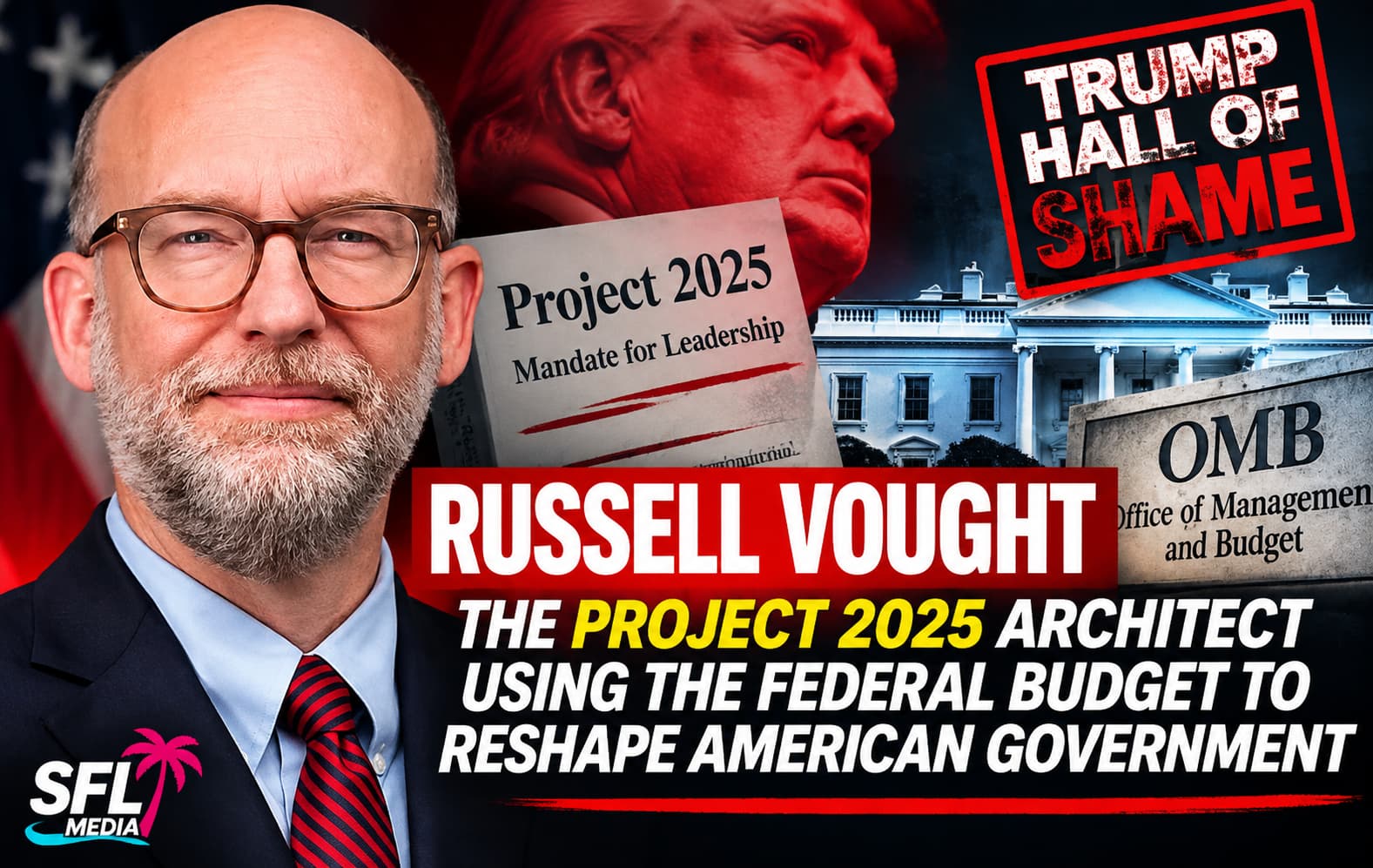
Russell Vought: The Project 2025 Architect Using the Federal Budget to Reshape American Government
Russell Vought may not command the public attention of Donald Trump, Elon Musk, or JD Vance, but few officials have played a more consequential role in turning the conservative movement’s plans for expanded presidential power into federal policy. As director of the Office of Management and Budget, Vought oversees an institution capable of influencing nearly every federal agency, from how taxpayer money is distributed to which government programs receive the resources necessary to operate.
Vought’s influence extends far beyond traditional budget management. A prominent contributor to Project 2025, the Heritage Foundation led blueprint for a conservative administration, he has spent years advocating for a dramatic restructuring of the federal government, tighter presidential control over executive agencies, and a reduction in the authority of career civil servants. His return to the Office of Management and Budget in February 2025 placed him at the center of an administration pursuing many of those objectives through sweeping workforce reductions, spending restrictions, and changes to federal regulatory enforcement.
His appointment also exposed a contradiction in Trump’s political messaging. During the 2024 presidential campaign, Trump publicly distanced himself from Project 2025 and insisted that he was not responsible for its proposals. Once back in the White House, however, he selected one of the project’s most influential contributors to oversee the federal budget and help implement his administration’s domestic policy agenda. For critics, the appointment represented the movement of Project 2025’s ideas from conservative policy circles into the federal government’s administrative machinery.
The controversy surrounding Vought is not simply about whether government should be larger or smaller. It concerns the constitutional boundaries between the presidency and Congress, the independence of federal agencies, and the extent to which a president can restrict spending or restructure institutions without new legislation. His defenders argue that the federal bureaucracy has accumulated excessive authority and must be made accountable to elected leadership, while opponents warn that his approach concentrates power in the White House at the expense of longstanding checks and balances.
The Man Behind Project 2025
Russell Thurlow Vought served as director of the Office of Management and Budget during the final months of Trump’s first administration, from July 2020 until January 2021. Following Trump’s departure from office, Vought founded the Center for Renewing America, a conservative policy organization that became an important participant in efforts to develop a more aggressive governing agenda for a future Republican administration.
His involvement in Project 2025 was particularly significant. Vought authored the chapter addressing the Executive Office of the President in the Heritage Foundation’s Mandate for Leadership, arguing that the White House should exercise more direct authority over federal agencies and the officials responsible for implementing presidential policy. His vision placed the Office of Management and Budget at the center of that effort, positioning the agency not merely as a financial oversight institution but as a mechanism for coordinating presidential priorities throughout the executive branch.
Project 2025’s broader agenda included restructuring federal agencies, strengthening political supervision of career employees, reducing regulatory authority, and eliminating programs considered inconsistent with conservative priorities. Vought also participated in planning intended to accelerate implementation of those policies during the opening months of a new administration. When Trump nominated him to return as OMB director, the decision placed a leading advocate of those changes in one of Washington’s most powerful administrative positions.
On February 6, 2025, the Senate confirmed Vought by a 53–47 vote, returning him to the same office he had led during Trump’s first presidency. The confirmation was opposed by Senate Democrats, who raised concerns about his interpretation of executive authority, his involvement in Project 2025, and his previous role in disputes over congressionally appropriated spending.
The Remark That Revealed His Approach to Federal Workers
One of Vought’s most controversial public statements came during a 2023 speech in which he discussed how a future conservative administration should confront the federal bureaucracy. Rather than describing career government employees simply as workers whose agencies required restructuring, Vought advocated creating conditions that would make them feel professionally threatened and demoralized.
His statement that federal bureaucrats should be “traumatically affected” attracted widespread attention after recordings of the remarks became public. He also discussed restricting agency funding to limit the ability of regulators to carry out policies he opposed, particularly environmental regulations affecting the energy industry. The comments provided an unusually explicit description of the pressure he believed a future administration should place on federal institutions.
Those remarks became particularly relevant after Vought returned to government and helped oversee an administration wide effort to reduce federal staffing and reorganize agencies. Critics pointed to his earlier language as evidence that the reductions were not simply an exercise in fiscal management but part of a broader effort to weaken the institutional independence of the civil service.
Vought’s position reflects a longstanding conservative argument that unelected federal officials exercise excessive authority over public policy. His opponents counter that professional civil servants provide continuity, technical expertise, and safeguards against political interference. The dispute has direct consequences for government employees and for Americans who depend on federal programs, regulatory enforcement, and public services.
Federal Workforce Reductions and the Return of Schedule F
Shortly after Vought’s confirmation, the Office of Management and Budget and the Office of Personnel Management directed federal agencies to prepare plans for substantial workforce reductions and organizational restructuring. The effort formed part of the Trump administration’s broader initiative to reduce the size of the federal government, consolidate functions, and eliminate positions officials considered unnecessary.
Vought’s role placed him alongside other administration figures pursuing aggressive government downsizing, including Elon Musk and the Department of Government Efficiency initiative. Agencies were instructed to examine staffing levels, identify opportunities for reductions in force, and consider changes to their organizational structures and geographic footprints. The resulting plans generated concerns about the loss of institutional knowledge, disruptions to public services, and the ability of agencies to fulfill responsibilities established by Congress.
The administration also revived the concept behind Schedule F, a first-term Trump initiative designed to reclassify certain policy-influencing federal positions and make affected employees easier to remove. Supporters maintained that presidents must be able to replace officials who obstruct their lawful policy agenda, while federal employee unions and civil service advocates warned that the changes could undermine merit-based employment protections and increase political pressure on government workers.
The legal and operational consequences of these initiatives have extended across the federal government, raising questions about agency capacity, public service delivery, and the long term independence of the professional workforce. For Vought, the restructuring is consistent with his stated belief that the executive branch must operate under much tighter presidential supervision.
The Fight Over Congress’s Power of the Purse
Perhaps the most consequential element of Vought’s governing philosophy is his interpretation of presidential authority over federal spending. Under the Constitution, Congress controls federal appropriations, while the executive branch administers spending according to laws enacted by Congress. Vought has challenged the limits imposed on presidential discretion, arguing that the executive branch should possess broader authority to withhold or delay expenditures that conflict with the president’s policy priorities.
The dispute centers on the Impoundment Control Act of 1974, enacted after President Richard Nixon repeatedly attempted to withhold funds appropriated by Congress. The law established procedures restricting a president’s ability to unilaterally cancel or delay spending. Vought and other advocates of expanded executive authority argue that aspects of those restrictions improperly interfere with presidential power, while congressional Democrats and government accountability organizations contend that unilateral spending freezes violate federal law and undermine the constitutional separation of powers.
The conflict became immediate in January 2025, when the Office of Management and Budget issued a sweeping memorandum directing federal agencies to pause certain financial assistance activities while reviewing their consistency with Trump’s executive orders. The directive generated confusion among state governments, nonprofit organizations, research institutions, and other recipients of federal funding, prompting emergency litigation and judicial intervention.
The January 27 memorandum was issued before Vought’s February 6 confirmation, while Matthew Vaeth was serving as acting OMB director. Vought nevertheless became responsible for defending and implementing the administration’s broader spending policies after assuming office. On February 25, U.S. District Judge Loren AliKhan issued a preliminary injunction restricting implementation of the funding freeze, finding that the plaintiffs had demonstrated grounds for judicial intervention.
The broader battle continued through 2025 and 2026 as congressional Democrats accused the administration of withholding hundreds of billions of dollars in appropriated funding. Those allegations included concerns about research grants, education programs, environmental initiatives, and other federal expenditures. The precise totals and legal status of individual funding decisions remain contested, and congressional allegations should not be confused with final judicial findings that every disputed dollar was unlawfully withheld.
Federal Courts Ordered Vought’s Budget Office to Restore Spending Transparency
One of the clearest judicial rebukes of Vought’s leadership involved the removal of a public database showing how the federal government distributes congressionally appropriated money to individual agencies. In March 2025, OMB disabled its Public Apportionments Database, which allowed lawmakers, watchdog organizations, journalists, and members of the public to examine important federal spending decisions. The database was especially significant during a period when the administration was facing multiple legal challenges involving delayed or withheld appropriations.
Citizens for Responsibility and Ethics in Washington and Protect Democracy challenged the removal, arguing that federal law required the information to remain publicly accessible. On July 21, 2025, U.S. District Judge Emmet Sullivan ruled against OMB and ordered the database restored. The administration sought relief from the U.S. Court of Appeals for the D.C. Circuit, but the appellate court rejected its request to stay the ruling in August. The database was subsequently restored while litigation continued.
The dispute did not end with the website’s restoration. Additional disagreements arose over spending plans incorporated into legally binding budget documents but not made publicly available. On January 28, 2026, the district court ordered OMB to disclose qualifying spending plans, reinforcing the requirement that legally mandated budget information remain accessible for congressional and public oversight.
The significance of the rulings extends beyond a government website. Public apportionment records help Congress and federal watchdogs determine whether agencies are receiving the money lawmakers authorized and whether the executive branch is complying with spending laws. By removing that information, OMB made independent oversight more difficult at precisely the moment when the administration’s spending decisions were attracting intense scrutiny.
Taking Control of the Consumer Financial Protection Bureau
Vought’s influence extended beyond OMB when Trump designated him acting director of the Consumer Financial Protection Bureau in February 2025. Established after the 2008 financial crisis, the CFPB was created to protect consumers from unlawful practices involving mortgages, credit cards, loans, debt collection, and other financial products. Since its creation, the agency has pursued enforcement actions against major financial institutions and secured billions of dollars in monetary relief for consumers.
Within days of assuming the acting role, Vought ordered a broad suspension of agency activities, including significant portions of its supervision, investigations, and enforcement work. He also announced that the bureau would not request its next round of funding from the Federal Reserve, describing its existing financial reserves as sufficient. The decisions effectively brought much of the agency’s work to a halt while the administration pursued substantial reductions in its workforce and operations.
Consumer advocates warned that weakening the CFPB would benefit financial institutions at the expense of borrowers, particularly Americans facing predatory lending, abusive debt collection, or unlawful financial charges. Administration officials argued that the bureau had exceeded its statutory mission and imposed unnecessary regulatory burdens on businesses. The disagreement became a major legal battle over whether the executive branch could substantially restrict an agency’s ability to perform responsibilities established by Congress.
On September 25, 2026, U.S. District Judge Ann Aiken ruled in litigation brought by a coalition of states that challenged CFPB funding decisions were contrary to law, constituted unlawfully withheld agency action, and violated the constitutional separation of powers. The court rejected the administration’s interpretation of the bureau’s funding statute, vacated the challenged decisions, and declared that the Federal Reserve was required to provide funding under the statutory formula. The ruling did not resolve every dispute over CFPB staffing or enforcement, but it represented a significant judicial rejection of the administration’s funding strategy.
Consumer Enforcement Rollbacks and Corporate Accountability
The CFPB restructuring also raised questions about the administration’s commitment to enforcing consumer protection laws against major financial institutions. Consumer advocacy organizations criticized the dismissal or reduction of enforcement actions involving banks, lenders, payment companies, and other businesses, arguing that those decisions could deprive consumers of restitution and weaken deterrence against unlawful financial practices.
Among the enforcement matters cited by critics were cases involving Toyota Motor Credit Corporation and international payments company Wise. Advocacy organizations pointed to changes in previously announced penalties and remedies as examples of the administration retreating from aggressive consumer protection enforcement. The circumstances and legal justification for each enforcement decision differ, however, and the available record does not establish that Vought personally directed every individual case dismissal or penalty reduction.
Sen. Elizabeth Warren, a leading advocate for the CFPB’s creation, has been among the administration’s most vocal critics, challenging Vought over the bureau’s direction and questioning whether consumers were being denied protections Congress intended them to receive. Administration defenders maintain that the agency must operate within its statutory authority and that previous leadership pursued overly aggressive regulation. The dispute reflects a fundamental disagreement over the federal government’s responsibility to police financial misconduct and the degree of discretion regulators should exercise when pursuing enforcement actions.
The Ukraine Aid Freeze and Trump’s First Impeachment
Vought’s involvement in controversial federal spending decisions predates Trump’s second presidency. During the first administration, he served in senior OMB positions while the White House withheld congressionally approved security assistance to Ukraine in 2019, an episode that became central to the investigation leading to Trump’s first impeachment.
The Government Accountability Office subsequently concluded that OMB had violated the Impoundment Control Act by withholding certain Ukraine security assistance funds for policy reasons rather than executing the spending directed by Congress. The finding established that the agency’s handling of the funds was inconsistent with federal law, although it was not a criminal judgment against Vought personally.
Vought resisted congressional demands for testimony during the impeachment investigation and defended the administration’s position. His involvement illustrates the continuity between the spending disputes of Trump’s first presidency and the more expansive arguments about presidential authority advanced during his second term. In both periods, the central constitutional question concerned whether the executive branch could withhold money that Congress had already directed it to spend.
Colorado, Tina Peters, and Allegations of Political Retaliation
Another controversy involving Vought emerged from the administration’s confrontation with Colorado officials following Trump’s attempted pardon of former Mesa County clerk Tina Peters, who had been convicted on state charges connected to a breach of election equipment.
Trump’s December 2025 pardon announcement did not automatically invalidate Peters’ state conviction because presidential pardon authority generally applies to federal offenses. Colorado officials declined to release her on that basis, prompting additional political conflict between the state and the administration.
Less than a week later, Vought announced plans to dismantle or restructure the National Center for Atmospheric Research in Boulder, Colorado, describing portions of its work as objectionable climate-related research. The timing attracted scrutiny, and plaintiffs challenging the restructuring raised questions about whether the federal action was connected to the administration’s dispute with Colorado.
The allegations require a distinction between documented events and disputed motives. The administration publicly announced the proposed restructuring, and the dispute over Peters’ imprisonment was ongoing. However, the timing alone does not establish that Vought acted in retaliation against Colorado, and the evidence reviewed for this profile does not establish such a motive as a judicial finding. Vought framed the decision as an effort to eliminate research priorities opposed by the administration, while critics questioned whether federal funding authority was being used against a politically disfavored state.
A Reported $4.7 Million Security Detail Amid Agency Cuts
Vought also faced scrutiny over reported arrangements to finance his personal security protection through the Consumer Financial Protection Bureau. Reporting attributed to Government Executive described approximately $4.7 million in funding for security expenses extending through December 2026, drawing attention because the arrangement coincided with efforts to substantially reduce the bureau’s operations.
Critics questioned the priorities reflected in financing executive protection while pursuing reductions in an agency responsible for protecting consumers from unlawful financial practices. However, security expenditures for senior federal officials can be legitimate, particularly when credible threats exist, and the existence of a large allocation does not itself establish improper spending or personal misconduct.
The relevant oversight questions concern the funding source, legal authorization, necessity, and relationship between the expenditure and the CFPB’s statutory mission. Without complete documentation establishing the final amount spent, the reported figure should be treated as an allocation or planned expenditure rather than a verified total of completed spending.
The Constitutional Question at the Center of Vought’s Agenda
Taken together, Vought’s record reveals a consistent governing philosophy centered on strengthening presidential control over the federal bureaucracy. His approach seeks to give the White House greater influence over agency staffing, regulatory enforcement, budget execution, and the implementation of federal programs, including in circumstances that produce conflict with Congress and the courts.
Supporters describe that philosophy as a necessary correction to an administrative state they believe has become insufficiently accountable to elected leadership. They argue that the president, as head of the executive branch, must possess meaningful authority to direct agencies and ensure that government officials implement lawful administration policies.
Critics contend that the approach threatens constitutional checks and balances by concentrating authority in the presidency and weakening institutions designed to prevent political interference. They point to the funding freeze litigation, court-ordered restoration of spending disclosures, CFPB restructuring, and federal workforce reductions as evidence that the administration has repeatedly tested statutory and constitutional limits.
The disagreement is ultimately about more than the size of government. It concerns who controls federal spending after Congress appropriates money, how much independence career officials should possess, and whether a president can substantially weaken agencies without obtaining new legislation.
Russell Vought’s Place in the Trump Administration
Russell Vought’s influence is distinctive because it operates through administrative mechanisms that rarely receive the public attention devoted to presidential speeches, congressional confrontations, or high-profile political controversies. Budget apportionments, staffing classifications, agency reorganizations, and regulatory enforcement priorities may appear technical, but they determine how federal policy is implemented and which government functions receive the resources necessary to operate.
His record also demonstrates that the ideas associated with Project 2025 were not merely theoretical proposals developed outside government. Through his leadership at OMB and his temporary control of the CFPB, Vought helped advance a governing program that has produced major institutional changes, sustained litigation, and significant constitutional disputes.
For SFL Media’s Trump Hall of Shame, the documented basis for scrutinizing Vought includes his leadership in Project 2025, his public statements about federal employees, his role in government downsizing, his advocacy of expanded presidential spending authority, and the court rulings against actions taken by agencies under his leadership. These are not simply disagreements over political philosophy; several of the administration’s decisions have been challenged in federal court, and some have been expressly ruled unlawful.
Vought has become one of the central figures in the effort to redefine how the federal government operates. His career illustrates how consequential political change can occur not only through legislation and executive orders, but through administrative decisions that determine whether federal laws and programs function as Congress intended.

Sources & Further Reading
-
Office of Management and Budget — Official Agency Information
-
U.S. Senate Budget Committee — Vought Nomination and Federal Funding Concerns
-
Federal Court — National Council of Nonprofits v. OMB, February 2025
-
Public Citizen — CREW v. OMB, Spending Transparency Litigation
-
CREW — January 2026 Court Order on Undisclosed Federal Spending Plans
-
Associated Press — Trump Administration Orders Consumer Protection Agency to Stop Work
-
Bloomberg Law — Vought Expands CFPB Work Freeze and Cancels Funding Request
-
U.S. District Court — State of New York v. Vought, September 25, 2026
-
Government Accountability Office — Federal Spending and Impoundment Oversight



Loading comments…