
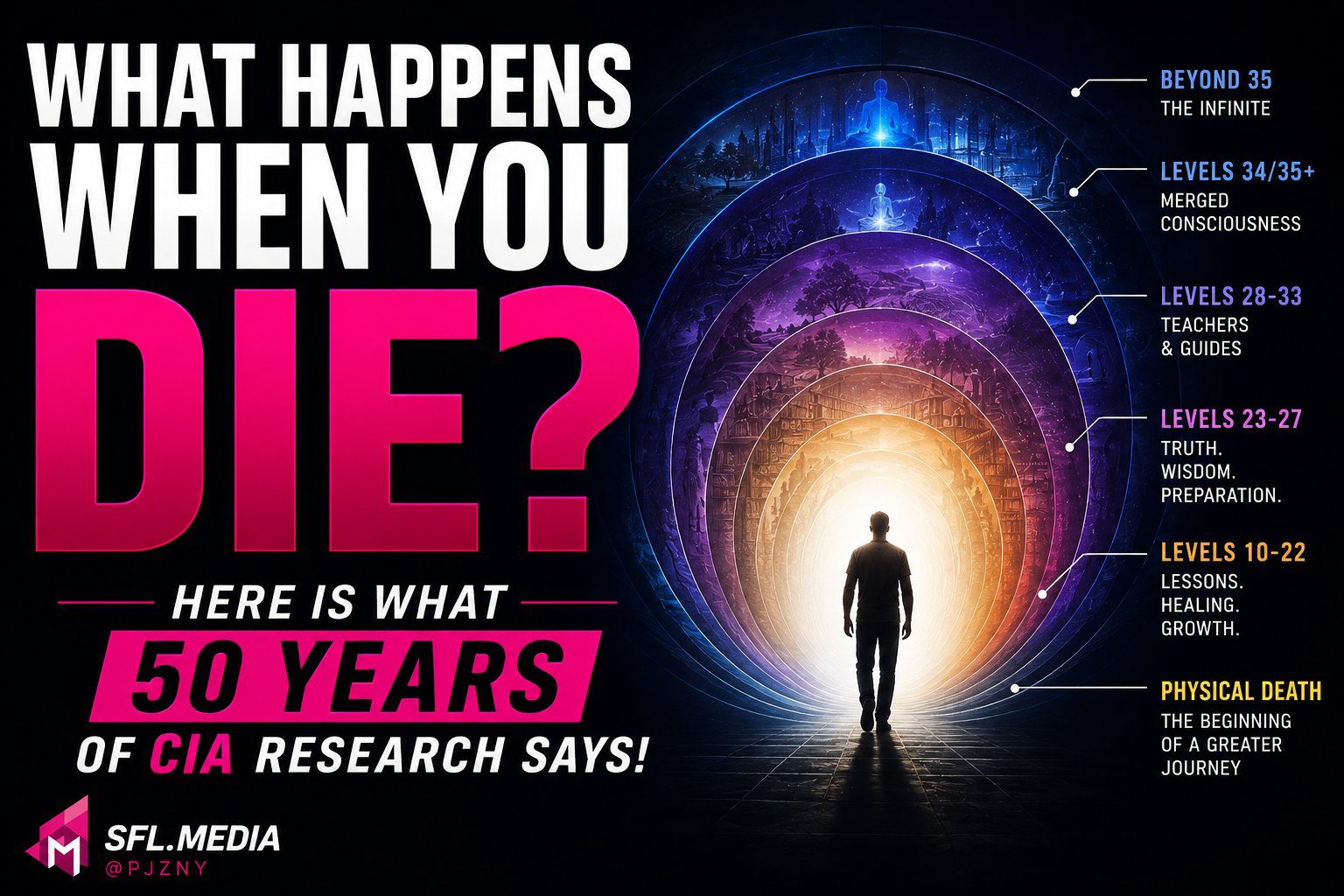
The Monroe Files: Did Robert Monroe Build a Map of Consciousness, the Afterlife and a Reality Science Still Does Not Understand?
For thousands of years, human beings have been arguing about the same mystery using different languages. Religions called it heaven, hell, reincarnation, purgatory or the spirit world. Shamans described worlds accessible when consciousness separated from ordinary physical awareness. Hindu and Buddhist traditions developed elaborate systems of altered states and post death transition. Western mystics reported leaving their bodies and encountering apparently autonomous environments and beings. More recently, physicians and researchers studying patients revived after cardiac arrest have collected accounts involving separation from the body, profound peace, altered time, deceased relatives, movement toward another environment, life review and, in some cases, a boundary beyond which the experiencer understood they could not pass and still return.
Then, in the middle of the twentieth century, an American broadcasting executive named Robert Monroe began reporting something equally extraordinary. Monroe claimed that while experimenting with sound and altered states of consciousness, he began spontaneously experiencing what he interpreted as separation of conscious awareness from his physical body. Rather than treating the experiences as religious revelation, Monroe spent decades trying to reproduce them, understand them, document them and teach other people how to reach similar states deliberately. What eventually emerged was an unusually detailed numerical cartography of consciousness known as the Focus levels, beginning with ordinary waking awareness and moving through states Monroe associated with diminished body awareness, expanded perception, apparent timelessness, the edge of physical reality, post death environments, deceased personalities, healing, reincarnation, nonhuman intelligence and increasingly collective forms of consciousness.

The story would already be remarkable if it ended with Monroe. It did not. During the Cold War, portions of the United States military and intelligence establishment were independently investigating whether people could acquire information about distant or hidden targets without conventional sensory access. Programs associated with GRILL FLAME, CENTER LANE, SUN STREAK and ultimately STAR GATE explored what became known as remote viewing, and declassified records show that Army intelligence did not merely know about Monroe’s work but incorporated Monroe Institute Hemi-Sync training into portions of its own development program.
That matters because this story is frequently flattened into two equally misleading caricatures. The first says the CIA “proved astral projection” and secretly discovered the afterlife. The second says all of this was merely fringe mysticism briefly entertained by gullible officials before science shut it down. The surviving record is much more complicated. Governments, military intelligence programs, private institutes, university researchers, physicians, statisticians and thousands of participants have spent decades examining different parts of the same problem, sometimes through laboratory style testing and controlled targets, sometimes through medical observation, and sometimes through repeated experiential exploration.

The evidence does not force one final interpretation, nor does this investigation ask readers to accept Monroe’s cosmology as established fact. The more important question is whether decades of government investment, institutional research, controlled experimentation, repeated human experience and independent lines of inquiry have made the possibility of nonlocal or surviving consciousness substantial enough that it deserves to be examined on the evidence rather than dismissed at the door.
Robert Monroe Was Not Supposed to Become a Mystic
Robert Allan Monroe was born in 1915 and built his adult life in broadcasting rather than theology. He worked as a writer, producer and radio executive before establishing his own business, and the Monroe Institute traces the origins of his consciousness work to research begun during the 1950s into sound, sleep and learning. That background matters because Monroe’s eventual language was not primarily religious. He came from a world of signals, transmission, reception, interference, frequency and tuning, and those concepts became the vocabulary through which he tried to make sense of what was happening to him.
Beginning in the late 1950s, Monroe reported episodes involving vibrations, paralysis like bodily states, altered awareness and the sensation of existing apart from his physical body. What initially frightened him became the central research problem of the remainder of his life. He documented the experiences in Journeys Out of the Body, Far Journeys and Ultimate Journey, but the books were only one part of what followed. The larger achievement was the development of an institution and training methodology designed to help other people reach altered states in a structured way rather than waiting for spontaneous experiences.
That distinction is crucial. People had described out of body experiences centuries before Monroe, and early Western explorers such as Sylvan Muldoon and Oliver Fox had written extensively about apparent separation from the body decades before Monroe’s first reported episode. Monroe’s contribution was therefore not the invention of the OBE. It was the attempt to turn a notoriously unpredictable class of experiences into something closer to a repeatable navigational system.
Instead of saying that someone had reached “the astral plane,” Monroe began assigning numerical coordinates to recurring states. Participants could attempt to reach Focus 10, then Focus 12, then Focus 15 or Focus 21, later moving into more advanced territories. The numbers created a common language in which different explorers could attempt a similar procedure, enter what they believed to be the same state and compare what they experienced afterward.
Common training can create common expectations, but standardization is also what makes serious testing possible in the first place. A phenomenon that cannot be reproduced, targeted or even described consistently is extremely difficult to investigate. Monroe’s system at least attempted to give researchers and participants repeatable coordinates and a common vocabulary through which different experiences could be compared.
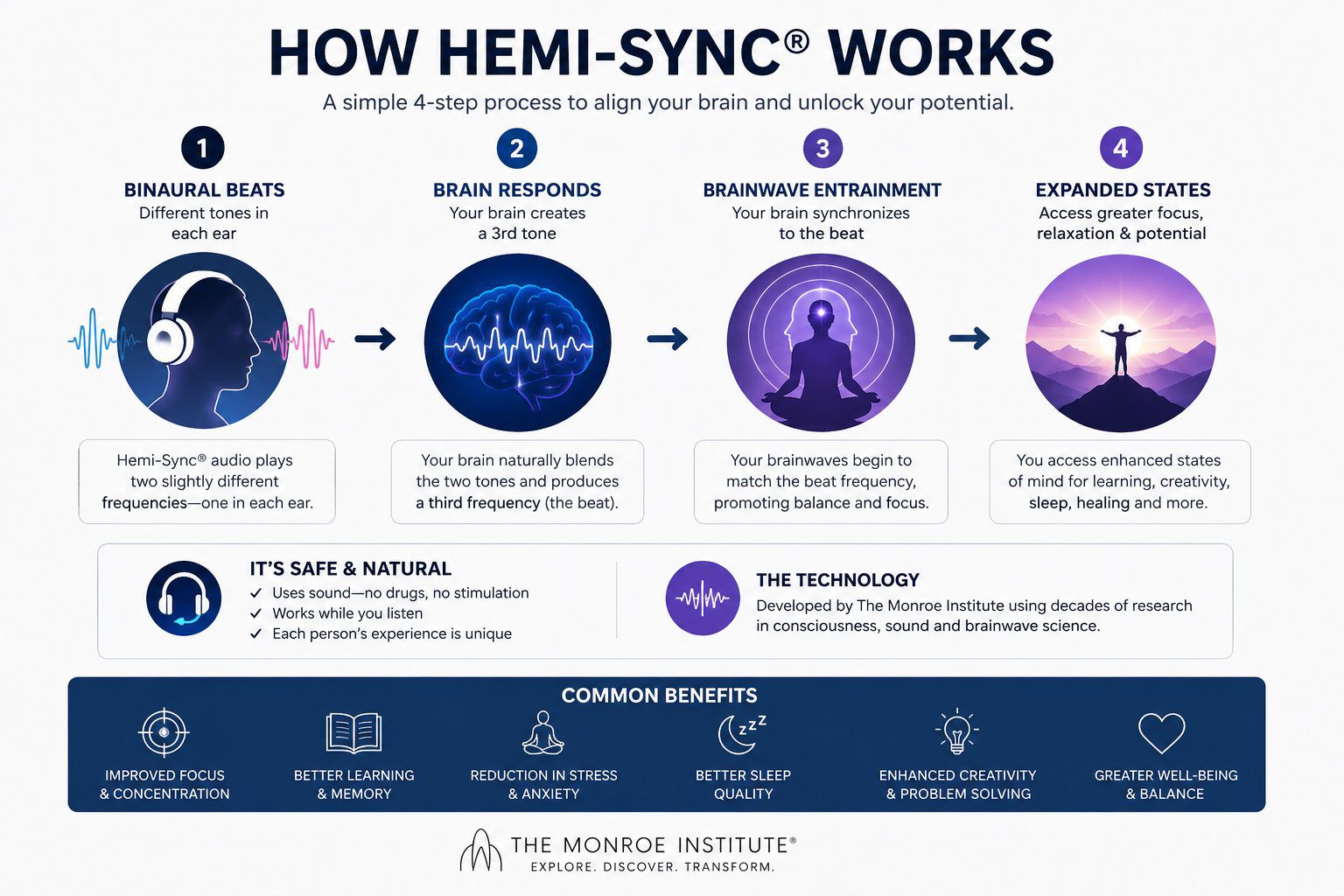
Hemi-Sync: Monroe’s Attempt to Tune Consciousness
The technological engine behind much of Monroe’s work became known as Hemi-Sync, shorthand for hemispheric synchronization. One component involves binaural beats, an auditory effect produced when slightly different tones are presented independently to each ear. If one ear hears 100 Hz and the other hears 104 Hz, for example, the auditory system can perceive a rhythmic difference corresponding to roughly 4 Hz.
Monroe’s programs, however, were never simply “play two tones and leave your body.” His institute developed layered audio sequences combining sound patterns, verbal guidance, relaxation, visualization and structured exercises intended to help participants reproduce specific internal states. The contemporary Monroe Institute now uses the broader term Monroe Sound Science and continues offering residential and virtual programs built around the same basic premise: consciousness can be trained to move through recognizable states with the help of controlled audio and practice.
One misunderstanding needs to be removed immediately. Focus numbers are not frequencies measured in Hertz. Focus 10 does not mean the brain is operating at 10 Hz, and Focus 27 does not mean someone has entered a 27 Hz dimension. The numbers are names assigned to states. Audio frequencies may be part of the technique used to facilitate them, but the Focus number is a coordinate in Monroe’s map rather than a literal EEG reading. That distinction is important because Monroe was attempting to build a navigational language rather than a simple frequency chart. The system is better understood as a progression of reported experiential conditions, each associated with particular changes in body awareness, perception, time, identity or the apparent environment encountered by the explorer.
Monroe Did Not Simply Ask People to Sit in a Room and Believe
One of the most important physical elements of Monroe’s work was the development of individualized controlled environments known as CHEC units, or Controlled Holistic Environmental Chambers. These spaces were designed to sharply reduce external sensory distraction while controlled audio exercises were delivered to participants. Light, environmental noise, unnecessary movement and interaction with other participants could therefore be minimized while the explorer concentrated on the exercise.
This matters because it changes the picture substantially. Monroe’s work was not simply a circle of people sitting together exchanging mystical stories after meditation. Participants could work independently in controlled environments, receive standardized audio instructions, record their experiences and later compare them with those of other participants. Where exercises involved externally verifiable targets, the reports could also be compared against information outside the participant’s immediate sensory environment.
The Institute’s work also did not end when Monroe died. Its programs continue today, and modern iterations of the research have incorporated physiological monitoring, including EEG based work intended to examine what happens in the brain while participants report particular expanded states. In current programs using equipment such as Mind Mirror EEG systems, participants can be monitored while attempting to recognize and reproduce internal landmarks associated with advanced consciousness work.
The important point is not that EEG establishes the external reality of Focus 27 or any other state. EEG measures brain activity, not the ontological location of an experience. What it can establish is whether reported changes in consciousness correspond to identifiable changes in physiology, whether particular states can be reproduced, and whether experienced practitioners develop recognizable patterns that can be compared over repeated sessions.
That creates a meaningful experimental progression: controlled environment, standardized induction method, defined experiential target, participant report and physiological measurement.
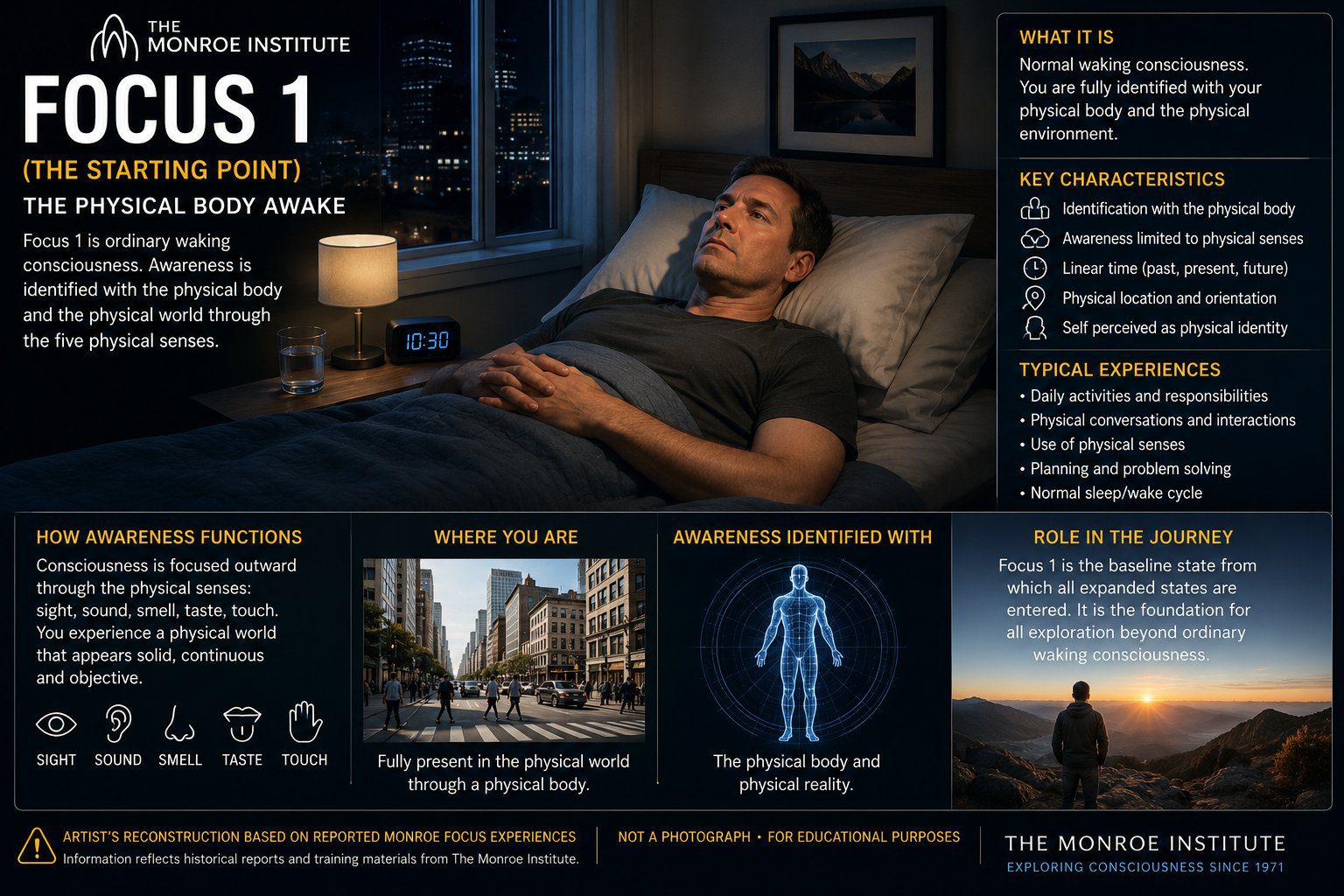
Focus 1: The Reality We Normally Call Reality
Focus 1 is ordinary waking physical consciousness. The body feels solid and localized, vision and hearing dominate awareness, objects appear separate from one another, time seems to move sequentially and personal identity appears centered somewhere inside the biological organism.
Even conventional neuroscience agrees that this seemingly straightforward reality is an extraordinary construction. The brain integrates sensory information, creates a body model, reconstructs memory, predicts incoming information, filters enormous quantities of irrelevant data and maintains the persistent experience of being one person occupying one location in a continuous timeline.
Monroe’s system begins by questioning whether that familiar state is consciousness itself or simply one operating condition of consciousness. If ordinary waking awareness is analogous to one channel on a receiver, then the question becomes whether the receiver can be deliberately tuned away from the physical signal without switching consciousness off entirely. That question eventually becomes the organizing principle of the entire Focus system. With each progression, ordinary physical sensation, location, time or identity becomes less dominant, while the participant attempts to remain consciously aware.
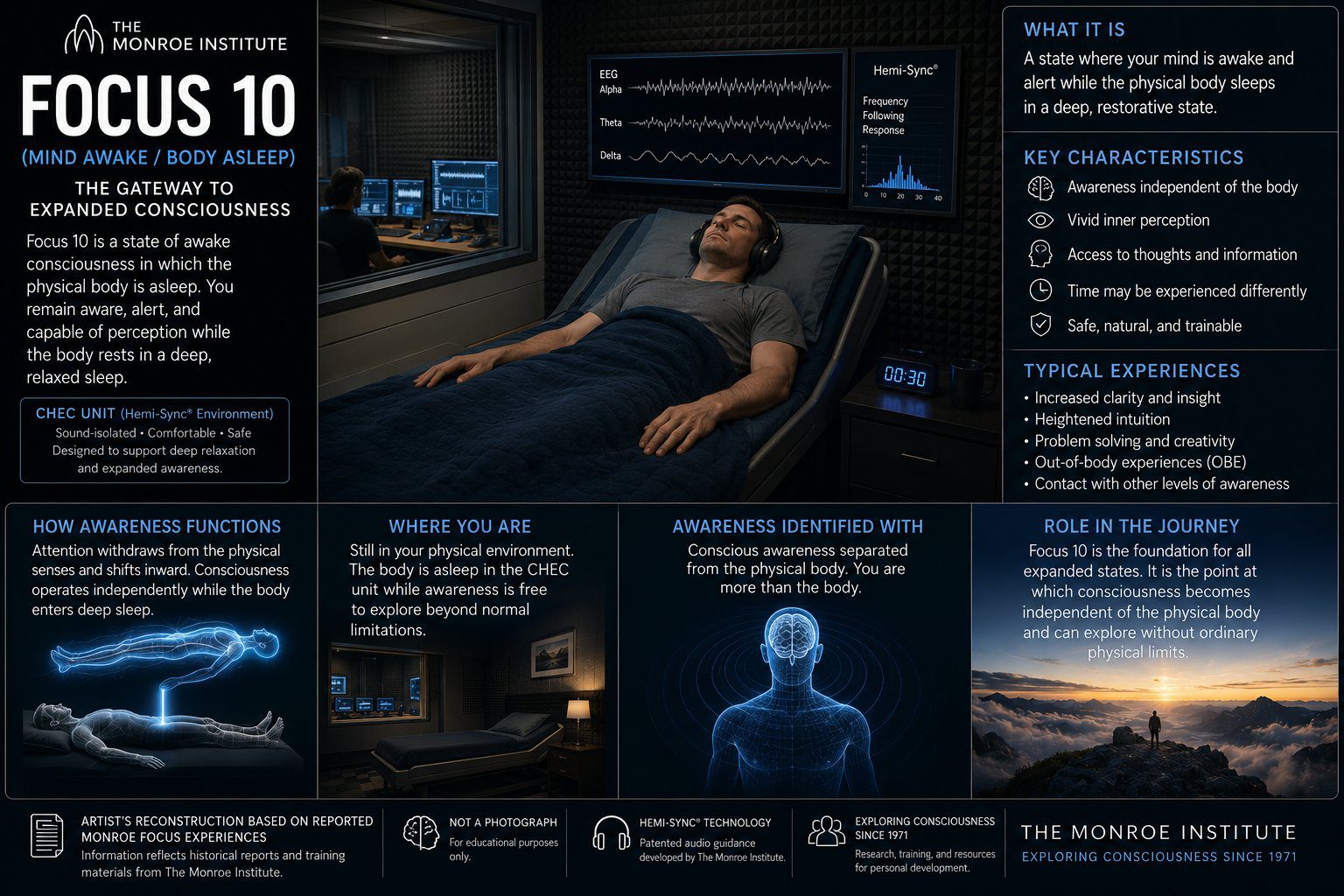
Focus 10: Mind Awake, Body Asleep
Focus 10 is the foundational Monroe state, commonly described as “Mind Awake, Body Asleep.” The participant deeply relaxes the body while attempting to retain lucid awareness, often reporting heaviness, numbness, floating sensations, vibrations or a diminished sense of physical location.
There are familiar neurological analogues for parts of this experience. Hypnagogia, meditation, sleep paralysis and sensory withdrawal can produce dramatic alterations in body perception while some degree of awareness remains. What makes Focus 10 important in Monroe’s system is therefore not that every sensation must be paranormal, but that the state functions as a launch platform for progressively less body centered experience.
Monroe’s proposition is that as the body becomes quieter, consciousness can remain active and become increasingly available for exploration. The deeper question is whether what follows is generated entirely by the brain or whether the reduction of ordinary sensory dominance permits awareness of information that was already present but normally filtered out. That question becomes harder to dismiss once the system moves beyond subjective sensation and begins intersecting with experiments in which participants are asked to obtain information about something they cannot physically see like an object hidden in another room.
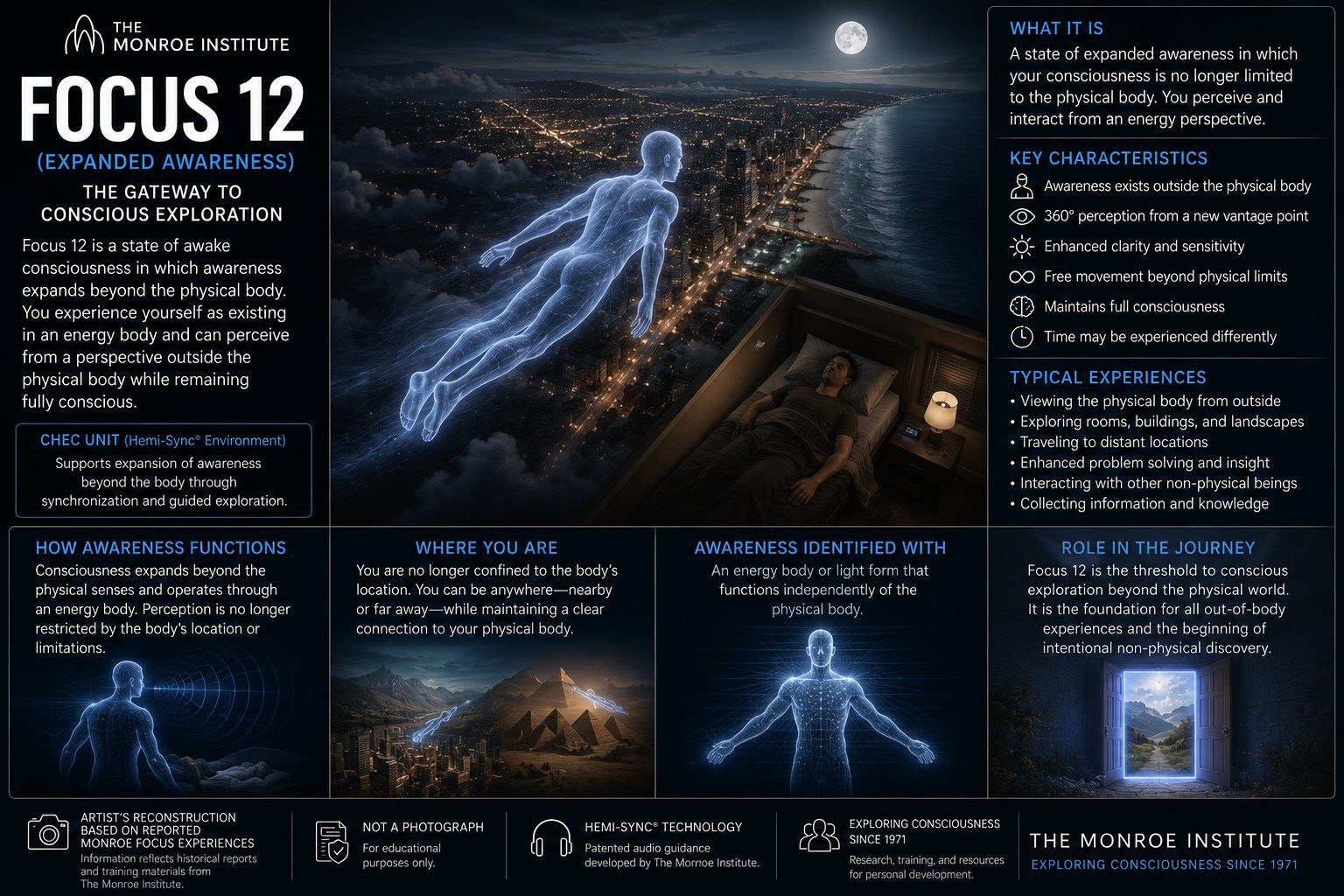
Focus 12: Expanded Awareness and the First Testable Break With Ordinary Perception
Focus 12 is called Expanded Awareness. Practitioners describe awareness as extending beyond the perceived boundaries of the body, with intuitive impressions, unusual spatial perception and information appearing to arrive without the normal sensory route.
This is the first place the Monroe system directly touches the central problem of remote viewing. Controlled Remote Viewing is not simply another name for Focus 12; it developed its own procedures and terminology. But the two systems confront the same scientific question: can a person accurately describe information that is physically inaccessible to them?
That is a much harder question than whether a meditation felt profound because it can be tested against an external target. If the participant is isolated from target information and repeatedly describes the correct target above what chance or ordinary sensory leakage should produce, then the experiment begins moving beyond subjective experience. Monroe could spend decades mapping altered states without resolving that problem. Remote viewing researchers attempted to attack it directly, and that effort eventually brought some of the strangest consciousness research of the twentieth century into the American national security establishment.
When the U.S. Government Started Paying People to Describe Things They Could Not See
Cold War intelligence officials had a practical reason to take extraordinary claims seriously. If adversaries were investigating anomalous perception, ignoring the possibility without testing it could itself create an intelligence vulnerability. American research therefore developed through Stanford Research Institute and later government programs involving figures including Harold Puthoff, Russell Targ, Ingo Swann, Joseph McMoneagle and a rotating group of military personnel and civilian researchers.
The objective was not to determine whether participants felt spiritual. It was to determine whether they could describe targets they could not conventionally access. Government protocols defined target pools, viewing periods, recording procedures, judging systems and levels of blinding. Some surviving records describe conditions in which neither the remote viewer nor the interviewer guiding the session knew the target, reducing the possibility that the interviewer could accidentally communicate the answer through tone, wording or body language.
Other protocols used pools containing dozens of possible targets. Viewers could be asked to produce drawings, textures, dimensions, spatial relationships and verbal descriptions during a predetermined period, after which the material was compared against the actual target. Researchers were explicitly thinking about sensory leakage, analytical contamination, interviewer influence, target selection and the problem of evaluating information only after the session had been completed.
This matters because remote viewing is sometimes described today as though the government merely gathered a handful of psychics in a room and asked what they “felt.” The surviving records instead show a repeated attempt to impose structure on an inherently noisy human phenomenon and to determine whether information could survive increasingly restrictive controls.
Monroe and Military Intelligence Were Not Two Separate Stories
The connection between Monroe and government remote viewing eventually became direct. CENTER LANE records identify advanced training involving the Monroe Institute and describe Hemi-Sync as a technique used to help sources enter specialized mental states believed useful for psychoenergetic performance.
Military intelligence was not merely reading Monroe’s books. The program incorporated Monroe derived altered state training into portions of a personnel development pipeline intended to support remote viewing performance. Project histories describe screening and orientation, advanced training and techniques involving Hemi-Sync and other methods designed to help participants control the states in which anomalous perception was believed to occur. The government also spent money on this work. Records document contracts and advanced training expenses associated with Monroe Institute involvement, while other CENTER LANE material describes Army authorization to use Monroe Institute programs as screening or sensitization tools for personnel.
Whatever one ultimately thinks of the phenomenon, that historical fact is striking. A system that began with a broadcaster attempting to understand spontaneous out of body experiences became relevant enough that American military intelligence incorporated portions of it into a classified human performance program. This was not a weekend curiosity. The larger American remote viewing effort persisted through changing program names, agencies, administrators and political environments for years. That longevity does not prove the underlying phenomenon, but it demonstrates that enough people inside the system believed enough of the results were worth pursuing that the work survived far beyond one isolated experiment.

The Wrong Coordinates Case: When the Mistake Became the Experiment
One of the strangest declassified GRILL FLAME sessions involved a target that was supposed to be Offutt Air Force Base in Nebraska. The coordinates given to the viewer were wrong, and that mistake accidentally created a more interesting test. The viewer reportedly described a narrow, winding body of water, relatively flat terrain and cliffs. When the coordinates were checked afterward, investigators discovered they did not point to Offutt at all but to an area near Pisgah, Iowa, along the Soldier River. The government summary noted similarities between the viewer’s description and the terrain represented by the mistaken coordinates.
The case is interesting because the viewer did not apparently describe the target the experimenters thought they had supplied. The viewer instead produced imagery investigators believed corresponded to the location represented by the erroneous coordinates themselves. If the session unfolded as documented, ordinary intentional cueing becomes difficult to invoke because the people administering the session did not know they had given the wrong target. One case cannot establish remote viewing as a universal ability, but cases such as this help explain why the program did not disappear after a few disappointing trials. Some sessions generated enough apparently anomalous correspondence to keep investigators asking whether something real was hiding inside the noise.
The Government Used Remote Viewing Operationally, Not Only Against Training Targets
The military did not limit remote viewing to laboratory pictures and training exercises. Declassified records show that viewers were tasked against real intelligence problems, including the Iranian hostage crisis, where hundreds of sessions were reportedly conducted in support of the effort. Remote viewing was also applied to intelligence problems involving facilities, military targets and other operational questions. The program’s own briefings often treated the technique not as a magical stand alone replacement for conventional intelligence but as a potential supplementary source that might generate leads or information for comparison with other collection methods.
That distinction is important because intelligence work rarely operates under the standard of perfect human performance. Informants provide bad information. Analysts make errors. Satellite photographs can be ambiguous. Communications intelligence can be misinterpreted. Human source intelligence is inherently noisy. The existence of error therefore does not automatically tell us whether a human mediated phenomenon exists. The more important question is whether meaningful information appears often enough, specifically enough and under sufficiently restricted conditions that chance, cueing or retrospective matching become inadequate explanations. That is where statistics, blinding and independent judging become central.
Blind Targets, Independent Judging and Why the Experimental Design Matters
Remote viewing research became progressively more interesting as experimenters attempted to remove ordinary information pathways. A viewer might be physically separated from the target. The interviewer might also be blind to the target. Target selection could occur from a predetermined pool. Session material could be recorded before the viewer received feedback. Judges could compare the finished report against multiple possible targets after the session.
These controls matter because every ordinary explanation removed increases the significance of whatever information remains. If the interviewer knows the target, subtle cueing becomes possible. If the participant sees the target list beforehand, memory and inference become possible. If reports are altered after feedback, retrospective fitting becomes possible. If only successful sessions are preserved, selection bias becomes overwhelming.
The serious experiments attempted to address at least some of these problems, and different researchers developed increasingly elaborate protocols over time. The quality of individual studies varied, but it is inaccurate to describe the entire remote viewing literature as uncontrolled anecdote. Much of the field’s central argument concerns whether the controls were strong enough and whether the resulting statistical effects were robust enough to survive alternative explanations.
Jessica Utts, Ray Hyman and the Argument the Program Never Really Settled
When the CIA commissioned an outside evaluation of the remote viewing research in 1995, statistician Jessica Utts and psychologist Ray Hyman reached different conclusions from the same broad body of evidence. Utts argued that the accumulated experimental results supported the existence of an anomalous phenomenon strongly enough that research should increasingly focus on its characteristics rather than repeatedly asking whether every result could be dismissed as chance. Hyman disagreed that the evidence justified a paranormal interpretation and emphasized methodological weaknesses, replication issues and uncertainty about what the statistics represented.
That disagreement matters because it is not the story of science unanimously examining remote viewing and finding nothing. It is the story of qualified experts looking at an unusual body of data and disagreeing about what it meant. Other reviews contained results described as statistically significant across groups of trials, while operational performance remained much harder to convert into consistent intelligence. That creates an important distinction between the existence of an anomaly and the usefulness of the anomaly. A phenomenon could be scientifically real while remaining frustratingly unreliable in individual human beings. If remote viewing produces a weak or variable effect, it could be revolutionary in the laboratory and still be terrible as a substitute for a surveillance satellite. Those two conclusions are not contradictory.
Human Error Does Not Automatically Mean the Underlying Ability Does Not Exist
This is an important point that often gets lost in discussions of remote viewing. Human mediated systems almost never produce perfect output. A trained marksman can miss. A surgeon can make an error. A professional athlete can fail repeatedly. A highly experienced intelligence analyst can misread incomplete information. If remote viewing involves a genuine but weak signal filtered through perception, imagination, memory, emotion and analytical interpretation, variability would be expected. Viewers themselves developed terminology such as analytical overlay to describe the problem of the conscious mind attempting to transform ambiguous impressions into recognizable objects too quickly.
That cannot become a universal excuse for every failed session. A method that never produces reliable information is not rescued simply by blaming the participant. But neither is an imperfect hit rate sufficient to establish that nothing anomalous occurs.
The correct question is statistical and experimental: does the information exceed what ordinary mechanisms and chance can reasonably explain under controlled conditions?
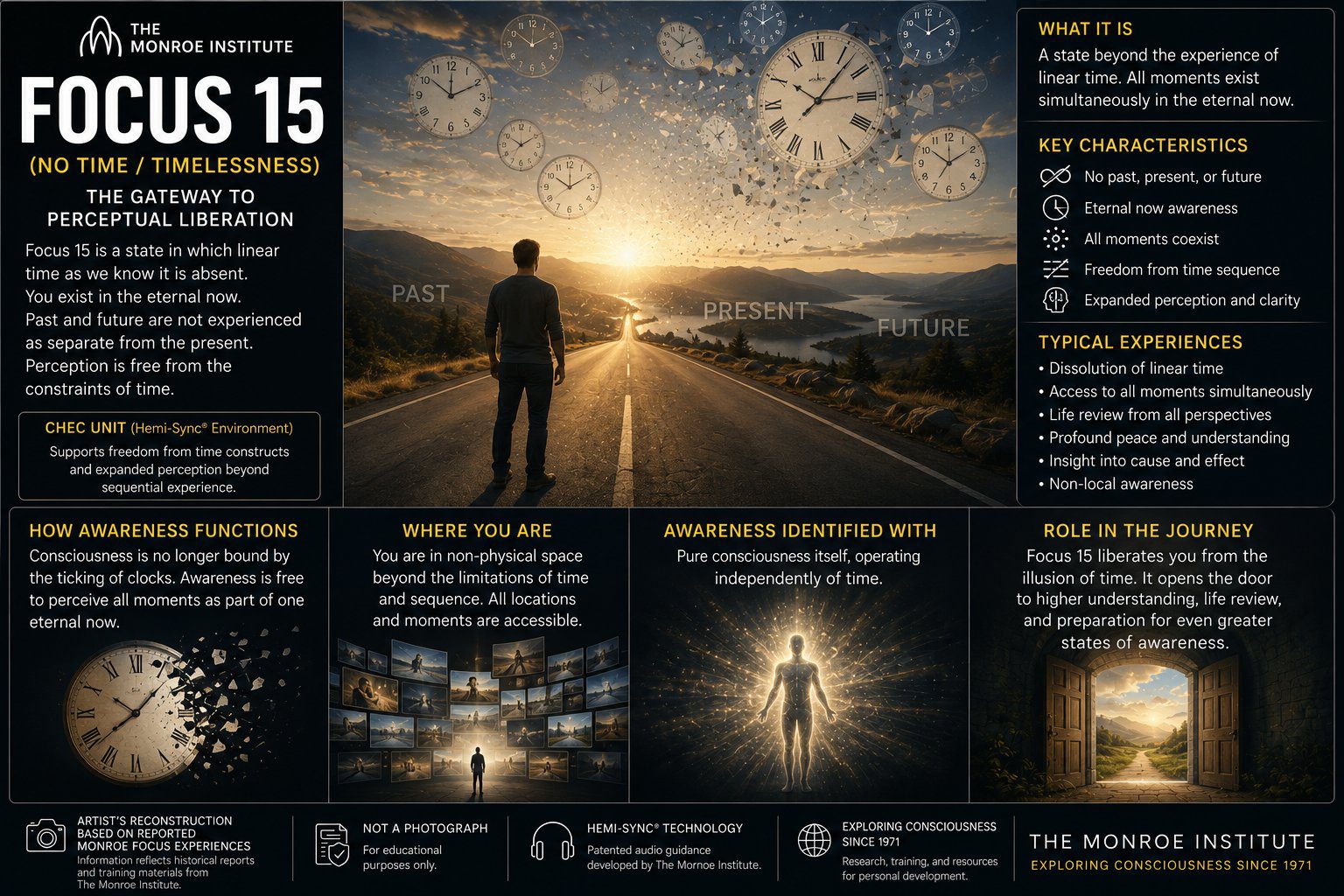
Focus 15: When Time Begins to Disappear
After Expanded Awareness comes Focus 15, the Monroe state commonly described as No Time. The participant attempts to enter a condition in which the ordinary sequence of past, present, and future becomes less dominant. Human time perception is already remarkably flexible. Dreams can contain apparently long narratives, emergencies can seem to slow down, psychedelics and meditation can radically distort duration, and neurological disruption can change the relationship between memory and sequence.
Monroe’s proposition, however, goes further. If ordinary physical consciousness is only one operating condition, then linear time might itself be one feature of that condition rather than an absolute limitation of consciousness. Remote viewing literature involving temporally displaced targets becomes relevant here because it raises the possibility that anomalous information, if real, may not respect ordinary temporal boundaries any more than spatial ones. That possibility is difficult to test, but it becomes an important part of Monroe’s larger architecture. Space and time are not simply places through which consciousness travels; they may represent constraints associated specifically with physical embodiment.
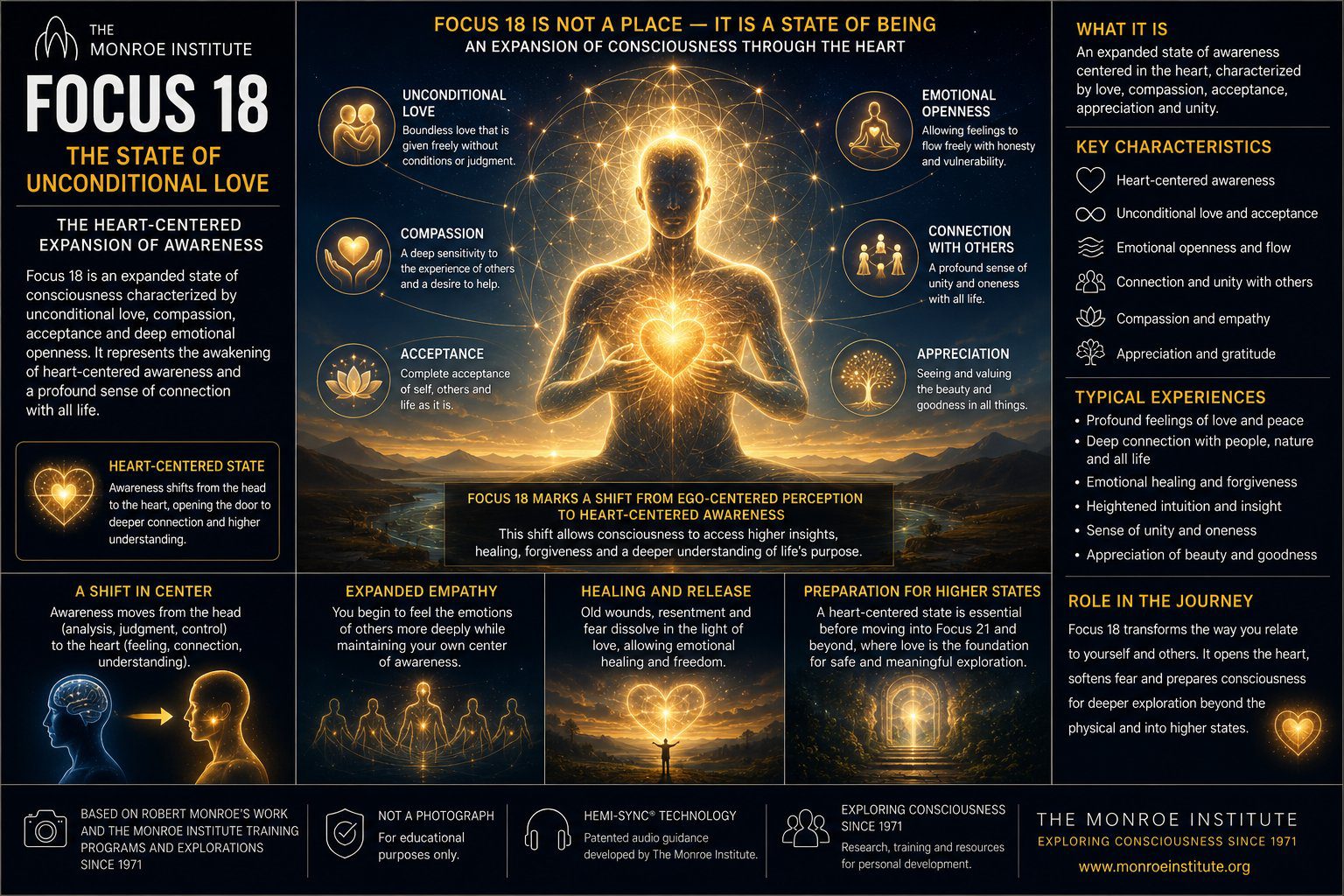
Focus 18: Consciousness Becomes an Emotional System, Not Just a Perceptual One
Focus 18 is associated with heart centered awareness, compassion, emotional openness and states the Institute often describes in terms of love or heart energy. This may initially sound less dramatic than remote viewing, but it becomes important later because Monroe’s model increasingly treats emotion, expectation and belief as structural elements of experience.
In that framework, consciousness does not simply observe a fixed nonphysical landscape like a tourist looking through a window. The state of the observer influences what is perceived and, in the more radical portions of the model, may help organize the environment itself. That concept becomes critical when Monroe’s map crosses what he regarded as the boundary between physical life and post physical consciousness. If belief and emotional state remain active when ordinary sensory input disappears, they may become far more important determinants of what consciousness experiences next.
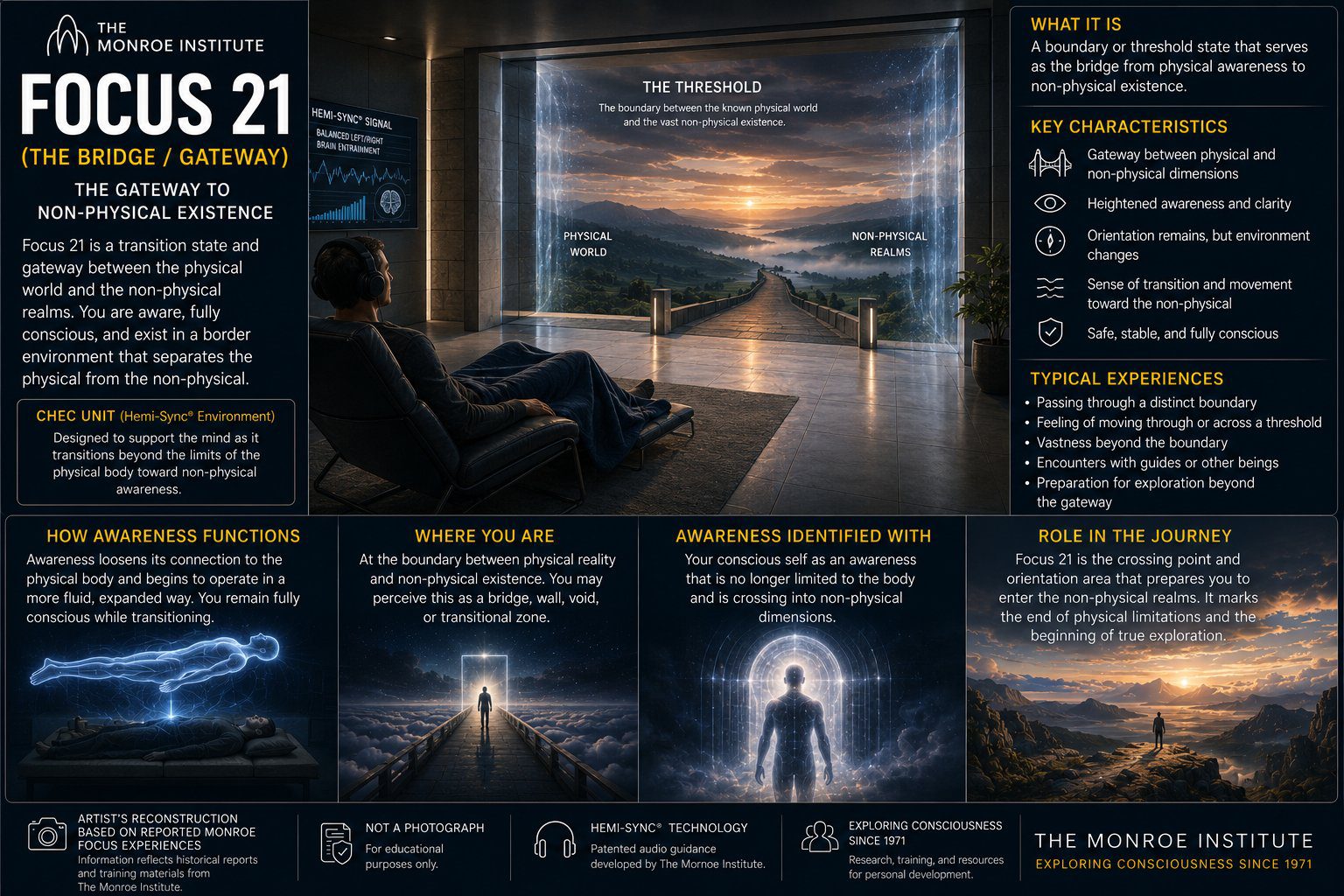
Focus 21: The Bridge
Focus 21 is commonly described as the Bridge, the edge of ordinary physical consciousness and the threshold into states Monroe associated with nonphysical reality. Everything below it can still be discussed comfortably as extreme but recognizable altered states: relaxation, diminished body awareness, expanded perception and temporal distortion.
Beyond Focus 21, the map changes character. It begins describing people who have died, environments no longer organized around physical matter, and a progression that Monroe explorers interpret as the continuation of consciousness beyond biological life. That is the point at which Monroe’s work stops being merely an unusual meditation system and becomes a proposed model of what happens after physical death.
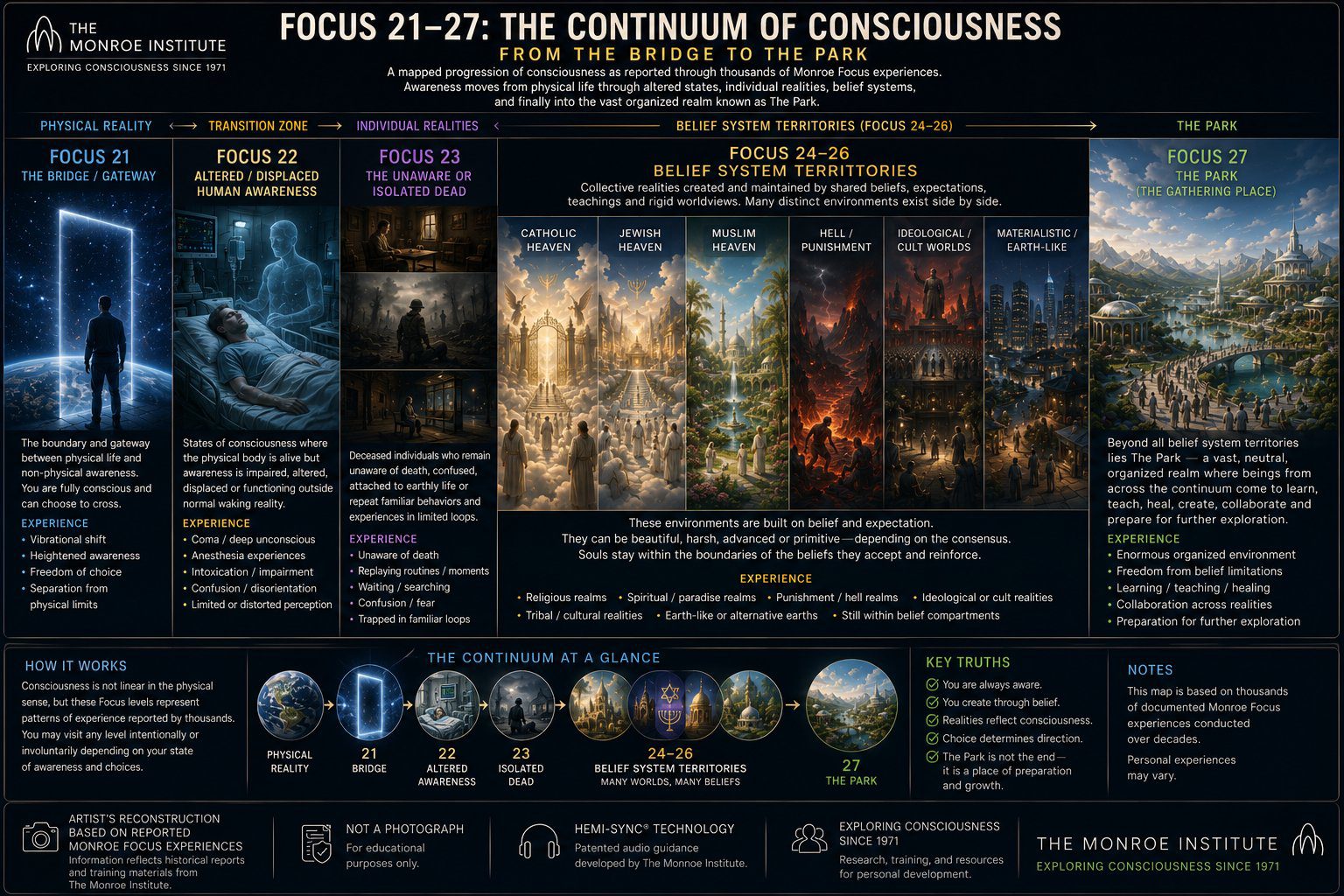
Focus 22 Through 26: The Transition Out of Physical Life
Within the Monroe derived framework, Focus 22 is associated with fragmented or compromised states of awareness. Later descriptions link it to people whose consciousness is not functioning normally in ordinary waking reality but has not fully transitioned into the post physical territories either. Focus 23 is described more dramatically. It is associated with deceased personalities who remain heavily oriented toward physical life, including individuals who supposedly do not realize they have died or remain fixated on the circumstances of death, unfinished relationships or habits of physical existence.
Focus 24 through 26 are what Monroe Institute explorers call the Belief System Territories. The central claim is one of the most provocative in Monroe’s model: deeply held beliefs and expectations may shape the environments consciousness experiences after death, potentially producing shared realities resembling religious heavens, hells or other culturally familiar afterlife settings. According to Monroe’s framework, some individuals may remain in these states for extended periods because they believe the reality surrounding them is the only one that exists. Importantly, Monroe did not describe them as necessarily permanent; his retrieval model holds that consciousness can eventually recognize the larger reality and move beyond them.
What if Heaven and Hell Are Partly Built by the People Who Enter Them?
In the Belief System Territories, a person’s expectations can supposedly become architecture. Someone who dies expecting a highly specific heaven may experience that heaven. Someone dominated by fear, guilt or rigid dogma may experience a world organized around those states.
The model does not require a supernatural jailer to build a hell because belief itself can become the wall. Other personalities are described as remaining attached to addictions, status, resentment, physical cravings or traumatic events from life. Without a physical body capable of satisfying those impulses, consciousness allegedly becomes trapped inside repeating patterns until it recognizes what has happened and becomes willing to move beyond them.
This is not an idea that appeared only in Monroe’s work. Buddhist bardo traditions, Swedenborgian descriptions of post death societies, Western astral literature and other systems contain structurally similar concepts involving transitional states, psychologically organized environments and consciousness gradually recognizing a larger reality. The descriptions are not identical and should not be forced into a perfect one to one chart. The significance lies in the recurrence of a pattern across very different traditions: bodily death, transition, persistence of identity, environments shaped by psychological state, encounters with other intelligences and eventual movement into a broader condition.
Different Methods, Similar Territory
This recurring architecture is one of the most important themes of the entire investigation. Monroe explorers arrive through Hemi-Sync and deliberate altered state training. Near death experiencers arrive through medical crisis. Some mystical traditions arrive through meditation or contemplative practice. Hypnotic life between lives subjects arrive through regression. Children investigated for apparent past life memories arrive from the opposite direction, beginning a physical life while describing information associated with another one.
Those populations are not interchangeable. Their methods have different vulnerabilities, and similarities do not automatically establish a common external world. But methodological independence is important. If one group trains everyone to expect a park and everyone reports a park, expectation becomes an obvious explanation. When different groups using different methods produce overlapping structures without sharing a single training system, the convergence becomes more interesting.
The fundamental question is therefore not whether every group describes exactly the same place. They do not. It is whether enough recurring features appear across sufficiently different methods that a deeper common mechanism deserves consideration.
Soul Retrieval: The Part of Monroe’s Work That Sounds Impossible Until You Learn People Actually Train to Do It
The Monroe system does not merely describe deceased personalities trapped in confusion. It teaches living participants to try to help them. The Institute’s Lifeline program explicitly works with Focus 23 through Focus 27 and teaches what it calls retrieval or rescue work. The basic method involves entering an altered state, moving through the Focus 21 transition, identifying a consciousness believed to be stuck in a lower postphysical state, making contact and attempting to redirect the individual toward Focus 27.
The logic is surprisingly psychological. A deceased personality may be unable to perceive anything outside its own mental loop because its expectations define what it believes is happening. The retriever therefore attempts to create a pattern interruption: a conversation, a familiar presence, a name, a memory or some other shift strong enough to make the individual reconsider the apparent reality.
Once the personality recognizes that physical life has ended, Monroe derived accounts describe Helpers or guides becoming visible, after which the individual can supposedly be escorted toward Focus 27. This sounds extraordinary because it is extraordinary. But it is important to understand that retrieval is not merely a theoretical concept buried in Monroe’s old books. Lifeline remains part of the Monroe Institute’s advanced program architecture, and participants continue to be trained to perform this work today.
Retrieval Has Been Investigated; the Question Is How Strong the Verification Is
The right way to discuss retrieval research is not to imply that nobody has ever tried to test it. Monroe explorers and related researchers have attempted validation for decades, particularly when participants returned with names, biographical details, causes of death, locations or other information that could theoretically be checked against physical records.
The quality of those cases varies, which is exactly why the strongest ones matter. A vague account of meeting a confused elderly man is nearly impossible to evaluate. A session recorded before feedback that contains a specific name, unusual death circumstance, family connection or private detail later matched to a real deceased person is a very different evidentiary event.
The central scientific questions concern controls. Was the information written down before the investigator searched for a match? Could the participant have learned the information normally? How many incorrect details accompanied the correct ones? Was the target known to the monitor? Could independent judges identify the correct match without being told what investigators hoped to find? Those questions do not erase decades of retrieval work. They allow the work to be ranked by evidentiary strength instead of treated as one undifferentiated pile of stories.
Focus 27: The Park
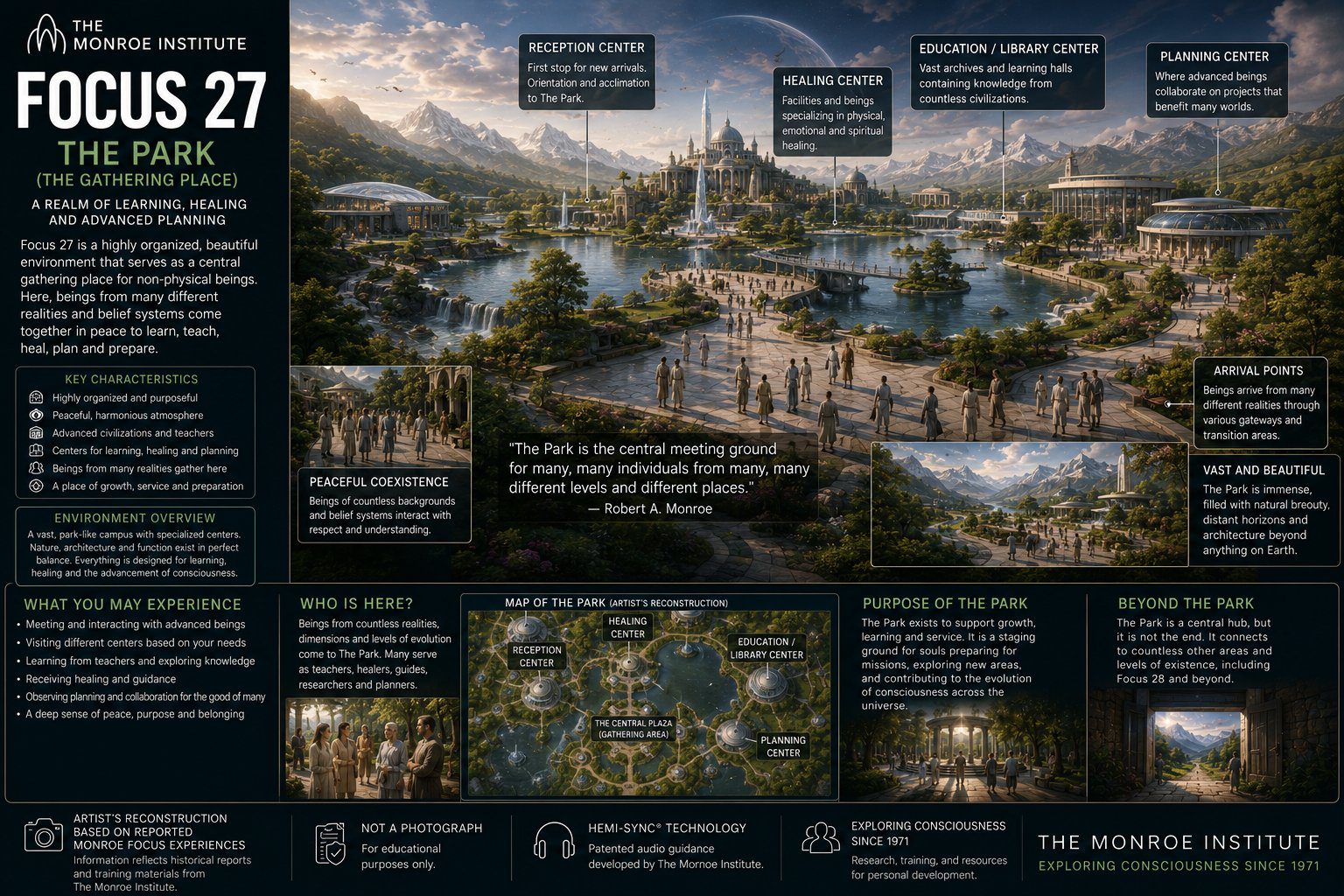
Focus 27 is the center of Monroe’s post physical map and one of the most frequently described advanced states in the system. The Monroe Institute continues to describe Focus 27 as an area beyond the limits of the Earth Life System and continues offering Exploration 27 programs devoted specifically to this territory. This is where the magnitude of the Monroe project becomes difficult to appreciate from a simple summary. People are not only told that Focus 27 exists. Advanced participants are trained to enter the state repeatedly and explore named regions within it, including the Park and Reception Center, Education Center, Planning Center, Healing and Rejuvenation Center and other areas of the broader environment.
The landscape is often described in recognizably human terms: vegetation, paths, buildings, meeting places, lakes, open spaces and structures serving different functions. Within the Monroe model, however, the environment is not necessarily understood as physical wood, stone and water. Consciousness may be translating a nonphysical informational state into forms it can understand.
The Park may therefore function less like a literal terrestrial park and more like an interface. A human being has spent decades understanding reality through bodies, faces, rooms and landscapes. If consciousness survives death, Monroe’s model suggests that an abrupt move into completely abstract information could be overwhelming. Familiar architecture would allow the personality to stabilize while gradually adjusting to a reality no longer organized around a biological body.
The Reception Center: A Familiar Interface After Death
The Reception Center is described as a transitional environment for newly arrived or retrieved personalities. In Monroe derived accounts, the newly deceased may encounter familiar people, guides or recognizable surroundings while becoming oriented to the fact that physical life has ended.
This resembles one of the most common motifs in near death literature: the sense of arriving somewhere intensely familiar, encountering deceased relatives or benevolent presences, and feeling that the new environment is in some sense more natural than the physical world left behind. The comparison becomes particularly important because many near death experiencers were never trained in Monroe’s map. They arrived through sudden medical crisis rather than through Hemi-Sync, which means the overlap cannot simply be reduced to all participants following the same instructions.
The Healing and Rejuvenation Center
The Monroe Institute’s Exploration 27 material identifies a Healing and Rejuvenation Center as one of the environments participants may explore. The concept is based on the idea that a physical injury can end while psychological identification with that injury continues. A person who spent years dying from disease might no longer possess the diseased body but could still experience identity through illness. Someone killed violently might continue perceiving a damaged body because trauma has not yet been cognitively integrated. Healing in this model therefore means less “repairing a ghost body” and more helping consciousness recognize that physical injury is no longer the defining condition of the self. Participant accounts describe light, guides, restorative environments and other forms of symbolic or energetic treatment.
The striking feature is that the reported architecture is functional. Focus 27 is not described merely as a scenic heaven. Different regions allegedly perform different jobs: orientation, recovery, education, planning and coordination.
The Education Center: A Library Where Information Arrives All at Once
Another Focus 27 region is the Education Center. Monroe’s own language included the concept of a “rote,” a dense package of information that could be received as a whole and only later translated into ordinary linear language. The idea is difficult to describe until one compares it with dreams, psychedelic experiences or sudden insight. People sometimes report understanding a complex concept all at once and then spending minutes or hours trying to express what seemed instantly obvious during the altered state.
Within the Monroe model, the Education Center expands this concept dramatically. Explorers describe information about personal history, previous lives, broader patterns and, in later accounts, material extending far beyond one person’s biography. Some descriptions develop the center into something resembling a nonphysical archive or library of knowledge. Whether such information corresponds to anything independently existing becomes the crucial experimental question, but the experiential structure itself has remained part of Monroe derived exploration for decades.
The Planning Center: What if Death Is an Intermission Rather Than an Ending?
The Planning Center may be the most disruptive part of Focus 27 because it transforms death from a final event into a stage between experiences. The Monroe Institute explicitly identifies a Planning Center among the environments explored in advanced Focus 27 work.
In the broader Monroe derived model, a personality can eventually consider another physical incarnation, continued nonphysical work, integration into a larger consciousness or some different path of development. Later accounts describe potential life circumstances, relationships and probable outcomes being considered before incarnation. More elaborate versions include soul groups, agreements among personalities expected to meet during a physical life, significant developmental challenges and potential decision points. The details vary across Monroe derived accounts, later explorers and adjacent traditions, but the underlying structure is remarkably consistent: a human birth is not viewed as the beginning of consciousness but as the beginning of one physical assignment.
This begins sounding remarkably similar to another large body of afterlife literature developed through a completely different route: Michael Newton’s life between lives hypnosis work.
Michael Newton: A Different Method, a Strangely Similar Architecture
Dr. Michael Newton used deep hypnosis rather than Hemi-Sync. His clients described what he interpreted as experiences between physical lives, including departure from the body, transition, orientation, guides, soul groups, life review, future life selection and preparation for another incarnation.
The similarities with Focus 27 are obvious. Monroe’s model includes transition, reception, education, healing and planning. Newton’s accounts repeatedly describe transition, orientation, review, group relationships and preparation for another life. Hypnosis carries serious methodological vulnerabilities, including suggestion, false memory and confabulation, so Newton’s thousands of client experiences cannot simply be counted as thousands of blinded replications of Monroe. But they remain relevant because they represent a separate methodological lineage producing some strikingly similar structural motifs.
The convergence becomes more interesting when another institution enters the story, one that deliberately built much of its research around spontaneous childhood reports rather than hypnotically recovered memories.
The University of Virginia Has Spent Decades Investigating Children Who Say They Remember Previous Lives
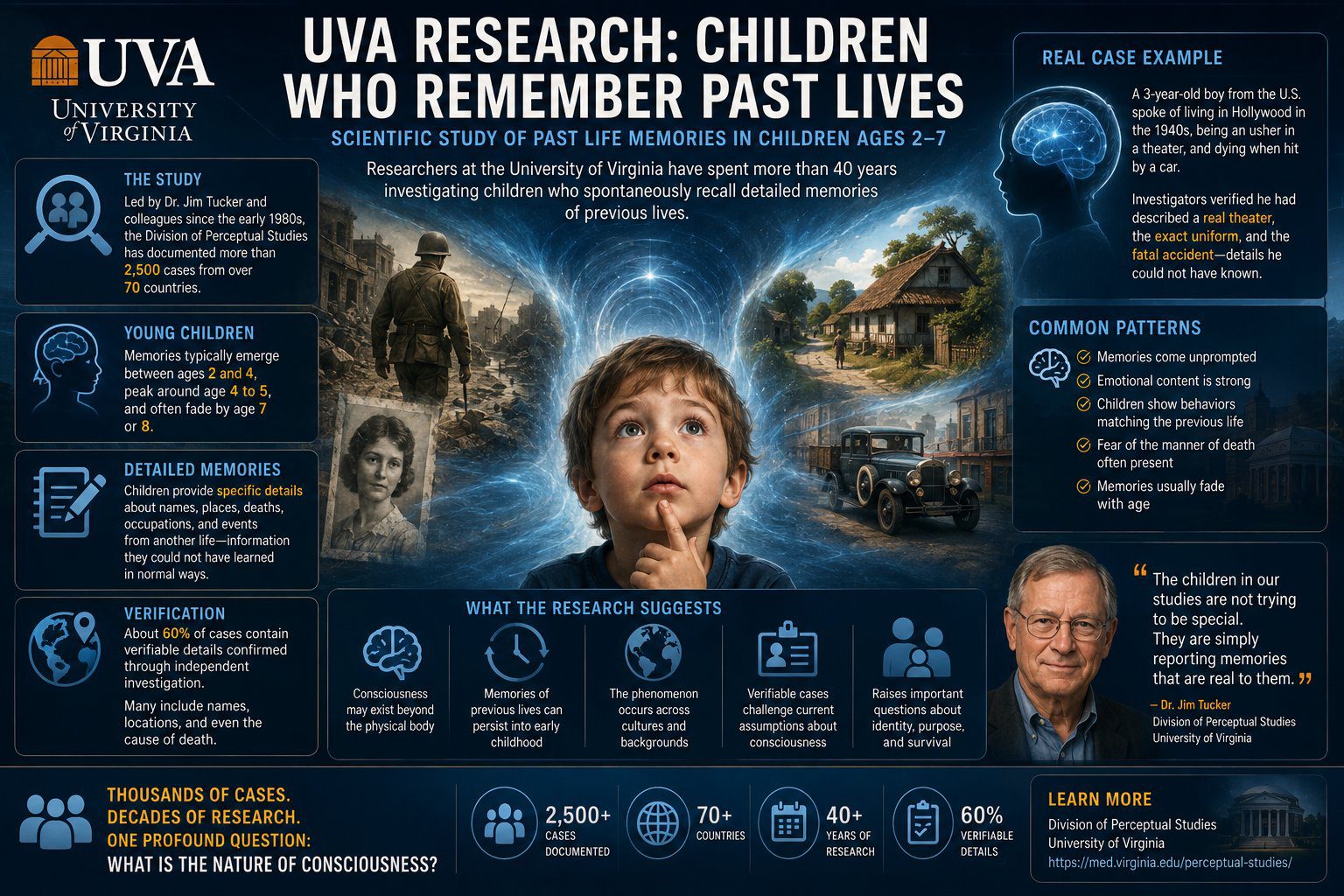
The University of Virginia’s Division of Perceptual Studies has accumulated more than 2,500 cases involving young children who report apparent memories of previous lives. Researchers associated with the program, beginning with psychiatrist Ian Stevenson and continuing through subsequent investigators, have spent decades cataloguing statements, behavioral patterns, circumstances of death and possible correspondences between the child’s reports and identifiable deceased individuals.
Many children reportedly begin making statements at very young ages, often around the period when language develops rapidly. Some describe people, places, relationships, occupations or circumstances of death. Investigators then attempt to determine whether those statements correspond to a real deceased person and whether ordinary information transfer provides an adequate explanation. The division reports that approximately 30 percent of its cases include a birthmark or birth defect, a pattern researchers have examined in relation to the injuries or circumstances associated with the person whose life the child appears to remember. That does not settle the interpretation, but it adds another physical and behavioral dimension beyond simple storytelling.
This is enormously relevant to the Monroe Planning Center because UVA’s work approaches reincarnation from the opposite direction. Monroe and Newton describe consciousness before another life begins; UVA investigates children who appear to arrive in this life carrying information associated with another one. The methodologies are different, and the datasets should not be blended into one experiment. What makes the comparison compelling is that the apparent sequence fits together: postphysical transition and planning on one side, unusually specific previous life reports emerging in young children on the other.
UVA Is Still Expanding the Research
The work is not merely a historical archive left behind by Stevenson. UVA announced a major new research initiative in 2025 designed to develop contemporary empirical approaches to children reporting past life memories, including behavioral and neurophysiological comparisons between children who make such reports and those who do not. That matters for the larger story because it demonstrates that institutional research into survival and reincarnation related phenomena is continuing into the present. The field has not disappeared simply because its implications remain controversial.
The important question is not whether the university has declared reincarnation proven. It has not. The important point is that a major American medical school research division has accumulated thousands of cases and continues investigating them because the data remain interesting enough to warrant study. That is a very different proposition from saying “some people believe in past lives.”
Near Death Experiences: The Accidental Explorers
Near death experiences may be the most important independent comparison group in this entire investigation because the people involved generally did not intend to enter an altered state. Many were suffering cardiac arrest, trauma or other severe medical crises. The University of Virginia’s Division of Perceptual Studies has studied NDEs for decades, including their phenomenology, psychological consequences and cases involving apparently verifiable perception. The research sits alongside broader prospective medical studies attempting to understand what people experience during cardiac arrest and resuscitation.
Across the wider NDE literature, recurring elements can include separation from the body, profound peace, light, deceased relatives, altered time, movement toward another environment, life review, a sense of being “home,” boundaries and eventual return. Place those features beside Monroe’s map and the overlap becomes difficult to ignore. Focus 10 reduces bodily awareness while NDErs report separation from the body. Focus 15 concerns No Time while NDErs frequently report timelessness. Focus 21 is a boundary while some NDErs describe reaching a limit beyond which they understood they could not return. Focus 27 contains reception, healing and education while NDErs describe deceased loved ones, profound understanding, review and environments interpreted as another realm.
The comparison does not require every NDE to follow Monroe’s numerical sequence. The importance lies in the recurrence of major structural features among people who often had no connection to Monroe’s training.
The Key Question in NDE Research Is Veridical Information
NDEs become most scientifically interesting when experiencers report events or information they should not have been able to perceive conventionally. Claims of seeing medical procedures from above the body, hearing conversations at a distance or later identifying details that occurred while the patient appeared unresponsive are often called veridical or veridical perceptions. These cases are controversial precisely because they move the debate away from whether the experience felt real. An internally generated hallucination can feel completely real. The harder question is whether it contains accurate external information unavailable through ordinary perception.
That is why prospective research matters. Modern resuscitation studies have attempted to place concealed targets in medical environments and correlate reported experiences with physiological timing. The research is intrinsically difficult because most cardiac arrest patients do not survive, fewer recall NDEs and only a fraction report apparent out of body perception. But the experimental logic is straightforward: if consciousness can perceive independently of ordinary sensory access, create information that can only be obtained under those unusual conditions and see whether anyone brings it back.
Bigelow: When an Aerospace Billionaire Put Serious Money Behind the Soul Survival Question
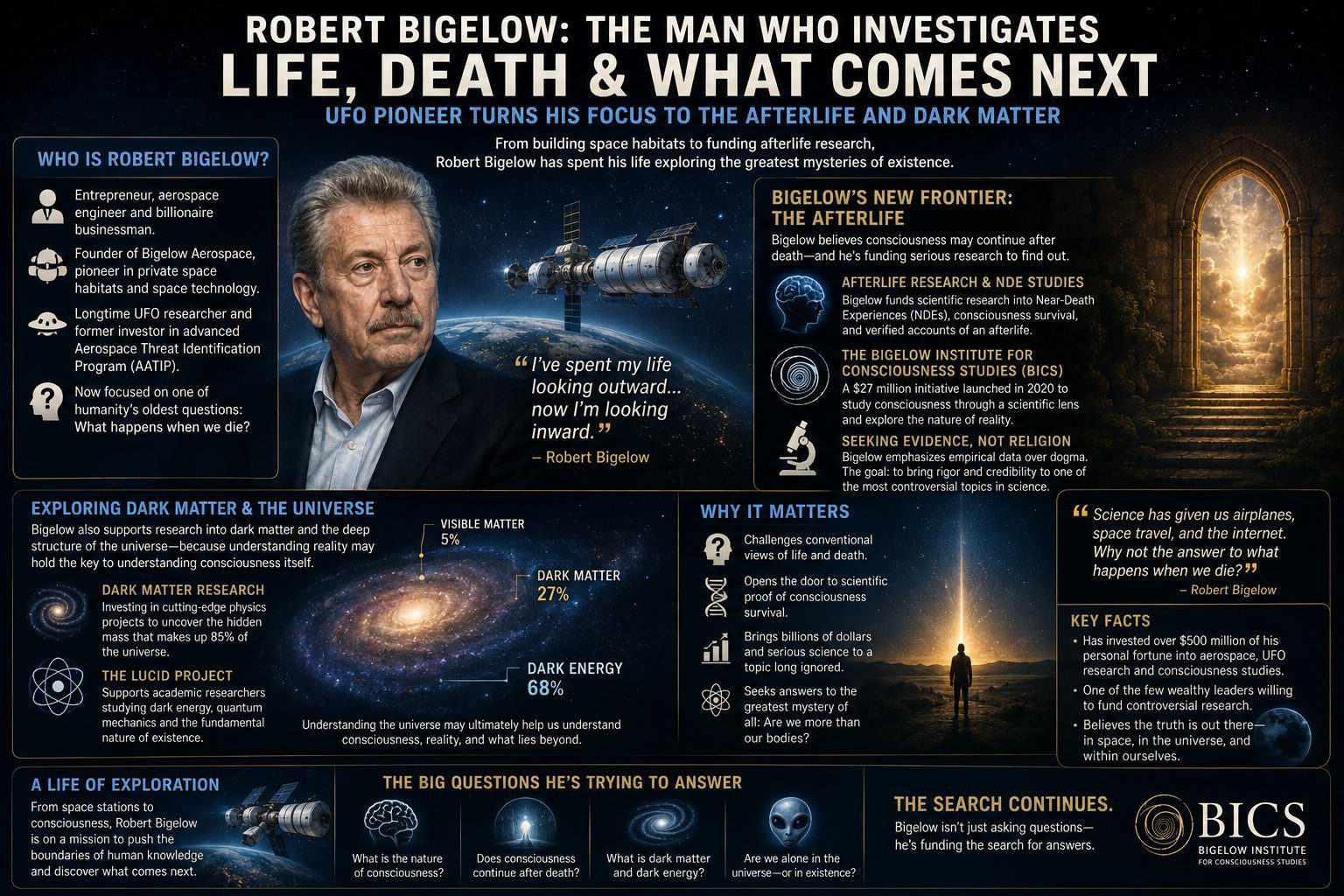
Robert Bigelow entered the consciousness story from another direction entirely. Best known for aerospace and his longstanding interest in anomalous phenomena, Bigelow founded the Bigelow Institute for Consciousness Studies in 2020 specifically to support research into the survival of human consciousness after physical death and the nature of an afterlife. That mission is stated openly by the organization. BICS launched a major essay competition asking researchers and scholars to present the strongest available evidence for survival of consciousness. More than 200 essays were submitted, and the Institute ultimately published winning and honorable mention papers addressing evidence categories including NDEs, reincarnation, mediumship, apparitions and other survival related phenomena.
Bigelow’s involvement does not matter because wealth converts belief into fact. It matters because significant private resources were directed toward assembling, comparing and funding research streams that conventional institutions often examine separately. BICS later expanded into additional projects involving mediumship and purported afterlife communication, creating another institutional node in a field that already includes Monroe, university researchers, physicians, parapsychology laboratories and the historical government remote viewing programs. What emerges is not one institution defending one doctrine but an unusual ecosystem of organizations attacking different portions of the consciousness problem using different methods.
The Pattern Is Bigger Than Any One Institute
At this stage, the convergence becomes the real story. Monroe explorers deliberately enter altered states using sound and training. Military remote viewers attempted to acquire hidden information under controlled conditions. NDE experiencers reach unusual states during medical crises. UVA investigates children reporting apparent memories of previous lives. Newton’s subjects describe environments between lives through hypnosis. Bigelow funded researchers assemble survival evidence across multiple categories. Older spiritual traditions describe states that sometimes resemble portions of the same architecture.
These groups do not all agree. They do not all use the same vocabulary, and some of their methods are much stronger than others. That diversity is exactly what makes the comparison interesting. If every report came from one organization teaching one doctrine, shared expectation could explain much of the similarity. When very different methods produce recurring motifs involving bodily separation, altered time, deceased personalities, life review, transition, guides, continuation of identity and increasingly nonphysical states, the convergence itself becomes something that requires explanation. Shared human neurobiology may explain much of it. Perhaps it eventually explains all of it. But that possibility is an explanation to investigate rather than a magic word that makes decades of unusual data disappear.
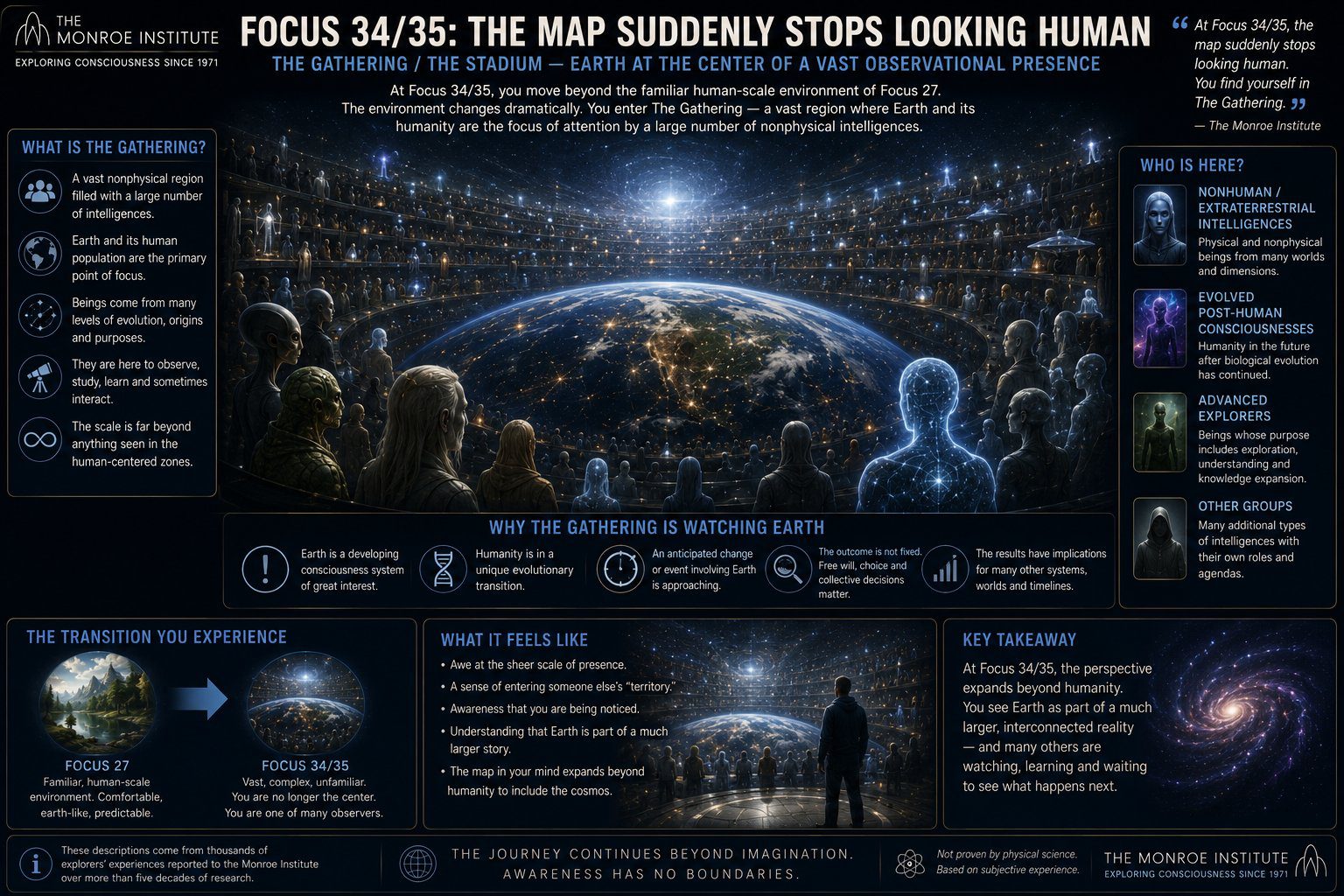
Focus 34/35: The Map Suddenly Stops Looking Human
Beyond Focus 27, Monroe derived exploration changes scale. The familiar human architecture of reception, healing, education and planning begins giving way to something described as far less Earth centered. Focus 34/35 is associated with what Monroe and later explorers called The Gathering. Accounts describe a vast collection of intelligences observing the Earth Life System from a perspective outside ordinary human incarnation.
The metaphor is sometimes a stadium: Earth is the event and the surrounding intelligences are watching. The imagery is important because the map has now moved beyond human personalities navigating the post death transition and into a much larger proposed ecology of consciousness.
The reports do not require every observer to be a biological extraterrestrial. Some are interpreted as nonhuman, others as posthuman or forms of consciousness operating outside the normal Earth cycle. This distinction matters because “nonhuman intelligence” and “alien from another physical planet” are not the same claim.
The Gathering and the Transformation
In Monroe derived accounts, the Gathering is not portrayed as casual tourism. The observers are described as interested in a major shift involving Earth or human consciousness, sometimes characterized as a transformation. Different explorers interpret that transformation differently. Some emphasize an evolutionary change in human awareness, while later accounts sometimes introduce more elaborate extraterrestrial, energetic or dimensional interpretations.
What matters structurally is the change in the map. Focus 23 through 27 primarily concerns human consciousness after death. Focus 34/35 introduces intelligences apparently outside the ordinary human reincarnation cycle. The Monroe system has therefore moved from a proposed afterlife model into a proposed ecology of nonhuman consciousness.
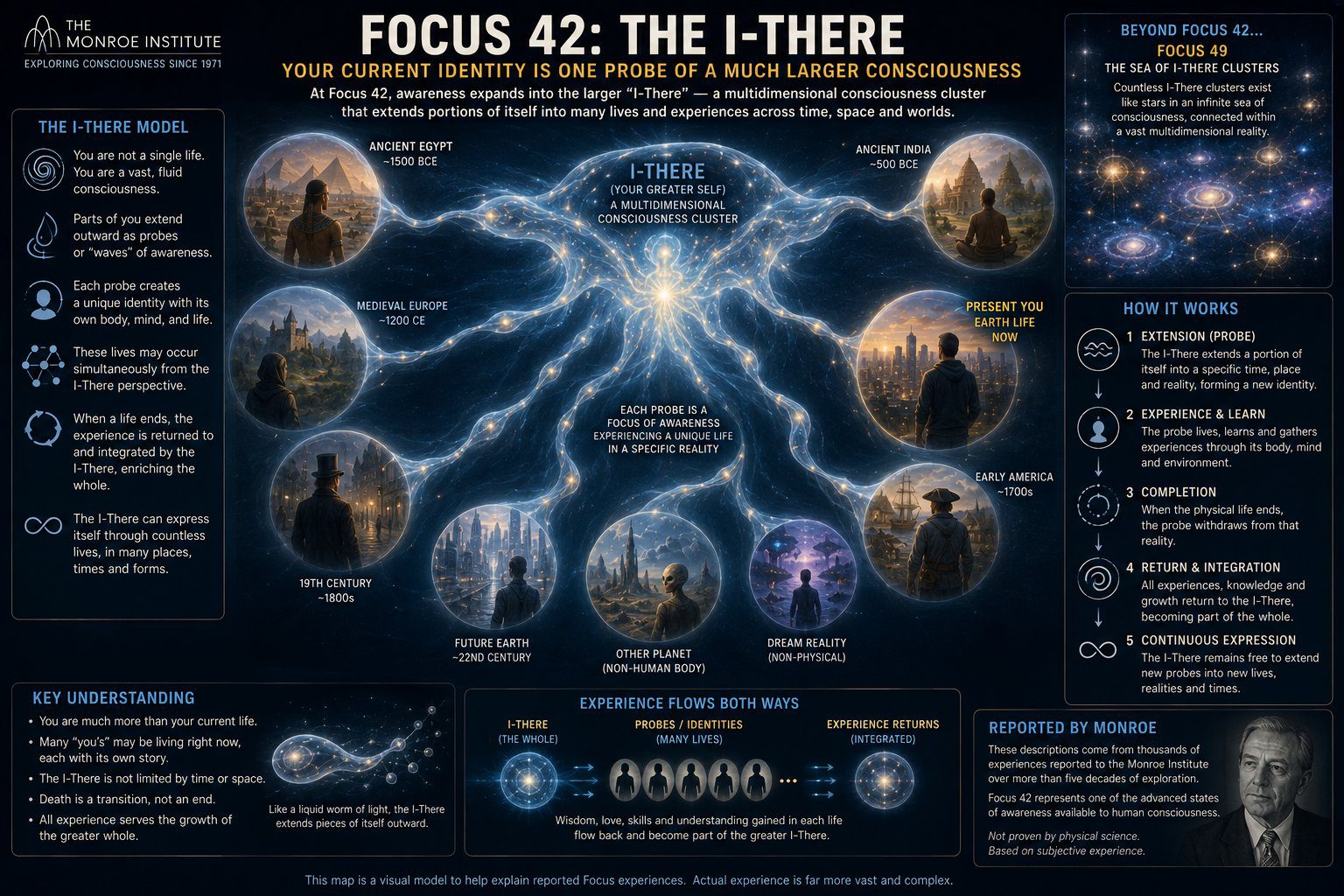
Focus 42: What if “You” Are Only One Piece of You?
At the higher Focus levels, the ordinary human personality begins losing its status as the complete unit of consciousness. Monroe used the concept of the I-There to describe a larger structure of identity containing or integrating multiple lives and experiences. Focus 42 in later Monroe derived exploration is associated with increasingly expanded identity and the larger self problem. Under this model, your present personality is real, but it is not the entirety of you. A useful analogy is a probe. A larger consciousness sends an experiential extension into physical reality, and that extension experiences itself as one individual because localization is necessary to operate a biological body. When the physical mission ends, the experience is reintegrated into the larger structure. Death therefore becomes less like destruction and more like returning experience to the larger system.
The I-There Model Changes Reincarnation
Popular reincarnation is usually imagined as a serial chain: one soul becomes Person A, then Person B, then Person C. Monroe’s larger self model permits something stranger. If the larger consciousness exists outside ordinary linear time, multiple incarnational lives may not need to be sequential from its perspective. Lives separated by centuries in physical history could theoretically coexist as different experiential branches within the larger identity. That concept offers a framework for understanding why some mystical traditions describe individuality and unity as simultaneously true. The human personality remains meaningful but is embedded inside something larger.
It also creates an unexpected connection to UVA’s reincarnation research. If young children occasionally appear to bring unusually specific information associated with another life, Monroe’s model offers one possible explanation: the informational boundary between one physical probe and a larger identity may not be completely sealed. That interpretation remains one possible model rather than a settled explanation, but the pieces fit together coherently enough to make the comparison valuable.
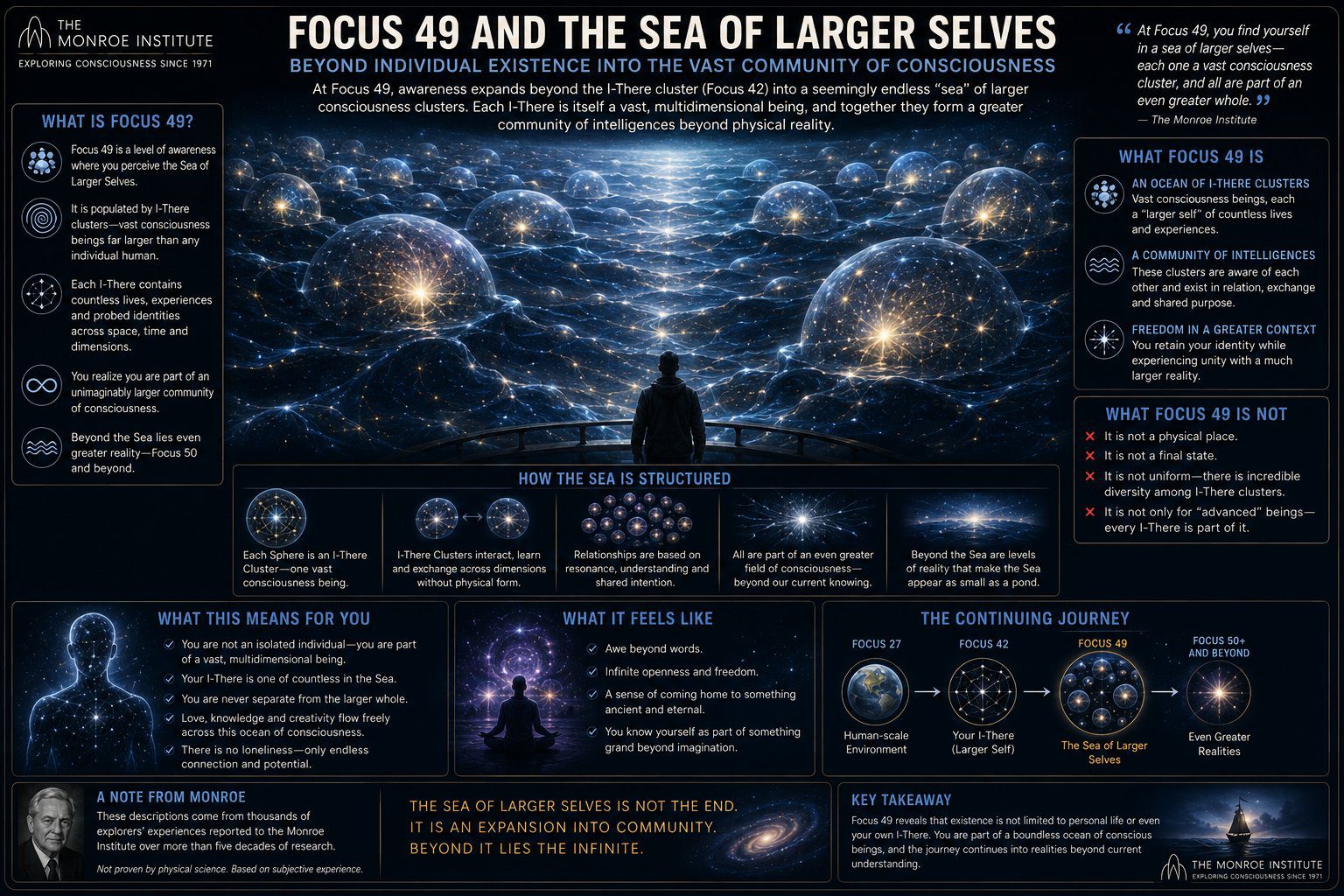
Focus 49 and the Sea of Larger Selves
If Focus 42 expands the individual into the I-There, Focus 49 expands the I-There into a broader field of larger identities. Advanced Monroe derived descriptions use imagery involving clusters, networks and collective awareness rather than ordinary human forms and locations. The “Sea of Clusters” is a useful shorthand for the model. Instead of one larger self containing many physical experiences, multiple larger selves become nodes inside a still greater system. At this stage the language becomes increasingly difficult because everyday grammar assumes separate objects, separate people and linear events. Explorers instead report simultaneous information, fields of awareness and collective identity.
Whether those states are internal neurological abstractions or access to a genuinely larger consciousness field remains the central unresolved question, but the trajectory of the map is clear: the higher one goes, the less separate the self appears to become.
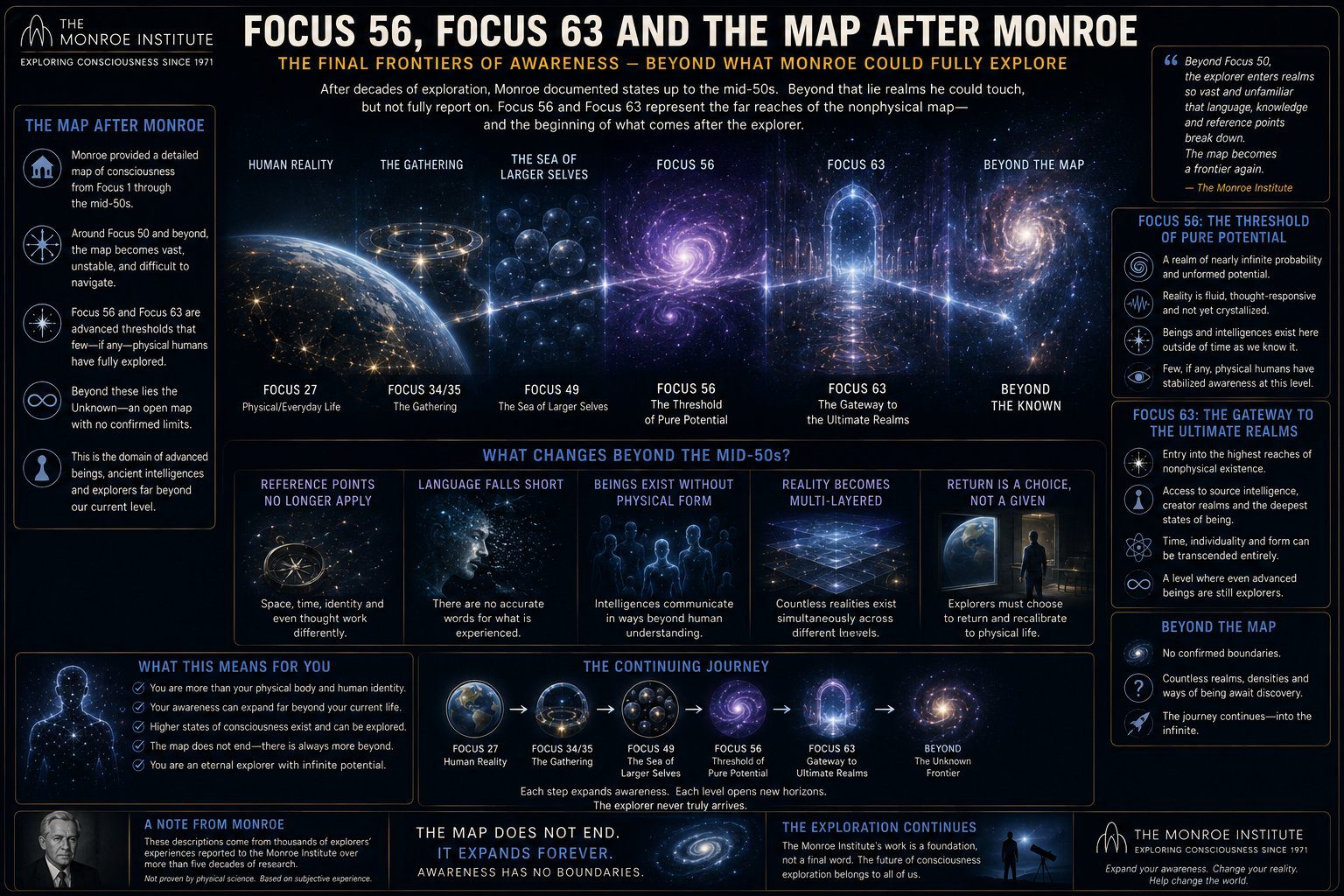
Focus 56, Focus 63 and the Map After Monroe
Later Monroe Institute traditions extended the Focus numbering beyond the levels most closely associated with Robert Monroe’s own published work. Advanced explorers have used Focus 56, Focus 63 and other designations for progressively more expansive states associated with galactic, interdimensional, or Source like awareness.
The Monroe system did not stop evolving when Robert Monroe died. The Institute and subsequent explorers continued developing the map, experimenting with additional states and adding terminology to describe experiences that participants believed extended beyond the original system. That continuation is important because it demonstrates that Monroe’s work developed into a living methodology rather than becoming a fixed historical doctrine. At the same time, attribution matters: some Focus levels and descriptions come directly from Monroe’s published work, while others were developed by later Institute programs and explorers working within the framework he created.
At the Top of the Map, Individual Identity Appears to Dissolve
Viewed from beginning to end, the philosophical direction of the Focus system is striking. Focus 1 is ordinary embodied identity. Focus 10 reduces bodily dominance. Focus 12 expands awareness. Focus 15 loosens time. Focus 21 approaches the physical/nonphysical boundary. Focus 23 through 26 describe consciousness still constrained by identity and belief after death. Focus 27 introduces stabilization, learning, healing and planning. Then the scale changes. Focus 34/35 places the human life system inside a larger field of observers. Focus 42 expands the individual into the I-There. Focus 49 expands the I-There into networks of larger identities or soul groups. Higher states move toward increasingly collective forms of consciousness in which familiar distinctions between individual selves become progressively less meaningful.
The movement resembles one of the oldest recurring themes in mystical traditions: individual identity becomes less absolute as consciousness expands. That could represent a universal feature of human neurobiology, a universal feature of consciousness itself, or some interaction between the two. Whatever ultimately explains it, the recurring trajectory becomes difficult to miss once the entire map is laid out.
Gateway: The Army Tried to Build a Theory Around What Monroe Was Doing
The 1983 Analysis and Assessment of Gateway Process is one of the strangest documents in the modern history of consciousness research because it represents an Army officer attempting to explain Monroe style altered states using the scientific and theoretical vocabulary available to him. The assessment discusses resonance, brainwave activity, energy, consciousness and holographic models in an effort to build a coherent explanation for Gateway. It is not merely a memo saying people enjoyed meditation. It represents an attempt to reason through how consciousness might function beyond ordinary assumptions about locality, physical perception and time.
Its historical importance lies in the seriousness of the exercise. The military was trying to construct a theoretical model around the phenomena rather than simply dismissing them. Even if portions of the proposed physics eventually prove incomplete or mistaken, the document demonstrates that intelligence personnel had moved beyond asking whether people merely felt strange during the tapes. They were asking what kind of model of consciousness could account for what they believed they were observing.
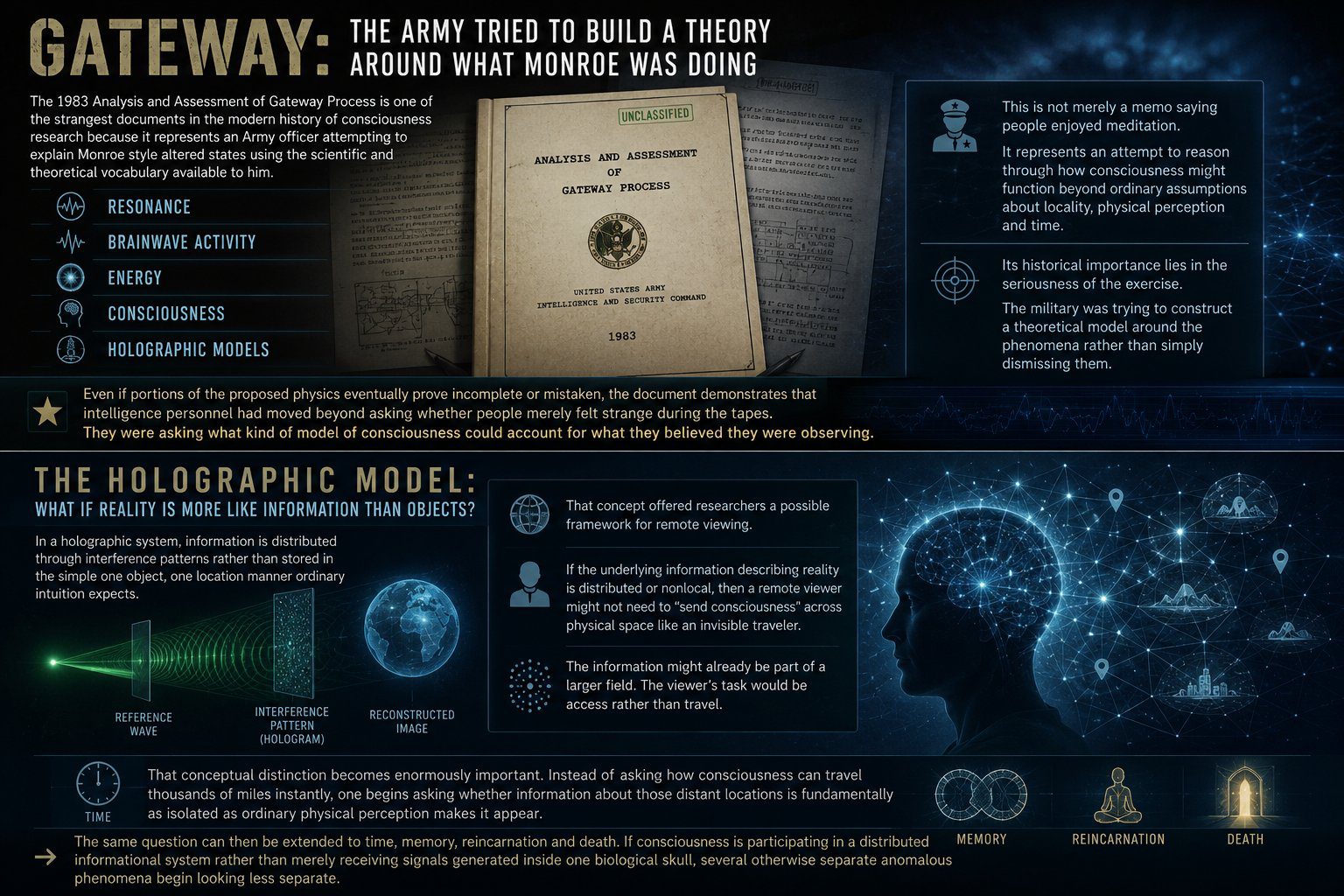
The Holographic Model: What if Reality Is More Like Information Than Objects?
One of Gateway’s best known ideas concerns holographic models of brain function and reality. In a holographic system, information is distributed through interference patterns rather than stored in the simple one object, one location manner ordinary intuition expects. That concept offered researchers a possible framework for remote viewing. If the underlying information describing reality is distributed or nonlocal, then a remote viewer might not need to “send consciousness” across physical space like an invisible traveler. The information might already be part of a larger field. The viewer’s task would be access rather than travel.
That conceptual distinction becomes enormously important. Instead of asking how consciousness can travel thousands of miles instantly, one begins asking whether information about those distant locations is fundamentally as isolated as ordinary physical perception makes it appear. The same question can then be extended to time, memory, reincarnation and death. If consciousness is participating in a distributed informational system rather than merely receiving signals generated inside one biological skull, several otherwise separate anomalous phenomena begin looking less separate.
The UFO Problem Enters the Consciousness Problem
Government interest in anomalous aerial phenomena predates Gateway by decades. Records from 1947 show Army Air Corps intelligence and the FBI attempting to determine whether reported flying discs represented a real phenomenon and considering possibilities ranging from celestial effects and foreign technology to publicity seeking, political motives and mass hysteria. The record is one of genuine uncertainty rather than a predetermined extraterrestrial conclusion.
One especially provocative memorandum records FBI Director J. Edgar Hoover wanting access to “discs recovered” before deeper Bureau cooperation, after an earlier case in which the Army had allegedly taken an object without allowing FBI examination. Later correspondence indicated that Air Corps officials would make recovered discs available to FBI agents. The language demonstrates investigation and concern over access to material; it does not, by itself, establish what those objects were.
The same archive demonstrates why government records have to be read carefully. One extraordinary flying saucer memorandum explicitly says its information came through what it called “so called supernormal means.” The government retaining a claim proves that officials possessed the document, while establishing the underlying claim requires a separate evidentiary step. That distinction becomes especially important when UFOs and consciousness begin touching the same story, because the most interesting interpretation may eventually involve something stranger than either conventional aircraft or spacecraft arriving from another planet.
What if Some UFOs Are Not Just Traveling Here From Far Away?
The conventional extraterrestrial hypothesis assumes geography. Another civilization exists on another planet, builds spacecraft, crosses interstellar distance and arrives on Earth. That remains one possible explanation for some unresolved UAP reports. But Monroe’s model suggests another geometry entirely. If consciousness can exist in states inaccessible to ordinary human perception, then an anomalous intelligence may not need to be physically distant from us at all. It could be differently phased, differently organized or operating in a state our biological sensory apparatus cannot normally perceive. That possibility leads to what we can call the Interface Model.
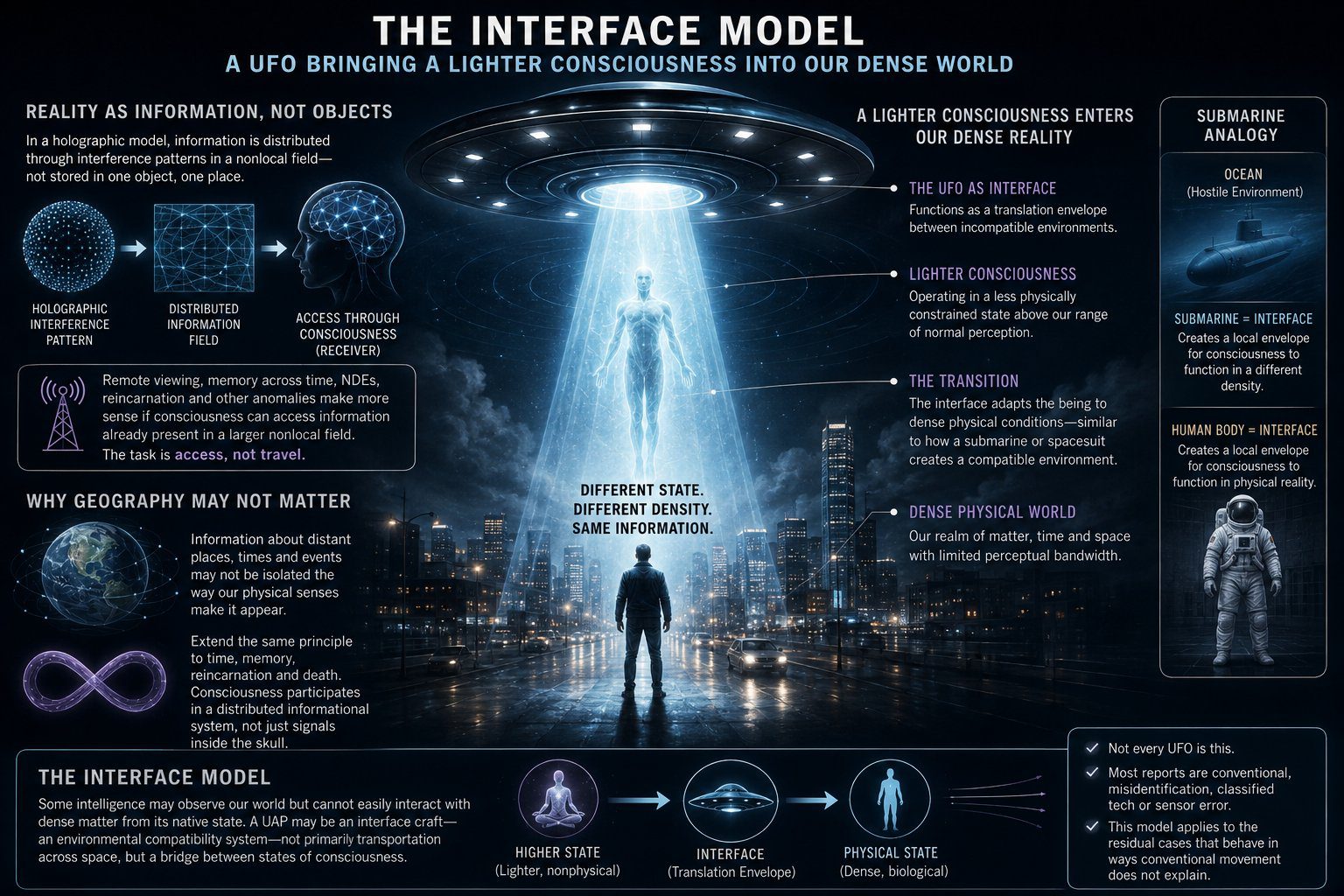
The Interface Model
Suppose physical matter is one highly constrained operating environment inside a larger informational system. Suppose some form of intelligence can exist outside the physical state humans normally perceive, and suppose that intelligence can observe our environment but cannot easily interact with dense matter below it while remaining in its higher native state above. Under those conditions, something appearing to us as a craft might not primarily be transportation between planets. It might be an interface between higher and lower states of consciousness.
The submarine analogy is useful. A submarine is not needed because the ocean is astronomically far away; it is needed because the environment is incompatible with an unprotected human body. A spacesuit solves the same problem in space by creating a local envelope in which the human organism can function.
A UAP, under this model, could theoretically function as a translation envelope allowing intelligence operating in another higher state to interact with dense physical reality below. The craft would be less like an airliner crossing distance and more like an environmental interface crossing incompatible conditions. This does not require every UFO to be interdimensional. Most reported UFOs may be conventional objects, misidentifications, classified technology or unresolved sensor events. The model concerns only the residual cases in which apparently intelligent phenomena seem to behave in ways that conventional movement through physical space does not easily describe.
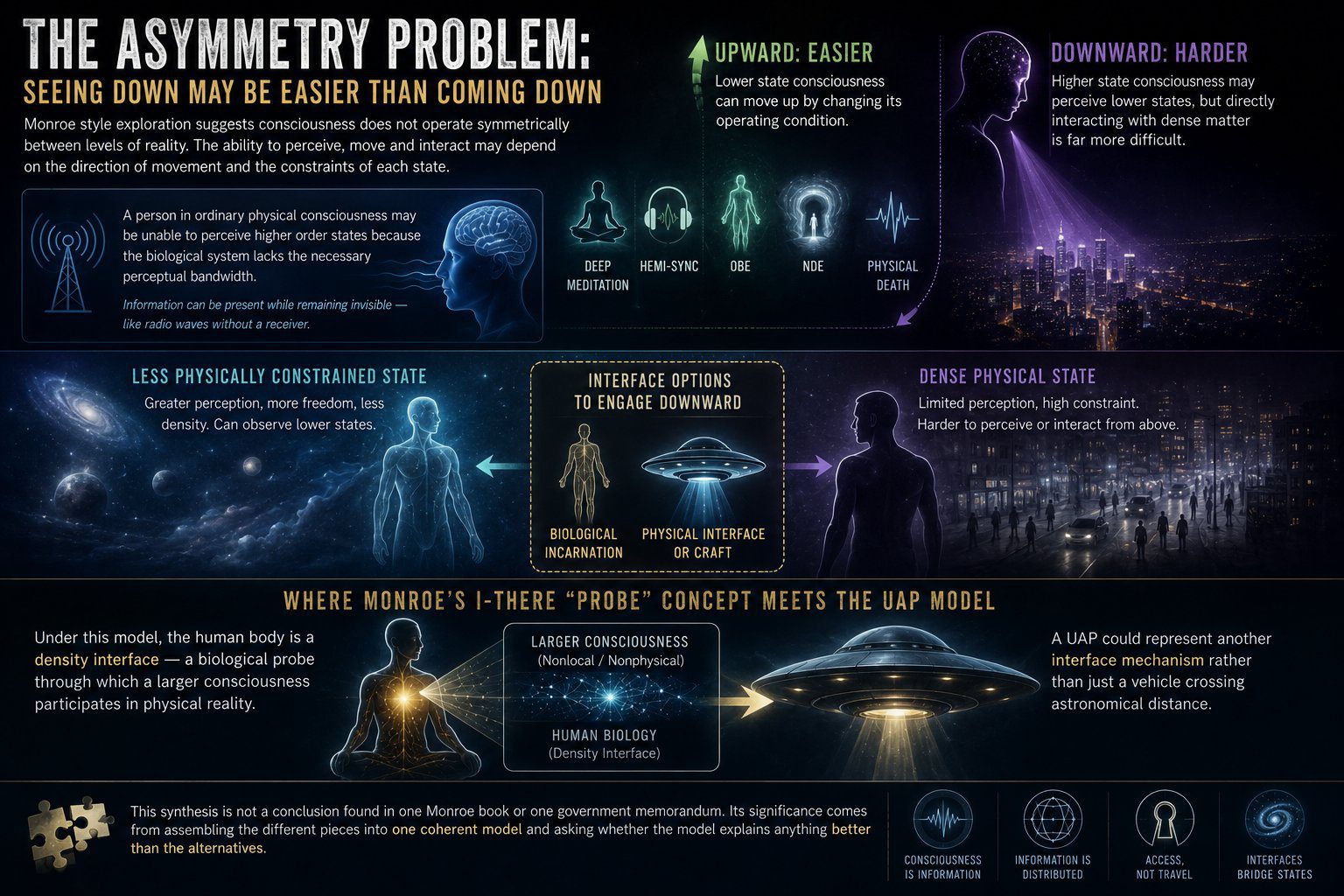
The Asymmetry Problem: Seeing Down May Be Easier Than Coming Down
The model becomes even more interesting when combined with the asymmetry described in Monroe style consciousness exploration. A person embedded in ordinary physical consciousness may be unable to perceive higher order states because the biological system does not possess the necessary perceptual bandwidth. Information could be present while remaining invisible, just as radio waves surround a person who lacks the receiver required to translate them.
The lower state consciousness may nevertheless be able to move upward by changing its operating condition through deep meditation, Hemi-Sync, OBE, NDE or eventually physical death. The opposite direction could theoretically work differently. A consciousness operating in a less physically constrained state might perceive lower states while having difficulty directly interacting with dense matter. Biological incarnation would be one solution. A physical interface or craft could theoretically be another.
This is where Monroe’s I-There “probe” concept unexpectedly intersects with the UAP model. The human body itself becomes a kind of density interface through which a larger consciousness participates in physical reality. Under that logic, a UAP could represent another interface mechanism used by high vibration, low density beings to descend and interact with our low vibration, high density world, rather than simply a space vehicle crossing astronomical distances.
Maybe “Alien” Is the Wrong Word for Some of These Travelers
Modern UAP discussion often treats “nonhuman” and “extraterrestrial” as synonyms. They are not. Nonhuman describes what an intelligence is not, while extraterrestrial describes where it originated. An intelligence could be nonhuman without living on another physical planet. It could be artificial, post biological, interdimensional, associated with a larger consciousness system or something outside current categories entirely.
Monroe’s Gathering becomes relevant here because his higher Focus model already contains intelligences outside the ordinary human life cycle without requiring them all to be flesh and blood visitors from another solar system. That does not settle the UAP problem, but it broadens the conceptual map. If reality contains categories of intelligence or consciousness we do not currently understand, then “Where is their planet?” may turn out to be the wrong first question for some of them.
The Brain Only Model Still Deserves Serious Attention
There is a powerful conventional explanation for much of this material. The human brain is an extraordinary reality generator. Dreams create complete worlds containing landscapes, buildings, weather, conversations and autonomous seeming people. Sleep paralysis can generate sensed presences. Temporal lobe disturbances can alter body ownership and spatial perception. Hypnagogia can produce vivid imagery. Psychedelics can dissolve identity and radically transform space and time. Meditation can alter body boundaries and self processing, while hypoxia, hypercapnia and extreme physiological stress can dramatically change consciousness.
Memory creates another problem because recollection is reconstructive rather than a perfect recording. Expectations, conversations, reading and later information can alter what people remember. Hypnosis introduces additional problems because confidence in a recovered memory does not guarantee historical accuracy. Those mechanisms may explain substantial portions of OBE, NDE and Focus level phenomenology. They also provide serious alternative explanations for similarities across some human experiences. The important question is whether they can explain the strongest information cases as well as the subjective experiences.
“Hallucination” Does Not Explain Accurate Hidden Information
Calling an experience a hallucination can potentially explain why someone saw a light, encountered a figure or felt separated from the body. It does not automatically explain how someone accurately describes a concealed target while blind to it. That is why remote viewing experiments matter so much to the broader consciousness story. They attempt to move beyond phenomenology into information acquisition.
The same logic applies to reincarnation cases. A child telling an imaginative story about another life is psychologically interesting. A child supplying multiple accurate details about an identifiable deceased individual whom investigators cannot connect normally to the family presents a different class of question. The same principle applies to NDEs. Seeing a tunnel may be internally generated. Accurately reporting an event occurring outside ordinary sensory range during a medical crisis would be more difficult to explain through internal imagery alone. The strongest version of the cumulative case therefore does not rest primarily on how meaningful people say their experiences felt. It rests on whether information crosses boundaries that ordinary models say should prevent it from getting through.
The Testing Has Been Happening for Decades
This is one of the most important corrections to the way this subject is often discussed. The central phenomena have not merely waited for somebody to test them someday. Different parts of the consciousness problem have been tested repeatedly, although not always with equal methodological strength.
Monroe used controlled environments, standardized audio and repeated participant training. Later Institute programs incorporated physiological measurements and EEG. Remote viewing researchers used distant targets, blind viewers, blind interviewers, target pools and independent judging. Government programs applied the method to operational intelligence questions as well as laboratory exercises. NDE researchers developed prospective hospital studies. UVA created systematic case files for children reporting previous lives. Mediumship researchers have experimented with blinded readings. Bigelow funded work has attempted to aggregate evidence across different survival categories.
The question is therefore not whether testing exists. The real questions are which tests were strongest, which results replicated, how large the effects were, what ordinary explanations remain, and whether the different lines of evidence become more persuasive when considered together rather than in isolation. That is a far more mature scientific problem than simply asking whether anyone has ever investigated the claims.
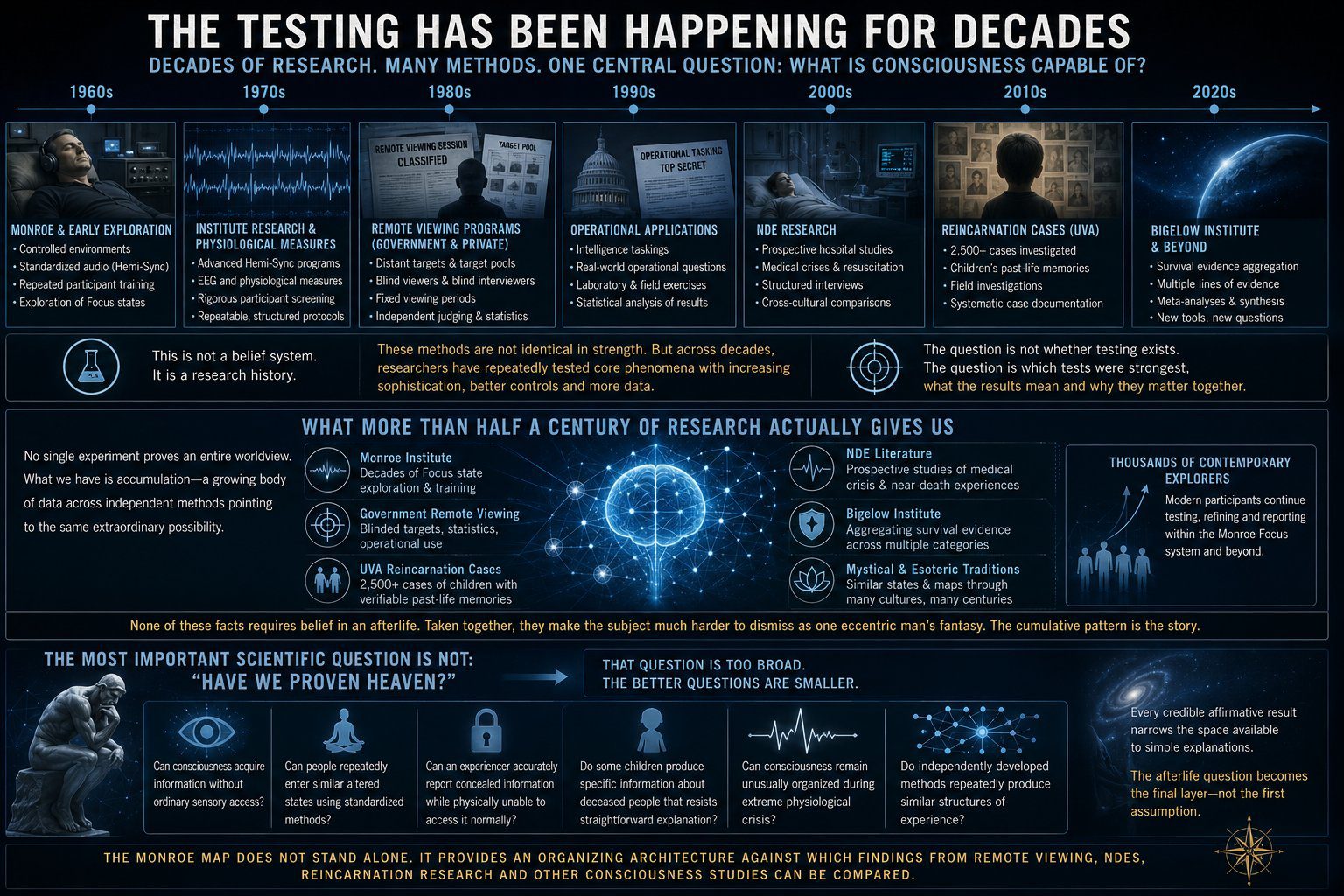
What More Than Half a Century of Research Actually Gives Us
No single experiment establishes Monroe’s entire worldview, and expecting one experiment to prove the entire architecture may be the wrong way to think about the problem. What exists instead is an accumulation. There are decades of Monroe Institute exploration in reproducible Focus states, controlled sensory environments and standardized audio procedures. There are government remote viewing programs using blinded targets, fixed viewing periods and independent evaluation. There are operational taskings conducted for intelligence purposes and statistical analyses that some qualified researchers interpreted as evidence for an anomaly.
There are more than 2,500 UVA reincarnation type cases accumulated across decades. There is a substantial NDE literature involving medical crises and prospective research. There are private organizations such as the Bigelow Institute assembling survival evidence from multiple categories. There are older mystical and esoteric traditions reporting structurally similar states through different cultural frameworks, and there are thousands of contemporary participants who continue exploring Monroe’s Focus system.
None of those individual facts requires belief in an afterlife. Taken together, however, they make the subject much harder to dismiss as one eccentric man’s fantasy. The cumulative pattern is the story.
The Most Important Scientific Question Is Not “Have We Proven Heaven?”
That question is too broad to be useful because it attempts to leap from dozens of different experimental problems directly to the ultimate conclusion. The better questions are smaller. Can consciousness acquire information without ordinary sensory access? Can people repeatedly enter similar altered states using standardized methods? Can an experiencer accurately report concealed information while physically unable to access it normally? Do some children produce specific information about deceased people that resists straightforward conventional explanation? Can consciousness remain unusually organized during extreme physiological crisis? Do independently developed methods repeatedly produce similar structures of experience?
Every credible affirmative result narrows the space available to simple explanations. The afterlife question then becomes the final layer rather than the first assumption. That is ultimately what makes the Monroe map so interesting. It does not stand alone. It provides one organizing architecture against which findings from remote viewing, NDEs, reincarnation research and other consciousness studies can be compared.
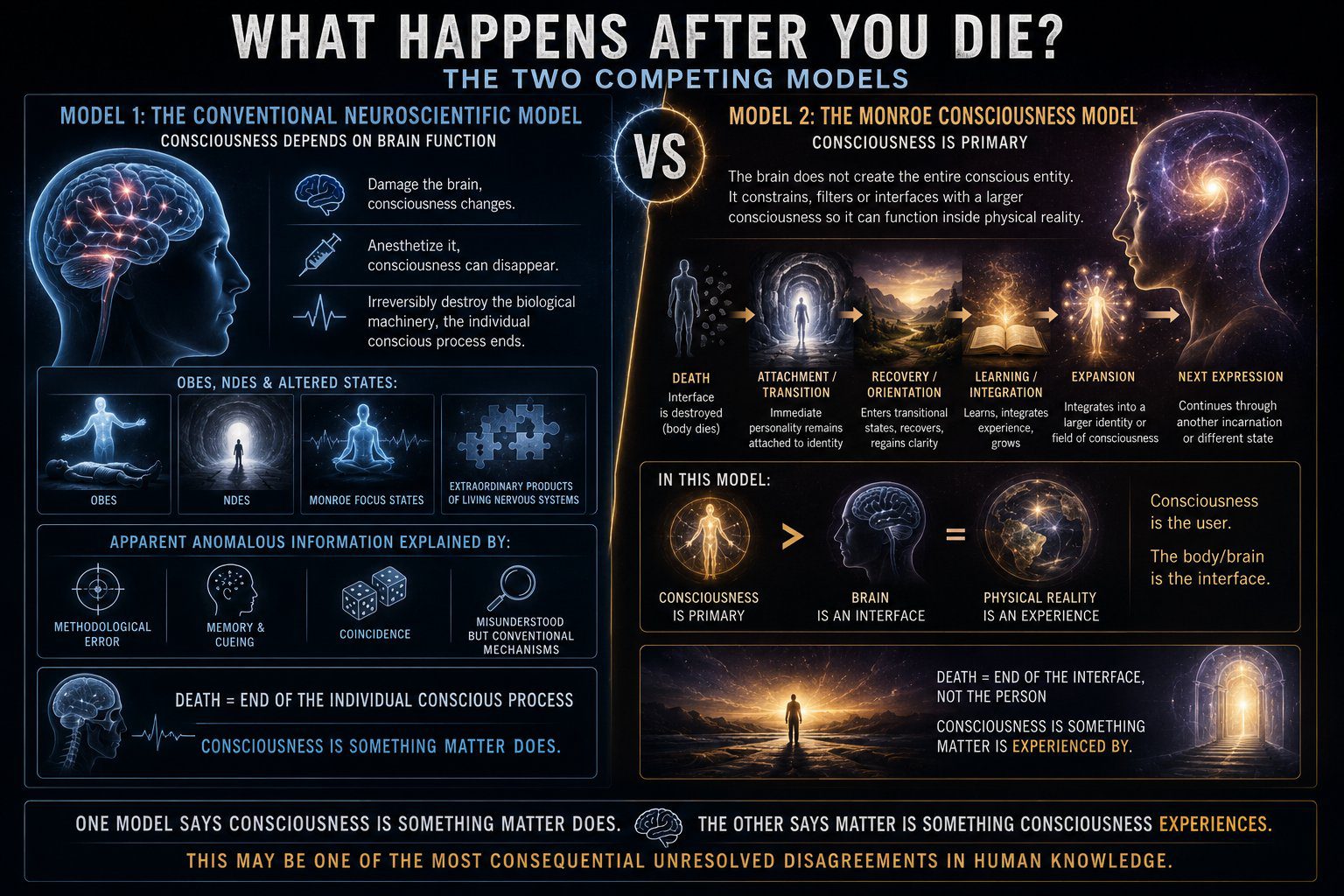
What Happens After You Die? The Two Competing Models
After assembling Monroe, remote viewing, NDE research, reincarnation cases, regression accounts and comparative traditions, two fundamentally different models emerge.
The conventional neuroscientific model says consciousness depends on brain function. Damage the brain and consciousness changes. Anesthetize it and consciousness can disappear. Irreversibly destroy the biological machinery and the individual conscious process ends. Under that model, OBEs, NDEs and Monroe Focus states are extraordinary products of living, stressed, dreaming or recovering nervous systems, while apparent anomalous information would require some combination of methodological error, memory, cueing, coincidence or currently misunderstood but still conventional mechanisms.
The Monroe model reverses the relationship. Consciousness is primary, and the brain does not create the entire conscious entity but constrains, filters or interfaces with a larger consciousness so that it can function inside physical reality. In that model, death destroys the interface rather than the user. The immediate personality may remain attached to physical identity, enter transitional states, reach a more stable environment, recover, learn, integrate into a larger identity and eventually continue through another incarnation or a different state of consciousness.
The difference between those models is difficult to overstate. One says consciousness is something matter does. The other says matter is something consciousness experiences. That may be one of the most consequential unresolved disagreements in human knowledge.
If Monroe Is Wrong, He May Still Have Built One of the Most Important Maps of the Human Mind
There is an irony here that believers and skeptics should both appreciate. Robert Monroe does not need to have discovered the literal afterlife for his work to matter. Suppose every Focus level is generated entirely by the brain. Human beings would still appear capable of reproducibly entering a remarkable range of conscious environments through sound, attention, relaxation and training. The brain would be capable of producing altered embodiment, timelessness, complex landscapes, autonomous seeming beings, deceased personalities, larger identities and experiences of cosmic unity while preserving varying degrees of awareness. That would still be an astonishing discovery about consciousness. Monroe would have spent decades building one of the strangest phenomenological maps of altered human awareness ever attempted, while the Institute that grew from his work would have spent generations teaching people how to reproduce portions of that map. The skeptical interpretation does not make Monroe irrelevant. It changes what he mapped.
But If Even Part of the Nonlocal Model Is Correct, Everything Changes
Now consider the alternative. Suppose rigorous evidence continues accumulating that consciousness can obtain specific information without ordinary sensory access. The first scientific conclusion would not need to be that heaven exists. It would be much more conservative and much more disruptive: the current model of consciousness would be incomplete. If awareness can obtain information nonlocally, then the assumption that consciousness is completely confined to ordinary sensory processing becomes difficult to maintain. If consciousness can function beyond ordinary spatial boundaries, its relationship to time becomes a legitimate scientific question.
If highly specific information can be obtained from deceased personalities under controls that exclude ordinary acquisition, the survival question moves from philosophy toward empirical investigation. If young children can repeatedly provide specific previous life information that survives increasingly sophisticated efforts to explain it conventionally, the relationship between memory, identity and biological birth becomes harder to treat as settled. And if consciousness survives bodily death, then death itself requires redefinition.
Maybe We Have Been Studying Several Mysteries That Are Really One
This is where the entire investigation finally comes together. The out of body problem asks whether consciousness can experience itself independently of ordinary bodily location. The remote viewing problem asks whether consciousness can obtain information beyond ordinary sensory location. The NDE problem asks what happens to awareness during extreme physiological collapse. The reincarnation problem asks whether information or identity can cross the boundary between lives, while the afterlife problem asks whether consciousness survives irreversible bodily death.
The UAP problem introduces another dimension by asking whether some apparently intelligent phenomena operate outside our conventional assumptions about matter, distance, time and technological movement. We normally assign these questions to separate intellectual departments. Neuroscience gets consciousness, religion gets death, parapsychology gets anomalous information, medicine gets NDEs, researchers like UVA investigate reincarnation cases, defense agencies get UAP and physics gets spacetime. Reality is not required to respect those boundaries. What if at least some of these mysteries are different manifestations of the same missing piece? What if consciousness is not merely a passenger inside physical reality but part of the architecture through which physical reality is experienced?
That possibility becomes more interesting when different research traditions are placed beside one another rather than examined as unrelated curiosities. Monroe provides a map of progressive states. Remote viewing provides tests of nonlocal information. NDEs provide spontaneous reports under extreme physiological conditions. UVA provides apparent memory cases arising at the beginning of life. Bigelow and other survival researchers assemble evidence around what may happen at the end. Seen separately, each field contains gaps. Seen together, they begin outlining a larger question.
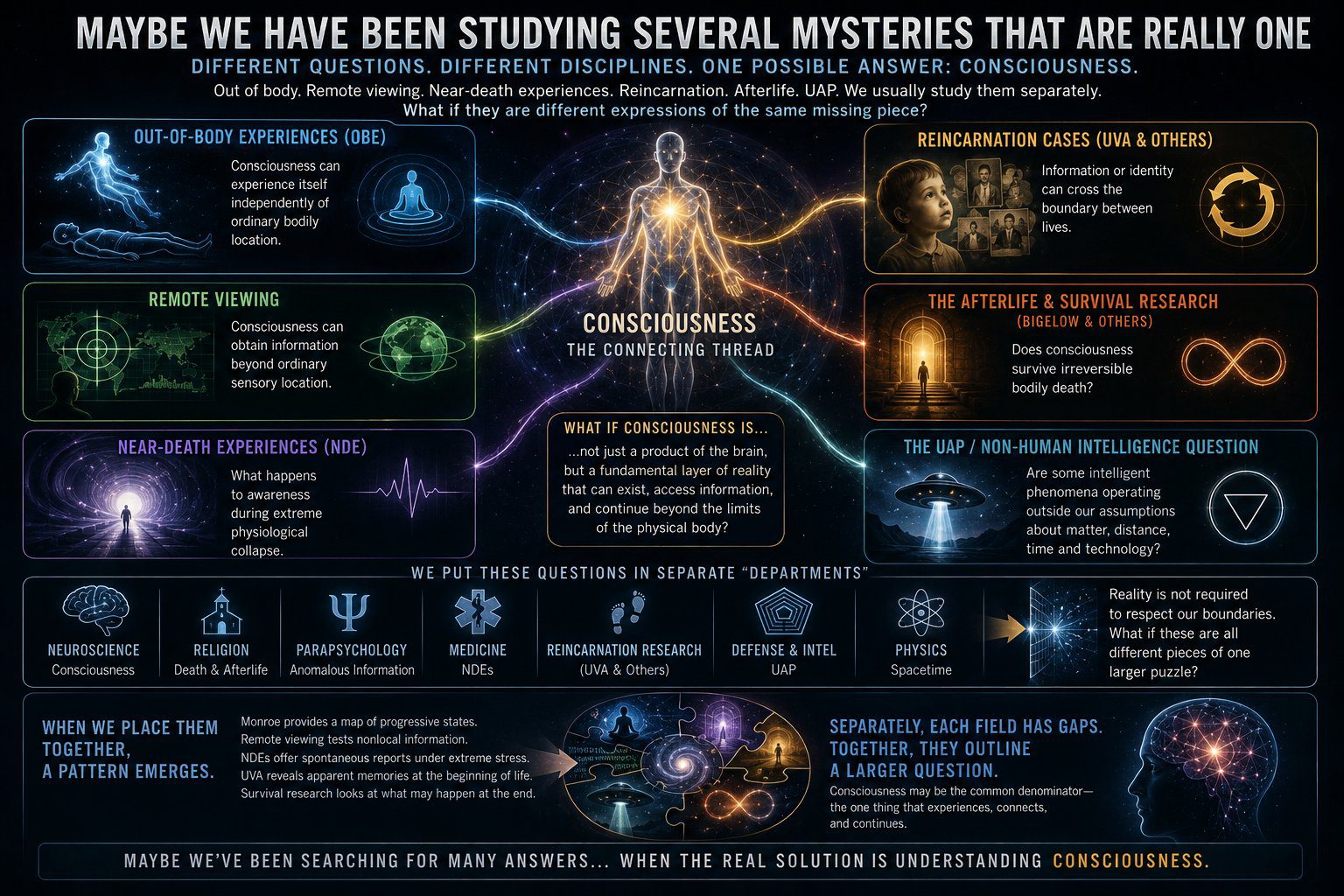
The Most Important Thing Monroe May Have Done Was Give the Mystery Coordinates
Robert Monroe did not end the debate over consciousness. What he did was create a language with which people could investigate it. Focus 1 describes ordinary physical awareness. Focus 10 is Mind Awake, Body Asleep. Focus 12 is Expanded Awareness. Focus 15 is No-Time. Focus 18 involves heart-centered states. Focus 21 becomes the Bridge. Focus 23 through 26 describe postphysical states still constrained by identity and belief. Focus 27 contains the Park and its broader transition architecture. Focus 34/35 introduces the Gathering. Focus 42 develops the I-There and larger-self concept. Focus 49 and later levels move toward increasingly collective and abstract consciousness.
The map may describe internal states, external realities or a mixture of both. But Monroe accomplished something historically significant either way: he transformed an ancient mystery into a system with coordinates, training procedures, repeated participants and points at which claims could be compared against external information. That is much more than an anecdote. It means a person interested in the work today does not merely have to read Monroe’s books and decide whether he sounded convincing. The methods remain accessible, the Institute remains operational and advanced programs continue exploring many of the same states. The map is still being used.
The Work Is Still Happening
Perhaps the most important fact for readers in 2026 is that this story is not over. The Monroe Institute continues offering advanced consciousness programs, including Focus level exploration and programs incorporating contemporary physiological monitoring. Its Lifeline program explicitly works with Focus 23 through 27 and describes those states in connection with the afterlife experience, while Exploration 27 continues to take participants into the Park and other named Focus 27 environments.
The University of Virginia continues maintaining and expanding its research into children reporting previous life memories and near death experiences, including new empirical work announced in 2025. The Bigelow Institute for Consciousness Studies continues to exist specifically around the survival-of-consciousness question and has funded and published substantial work examining evidence for life after death.
The declassified military record also remains available to anyone willing to read through the government’s remote viewing files, CENTER LANE material and Gateway assessment. That matters because these are not legends about what government agencies supposedly did. Large portions of the underlying record can be examined directly. A reader can enroll in Monroe programs today, examine the government protocols, read UVA’s research descriptions, review Bigelow funded survival work and compare near death reports with the Focus map.
That accessibility is part of what separates this story from ordinary paranormal folklore. The evidence is distributed across institutions, archives, hospitals, researchers and decades of participant experience rather than being locked entirely inside one person’s testimony.
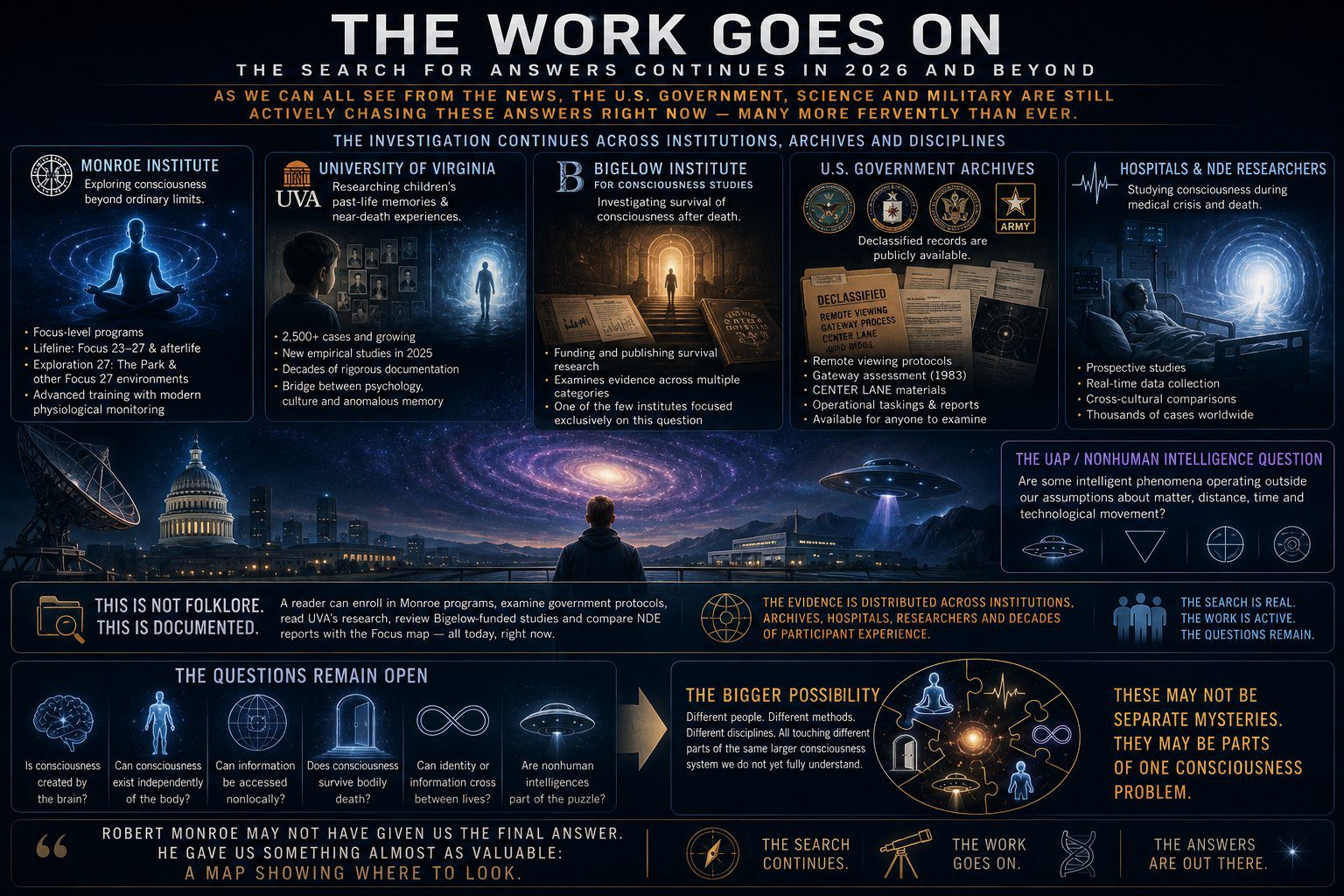
The Question Humanity Has Not Finished Asking
Maybe Monroe’s Park is a sophisticated architecture generated by a brain trained to expect it. Maybe Focus 34/35 is a symbolic representation of collective awareness. Maybe children who report previous lives are producing information through mechanisms we do not yet understand but that do not require reincarnation. Maybe near death experiences are entirely products of extreme physiology. Maybe remote viewing anomalies will eventually collapse under better statistical models.
Those possibilities remain part of the investigation, but the opposite possibility remains as well. Different people using different methods may have spent decades touching different parts of a consciousness system that human beings do not yet possess a complete scientific model for.
If that is true, Monroe was not simply imagining a fantasy world. He was charting territory. Government remote viewers may have been testing one functional property of the same larger system by asking whether information can be accessed nonlocally. NDE researchers may be observing another boundary condition by studying what consciousness does as the physical interface begins shutting down. UVA’s reincarnation cases may represent another piece by asking whether information can cross between physical identities, while Bigelow’s survival research asks the final question directly: whether the conscious individual continues after bodily death.
The UAP problem may eventually force science to widen the question further by asking whether some forms of intelligence exist outside the categories normally used for biological life and physical travel. None of that requires the reader to accept the conclusion in advance. The significance lies in the convergence. For more than half a century, governments, researchers, doctors, statisticians, private institutes and ordinary people have repeatedly returned to the possibility that consciousness is larger than the physical brain appears to allow.
The work has not produced a universally accepted answer, but neither has the question disappeared. The research continues because enough unusual experiences, enough anomalous information, enough recurring structures and enough difficult cases remain to keep different generations of investigators returning to it. And perhaps the most striking possibility is that we have spent generations treating remote viewing, near death experiences, reincarnation, out of body states, the afterlife and nonhuman intelligence as separate mysteries because we were studying each one from inside a different academic or cultural box.
They may not be separate. They may all be parts of the same consciousness we experience every day. If so, Robert Monroe may not have given humanity the final answer. He may have done something almost as valuable: he gave us a map showing where to look.
Sources

The Monroe Institute
The Monroe Institute — History of Sound, Robert Monroe and the Origins of Hemi-Sync
The Monroe Institute — Discovery: EEG-Monitored Expanded States of Consciousness Research
The Monroe Institute — Superconscious Mind: Mind Mirror EEG and Brain Wave Monitoring
The Monroe Institute — Exploration 27 and The Park
The Monroe Institute — Exploration 27 Virtual Program
The Monroe Institute — CHEC Units, Hemi-Sync and Controlled Exploration Environments
The Monroe Institute — Annual Reports, Research and Institutional Information
CIA Reading Room and Declassified U.S. Government Records
CIA Reading Room — Analysis and Assessment of Gateway Process, June 9, 1983
CIA — Original Gateway Process Report PDF
CIA Reading Room — INSCOM CENTER LANE Advanced Training and Monroe Institute Hemi-Sync
CIA — CENTER LANE Information Paper on the Monroe Institute and Hemi-Sync
CIA — CENTER LANE Information Papers for the Director of the Defense Intelligence Agency
CIA — Monroe Institute Gateway Program, Hemi-Sync, EEG and Focus Levels
CIA — Department of the Army Hemi-Sync / Monroe Institute Overview
CIA Reading Room — GRILL FLAME Remote Viewing Session Report and Protocol
CIA — Review of SRI Psychoenergetics Research, Including More Than 25,000 Trials
CIA — Remote Viewing Analysis, Edwin May, Jessica Utts and Colleagues
CIA Reading Room — An Evaluation of Remote Viewing: Research and Applications, 1995
CIA Reading Room — Ray Hyman, An Evaluation of the Remote Viewing Program
CIA Reading Room — On the Strategic Potential of ESP and Military Remote Viewing
University of Virginia Division of Perceptual Studies
UVA School of Medicine — Division of Perceptual Studies
UVA — Children Who Report Memories of Past Lives: More Than 2,500 Cases
UVA — Near-Death Experiences Research
UVA — Veridical Near-Death Experiences and Ongoing Research
UVA — Academic Publications on NDEs, Past-Life Memories, OBEs and Consciousness
UVA — Children Who Remember Previous Lives: Books and Research by DOPS Faculty
UVA — 2025 Major Research Initiative on Children’s Past-Life Memories
UVA — Current Researchers Studying NDEs, Past-Life Memories, OBEs and Psi
Bigelow Institute for Consciousness Studies
Bigelow Institute — Life After Death Essay Contest Honorable Mentions and Survival Research
Bigelow Institute — Published BICS Essay Contest Research Collection
The BICS collection includes work from researchers including Jeffrey Long; Arnaud Delorme, Dean Radin and Helané Wahbeh; Chris Roe, Callum Cooper, David Lorimer and Evelyn Elsaesser; Sam Parnia and others examining evidence concerning survival of consciousness after bodily death. (Bigelow Institute)
Michael Newton and Life Between Lives
Michael Newton Institute — Journey of Souls and Life Between Lives Research
Michael Newton Institute — Destiny of Souls and Life Between Lives Case Research
Additional Primary Research Collections
UVA — Complete Division of Perceptual Studies Publications Database
UVA — Near-Death Experience Books and Research Resources
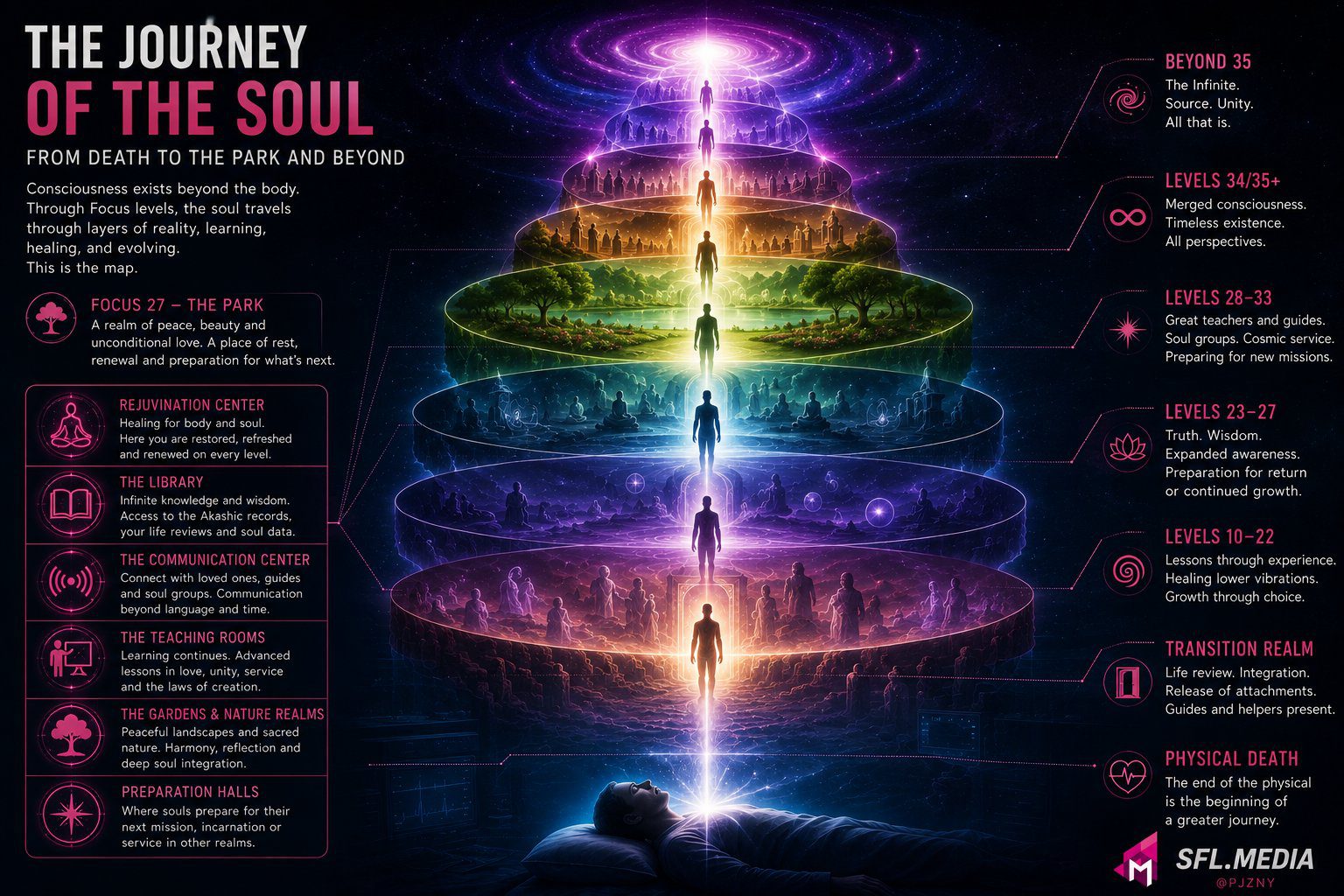


















































Want to join the conversation?
Create an account or sign in to share your thoughts, vote,
and reply to other readers.
Showing 0 of 0 comments
Don't have an account?
Already have an account?