
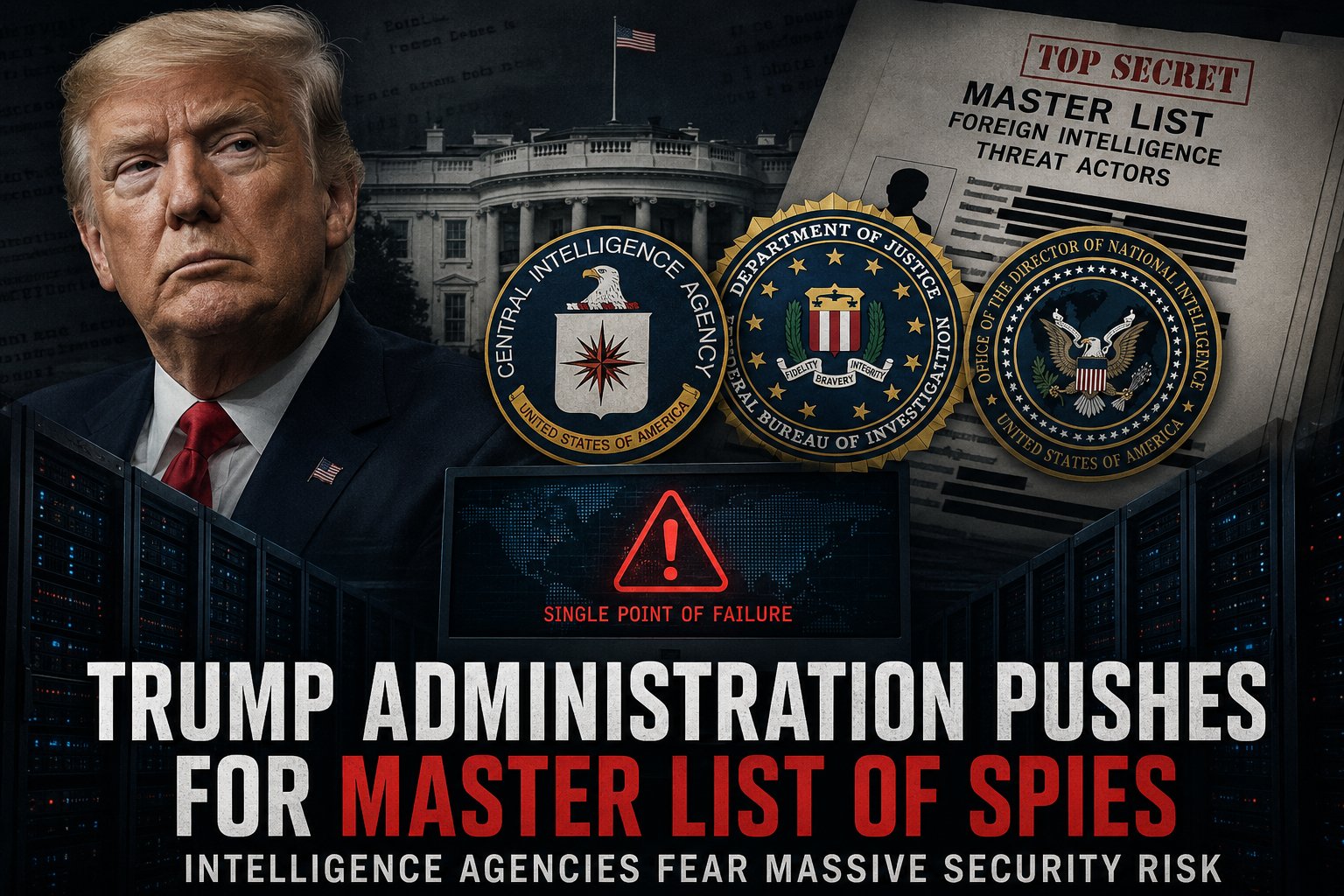
Trump Administration’s Push for Intelligence “Master List” Sparks Fierce Resistance Inside CIA and FBI
The Trump administration is facing an extraordinary internal battle with America’s intelligence community after demanding the creation of a centralized database containing the identities of foreign espionage targets, suspected spies, potential intelligence recruits, and other highly sensitive counterintelligence information.
According to an exclusive report published by The New York Times, senior officials at the FBI and CIA have resisted repeated demands from the Office of the Director of National Intelligence (ODNI) to surrender some of their most closely guarded intelligence records. Career intelligence officials reportedly fear that consolidating decades of compartmentalized human intelligence into a single repository could create one of the greatest security vulnerabilities in modern U.S. intelligence history.
Rather than bringing agencies together, the proposal has reportedly exposed growing distrust between the Trump administration’s intelligence leadership and the nation’s premier spy agencies.
A “Master List” of America’s Intelligence Targets
At the center of the dispute is the administration’s effort to build what officials describe as a comprehensive database of foreign intelligence threat actors. That list would reportedly include far more than traditional foreign spies. Under the government’s broad definition, it could encompass suspected intelligence officers, confidential human sources, foreign criminal organizations, cyber actors, international corporations linked to foreign governments, and individuals considered potential intelligence recruits.
For the FBI, the database could include individuals under active counterintelligence investigation who may someday face criminal charges. For the CIA, it could include potential foreign assets being quietly cultivated over years or even decades. Many of those identities are currently protected through strict compartmentalization, with access limited to only a handful of officials, even within the agencies themselves.
“You would have to be completely ignorant of the past 20 years of history to trust Tulsi Gabbard and Donald Trump with information this important.” – Patrick Zarrelli
White House Says Better Coordination Is Needed
Officials with the Office of the Director of National Intelligence argue that the initiative is intended to improve coordination across the intelligence community. The proposal follows guidance contained in National Security Presidential Memorandum 7, originally issued during President Trump’s first term. The directive instructs federal agencies to lawfully identify, integrate, maintain, and share national security threat actor information across relevant secure systems.
Supporters inside the administration reportedly envision a system similar to America’s terrorist watch lists, one capable of tracking suspected foreign intelligence targets in real time while allowing agencies to quickly share updates regarding travel, communications, and operational activity. An official from Acting Director of National Intelligence Bill Pulte’s office told The New York Times that the effort is simply carrying out existing presidential directives and statutory responsibilities assigned to the ODNI after the September 11 attacks to improve information sharing across intelligence agencies.
Intelligence Agencies Warn of Catastrophic Risks
Inside the CIA and FBI, however, officials reportedly see the proposal very differently. Current and former intelligence officials interviewed by The New York Times warned that placing some of America’s most sensitive human intelligence operations into a centralized database would create a dangerous single point of failure. If compromised through hacking, insider leaks, or unauthorized access, a centralized repository could expose confidential sources, undercover operations, long-running espionage investigations, and foreign intelligence assets around the world.
Officials also remain divided over fundamental questions that have yet to be resolved, including:
- Which individuals should qualify as foreign intelligence threat actors.
- Whether domestic FBI counterintelligence investigations should be merged with CIA foreign operations.
- How classified information would be encrypted and protected.
- Which agencies, and which individuals, would have authority to access the database.
- How information obtained through the Foreign Intelligence Surveillance Court could legally be shared.
Those disagreements have reportedly stalled the project for months.
Growing Distrust Inside the Intelligence Community
The dispute also reflects worsening relations between the Office of the Director of National Intelligence and America’s intelligence agencies. The tensions intensified during former Director of National Intelligence Tulsi Gabbard’s tenure, when the ODNI pursued several Trump administration priorities, including significant workforce reductions and reviews of election-fraud allegations that critics argued lacked credible supporting evidence.
Those concerns have reportedly increased since Bill Pulte assumed the role of Acting Director of National Intelligence. Pulte, whose background is primarily in housing and business rather than intelligence operations, now oversees an office responsible for coordinating America’s 18 intelligence agencies. Some intelligence officials reportedly question whether the ODNI should possess unrestricted access to the government’s most sensitive counterintelligence operations under its current leadership.
A Debate Over Oversight or Operational Security?
Supporters argue the proposal represents overdue modernization. Following intelligence failures surrounding the September 11 terrorist attacks, Congress created the ODNI specifically to improve communication between agencies that had historically operated in isolated bureaucratic silos.
Advocates believe today’s increasingly complex global threats, including cyber espionage, foreign influence operations, transnational criminal organizations, and hostile intelligence services, require faster information sharing than current systems allow. Critics counter that compartmentalization exists precisely because intelligence operations depend on secrecy. Unlike ordinary government databases, human intelligence networks rely on protecting the identities of confidential informants, undercover officers, foreign recruits, and intelligence assets whose exposure could jeopardize investigations, diplomatic relationships, or even lives.
Former counterintelligence officials also warn that sophisticated foreign intelligence officers are trained to detect signs of surveillance. Broad information sharing across government systems could unintentionally reveal investigations or compromise years of covert work.
The Fight Remains Behind Closed Doors
According to The New York Times, senior FBI and CIA officials have so far resisted the administration’s requests, and negotiations continue behind closed doors. Officials still have not agreed on the basic architecture of any centralized system, and some reportedly hope the proposal will ultimately be abandoned altogether. Whether the administration continues pressing the issue may become one of the most consequential intelligence policy battles of Trump’s second term, raising difficult questions about executive oversight, operational security, cybersecurity, and the balance between coordination and secrecy inside America’s intelligence apparatus.


















































Want to join the conversation?
Create an account or sign in to share your thoughts, vote,
and reply to other readers.
Showing 0 of 0 comments
Don't have an account?
Already have an account?