
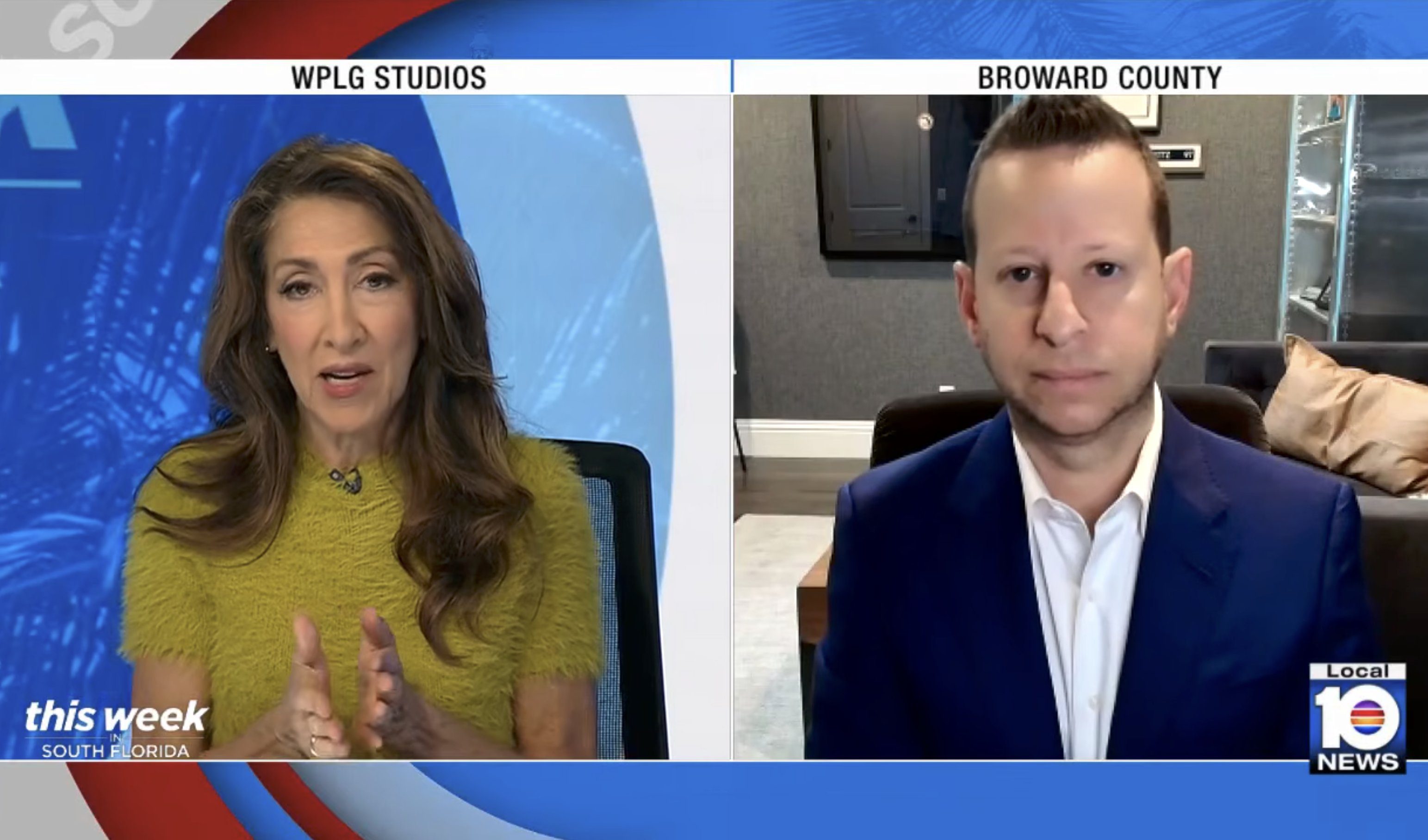
South Florida’s Democratic Civil War: Socialist Challenger Oliver Larkin Takes Aim at Jared Moskowitz in Florida’s 25th District
FORT LAUDERDALE, Fla. — South Florida Democrats are heading toward an ideological showdown that will test whether the democratic-socialist movement gaining influence in parts of the national party can translate its message into votes in one of Florida’s most politically distinctive regions. U.S. Rep. Jared Moskowitz is facing an Aug. 18 Democratic primary challenge from Oliver Larkin, a South Florida union organizer, longtime progressive activist and Democratic Socialists of America member who is running explicitly as a democratic socialist.
The contest represents two sharply different theories about where the Democratic Party should go next. Larkin argues that Democrats need a more aggressive economic and ideological break from the political establishment, campaigning on Medicare for All, abolishing ICE, a $25 federal minimum wage and ending U.S. military support for Israel. Moskowitz represents a more pragmatic and frequently bipartisan model, one that has occasionally put him at odds with the Democratic left.
For South Florida Democrats, the question is whether replacing an established incumbent with a candidate significantly to his left would strengthen the party or sacrifice a political style that has allowed Moskowitz to build a distinctive profile in a state increasingly dominated by Republicans.
Larkin Is Running an Unapologetically Democratic Socialist Campaign
There is little ambiguity about Larkin’s politics. He has been a DSA member since 2020, previously worked as a union organizer and was involved with Bernie Sanders’ presidential campaign. The Broward, Miami and Palm Beach Treasure Coast DSA organizations have backed his congressional campaign, and national DSA has also embraced his candidacy.
Larkin has argued that Democrats such as Moskowitz have been insufficiently aggressive in confronting Republicans and addressing the economic pressures facing working class Americans. His campaign calls for Medicare for All, abolishing Immigration and Customs Enforcement, a $25 minimum wage and major changes to American foreign policy, particularly toward Israel. Larkin is therefore not attempting to disguise the ideological contrast. He is making it the central argument of the campaign.
The theory is straightforward: Democrats have failed working class voters because they remain too closely connected to corporations, wealthy donors and a political establishment unwilling to pursue structural economic change. That message has demonstrated electoral power elsewhere in the country. Whether it fits South Florida is the considerably more complicated question.
South Florida Is Not New York City
South Florida’s Democratic electorate has its own political history, demographic composition and ideological fault lines. The newly configured 25th Congressional District stretches through coastal communities in Palm Beach, Broward and Miami-Dade counties, including Boca Raton, Pompano Beach, Fort Lauderdale, Hollywood, Aventura, North Miami Beach and Miami Beach. That creates an electorate very different from the progressive strongholds where democratic socialist candidates have enjoyed some of their greatest successes.
South Florida contains substantial Jewish, Latino, Caribbean, immigrant and retiree populations alongside younger progressive voters and organized labor. Those communities are not politically monolithic, but socialism carries complicated historical and cultural associations throughout the region. The district’s significant Jewish electorate also makes Israel a particularly consequential issue.
Larkin has called for ending U.S. military support for Israel and has publicly described his campaign as standing on anti-Zionist principles. Moskowitz, who is Jewish, has been one of Congress’ most vocal Democratic supporters of Israel. That disagreement alone creates one of the clearest dividing lines in the primary.
Moskowitz Holds a Major Polling Advantage
For all the national attention surrounding the democratic socialist movement, the available polling indicates Larkin faces a steep climb. A Beacon Insights survey reported in late June placed Moskowitz at 51% among likely Democratic primary voters, compared with 19% for Larkin, with approximately 30% undecided. That gave the incumbent a 32 point advantage and, more importantly, put Moskowitz above the 50% threshold. One poll does not determine an election, particularly a lower-turnout congressional primary. But a challenger sitting more than 30 points behind an incumbent less than two months before Election Day faces an obvious mathematical problem.
Larkin needs more than enthusiasm from the progressive base. He needs to fundamentally change the composition or preferences of the electorate. Early voting makes that challenge even more immediate. Voting is already underway in portions of the district ahead of the Aug. 18 primary.
But Larkin Has Scored a Significant Victory With Organized Labor
Writing off Larkin completely would also ignore one of the most interesting developments in the race. The Florida AFL CIO endorsed incumbent Democratic members of Florida’s congressional delegation but withheld an endorsement from Moskowitz following lobbying by Larkin and his supporters. According to the Miami Herald, labor leaders raised concerns about Moskowitz’s record, including his decision to become the first Democrat associated with the congressional DOGE Caucus. For a challenger whose political identity is rooted heavily in organized labor, denying an incumbent the automatic support of a major labor federation is a legitimate political accomplishment.
It also complicates the argument that Larkin represents nothing more than activists operating outside the Democratic mainstream. His campaign has found an audience among portions of organized labor and progressive activists who believe Moskowitz has moved too far toward Republicans on immigration, government spending, Israel and other major issues. The primary will determine how large that constituency actually is.
Moskowitz Has Built His Brand on Crossing Party Lines
Moskowitz has never positioned himself as a conventional progressive Democrat. That is largely the point. His political career has been defined by a willingness to work with Republicans when he believes doing so produces tangible results, while remaining firmly Democratic on many of the party’s central domestic priorities. That approach was especially visible following the 2018 mass shooting at Marjory Stoneman Douglas High School in Parkland, Moskowitz’s alma mater.
While serving in the Florida Legislature, Moskowitz participated in negotiations surrounding the Marjory Stoneman Douglas High School Public Safety Act, a sweeping response passed by a Republican-controlled Legislature and signed by then Gov. Rick Scott. The legislation included raising Florida’s minimum age for purchasing rifles from 18 to 21, establishing a risk protection order system commonly known as a red-flag law and implementing extensive new school safety requirements. Passing significant firearm restrictions through a Republican-controlled Florida government would be difficult to imagine in today’s political environment.
For Moskowitz, it became an example of the governing philosophy that has followed him throughout his career: ideological compromise can sometimes produce legislation that ideological purity cannot.
From Tallahassee to Disaster Management to Congress
Moskowitz later served as director of the Florida Division of Emergency Management under Republican Gov. Ron DeSantis, overseeing the agency through hurricanes and the COVID-19 pandemic. Their relationship demonstrated the unusual political space Moskowitz has occupied. He was a Democrat serving prominently inside a Republican administration during one of the most politically divisive public-health emergencies in modern American history.
Moskowitz subsequently won election to Congress, where he has continued cultivating a reputation as a Democrat willing to appear on conservative media, work with Republicans and occasionally break with his own party. Larkin views those decisions as evidence that Moskowitz is too conservative for Democratic voters. Moskowitz’s supporters see essentially the same record and reach the opposite conclusion, that his ability to operate across partisan lines is an asset rather than a liability. That disagreement is the heart of the primary.
Larkin’s Case Against Moskowitz
Larkin has criticized Moskowitz for a series of votes and political decisions that he argues demonstrate the incumbent is disconnected from the Democratic base. Among them are Moskowitz’s support for the Laken Riley Act, his participation in the DOGE Caucus and his positions regarding Israel. Larkin has also attacked Moskowitz’s frequent appearances on Fox News and his willingness to collaborate publicly with Republican lawmakers. From Larkin’s perspective, Democrats have spent too long attempting to compromise with a Republican Party that increasingly treats compromise as weakness.
His candidacy therefore represents a broader progressive argument taking place nationally: Democrats should stop trying to win voters by moving toward the center and instead offer a substantially more ambitious economic agenda capable of mobilizing working-class voters who have become disillusioned with both parties. That argument deserves to be evaluated on its merits rather than dismissed simply because Larkin calls himself a socialist. But elections ultimately test theories against actual voters.
The Israel Divide Could Be Particularly Important
Few issues demonstrate the contrast between the candidates more clearly than Israel. Moskowitz has been one of the Democratic Party’s most forceful supporters of the U.S. Israel relationship. Larkin occupies nearly the opposite position, campaigning on ending American military support for Israel and publicly embracing anti-Zionism. That debate is occurring nationally across the Democratic Party, particularly among younger progressive voters who have become increasingly critical of Israeli government policy and U.S. military assistance. But congressional politics are local.
In a South Florida district containing a substantial Jewish population, the electoral consequences of making anti-Zionism part of a congressional campaign could be very different from those in progressive districts elsewhere in the country. The Aug. 18 primary will provide an unusually clear test of that proposition.
This Is Really a Fight Over What Democrats Think Wins
The Moskowitz-Larkin primary is larger than a disagreement between two candidates. It represents competing theories about Democratic survival in Florida. One side argues that Democrats need candidates capable of appealing beyond the progressive base, working across party lines and building coalitions broad enough to compete in a state that has moved dramatically toward Republicans. The other argues that this strategy is precisely why Democrats keep losing, voters are not inspired by cautious centrism, and the party needs candidates willing to champion transformational economic policies without apologizing for them.
There are examples around the country that both sides can cite. Progressive candidates have scored major victories in heavily Democratic urban districts. Moderates have succeeded in politically competitive territory. Both factions have also suffered embarrassing defeats. South Florida voters will now get to decide which argument better fits their district.
The Primary Will Put the Socialist Strategy to a Real-World Test
There is nothing illegitimate about challenging an incumbent in a Democratic primary. Competitive primaries are part of democracy, and no elected official is entitled to renomination without defending their record. The more important question is whether the challenger is offering something the electorate actually wants. Larkin believes South Florida Democrats are ready for democratic socialism and that voters will respond to an agenda built around universal healthcare, dramatically higher wages, stronger organized labor and a fundamental restructuring of American immigration and foreign policy.
Moskowitz is effectively betting that they are not. The available polling currently favors the incumbent by a wide margin, but Larkin’s support from DSA organizations and his success among portions of organized labor mean the primary still offers something politically valuable regardless of its final margin: a measurable test of how far the democratic-socialist movement has penetrated South Florida’s Democratic electorate.
That makes Aug. 18 more than another congressional primary. South Florida voters will be deciding whether Jared Moskowitz’s brand of pragmatic, sometimes bipartisan Democratic politics still represents them, or whether a new generation of activists has correctly identified an appetite for something substantially further left. For all the national arguments about the future of the Democratic Party, this time South Florida gets to answer the question for itself.
Sources
CBS News Miami — Interview with Oliver Larkin on his challenge to Jared Moskowitz
Florida Politics — Beacon Insights polling in the CD-25 Democratic primary
Miami Herald — Larkin, Moskowitz and the Florida AFL-CIO endorsement fight
Broward County DSA — South Florida DSA endorsement of Oliver Larkin
Oliver Larkin Campaign — Platform and Florida’s 25th Congressional District
Democratic Left — Larkin discusses his DSA membership and campaign platform




















































Want to join the conversation?
Create an account or sign in to share your thoughts, vote,
and reply to other readers.
Showing 0 of 0 comments
Don't have an account?
Already have an account?