
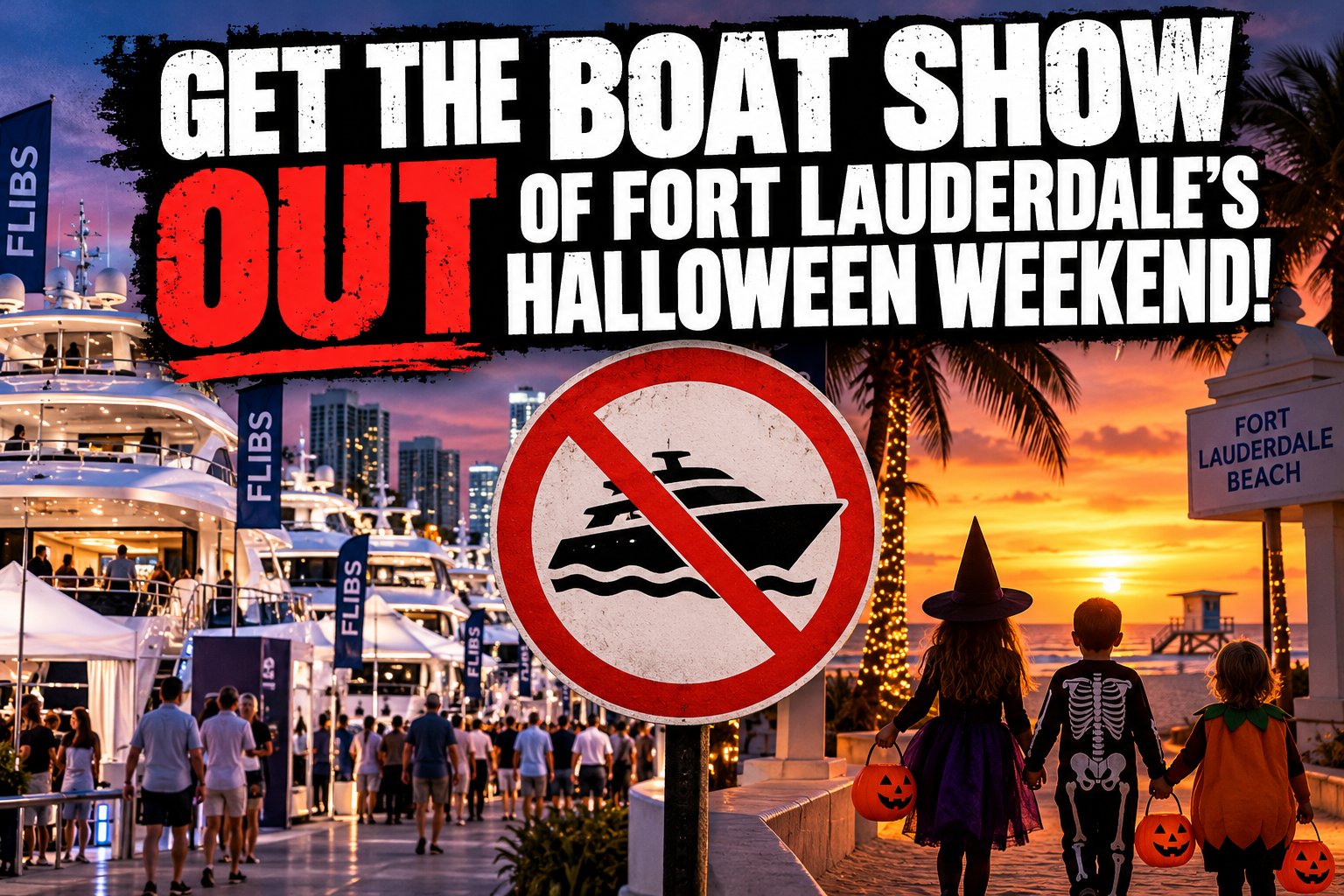
Fort Lauderdale Deserves Its Halloween Back: Why the International Boat Show Needs to Move Off Halloween Weekend
Fort Lauderdale has spent decades building its reputation as the Yachting Capital of the World, but somewhere along the way, the city appears to have forgotten that it is also home to families, children, residents, and taxpayers who deserve access to their own beachfront during one of America’s most celebrated holidays. Every fall, the Fort Lauderdale International Boat Show (FLIBS) arrives with an enormous footprint, transforming waterfront venues, marinas, parking facilities, and major transportation corridors into an international marketplace for yachts, marine equipment, and luxury boating services. The exhibition brings prestige, visitors, and significant commercial activity to South Florida, but it also creates a substantial disruption for the people who live here year round.
In 2026, that disruption comes at a particularly unfortunate time. The 67th annual Fort Lauderdale International Boat Show runs from October 28 through November 1, placing the world’s largest in water boat show directly over Halloween, which falls on Saturday, October 31. The exhibition operates from 10 a.m. until 7 p.m. on Halloween itself, with more than 100,000 attendees expected across its five day run. While exhibitors and international yacht brokers conduct business, residents must contend with additional traffic, restricted parking, crowded public infrastructure, and a beachfront district largely organized around the demands of a commercial event.
That raises a question Fort Lauderdale’s elected officials should be forced to answer: Why should an international luxury boat trade show receive priority over the public’s ability to celebrate Halloween on Fort Lauderdale Beach?
This is not an argument for eliminating the boat show or dismissing the importance of South Florida’s marine industry. It is an argument for ending the assumption that the industry’s preferred calendar should automatically take precedence over the needs of the community hosting it. Fort Lauderdale can remain the Yachting Capital of the World without surrendering one of the most popular holidays of the year to an industry exhibition.
A World Class Beach Should Not Become a Commercial Showroom on Halloween
Fort Lauderdale Beach is one of South Florida’s most recognizable public assets, drawing residents and visitors to its shoreline, promenade, waterfront parks, restaurants, and entertainment districts. Yet when the boat show arrives, significant portions of the surrounding waterfront are transformed into a massive commercial operation. Temporary exhibition facilities, security arrangements, transportation staging areas, parking restrictions, and increased vehicle traffic alter the experience of visiting the barrier island, particularly around Bahia Mar, Las Olas Marina, and the southern beach district.
The beach itself is not entirely closed, and residents retain access to many public areas. But there is a meaningful difference between a public space being technically open and being conveniently accessible. For families hoping to spend Halloween at the beach, access involves more than the legal right to walk onto the sand. It means being able to travel safely, find parking, navigate sidewalks, and enjoy the waterfront without competing with the logistical demands of one of the world’s largest marine exhibitions.
Fort Lauderdale could use Halloween weekend to establish a signature public celebration, complete with beachfront trick or treating, children’s costume competitions, decorated public spaces, live entertainment, local food vendors, and coordinated activities throughout the Las Olas and beachfront districts. Instead, the city’s most recognizable coastal destination spends the holiday accommodating a commercial marketplace whose primary audience consists of marine industry professionals, boat buyers, brokers, and exhibitors.
The question is not whether boats are important to Fort Lauderdale. They clearly are. The question is whether they are so important that other potential uses of the city’s most valuable public spaces must remain secondary whenever the exhibition arrives.
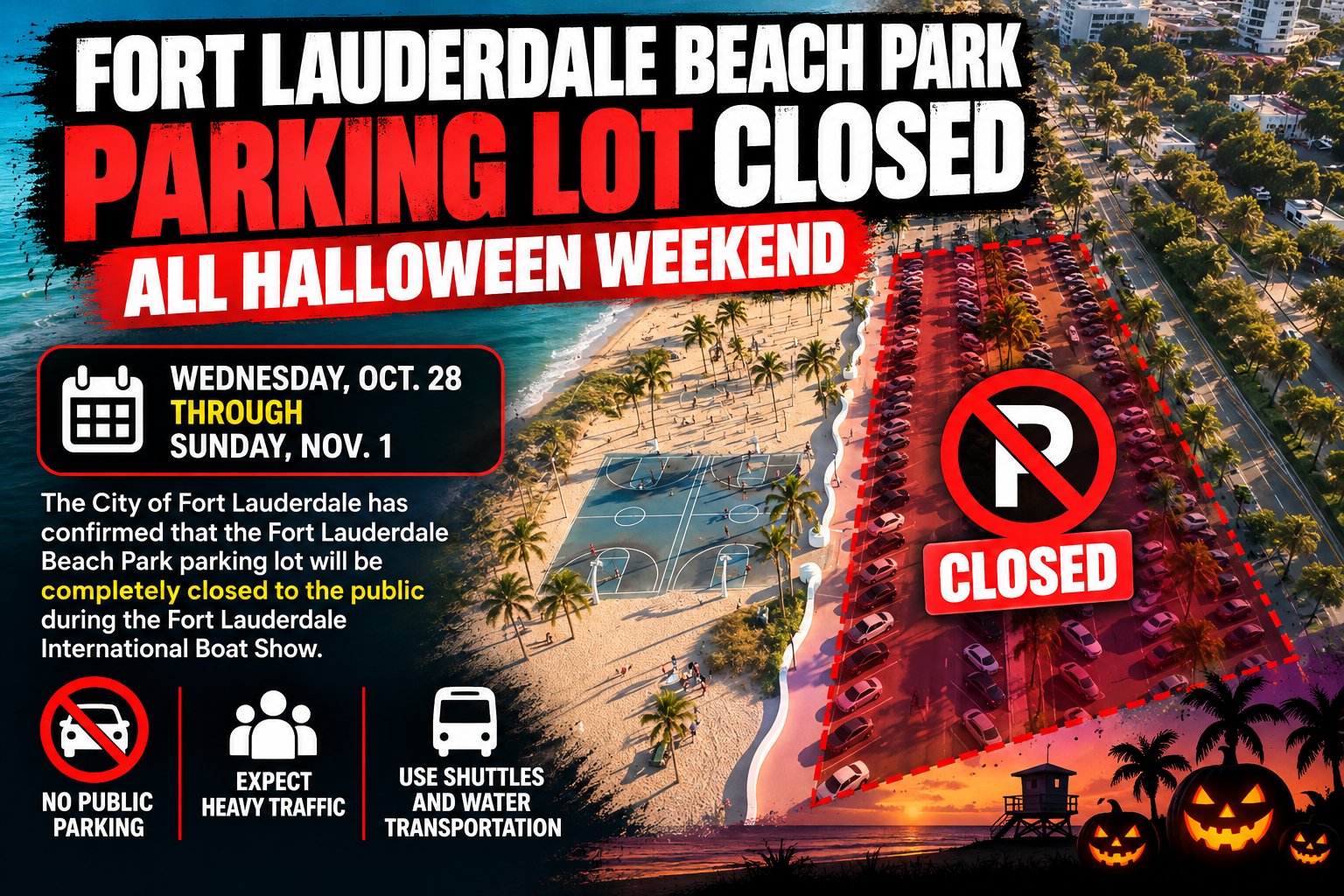
Fort Lauderdale Is Closing Public Beach Parking During Halloween Weekend
The impact on public access is not hypothetical. In an October 23 traffic advisory, the City of Fort Lauderdale confirmed that the Fort Lauderdale Beach Park parking lot would be completely closed to the public during the boat show, from Wednesday, October 28, through Sunday, November 1. The city also warned motorists about additional congestion and encouraged attendees to use shuttle buses and water transportation rather than drive directly to the exhibition.
That means a public parking facility serving one of Fort Lauderdale’s most popular beachfront areas is being removed from normal public use throughout Halloween weekend to accommodate an independently organized commercial event. Fort Lauderdale police officers will also be stationed around the exhibition to direct vehicles and pedestrians, reflecting the additional traffic management requirements associated with the show.
These restrictions are particularly consequential because Fort Lauderdale Beach sits on a barrier island with a limited number of major access routes. Traffic along Las Olas Boulevard, Seabreeze Boulevard, and the surrounding corridors can become difficult even under ordinary weekend conditions. Adding tens of thousands of exhibition visitors, shuttle operations, delivery vehicles, and rideshare trips creates additional pressure on infrastructure that residents depend on for everyday travel.
The city also faces unusually high tides during the same period, with officials warning about potential flooding around the October 24–31 king-tide window. That is a separate issue from the boat show, but it underscores how vulnerable coastal transportation can be when multiple demands converge on the same streets.
A family trying to enjoy Halloween should not have to treat a trip to its own public beach as a major logistical undertaking simply because an international trade show happens to be in town.
Fort Lauderdale Already Celebrated Halloween, A Week Before Halloween!
Perhaps the clearest illustration of the city’s misplaced priorities is its own holiday programming. Fort Lauderdale scheduled its free LauderBOO family celebration for Saturday, October 24, at Snyder Park, a full week before Halloween. The event featured trick or treat stations, carnival games, arts and crafts, bounce houses, music, contests, prizes, and other children’s activities. Additional neighborhood Halloween and fall celebrations were also advertised through the city’s parks and recreation programming.
Those are valuable community events, and the city deserves credit for providing them. However, they also demonstrate that Fort Lauderdale possesses the facilities, staff, and organizational experience to produce family friendly Halloween programming. What is missing from the identified official schedule is a major, coordinated celebration centered on the city’s most famous public destination on Halloween itself. There is no established evidence that the boat show directly caused LauderBOO to be scheduled a week early, and the city does offer other seasonal activities. Nevertheless, the contrast is striking: the city’s major family celebration takes place at an inland park on October 24, while its beachfront district prepares to accommodate an international boat exhibition through October 31.
Imagine a different approach. Fort Lauderdale could organize a beachfront Halloween festival extending from Las Olas Oceanside Park toward the promenade, with supervised trick or treating, family entertainment, local businesses participating in costume themed activities, and designated areas for children of different ages. Restaurants could offer Halloween specials, local performers could provide entertainment, and the city could coordinate safe pedestrian access and transportation. The result could become an annual tradition that attracts families from across Broward County while supporting the very restaurants, hotels, retailers, and hospitality businesses that already benefit from major events.
If Fort Lauderdale can help accommodate an exhibition spanning millions of square feet, it should be capable of developing a first class Halloween celebration for its own residents.
The Boat Show’s $1.79 Billion Economic Impact Claim is Mostly Bullshit
Supporters of the boat show have a powerful argument for preserving its existing schedule: money. According to the exhibition’s official economic-impact information, the event generates approximately $1.79 billion in statewide economic output, including an estimated $709.7 million in sales by Florida companies. The organizers also report approximately $85.8 million in state and local taxes generated within Florida, including $24.5 million attributed to Broward County.
Those are substantial figures, and dismissing them outright would be irresponsible. The marine industry supports real businesses, real workers, and important economic activity throughout South Florida. Fort Lauderdale’s shipyards, marine technicians, captains, dockworkers, contractors, equipment suppliers, and hospitality businesses all participate in an ecosystem that extends far beyond the exhibition itself.
But there is a critical distinction between statewide economic output and the direct fiscal benefit received by the City of Fort Lauderdale. Economic impact studies commonly include direct spending alongside indirect and induced activity, estimating how expenditures circulate through suppliers, workers, and related businesses. These calculations can be useful for understanding an industry’s reach, but they do not represent cash deposited into the municipal treasury, nor do they establish the event’s net financial benefit to city taxpayers.
The geographic distinction matters as well. Statewide sales, economic output, and tax revenue are not interchangeable with money retained inside Fort Lauderdale’s municipal boundaries. The $24.5 million Broward County figure also should not be confused with revenue received by Broward County government alone; it represents an estimated geographic allocation of state and local tax activity associated with the event.
A yacht manufactured outside Fort Lauderdale, sold through an international brokerage, and delivered to a buyer elsewhere may contribute to the exhibition’s commercial totals without producing an equivalent benefit for the city’s municipal budget. Conversely, local shipyards, marine service businesses, hotels, restaurants, and transportation providers can benefit even when the vessels or buyers originate elsewhere.
Both realities can be true. The boat show can generate meaningful economic activity while its promoters’ headline figures fail to answer the most important question for Fort Lauderdale residents: How much additional net economic benefit does the city receive from holding the show specifically on Halloween weekend rather than on another weekend?
That distinction should be central to any serious discussion about the exhibition’s future.
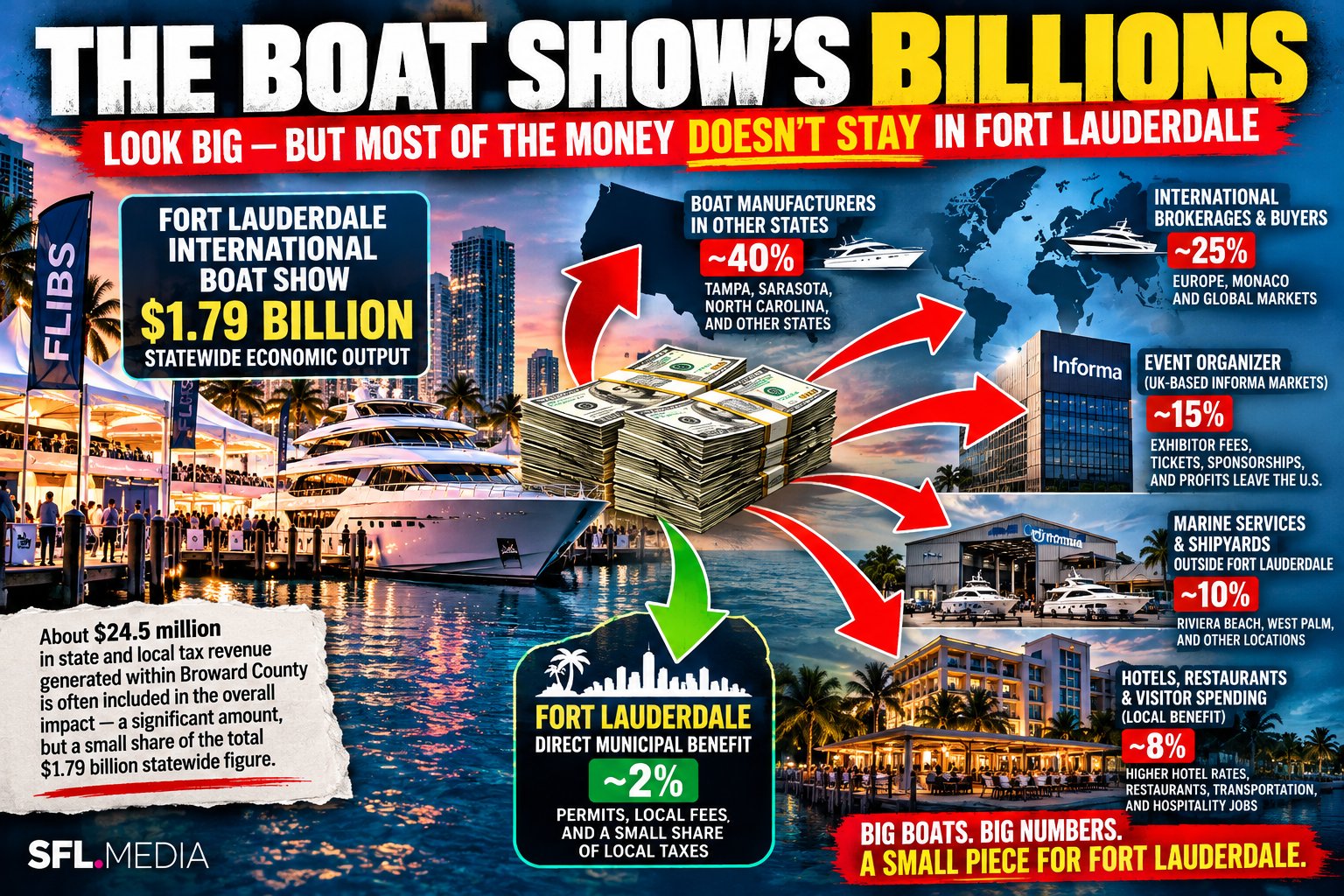
Hundreds of Millions in Boat Sales Do Not Mean Hundreds of Millions for Fort Lauderdale
The Marine Industries Association of South Florida’s published study of the 2024 exhibition estimated approximately $823.5 million in sales by show participants, $1.778 billion in statewide economic output, and $54.2 million in spending by nonlocal visitors and exhibitors. Its promotional materials separately highlighted $45 million in direct spending by out of town visitors and reported that 52% of exhibitors were based outside Florida.
These figures reveal the show’s considerable international reach, but they also demonstrate why economic impact numbers require careful interpretation. The $823.5 million sales estimate reflects commercial transactions associated with participating exhibitors, not the amount of money Fort Lauderdale earns from hosting the event. The statewide output figure includes broader modeled economic activity, while visitor spending represents a different measure of economic contribution.
The boat show’s international structure also means that its commercial benefits are distributed across manufacturers, dealerships, brokerage firms, suppliers, workers, and businesses in multiple jurisdictions. That is normal for a major international trade exhibition, but it complicates attempts to portray the entire financial impact as a direct benefit to the host city. The latest figures do not establish that the event is economically insignificant.
Quite the opposite: they indicate that FLIBS is a major commercial institution. What they do not establish is that the event must take place on Halloween weekend to generate those benefits.
The most relevant financial comparison is not between holding the boat show and canceling it altogether. It is between holding the same boat show on Halloween weekend and holding it on a different weekend while preserving its exhibitors, buyers, visitors, and commercial opportunities. If much of the exhibition’s economic activity could be retained through a scheduling adjustment, Fort Lauderdale might be able to protect the marine industry’s interests while reclaiming Halloween for a broader community celebration. That possibility deserves independent study rather than automatic dismissal.
At Its Core, the Boat Show is Just a Traveling Used Car Lot for Marine Vessels
The Fort Lauderdale International Boat Show is marketed as an extraordinary waterfront spectacle, featuring superyachts, luxury vessels, technological innovations, international exhibitors, and exclusive experiences. For marine enthusiasts and prospective buyers, it can certainly be impressive. The 2026 edition features more than 1,300 boats and numerous vessel debuts, with exhibits spread across multiple waterfront locations. Underneath the elaborate presentation, however, the exhibition’s fundamental purpose is straightforward: selling and marketing boats, marine equipment, and related services. Manufacturers showcase new models, brokers introduce prospective buyers to vessels, dealerships develop sales opportunities, and suppliers promote products to industry professionals and consumers.
Much of this activity follows the familiar trade show model used across countless industries. Exhibitors travel between major events, cultivate relationships, display merchandise, and attempt to convert interested visitors into customers. Although new vessels and technologies change from year to year, the underlying commercial format remains largely consistent. In that respect, FLIBS sometimes resembles an extraordinarily elaborate floating dealership, one with multimillion-dollar yachts instead of rows of automobiles. That comparison is not intended to diminish the expertise of marine professionals or the value of the products they represent. It highlights the difference between an industry marketplace and a civic celebration.
The show does include attractions and activities beyond vessel sales, including educational programming and entertainment. But its central identity remains tied to boating commerce, and its ticketed format is fundamentally different from a free public holiday celebration designed around local families. Fort Lauderdale should welcome commercial events that support its economy, but their international reputation should not automatically entitle them to the most desirable dates and public spaces on the community calendar.
The Global Yacht Calendar Is an Explanation, Not an Excuse
Boat show organizers have legitimate reasons for preferring their established late October schedule. International yacht manufacturers, brokers, suppliers, and crews coordinate their participation around a global calendar of exhibitions, including major events in Europe and the United States. Moving large vessels requires transportation planning, dockage arrangements, staffing, preparation, and substantial financial commitments.
Fort Lauderdale also occupies an important position in the marine industry’s seasonal calendar as businesses prepare for winter boating and Caribbean charter activity. A scheduling change could create conflicts with other exhibitions, vessel movements, commercial commitments, or waterfront venue availability.
These considerations deserve respect, but they should not be treated as an automatic veto over the interests of the city and its residents. The fact that an event has historically operated during the final days of October does not establish that every alternative date is commercially impossible. Nor does the international nature of the exhibition mean that Fort Lauderdale must indefinitely accept the same scheduling arrangement regardless of its impact on public holidays.
The city should request a documented assessment of potential alternative dates, including their effect on exhibitor participation, transportation logistics, hotel availability, venue operations, and expected economic activity. If organizers believe that avoiding Halloween weekend would create substantial financial losses, they should be prepared to explain and substantiate those concerns. A commercial preference is not the same thing as a public necessity, and a longstanding tradition should not be exempt from reasonable reconsideration.
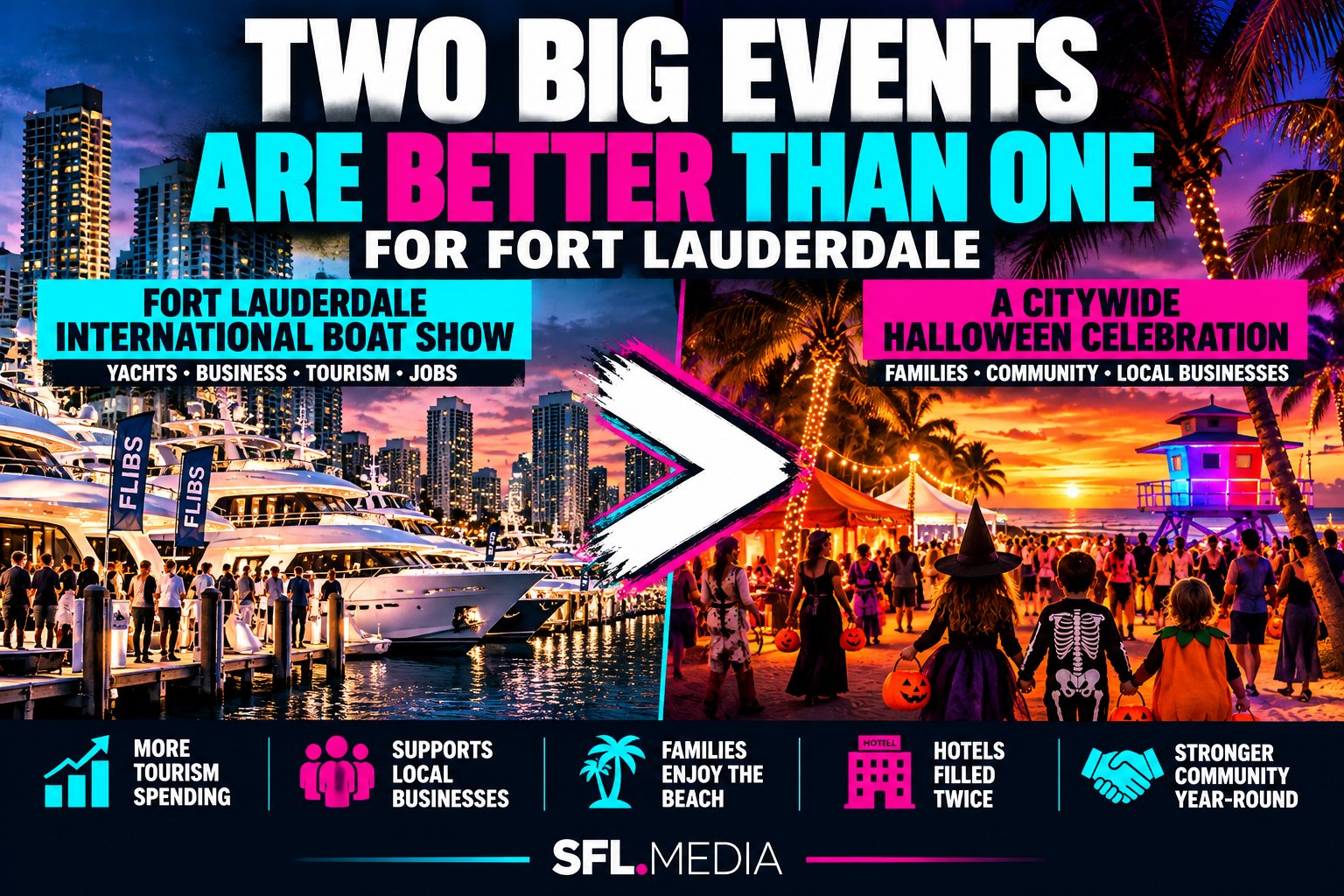
If It’s About Money, Why Not Give Fort Lauderdale Two Major Events Instead of One?
There is another economic possibility that deserves attention: separating the boat show from Halloween could allow Fort Lauderdale to develop two major event weekends rather than concentrating commercial activity and community disruption into the same period.
The boat show could continue attracting marine industry visitors, exhibitors, and buyers on its own dates, while a coordinated beachfront Halloween celebration could bring families, residents, regional visitors, and additional customers to local businesses on October 31. Restaurants, retailers, entertainment venues, and hotels might benefit from having two distinct opportunities to attract visitors. A family oriented Halloween festival could also broaden the economic participation of smaller businesses that are not directly connected to the marine industry.
That outcome is not guaranteed. Some visitors might attend both events, while others might simply shift their spending between weekends. Organizing a major public celebration would also require funding, transportation planning, sanitation, security, and public-safety resources. Nevertheless, the potential deserves evaluation. A serious cost benefit analysis should compare alternative boat show dates, possible visitor spending, public expenditures, and the economic contribution of a separate Halloween celebration.
Fort Lauderdale should not assume that the current arrangement produces the greatest possible benefit simply because it is familiar.
Five Questions the Fort Lauderdale City Commission Must Answer
Before approving future boat show arrangements that overlap Halloween weekend, Mayor Dean Trantalis and the Fort Lauderdale City Commission should demand a detailed accounting of the event’s financial and operational impact.
First, what is the show’s actual net fiscal benefit to the City of Fort Lauderdale, separately from broader Broward County and statewide economic estimates? Residents deserve to know what the municipal government collects through applicable fees, taxes, permits, and other revenue sources, and how those amounts compare with the public resources required to support the event.
Second, what does the city spend on police staffing, traffic management, public works, sanitation, parking operations, security, and other event-related services? Which expenses are reimbursed by organizers, and which remain the responsibility of taxpayers? A credible financial assessment must consider costs as well as revenue.
Third, what contractual agreements, venue requirements, permitting arrangements, or other legal obligations govern the exhibition’s dates? The City Commission’s ability to influence the schedule depends on the specific agreements and legal authority involved, and those arrangements should be transparent to the public.
Fourth, has the city or the show’s organizers conducted an independent comparison of the economic and operational consequences of holding FLIBS on Halloween weekend versus an alternative date? If no such analysis exists, one should be commissioned before future scheduling decisions are treated as settled.
Finally, why has Fort Lauderdale not established a major, coordinated Halloween celebration centered on its beachfront on October 31, and what resources would be necessary to create one? A city capable of supporting a world renowned marine exhibition should be equally serious about developing traditions that serve its residents.
These questions are not attacks on the marine industry. They are reasonable demands for transparency, accountability, and responsible stewardship of public resources.
Moving the Boat Show Is Not Anti-Business. It Is Pro-Fort Lauderdale!
The solution is straightforward in principle: Fort Lauderdale should establish a clear policy objective that future editions of the International Boat Show avoid Halloween weekend whenever October 31 falls on a Friday, Saturday, or Sunday.
Implementing that policy would require negotiations with the Marine Industries Association of South Florida, Informa Markets, venue operators, and other stakeholders. Existing agreements would need to be reviewed, alternative dates evaluated, and potential legal or operational restrictions addressed. The city cannot simply assume it has unlimited authority to dictate the dates of a privately organized event, but it can use its lawful permitting, public-property, and negotiating authority to advocate for community priorities.
The objective should not be to punish the marine industry or undermine an important regional institution. It should be to establish a reasonable boundary between the commercial needs of an international exhibition and the public’s interest in enjoying one of the year’s most recognizable holidays.
Fort Lauderdale could preserve the prestige and economic opportunities associated with the boat show while building a separate Halloween tradition that is accessible to families, children, and residents of all income levels. Such a celebration should prioritize free public programming and broad community participation rather than becoming another expensive ticketed attraction. The marine industry has helped shape Fort Lauderdale’s history, economy, and international identity. It deserves continued support. But that support should not require residents to accept every inconvenience, restriction, or scheduling decision without question.
Fort Lauderdale Should Be More Than a Showroom for Wealthy Visitors
The deeper issue is one of civic priorities. Fort Lauderdale has invested heavily in becoming an international destination, with its waterfront, marinas, luxury developments, restaurants, and hospitality businesses attracting visitors from around the world. That success has brought jobs, investment, and recognition, but it has also increased pressure on public infrastructure and intensified the competition between tourism, commercial activity, and everyday community life.
Residents experience the traffic, construction, parking shortages, rising costs, and competing demands on public space that accompany a major destination economy. Some of those sacrifices may be justified by meaningful economic and civic benefits, but they should never be treated as automatic obligations simply because a commercial event has operated in the same location for decades.
Halloween is not an obscure holiday or a minor scheduling inconvenience. It is an annual opportunity for families, neighborhoods, and communities to gather, celebrate, and create traditions. Fort Lauderdale should be embracing that opportunity, particularly in its signature beachfront district, rather than treating the holiday as another date to be accommodated around a major industry exhibition. The boat show can have its international audience, luxury yachts, corporate sponsors, marine exhibitions, and substantial commercial activity. It does not need Halloween, too.
The City Commission Needs to Give Fort Lauderdale Halloween Back to the Kids
Mayor Dean Trantalis and the Fort Lauderdale City Commission should begin planning now for a future in which Halloween weekend is protected for community celebrations and reasonable public access to the beach. That effort should begin with an independent review of the boat show’s actual municipal benefits, public costs, scheduling restrictions, and potential alternatives, followed by meaningful negotiations with the exhibition’s organizers.
At the same time, Fort Lauderdale should develop a serious proposal for a signature beachfront Halloween celebration that gives families and residents a reason to gather at the waterfront on the holiday itself. The city already knows how to coordinate major events, manage transportation, provide public safety, and promote itself to regional and international audiences. Those capabilities should be used to benefit the broader community as well as commercial visitors. The marine industry is an important part of Fort Lauderdale, but it is not the entirety of Fort Lauderdale. The city belongs to the people who live here, work here, raise families here, and contribute to its economy throughout the year.
Fort Lauderdale is a city, not a permanent floating sales floor. Its beachfront is a public asset, not merely an extension of the international yacht brokerage business.
The boat show has had decades to build its reputation, and an event of that stature should be capable of participating in a serious conversation about scheduling. Its continued success should not depend on residents surrendering Halloween weekend without debate.
Keep the boats. Keep the business. Move the show. Give Fort Lauderdale Halloween back to local families.
Sources & Further Reading

Official government and marine industry sources
- Fort Lauderdale International Boat Show — Official Show Overview, Schedule and Economic Impact
- Fort Lauderdale International Boat Show — Official 2026 FAQs and Exhibition Details
- Marine Industries Association of South Florida — Boat Show Economic Impact
- MIASF — Economic Activity Associated With the 65th Annual Fort Lauderdale International Boat Show (2024)
- MIASF — 2026 Annual Report
- City of Fort Lauderdale — October 23, 2026 Boat Show Traffic Advisory and Public Parking Closure
- Fort Lauderdale Parks and Recreation — LauderBOO and Halloween Community Events
Independent reporting and additional context
- Fort Lauderdale Journal — 2026 Boat Show Dates, Traffic, Parking and Venue Information
- Axios Fort Lauderdale — 2026 Boat Show Attractions, Attendance and Economic Impact
- IYC — Fort Lauderdale International Boat Show 2026 and International Yacht Brokerage Activities
SFL Media Related Local Coverage














































Want to join the conversation?
Create an account or sign in to share your thoughts, vote,
and reply to other readers.
Showing 0 of 0 comments
Don't have an account?
Already have an account?