Is the AI Bubble Finally Bursting? Wall Street Confronts Massive Spending, Mounting Debt and Uncertain Returns
Wall Street’s artificial intelligence gold rush is facing its most serious financial reckoning yet, as investors question whether hundreds of billions of dollars in data centers, advanced chips, and computing infrastructure can ever generate enough profit to justify the extraordinary spending.
For years, artificial intelligence has been the dominant investment story in American technology, driving soaring stock valuations, record breaking capital expenditures, and an unprecedented race to build the infrastructure needed to power increasingly sophisticated AI systems. Microsoft, Alphabet, Amazon, Meta, and other technology giants have committed enormous resources to the industry, betting that artificial intelligence will transform everything from corporate productivity and internet search to software development, medicine, and national defense.
But the financial assumptions underpinning that expansion are facing increasing scrutiny. Investors are becoming less willing to reward companies simply for announcing larger AI investments, particularly when the spending reduces free cash flow, increases debt obligations, and produces returns that remain difficult to measure. The resulting anxiety has intensified comparisons with the dot com bubble of the late 1990s, when investors poured extraordinary amounts of money into internet infrastructure and technology companies before a devastating market correction exposed the gap between expectations and financial reality.
The central question is no longer whether artificial intelligence represents an important technological breakthrough. It is whether the companies financing the AI revolution have built an economically sustainable business model, or whether Wall Street has once again confused a transformative technology with an unlimited investment opportunity.
The AI Spending Explosion Is Testing Wall Street’s Patience
The largest American technology companies are engaged in one of the most expensive infrastructure expansions in corporate history. Their investments include massive data centers, specialized graphics processing units, high speed networking equipment, cooling systems, electricity infrastructure, and the construction of facilities capable of supporting increasingly demanding artificial intelligence workloads.
These expenditures are necessary to train and operate advanced AI models, but they also create substantial financial pressure. Companies must spend billions of dollars building infrastructure long before they can determine whether customer demand will generate sufficient revenue to recover those investments. Unlike software products that can be distributed to additional customers at relatively low marginal cost, advanced AI services require expensive computing resources, electricity, and ongoing infrastructure maintenance.
The financial consequences are becoming more visible as investors examine the difference between operating profits and free cash flow. A company can report strong revenue growth and substantial accounting profits while simultaneously consuming enormous amounts of cash on capital expenditures. When infrastructure spending grows faster than cash generated by operations, free cash flow can decline sharply or turn negative, even when the underlying business remains profitable.
Alphabet’s aggressive investment in AI infrastructure has become an important example of this tension. The company is spending heavily to expand Google Cloud, support Gemini, and increase the computing capacity available across its services. Those investments may strengthen Google’s competitive position over the long term, but they also require investors to accept significant near term financial costs in exchange for future returns that are not guaranteed.
The same basic challenge applies to Microsoft, Amazon, and Meta. Each company has a powerful existing business capable of generating substantial revenue, but each is also committing extraordinary resources to a technology whose eventual market size, profit margins, and competitive structure remain uncertain.
For Wall Street, the issue is increasingly straightforward: how much additional money must these companies invest before artificial intelligence produces a measurable and sustainable financial return?
The Financial Math Behind the AI Boom Is Becoming Harder to Defend
Artificial intelligence companies and their investors have frequently justified enormous capital expenditures by pointing to the technology’s potential to transform global economic productivity. If AI systems can automate complex tasks, accelerate scientific research, reduce operating costs, and create entirely new industries, the eventual economic benefits could be extraordinary.
However, the existence of a potentially enormous market does not guarantee that every company investing in it will earn attractive returns. History is filled with transformative technologies that created tremendous value for consumers while producing disappointing financial outcomes for many of their early investors.
The railroad industry, telecommunications infrastructure, and the early internet all demonstrated that a technology can change the world without making every infrastructure investment profitable. Excessive competition, high fixed costs, rapid technological change, and overbuilding can destroy shareholder value even when the underlying innovation succeeds.
Artificial intelligence faces similar economic pressures. Companies are investing heavily in computing infrastructure at a time when the cost of delivering AI services remains significant and competition is placing downward pressure on prices. As AI models become more capable and widely available, customers may benefit from cheaper services while providers struggle to maintain the profit margins needed to justify their investments.
The useful life of AI hardware introduces another complication. Advanced chips and servers can become economically outdated long before their physical components stop functioning, particularly when newer generations offer substantial improvements in performance or energy efficiency. That creates the possibility that companies will need to replace expensive equipment before recovering their original investments.
For investors, the problem is not simply that AI infrastructure is expensive. It is that the industry may be entering a cycle in which companies must continue spending enormous amounts of money merely to remain competitive, regardless of whether previous investments have generated adequate returns.
The Circular AI Economy Is Raising Serious Financial Questions
One of the most controversial features of the artificial intelligence boom is the increasingly interconnected financial relationship between AI developers, cloud computing companies, semiconductor manufacturers, and infrastructure investors. Companies involved in the AI industry frequently occupy multiple positions within the same economic ecosystem. A technology giant may invest in an AI startup, provide that startup with cloud computing services, purchase specialized chips from another major supplier, and simultaneously sell AI products that depend on the startup’s models.
These relationships are not inherently improper. Strategic investments and long term commercial agreements are common throughout the technology industry. However, they can make it more difficult for investors to determine how much demand represents independent customer spending and how much is supported by financing circulating among a relatively small group of companies.
Consider a simplified example. A cloud provider invests billions of dollars in an AI developer, which then uses substantial portions of that funding to purchase computing services from the same provider. The cloud company records revenue from the arrangement, while the AI developer gains access to infrastructure needed to expand its products. Both businesses may benefit, but the economic sustainability of the relationship ultimately depends on whether outside customers generate enough revenue to support the arrangement without continued investment.
Similar concerns arise when chip manufacturers invest in companies that purchase their hardware, or when infrastructure financing depends on optimistic projections of future demand from AI laboratories.
The danger emerges if one part of the system experiences a serious financial setback. An AI developer that struggles to raise additional funding may reduce its cloud spending, weakening revenue expectations for infrastructure providers. Those providers may subsequently reduce equipment purchases, affecting chip manufacturers and data center developers. Financial pressure can then spread through the same network of companies that benefited from the expansion.
This interconnected structure does not prove that the AI economy is fraudulent or unsustainable. It does, however, create financial dependencies that investors must understand before treating every new investment announcement or infrastructure contract as evidence of independent, profitable demand.
Debt Financed Data Centers Could Become the Next Major Financial Vulnerability
The enormous cost of building AI infrastructure has encouraged companies and financial investors to explore increasingly complex financing arrangements. While the largest technology corporations can fund substantial portions of their spending through operating cash flow, many data center developers, infrastructure companies, and emerging AI businesses depend more heavily on borrowed money.
Data centers require expensive land, construction, specialized equipment, cooling systems, electrical connections, and long term power agreements. Financing these projects often involves substantial upfront borrowing, with lenders expecting future rental payments or computing contracts to generate enough revenue to service the debt.
This model can work when customer demand remains strong, facilities operate at high utilization rates, and long-term contracts provide predictable cash flow. But it becomes considerably more dangerous if AI demand grows more slowly than expected, computing prices decline, or customers cancel expansion plans.
The risk is particularly acute for highly leveraged developers and lower rated borrowers. Unlike Microsoft or Alphabet, which possess diversified businesses and substantial financial resources, smaller infrastructure companies may have limited capacity to withstand prolonged periods of weak revenue or rising financing costs.
Another concern involves the physical limitations of AI infrastructure. Building a data center does not automatically mean it can begin operating. Developers must secure electricity, grid connections, cooling capacity, equipment deliveries, and regulatory approvals. Delays in any of these areas can increase construction costs and postpone the revenue needed to repay lenders.
If AI infrastructure investment eventually exceeds sustainable customer demand, some facilities could become underutilized while their owners remain responsible for substantial debt obligations. That scenario would not necessarily destroy the AI industry, but it could produce severe financial losses for investors who financed projects based on overly optimistic forecasts.
Alphabet’s $482 Billion Market Value Wipeout Sends a Warning Across Silicon Valley
The clearest evidence of Wall Street’s changing attitude arrived after Alphabet reported its third quarter financial results. Shares of Google’s parent company plunged approximately 12.6% on October 29, erasing roughly $482 billion in market capitalization in a single trading session. The decline was particularly striking because Alphabet remained a highly profitable corporation with growing revenue, yet investors were increasingly concerned about its ability to convert that growth into available cash.
Alphabet reported approximately $9.1 billion in negative free cash flow during the quarter as capital expenditures reached roughly $51.4 billion. The company also indicated that its annual investment spending could reach approximately $205 billion, underscoring the extraordinary cost of expanding its AI and cloud computing operations.
Google Cloud revenue more than doubled compared with the previous year, demonstrating that demand for AI related infrastructure and enterprise computing services remains substantial. However, growth in Google’s core search advertising business slowed, raising additional questions about whether AI powered search products could undermine the advertising model that has historically financed much of the company’s expansion.
This creates a particularly difficult financial situation. Alphabet must invest heavily in AI to defend its position against competitors, but the technology itself could alter how users interact with search engines and how advertisers reach customers. AI generated answers may reduce some traditional website visits, change advertising placements, and require more expensive computing resources than conventional search results.
The company’s financial results do not establish that its AI investments will fail. They do, however, demonstrate why investors are becoming more skeptical of the assumption that AI spending will inevitably produce attractive returns.
The Nasdaq’s October Sell Off Shows the Anxiety Is Spreading
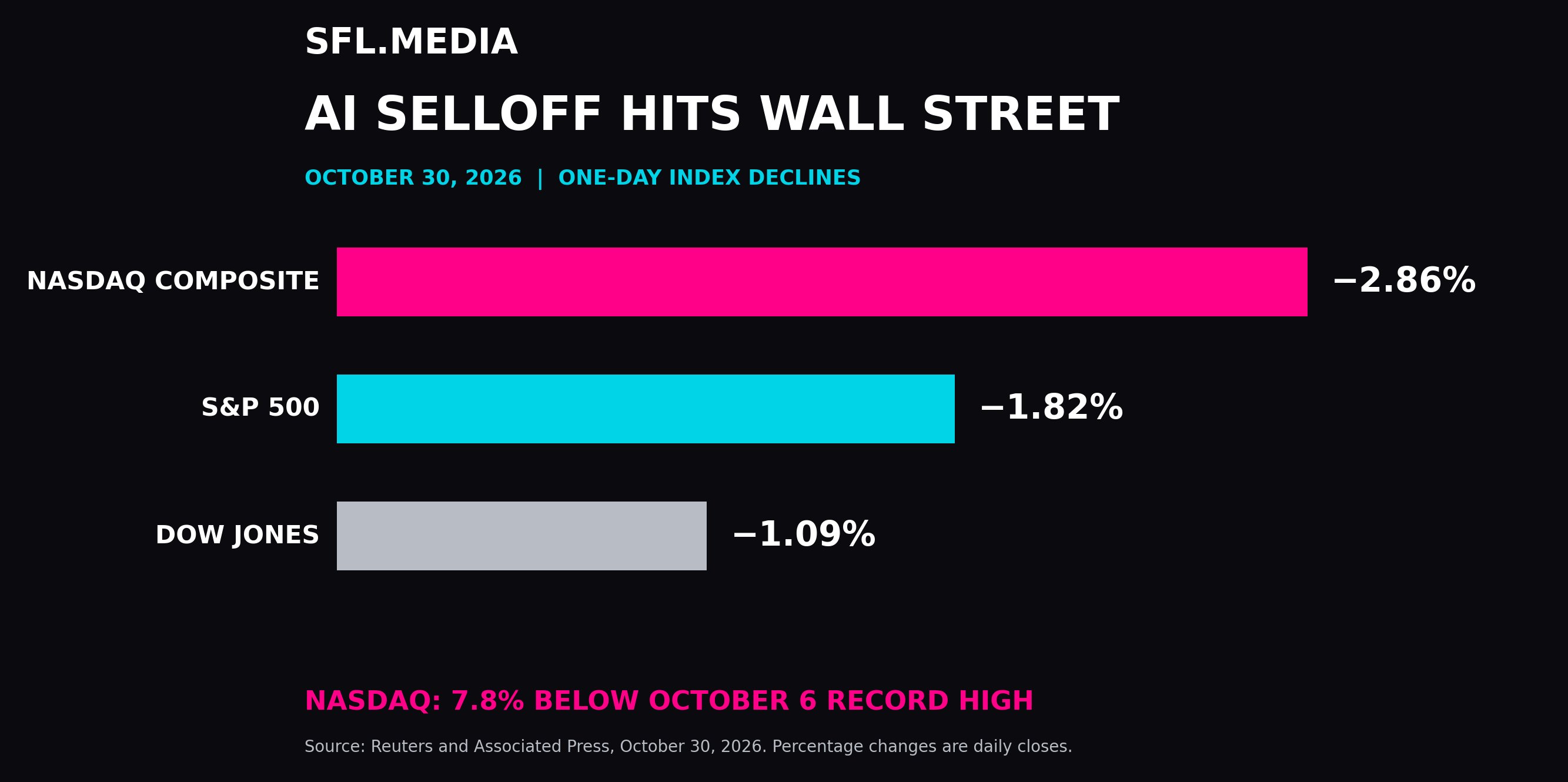
Alphabet’s decline was part of a broader technology sell off that intensified on Friday, October 30. The Nasdaq Composite fell approximately 2.86%, its steepest daily decline since early June, while the S&P 500 dropped 1.82% and the Dow Jones Industrial Average declined 1.09%.
Semiconductor companies were hit particularly hard. Intel plunged approximately 28.6% after disappointing financial results and a weak outlook, while Advanced Micro Devices declined about 10.9% and Nvidia lost approximately 4.2%. The Philadelphia semiconductor index fell roughly 7.2%, reflecting concerns about both AI infrastructure spending and weakness in other parts of the technology market.
The Nasdaq finished the session approximately 7.8% below its October 6 record, demonstrating how quickly investor enthusiasm has deteriorated. Reuters reported that the Nasdaq 100 had faced more than $2 trillion in market value losses during October as investors questioned the financial sustainability of the industry’s investment plans.
Not every decline can be attributed exclusively to artificial intelligence. Intel’s difficulties also reflected weakness in personal computing demand, while other companies faced their own earnings disappointments and operational challenges. Nevertheless, the concentration of selling across technology and semiconductor stocks illustrates how closely market valuations have become tied to expectations surrounding the AI boom.
The broader market remains far from a confirmed collapse comparable to the dot-com crash. However, the recent selling has exposed how vulnerable richly valued technology stocks can become when investors begin questioning the financial assumptions behind their growth projections.
Congress Is Already Warning Against an AI Bubble Bailout
Concerns about artificial intelligence have now moved beyond Wall Street and into Congress. On October 29, Democratic Representatives Greg Casar of Texas and Maxine Waters of California introduced a resolution warning that an AI-related asset bubble could create systemic economic risks and urging the federal government not to rescue corporations or executives whose speculative investments collapse.
The proposal, supported by other Democratic lawmakers, argues that excessive financial risk-taking, opaque financing arrangements, and growing concentrations of investment in a small number of technology companies could expose workers, retirees, and ordinary households to serious economic consequences.
The resolution draws comparisons with the 2008 financial crisis, when the collapse of heavily leveraged mortgage-related investments triggered a global banking emergency and prompted extraordinary federal interventions. Lawmakers argue that an AI-driven financial crisis could similarly create pressure for government assistance if large corporations, financial institutions, or interconnected infrastructure providers face severe financial distress.
Importantly, the resolution is not a binding prohibition on future bailouts. It expresses the position of its sponsors and calls for policies prioritizing affected workers and communities rather than protecting investors and corporate executives from the consequences of unsuccessful financial decisions.
The proposal also highlights concerns about electricity costs, private credit markets, and the possibility that AI infrastructure spending is diverting financial resources from other productive sectors of the economy.
Its introduction is politically significant because it demonstrates that concerns about an AI investment bubble are no longer confined to market analysts and skeptical investors. Members of Congress are beginning to consider what would happen if the industry’s enormous financial commitments fail to produce the anticipated economic returns.
For lawmakers, the central question is whether American taxpayers should ultimately bear the consequences of speculative decisions made by some of the wealthiest companies and investors in the world.
The most obvious historical comparison is the dot com bubble, which collapsed beginning in 2000 after investors assigned extraordinary valuations to internet businesses that frequently lacked sustainable revenue, profits, or viable long term business models. During the late 1990s, companies could attract substantial investment simply by associating themselves with the internet. Investors believed that rapid technological adoption would create enormous markets, and they were correct about the internet’s transformative potential. What they underestimated was how many individual businesses would fail before that potential translated into durable profits.
The Nasdaq Composite eventually lost approximately 78% of its value between its March 2000 peak and October 2002 low. Numerous internet startups disappeared, telecommunications infrastructure companies suffered enormous losses, and investors discovered that a revolutionary technology did not guarantee attractive investment returns.
Artificial intelligence shares several characteristics with that period, including ambitious growth projections, aggressive infrastructure spending, intense competition, and valuations that depend heavily on expectations about the future. However, there are also important differences. Unlike many speculative internet startups of the late 1990s, today’s largest AI investors include some of the most profitable corporations in the world. Microsoft, Alphabet, Amazon, and Meta operate established businesses that generate substantial revenue independently of their AI investments. Their existing financial strength provides a cushion that many dot-com companies never possessed.
Furthermore, artificial intelligence already has commercially useful applications. Businesses are using AI systems for software development, customer support, document analysis, advertising, research, and workflow automation. Cloud providers are reporting substantial demand for computing capacity, while enterprise software companies are incorporating AI features into products used by millions of customers. These realities weaken the argument that the entire AI industry is built on nonexistent demand. Nevertheless, genuine demand does not necessarily justify every valuation or investment. A market can be technologically legitimate and financially overheated at the same time.
The dot com collapse did not mean the internet was a failure. It meant investors had paid too much for businesses and infrastructure whose eventual economics could not support the prices. Artificial intelligence could experience a similar financial correction without losing its importance as a transformative technology.
The Bull Case: AI Demand Is Real, and Big Tech Can Afford to Keep Investing
Despite the recent market turbulence, there are credible reasons to believe the AI boom could continue without a catastrophic collapse. The strongest argument is that demand for AI computing remains substantial and the largest infrastructure investors possess diversified businesses capable of supporting continued expansion.
Google Cloud’s rapid growth provides one example of the commercial demand underlying the investment cycle. Microsoft continues to integrate AI services into its enterprise software and cloud offerings, while Amazon Web Services is expanding its AI infrastructure and tools for corporate customers. These companies are not relying exclusively on speculative investment funding to sustain their operations.
AI technology is also becoming increasingly embedded in everyday business processes. Companies are experimenting with automated customer service, software engineering assistants, document processing, cybersecurity tools, and AI driven research. Some applications may produce measurable cost savings or productivity improvements, creating opportunities for providers to generate recurring revenue.
Supporters of the investment boom argue that building infrastructure ahead of demand is necessary when a new technology is expanding rapidly. Data centers, electrical connections, semiconductor production, and advanced networking systems require years of planning and construction. Companies that wait until demand is fully established may find themselves unable to secure sufficient capacity.
The bullish argument also recognizes that the economic benefits of major technological transformations often take years to become visible. Businesses must redesign workflows, train employees, integrate new systems, and develop products before productivity improvements translate into measurable financial gains.
From this perspective, the current sell off may represent a reassessment of overly optimistic expectations rather than the beginning of a fundamental industry collapse. Some analysts argue that slower investment growth and more disciplined spending could actually strengthen the long term economics of artificial intelligence by reducing overcapacity and forcing companies to prioritize profitable applications.
The opposing argument is that artificial intelligence has attracted far more capital than the industry’s near-term economics can support. Investors may be correctly anticipating a technological revolution while dramatically overestimating how quickly companies can turn that revolution into sustainable profits.
The enormous cost of AI infrastructure creates an especially difficult financial equation. Companies must continually purchase advanced processors, construct data centers, secure electricity, and maintain complex computing systems. As models become more capable, competitive pressure may require additional investment rather than allowing infrastructure spending to decline.
At the same time, competition could make AI services increasingly affordable, reducing the revenue generated per unit of computing capacity. Open-source models, improved algorithms, and more efficient hardware could further undermine the economics of companies that invested heavily in expensive infrastructure based on earlier assumptions.
The danger is particularly significant for businesses financing expansion with debt. If expected revenue fails to materialize, lenders may demand higher interest rates, refuse to refinance existing obligations, or impose more restrictive financing terms. Highly leveraged infrastructure providers could face severe financial pressure even while AI adoption continues to grow.
There is also the possibility that the market has overestimated the speed at which businesses can deploy AI profitably. Many organizations face practical limitations involving data quality, regulatory compliance, security, employee training, and the reliability of automated systems. These obstacles can delay adoption and reduce the immediate financial benefits of AI investments.
Under this scenario, artificial intelligence could continue advancing technologically while companies and investors experience years of disappointing financial returns. The most vulnerable businesses would likely be those with excessive debt, concentrated customers, limited cash reserves, or valuations dependent on uninterrupted growth.
What Happens if the AI Bubble Actually Bursts?
A severe correction in artificial intelligence investment could produce consequences extending far beyond Silicon Valley. The scale of the industry’s infrastructure expansion has created economic relationships involving semiconductor manufacturers, construction companies, utilities, electrical equipment suppliers, commercial real estate developers, financial institutions, and local governments.
If technology companies substantially reduce their capital expenditure plans, demand for specialized chips, servers, networking equipment, and data center construction could decline. Businesses that expanded production capacity in anticipation of continued AI investment might face excess inventory, weaker revenue, and financial losses.
Communities that invested in infrastructure to attract data center developments could also experience economic setbacks if projects are delayed or canceled. Some utilities and regional power providers have begun planning expensive capacity expansions around anticipated electricity demand from AI facilities. If those forecasts prove overly optimistic, regulators and consumers may face difficult questions about how infrastructure costs should be allocated.
Financial institutions could also be exposed through loans, private credit arrangements, corporate bonds, and investments linked to AI infrastructure. The severity of any broader financial disruption would depend on how much leverage exists, which institutions hold the debt, and whether losses are concentrated or widely distributed.
However, a stock market correction would not automatically produce a banking crisis or recession. Falling technology valuations can reflect changes in investor expectations without causing widespread corporate insolvency. The distinction between a painful market repricing and a systemic financial crisis depends heavily on debt exposure, liquidity, and the resilience of the businesses involved.
For American workers, the potential consequences could include layoffs, reduced hiring, canceled construction projects, and weaker retirement account balances. Yet a reduction in speculative investment could also redirect capital toward other industries and encourage AI companies to focus on applications that deliver measurable economic benefits.
The Real Test for Artificial Intelligence Is No Longer Technological, It Is Financial
The artificial intelligence industry has already demonstrated that advanced machine learning systems can perform tasks that would have seemed extraordinary only a few years ago. The question now confronting investors is whether those capabilities can support an economic structure large enough to justify the extraordinary amount of money being invested.
Wall Street is beginning to distinguish between companies that are generating profitable demand for AI services and those whose financial performance depends on continuously expanding infrastructure investment. Investors are also paying closer attention to free cash flow, debt obligations, customer concentration, and the useful life of expensive computing equipment.
The coming quarters will be particularly important. If AI related revenue continues growing rapidly while infrastructure spending begins stabilizing, the industry could demonstrate that its investment cycle is producing sustainable financial returns. Conversely, if capital expenditures continue accelerating while cash flow deteriorates and debt increases, concerns about over investment will likely intensify.
There is no reliable way to determine from the October sell off alone whether the AI boom has entered a prolonged collapse. Markets can experience severe corrections during otherwise durable periods of technological expansion, and even profitable companies can suffer substantial valuation declines when expectations become excessive.
What has changed is the burden of proof. Investors are no longer satisfied with promises that artificial intelligence will eventually transform the global economy. They increasingly want evidence that the companies financing that transformation can generate enough cash to justify the cost.
The AI Revolution May Be Real, but That Does Not Mean Every AI Investment Makes Sense
The most important lesson from previous technology bubbles is that innovation and investment returns are not the same thing. Railroads transformed transportation, telecommunications revolutionized communication, and the internet fundamentally changed commerce, media, and everyday life. Yet each of those industries experienced periods of speculative excess in which investors lost enormous amounts of money.
Artificial intelligence may follow a similar trajectory. The technology could become an essential component of the global economy while many of the companies currently financing its expansion fail to earn attractive returns. Some businesses may emerge as dominant, highly profitable providers, while others struggle with excessive debt, obsolete infrastructure, or business models that cannot support their operating costs.
The recent market sell off does not establish that the AI bubble has definitively burst. It does, however, demonstrate that Wall Street is becoming less willing to accept unlimited spending based on the promise of future technological dominance.
For the technology giants, the challenge is proving that hundreds of billions of dollars in infrastructure investment will eventually translate into sustainable earnings and free cash flow. For investors, the challenge is separating genuinely profitable businesses from companies whose valuations depend on increasingly optimistic assumptions.
For policymakers, the challenge is ensuring that the financial consequences of speculative corporate investments do not ultimately fall on taxpayers, workers, and communities that had little influence over those decisions.
Artificial intelligence does not have to fail for an AI investment bubble to burst. The technology can change the world, become indispensable to modern society, and still leave investors with trillions of dollars in losses if the financial expectations surrounding it prove unrealistic.
That is the uncomfortable reality now confronting Wall Street. The AI revolution may be only beginning, but the era of investors unquestioningly rewarding every billion dollars spent on it appears to be ending.
Sources & Further Reading

Financial Markets and Corporate Earnings
Congressional Action and Financial Risk
SFL Media Related Coverage


























Loading comments…