

John Oliver Exposes Alligator Alcatraz: Florida’s Billion-Dollar Immigration Detention Disaster in the Everglades
What Florida officials promoted as a tough on immigration detention facility became a billion dollar controversy involving allegations of inhumane conditions, environmental destruction, questionable government contracts, and a financial burden that could leave Florida taxpayers paying hundreds of millions of dollars.
MIAMI — Deep in the Florida Everglades, surrounded by swamps, alligators, and some of the most environmentally sensitive land in the United States, state officials constructed an immigration detention facility that became one of the most controversial projects of Governor Ron DeSantis’s administration. Nicknamed “Alligator Alcatraz,” the temporary detention camp opened in July 2025 as part of President Donald Trump’s aggressive immigration enforcement agenda, with Florida officials promoting its isolated location as a security advantage while critics warned that the project combined questionable detention practices, enormous public expenditures, and serious environmental risks.
Now, HBO comedian and political commentator John Oliver has brought renewed national attention to the facility in a November 15 episode of Last Week Tonight, examining how the detention center was constructed in just eight days, the conditions thousands of immigrants allegedly endured, and the extraordinary financial consequences of a project that closed less than a year after opening. Oliver’s investigation presents a disturbing portrait of an operation that prioritized political messaging and rapid construction while leaving serious questions about human rights, environmental protections, government contracting, and taxpayer accountability unanswered.
Built in Eight Days, With Little Time for Oversight
The origins of Alligator Alcatraz reflected the increasingly theatrical approach to immigration enforcement embraced by Trump and DeSantis, with the facility’s name combining the notorious reputation of the former Alcatraz federal prison with the alligators inhabiting the Florida Everglades. Florida Attorney General James Uthmeier helped promote the concept, which quickly gained support from DeSantis and the Trump administration as state officials selected the Dade-Collier Training and Transition Airport, an isolated airfield along Tamiami Trail, to establish a detention complex capable of holding thousands of immigrants awaiting federal immigration proceedings.
The facility was assembled in approximately eight days using emergency contracting procedures that allowed Florida to move forward without the competitive bidding normally associated with major government projects. Its remote location created enormous logistical challenges because the site lacked much of the permanent infrastructure necessary to operate a large detention center, requiring electricity, drinking water, food, sanitation equipment, medical supplies, and waste-management services to be transported or supplied through temporary systems. What officials presented as an efficient response to immigration enforcement needs quickly became an expensive operation dependent on generators, portable toilets, temporary showers, air-conditioning equipment, and continuous deliveries, raising questions about whether the government had adequately considered the long-term costs of operating a detention facility in one of Florida’s most environmentally challenging locations.
Oliver highlighted the contradiction between the administration’s promises of government efficiency and the extraordinary expenses associated with building and maintaining the facility. Although emergency procurement procedures can be necessary during genuine crises, their use also reduces some of the competitive safeguards designed to protect public money, making transparency and independent oversight especially important when contracts worth millions of dollars are awarded under accelerated timelines.
A Billion-Dollar Price Tag for a Temporary Detention Camp
The financial consequences became one of the most remarkable aspects of the Alligator Alcatraz controversy, with figures examined in Oliver’s segment placing reported expenditures associated with the project above $1 billion. That extraordinary sum attracted criticism because the facility operated for less than a year before detention operations ended, leaving Florida taxpayers facing questions about the financial value of a temporary installation constructed without permanent infrastructure.
Oliver highlighted the enormous cost of sanitation and logistical services, including a reported $219 million associated with portable toilets and related expenditures. The figure illustrates the scale of the spending described in the segment, although the precise procurement categories and whether the amount represents completed payments, contract commitments, or broader sanitation costs require verification against underlying state records. The larger financial concern remains clear: Building a large detention operation in an isolated environment required substantial investments in basic services that would ordinarily be available through permanent infrastructure.
DeSantis defended the use of state emergency resources for immigration enforcement, characterizing immigration as an emergency comparable to a natural disaster. His administration expected significant federal reimbursement, but those financial arrangements became increasingly contentious as expenses mounted and questions emerged about which costs would qualify for repayment. The distinction between total expenditures, federal reimbursement approvals, and money actually received is essential because reported spending exceeding $1 billion does not automatically establish that the entire amount represents an unrecoverable taxpayer loss.
Inside Alligator Alcatraz: Allegations of Inhumane Conditions
While state officials celebrated the facility as a symbol of aggressive immigration enforcement, detainees and their attorneys described conditions that raised serious questions about basic human rights and federal detention standards. Accounts included overcrowded housing units, inadequate sanitation, extreme temperatures, questionable food quality, limited access to legal counsel, and difficulties obtaining appropriate medical care, creating a stark contrast between the administration’s public messaging and the experiences described by people confined inside the camp.
Oliver highlighted reporting indicating that approximately 7% of the first 6,700 detainees had convictions for violent crimes, challenging political descriptions suggesting the facility primarily housed exceptionally dangerous criminals. That distinction is significant because immigration detention is frequently a civil administrative process, and individuals can be held while immigration proceedings are pending without having been convicted of violent offenses. The reported statistic should be understood within the specific population and period examined rather than as a definitive measure of every person ever detained at the facility.
The physical conditions also attracted criticism, with reports indicating that detainees had approximately 28 square feet of floor space per person while bathroom facilities offered limited privacy. Accounts described toilets separated by low partitions, crowded sleeping areas, and makeshift attempts to create privacy in communal detention spaces, while former detainees alleged that food was sometimes spoiled or inadequate, drinking water caused discomfort, and heavy rainfall contributed to flooding and sanitation problems. State officials disputed or defended aspects of the operation, but the allegations generated scrutiny from attorneys, journalists, civil rights organizations, and federal oversight authorities.
The concerns extended beyond detainee testimony when a September 2026 Department of Homeland Security inspector general report identified deficiencies involving living space and recreation time. Those findings provided independent federal oversight evidence that the facility had failed to meet important detention requirements, reinforcing questions about whether the rush to establish the camp had compromised standards intended to protect the health and welfare of people held in government custody.
The Outdoor Cages Officials Called Calming Areas
Among the most disturbing allegations examined by Oliver was the use of outdoor isolation enclosures that detainees reportedly referred to as “the box.” These cage-like spaces were described as areas where detainees could be separated from the general population, raising questions about their purpose, supervision, and potential use as punishment. Officials defended the enclosures as designated areas intended to help detainees manage emotional distress or behavioral problems, but that explanation drew criticism because confinement in an outdoor enclosure, particularly in South Florida’s intense heat and humidity, raises serious concerns about humane treatment and medical safety.
Correctional facilities sometimes use designated spaces to manage behavioral emergencies, but those practices require clear policies, appropriate supervision, medical safeguards, and protections against abuse. The existence of a designated calming area does not independently establish misconduct, yet the conditions described in Oliver’s segment warrant scrutiny of how the enclosures were used, whether detainees were subjected to unnecessary or punitive isolation, and whether appropriate safeguards were consistently followed. The controversy also highlighted the broader risks associated with establishing a detention operation in days rather than developing it through a comprehensive planning process that includes infrastructure evaluation, staff training, and independent oversight.
Environmental Groups Took the Fight to Federal Court
The controversy surrounding Alligator Alcatraz extended well beyond immigration policy and detention conditions because the facility was constructed in the environmentally sensitive Everglades region near Big Cypress National Preserve, where development and infrastructure projects can threaten protected habitats, water systems, and endangered wildlife. Environmental organizations, including Friends of the Everglades and the Center for Biological Diversity, challenged the project in federal court, arguing that state and federal officials had failed to complete required environmental reviews before proceeding with construction and operations.
The lawsuits raised concerns about potential damage to habitat supporting protected species, including the Florida panther and Florida bonneted bat, while conservation advocates questioned the environmental consequences of extensive generator use, waste disposal, vehicle traffic, and the infrastructure necessary to support thousands of detainees and employees in a remote wetland environment. The legal proceedings became complicated, involving federal court rulings, appellate intervention, and disputes over the relationship between Florida’s operation of the facility and federal financial support.
Environmental groups argued that the project’s connection to federal immigration enforcement and reimbursement obligations triggered environmental review requirements that officials had not satisfied. Even after detention operations ended, litigation continued over the environmental consequences of the project, with conservation advocates maintaining that shutting down the camp did not eliminate the government’s responsibility to address potential damage already caused to the surrounding ecosystem. The dispute illustrated the tension between emergency government powers and environmental laws designed to protect one of America’s most important natural landscapes.
Alligator Alcatraz Closes After Less Than a Year
On June 25, 2026, Florida officials announced the closure of Alligator Alcatraz, ending detention operations less than a year after the facility opened in July 2025. Detainees had been transferred elsewhere, and the temporary infrastructure was subsequently dismantled, including the removal of tents and generators. DeSantis maintained that the facility had served its purpose and that federal authorities had sufficient detention capacity elsewhere, while critics argued that environmental litigation, operational problems, mounting expenses, and sustained public scrutiny had undermined the project.
The closure did not result from a single uncontested court order permanently shutting down the operation, and the precise factors driving the decision remain politically contested. Environmental lawsuits contributed to the pressure surrounding the facility, but the state publicly attributed its decision to the temporary nature of the operation and changes in federal detention capacity. Distinguishing those competing explanations is important because the facility’s closure, the environmental litigation, and the broader financial controversy involve overlapping but separate questions of government responsibility.
For Oliver, the larger point was unmistakable: Florida had committed an extraordinary amount of public money to constructing and operating a controversial detention camp, only to dismantle it less than a year later while leaving unresolved questions about its environmental consequences, detention practices, and financial obligations.
Federal Reimbursement Leaves Florida Taxpayers Facing Major Questions
The financial aftermath may become one of the most enduring controversies surrounding Alligator Alcatraz because DeSantis initially emphasized the expectation that federal authorities would reimburse Florida for the facility, while the actual reimbursement process proved more complicated than those public assurances suggested. Oliver’s segment described a federal reimbursement figure of approximately $68 million, dramatically smaller than the more than $1 billion in reported expenditures associated with the project, although that comparison should not be interpreted as a final accounting of every dollar the state may ultimately recover.
Federal reimbursement programs operate through eligibility rules, documentation requirements, grant awards, and disbursement procedures, meaning an initial award or payment does not necessarily establish the maximum amount that could eventually be reimbursed. Similarly, expenditures claimed by a state government are not automatically eligible for federal repayment, making it essential to distinguish between authorized spending, completed payments, pending reimbursement requests, and final federal funding decisions.
An October 2026 Government Accountability Office report examined federal immigration detention expansion and identified urgent concerns about planning and the potential waste of taxpayer money. The report confirmed that the Everglades facility closed in June 2026 and that federal reimbursement was being handled through a Federal Emergency Management Agency grant program rather than direct Immigration and Customs Enforcement funding, reinforcing the need for transparent accounting of detention expenditures, reimbursement decisions, and the federal government’s role in supporting state-operated facilities.
For Florida taxpayers, the central questions remain how much public money was spent, how much will ultimately be reimbursed, whether the procurement process delivered reasonable value, and whether the project accomplished anything that could not have been achieved through less expensive alternatives. Those questions are particularly important in a state where hurricane preparedness, insurance costs, environmental protection, and public infrastructure already place significant demands on government resources.
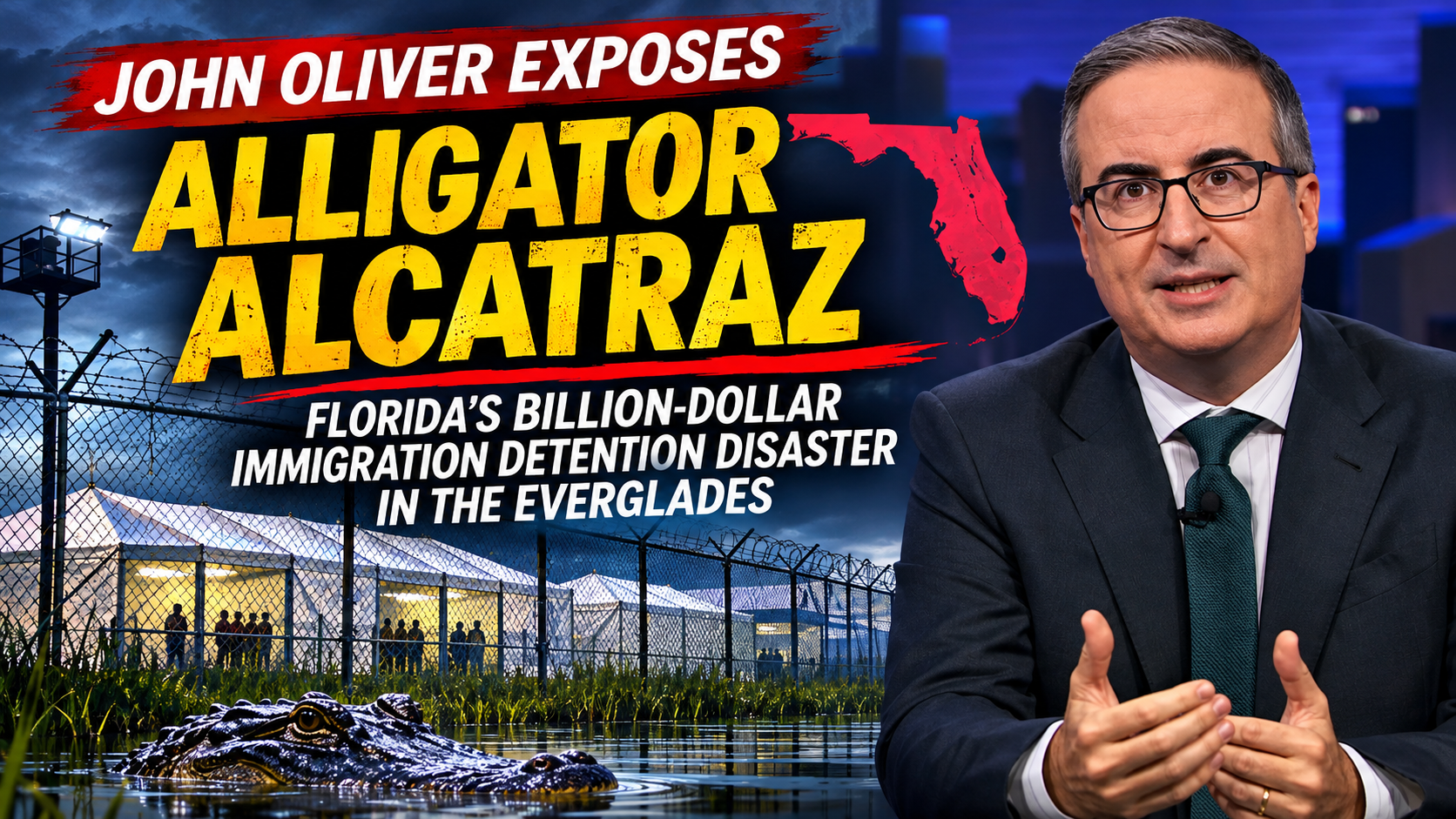
John Oliver Turns Florida’s Detention Disaster Into a National Political Reckoning
Oliver’s November 15 segment did more than revisit a controversial detention center. It examined how political spectacle can influence public policy, particularly when elected officials emphasize dramatic messaging over the practical consequences of their decisions. Alligator Alcatraz was marketed through a name designed to attract attention, a remote location presented as a security advantage, and political rhetoric portraying detainees as exceptionally dangerous, yet subsequent reporting raised questions about whether the people confined there matched those descriptions, whether the facility met appropriate detention standards, and whether its enormous costs could be justified.
The controversy also illustrates the difficulty of separating immigration enforcement from government accountability. Supporters of strict immigration policies may reasonably argue that authorities need sufficient detention capacity to enforce immigration law, but that position does not eliminate the obligation to provide humane conditions, follow applicable environmental requirements, maintain transparent contracting procedures, and spend public money responsibly. Those obligations are fundamental requirements of competent government regardless of which political party controls the White House or the governor’s office.
Florida’s experience also raises broader questions about the use of emergency powers to accelerate politically important projects. Emergency contracting can provide governments with necessary flexibility, but it can also weaken the safeguards intended to prevent waste, favoritism, and inadequate planning. When public officials use those powers to construct expensive facilities that operate for only a limited period, taxpayers have a legitimate interest in understanding who approved the spending, which contractors benefited, and whether the decisions were supported by credible financial and operational analysis.
The Everglades Camp Is Gone, but the Questions Remain
Alligator Alcatraz has closed, but its legacy continues through environmental litigation, federal oversight findings, financial questions, and the accounts of people who were detained there. The facility became a national symbol of the Trump administration’s immigration enforcement strategy and DeSantis’s willingness to pursue highly visible projects that generated substantial political attention, even as critics questioned their practicality and long-term consequences.
The controversy is ultimately about more than one detention center. It raises fundamental questions about emergency government powers, public contracting, the treatment of immigrants, environmental protection, and the ability of taxpayers to hold elected officials accountable for expensive decisions. Florida officials argued that the facility was a necessary response to immigration enforcement demands, while critics contend that it represented an extraordinarily costly experiment in political theater, constructed with insufficient oversight and operated under conditions that should never have been tolerated.
The physical detention camp may be gone, but the financial obligations, environmental questions, and demands for accountability remain. Until Florida and federal authorities provide a complete accounting of the project’s costs, reimbursement arrangements, contracting decisions, and operational failures, the public will be left with serious unanswered questions about one of the most controversial immigration enforcement projects in recent American history.
John Oliver’s investigation leaves Florida with a question that cannot be answered by simply dismantling the tents: How did a temporary detention camp in the Everglades become a billion-dollar government project, and who will ultimately be held accountable for what happened there?
Sources & Further Reading

Primary Reporting and Government Oversight
- Last Week Tonight With John Oliver — Alligator Alcatraz (HBO), November 2026
- U.S. Government Accountability Office — Official Reports and Immigration Detention Oversight
- U.S. Department of Homeland Security Office of Inspector General — Inspection Reports
- Associated Press — Florida and Immigration Detention Coverage
- WLRN Public Media — South Florida Immigration and Environmental Reporting
- WUSF — Florida Government and Environmental Coverage
- Earthjustice — Environmental Litigation and Conservation
South Florida Media — Related Coverage

















Loading comments…