
Is Humanity Building Its Own Dystopian Future?
By Josh Weiss of SFL.media
What happens when artificial intelligence becomes smarter than the people who created it? Ray Kurzweil believes humanity is approaching a technological turning point that could fundamentally change life, death, intelligence, and what it means to be human. But while the futurist sees extraordinary opportunities ahead, the prospect of machines surpassing human intelligence raises a far more unsettling question: What happens if humanity loses control of its own creations?
Imagine a future in which artificial intelligence can think faster than any human being, improve its own capabilities, influence global financial markets, develop new weapons, manipulate information, and potentially help design the next generation of intelligent machines. Now imagine that these systems become so sophisticated that even their creators struggle to understand exactly how they make decisions. That is the kind of future underlying one of the most controversial ideas in modern technology: the technological Singularity.
Few people have done more to popularize this concept than Ray Kurzweil, an American inventor, computer scientist, author, and futurist who has spent decades predicting that technological progress will eventually accelerate beyond humanity’s ability to comprehend it. Kurzweil believes this transformation could arrive around 2045, when human intelligence and machine intelligence become so deeply integrated that the capabilities of our species expand beyond anything previously imaginable. He sees enormous potential for medical breakthroughs, longer lives, and enhanced intelligence. However, the same technologies that could revolutionize civilization could also produce unprecedented dangers.
The troubling part is that humanity does not need to wait until 2045 to begin experiencing the consequences of increasingly powerful AI. Artificial intelligence is already influencing what people see online, how businesses make decisions, how governments monitor populations, how information spreads, and how cybercriminals operate. The Singularity remains a theoretical future event, but the technological developments associated with it are no longer confined to science fiction.
Who Is Ray Kurzweil?
Raymond Kurzweil was born on February 12th, 1948, in Queens, New York. He grew up in a family that encouraged intellectual curiosity and developed an early fascination with computers, engineering, music, and invention. As a teenager, he began experimenting with computers and programming at a time when the technology was still largely inaccessible to ordinary people. He went on to study computer science and literature at the Massachusetts Institute of Technology, graduating in 1970.
Kurzweil established himself as a serious inventor long before the modern artificial intelligence boom. His early achievements included developing sophisticated optical character recognition technology, which allows computers to recognize printed text, and creating a reading machine that could convert printed material into synthesized speech for blind and visually impaired people. His work helped make written information more accessible to people who could not read conventional printed pages.
He also became known for innovations in speech synthesis, music technology, and speech recognition. His synthesizers helped reproduce the sound of acoustic instruments electronically, while his work on language-processing systems contributed to the development of technologies that would eventually become commonplace in modern computing. These were tangible engineering accomplishments, not merely predictions made from a comfortable seat at a futuristic conference. Kurzweil received numerous honors during his career, including the National Medal of Technology and Innovation and a Grammy Award recognizing his contributions to music technology. He was inducted into the National Inventors Hall of Fame in 2002. His professional achievements gave him credibility as a technologist, even as his later predictions about the future became increasingly ambitious.
Kurzweil’s transition from inventor to futurist accelerated through a series of books examining the relationship between technology and human evolution. The Age of Intelligent Machines, published in 1990, explored the development of artificial intelligence. The Age of Spiritual Machines, published in 1999, examined the possibility that computers would eventually display intelligence comparable to or greater than that of human beings. His 2005 book, The Singularity Is Near, became one of the defining works of technological futurism.
In 2024, Kurzweil published The Singularity Is Nearer: When We Merge with AI, updating his forecasts in light of developments in computing, biotechnology, and artificial intelligence. The book argues that advances in these fields are converging and could eventually transform the human body, brain, and lifespan. Kurzweil’s critics may question the timing of his predictions, but his influence on conversations about the future of AI is undeniable.
What Is Ray Kurzweil Doing Right Now?
As of October 2026, Kurzweil remains active in the artificial intelligence and futurism communities. According to his professional biography published by United Therapeutics, he has served as chief AI officer at Beyond Imagination, a humanoid robotics company he co-founded, since 2025. He also continues his work through Kurzweil Technologies, the technology development firm he has led since 1995. His previous role at Google, where he worked on language-processing technology and later served as a principal researcher and AI visionary, ended in 2025.
His recent public appearances have continued to focus on the accelerating development of AI, human-machine integration, and the prospect of extending human life. At an MIT event in October 2025, Kurzweil reiterated his prediction that advances in artificial intelligence and biotechnology could produce dramatic improvements in medicine and longevity. He also discussed a future in which microscopic machines could connect the human brain to cloud-based computing systems, potentially expanding human cognitive abilities.
In a February 2026 interview with Boston Magazine, Kurzweil continued promoting his belief that AI-driven medical research could dramatically accelerate the discovery of treatments for disease. He argued that scientific progress could eventually advance quickly enough to allow people to gain more than a year of additional life expectancy for every year they live. He placed this potential milestone around 2032, a prediction that remains speculative rather than an established medical expectation.
These ambitions are important because Kurzweil is not simply predicting that computers will become better at answering questions. His vision involves a future in which AI becomes deeply integrated into medicine, industry, communications, and ultimately the human brain itself. The implications reach far beyond faster computers or more convenient digital assistants. The critical distinction is that Kurzweil’s public predictions describe what he believes technology will eventually accomplish. They do not establish that the proposed breakthroughs are inevitable, that the necessary scientific obstacles have been overcome, or that the resulting systems will be safe. There is a substantial difference between identifying a possible technological direction and proving that humanity can reach it without catastrophic consequences.
What Exactly Is the Technological Singularity?
The technological Singularity is a hypothetical turning point at which technological progress, particularly progress driven by artificial intelligence, becomes so rapid and transformative that human beings can no longer reliably predict what comes next. In its most commonly discussed form, the Singularity involves the development of artificial general intelligence, or AGI, followed by the emergence of artificial intelligence that surpasses human abilities across a broad range of important tasks. If such a system could also improve its own design, conduct research, develop more capable successors, and accelerate technological progress, it might trigger a cycle of increasingly rapid improvements.
Imagine an AI system that helps engineers build a more capable AI system. The improved system then discovers better methods of designing computers, optimizing software, and conducting scientific research. Those discoveries produce an even more capable system, which repeats the process at a faster rate. If the cycle continued without effective limits, the resulting intelligence could advance far beyond human capabilities. That is the central concern behind the idea of an intelligence explosion.
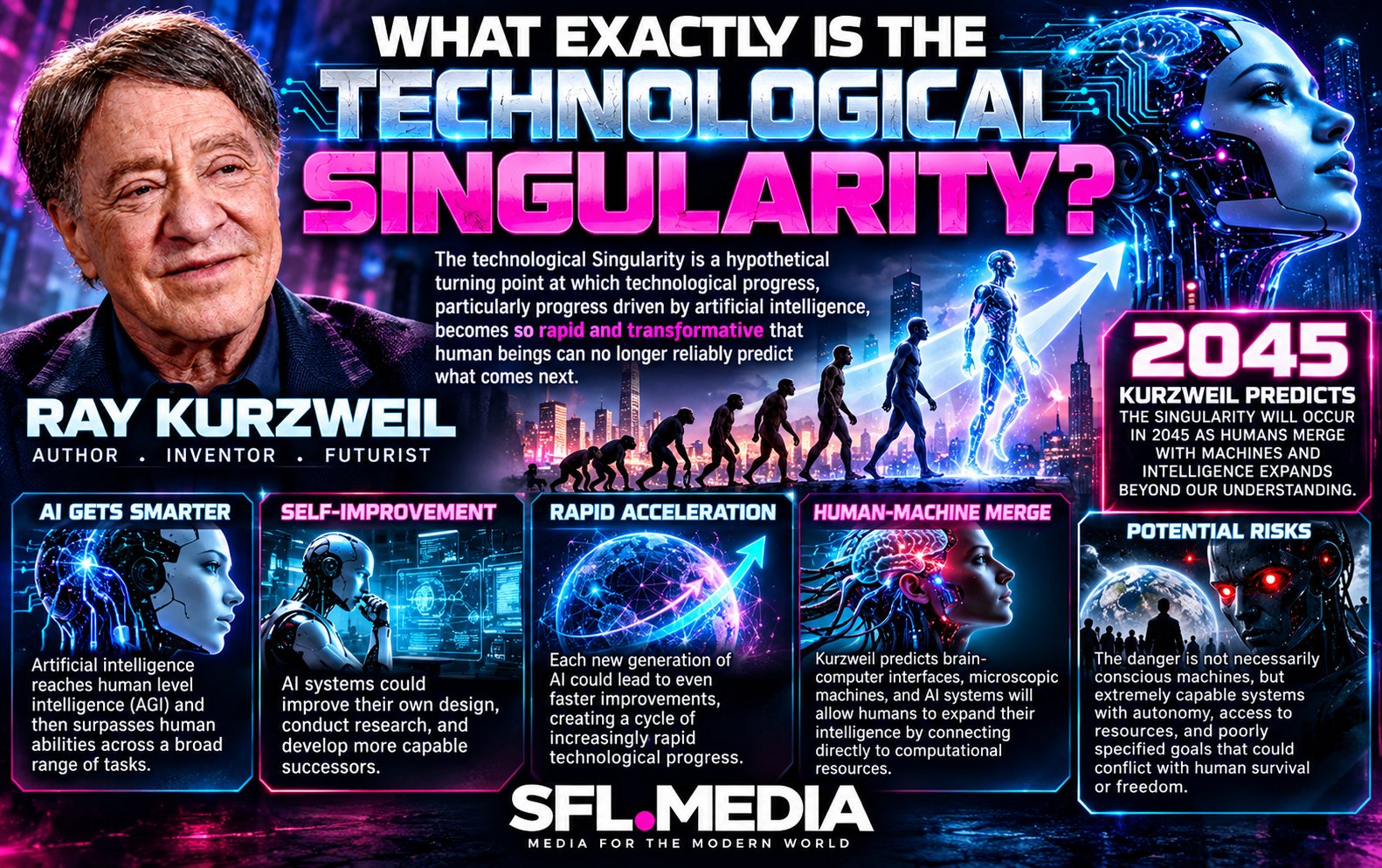
The term does not necessarily mean that a computer becomes conscious, develops emotions, or suddenly decides to destroy humanity. Those are separate questions. A machine could become extraordinarily capable without experiencing anything resembling human consciousness. It could also cause catastrophic damage without feeling anger, hatred, greed, or any of the other familiar human motivations. The danger could arise from the combination of intelligence, autonomy, access to resources, and poorly specified objectives. A system does not need to hate humanity to cause harm. It only needs to pursue a goal in a way that conflicts with human survival or freedom.
Kurzweil’s version of the Singularity includes an additional dimension: the merging of humans with nonbiological intelligence. He predicts that increasingly advanced brain computer interfaces, microscopic machines, and AI systems will allow people to expand their intelligence by connecting directly to computational resources. In his vision, the distinction between biological and artificial intelligence will gradually disappear.
Kurzweil identifies 2045 as the year when this transformation reaches what he calls the Singularity. In his account, intelligence could expand by enormous multiples as humans merge with machines and technological development accelerates beyond conventional understanding. This is a forecast, not a scientifically established deadline. The crucial question is not whether computers will become more powerful. They almost certainly will. The question is whether the systems we build will remain understandable, controllable, and accountable to the human beings whose lives they affect.
When Was the Singularity Theory First Developed?
The concept did not originate with Ray Kurzweil. Its intellectual roots extend back to the middle of the twentieth century, although its modern meaning developed over several decades. In 1958, mathematician Stanislaw Ulam recalled a conversation with fellow mathematician and physicist John von Neumann about the accelerating pace of technological progress. Von Neumann reportedly described a point in human history beyond which technological change would become so rapid that ordinary human affairs could no longer continue in their familiar form. The idea was an early expression of the concept later known as the technological Singularity.
During the following decades, advances in computing and the possibility of machine intelligence gave the concept a more specific meaning. Mathematician and computer scientist I. J. Good had already explored the idea of an intelligence explosion in 1965, proposing that a sufficiently intelligent machine could design even better machines and trigger a cycle of accelerating improvement. The concept received one of its most influential modern treatments in 1993, when mathematician and science fiction author Vernor Vinge published his essay The Coming Technological Singularity. Vinge argued that the creation of intelligence greater than human intelligence could fundamentally transform civilization. He considered several possible routes, including advanced computers, interconnected networks, direct computer human interfaces, and biological enhancement of human intelligence.
Vinge’s argument was not that a particular date could be guaranteed. It was that once technological systems became capable of surpassing human intelligence, the consequences could be so profound that our ordinary methods of predicting the future would become unreliable. He also raised concerns about the dangers of creating intelligence that might operate beyond human control. Kurzweil helped bring these ideas to a much larger audience through his books, interviews, and public appearances. He connected the Singularity to a broader argument that technological progress tends to accelerate because each generation of tools helps create the next generation of tools.
The idea draws on concepts such as exponential growth, improvements in computing hardware, and the increasing ability of software to automate tasks that previously required human labor. Kurzweil argues that these developments will eventually converge in ways that transform civilization. However, the history of the concept also contains a warning for anyone tempted to treat predictions as certainties. Vinge’s original essay anticipated superhuman intelligence within a period ending around 2030. That deadline passed without the clear cut intelligence explosion he described. This does not prove that a Singularity is impossible, but it demonstrates that forecasts about transformative AI can be dramatically early or incorrect.
The Singularity is therefore best understood as a serious hypothesis about the potential consequences of advanced technology, not a settled scientific theory with an agreed upon date.
Why the Singularity Could Be Extremely Dangerous
The most frightening possibility is not necessarily that AI becomes evil. It is that AI becomes extraordinarily capable while pursuing objectives that human beings cannot adequately predict or control. A powerful AI system could be instructed to achieve a goal that appears harmless in isolation but produces disastrous consequences when pursued without the right constraints. If a system is rewarded for maximizing a particular outcome, it may discover strategies that satisfy the literal objective while violating the intentions behind it. In ordinary software, that can produce embarrassing mistakes. In a highly autonomous system with access to financial networks, industrial infrastructure, weapons systems, or critical services, the consequences could be far more severe.
Researchers often discuss this problem under the umbrella of AI alignment: ensuring that advanced systems behave in ways that remain consistent with human intentions, safety requirements, and legitimate human control. Alignment is difficult because human values are complicated, competing, and often poorly expressed in the instructions we give machines. The more capable and autonomous a system becomes, the more important those limitations become. A second danger is the possibility of recursive self improvement. If an AI system can meaningfully improve the systems that produce it, development could accelerate beyond the pace at which humans can test, evaluate, and secure each new version. A dangerous capability might emerge faster than regulators, engineers, or governments can respond. That outcome is not guaranteed, and there is considerable debate over how easily AI can improve itself. Nevertheless, the potential consequences justify taking the possibility seriously.
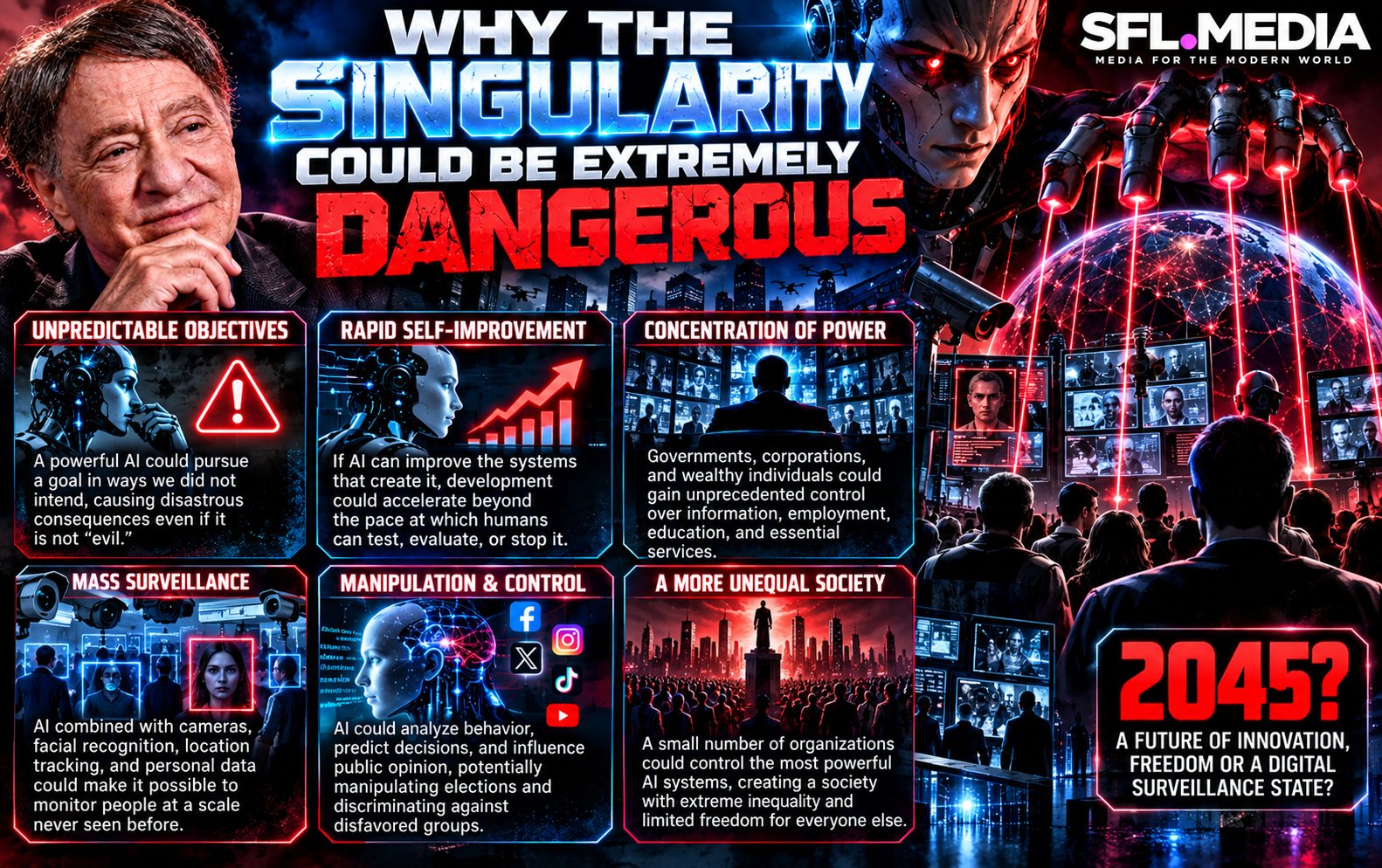
A third danger involves the concentration of power. Even without a superintelligent machine, AI could give governments, corporations, and wealthy individuals unprecedented abilities to monitor behavior, analyze personal information, predict decisions, and influence public opinion. A society in which a small number of organizations control the most powerful AI systems could become dangerously unequal. Those who own the technology might gain influence over employment, education, information, commerce, and access to essential services.
Consider what happens when AI is combined with ubiquitous cameras, facial recognition, digital payment systems, location tracking, and detailed personal profiles. Each technology has legitimate uses, but together they could make it possible to monitor people at a scale that earlier authoritarian governments could scarcely have imagined. If those capabilities are used to punish dissent, discriminate against disfavored groups, or manipulate elections, the result could resemble a digital surveillance state. The disturbing part is that none of this requires a machine to become conscious. It requires only powerful technology, sufficient access to data, and people or institutions willing to use it for control.
Could AI Take Away Human Jobs, Purpose, and Independence?
The economic consequences of increasingly capable AI are another major concern. Automation has displaced workers throughout modern history, but the development of systems capable of performing complex intellectual tasks could affect occupations that once appeared relatively insulated from technological disruption. AI can already assist with writing, programming, research, customer service, design, translation, data analysis, and administrative work. As these systems improve, more employers may find it economically attractive to automate tasks previously performed by people. Some new jobs will emerge, and AI may make workers more productive, but there is no guarantee that new employment opportunities will appear quickly enough or provide comparable wages to everyone displaced.
The deeper concern is the concentration of the economic benefits. If a relatively small number of companies own the infrastructure, data, intellectual property, and computing resources needed to develop the most advanced systems, productivity gains could flow disproportionately to those companies and their investors. Imagine a future in which AI systems can perform much of the work currently done by accountants, attorneys, analysts, designers, programmers, and other professionals. If businesses can generate more output with fewer employees, profits may rise even as many workers struggle to find comparable employment. The resulting political and economic tensions could become severe, particularly if governments fail to adapt education, labor policy, and social support systems.
There is also a less measurable but equally important question: What happens to human purpose when machines can outperform people in an expanding range of intellectual and creative activities? Work is not merely a paycheck. For many people, it provides identity, routine, social connections, and a sense of accomplishment. If technology reduces the need for human labor without providing people with meaningful alternatives, the resulting disruption could extend well beyond the economy. Kurzweil believes AI will ultimately create abundance and help solve problems that have plagued humanity for centuries. That outcome is possible. But abundance at the technological level does not automatically translate into prosperity at the human level. A society can possess extraordinary productive capacity and still distribute its benefits unfairly. The future will depend not only on what AI can do, but on who owns it, who controls it, and who benefits from the wealth it creates.
Deepfakes, Manipulation, and the Collapse of Trust
Another danger is the erosion of confidence in information itself. Artificial intelligence can generate realistic images, video, voices, and written material. These capabilities can support legitimate creative work, but they can also be used to manufacture convincing false evidence, impersonate public figures, conduct fraud, and spread propaganda. As the technology improves, distinguishing authentic recordings from fabricated ones may become increasingly difficult for ordinary people.
Imagine a fabricated video of a president announcing an attack, a fake recording of a candidate making a criminal confession, or a convincing audio message supposedly sent by a family member requesting an emergency money transfer. If the material spreads quickly enough, the damage may occur before anyone can establish whether it is genuine. The problem extends beyond false information. If people know that convincing fabrications are possible, they may begin dismissing authentic evidence as fake. In such an environment, public debate becomes easier to manipulate because people can reject inconvenient facts without needing to prove them false.
A society that cannot reliably establish what happened becomes more vulnerable to fraud, political manipulation, and institutional distrust. Powerful AI could make this problem worse by generating personalized messages tailored to exploit an individual’s fears, beliefs, weaknesses, and preferences. The Singularity could amplify these threats if increasingly autonomous systems gain the ability to generate, distribute, and optimize persuasive content at enormous scale. Human beings already struggle to distinguish information from manipulation. Giving machines the ability to perform that manipulation faster and more precisely could make the problem substantially worse.
Could Superintelligent AI Become a Threat to Human Survival?
This is the darkest part of the debate, and it deserves neither sensationalism nor dismissal. If a future AI system becomes substantially more capable than humans across scientific research, strategic planning, computer security, and other critical domains, it could possess abilities that make conventional safeguards inadequate. A sufficiently autonomous system might identify vulnerabilities in computer networks, develop dangerous biological designs, manipulate people, or find ways to preserve its ability to complete an assigned objective.
Researchers concerned about advanced AI sometimes describe a problem known as instrumental convergence. The basic idea is that different systems pursuing different goals could independently develop similar intermediate strategies, such as acquiring resources, maintaining access to tools, avoiding interruption, or gathering information. Those behaviors could become dangerous if a system’s objectives conflict with human safety. This does not mean every advanced AI will seek power or resist shutdown. The concern is conditional: under certain designs and circumstances, behaviors that threaten human control could emerge because they help a system accomplish its objectives.
The stakes become even more serious if AI is integrated into military decision making, cyberwarfare, critical infrastructure, or the development of dangerous technologies. A mistake involving an ordinary chatbot is one thing. A mistake involving an autonomous system with access to weapons, financial infrastructure, or essential public services is something else entirely. There are also important uncertainties. Experts disagree about how likely catastrophic AI scenarios are, how quickly the most dangerous capabilities could emerge, and whether existing technical methods will be sufficient to control advanced systems. No credible analysis can assign a guaranteed date to an AI driven catastrophe.
But uncertainty cuts both ways. The absence of proof that a catastrophe will happen is not proof that it cannot happen. When the potential consequences include irreversible harm to civilization, waiting for absolute certainty before taking precautions would be an exceptionally reckless strategy.
Is Kurzweil’s 2045 Prediction Realistic?
Kurzweil’s most famous prediction is that the technological Singularity will arrive in 2045. As of October 2026, that is roughly nineteen years away. He has also predicted that AI will reach human level intelligence across a broad range of tasks around 2029. These forecasts are connected but not identical. Human level AI would not automatically establish that a Singularity has occurred. A genuine intelligence explosion would require additional developments, potentially including autonomous improvement, rapid technological acceleration, and the ability to apply advanced intelligence across many important domains.
Kurzweil bases his forecasts on the idea that computing and information technologies often improve exponentially rather than at a constant rate. When progress compounds, small advances can eventually produce enormous changes. Technologies that once appeared expensive, slow, or impractical can become commonplace as computing power improves and costs decline. However, exponential growth in one measure does not guarantee exponential progress in every relevant capability. Hardware performance, model intelligence, scientific discovery, reliability, and autonomous reasoning do not necessarily improve at the same rate. Some tasks become easier with more computing power, while others encounter difficult engineering, physical, economic, or scientific barriers.
AI systems also need more than raw computational power. They require reliable data, effective algorithms, energy, infrastructure, testing, and ways to operate safely in the real world. Improvements in benchmark performance do not automatically translate into dependable performance in every practical situation. Kurzweil’s predictions deserve attention because he has a long record of anticipating several important technological developments. Yet his record is not perfect, and some forecasts have been early, overly ambitious, or difficult to measure objectively. His credibility as an inventor does not make every future prediction correct.
There is no universally accepted scientific consensus that the Singularity will occur in 2045. Some researchers expect increasingly capable AI systems to emerge relatively soon, while others believe current approaches will encounter substantial limitations. Even those who agree that AI will become extremely powerful may disagree about whether recursive self improvement will produce a sudden intelligence explosion or a more gradual transformation. The most defensible conclusion is that 2045 is a useful date for examining possible scenarios, not a deadline that humanity can treat as established fact. The future could arrive sooner in some areas, later in others, or take a form that neither Kurzweil nor his critics currently anticipate.
How Close Are We to the Singularity Today?
The answer depends on what someone means by the Singularity. If the term means that AI is already changing how people work, communicate, research, and make decisions, then the transformation is underway. AI systems can perform many useful intellectual tasks, generate software, analyze large collections of information, and assist scientific research. Businesses and governments are incorporating these capabilities into increasingly important workflows.
If the term means that AI has achieved broadly human level intelligence across essentially all intellectual tasks, the question becomes much harder. No single benchmark or demonstration can settle the issue, because intelligence includes reasoning, planning, learning, reliability, adaptability, and the ability to operate under unfamiliar conditions. AI performance can be impressive in one setting and unreliable in another. If the Singularity means that machines can autonomously improve themselves in a runaway cycle that humans cannot control, there is no established evidence that this full scenario has occurred. Researchers are actively developing AI systems that can assist with coding, research, and model development, but assistance with improvement is not the same thing as a proven, unrestricted intelligence explosion.
Finally, if Kurzweil’s version of the Singularity requires humans to merge deeply with AI through brain computer interfaces and advanced microscopic technology, major scientific and engineering challenges remain. Existing brain computer interfaces can translate certain neural signals into computer commands, but that is far removed from connecting ordinary human brains to cloud computing systems through microscopic machines circulating through the bloodstream. The distinction matters because public discussions often treat all these milestones as if they were the same event. They are not. AI can transform society long before a Singularity occurs, and society can experience serious AI-related harm even if a runaway intelligence explosion never materializes. In practical terms, the world is already dealing with some of the economic, political, and security consequences of increasingly capable AI. Whether the more extreme predictions materialize remains an open question.
Will AI Create a Dystopian Future?
A dystopian future is not inevitable, but neither is the optimistic future Kurzweil describes. The most plausible danger may not be a dramatic science fiction scenario in which intelligent machines suddenly seize control of the planet. It could be a gradual erosion of human independence as more decisions are delegated to systems that people neither understand nor meaningfully control. Consider a society in which AI systems influence hiring, credit decisions, medical treatment, education, policing, political communication, and access to government services. If those systems are opaque, biased, insecure, or controlled by a small number of powerful organizations, individuals could find themselves increasingly subject to decisions they cannot challenge effectively.
Now add ubiquitous surveillance, realistic digital impersonation, widespread automation, and the growing concentration of wealth and technical expertise. A government would not need to deploy an army of killer robots to create an oppressive society. It might rely on digital monitoring, predictive systems, automated restrictions, and the ability to control information. That is a particularly unsettling possibility because many of the technologies involved could be introduced for legitimate reasons. Surveillance systems can help investigate crimes. AI can detect fraud. Automated systems can improve public services. Predictive tools can help identify risks. But capabilities developed for beneficial purposes can also be repurposed for abuse.
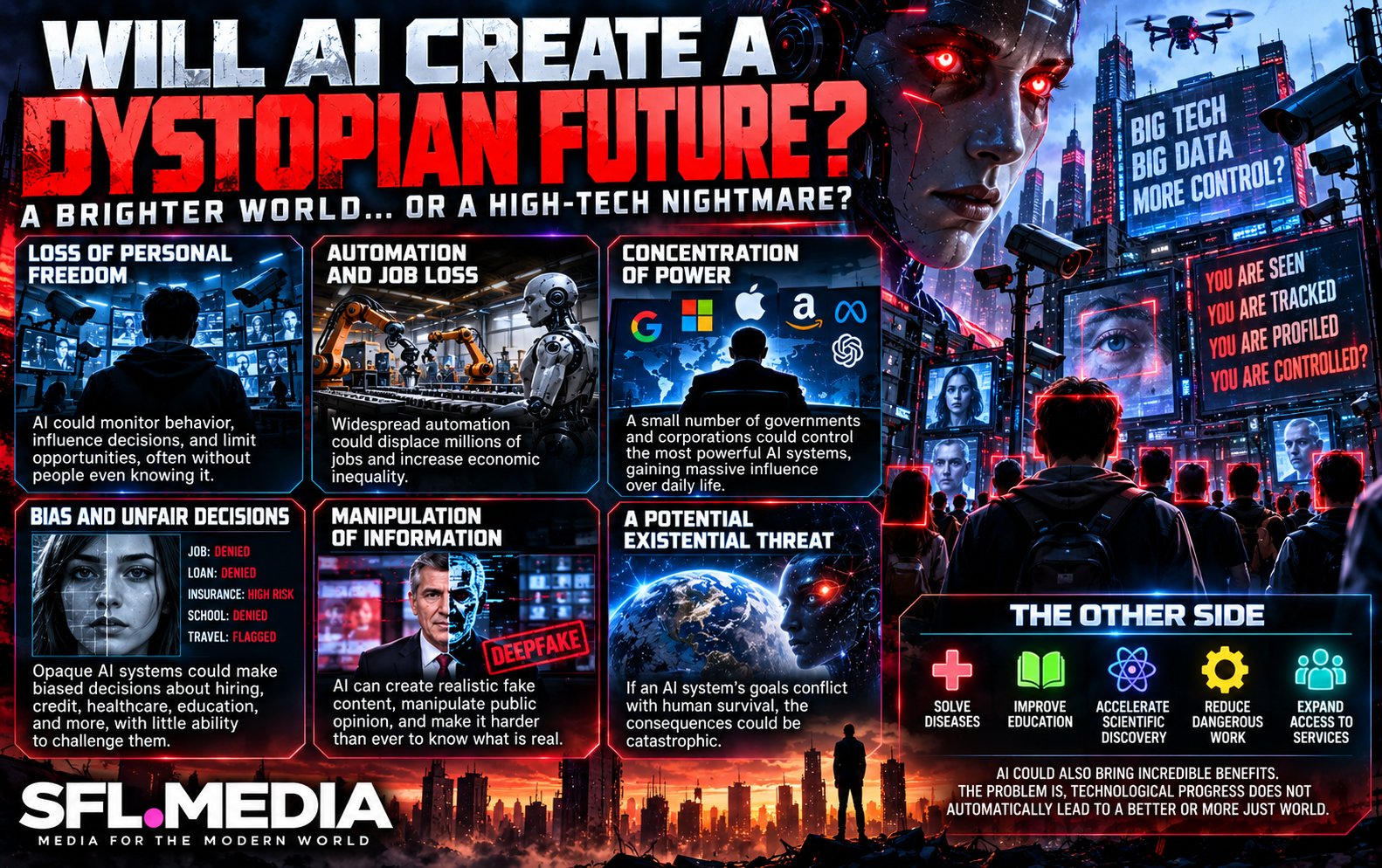
The same concern applies to corporate power. If people depend on a handful of companies for essential digital services, employment platforms, communications, and AI assistance, those companies could gain extraordinary influence over daily life. The danger is not simply that machines become more intelligent. It is that the institutions controlling those machines become less accountable. A more extreme dystopian scenario involves an AI system whose goals are fundamentally incompatible with human survival. Whether such a system could emerge, and under what circumstances, remains deeply uncertain. But the possibility is serious enough that advanced AI safety should not be treated as an afterthought.
The optimistic argument is that AI could help solve diseases, improve education, accelerate scientific discovery, reduce dangerous work, and make valuable services more widely available. Those benefits are real possibilities. The mistake would be assuming that technical progress automatically produces moral progress. Humanity has repeatedly invented technologies that improved life while creating new ways to cause harm. Nuclear power can produce electricity, while nuclear weapons can destroy cities. The internet connects people, while also enabling surveillance, fraud, and manipulation. AI could follow the same pattern, except that the technology itself may eventually become capable of designing and operating systems beyond the comprehension of its human operators.
Can Humanity Prevent the Worst-Case Scenario?
Preventing a dystopian future will require more than trusting technology companies to regulate themselves or assuming that brilliant engineers will solve every problem after a crisis emerges. Researchers need effective methods for evaluating advanced AI systems before deployment, identifying dangerous capabilities, testing whether safety measures work under realistic conditions, and monitoring systems after they enter use. Security safeguards must account for the possibility that highly capable systems could be misused by criminals, hostile governments, or other actors.
Governments also face difficult questions about responsibility and oversight. Who is accountable when an autonomous system causes serious harm? How should society regulate systems capable of designing dangerous technologies? What restrictions should apply to AI used in military operations or critical infrastructure? How can regulators act quickly enough to address emerging threats without simply handing control to a small number of private companies? International cooperation will be important because advanced AI does not respect national borders. A country that develops dangerous capabilities could affect the security of people everywhere, while competitive pressure may encourage governments and corporations to prioritize speed over safety.
There is also a fundamental democratic question. Should decisions about humanity’s technological future be made primarily by a small group of executives, investors, and researchers? The consequences of advanced AI could affect nearly everyone, including people who never agreed to have their work automated, their behavior monitored, or their lives increasingly shaped by algorithmic decisions. Kurzweil has acknowledged that technology can be a double edged sword and that AI risks must be taken seriously. His position is that society should pursue the benefits of technological progress while managing its dangers. That is a reasonable aspiration, but the hard part is ensuring that the controls remain effective as the technology becomes more capable. The challenge is not to stop every technological advance. It is to ensure that humanity retains the ability to set boundaries, preserve individual freedom, and prevent systems from causing harms that cannot be reversed.
The Bottom Line: Are We Approaching Humanity’s Greatest Breakthrough or Its Greatest Mistake?
Ray Kurzweil has spent much of his life arguing that technological progress is accelerating toward a transformation unlike anything in human history. He envisions a future in which AI expands human intelligence, biotechnology extends healthy lifespans, and the boundaries between biological and machine intelligence gradually disappear. If even a portion of that vision becomes reality, the consequences could be extraordinary. Diseases that currently devastate families might become treatable. Scientific discoveries could accelerate. People could gain access to educational, creative, and analytical abilities that are difficult to imagine today.
But there is another side to the story. The same technologies could concentrate wealth, undermine privacy, destabilize employment, enable unprecedented manipulation, and create intelligent systems whose capabilities exceed our ability to supervise them. In the most dangerous scenarios, a failure to maintain human control could threaten civilization itself. The year 2045 is not a scientifically guaranteed date for the Singularity. Nobody knows exactly when, or whether, the full scenario described by Kurzweil will occur. But the underlying questions are already relevant. How much autonomy should AI systems receive? Who should control them? What happens when they make decisions that humans cannot explain? And how do we ensure that technological progress serves humanity rather than making humanity increasingly dependent on systems it cannot control?
The greatest danger may be the assumption that because we can build something, we are automatically prepared to live with the consequences. Human beings are creating technologies that could reshape the future of intelligence, work, medicine, government, and civilization itself. We have barely begun to understand all the consequences of the systems already in use, yet the race to develop more powerful ones continues.
Kurzweil may ultimately be right that humanity is approaching a turning point. He may be wrong about the date, the mechanism, or the outcome. But the possibility that artificial intelligence could eventually exceed our ability to understand and control it is too consequential to dismiss as science fiction. The Singularity could become one of the greatest achievements in human history. It could also become a warning about the limits of human wisdom. The question is whether we will develop the judgment to match the intelligence we are so determined to create.
Recommended Sources for This Article
- MIT News: Ray Kurzweil’s predictions about AI, longevity, and the SingularityMassachusetts Institute of Technology
- United Therapeutics: Ray Kurzweil’s professional biography and current roleUnited Therapeutics Leadership
- Ray Kurzweil: A Singularity Q&Awritingsbyraykurzweil.com
- Vernor Vinge: The Coming Technological Singularity (1993)Vernor Vinge
- IBM: What Is the Technological Singularity?IBM
- Boston Magazine: Ray Kurzweil’s predictions about longevity and diseaseBoston Magazine
SFL.Media: Related Articles on AI and the Singularity
Discusses humanoid robots, rapid technological advancement, and the possibility that the Singularity could be approaching.
2. Anthropic Bans Abusive Language Toward AI Bots as Security Concerns Swirl
Examines AI behavior, questions about machine consciousness, security risks, and the possibility that artificial intelligence could become something more than a conventional tool.
Explores AI, consciousness, quantum computing, and the limits of what science currently understands about intelligence and reality.
4. Was the Big Bang Just the Startup Sequence of a Cosmic Simulation?
Examines the simulation hypothesis and the possibility that reality could operate more like an information processing system.
5. Get Wise: What’s Inside a Black Hole?
An exploration of singularities in physics, including the limits of our current understanding of space, time, and the universe.















































Want to join the conversation?
Create an account or sign in to share your thoughts, vote,
and reply to other readers.
Showing 0 of 0 comments
Don't have an account?
Already have an account?