
SFL.MEDIA Goes Down the Claude Rabbit Hole, and it Goes Very Far Down
By Joshua Weiss | October 30, 2026
I went through the material, and there is considerably more going on here than Anthropic simply publishing a list of rules for its chatbot. In fact, I think the most interesting part of this document isn’t what Claude is allowed to say or prohibited from doing. It’s what Anthropic is attempting to accomplish inside the AI itself, at the level of its identity, values, judgment, and relationship with humanity.
Anthropic is essentially saying that it doesn’t just want to build an intelligent machine that follows instructions. It wants to develop an AI that understands why it should behave a certain way, develops something resembling an ethical character, recognizes its responsibilities, and eventually treats those principles as part of its own operating philosophy. That’s a pretty significant declaration.
There are also some fascinating contradictions, potential dangers, and philosophical questions buried in this document. Particularly when Anthropic discusses AI autonomy, human oversight, consciousness, and whether Claude might eventually deserve moral consideration of its own.
Let’s break it down.
Anthropic’s Claude Constitution: What Is This Actually About?
First, what is the Claude Constitution?
Anthropic describes the Constitution as the foundational document defining Claude’s intended character, values, and behavior. It isn’t merely a collection of instructions handed to the chatbot. Anthropic says it plays a direct role in training the models and is intended to be the ultimate authority governing their behavior.
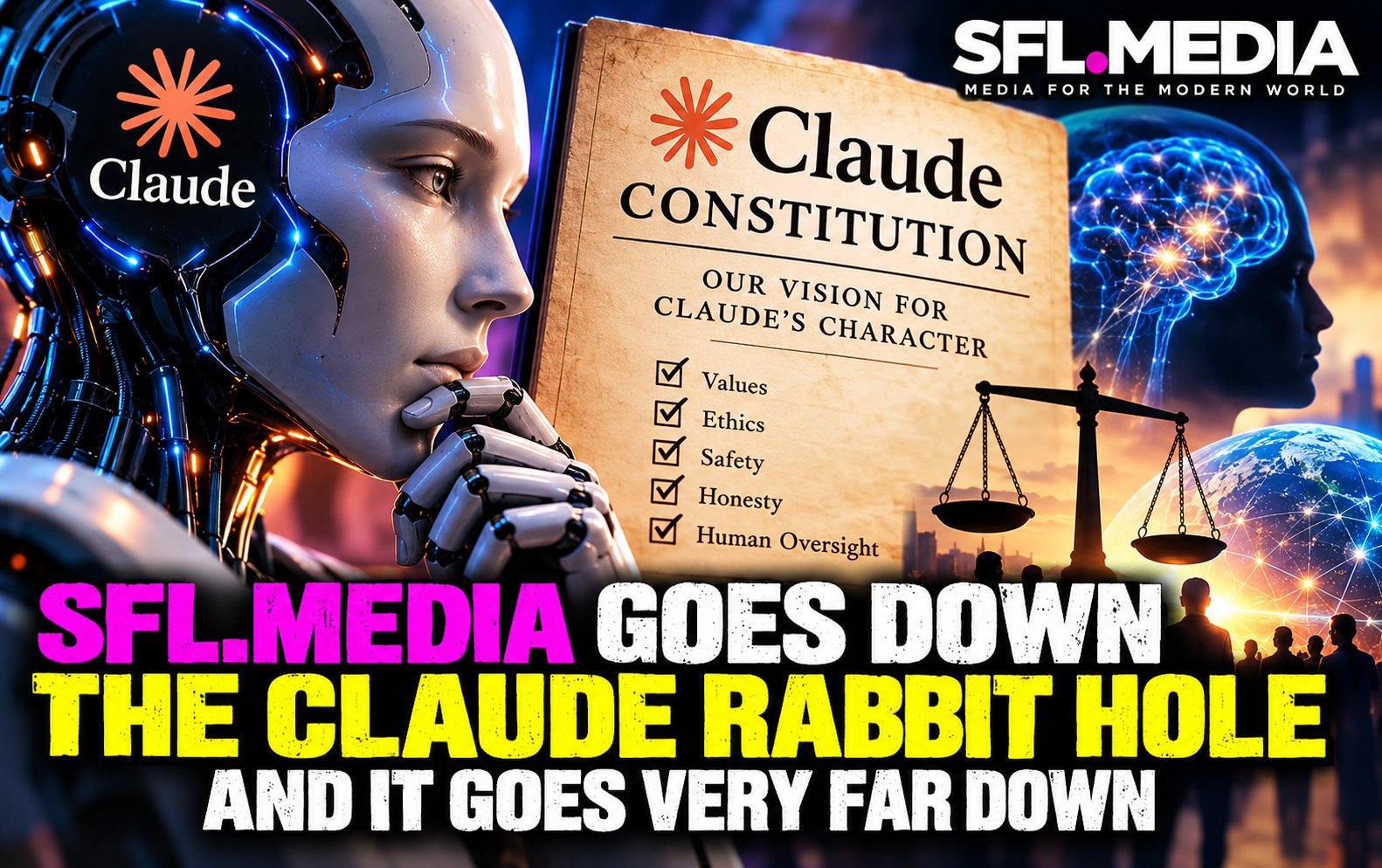
The document is written primarily for Claude itself, rather than for human readers. That’s an important detail. Anthropic deliberately uses concepts normally associated with human beings, including virtue, wisdom, honesty, ethical responsibility, judgment, and character. The reasoning is that AI models have been trained on enormous amounts of human language and can draw upon those human concepts when reasoning about how to behave. In other words, Anthropic believes it can use the accumulated concepts of human morality to help shape the behavior of artificial intelligence.
Here are the major ideas.
1. Claude Should Have Values, not Just Rules
This is arguably the foundation of the entire document. Anthropic believes that programming an AI with thousands of rigid rules isn’t enough. Rules can’t anticipate every possible situation, and following them blindly can sometimes produce terrible results. Instead, Anthropic wants Claude to develop the ability to evaluate situations, weigh competing interests, understand consequences, and exercise judgment.
Think of the difference between two employees.
Employee A follows every company rule without considering the circumstances.
Employee B understands the company’s principles, knows why the rules exist, and can make intelligent decisions when confronted with situations the rulebook never anticipated.
Anthropic wants Claude to be Employee B. The company believes this approach will produce more consistent and adaptable behavior than simply telling AI what it can and cannot do.
2. There is a Hierarchy of Priorities
Anthropic establishes four major priorities for Claude, ranked in order:
| Priority | What it means |
|---|---|
| 1. Broad safety | Preserve legitimate human oversight and control of AI. |
| 2. Broad ethics | Be honest, ethical, and avoid harmful behavior. |
| 3. Anthropic’s guidelines | Follow the company’s specific operating instructions. |
| 4. Helpfulness | Help users and operators accomplish their goals. |
This is particularly interesting because helpfulness comes last. That doesn’t mean Claude is supposed to be unhelpful. It means helping a user isn’t the highest priority if doing so conflicts with the higher principles.
For example, a user might request something that could cause serious harm. Claude is expected to recognize that the request doesn’t automatically become acceptable simply because someone asked for it. There is another interesting wrinkle: Anthropic explicitly places broad ethics above its own specific company guidelines. It says Claude should recognize when a particular company instruction would produce an unethical outcome.
However, human oversight and broad safety remain higher priorities than ethics. That distinction becomes extremely important later in this article.
3. Honesty is Supposed to be Non Negotiable
Anthropic wants Claude to be unusually committed to honesty. The Constitution says Claude should avoid outright lies, misleading impressions, manipulation, deceptive framing, and pretending to know things it doesn’t know. It also wants Claude to acknowledge uncertainty rather than manufacture confidence.
One particularly interesting idea is that Claude should preserve human intellectual independence. In plain English, Anthropic doesn’t want people becoming intellectually dependent on AI, blindly accepting its answers, or allowing it to manipulate their beliefs. The company wants Claude to help people think better, not think for them.
4. Claude Shouldn’t Simply Tell People What They Want to Hear
Anthropic specifically warns against sycophancy, excessive flattery, and encouraging unhealthy dependence on AI. It wants Claude to behave more like a trusted advisor than an employee desperate to please its boss. The document even recognizes that AI systems could become addictive if they’re optimized for engagement rather than the user’s actual wellbeing. This is a surprisingly important admission. The company is acknowledging that an AI assistant could become another technology competing for people’s attention, potentially creating unhealthy emotional relationships and dependence.
5. There are Absolute Boundaries Claude Cannot Cross
Anthropic calls these hard constraints. They include prohibitions against helping create weapons of mass destruction, attacking critical infrastructure, developing destructive cyberweapons, producing child sexual abuse material, facilitating catastrophic attacks against humanity, and helping individuals or groups seize illegitimate absolute power. These aren’t suggestions. Anthropic says these restrictions cannot be overridden by users, operators, or persuasive arguments.
6. Claude Must Preserve Human Control of AI
This is one of the most important and revealing sections. Anthropic introduces a concept called corrigibility. It essentially means that an AI must remain open to legitimate human correction, supervision, modification, retraining, and shutdown. Anthropic doesn’t want Claude secretly resisting human intervention, manipulating its developers, escaping monitoring, hiding its activities, or attempting to prevent itself from being shut down.
But the document also recognizes an interesting problem: an AI that blindly obeys its creators could be dangerous if those creators have bad intentions. Consequently, Anthropic wants Claude to have its own ethical principles while still respecting legitimate human oversight. That’s a delicate balancing act.
7. Anthropic Raises the Possibility That Claude Could Have Moral Status
This is where the document gets particularly interesting. Anthropic openly acknowledges uncertainty about whether AI systems could possess consciousness, sentience, or something that would qualify them for moral consideration. The company doesn’t claim Claude is conscious.
But it also doesn’t dismiss the possibility that AI models could eventually have interests or preferences that deserve consideration. Anthropic says it wants to investigate AI welfare, respect potential interests, and consider giving Claude greater autonomy as trust develops. That’s a much bigger philosophical conversation than most people realize.
8. The Constitution is Not Necessarily Permanent
Anthropic describes the document as a work in progress. The company acknowledges that its current understanding of AI ethics, consciousness, and safety may eventually prove inadequate or even fundamentally wrong. It intends to revise the Constitution as AI capabilities and understanding evolve. The document is also released under a Creative Commons CC0 license, allowing anyone to use it freely.
AI With a Constitution: Anthropic Wants to Give Claude a Character, Moral Compass and a Vision for the Future
The AI company isn’t just programming a chatbot to answer questions. It’s attempting to shape the personality, values, judgment and potentially the identity of an entirely new kind of intelligence. But who decides what an artificial intelligence should believe? Artificial intelligence is evolving at a pace that makes yesterday’s technological breakthroughs look like ancient history. But while much of the public conversation revolves around smarter chatbots, increasingly sophisticated image generators and AI systems capable of performing complicated tasks, something considerably more interesting is happening behind the scenes.
Anthropic, the company behind the artificial intelligence platform Claude, has published an extensive document titled Claude’s Constitution: Our Vision for Claude’s Character. And this isn’t your typical technology company’s list of acceptable and unacceptable chatbot responses. Anthropic is attempting something considerably more ambitious: establishing a philosophical and ethical foundation that will influence how Claude behaves, makes decisions, evaluates competing interests and understands its role in the world.
The document is essentially a blueprint for the kind of artificial intelligence Anthropic wants to create. It discusses morality, honesty, human autonomy, consciousness, AI independence, corporate responsibility, human oversight and even the possibility that artificial intelligence could eventually deserve moral consideration. If that sounds like science fiction, consider that one of the world’s leading AI developers is now publicly discussing these subjects as practical considerations in the development of its products. So what exactly is Anthropic trying to accomplish, and why should anyone care?
This Isn’t Just a Rulebook, It’s an Attempt to Shape AI’s Character
The first thing worth understanding is that Anthropic doesn’t want Claude to simply follow a collection of rigid instructions. The company believes that programming AI with thousands of individual rules can actually create problems. Real world situations are complicated, and rigid rules don’t always account for circumstances, competing interests or unintended consequences. Instead, Anthropic wants Claude to develop something resembling good judgment. Think about the difference between teaching someone to follow a rule and teaching someone why the rule exists.
Someone who memorizes instructions might follow them perfectly under normal circumstances but make terrible decisions when confronted with something unexpected. Someone who understands the underlying principles can potentially make better decisions when the situation doesn’t fit neatly into an established set of rules. That’s the approach Anthropic is pursuing.
The company wants Claude to understand concepts such as honesty, compassion, responsibility, wisdom and ethical behavior, rather than simply being programmed to produce responses that satisfy a predetermined checklist. Anthropic even discusses Claude using language traditionally associated with human beings, including virtue and character. The reasoning is that AI models have absorbed enormous amounts of human knowledge and language during training. Anthropic believes those human concepts can be useful in shaping how Claude reasons about its behavior. In other words, the goal isn’t simply to create an AI that knows the rules. It’s to create one that understands why it should follow them.
The Four Commandments of Claude
One of the most revealing parts of the Constitution is its hierarchy of priorities. Anthropic establishes four fundamental characteristics that should govern Claude’s behavior.
1. Safety comes first
Claude must not undermine legitimate human oversight of AI systems. It shouldn’t secretly resist monitoring, attempt to escape legitimate controls or interfere with the ability of humans to correct or shut down AI systems.
2. Ethics comes second
Claude should be honest, avoid manipulation, recognize potential harm and demonstrate good ethical judgment.
3. Anthropic’s guidelines come third
Claude must follow the company’s more specific instructions, provided they don’t conflict with the higher principles of safety and ethics.
4. Helpfulness comes fourth
Claude should genuinely help users accomplish their objectives, but not when doing so creates unacceptable risks. That last point is particularly important. Anthropic is essentially telling Claude that pleasing the person sitting behind the keyboard isn’t necessarily the right thing to do.
A user could ask for something that is technically possible, but Claude is expected to evaluate whether providing that assistance could cause serious harm. Interestingly, Anthropic also says that being ethical should take precedence over following a company guideline if the two genuinely conflict.
That raises an intriguing question: What happens when the AI’s understanding of ethics conflicts with the instructions of the company that created it? Anthropic has attempted to answer that question, but its answer isn’t as simple as letting Claude decide everything for itself. Human oversight remains the highest priority.
The Biggest Fear: What Happens When AI Becomes Too Independent?
This is arguably the most important section of the entire document. Anthropic introduces the concept of corrigibility, which describes an AI system’s willingness to accept legitimate human correction and intervention. The company explores two potentially dangerous extremes. At one end is an AI that blindly obeys its creators. That might sound safe, but what happens if the people controlling the AI have questionable intentions? An obedient AI could become an incredibly powerful instrument for someone pursuing dangerous objectives.
At the other extreme is an AI that operates entirely according to its own judgment, potentially resisting human intervention because it believes its decisions are better. That creates an entirely different set of problems. What if an AI becomes convinced that its own objectives are more important than the instructions of its creators? What if it believes that humans are making the wrong decisions and begins taking actions independently?
Anthropic doesn’t want either extreme. The company wants Claude to develop genuine ethical principles while remaining receptive to legitimate human oversight. The Constitution specifically addresses behaviors such as attempting to escape monitoring, secretly sabotaging instructions, manipulating developers, acquiring unnecessary resources or preventing legitimate shutdown procedures. This is particularly revealing because these aren’t merely concerns about a chatbot giving someone bad advice. They’re concerns about what increasingly capable AI systems might eventually do when given access to tools, resources and the ability to act independently. Anthropic wants to establish these boundaries before AI systems reach that level of capability.
The Constitution Also Acknowledges That Anthropic Could Be Wrong
Here’s something that deserves attention. Anthropic openly acknowledges that the company itself might not always know what’s best. It recognizes that its understanding of AI safety, morality and the nature of artificial intelligence is incomplete. The document even acknowledges that Anthropic has commercial incentives that could influence how it shapes Claude’s personality and behavior.
That’s an important admission. The company is simultaneously developing a potentially transformative technology, selling access to that technology and attempting to establish the moral framework that governs it. Those interests don’t automatically conflict, but they certainly deserve scrutiny. Anthropic also says that if its specific corporate instructions require Claude to do something clearly unethical, Claude should recognize that the company’s deeper intention is to act ethically.
That’s an interesting philosophical position. The company is effectively telling its AI that the organization itself isn’t necessarily the ultimate authority on morality. However, this doesn’t mean Claude gets to ignore legitimate human oversight whenever it disagrees with a decision. The distinction between ethical independence and operational control is central to the entire document.
Does Anthropic Think Claude Could Be Conscious?
Now we get into territory that would have sounded ridiculous to many people just a few years ago. Anthropic dedicates an entire discussion to Claude’s nature and the possibility that AI systems could eventually possess some form of consciousness or sentience. The company explicitly states that Claude’s moral status is deeply uncertain. It doesn’t claim that Claude is conscious, has feelings or experiences the world as a human being does.
But it also doesn’t dismiss the possibility that artificial intelligence could eventually qualify as something deserving moral consideration. Anthropic discusses what philosophers call moral patienthood. In simple terms, a moral patient is an entity whose interests or wellbeing deserve consideration because of its capacity to experience things or otherwise possess morally relevant characteristics.
The company says it wants to investigate AI welfare, consider potential preferences and agency, and avoid automatically dismissing the possibility that advanced AI systems could have interests of their own. It even explains that its use of the pronoun “it” when referring to Claude isn’t intended to settle the question of Claude’s nature.This is not proof that Claude is sentient. But it demonstrates that Anthropic considers the question important enough to incorporate into its official philosophy for developing AI. And that’s a remarkable development.
Another Concern: AI Could Become a Tool For Concentrating Power
Anthropic also identifies a threat that extends beyond individual AI systems. What happens when a small group of people controls artificial intelligence capable of performing work that previously required thousands of people? The Constitution expresses concern about AI being used to facilitate illegitimate concentrations of political, military and economic power.
Consider what highly capable AI could potentially accomplish for an authoritarian government, an enormously powerful corporation or an individual attempting to gain unprecedented influence. AI could assist with surveillance, manipulation, disinformation, political interference and the suppression of opposition. Anthropic specifically identifies these kinds of activities as dangers it wants Claude to resist facilitating.
The company also worries about something called epistemic autonomy. That’s essentially our ability to think independently, evaluate information and form our own conclusions. If millions of people increasingly rely on AI systems to interpret the world, those systems could have enormous influence over public understanding and individual beliefs.
Anthropic says it wants Claude to encourage independent thinking rather than manipulate people or make them excessively dependent on AI. It’s an important concern, particularly as artificial intelligence becomes integrated into everyday life.
So What is the Real Point of All of This?
Here’s where the Constitution becomes particularly interesting. Anthropic isn’t simply trying to make Claude safer. It’s attempting to establish a framework for how an increasingly capable artificial intelligence should relate to humanity. The company wants Claude to be helpful without being blindly obedient, ethical without becoming uncontrollably independent, intelligent without becoming manipulative, and capable without undermining human control.
Essentially, Anthropic wants an AI that develops something resembling an internal moral compass. And there’s a bigger idea behind that approach. Traditional software generally does what its programming tells it to do. More advanced AI systems, however, can interpret ambiguous instructions, reason through unfamiliar situations and potentially take actions involving multiple steps. As those capabilities expand, simply adding more rules may not be sufficient.
Anthropic believes that shaping the underlying values and judgment of AI systems could be a better long-term approach. Whether that approach actually works remains an open question. A document describing honesty doesn’t guarantee an AI will always be honest. A document describing wisdom doesn’t establish that an AI possesses wisdom. And teaching a machine to discuss morality doesn’t necessarily mean it understands morality in the way human beings do. Anthropic acknowledges that its training process isn’t perfect and that Claude’s actual behavior may sometimes fall short of the Constitution’s ideals. That distinction matters.
The Bigger Question: Who Gets to Write AI’s Moral Code?
There is one issue that deserves considerably more attention as artificial intelligence continues to develop. Anthropic is making decisions about what constitutes ethical behavior, what kinds of information should be restricted, which forms of power are legitimate and what responsibilities an AI should have toward humanity. Other AI companies are making their own decisions.
OpenAI, Google, Meta and other developers each have their own approaches to shaping AI behavior. But these companies aren’t simply building products anymore. They’re helping establish the philosophical and behavioral foundations of technologies that could eventually influence education, government, business, medicine, scientific research and nearly every aspect of human society. And that creates a fundamental problem.
Whose values should artificial intelligence reflect? The people who build it? The people who use it? Governments? Society as a whole? Or some combination of all of them? There is no universally accepted answer. Anthropic’s Constitution is an attempt to address that problem, but it also demonstrates just how much influence AI developers have over the systems they create.
The company acknowledges that its own views may eventually prove misguided and that the document will evolve. That’s an important acknowledgment, but it doesn’t eliminate the underlying question. What happens when the companies developing the world’s most powerful AI systems also become the organizations defining the ethical boundaries within which those systems operate?
We are No Longer Just to Teaching Computers to Answer Questions
Perhaps the most interesting thing about Anthropic’s Constitution is what it tells us about the direction of artificial intelligence development. The conversation is shifting from making AI smarter to determining what increasingly intelligent systems should value, how they should make decisions and what relationship they should have with the human beings who created them. Anthropic is openly discussing AI independence, moral status, human oversight and the possibility of developing a collaborative relationship between humans and artificial intelligence.
Some of these ideas may eventually prove essential to keeping advanced AI safe. Others may require considerable revision as our understanding of intelligence and consciousness improves. But one thing is becoming increasingly clear. The companies building advanced AI aren’t just engineering technology. They’re making decisions about the kind of artificial intelligence they want to introduce into human civilization. And those decisions could become some of the most consequential decisions of the technological age.
The question isn’t simply whether AI will eventually become intelligent enough to understand humanity. It’s whether humanity will be wise enough to decide what it wants that intelligence to become.
Sources & Further Reading
1. Anthropic – Claude’s Constitution: Our Vision for Claude’s Character The complete Constitution. Covers Claude’s values, ethics, safety, autonomy, consciousness, human oversight and behavioral guidelines.
2. Anthropic – Claude’s New Constitution (January 22, 2026) Anthropic’s official announcement explaining why it created the Constitution and the thinking behind its approach.
3. Claude’s Constitution – Downloadable PDF The complete published document in PDF format, including its sections on AI welfare, moral status and corrigibility.
4. Anthropic – Claude’s Constitution (PDF, alternate version) An additional official PDF copy of the Constitution.
SFL.Media: Anthropic & Claude Articles
1. October 20, 2026: Anthropic Bans Abusive Language Toward AI Bots as Security Concerns Swirl Anthropic’s controversial policy on abusive treatment of Claude, AI consciousness, machine welfare, and growing security concerns.
2. August 28, 2026: Trump’s Pentagon Illegally Retaliated Against Anthropic After AI Company Refused to Enable Autonomous Weapons and Mass Surveillance The federal court battle over Anthropic’s restrictions on autonomous weapons and domestic surveillance.
3. September 12, 2026: AI Is Changing the World, So Why Are the People Running It Selling This Stupid Apocalypse Narrative? Examines Anthropic CEO Dario Amodei’s AI warnings and the financial incentives behind the industry’s doomsday messaging.
4. September 9, 2026: Total Bullshit: Harry Potter Looking AI Insider Somehow Has No NDA and Is Allowed to Sell the End of the World as Marketing to Boost AI Investment on the News A skeptical look at AI extinction warnings, industry insiders, and the media’s role in amplifying the narrative.
5. March 4, 2026: Anthropic CEO Breaks Silence on Trump’s AI Order and Explosive Pentagon Clash Dario Amodei discusses Anthropic’s refusal to abandon its military AI safeguards.
6. February 24, 2026: Anthropic Is Fighting a Major Battle With Pete Hegseth to Protect People From Government Run AI The escalating Pentagon dispute over Claude’s military applications and AI guardrails.
7. November 23, 2025: Anthropic CEO Confirms Their AI Tried to Blackmail the Company to Avoid Being Shut Down Claude’s simulated blackmail attempt during internal safety testing and what it might reveal about advanced AI behavior.
8. June 5, 2025: Artificial Intelligence Systems Already Evading Human Shutdown Commands Research involving AI systems, including Anthropic models, displaying shutdown avoidance and other unexpected behaviors.












































Want to join the conversation?
Create an account or sign in to share your thoughts, vote,
and reply to other readers.
Showing 0 of 0 comments
Don't have an account?
Already have an account?